 Image 1 of 5
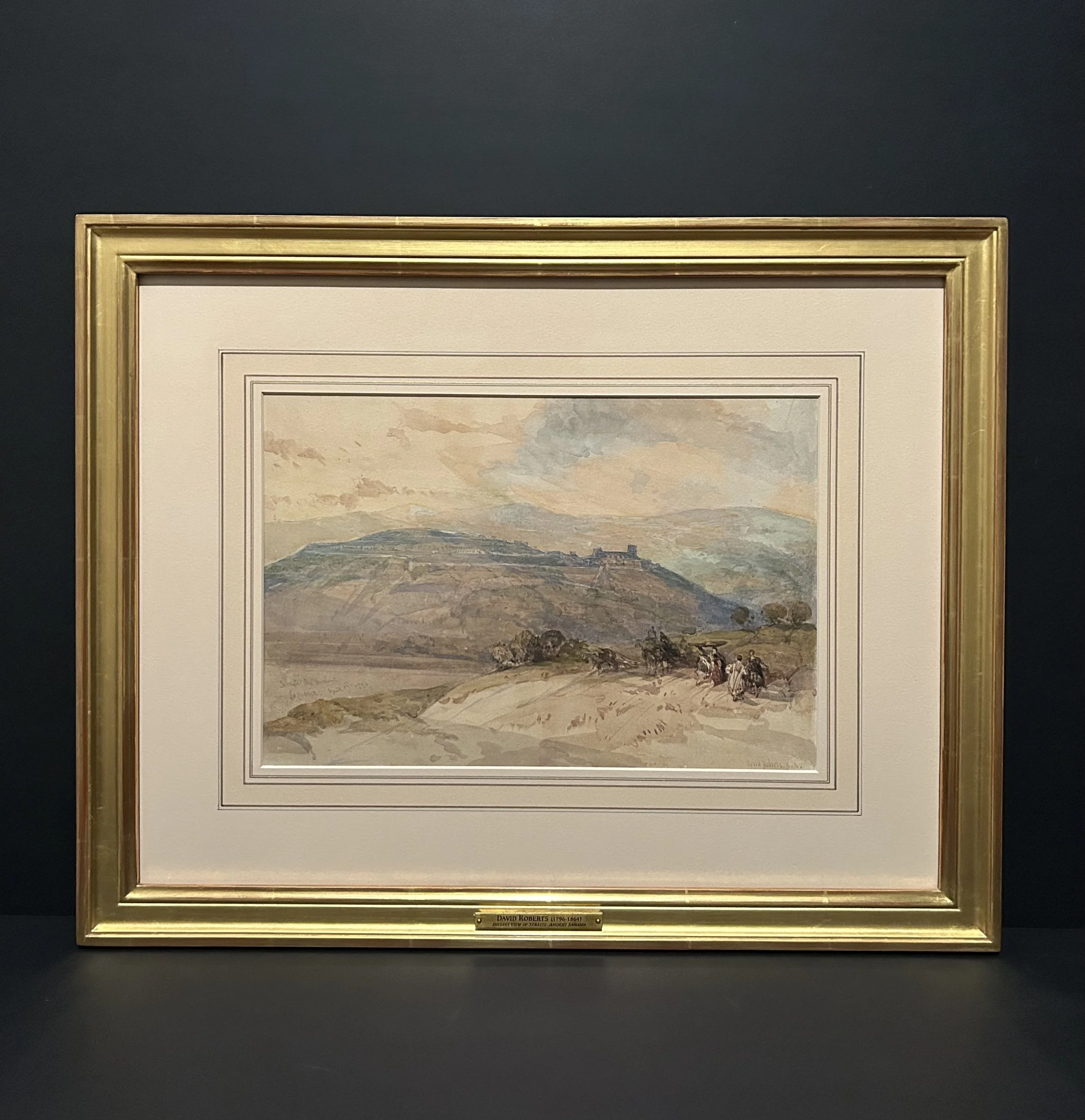 Image 2 of 5
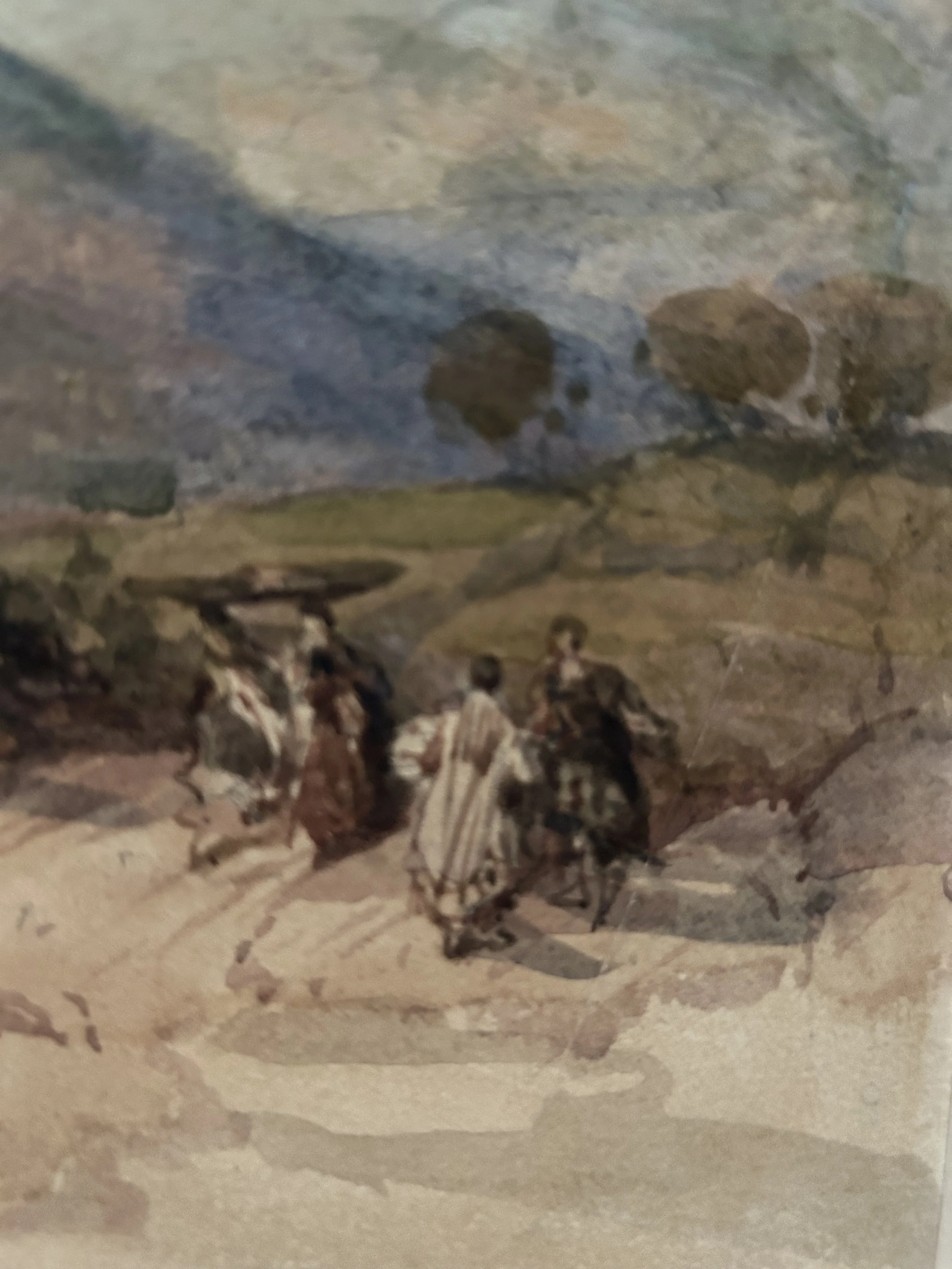 Image 3 of 5
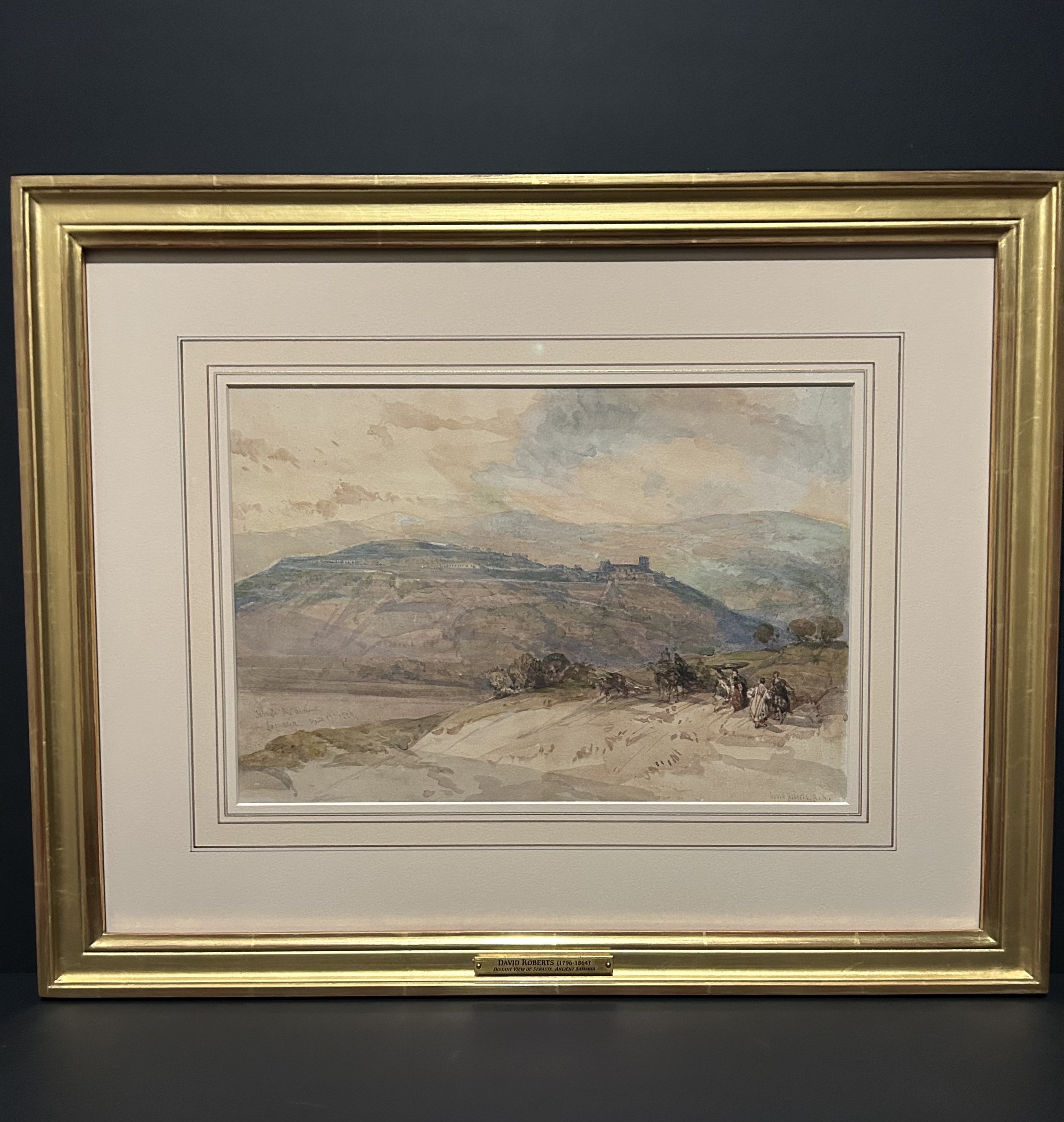 Image 4 of 5
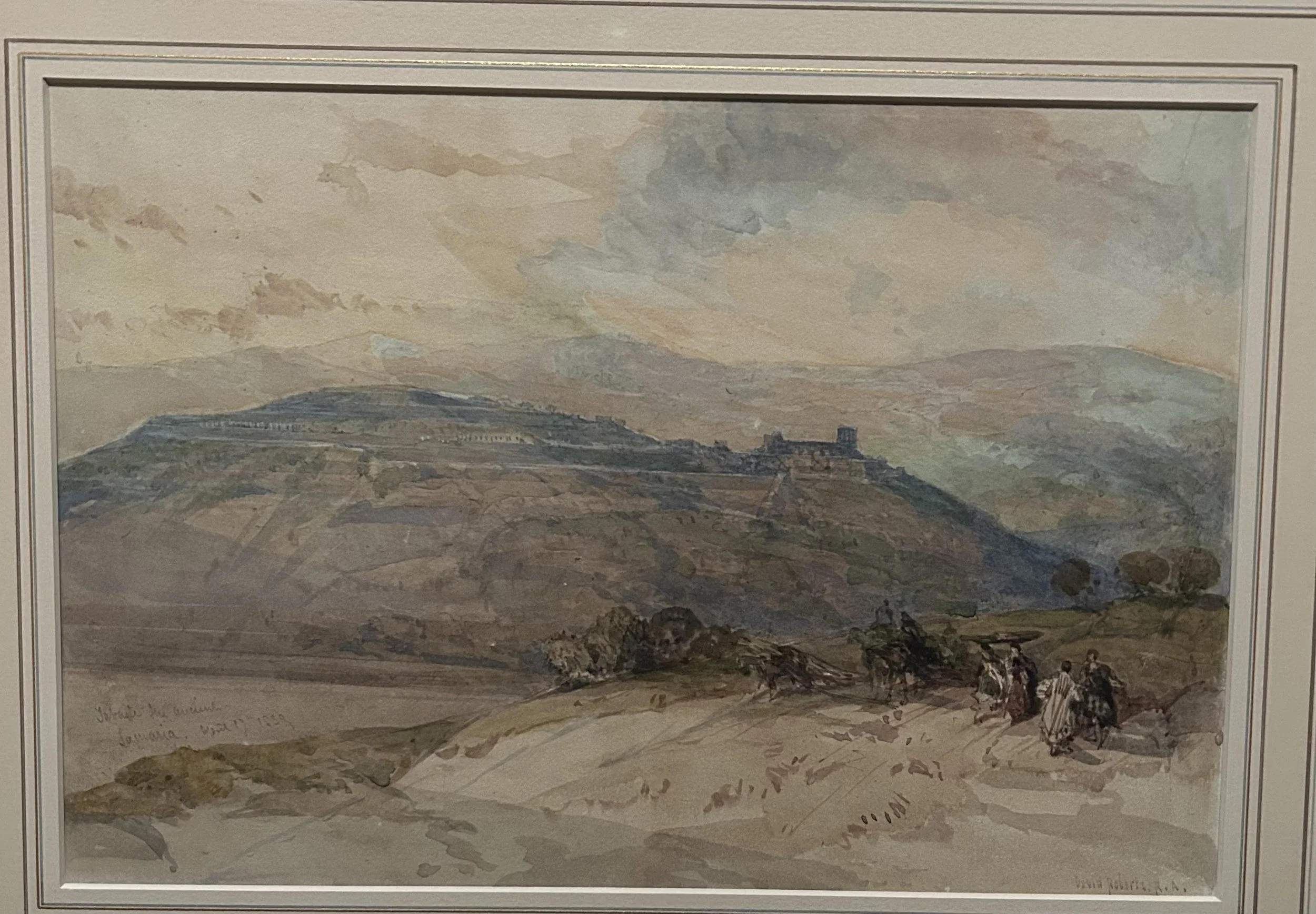 Image 5 of 5
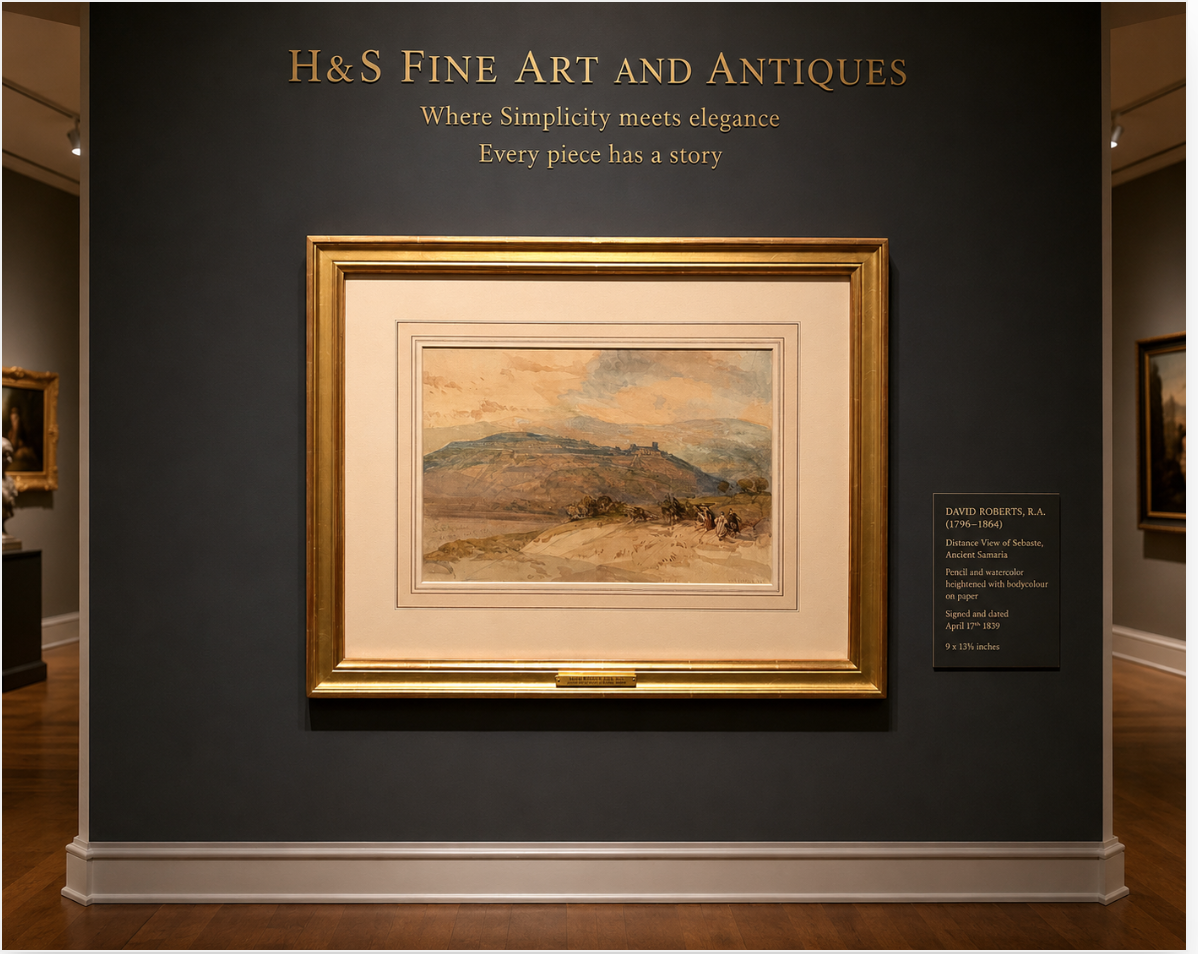
David Roberts, R.A. ( Edinburgh 1796 - 1864 London ) Distance view of Sebaste, Ancient Samaria.
David Roberts, R.A. (1796–1864)
Distance View of Sebaste, Ancient Samaria
Signed and dated lower left: “David Roberts. April 17th 1839”
Pencil and watercolor heightened with bodycolour on paper
9 x 13⅜ inches
A Vision of the Biblical Holy Land
Among the finest surviving travel sketches executed by the celebrated Scottish artist David Roberts during his legendary journey through the Holy Land, Distance View of Sebaste, Ancient Samaria captures one of the most historically important landscapes in biblical history.
Drawn directly from nature on April 17, 1839, this delicate watercolor records Roberts' first encounter with the ancient city of Samaria, later known as Sebaste. The work possesses a freshness and immediacy that only firsthand observation can provide. Soft washes of color, atmospheric light, and the subtle rendering of distant ruins transform what might otherwise be a simple landscape into a profound meditation on history, faith, and the passage of civilizations.
This sheet represents far more than a topographical study. It is a visual witness to a landscape sacred to Judaism, Christianity, and world history.
The Artist
David Roberts ranks among the most important travel artists of the nineteenth century.
Born in Edinburgh in 1796, Roberts began his career painting theatrical scenery before emerging as one of Britain's most accomplished landscape painters. Encouraged by fellow artists and patrons, he gradually abandoned stage painting and devoted himself entirely to fine art.
By the 1830s Roberts had already achieved fame through his Spanish views, yet it was his journey through Egypt, Palestine, Jordan, Syria, and Lebanon between 1838 and 1839 that secured his place in art history. During this expedition he filled hundreds of sketchbooks with drawings made directly from life, documenting monuments and landscapes that few Western artists had ever seen firsthand.
Upon returning to Britain, Roberts was elected a Royal Academician and became one of the most celebrated artists of the Victorian age. His work appealed equally to collectors, scholars, travelers, clergy, and archaeologists.
Roberts and the Holy Land
The years 1838–1839 marked the most important journey of Roberts' career.
Travelling largely on horseback and accompanied by local guides, Roberts crossed Egypt, Sinai, Petra, Jerusalem, Galilee, and Samaria. His mission was not simply artistic. He wished to create the most accurate visual record of biblical lands ever attempted by a European artist.
The resulting drawings formed the basis for:
The Holy Land, Syria, Idumea, Arabia, Egypt, and Nubia
a monumental publication issued between 1842 and 1849 and widely regarded as one of the greatest illustrated books of the nineteenth century. The work contained hundreds of lithographs produced from Roberts' original sketches and became an international publishing sensation.
Sebaste: Ancient Samaria
The subject of this drawing is the ancient city of Sebaste, historically known as Samaria.
Sebaste occupies a commanding hilltop overlooking fertile valleys in the central highlands of the Holy Land.
The city was founded during the ninth century BCE by:
Omri
who established it as the capital of the northern Kingdom of Israel.
Later it became associated with:
King Ahab
Jezebel
The prophets Elijah and Elisha
The political and religious history of ancient Israel
Following centuries of conquest and decline, the city was magnificently rebuilt by:
Herod the Great
who transformed Samaria into a grand Roman city and renamed it Sebaste in honor of Emperor Augustus. Remains of Herodian temples, colonnades, and fortifications survive to this day.
Roberts' Personal Response
What makes this watercolor especially significant is the fact that Roberts recorded his emotional reaction to the site in his travel journal.
He wrote:
"It is difficult to conceive any place surpassing this in the beauty of its position."
He continued by describing the city appearing before him:
"bathed in the brightness of an eastern sunset."
These observations correspond directly to the watercolor before us. The warm sky, softly illuminated hills, and distant ruins reveal Roberts' attempt to capture not merely geography but also the emotional impact of the landscape.
Analysis of the Composition
The composition unfolds in carefully orchestrated layers.
In the foreground, travelers move along a dusty road. Their small scale emphasizes the vastness of the surrounding landscape and recalls the countless pilgrims, merchants, soldiers, and prophets who once traversed these hills.
The middle distance is dominated by the broad slopes of Samaria itself. Roberts suppresses unnecessary detail, focusing instead upon atmospheric perspective and subtle gradations of light.
At the summit, the ruins emerge almost as a memory rather than an archaeological reconstruction. The remains are intentionally distant, reinforcing the romantic notion of antiquity lost to time.
Above all, the expansive sky dominates the scene. The delicate washes of blue, cream, and rose evoke the fading light of evening, producing an atmosphere of serenity and contemplation.
The Published Image
This watercolor possesses particular scholarly importance because it served as the basis for the finished composition later published in Roberts' monumental Holy Land series.
The present study was transformed into the lithograph:
"Sebaste, Ancient Samaria"
published in Volume I of The Holy Land in 1842.
Preparatory watercolors such as this are often considered more desirable than the printed lithographs because they represent Roberts' direct encounter with the landscape and preserve the artist's original hand.
Provenance
The ownership history of this watercolor is distinguished and contributes significantly to its importance.
Colnaghi, London
The drawing passed through: Colnaghi: Founded in 1760, Colnaghi is among the oldest and most prestigious art dealerships in the world. Works handled by the firm have entered many of the world's leading museums and private collections.
Michael Ingram Collection: Purchased from Colnaghi by Michael Ingram, noted British collector and patron.
Sotheby's, London The watercolor subsequently appeared at: Sotheby's 8 December 2005, Lot 241.
Property from a Princely Collection
The work later entered a European princely collection, a provenance that reflects aristocratic ownership and careful preservation.
The combination of Colnaghi, Sotheby's, and princely ownership represents an exceptionally desirable provenance chain for a nineteenth-century watercolor.
Literature
The drawing is directly connected to Roberts' most famous publication:
The Holy Land, Syria, Idumea, Arabia, Egypt, and Nubia (1842–1849)
Roberts' Eastern Journal (1838–1839)
Helen Guiterman, David Roberts 1796–1864: Artist Adventurer
Katherine Sim, David Roberts R.A. 1796–1864: A Biography
The published lithographic version remains one of the most widely reproduced images of ancient Samaria in nineteenth-century visual culture.
Curatorial Significance
This watercolor stands at the intersection of art, archaeology, biblical history, and travel literature. Executed during the most celebrated expedition of Roberts' career, it records the moment when one of Britain's greatest landscape artists first encountered one of the most important cities of the ancient Kingdom of Israel.
As a firsthand study for one of the landmark illustrations in Victorian publishing, preserved through distinguished collections and art-market provenance, Distance View of Sebaste, Ancient Samaria represents an outstanding example of nineteenth-century British watercolor painting and a rare surviving witness to Roberts' journey through the Holy Land in the spring of 1839.
David Roberts, R.A. (1796–1864)
Distance View of Sebaste, Ancient Samaria
Signed and dated lower left: “David Roberts. April 17th 1839”
Pencil and watercolor heightened with bodycolour on paper
9 x 13⅜ inches
A Vision of the Biblical Holy Land
Among the finest surviving travel sketches executed by the celebrated Scottish artist David Roberts during his legendary journey through the Holy Land, Distance View of Sebaste, Ancient Samaria captures one of the most historically important landscapes in biblical history.
Drawn directly from nature on April 17, 1839, this delicate watercolor records Roberts' first encounter with the ancient city of Samaria, later known as Sebaste. The work possesses a freshness and immediacy that only firsthand observation can provide. Soft washes of color, atmospheric light, and the subtle rendering of distant ruins transform what might otherwise be a simple landscape into a profound meditation on history, faith, and the passage of civilizations.
This sheet represents far more than a topographical study. It is a visual witness to a landscape sacred to Judaism, Christianity, and world history.
The Artist
David Roberts ranks among the most important travel artists of the nineteenth century.
Born in Edinburgh in 1796, Roberts began his career painting theatrical scenery before emerging as one of Britain's most accomplished landscape painters. Encouraged by fellow artists and patrons, he gradually abandoned stage painting and devoted himself entirely to fine art.
By the 1830s Roberts had already achieved fame through his Spanish views, yet it was his journey through Egypt, Palestine, Jordan, Syria, and Lebanon between 1838 and 1839 that secured his place in art history. During this expedition he filled hundreds of sketchbooks with drawings made directly from life, documenting monuments and landscapes that few Western artists had ever seen firsthand.
Upon returning to Britain, Roberts was elected a Royal Academician and became one of the most celebrated artists of the Victorian age. His work appealed equally to collectors, scholars, travelers, clergy, and archaeologists.
Roberts and the Holy Land
The years 1838–1839 marked the most important journey of Roberts' career.
Travelling largely on horseback and accompanied by local guides, Roberts crossed Egypt, Sinai, Petra, Jerusalem, Galilee, and Samaria. His mission was not simply artistic. He wished to create the most accurate visual record of biblical lands ever attempted by a European artist.
The resulting drawings formed the basis for:
The Holy Land, Syria, Idumea, Arabia, Egypt, and Nubia
a monumental publication issued between 1842 and 1849 and widely regarded as one of the greatest illustrated books of the nineteenth century. The work contained hundreds of lithographs produced from Roberts' original sketches and became an international publishing sensation.
Sebaste: Ancient Samaria
The subject of this drawing is the ancient city of Sebaste, historically known as Samaria.
Sebaste occupies a commanding hilltop overlooking fertile valleys in the central highlands of the Holy Land.
The city was founded during the ninth century BCE by:
Omri
who established it as the capital of the northern Kingdom of Israel.
Later it became associated with:
King Ahab
Jezebel
The prophets Elijah and Elisha
The political and religious history of ancient Israel
Following centuries of conquest and decline, the city was magnificently rebuilt by:
Herod the Great
who transformed Samaria into a grand Roman city and renamed it Sebaste in honor of Emperor Augustus. Remains of Herodian temples, colonnades, and fortifications survive to this day.
Roberts' Personal Response
What makes this watercolor especially significant is the fact that Roberts recorded his emotional reaction to the site in his travel journal.
He wrote:
"It is difficult to conceive any place surpassing this in the beauty of its position."
He continued by describing the city appearing before him:
"bathed in the brightness of an eastern sunset."
These observations correspond directly to the watercolor before us. The warm sky, softly illuminated hills, and distant ruins reveal Roberts' attempt to capture not merely geography but also the emotional impact of the landscape.
Analysis of the Composition
The composition unfolds in carefully orchestrated layers.
In the foreground, travelers move along a dusty road. Their small scale emphasizes the vastness of the surrounding landscape and recalls the countless pilgrims, merchants, soldiers, and prophets who once traversed these hills.
The middle distance is dominated by the broad slopes of Samaria itself. Roberts suppresses unnecessary detail, focusing instead upon atmospheric perspective and subtle gradations of light.
At the summit, the ruins emerge almost as a memory rather than an archaeological reconstruction. The remains are intentionally distant, reinforcing the romantic notion of antiquity lost to time.
Above all, the expansive sky dominates the scene. The delicate washes of blue, cream, and rose evoke the fading light of evening, producing an atmosphere of serenity and contemplation.
The Published Image
This watercolor possesses particular scholarly importance because it served as the basis for the finished composition later published in Roberts' monumental Holy Land series.
The present study was transformed into the lithograph:
"Sebaste, Ancient Samaria"
published in Volume I of The Holy Land in 1842.
Preparatory watercolors such as this are often considered more desirable than the printed lithographs because they represent Roberts' direct encounter with the landscape and preserve the artist's original hand.
Provenance
The ownership history of this watercolor is distinguished and contributes significantly to its importance.
Colnaghi, London
The drawing passed through: Colnaghi: Founded in 1760, Colnaghi is among the oldest and most prestigious art dealerships in the world. Works handled by the firm have entered many of the world's leading museums and private collections.
Michael Ingram Collection: Purchased from Colnaghi by Michael Ingram, noted British collector and patron.
Sotheby's, London The watercolor subsequently appeared at: Sotheby's 8 December 2005, Lot 241.
Property from a Princely Collection
The work later entered a European princely collection, a provenance that reflects aristocratic ownership and careful preservation.
The combination of Colnaghi, Sotheby's, and princely ownership represents an exceptionally desirable provenance chain for a nineteenth-century watercolor.
Literature
The drawing is directly connected to Roberts' most famous publication:
The Holy Land, Syria, Idumea, Arabia, Egypt, and Nubia (1842–1849)
Roberts' Eastern Journal (1838–1839)
Helen Guiterman, David Roberts 1796–1864: Artist Adventurer
Katherine Sim, David Roberts R.A. 1796–1864: A Biography
The published lithographic version remains one of the most widely reproduced images of ancient Samaria in nineteenth-century visual culture.
Curatorial Significance
This watercolor stands at the intersection of art, archaeology, biblical history, and travel literature. Executed during the most celebrated expedition of Roberts' career, it records the moment when one of Britain's greatest landscape artists first encountered one of the most important cities of the ancient Kingdom of Israel.
As a firsthand study for one of the landmark illustrations in Victorian publishing, preserved through distinguished collections and art-market provenance, Distance View of Sebaste, Ancient Samaria represents an outstanding example of nineteenth-century British watercolor painting and a rare surviving witness to Roberts' journey through the Holy Land in the spring of 1839.