 Image 1 of 8
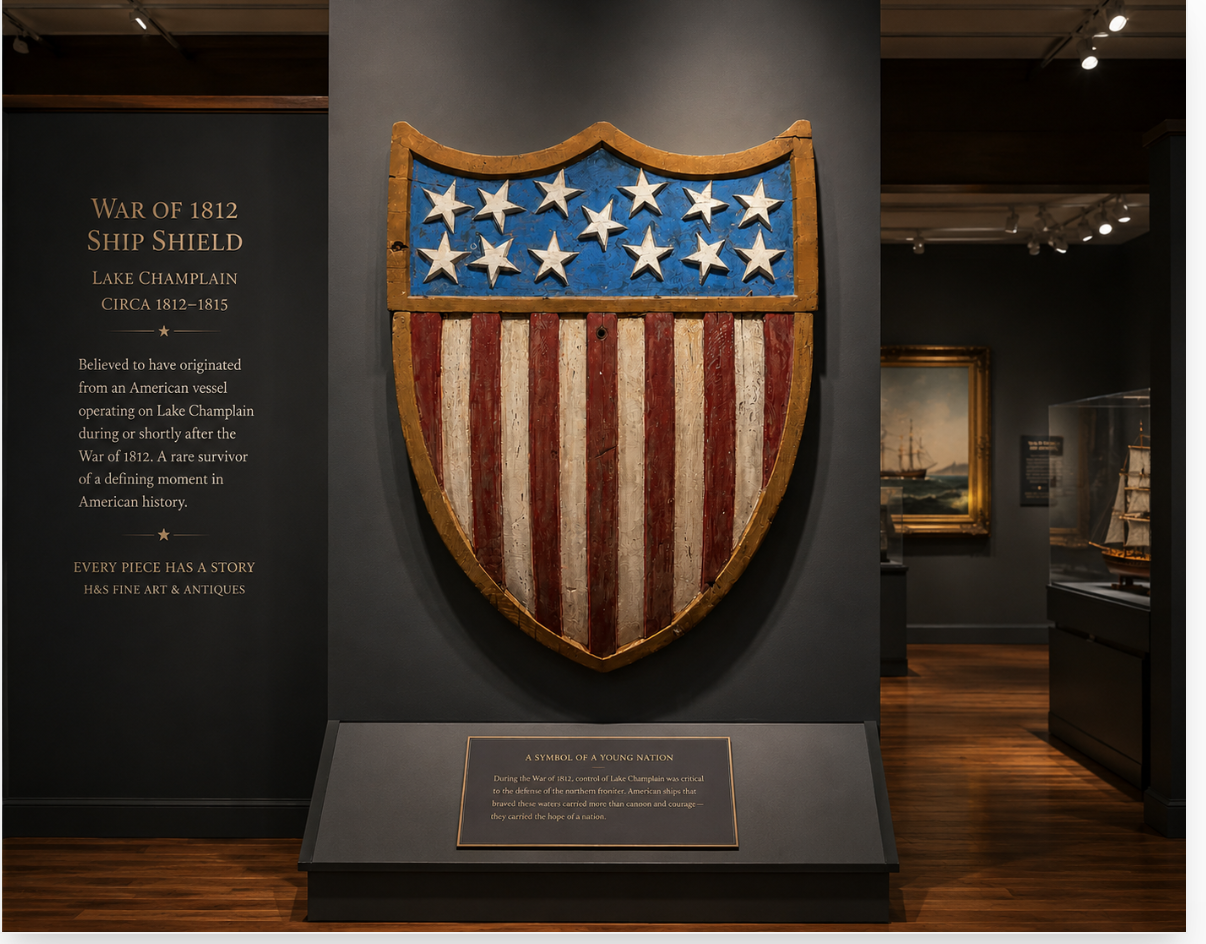 Image 2 of 8
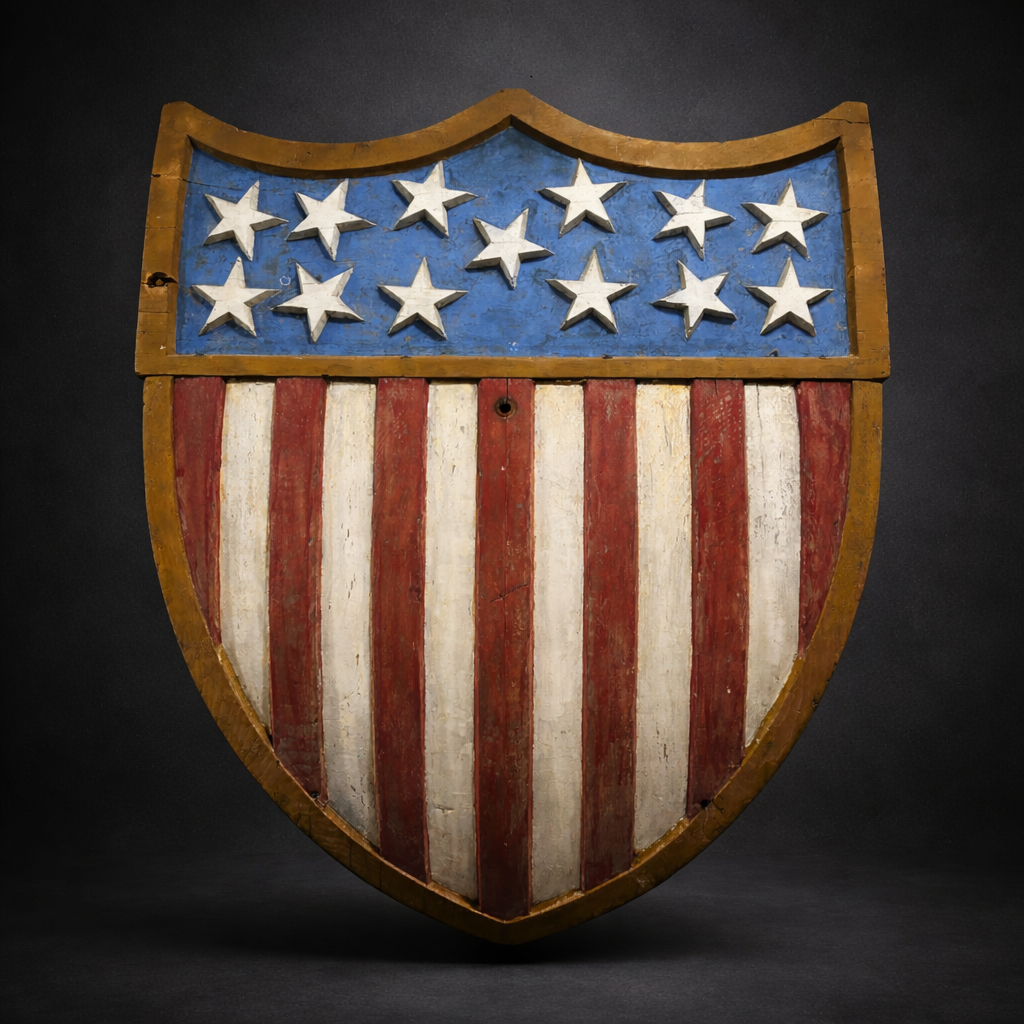 Image 3 of 8
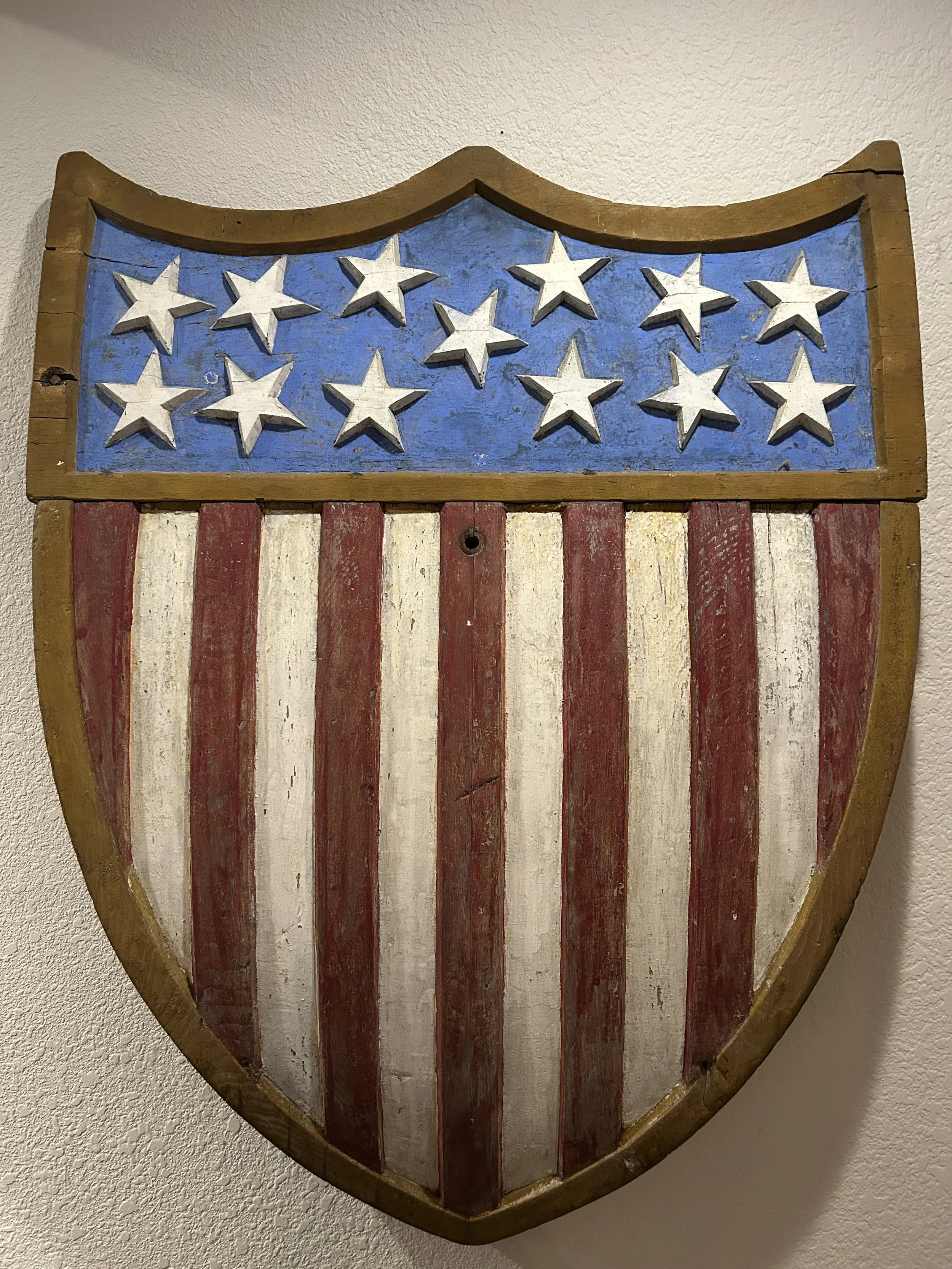 Image 4 of 8
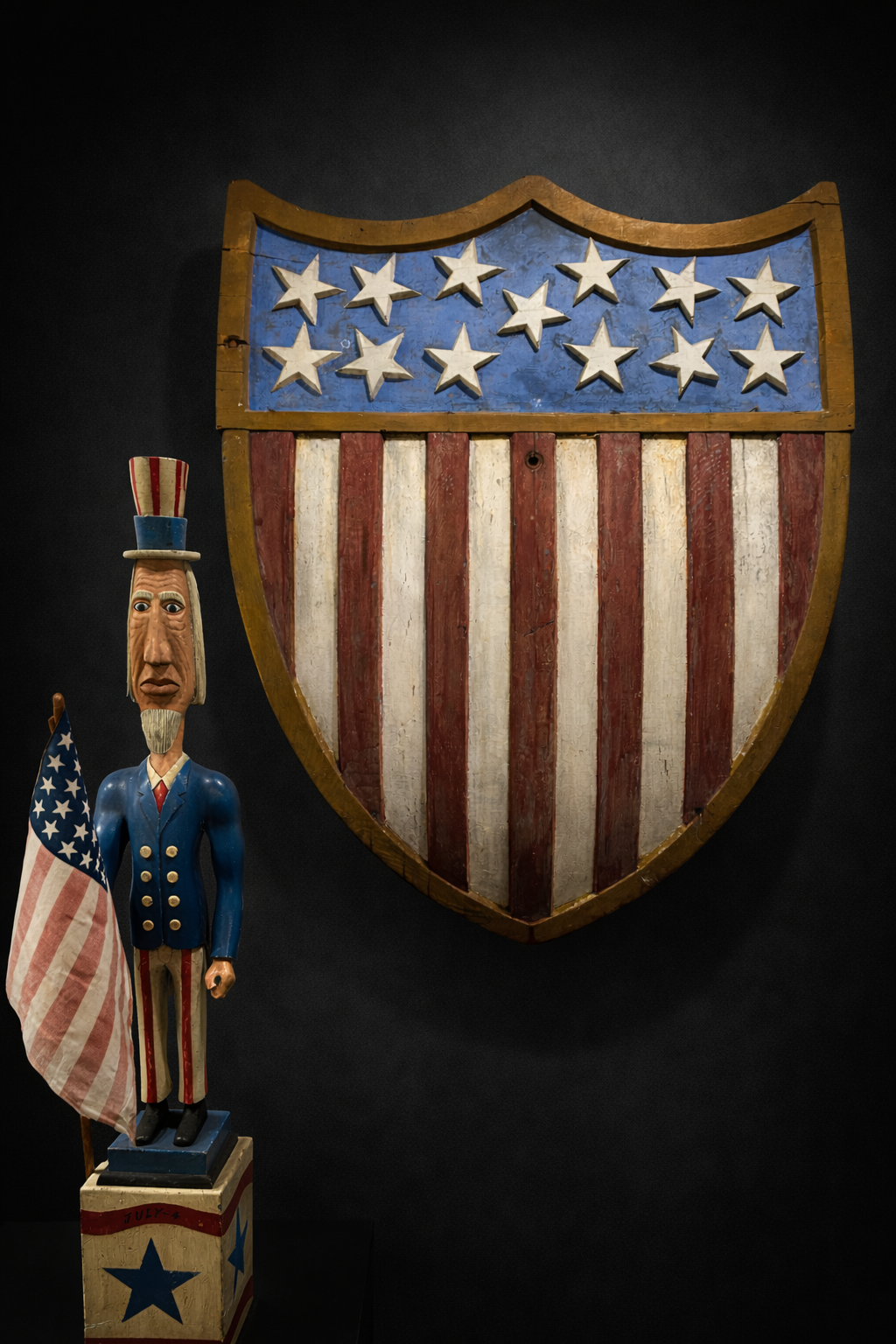 Image 5 of 8
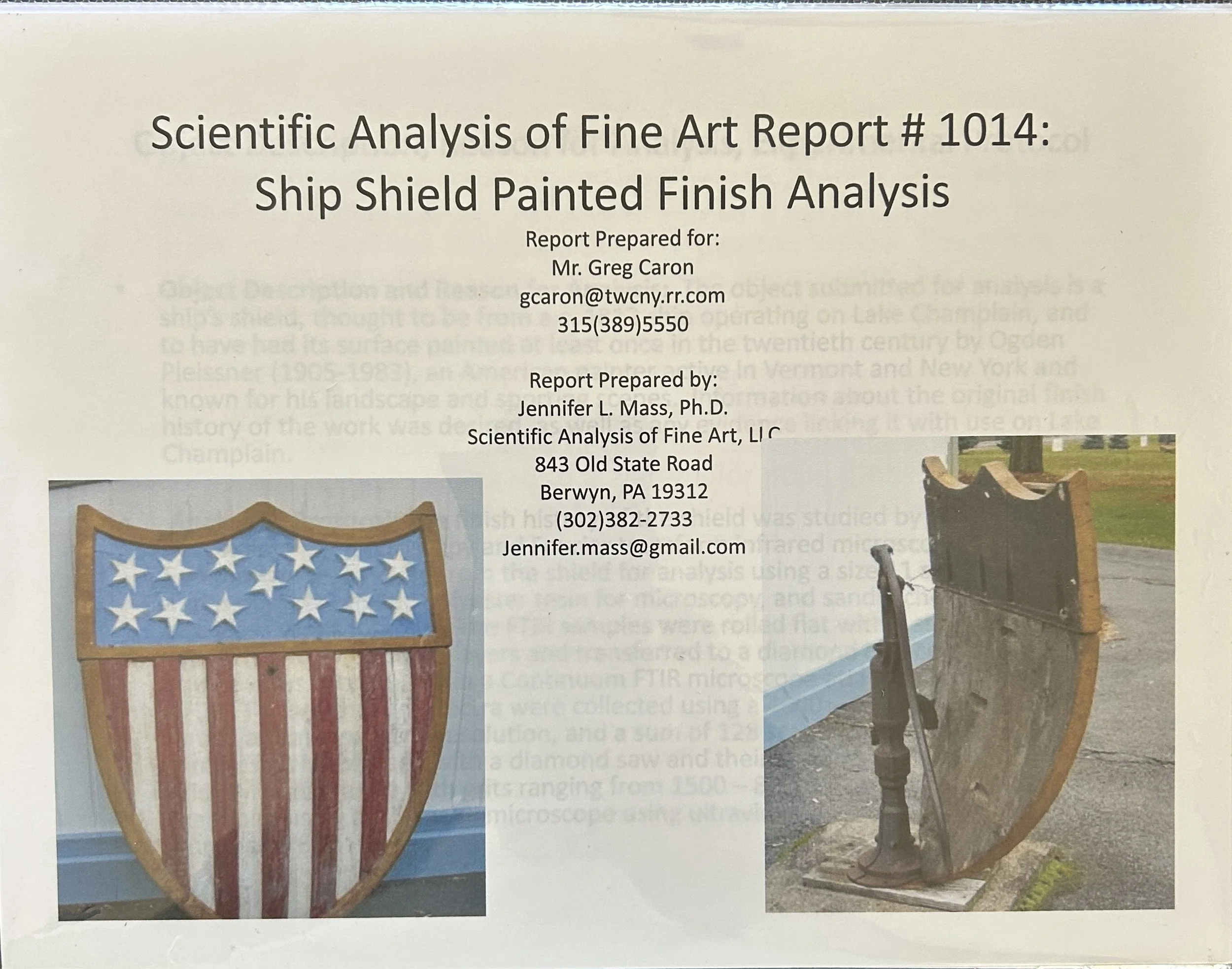 Image 6 of 8
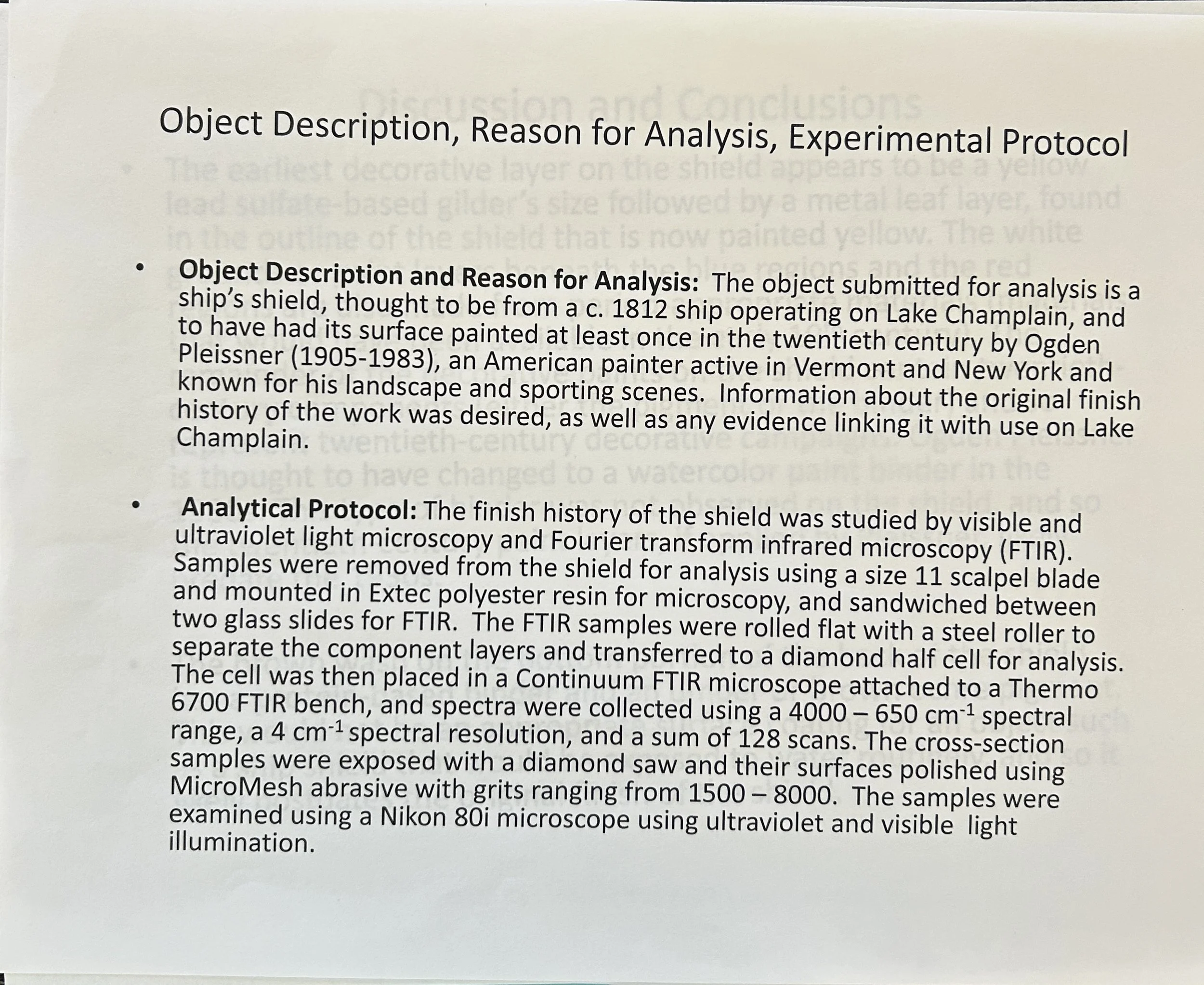 Image 7 of 8
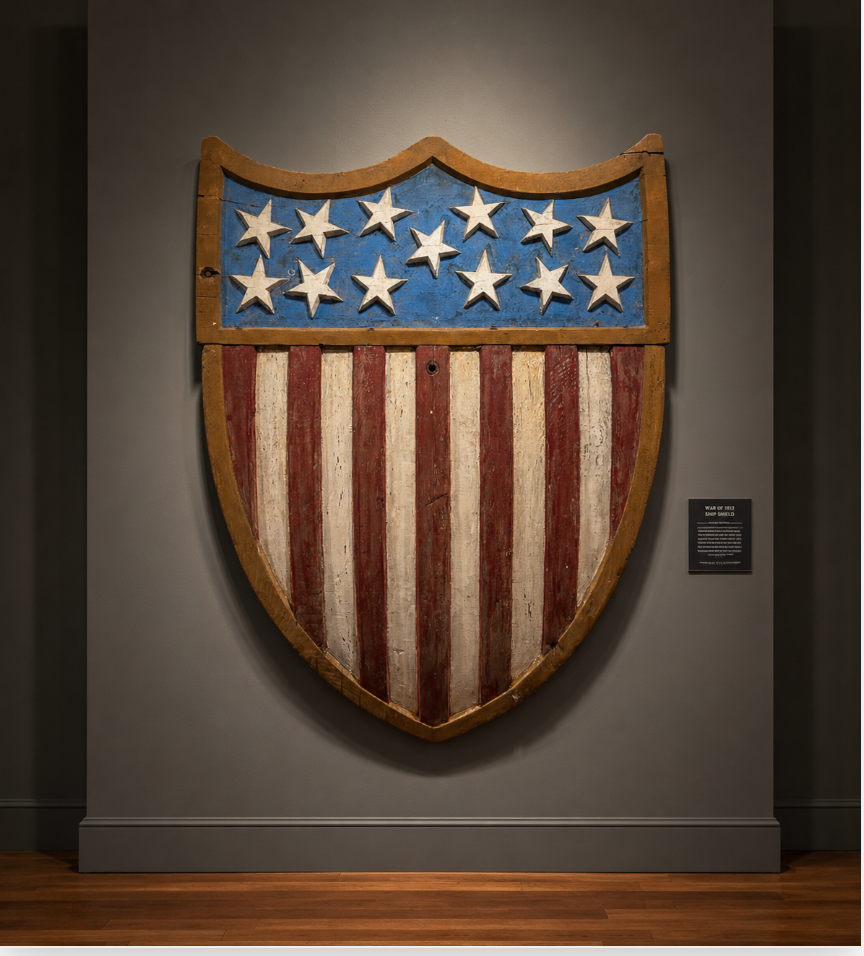 Image 8 of 8
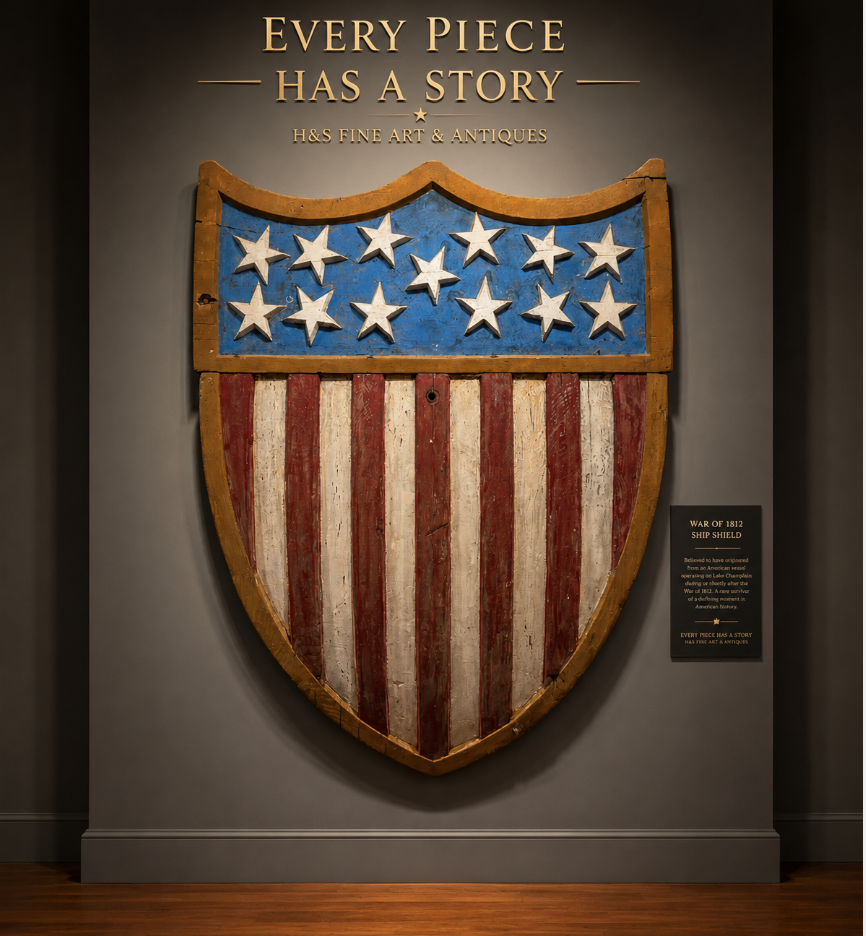
Important 1812 Carved Wood War Ship Shield. Scientific paint analysis confirmed the age and history of the shield.
IMPORTANT CARVED AND PAINTED WAR OF 1812 WOODEN SHIP SHIELD
Probably from an American Naval Vessel on Lake Champlain
Circa 1812–1815
Carved and painted wood
42 × 32 inches
Provenance
Believed to have originated from an American vessel operating on Lake Champlain during or shortly after the War of 1812; presented by Miss Lila Webb of Shelburne Farms to the Barbour family following the construction of White Birches Lodge, Forllensby Pond, Adirondack Mountains, New York, in 1913; preserved at White Birches Lodge for generations; Collection of Claude S. Harkins, one of America's foremost collectors of Americana; accompanied by the original scientific paint analysis by Dr. Jennifer L. Mass; H&S Fine Art & Antiques.
An Icon of America's Second War for Independence
Among the rarest survivals of early American maritime folk art, this monumental carved and painted wooden shield embodies one of the defining moments in the history of the young United States. Rich in patriotic symbolism, remarkable for its scale, and supported by an exceptional chain of provenance together with scientific authentication, the shield represents a tangible survivor of the era when the American Republic fought to secure its independence for a second time.
Unlike decorative patriotic carvings produced later in the nineteenth century, this shield almost certainly served an architectural purpose aboard an operating vessel. The bold arrangement of thirteen raised stars against a vivid blue field above thirteen red and white stripes reflects the Federal style of the early Republic and demonstrates the confidence of American craftsmen working only a generation after the adoption of the national flag.
Few maritime carvings associated with the War of 1812 survive today, and even fewer remain accompanied by documented provenance and scientific examination. The present shield therefore occupies a unique position at the intersection of American naval history, folk art, and material culture.
America in 1812
When this shield was carved, the United States was still a remarkably young nation. Barely thirty-six years had passed since the Declaration of Independence. The Constitution had been in effect for only twenty-three years, and much of the country remained an unsettled frontier.
The nation consisted of eighteen states:
Delaware
Pennsylvania
New Jersey
Georgia
Connecticut
Massachusetts
Maryland
South Carolina
New Hampshire
Virginia
New York
North Carolina
Rhode Island
Vermont
Kentucky
Tennessee
Ohio
Louisiana (admitted in 1812)
The population numbered fewer than eight million people.
America possessed only a small navy compared to Great Britain, whose Royal Navy was unquestionably the most powerful maritime force in the world.
President James Madison
The shield belongs to the presidency of James Madison (1809–1817), remembered as the "Father of the Constitution."
Madison faced perhaps the greatest crisis in American history before Abraham Lincoln.
During his presidency:
Britain declared war.
Washington was invaded.
The White House was burned.
The Capitol was destroyed.
Government buildings were looted.
The American economy nearly collapsed.
Yet Madison remained steadfast in preserving the independence won during the Revolution.
Many historians have described the War of 1812 as America's "Second War of Independence" because it confirmed that the United States would remain a sovereign nation.
The War of 1812
The War of 1812 (1812–1815) arose from growing tensions between the United States and Great Britain. The principal causes included the Royal Navy's impressment of American sailors, restrictions on American commerce during the Napoleonic Wars, and British support for Native American resistance along the western frontier.
Although often overshadowed by the American Revolution and the Civil War, the War of 1812 profoundly shaped the nation's identity. It produced enduring symbols of American patriotism, including "The Star-Spangled Banner," written by Francis Scott Key in 1814 after witnessing the bombardment of Fort McHenry.
The conflict was fought across multiple theaters, including:
The Great Lakes
The Niagara frontier
Chesapeake Bay
New Orleans
Lake Erie
Lake Champlain
Among these, Lake Champlain proved to be one of the most strategically decisive.
Lake Champlain: The Northern Gateway
Stretching approximately 120 miles between present-day New York, Vermont, and Canada, Lake Champlain served as the principal military corridor between British Canada and the Hudson River Valley.
For nearly two centuries, the lake had been contested by French, British, and American armies. During the War of 1812, whoever controlled Lake Champlain controlled the movement of troops, artillery, provisions, and communication between Canada and New York.
Without naval supremacy on the lake, neither army could successfully invade or defend the region.
The importance of Lake Champlain cannot be overstated. Military historians regard it as one of the decisive naval theaters of the war.
The Battle of Plattsburgh
September 11, 1814
The defining engagement on Lake Champlain occurred at Plattsburgh, New York.
American forces were commanded by Master Commandant Thomas Macdonough, whose brilliant naval tactics are still studied in naval academies today.
Opposing him was the experienced British commander Captain George Downie aboard HMS Confiance.
Macdonough's fleet consisted of:
USS Saratoga (flagship)
USS Eagle
USS Ticonderoga
USS Preble
ten armed gunboats
The British fleet included:
HMS Confiance
HMS Linnet
HMS Chubb
HMS Finch
numerous gunboats.
Macdonough famously anchored his flagship with spring lines that allowed the ship to rotate during battle, presenting fresh broadsides as one side became disabled. This innovative maneuver contributed directly to the American victory.
The British invasion of New York immediately collapsed following the naval defeat, making the Battle of Plattsburgh one of the decisive engagements leading to the Treaty of Ghent and the conclusion of the war.
Which Ship May Have Carried This Shield?
Although the exact vessel cannot now be identified with certainty, its Lake Champlain tradition and Federal patriotic design suggest several possibilities.
The shield could have adorned:
USS Saratoga
USS Eagle
USS Ticonderoga
USS Preble
one of the numerous American gunboats constructed at Vergennes, Vermont
Given its dimensions and curved profile, scholars have suggested that it formed part of a decorative assembly near the bow or bowsprit rather than serving as an interior decorative panel.
Its companion bowsprit ornament survives today.
The Companion at the Shelburne Museum
Perhaps the strongest evidence supporting the shield's early history is the survival of its companion bowsprit ornament, now preserved in the Shelburne Museum in Shelburne, Vermont.
Founded in 1947 by Electra Havemeyer Webb, the Shelburne Museum is internationally recognized for its unparalleled collection of American folk art, transportation, maritime objects, and early Americana.
The companion carving shares similar construction, carving techniques, proportions, and paint history, suggesting that both objects originally belonged to the same vessel.
Separated for generations, they now exist in public and private collections, preserving two halves of an extraordinary maritime survival.
Shelburne Farms and Miss Lila Webb
The shield's documented twentieth-century history begins with Miss Lila Osgood Webb, daughter of Dr. William Seward Webb and Eliza Vanderbilt Webb.
The Webb family created Shelburne Farms, one of America's great Gilded Age estates overlooking Lake Champlain. Their interest in preserving Vermont's regional history and decorative arts is well documented.
Following construction of the Barbour family's Adirondack retreat, White Birches Lodge, in 1913, Miss Webb presented the shield as a gift.
Its association with Shelburne Farms strongly reinforces its Lake Champlain tradition.
White Birches Lodge and the Barbour Family
White Birches Lodge, situated on Forllensby Pond in the Adirondacks, became one of the great American sporting camps of the early twentieth century.
The Barbour family assembled an important collection of Americana and regional artifacts. The shield remained prominently displayed there for decades, protected from the alterations and losses that befell many maritime carvings.
Its survival owes much to the stewardship of both the Webb and Barbour families.
Claude S. Harkins Collection
The next distinguished owner was Claude S. Harkins, one of the leading private collectors of American folk art and Americana.
Recognizing the shield's significance, Harkins commissioned scientific examination rather than relying solely upon stylistic opinion.
This decision transformed the shield from an object supported by family tradition into one corroborated by modern conservation science.
Scientific Paint Analysis
The shield is accompanied by a comprehensive scientific paint analysis conducted by Dr. Jennifer L. Mass, one of America's foremost specialists in the technical examination of historic painted surfaces. Dr. Mass served as Senior Scientist in the Scientific Research and Analysis Laboratory at Winterthur Museum and has collaborated with major institutions nationwide on the authentication and conservation of significant works of art.
Microscopic cross-sections of the paint were examined to study the complete paint stratigraphy. Analytical techniques identified the pigments, binding media, and successive paint campaigns while distinguishing original nineteenth-century surfaces from later restorations. These methods—commonly employed by museums for the study of historic painted objects—allow conservators to reconstruct the object's material history with exceptional precision.
The examination concluded that:
the pigment composition is appropriate for the early nineteenth century,
the sequence of paint layers is consistent with the shield's documented history,
later restoration campaigns were identified without compromising the integrity of the original surface,
the surviving paint is entirely compatible with an object of War of 1812 date.
Such scientific authentication provides independent material evidence supporting the shield's traditional attribution and substantially enhances its historical importance.
Ogden Pleissner
Family tradition further maintains that the shield received sympathetic retouching during the early twentieth century by the distinguished American artist Ogden Minton Pleissner before he devoted himself primarily to watercolor painting. While this attribution remains part of the shield's oral history rather than documented fact, it illustrates the esteem in which the object was held by its owners and their desire to preserve it rather than replace it.
Comparable Museum Collections
Comparable patriotic carved wooden shields are exceptionally uncommon. Related examples may be found in the collections of:
Shelburne Museum, Shelburne, Vermont (companion bowsprit ornament)
High Museum of Art, Atlanta (American polychrome carved shield, Gift of the Levine Folk Art Collection, Accession No. 2021.505)
Mystic Seaport Museum, Connecticut (maritime carvings and ship ornaments)
Smithsonian American Art Museum, Washington, D.C. (American folk art)
Peabody Essex Museum, Salem, Massachusetts (Federal maritime carvings)
Lake Champlain Maritime Museum, Vermont (War of 1812 naval archaeology and material culture)
The rarity of surviving War of 1812 shipboard patriotic carvings places this shield among a very small group of related objects preserved in museum collections and distinguished private holdings.
Significance
This shield is far more than a patriotic carving. It is a survivor of America's formative years, created during a conflict that secured the nation's independence, preserved through generations by prominent families, authenticated by modern conservation science, and linked to one of the most important naval battlefields in American history.
Its combination of documented provenance, scientific examination, association with Lake Champlain, relationship to the companion carving at the Shelburne Museum, and exceptional artistic quality elevates it to the level of an object worthy of institutional collections and scholarly study. It stands as an outstanding example of early American maritime folk art and a rare witness to the material culture of the War of 1812.
Selected Bibliography
Theodore Roosevelt, The Naval War of 1812.
Donald R. Hickey, The War of 1812: A Forgotten Conflict.
Alan Taylor, The Civil War of 1812.
Howard I. Chapelle, The History of the American Sailing Navy.
Howard I. Chapelle, The Search for Speed Under Sail.
William M. Fowler Jr., Jack Tars and Commodores: The American Navy, 1783–1815.
James P. Delgado, War of 1812 Naval Archaeology.
Jennifer L. Mass, Scientific Paint Analysis Report (accompanying the shield).
Painted Wood: History and Conservation, Getty Conservation Institute.
Winterthur Museum, Scientific Research and Analysis Laboratory publications on painted surfaces and technical examination.
Lake Champlain Maritime Museum, research on War of 1812 naval archaeology and the Battle of Plattsburgh.
This level of documentation, historical context, and material analysis places the shield comfortably within the standards expected of major museum catalogue essays and reinforces its significance as an exceptional artifact of the Early American Republic.
IMPORTANT CARVED AND PAINTED WAR OF 1812 WOODEN SHIP SHIELD
Probably from an American Naval Vessel on Lake Champlain
Circa 1812–1815
Carved and painted wood
42 × 32 inches
Provenance
Believed to have originated from an American vessel operating on Lake Champlain during or shortly after the War of 1812; presented by Miss Lila Webb of Shelburne Farms to the Barbour family following the construction of White Birches Lodge, Forllensby Pond, Adirondack Mountains, New York, in 1913; preserved at White Birches Lodge for generations; Collection of Claude S. Harkins, one of America's foremost collectors of Americana; accompanied by the original scientific paint analysis by Dr. Jennifer L. Mass; H&S Fine Art & Antiques.
An Icon of America's Second War for Independence
Among the rarest survivals of early American maritime folk art, this monumental carved and painted wooden shield embodies one of the defining moments in the history of the young United States. Rich in patriotic symbolism, remarkable for its scale, and supported by an exceptional chain of provenance together with scientific authentication, the shield represents a tangible survivor of the era when the American Republic fought to secure its independence for a second time.
Unlike decorative patriotic carvings produced later in the nineteenth century, this shield almost certainly served an architectural purpose aboard an operating vessel. The bold arrangement of thirteen raised stars against a vivid blue field above thirteen red and white stripes reflects the Federal style of the early Republic and demonstrates the confidence of American craftsmen working only a generation after the adoption of the national flag.
Few maritime carvings associated with the War of 1812 survive today, and even fewer remain accompanied by documented provenance and scientific examination. The present shield therefore occupies a unique position at the intersection of American naval history, folk art, and material culture.
America in 1812
When this shield was carved, the United States was still a remarkably young nation. Barely thirty-six years had passed since the Declaration of Independence. The Constitution had been in effect for only twenty-three years, and much of the country remained an unsettled frontier.
The nation consisted of eighteen states:
Delaware
Pennsylvania
New Jersey
Georgia
Connecticut
Massachusetts
Maryland
South Carolina
New Hampshire
Virginia
New York
North Carolina
Rhode Island
Vermont
Kentucky
Tennessee
Ohio
Louisiana (admitted in 1812)
The population numbered fewer than eight million people.
America possessed only a small navy compared to Great Britain, whose Royal Navy was unquestionably the most powerful maritime force in the world.
President James Madison
The shield belongs to the presidency of James Madison (1809–1817), remembered as the "Father of the Constitution."
Madison faced perhaps the greatest crisis in American history before Abraham Lincoln.
During his presidency:
Britain declared war.
Washington was invaded.
The White House was burned.
The Capitol was destroyed.
Government buildings were looted.
The American economy nearly collapsed.
Yet Madison remained steadfast in preserving the independence won during the Revolution.
Many historians have described the War of 1812 as America's "Second War of Independence" because it confirmed that the United States would remain a sovereign nation.
The War of 1812
The War of 1812 (1812–1815) arose from growing tensions between the United States and Great Britain. The principal causes included the Royal Navy's impressment of American sailors, restrictions on American commerce during the Napoleonic Wars, and British support for Native American resistance along the western frontier.
Although often overshadowed by the American Revolution and the Civil War, the War of 1812 profoundly shaped the nation's identity. It produced enduring symbols of American patriotism, including "The Star-Spangled Banner," written by Francis Scott Key in 1814 after witnessing the bombardment of Fort McHenry.
The conflict was fought across multiple theaters, including:
The Great Lakes
The Niagara frontier
Chesapeake Bay
New Orleans
Lake Erie
Lake Champlain
Among these, Lake Champlain proved to be one of the most strategically decisive.
Lake Champlain: The Northern Gateway
Stretching approximately 120 miles between present-day New York, Vermont, and Canada, Lake Champlain served as the principal military corridor between British Canada and the Hudson River Valley.
For nearly two centuries, the lake had been contested by French, British, and American armies. During the War of 1812, whoever controlled Lake Champlain controlled the movement of troops, artillery, provisions, and communication between Canada and New York.
Without naval supremacy on the lake, neither army could successfully invade or defend the region.
The importance of Lake Champlain cannot be overstated. Military historians regard it as one of the decisive naval theaters of the war.
The Battle of Plattsburgh
September 11, 1814
The defining engagement on Lake Champlain occurred at Plattsburgh, New York.
American forces were commanded by Master Commandant Thomas Macdonough, whose brilliant naval tactics are still studied in naval academies today.
Opposing him was the experienced British commander Captain George Downie aboard HMS Confiance.
Macdonough's fleet consisted of:
USS Saratoga (flagship)
USS Eagle
USS Ticonderoga
USS Preble
ten armed gunboats
The British fleet included:
HMS Confiance
HMS Linnet
HMS Chubb
HMS Finch
numerous gunboats.
Macdonough famously anchored his flagship with spring lines that allowed the ship to rotate during battle, presenting fresh broadsides as one side became disabled. This innovative maneuver contributed directly to the American victory.
The British invasion of New York immediately collapsed following the naval defeat, making the Battle of Plattsburgh one of the decisive engagements leading to the Treaty of Ghent and the conclusion of the war.
Which Ship May Have Carried This Shield?
Although the exact vessel cannot now be identified with certainty, its Lake Champlain tradition and Federal patriotic design suggest several possibilities.
The shield could have adorned:
USS Saratoga
USS Eagle
USS Ticonderoga
USS Preble
one of the numerous American gunboats constructed at Vergennes, Vermont
Given its dimensions and curved profile, scholars have suggested that it formed part of a decorative assembly near the bow or bowsprit rather than serving as an interior decorative panel.
Its companion bowsprit ornament survives today.
The Companion at the Shelburne Museum
Perhaps the strongest evidence supporting the shield's early history is the survival of its companion bowsprit ornament, now preserved in the Shelburne Museum in Shelburne, Vermont.
Founded in 1947 by Electra Havemeyer Webb, the Shelburne Museum is internationally recognized for its unparalleled collection of American folk art, transportation, maritime objects, and early Americana.
The companion carving shares similar construction, carving techniques, proportions, and paint history, suggesting that both objects originally belonged to the same vessel.
Separated for generations, they now exist in public and private collections, preserving two halves of an extraordinary maritime survival.
Shelburne Farms and Miss Lila Webb
The shield's documented twentieth-century history begins with Miss Lila Osgood Webb, daughter of Dr. William Seward Webb and Eliza Vanderbilt Webb.
The Webb family created Shelburne Farms, one of America's great Gilded Age estates overlooking Lake Champlain. Their interest in preserving Vermont's regional history and decorative arts is well documented.
Following construction of the Barbour family's Adirondack retreat, White Birches Lodge, in 1913, Miss Webb presented the shield as a gift.
Its association with Shelburne Farms strongly reinforces its Lake Champlain tradition.
White Birches Lodge and the Barbour Family
White Birches Lodge, situated on Forllensby Pond in the Adirondacks, became one of the great American sporting camps of the early twentieth century.
The Barbour family assembled an important collection of Americana and regional artifacts. The shield remained prominently displayed there for decades, protected from the alterations and losses that befell many maritime carvings.
Its survival owes much to the stewardship of both the Webb and Barbour families.
Claude S. Harkins Collection
The next distinguished owner was Claude S. Harkins, one of the leading private collectors of American folk art and Americana.
Recognizing the shield's significance, Harkins commissioned scientific examination rather than relying solely upon stylistic opinion.
This decision transformed the shield from an object supported by family tradition into one corroborated by modern conservation science.
Scientific Paint Analysis
The shield is accompanied by a comprehensive scientific paint analysis conducted by Dr. Jennifer L. Mass, one of America's foremost specialists in the technical examination of historic painted surfaces. Dr. Mass served as Senior Scientist in the Scientific Research and Analysis Laboratory at Winterthur Museum and has collaborated with major institutions nationwide on the authentication and conservation of significant works of art.
Microscopic cross-sections of the paint were examined to study the complete paint stratigraphy. Analytical techniques identified the pigments, binding media, and successive paint campaigns while distinguishing original nineteenth-century surfaces from later restorations. These methods—commonly employed by museums for the study of historic painted objects—allow conservators to reconstruct the object's material history with exceptional precision.
The examination concluded that:
the pigment composition is appropriate for the early nineteenth century,
the sequence of paint layers is consistent with the shield's documented history,
later restoration campaigns were identified without compromising the integrity of the original surface,
the surviving paint is entirely compatible with an object of War of 1812 date.
Such scientific authentication provides independent material evidence supporting the shield's traditional attribution and substantially enhances its historical importance.
Ogden Pleissner
Family tradition further maintains that the shield received sympathetic retouching during the early twentieth century by the distinguished American artist Ogden Minton Pleissner before he devoted himself primarily to watercolor painting. While this attribution remains part of the shield's oral history rather than documented fact, it illustrates the esteem in which the object was held by its owners and their desire to preserve it rather than replace it.
Comparable Museum Collections
Comparable patriotic carved wooden shields are exceptionally uncommon. Related examples may be found in the collections of:
Shelburne Museum, Shelburne, Vermont (companion bowsprit ornament)
High Museum of Art, Atlanta (American polychrome carved shield, Gift of the Levine Folk Art Collection, Accession No. 2021.505)
Mystic Seaport Museum, Connecticut (maritime carvings and ship ornaments)
Smithsonian American Art Museum, Washington, D.C. (American folk art)
Peabody Essex Museum, Salem, Massachusetts (Federal maritime carvings)
Lake Champlain Maritime Museum, Vermont (War of 1812 naval archaeology and material culture)
The rarity of surviving War of 1812 shipboard patriotic carvings places this shield among a very small group of related objects preserved in museum collections and distinguished private holdings.
Significance
This shield is far more than a patriotic carving. It is a survivor of America's formative years, created during a conflict that secured the nation's independence, preserved through generations by prominent families, authenticated by modern conservation science, and linked to one of the most important naval battlefields in American history.
Its combination of documented provenance, scientific examination, association with Lake Champlain, relationship to the companion carving at the Shelburne Museum, and exceptional artistic quality elevates it to the level of an object worthy of institutional collections and scholarly study. It stands as an outstanding example of early American maritime folk art and a rare witness to the material culture of the War of 1812.
Selected Bibliography
Theodore Roosevelt, The Naval War of 1812.
Donald R. Hickey, The War of 1812: A Forgotten Conflict.
Alan Taylor, The Civil War of 1812.
Howard I. Chapelle, The History of the American Sailing Navy.
Howard I. Chapelle, The Search for Speed Under Sail.
William M. Fowler Jr., Jack Tars and Commodores: The American Navy, 1783–1815.
James P. Delgado, War of 1812 Naval Archaeology.
Jennifer L. Mass, Scientific Paint Analysis Report (accompanying the shield).
Painted Wood: History and Conservation, Getty Conservation Institute.
Winterthur Museum, Scientific Research and Analysis Laboratory publications on painted surfaces and technical examination.
Lake Champlain Maritime Museum, research on War of 1812 naval archaeology and the Battle of Plattsburgh.
This level of documentation, historical context, and material analysis places the shield comfortably within the standards expected of major museum catalogue essays and reinforces its significance as an exceptional artifact of the Early American Republic.