 Image 1 of 4
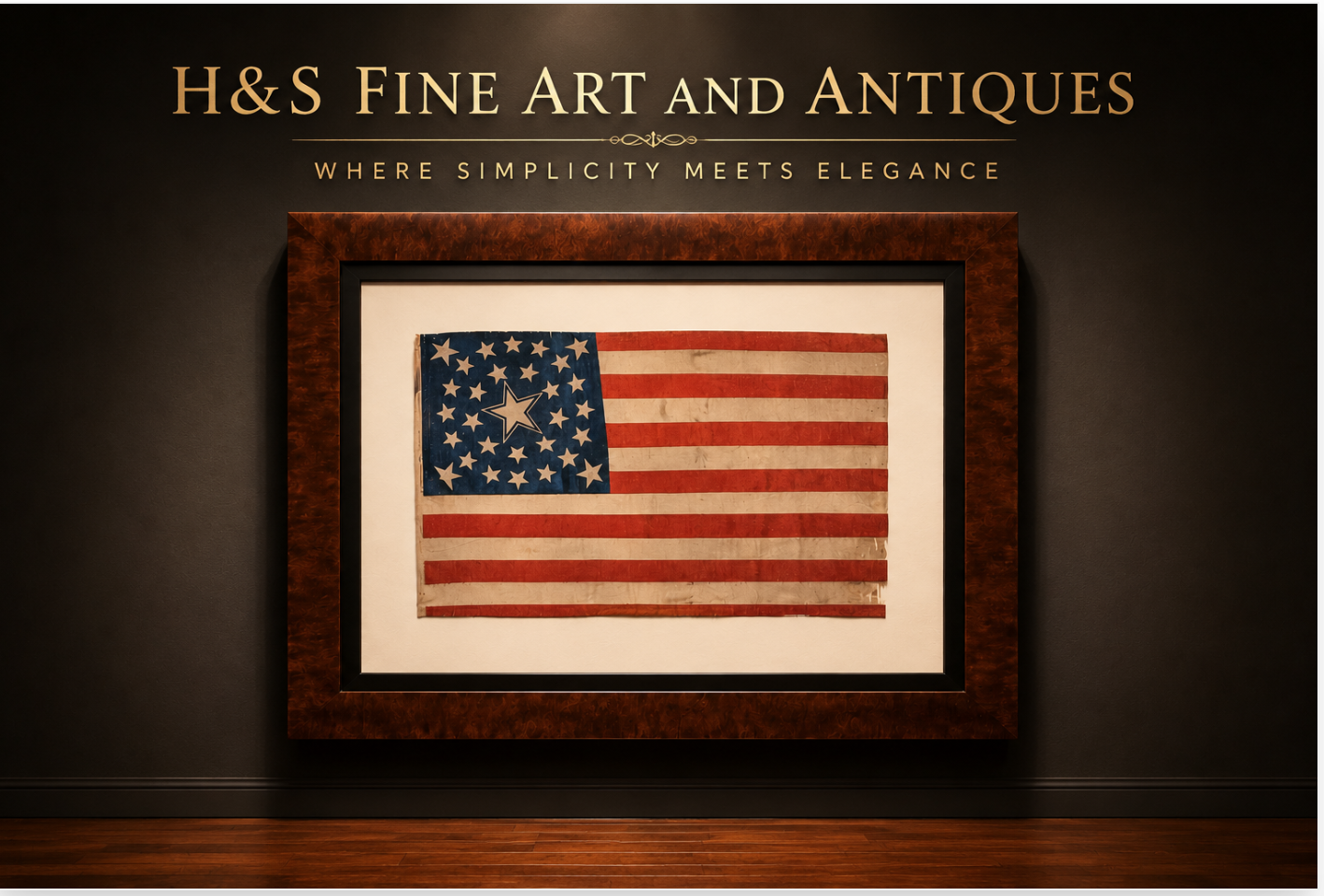 Image 2 of 4
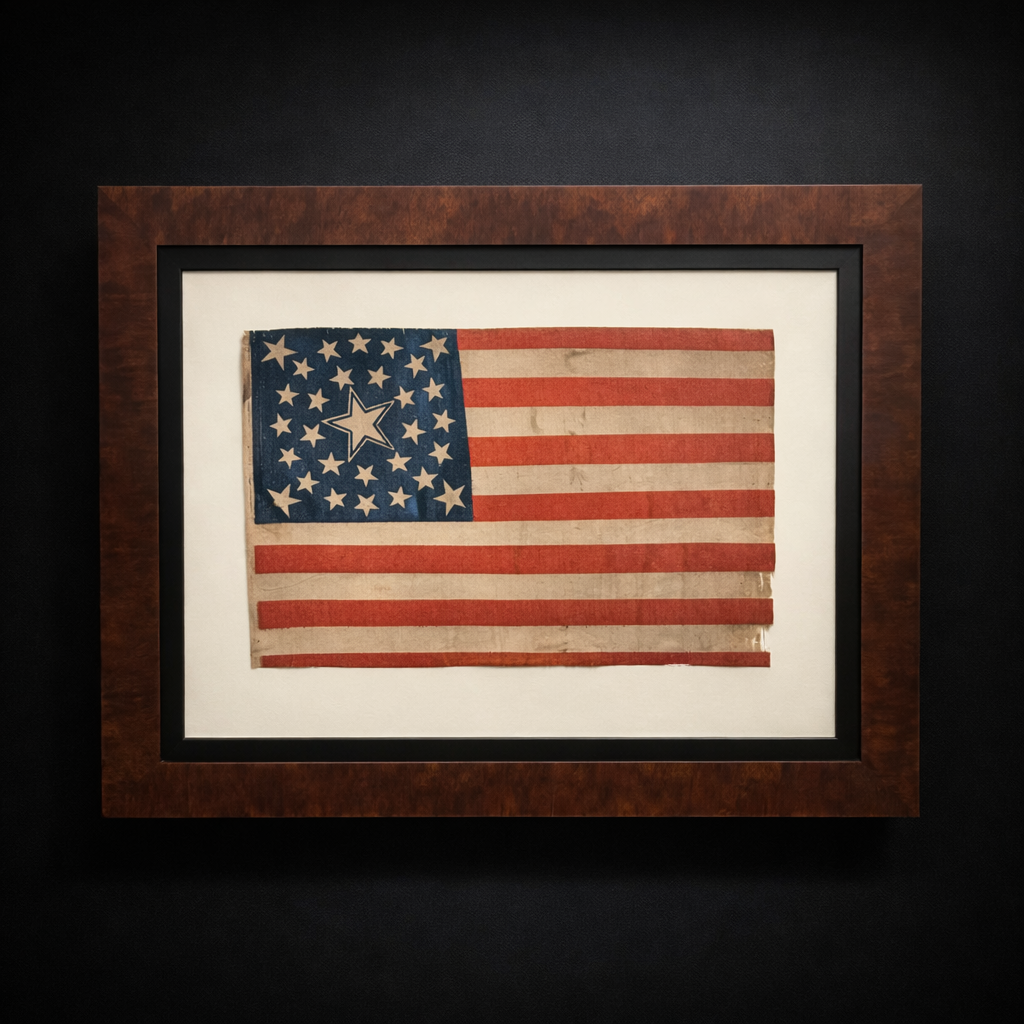 Image 3 of 4
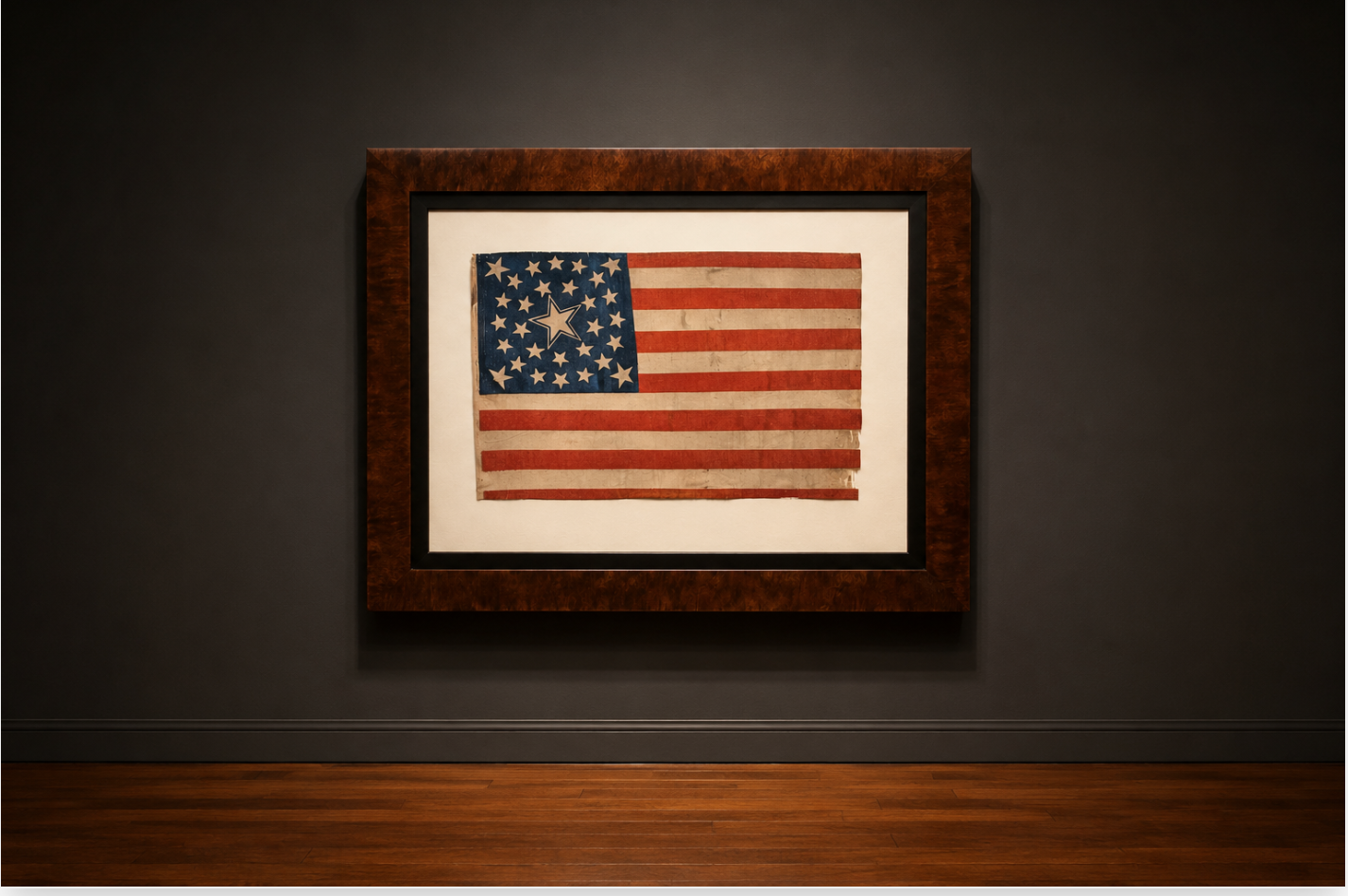 Image 4 of 4
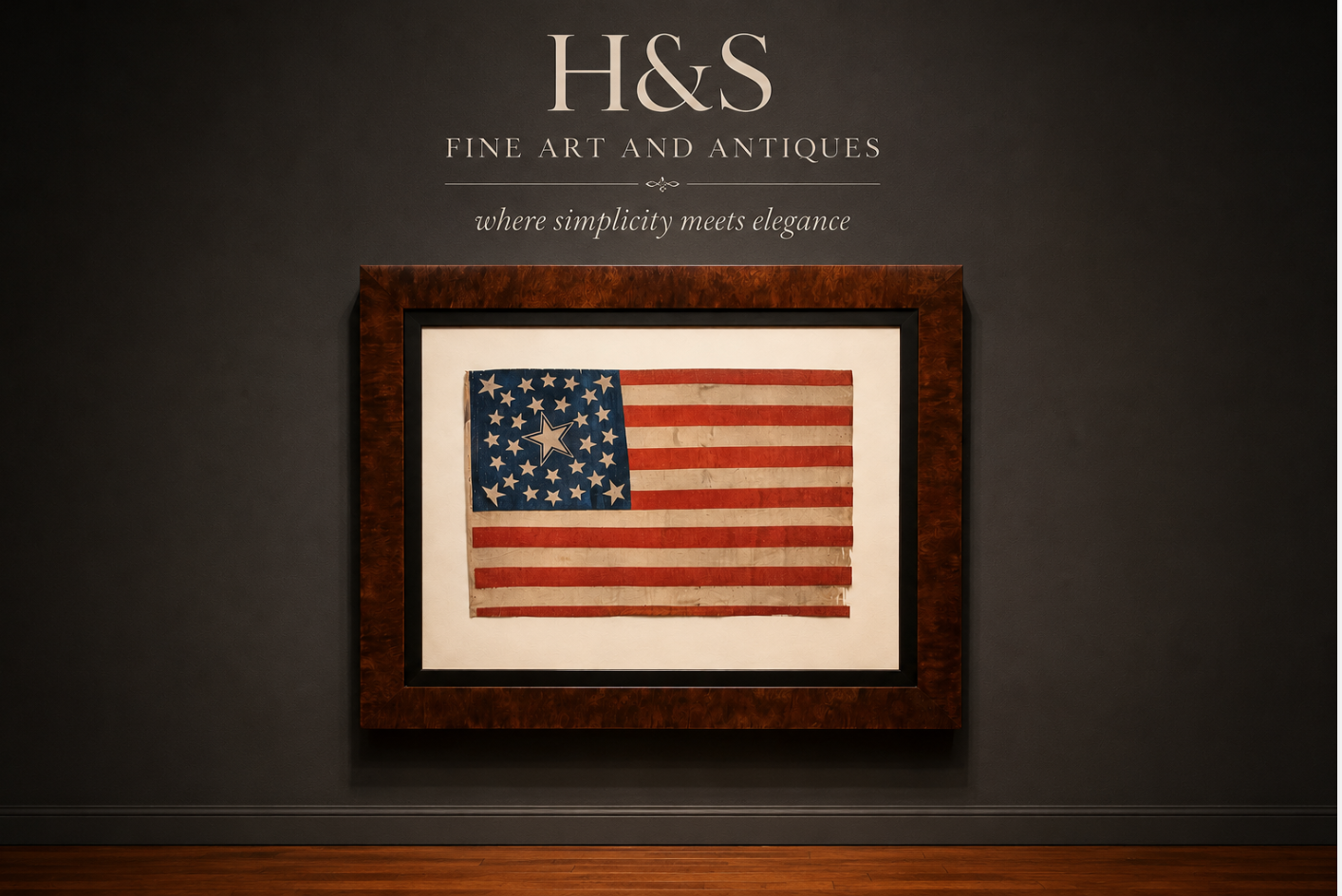
Thirty stars, pre-civil war, Haloed Medallion Pattern. Wisconsin statehood, 1848-1859.
Thirty-Star American Parade Flag
Wisconsin Statehood, Haloed Medallion Pattern, 1848–1851
American
Printed cotton parade flag
21 x 14 inches
Provenance:
Jeff R. Bridgman American Antiques, Mansfield, Pennsylvania
A Nation Expanding Westward
Few surviving objects capture the optimism, ambition, and growing tensions of antebellum America as powerfully as this rare Thirty-Star American parade flag. Printed on cotton and arranged in the celebrated Haloed Medallion pattern, this flag commemorates the admission of Wisconsin as the thirtieth state of the Union and belongs to one of the rarest and most sought-after categories of American patriotic textiles.
Wisconsin entered the Union on May 29, 1848, and its star was officially added to the American flag on July 4, 1848, in accordance with federal law. The thirty-star flag remained the official national flag until July 3, 1851, when California's admission increased the count to thirty-one stars. During this brief three-year period, the United States underwent one of the most transformative moments in its history.
Today, pre-Civil War printed parade flags are among the rarest surviving American textiles. Most were intended for temporary patriotic celebrations and were discarded after use. Their survival into the twenty-first century is exceptional, making examples such as the present flag important historical artifacts as well as remarkable works of American folk art.
The Haloed Medallion Pattern
The visual centerpiece of this flag is its dramatic star configuration.
Unlike modern flags, which follow standardized rows, nineteenth-century flag makers enjoyed considerable artistic freedom. Here, the stars are arranged in a medallion pattern surrounding a large central star outlined by a distinctive halo. This haloed center star creates a striking visual focal point that transforms the canton into a sophisticated graphic design.
Medallion configurations are among the most desirable star patterns for collectors because they combine patriotism with artistic invention. Within this category, the thirty-star Haloed Medallion pattern is exceptionally rare. Scholars and leading flag specialists believe that only a small number survive, making it one of the rarest known arrangements among pre-Civil War parade flags.
America in 1848
When this flag was produced, the United States was governed by President James Knox Polk, whose administration fundamentally reshaped the nation.
Polk had campaigned on a program of territorial expansion and achieved nearly all of his goals. During his presidency:
Texas was annexed.
The Oregon boundary dispute with Great Britain was settled.
The Mexican-American War was fought.
California and the American Southwest were acquired.
By 1848, the United States had become a continental nation stretching from the Atlantic to the Pacific Ocean.
The year Wisconsin entered the Union was also the year the Treaty of Guadalupe Hidalgo ended the Mexican-American War. Through this treaty, the United States acquired vast territories that would later become California, Nevada, Utah, Arizona, New Mexico, and portions of Colorado and Wyoming.
The nation was expanding at a pace never before experienced in its history.
The California Gold Rush
Only months after Wisconsin achieved statehood, gold was discovered at Sutter's Mill in California.
The California Gold Rush transformed the nation almost overnight. Hundreds of thousands of Americans and immigrants rushed westward in search of fortune. Wagon trains crossed the plains, clipper ships sailed around Cape Horn, and cities such as San Francisco exploded in size and importance.
California itself entered the Union on September 9, 1850, during the official life of the thirty-star flag. Yet its star would not officially appear on the national flag until July 4, 1851. Thus, this flag belongs to the final moment before California's arrival altered the political and economic landscape of the United States forever
The Shadow of the Civil War
Although the Civil War remained more than a decade away, the issues that would ultimately divide the nation were already emerging.
The acquisition of western territories raised a contentious question:
Would slavery be permitted in the newly acquired lands?
The debate dominated national politics throughout the period in which this flag flew. The Compromise of 1850 attempted to resolve these disputes by balancing the interests of free and slave states, but the agreement merely postponed the crisis.
Viewed today, the thirty-star flag represents one of the final moments of relative national optimism before sectional divisions deepened and the nation descended into civil war.
Wisconsin: America's New Frontier State
Wisconsin was among the most important frontier states of the nineteenth century.
Its admission reflected the rapid settlement of the Upper Midwest and the migration of thousands of immigrants from Germany, Scandinavia, and eastern states.
The state's economy was built upon:
Agriculture
Lumber production
Lead mining
Great Lakes commerce
Wisconsin's strategic position connected eastern markets to the expanding frontier and helped transform the Midwest into the agricultural heartland of the nation. The state's early seal and governmental imagery prominently featured mining, farming, manufacturing, and navigation, reflecting the industries that fueled its growth.
The Earliest Printed Flags
Flags such as this belong to the first generation of printed American flags.
Prior to the Civil War, most American flags were hand-sewn. Printed parade flags represented a new technology that allowed patriotic imagery to be produced quickly and inexpensively for rallies, celebrations, political campaigns, and statehood commemorations.
Because these flags were intended for temporary use, relatively few survived. The present example therefore serves as both a historical document and an important survivor of early American textile production.
Conservation and Presentation
The flag has been carefully conserved and mounted using museum standards.
It has been hand-stitched to a 100 percent cotton rag mat and housed within a period mahogany-veneered frame dating to approximately 1830–1850. The presentation is completed with ultraviolet protective glazing, ensuring the preservation of this rare textile for future generations.
The use of a period frame is particularly appropriate, creating an installation that is visually and historically consistent with the era in which the flag was originally produced.
Provenance
This flag was acquired from Jeff R. Bridgman American Antiques of Mansfield, Pennsylvania, widely recognized as one of the foremost authorities on antique American flags.
Bridgman's scholarship and connoisseurship have placed important flags in major private collections, museums, and institutional holdings throughout the United States. Objects originating from his collection are frequently cited in the study of early American textiles and patriotic material culture.
Literature
Herbert Ridgeway Collins, Threads of History: Americana Recorded on Cloth, 1775 to the Present
Boleslaw and Marie-Louise d'Otrange Mastai, The Stars and the Stripes
Kevin Keim and Peter Keim, A Grand Old Flag
William H. Rehnquist, The American Flag: Two Centuries of Concord and Conflict
Smithsonian Institution, Facts About the United States Flag
Significance
More than a patriotic emblem, this rare thirty-star flag stands as a witness to one of the most consequential periods in American history. It reflects the nation's expansion across a continent, the admission of Wisconsin into the Union, the aftermath of the Mexican-American War, the beginning of the California Gold Rush, and the mounting tensions that would ultimately lead to the Civil War.
Its rarity, artistic star configuration, early date, and remarkable state of preservation place it among the most important surviving examples of antebellum American patriotic textiles.
Thirty-Star American Parade Flag
Wisconsin Statehood, Haloed Medallion Pattern, 1848–1851
American
Printed cotton parade flag
21 x 14 inches
Provenance:
Jeff R. Bridgman American Antiques, Mansfield, Pennsylvania
A Nation Expanding Westward
Few surviving objects capture the optimism, ambition, and growing tensions of antebellum America as powerfully as this rare Thirty-Star American parade flag. Printed on cotton and arranged in the celebrated Haloed Medallion pattern, this flag commemorates the admission of Wisconsin as the thirtieth state of the Union and belongs to one of the rarest and most sought-after categories of American patriotic textiles.
Wisconsin entered the Union on May 29, 1848, and its star was officially added to the American flag on July 4, 1848, in accordance with federal law. The thirty-star flag remained the official national flag until July 3, 1851, when California's admission increased the count to thirty-one stars. During this brief three-year period, the United States underwent one of the most transformative moments in its history.
Today, pre-Civil War printed parade flags are among the rarest surviving American textiles. Most were intended for temporary patriotic celebrations and were discarded after use. Their survival into the twenty-first century is exceptional, making examples such as the present flag important historical artifacts as well as remarkable works of American folk art.
The Haloed Medallion Pattern
The visual centerpiece of this flag is its dramatic star configuration.
Unlike modern flags, which follow standardized rows, nineteenth-century flag makers enjoyed considerable artistic freedom. Here, the stars are arranged in a medallion pattern surrounding a large central star outlined by a distinctive halo. This haloed center star creates a striking visual focal point that transforms the canton into a sophisticated graphic design.
Medallion configurations are among the most desirable star patterns for collectors because they combine patriotism with artistic invention. Within this category, the thirty-star Haloed Medallion pattern is exceptionally rare. Scholars and leading flag specialists believe that only a small number survive, making it one of the rarest known arrangements among pre-Civil War parade flags.
America in 1848
When this flag was produced, the United States was governed by President James Knox Polk, whose administration fundamentally reshaped the nation.
Polk had campaigned on a program of territorial expansion and achieved nearly all of his goals. During his presidency:
Texas was annexed.
The Oregon boundary dispute with Great Britain was settled.
The Mexican-American War was fought.
California and the American Southwest were acquired.
By 1848, the United States had become a continental nation stretching from the Atlantic to the Pacific Ocean.
The year Wisconsin entered the Union was also the year the Treaty of Guadalupe Hidalgo ended the Mexican-American War. Through this treaty, the United States acquired vast territories that would later become California, Nevada, Utah, Arizona, New Mexico, and portions of Colorado and Wyoming.
The nation was expanding at a pace never before experienced in its history.
The California Gold Rush
Only months after Wisconsin achieved statehood, gold was discovered at Sutter's Mill in California.
The California Gold Rush transformed the nation almost overnight. Hundreds of thousands of Americans and immigrants rushed westward in search of fortune. Wagon trains crossed the plains, clipper ships sailed around Cape Horn, and cities such as San Francisco exploded in size and importance.
California itself entered the Union on September 9, 1850, during the official life of the thirty-star flag. Yet its star would not officially appear on the national flag until July 4, 1851. Thus, this flag belongs to the final moment before California's arrival altered the political and economic landscape of the United States forever
The Shadow of the Civil War
Although the Civil War remained more than a decade away, the issues that would ultimately divide the nation were already emerging.
The acquisition of western territories raised a contentious question:
Would slavery be permitted in the newly acquired lands?
The debate dominated national politics throughout the period in which this flag flew. The Compromise of 1850 attempted to resolve these disputes by balancing the interests of free and slave states, but the agreement merely postponed the crisis.
Viewed today, the thirty-star flag represents one of the final moments of relative national optimism before sectional divisions deepened and the nation descended into civil war.
Wisconsin: America's New Frontier State
Wisconsin was among the most important frontier states of the nineteenth century.
Its admission reflected the rapid settlement of the Upper Midwest and the migration of thousands of immigrants from Germany, Scandinavia, and eastern states.
The state's economy was built upon:
Agriculture
Lumber production
Lead mining
Great Lakes commerce
Wisconsin's strategic position connected eastern markets to the expanding frontier and helped transform the Midwest into the agricultural heartland of the nation. The state's early seal and governmental imagery prominently featured mining, farming, manufacturing, and navigation, reflecting the industries that fueled its growth.
The Earliest Printed Flags
Flags such as this belong to the first generation of printed American flags.
Prior to the Civil War, most American flags were hand-sewn. Printed parade flags represented a new technology that allowed patriotic imagery to be produced quickly and inexpensively for rallies, celebrations, political campaigns, and statehood commemorations.
Because these flags were intended for temporary use, relatively few survived. The present example therefore serves as both a historical document and an important survivor of early American textile production.
Conservation and Presentation
The flag has been carefully conserved and mounted using museum standards.
It has been hand-stitched to a 100 percent cotton rag mat and housed within a period mahogany-veneered frame dating to approximately 1830–1850. The presentation is completed with ultraviolet protective glazing, ensuring the preservation of this rare textile for future generations.
The use of a period frame is particularly appropriate, creating an installation that is visually and historically consistent with the era in which the flag was originally produced.
Provenance
This flag was acquired from Jeff R. Bridgman American Antiques of Mansfield, Pennsylvania, widely recognized as one of the foremost authorities on antique American flags.
Bridgman's scholarship and connoisseurship have placed important flags in major private collections, museums, and institutional holdings throughout the United States. Objects originating from his collection are frequently cited in the study of early American textiles and patriotic material culture.
Literature
Herbert Ridgeway Collins, Threads of History: Americana Recorded on Cloth, 1775 to the Present
Boleslaw and Marie-Louise d'Otrange Mastai, The Stars and the Stripes
Kevin Keim and Peter Keim, A Grand Old Flag
William H. Rehnquist, The American Flag: Two Centuries of Concord and Conflict
Smithsonian Institution, Facts About the United States Flag
Significance
More than a patriotic emblem, this rare thirty-star flag stands as a witness to one of the most consequential periods in American history. It reflects the nation's expansion across a continent, the admission of Wisconsin into the Union, the aftermath of the Mexican-American War, the beginning of the California Gold Rush, and the mounting tensions that would ultimately lead to the Civil War.
Its rarity, artistic star configuration, early date, and remarkable state of preservation place it among the most important surviving examples of antebellum American patriotic textiles.
The 30th state, Wisconsin joined the Union on May 29th, 1848. The 30 star flag was officially until July 3rd, 1851 and most likely would not been produced after the addition of state of California in 1850. This 30 stars example is among the earliest of all printed flags. It is also known fewer than ten flags to exist with 30 stars in this haloed medallion style. Flags made prior to the civil war are extremely rare. The flag has been hand-stitched to 100% cotton rag mat and placed in mahogany-veneered molding that dates to the period between 1830-1850. The glass is U.V. protective.