 Image 1 of 3
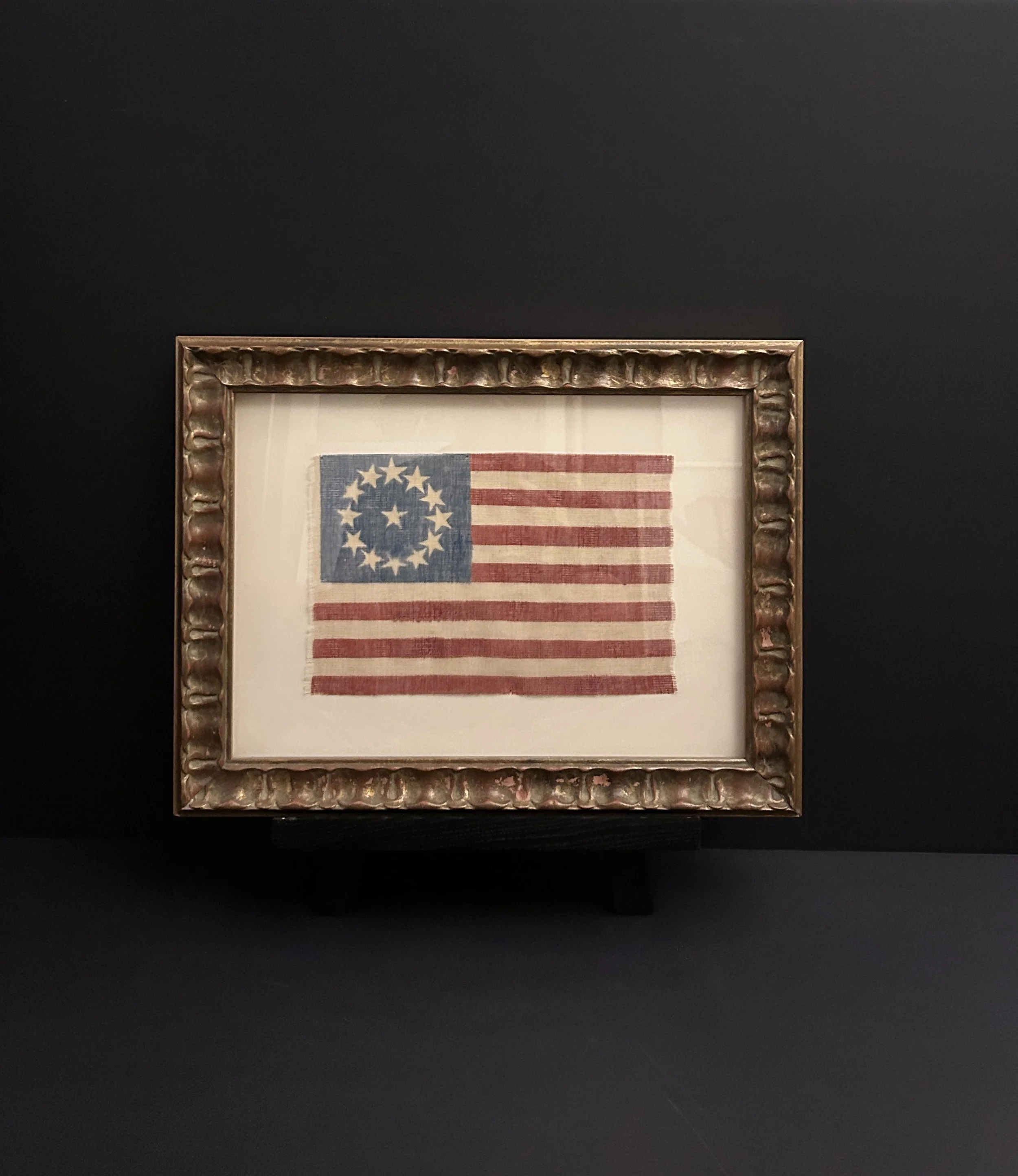 Image 2 of 3
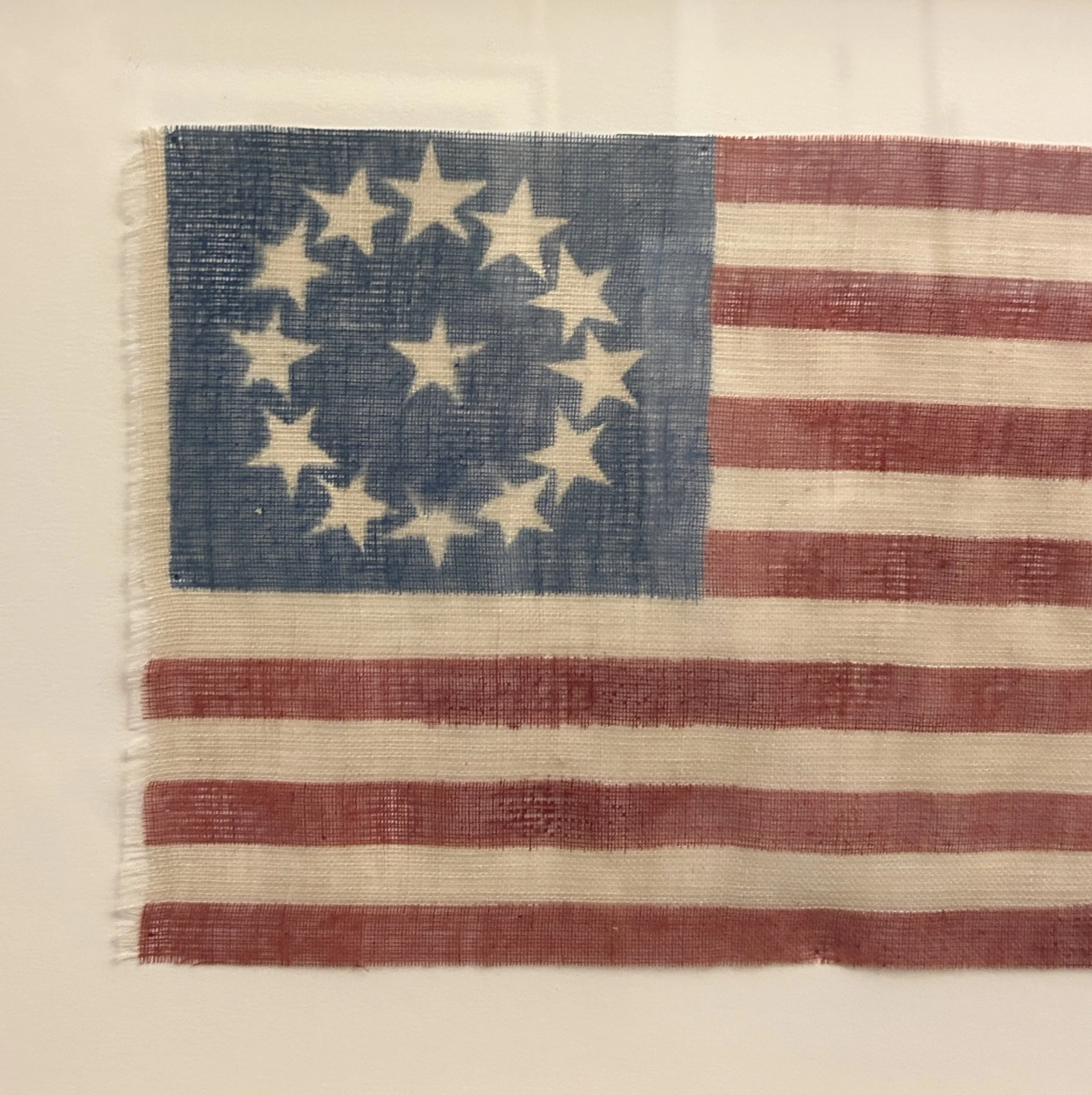 Image 3 of 3
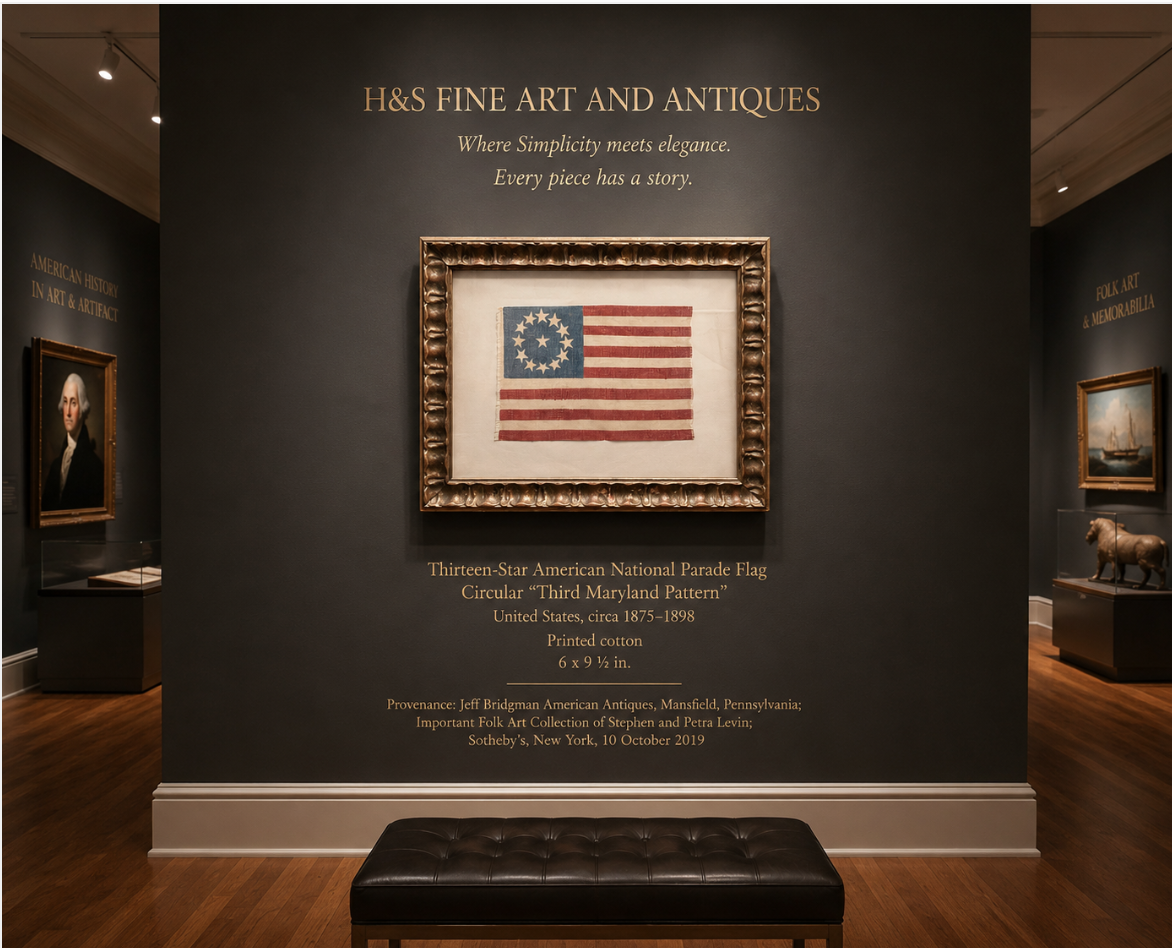
Thirteen-Star American National Parade Flag
Circular “Third Maryland Pattern”
United States, circa 1875–1898
Printed cotton
6 x 9 ½ in.
Provenance: Jeff Bridgman American Antiques, Mansfield, Pennsylvania; Important Folk Art Collection of Stephen and Petra Levin; Sotheby’s, New York, 10 October 2019
This small but visually powerful parade flag recalls the birth of the American nation through its thirteen stars and thirteen stripes, representing the original colonies. The Flag Act of June 14, 1777 established the national emblem as thirteen alternating red and white stripes with thirteen white stars on a blue field, “representing a new constellation.”
The stars are arranged in a distinctive circular wreath of twelve surrounding a single central star, a configuration known among collectors as the Third Maryland Pattern. The wreath suggests unity, permanence, and the Revolutionary memory of the first Union. Unlike later flags that counted newly admitted states, thirteen-star flags remained popular well into the nineteenth century as patriotic, commemorative, and Centennial-era symbols..
Dating to circa 1875–1898, this flag belongs to the period when Americans revived Revolutionary imagery during and after the 1876 Centennial, celebrating one hundred years of independence. Small printed parade flags like this were carried at civic ceremonies, political rallies, patriotic holidays, veterans’ gatherings, and public celebrations. Its modest scale makes it especially intimate: a hand-held emblem of national memory rather than an official government flag.
The flag’s provenance is notable. It passed through Jeff Bridgman American Antiques, one of the leading specialists in early American flags, and later formed part of the Important American Folk Art Collection of Stephen and Petra Levin, sold at Sotheby’s New York on 10 October 2019. Sotheby’s described the Levin collection sale as a major American folk art auction in New York.
Although made nearly a century after independence, the flag intentionally looks backward. Its thirteen-star count does not mark a statehood moment; instead, it honors the founding generation, the Revolution, and the symbolic “first flag” tradition. The circular star arrangement connects visually to early American flag mythology and to the broader nineteenth-century fascination with Revolutionary patriotism.
Primary historical reference:
Continental Congress, Flag Resolution, June 14, 1777.
Institutional references:
Library of Congress, Today in History: June 14.
Smithsonian National Postal Museum, Long May It Wave: The Evolution of the American Flag.
Smithsonian, Facts about the Star-Spangled Banner.
Provenance / market reference:
Sotheby’s, New York, Sculptural Fantasy: The Important American Folk Art Collection of Stephen and Petra Levin, 10 October 2019.
Thirteen-Star American National Parade Flag
Circular “Third Maryland Pattern”
United States, circa 1875–1898
Printed cotton
6 x 9 ½ in.
Provenance: Jeff Bridgman American Antiques, Mansfield, Pennsylvania; Important Folk Art Collection of Stephen and Petra Levin; Sotheby’s, New York, 10 October 2019
This small but visually powerful parade flag recalls the birth of the American nation through its thirteen stars and thirteen stripes, representing the original colonies. The Flag Act of June 14, 1777 established the national emblem as thirteen alternating red and white stripes with thirteen white stars on a blue field, “representing a new constellation.”
The stars are arranged in a distinctive circular wreath of twelve surrounding a single central star, a configuration known among collectors as the Third Maryland Pattern. The wreath suggests unity, permanence, and the Revolutionary memory of the first Union. Unlike later flags that counted newly admitted states, thirteen-star flags remained popular well into the nineteenth century as patriotic, commemorative, and Centennial-era symbols..
Dating to circa 1875–1898, this flag belongs to the period when Americans revived Revolutionary imagery during and after the 1876 Centennial, celebrating one hundred years of independence. Small printed parade flags like this were carried at civic ceremonies, political rallies, patriotic holidays, veterans’ gatherings, and public celebrations. Its modest scale makes it especially intimate: a hand-held emblem of national memory rather than an official government flag.
The flag’s provenance is notable. It passed through Jeff Bridgman American Antiques, one of the leading specialists in early American flags, and later formed part of the Important American Folk Art Collection of Stephen and Petra Levin, sold at Sotheby’s New York on 10 October 2019. Sotheby’s described the Levin collection sale as a major American folk art auction in New York.
Although made nearly a century after independence, the flag intentionally looks backward. Its thirteen-star count does not mark a statehood moment; instead, it honors the founding generation, the Revolution, and the symbolic “first flag” tradition. The circular star arrangement connects visually to early American flag mythology and to the broader nineteenth-century fascination with Revolutionary patriotism.
Primary historical reference:
Continental Congress, Flag Resolution, June 14, 1777.
Institutional references:
Library of Congress, Today in History: June 14.
Smithsonian National Postal Museum, Long May It Wave: The Evolution of the American Flag.
Smithsonian, Facts about the Star-Spangled Banner.
Provenance / market reference:
Sotheby’s, New York, Sculptural Fantasy: The Important American Folk Art Collection of Stephen and Petra Levin, 10 October 2019.