 Image 1 of 7
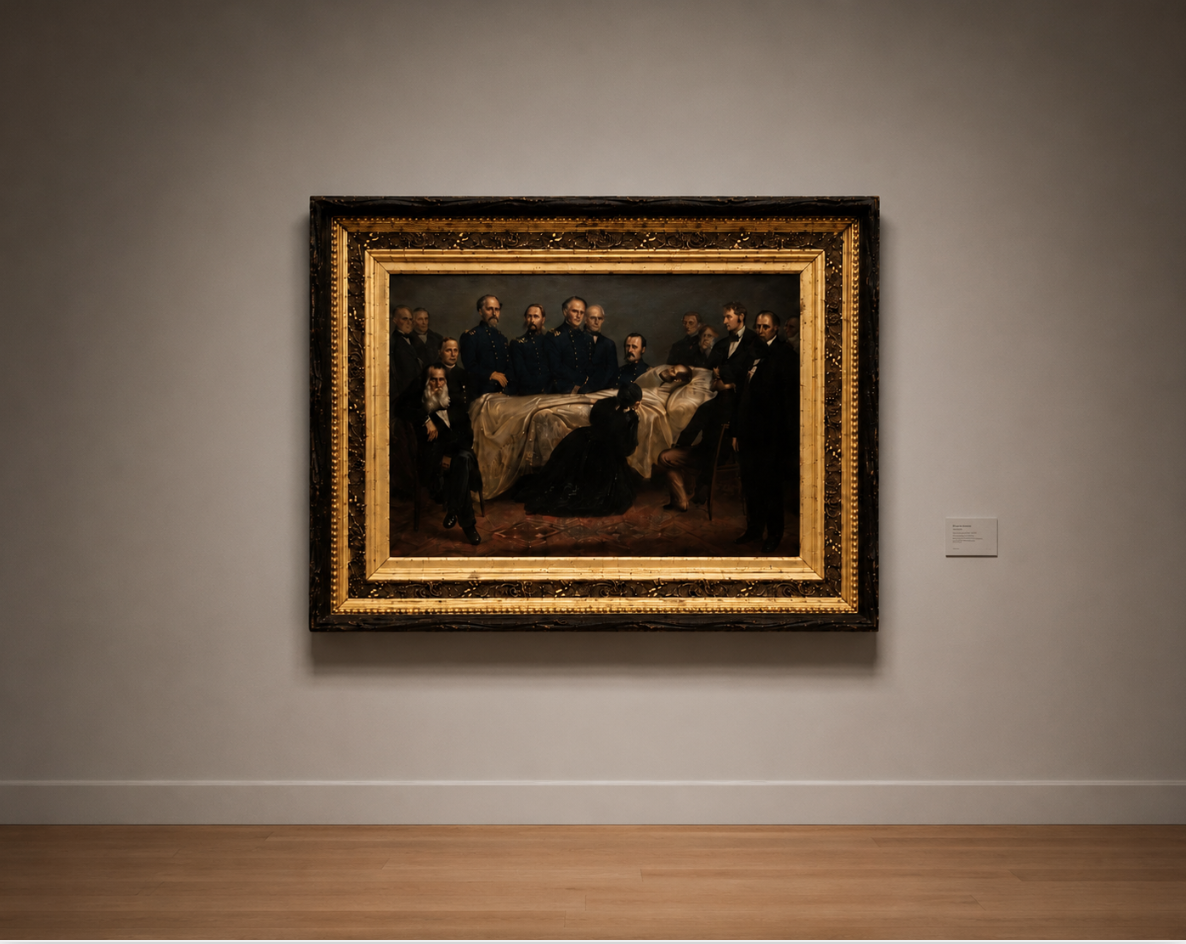 Image 2 of 7
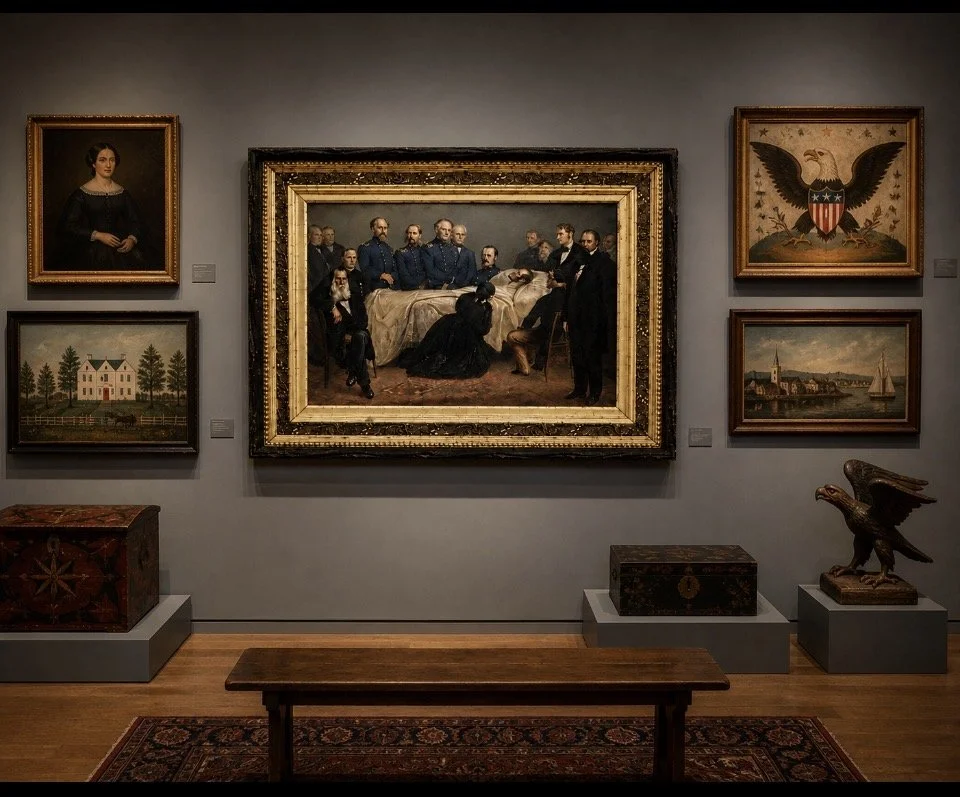 Image 3 of 7
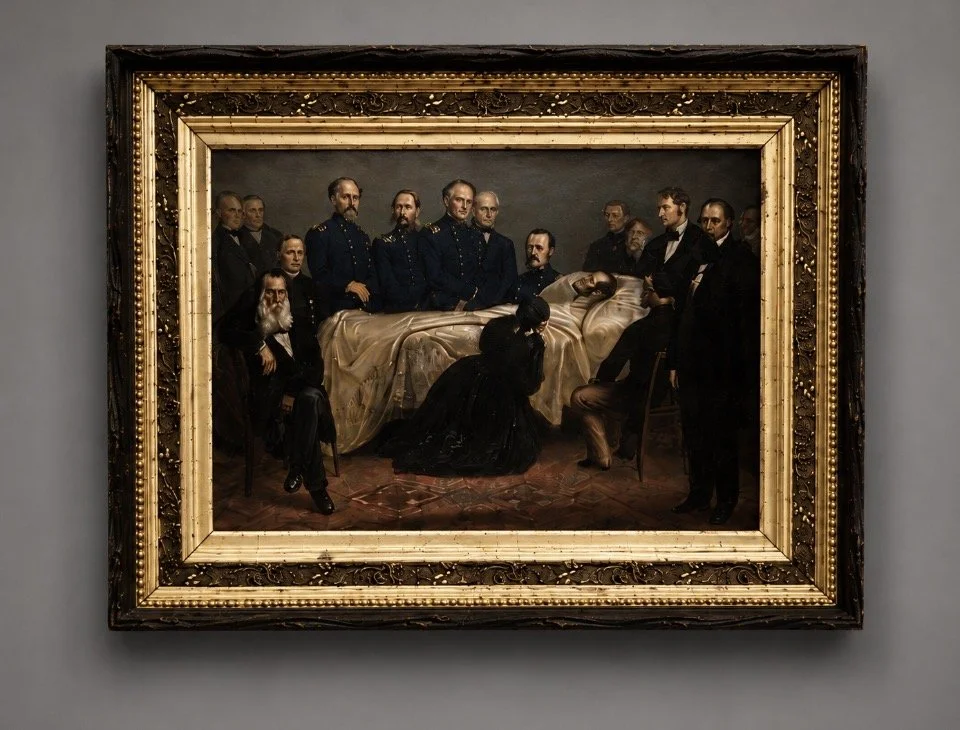 Image 4 of 7
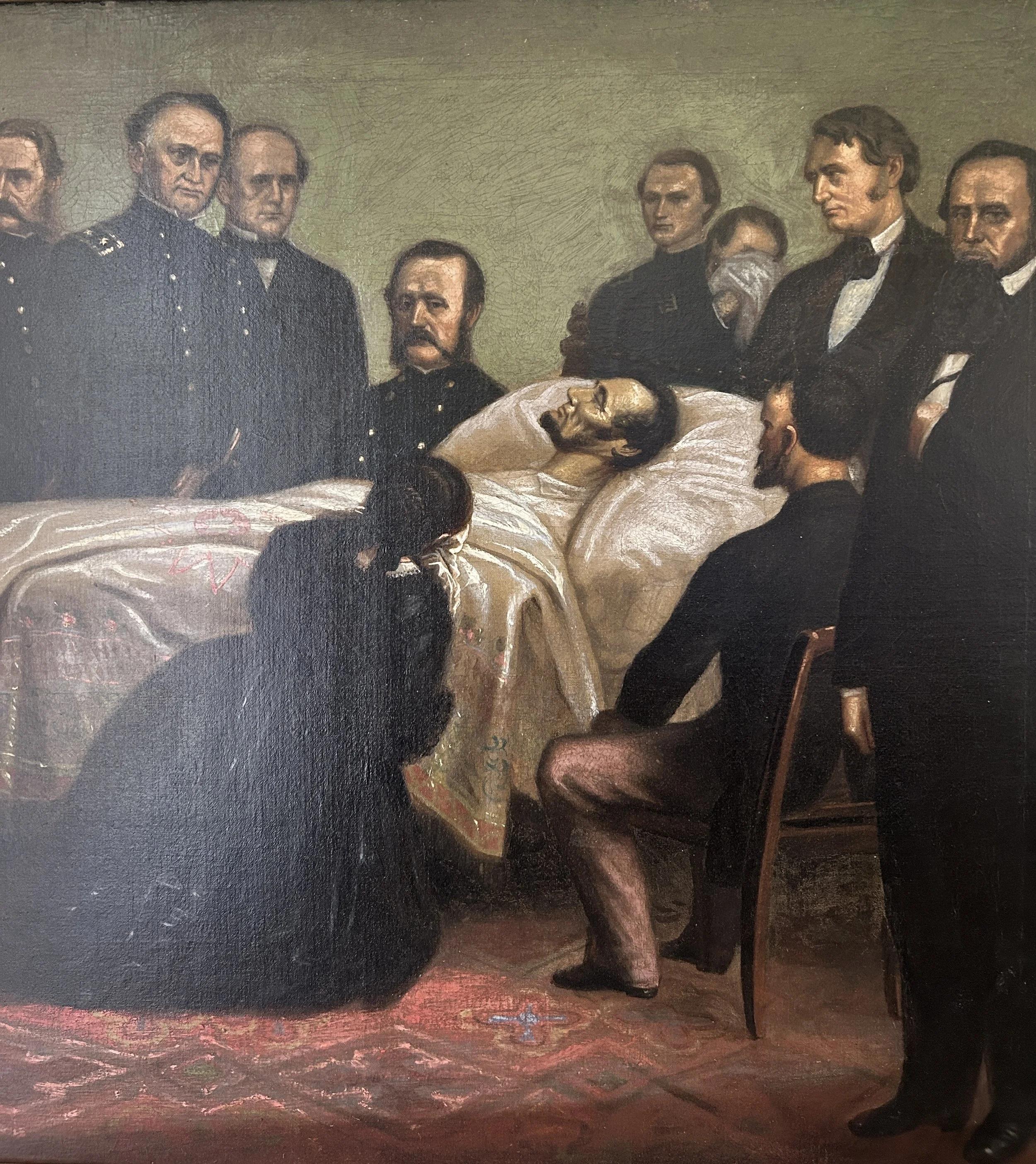 Image 5 of 7
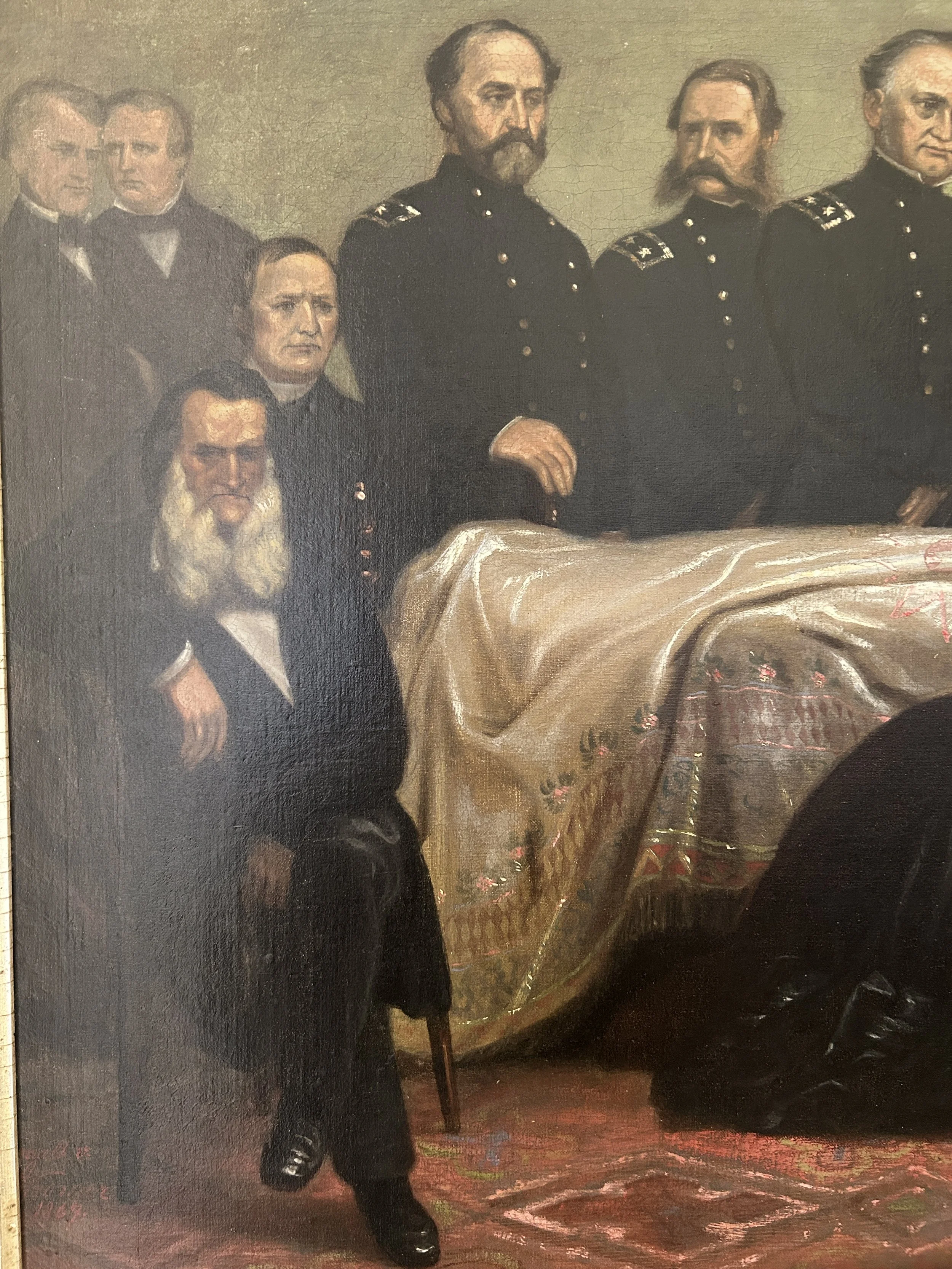 Image 6 of 7
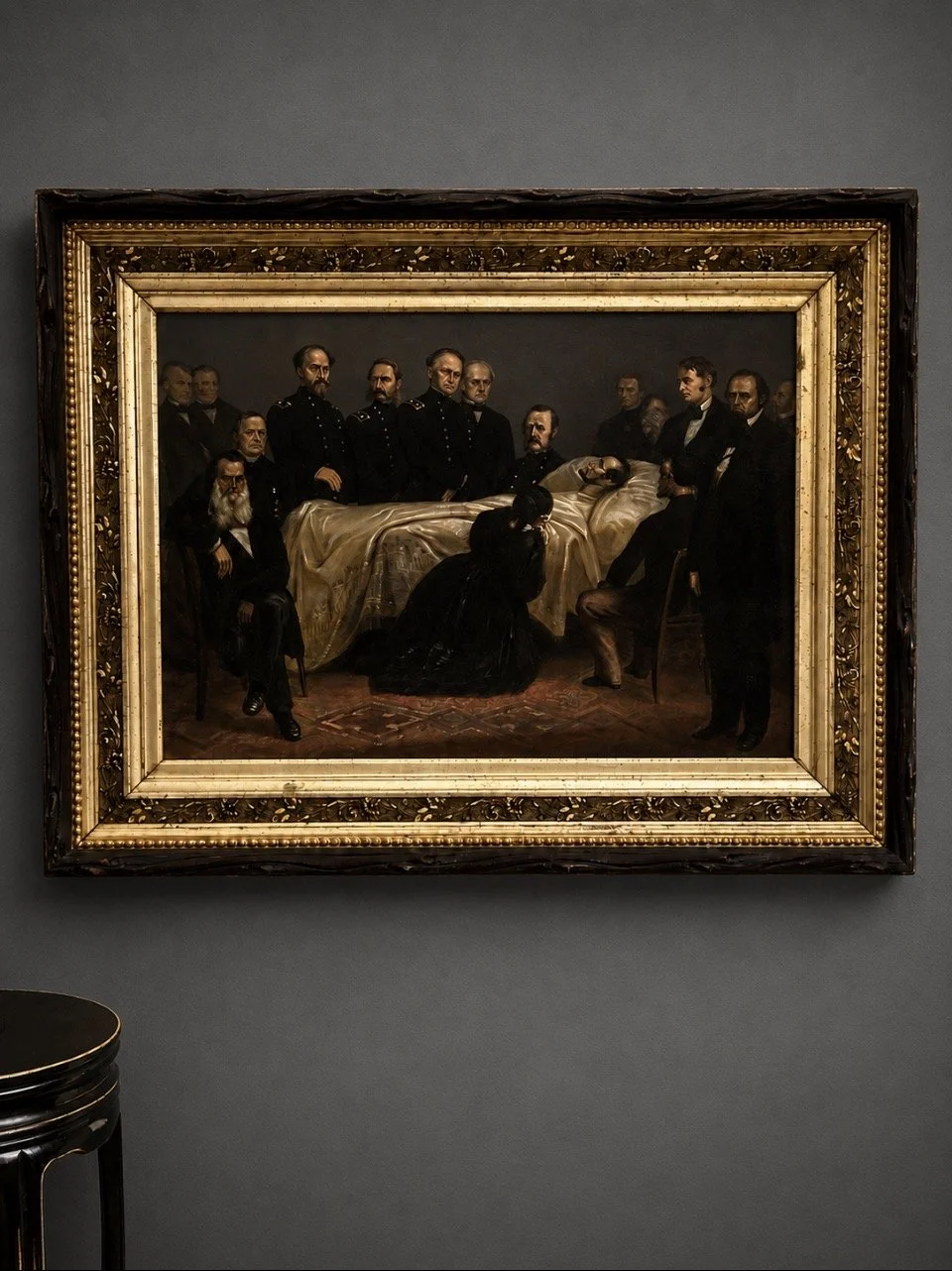 Image 7 of 7
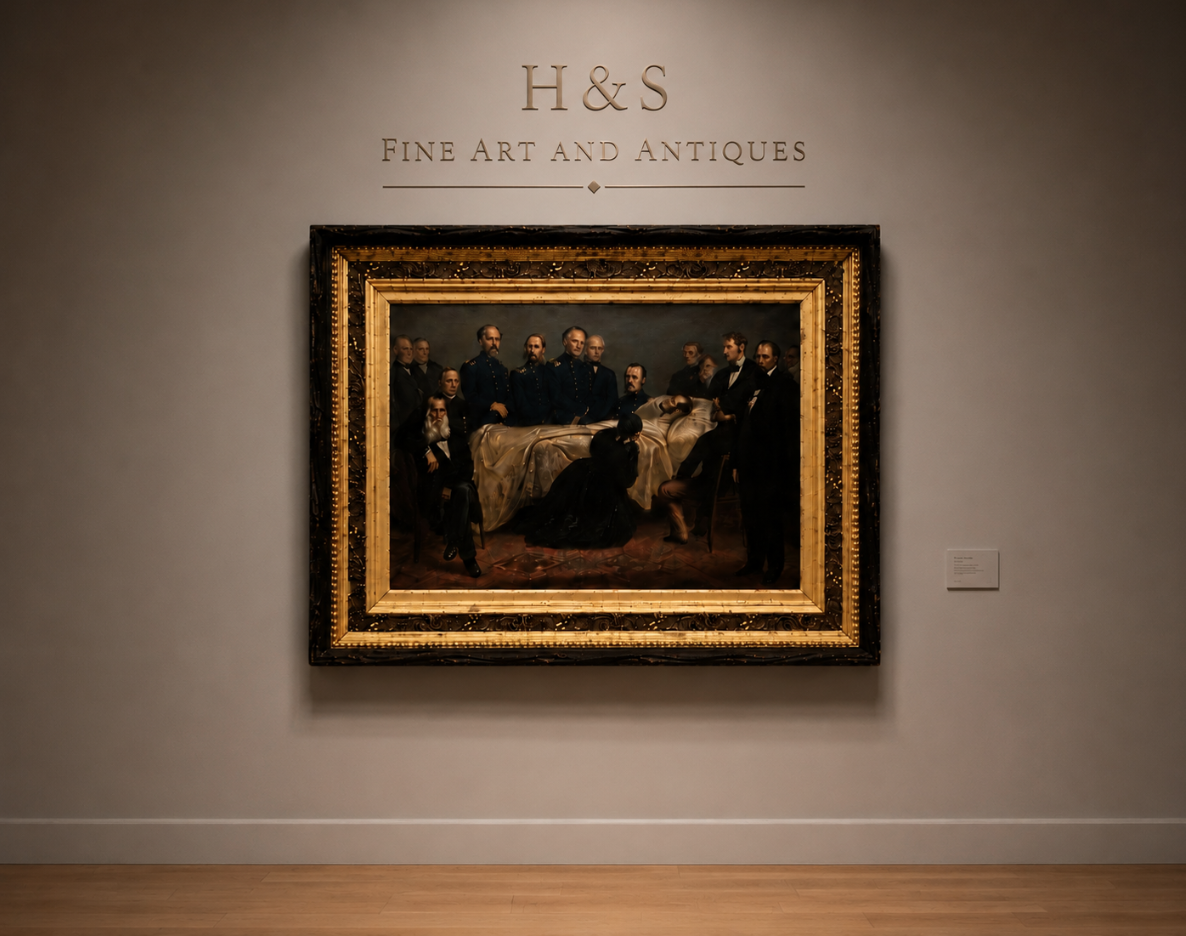
The Last Hours of Abraham Lincoln. A. Kromer 1867. this painting was in the Taper Collection before moving to the Abraham Lincoln Presidential Library Museum
The Last Hours of Abraham Lincoln
A. Kromer (German, active mid-19th century)
1867
Oil on Canvas
Provenance
The Louise and Barry Taper Collection, one of the most important private collections of Lincolniana ever assembled.
Acquired by the Abraham Lincoln Presidential Library and Museum, Springfield, Illinois
Historical Context
Few moments in American history have been memorialized as profoundly as the death of President Abraham Lincoln. Following his assassination at Ford's Theatre on the evening of April 14, 1865, the wounded President was carried across Tenth Street to the modest Petersen House, where he succumbed to his injuries at 7:22 a.m. on April 15.
Within months of the tragedy, painters, engravers, photographers, and publishers sought to preserve the event for a grieving nation. These compositions became visual memorials to the fallen President and helped establish Lincoln as one of America's greatest national heroes.
A. Kromer's monumental 1867 painting belongs to this distinguished tradition while remaining highly individual in both execution and emotional character.
Unlike many commercially produced engravings, Kromer's interpretation possesses the gravity and restraint associated with European academic history painting. Rather than emphasizing theatrical emotion, the artist presents Lincoln's final moments with remarkable dignity, solemnity, and reverence.
The Artist
Although relatively little is known about A. Kromer, historical records identify him as a Bavarian-born artist and church mural painter working during the nineteenth century.
His background in ecclesiastical painting is particularly evident throughout this composition. The arrangement of figures surrounding Lincoln resembles Renaissance depictions of the Entombment or the Lamentation over Christ.
Lincoln becomes not merely a political figure but a martyr whose sacrifice ensured the preservation of the Union.
This European interpretation distinguishes Kromer's work from most American depictions of the assassination and demonstrates the profound international admiration Lincoln inspired following the Civil War.
Composition and Iconography
The composition depicts more than twenty identifiable historical figures gathered around Lincoln's bedside inside the Petersen House.
Among those represented are:
Mary Todd Lincoln kneeling beside her husband in grief.
Robert Todd Lincoln standing weeping behind the bed.
Secretary of War Edwin M. Stanton.
Secretary of the Navy Gideon Welles.
Surgeon General Joseph K. Barnes.
Chief Justice Salmon P. Chase.
Military officers, physicians, cabinet members, clergy, and close associates who witnessed the President's final hours.
Although the actual bedroom measured only approximately nine by seventeen feet, artists intentionally expanded the dimensions of the room in order to include every important participant.
Historians have often referred to these enlarged memorial scenes as "Rubber Room" paintings, acknowledging the artistic license employed to transform a cramped interior into a stage suitable for a national tragedy.
Kromer's work is among the finest examples of this tradition.
Relationship to Contemporary Prints
The painting appears to draw inspiration from several celebrated contemporary sources, including engravings by C. A. Asp and N. P. Beers, while also reflecting the influence of James Burns's celebrated 1866 memorial paintings.
Many nineteenth-century artists relied upon photographs from the Mathew Brady Studio to accurately render the likenesses of Lincoln and the distinguished statesmen surrounding his deathbed.
Kromer combined these photographic references with European academic techniques to produce a work that transcends simple historical illustration.
The result is a sophisticated historical painting balancing documentary accuracy with emotional symbolism.
Artistic Qualities
One of the most remarkable aspects of the painting is its disciplined restraint.
Rather than portraying exaggerated expressions of grief, Kromer emphasizes quiet contemplation.
Each figure becomes almost sculptural, standing in silent witness to one of the defining moments in American history.
The subdued palette, controlled lighting, and careful modeling of the figures create an atmosphere that recalls Old Master religious painting more than contemporary American genre painting.
Lincoln's illuminated body forms the visual center of the composition, drawing the viewer immediately toward the President while the surrounding figures form an almost architectural framework of mourning.
Museum Exhibition History:
Acquired by the Abraham Lincoln Presidential Library and Museum, Springfield, Illinois.This painting is a striking version of "The Death Bed of Abraham Lincoln," a scene of immense national importance. It depicts the final moments of the 16th President at the Petersen House on the morning of April 15, 1865. Visually, this composition is closely aligned with the 1866 works by James Burns, These composite paintings were masterpieces of the 19th-century memorial art. As this piece originates from The Lincoln Museum collection, it carries a distinguished layer of institutional history. Such works were often based on contemporary photographs taken by the Mathew Brady studio to ensure the physical likeness of each figure was historically accurate.
This painting represents not just a piece of art, but a window into a pivotal moment of American history. It would serve as a profound centerpiece for any serious collection of 19th-century Americana.please see youtube presentation from the Lincoln Museum and article including the painting https://www.youtube.com/watch?v=hbvf_Lyd5Q0 https://www.sj-r.com/story/news/2015/04/13/150-years-ago-original-ap/34781618007/#
Academic Rarity: Unlike the more common mass-produced engravings of the era, this painting was in the Taper Collection before moving to the Abraham Lincoln Presidential Library Museum. The painting is housed in an impressive period-appropriate frame that truly complements its historical weight. This painting was acquired by the Abraham Lincoln Presidential Library and Museum in Springfield, Illinois, as part of the Taper Collection.
Notable Exhibits:
"Undying Words: Lincoln 1858-1865" (2015-2016): https://www.facebook.com/story.php?story_fbid=10153769326751469&id=100064874524810 This major exhibition at the Abraham Lincoln Presidential Library and Museum featured the painting as part of a deep dive into Lincoln's final years.
The Taper Collection Display: Before its permanent home in Springfield, the painting was part of the renowned Louise and Barry Taper Collection, one of the most significant private collections of Lincolniana ever assembled.
Presidential Museum Assassination Exhibit (2005): Upon the museum's official opening, this painting and related artifacts including the physical Lincoln deathbed on loan from the Chicago History Museum.
Articles and Historical Coverage: "Stories from the Vault" (April 2012) The Lincoln Presidential Library.
"The Lincoln Tragedy in Artwork" (2029): An article by Emerging Civil War https://emergingcivilwar.com/2019/04/14/the-lincoln-tragedy-in-artwork/ discusses how this painting fits into the broader tradition of "Rubber Room" art-a term historians use for deathbed scenes that exaggerated the size of the room to include more mourners.
"Prints as Historical Evidence" (2009): featured on the Antique Prints this analysis examines the painting's likely sources, such as the prints by C.A. ASP and N.P. Beers.
Significance
Deathbed scenes occupy a unique place in nineteenth-century American art.
Unlike portraits celebrating Lincoln during his presidency, these memorial paintings transformed the fallen President into a lasting symbol of sacrifice, reconciliation, and national unity.
Kromer's interpretation is particularly compelling because it combines European academic traditions with one of the defining moments of American history.
Its distinguished museum provenance, institutional exhibition history, and association with one of the nation's premier Lincoln collections elevate it well beyond the status of a conventional historical painting.
Today it stands as both a work of art and an extraordinary historical document.
Curatorial Note
Among the many artistic representations of Abraham Lincoln's assassination, A. Kromer's The Last Hours of Abraham Lincoln occupies a distinctive position. Painted only two years after the President's death, it reflects a period when collective memory of the Civil War was still immediate and deeply personal. Kromer approached the subject not simply as a historical event but as a solemn act of national remembrance, infusing the composition with the quiet dignity of European religious painting. Lincoln's bed becomes an altar of sacrifice, and the gathered statesmen resemble witnesses to a sacred historical rite rather than participants in a political tragedy.
The painting's later inclusion in the celebrated Louise and Barry Taper Collection, followed by its acquisition by the Abraham Lincoln Presidential Library and Museum, confirms its recognized historical significance. Works with such institutional provenance rarely re-enter the marketplace, making examples of this quality exceptionally desirable to collectors of museum-caliber Americana.
As both an artistic achievement and a visual record of one of the most consequential moments in United States history, Kromer's The Last Hours of Abraham Lincoln transcends traditional Civil War art. It serves as a lasting testament to Lincoln's enduring legacy and to the power of historical painting to preserve the memory of a nation in mourning.
The Last Hours of Abraham Lincoln
A. Kromer (German, active mid-19th century)
1867
Oil on Canvas
Provenance
The Louise and Barry Taper Collection, one of the most important private collections of Lincolniana ever assembled.
Acquired by the Abraham Lincoln Presidential Library and Museum, Springfield, Illinois
Historical Context
Few moments in American history have been memorialized as profoundly as the death of President Abraham Lincoln. Following his assassination at Ford's Theatre on the evening of April 14, 1865, the wounded President was carried across Tenth Street to the modest Petersen House, where he succumbed to his injuries at 7:22 a.m. on April 15.
Within months of the tragedy, painters, engravers, photographers, and publishers sought to preserve the event for a grieving nation. These compositions became visual memorials to the fallen President and helped establish Lincoln as one of America's greatest national heroes.
A. Kromer's monumental 1867 painting belongs to this distinguished tradition while remaining highly individual in both execution and emotional character.
Unlike many commercially produced engravings, Kromer's interpretation possesses the gravity and restraint associated with European academic history painting. Rather than emphasizing theatrical emotion, the artist presents Lincoln's final moments with remarkable dignity, solemnity, and reverence.
The Artist
Although relatively little is known about A. Kromer, historical records identify him as a Bavarian-born artist and church mural painter working during the nineteenth century.
His background in ecclesiastical painting is particularly evident throughout this composition. The arrangement of figures surrounding Lincoln resembles Renaissance depictions of the Entombment or the Lamentation over Christ.
Lincoln becomes not merely a political figure but a martyr whose sacrifice ensured the preservation of the Union.
This European interpretation distinguishes Kromer's work from most American depictions of the assassination and demonstrates the profound international admiration Lincoln inspired following the Civil War.
Composition and Iconography
The composition depicts more than twenty identifiable historical figures gathered around Lincoln's bedside inside the Petersen House.
Among those represented are:
Mary Todd Lincoln kneeling beside her husband in grief.
Robert Todd Lincoln standing weeping behind the bed.
Secretary of War Edwin M. Stanton.
Secretary of the Navy Gideon Welles.
Surgeon General Joseph K. Barnes.
Chief Justice Salmon P. Chase.
Military officers, physicians, cabinet members, clergy, and close associates who witnessed the President's final hours.
Although the actual bedroom measured only approximately nine by seventeen feet, artists intentionally expanded the dimensions of the room in order to include every important participant.
Historians have often referred to these enlarged memorial scenes as "Rubber Room" paintings, acknowledging the artistic license employed to transform a cramped interior into a stage suitable for a national tragedy.
Kromer's work is among the finest examples of this tradition.
Relationship to Contemporary Prints
The painting appears to draw inspiration from several celebrated contemporary sources, including engravings by C. A. Asp and N. P. Beers, while also reflecting the influence of James Burns's celebrated 1866 memorial paintings.
Many nineteenth-century artists relied upon photographs from the Mathew Brady Studio to accurately render the likenesses of Lincoln and the distinguished statesmen surrounding his deathbed.
Kromer combined these photographic references with European academic techniques to produce a work that transcends simple historical illustration.
The result is a sophisticated historical painting balancing documentary accuracy with emotional symbolism.
Artistic Qualities
One of the most remarkable aspects of the painting is its disciplined restraint.
Rather than portraying exaggerated expressions of grief, Kromer emphasizes quiet contemplation.
Each figure becomes almost sculptural, standing in silent witness to one of the defining moments in American history.
The subdued palette, controlled lighting, and careful modeling of the figures create an atmosphere that recalls Old Master religious painting more than contemporary American genre painting.
Lincoln's illuminated body forms the visual center of the composition, drawing the viewer immediately toward the President while the surrounding figures form an almost architectural framework of mourning.
Museum Exhibition History:
Acquired by the Abraham Lincoln Presidential Library and Museum, Springfield, Illinois.This painting is a striking version of "The Death Bed of Abraham Lincoln," a scene of immense national importance. It depicts the final moments of the 16th President at the Petersen House on the morning of April 15, 1865. Visually, this composition is closely aligned with the 1866 works by James Burns, These composite paintings were masterpieces of the 19th-century memorial art. As this piece originates from The Lincoln Museum collection, it carries a distinguished layer of institutional history. Such works were often based on contemporary photographs taken by the Mathew Brady studio to ensure the physical likeness of each figure was historically accurate.
This painting represents not just a piece of art, but a window into a pivotal moment of American history. It would serve as a profound centerpiece for any serious collection of 19th-century Americana.please see youtube presentation from the Lincoln Museum and article including the painting https://www.youtube.com/watch?v=hbvf_Lyd5Q0 https://www.sj-r.com/story/news/2015/04/13/150-years-ago-original-ap/34781618007/#
Academic Rarity: Unlike the more common mass-produced engravings of the era, this painting was in the Taper Collection before moving to the Abraham Lincoln Presidential Library Museum. The painting is housed in an impressive period-appropriate frame that truly complements its historical weight. This painting was acquired by the Abraham Lincoln Presidential Library and Museum in Springfield, Illinois, as part of the Taper Collection.
Notable Exhibits:
"Undying Words: Lincoln 1858-1865" (2015-2016): https://www.facebook.com/story.php?story_fbid=10153769326751469&id=100064874524810 This major exhibition at the Abraham Lincoln Presidential Library and Museum featured the painting as part of a deep dive into Lincoln's final years.
The Taper Collection Display: Before its permanent home in Springfield, the painting was part of the renowned Louise and Barry Taper Collection, one of the most significant private collections of Lincolniana ever assembled.
Presidential Museum Assassination Exhibit (2005): Upon the museum's official opening, this painting and related artifacts including the physical Lincoln deathbed on loan from the Chicago History Museum.
Articles and Historical Coverage: "Stories from the Vault" (April 2012) The Lincoln Presidential Library.
"The Lincoln Tragedy in Artwork" (2029): An article by Emerging Civil War https://emergingcivilwar.com/2019/04/14/the-lincoln-tragedy-in-artwork/ discusses how this painting fits into the broader tradition of "Rubber Room" art-a term historians use for deathbed scenes that exaggerated the size of the room to include more mourners.
"Prints as Historical Evidence" (2009): featured on the Antique Prints this analysis examines the painting's likely sources, such as the prints by C.A. ASP and N.P. Beers.
Significance
Deathbed scenes occupy a unique place in nineteenth-century American art.
Unlike portraits celebrating Lincoln during his presidency, these memorial paintings transformed the fallen President into a lasting symbol of sacrifice, reconciliation, and national unity.
Kromer's interpretation is particularly compelling because it combines European academic traditions with one of the defining moments of American history.
Its distinguished museum provenance, institutional exhibition history, and association with one of the nation's premier Lincoln collections elevate it well beyond the status of a conventional historical painting.
Today it stands as both a work of art and an extraordinary historical document.
Curatorial Note
Among the many artistic representations of Abraham Lincoln's assassination, A. Kromer's The Last Hours of Abraham Lincoln occupies a distinctive position. Painted only two years after the President's death, it reflects a period when collective memory of the Civil War was still immediate and deeply personal. Kromer approached the subject not simply as a historical event but as a solemn act of national remembrance, infusing the composition with the quiet dignity of European religious painting. Lincoln's bed becomes an altar of sacrifice, and the gathered statesmen resemble witnesses to a sacred historical rite rather than participants in a political tragedy.
The painting's later inclusion in the celebrated Louise and Barry Taper Collection, followed by its acquisition by the Abraham Lincoln Presidential Library and Museum, confirms its recognized historical significance. Works with such institutional provenance rarely re-enter the marketplace, making examples of this quality exceptionally desirable to collectors of museum-caliber Americana.
As both an artistic achievement and a visual record of one of the most consequential moments in United States history, Kromer's The Last Hours of Abraham Lincoln transcends traditional Civil War art. It serves as a lasting testament to Lincoln's enduring legacy and to the power of historical painting to preserve the memory of a nation in mourning.