 Image 1 of 5
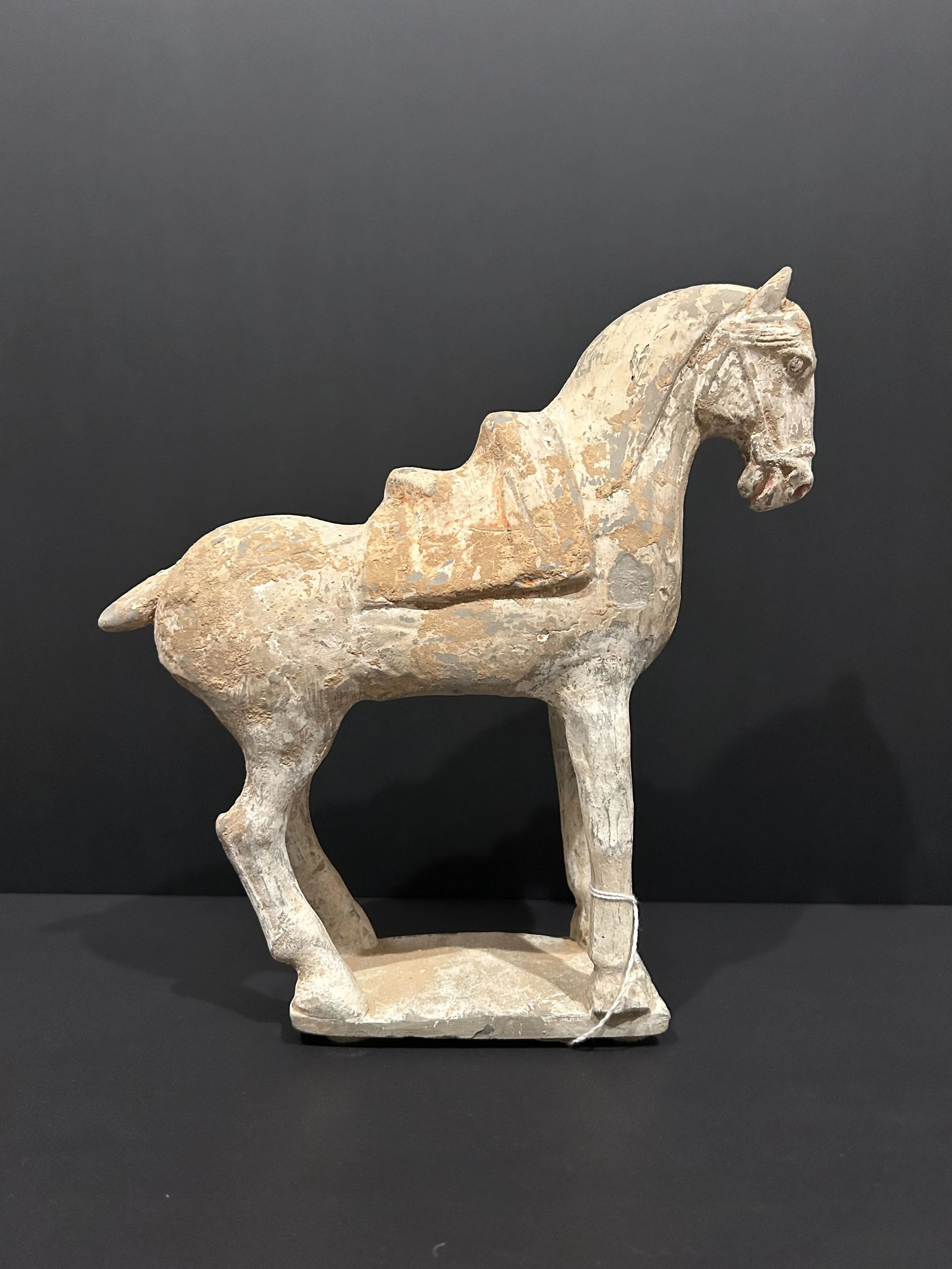 Image 2 of 5
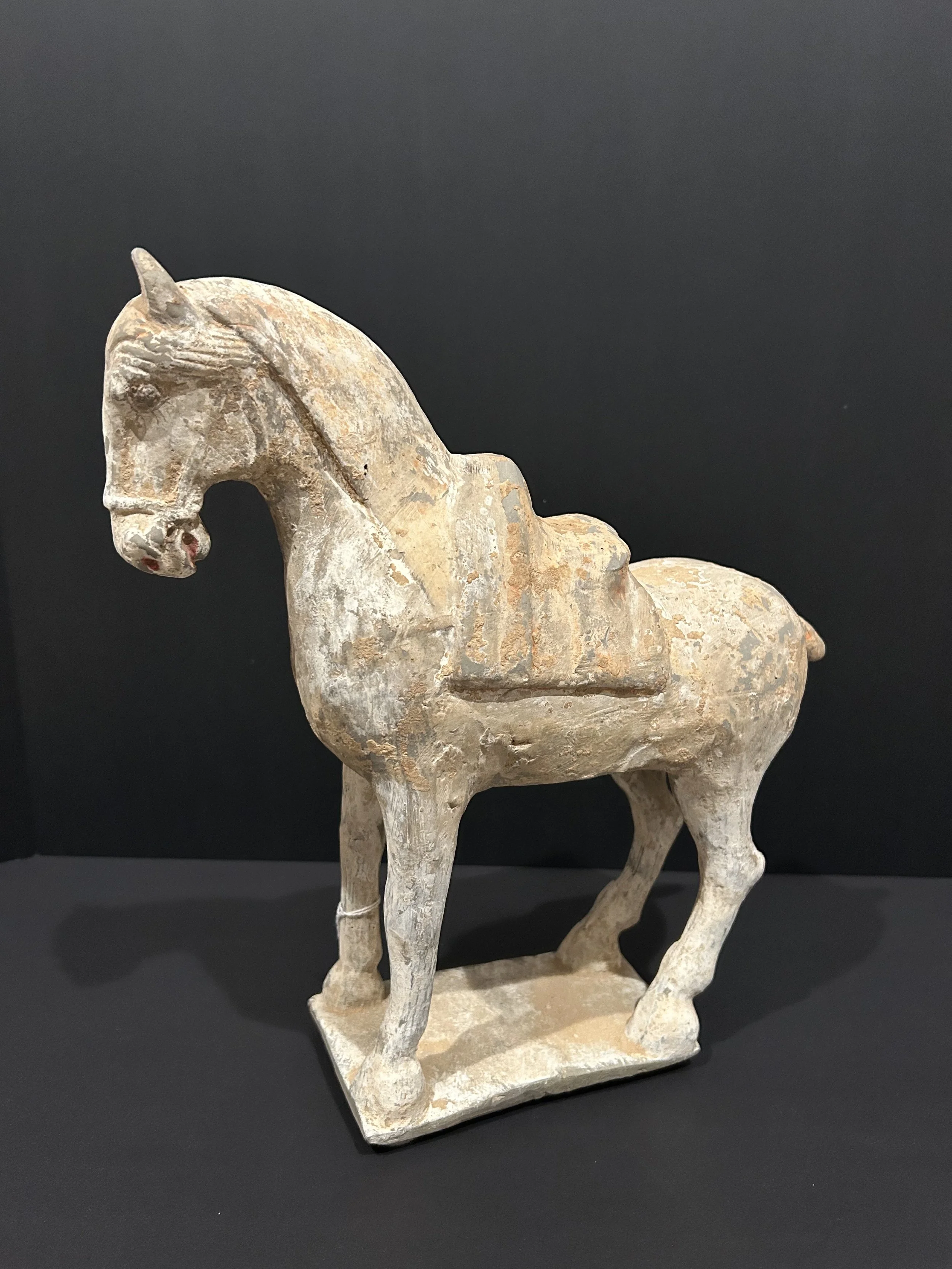 Image 3 of 5
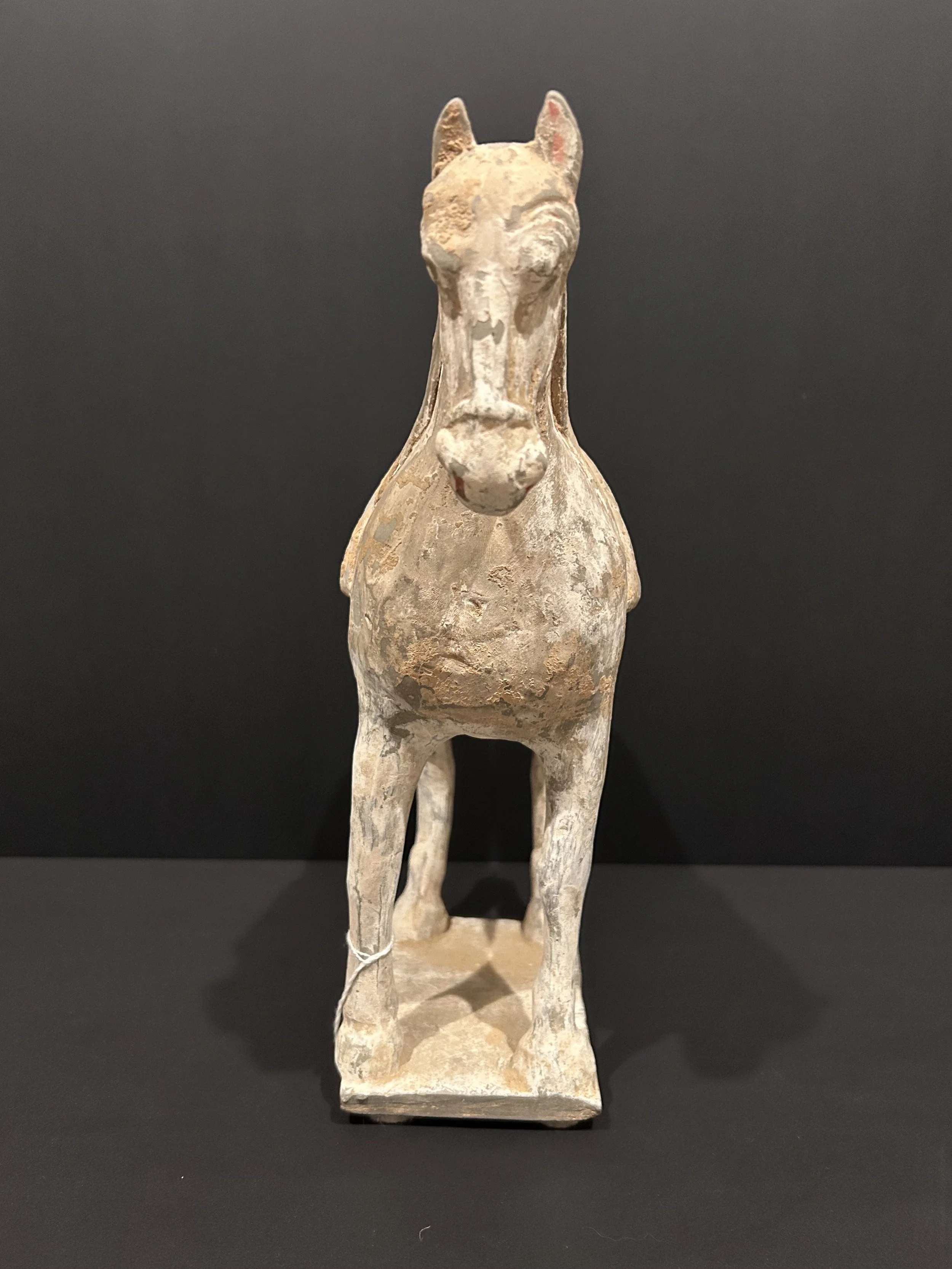 Image 4 of 5
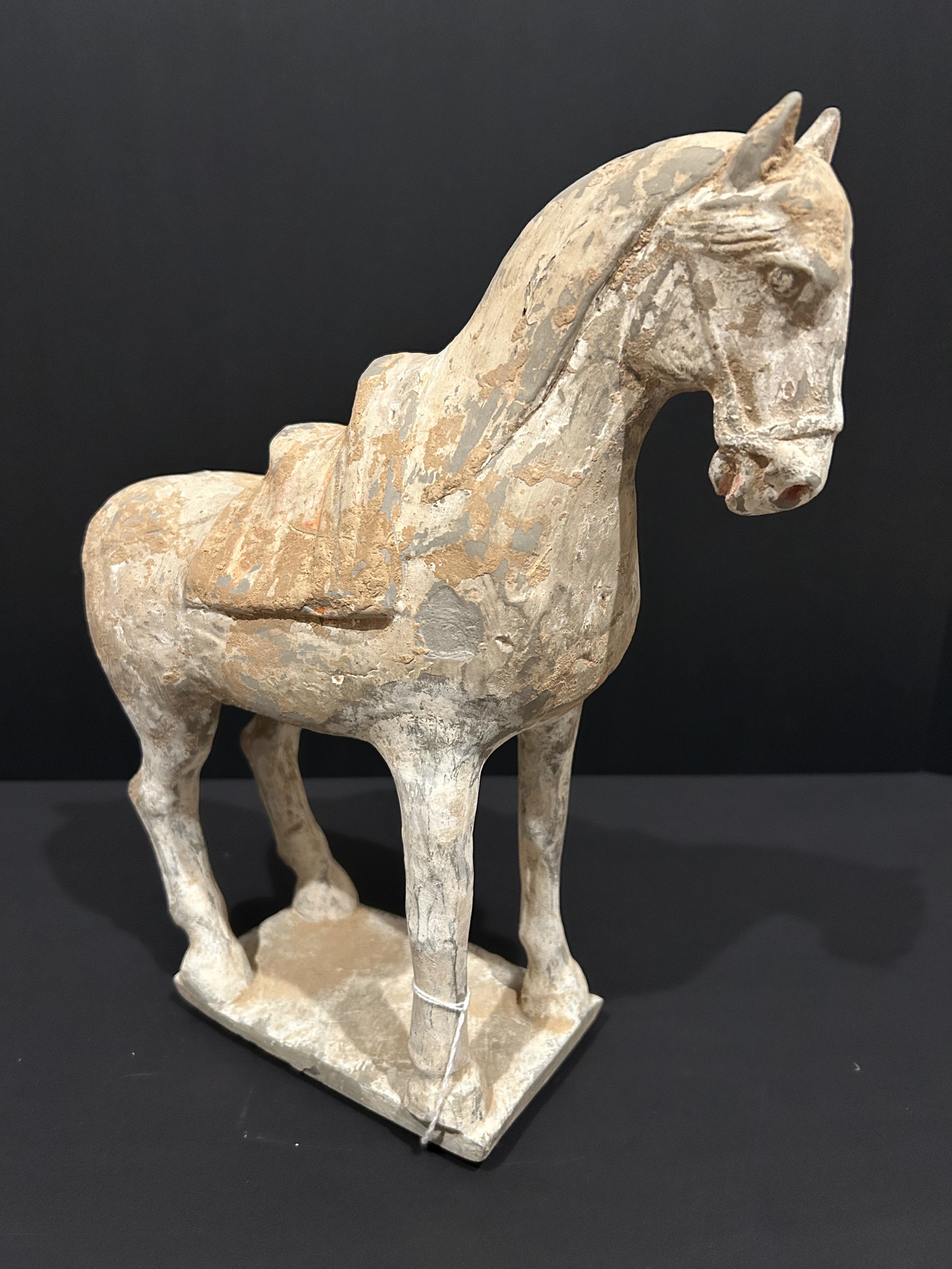 Image 5 of 5
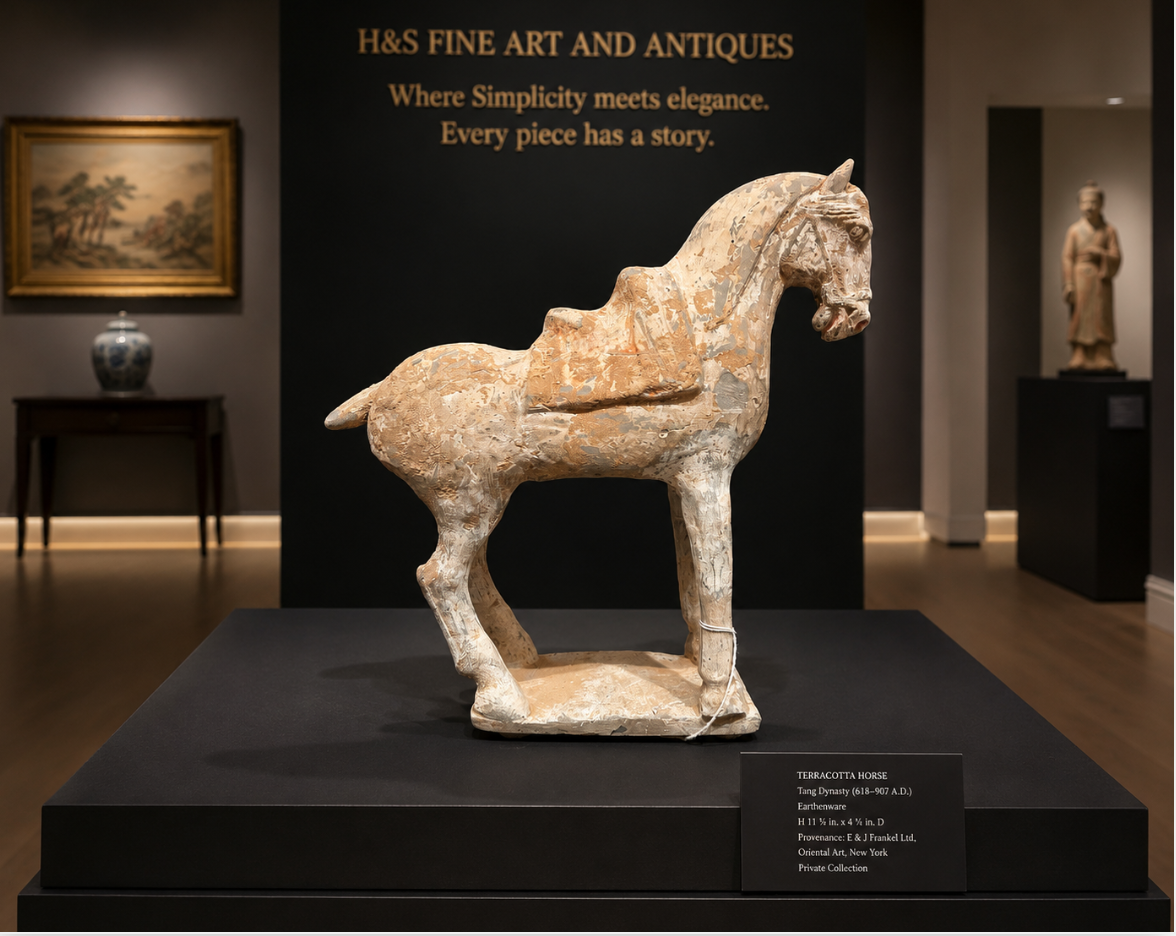
Terracotta Horse. Tang Dynasty (518-906 A.D.) Earthenware. H 11 ¾ in. x 4 ¼ in. D. TL tested.
HORSE FOR ETERNITY: POWER, PRESTIGE, AND THE AFTERLIFE IN TANG CHINA
A Painted Terracotta Horse
China, Tang Dynasty (618–907 CE), probably 7th–8th century
Painted earthenware
Height: 11¾ in. (29.8 cm); Depth: 4¼ in. (10.8 cm)
Thermoluminescence tested
Accompanied by a laboratory report issued by the Research Laboratory for Archaeology and the History of Art, Oxford University
Provenance:
E & J Frankel Ltd., Oriental Art, New York
Private Collection.
Exhibition Essay
Among the most enduring images of China's Tang dynasty is the horse: powerful, intelligent, disciplined, and magnificently present. Represented in painting, sculpture, poetry, and the decorative arts, the horse embodied the military strength, international reach, aristocratic culture, and extraordinary prosperity of one of the greatest periods in Chinese history.
The present Painted Terracotta Horse, dating to the Tang dynasty (618–907 CE), belongs to the celebrated tradition of ceramic funerary sculpture created to accompany members of Tang society into the afterlife.
Standing upon an integral rectangular base, the horse is modeled with a compact body, elongated legs, an elegantly rising neck, and an alert, expressive head. Upright ears, carefully articulated eyes, a pronounced muzzle, and the remains of painted decoration give the animal an engaging sense of individuality.
Across the surface survive traces of white, reddish-orange, and earth-colored pigments, precious remnants of what would originally have been a considerably more colorful appearance.
The prominently modeled saddle identifies the animal as a domesticated riding horse and connects the sculpture directly to the military, ceremonial, recreational, and social importance of horses in Tang China.
Although modest in scale, the sculpture embodies a much larger historical story: the transformation of the horse into a symbol of imperial authority, international exchange, social prestige, and eternal mobility.
The Tang Dynasty: An Empire at the Center of the World
The Tang dynasty, traditionally dated from 618 to 907 CE, represents one of the greatest periods of political power and cultural achievement in Chinese history.
The empire was governed from the great capitals of Chang’an, present-day Xi’an, and Luoyang.
Chang’an was among the largest and most cosmopolitan cities in the medieval world. Merchants, diplomats, monks, musicians, craftsmen, and travelers arrived from across Asia.
The commercial and diplomatic networks now collectively called the Silk Roads connected Tang China with Central Asia, Persia, India, the Korean Peninsula, Japan, and regions farther west.
Foreign merchants appeared in Chinese cities. New musical instruments, clothing styles, foods, religions, artistic traditions, and luxury materials entered the empire.
Among the most valuable commodities arriving from Central Asia were horses.
Tang China was therefore not an isolated civilization. It stood at the center of an immense network of cultural and commercial exchange.
The terracotta horse exhibited here should be understood within this cosmopolitan world.
It represents both an animal and an idea: mobility, internationalism, power, and prestige.
The Horse in Tang Society
Few animals occupied a more important position in Tang civilization than the horse.
Horses were essential to the military expansion and defense of the empire. Tang armies relied heavily upon cavalry, and the government maintained extensive systems for breeding, acquiring, and managing horses.
Superior horses were imported from Central Asia and received as diplomatic gifts and tribute.
The possession of exceptional horses became an expression of wealth and social standing.
Members of the imperial court and aristocracy rode horses during ceremonial processions, hunting expeditions, and recreational activities.
Polo became particularly fashionable among the Tang elite, and both men and women are represented riding horses in surviving paintings and ceramic sculptures.
The horse consequently became one of the great symbols of Tang culture.
Artists represented horses standing quietly, turning their heads, neighing, prancing, pawing the ground, carrying riders, and accompanying caravans.
The remarkable variety of Tang horse sculpture demonstrates the close observation of the animal by Chinese artists.
The present sculpture belongs to the more restrained tradition of Tang equine representation.
The horse does not rear dramatically or twist its body violently.
Instead, it stands with quiet dignity.
Its upright ears and carefully modeled head suggest alertness. The slightly flexed hind leg introduces subtle movement, while the elevated neck gives the animal a sense of controlled energy.
The result is an image of strength held in reserve.
An Object Made for Eternity
The present horse was almost certainly created as a funerary object.
Such objects are known in Chinese as mingqi (明器), a term commonly translated as “spirit objects,” “bright objects,” or “objects for the afterlife.”
The tradition of placing objects in Chinese tombs stretches back thousands of years.
The tomb was understood not simply as a repository for the body but as an environment prepared for the continuing existence of the deceased.
Objects representing possessions, servants, animals, buildings, food, transportation, entertainment, and social authority could therefore be placed within the burial complex.
By the Tang dynasty, this tradition had developed into one of the most sophisticated forms of funerary art in the ancient world.
Tang tombs could contain ceramic representations of court officials, soldiers, servants, court ladies, musicians, dancers, foreign merchants, camels, horses, guardian figures, and fantastic creatures.
Together these figures reconstructed the social world of the deceased.
They provided companionship, protection, transportation, entertainment, and symbolic status in the afterlife.
The horse therefore performed several functions simultaneously.
It provided symbolic transportation.
It represented the wealth and status of the deceased.
It recalled the military and administrative importance of horses within the Tang Empire.
It represented mobility between worlds.
And it formed part of the eternal household accompanying the deceased beyond death.
The presence of a saddled horse was particularly meaningful.
A saddle transformed the animal from a generic representation of nature into a horse prepared for human service.
The deceased would continue to travel, hunt, govern, inspect estates, participate in ceremonial life, or maintain the privileges of earthly existence in the world beyond.
The Sculpture
The horse stands upon an integral rectangular base that provides stability while emphasizing the verticality of the animal.
The body is compact and powerfully modeled.
Long legs raise the torso above the base, while the neck rises gracefully before turning toward the head.
One hind leg appears slightly flexed, preventing the composition from becoming completely static.
The head is among the most expressive elements of the sculpture.
The upright ears convey alertness.
The eyes are strongly defined.
The muzzle is carefully articulated.
The sculptor has succeeded in creating the impression of an individual animal without excessive anatomical detail.
A prominent saddle is positioned across the back.
The saddle provides an important visual and historical connection to Tang riding culture.
Traces of pigment survive across the body.
White, reddish-orange, and earth-colored areas suggest that the horse was originally considerably more colorful.
Time, burial conditions, handling, and cleaning have transformed the surface.
The resulting weathered appearance should not be interpreted merely as deterioration.
The surviving pigments and archaeological surface form part of the historical biography of the object.
They provide evidence of its original manufacture and subsequent passage through more than a millennium of history.
Material and Manufacture
The sculpture is made from low-fired earthenware, commonly described as terracotta.
Tang ceramic sculptures were frequently produced using molds combined with hand finishing.
Different sections of an animal could be formed separately and joined before firing.
The sculptor then refined individual details by hand.
The eyes, ears, nostrils, mouth, mane, saddle, musculature, and other features could be emphasized or altered before firing.
After drying, the sculpture was fired at relatively low temperatures.
The surface could then receive a pale slip that provided a ground for mineral pigments.
The present horse belongs to the tradition of painted Tang earthenware, rather than the better-known category of Tang sancai, or “three-color,” glazed ceramics.
The distinction is important.
Sancai figures received lead-based glazes that fused to the ceramic body during firing.
Painted pottery figures received pigments that were generally applied after firing.
These pigments were considerably more fragile.
As a result, many painted Tang sculptures have lost much of their original decoration.
The surviving traces of pigment on the present horse are therefore an important aspect of the sculpture.
Tang Horses and the Silk Roads
The horse was inseparable from the international character of the Tang Empire.
Central Asian horses were particularly admired for their size, strength, endurance, and beauty.
The importation and exchange of horses connected China with the great cultures and trading centers of Central Asia.
Caravans traveled across enormous distances.
Camels carried textiles, precious metals, glass, spices, and luxury goods.
Horses transported soldiers, officials, messengers, merchants, and members of the aristocracy.
The horse therefore became a visual symbol of the cosmopolitan character of Tang civilization.
Representations of horses and camels in Tang tombs preserved the memory of these international networks.
They transformed global commerce, diplomacy, and military power into objects intended for eternity.
Archaeology and Tang Funerary Culture
Some of the most important evidence for understanding Tang pottery horses comes from scientifically excavated tombs in the regions surrounding Xi’an and Luoyang.
The tombs of members of the imperial family and aristocracy have produced extensive assemblages of ceramic funerary figures.
Among the most celebrated are the tombs of Princess Yongtai, who died in 701; Prince Yide, who died in 701; and Prince Zhanghuai, who died in 684.
Excavated tomb assemblages demonstrate that ceramic horses did not exist as isolated decorative objects.
They belonged to carefully organized funerary environments.
Figures could be positioned along passageways, within niches, and near burial chambers.
Horses appeared alongside grooms, camels, officials, soldiers, attendants, guardians, and entertainers.
Together they created a symbolic procession leading toward the eternal residence of the deceased.
The present horse should therefore be imagined not as a solitary sculpture, but as one surviving element from the larger ceremonial and spiritual world of Tang burial culture.
Thermoluminescence Analysis and Scientific Study
The sculpture is accompanied by a thermoluminescence analysis report issued by the Research Laboratory for Archaeology and the History of Art at Oxford University.
Thermoluminescence testing, commonly abbreviated as TL testing, is an important scientific method used in the study of ancient ceramics.
When ceramic material is fired, previously accumulated thermoluminescence energy is released.
Following burial, natural radiation begins accumulating again within the ceramic material.
A laboratory can remove small samples from the object and measure the stored energy released when the sample is reheated.
The resulting analysis can determine whether the last firing of the sampled material is broadly consistent with the proposed archaeological period.
TL analysis should be understood as one element of a larger authentication process.
It can provide scientific evidence concerning the antiquity of the sampled ceramic material.
It does not independently establish the precise identity of the workshop, archaeological findspot, stylistic attribution, restoration history, or provenance of the sculpture.
For these reasons, scientific testing is most valuable when considered together with stylistic analysis, technical examination, provenance research, and comparison with excavated material.
Provenance: E & J Frankel Ltd., New York
The documented provenance of the sculpture begins with E & J Frankel Ltd., Oriental Art, New York.
E & J Frankel was a respected New York dealership specializing in Chinese and other Asian works of art and played a role in the formation of American collections during the second half of the twentieth century.
The horse subsequently entered a private collection.
Museum Comparisons and Collections
Tang pottery horses and related funerary sculptures are preserved in many of the world's major collections of Chinese art.
The British Museum preserves the celebrated group of Tang funerary figures associated with the tomb of the Tang general Liu Tingxun, who died in 728. The assemblage is particularly important because horses, camels, officials, grooms, and guardian figures can be understood as elements of a coordinated funerary program.
The Metropolitan Museum of Art holds important examples of Tang pottery horses, mounted riders, camels, and other funerary sculptures that provide comparative material for the study of modeling, saddlery, ceramic technology, pigments, and tomb culture.
The Nelson-Atkins Museum of Art preserves important Chinese ceramics and early Chinese funerary sculpture.
The Royal Ontario Museum maintains significant collections of Chinese art, including early ceramics and tomb sculpture.
Museum collections and archaeological institutes in Xi’an, Luoyang, Shaanxi, and Henan remain especially important for scholarly research because they preserve material from scientifically excavated tomb contexts.
Selected Literature and References
For comparative study and future cataloguing, the following publications are particularly relevant:
William Watson, The Arts of China to AD 900.
William Watson, Tang and Liao Ceramics.
Michael Sullivan, The Arts of China.
Mary Tregear, Chinese Art.
Jessica Rawson, The British Museum Book of Chinese Art.
Carol Michaelson, Gilded Dragons: Buried Treasures from China’s Golden Ages.
Rose Kerr and Nigel Wood, Science and Civilisation in China, Volume 5, Part XII: Ceramic Technology.
Sato Masahiko, Chinese Clay Figures, Toji Taikei, vol. 34, Tokyo, 1972.
As If Alive: Sui and Tang Dynasty Tomb Figurines in the Collection of the Gugong Museum, Beijing, 2006.
Archaeological publications concerning the Tang tombs of Princess Yongtai, Prince Yide, Prince Zhanghuai, and other imperial and aristocratic burials provide essential comparative material for the study of Tang funerary horses.
Conclusion: A Horse for the Eternal Journey
More than a thousand years after its creation, this painted terracotta horse remains a powerful witness to the artistic achievement and cultural sophistication of Tang China.
It was never intended simply as a decorative sculpture.
It was created for eternity.
The horse represented transportation and military strength, aristocratic privilege and international exchange, earthly prosperity and continuing existence beyond death.
Its elegant silhouette, expressive head, prominent saddle, surviving traces of painted decoration, scientific testing, and provenance through E & J Frankel Ltd. contribute to its historical and aesthetic significance.
Seen today in a gallery setting, the horse stands at the intersection of art, archaeology, technology, and belief.
It preserves the memory of the great Tang capitals, the caravans of the Silk Roads, the cavalry that defended and expanded the empire, the aristocratic culture of riding and polo, and the elaborate tombs created to preserve status and identity for eternity.
The horse was created to carry its owner beyond the limits of earthly life. Today, it carries forward the story of Tang China itself.
HORSE FOR ETERNITY: POWER, PRESTIGE, AND THE AFTERLIFE IN TANG CHINA
A Painted Terracotta Horse
China, Tang Dynasty (618–907 CE), probably 7th–8th century
Painted earthenware
Height: 11¾ in. (29.8 cm); Depth: 4¼ in. (10.8 cm)
Thermoluminescence tested
Accompanied by a laboratory report issued by the Research Laboratory for Archaeology and the History of Art, Oxford University
Provenance:
E & J Frankel Ltd., Oriental Art, New York
Private Collection.
Exhibition Essay
Among the most enduring images of China's Tang dynasty is the horse: powerful, intelligent, disciplined, and magnificently present. Represented in painting, sculpture, poetry, and the decorative arts, the horse embodied the military strength, international reach, aristocratic culture, and extraordinary prosperity of one of the greatest periods in Chinese history.
The present Painted Terracotta Horse, dating to the Tang dynasty (618–907 CE), belongs to the celebrated tradition of ceramic funerary sculpture created to accompany members of Tang society into the afterlife.
Standing upon an integral rectangular base, the horse is modeled with a compact body, elongated legs, an elegantly rising neck, and an alert, expressive head. Upright ears, carefully articulated eyes, a pronounced muzzle, and the remains of painted decoration give the animal an engaging sense of individuality.
Across the surface survive traces of white, reddish-orange, and earth-colored pigments, precious remnants of what would originally have been a considerably more colorful appearance.
The prominently modeled saddle identifies the animal as a domesticated riding horse and connects the sculpture directly to the military, ceremonial, recreational, and social importance of horses in Tang China.
Although modest in scale, the sculpture embodies a much larger historical story: the transformation of the horse into a symbol of imperial authority, international exchange, social prestige, and eternal mobility.
The Tang Dynasty: An Empire at the Center of the World
The Tang dynasty, traditionally dated from 618 to 907 CE, represents one of the greatest periods of political power and cultural achievement in Chinese history.
The empire was governed from the great capitals of Chang’an, present-day Xi’an, and Luoyang.
Chang’an was among the largest and most cosmopolitan cities in the medieval world. Merchants, diplomats, monks, musicians, craftsmen, and travelers arrived from across Asia.
The commercial and diplomatic networks now collectively called the Silk Roads connected Tang China with Central Asia, Persia, India, the Korean Peninsula, Japan, and regions farther west.
Foreign merchants appeared in Chinese cities. New musical instruments, clothing styles, foods, religions, artistic traditions, and luxury materials entered the empire.
Among the most valuable commodities arriving from Central Asia were horses.
Tang China was therefore not an isolated civilization. It stood at the center of an immense network of cultural and commercial exchange.
The terracotta horse exhibited here should be understood within this cosmopolitan world.
It represents both an animal and an idea: mobility, internationalism, power, and prestige.
The Horse in Tang Society
Few animals occupied a more important position in Tang civilization than the horse.
Horses were essential to the military expansion and defense of the empire. Tang armies relied heavily upon cavalry, and the government maintained extensive systems for breeding, acquiring, and managing horses.
Superior horses were imported from Central Asia and received as diplomatic gifts and tribute.
The possession of exceptional horses became an expression of wealth and social standing.
Members of the imperial court and aristocracy rode horses during ceremonial processions, hunting expeditions, and recreational activities.
Polo became particularly fashionable among the Tang elite, and both men and women are represented riding horses in surviving paintings and ceramic sculptures.
The horse consequently became one of the great symbols of Tang culture.
Artists represented horses standing quietly, turning their heads, neighing, prancing, pawing the ground, carrying riders, and accompanying caravans.
The remarkable variety of Tang horse sculpture demonstrates the close observation of the animal by Chinese artists.
The present sculpture belongs to the more restrained tradition of Tang equine representation.
The horse does not rear dramatically or twist its body violently.
Instead, it stands with quiet dignity.
Its upright ears and carefully modeled head suggest alertness. The slightly flexed hind leg introduces subtle movement, while the elevated neck gives the animal a sense of controlled energy.
The result is an image of strength held in reserve.
An Object Made for Eternity
The present horse was almost certainly created as a funerary object.
Such objects are known in Chinese as mingqi (明器), a term commonly translated as “spirit objects,” “bright objects,” or “objects for the afterlife.”
The tradition of placing objects in Chinese tombs stretches back thousands of years.
The tomb was understood not simply as a repository for the body but as an environment prepared for the continuing existence of the deceased.
Objects representing possessions, servants, animals, buildings, food, transportation, entertainment, and social authority could therefore be placed within the burial complex.
By the Tang dynasty, this tradition had developed into one of the most sophisticated forms of funerary art in the ancient world.
Tang tombs could contain ceramic representations of court officials, soldiers, servants, court ladies, musicians, dancers, foreign merchants, camels, horses, guardian figures, and fantastic creatures.
Together these figures reconstructed the social world of the deceased.
They provided companionship, protection, transportation, entertainment, and symbolic status in the afterlife.
The horse therefore performed several functions simultaneously.
It provided symbolic transportation.
It represented the wealth and status of the deceased.
It recalled the military and administrative importance of horses within the Tang Empire.
It represented mobility between worlds.
And it formed part of the eternal household accompanying the deceased beyond death.
The presence of a saddled horse was particularly meaningful.
A saddle transformed the animal from a generic representation of nature into a horse prepared for human service.
The deceased would continue to travel, hunt, govern, inspect estates, participate in ceremonial life, or maintain the privileges of earthly existence in the world beyond.
The Sculpture
The horse stands upon an integral rectangular base that provides stability while emphasizing the verticality of the animal.
The body is compact and powerfully modeled.
Long legs raise the torso above the base, while the neck rises gracefully before turning toward the head.
One hind leg appears slightly flexed, preventing the composition from becoming completely static.
The head is among the most expressive elements of the sculpture.
The upright ears convey alertness.
The eyes are strongly defined.
The muzzle is carefully articulated.
The sculptor has succeeded in creating the impression of an individual animal without excessive anatomical detail.
A prominent saddle is positioned across the back.
The saddle provides an important visual and historical connection to Tang riding culture.
Traces of pigment survive across the body.
White, reddish-orange, and earth-colored areas suggest that the horse was originally considerably more colorful.
Time, burial conditions, handling, and cleaning have transformed the surface.
The resulting weathered appearance should not be interpreted merely as deterioration.
The surviving pigments and archaeological surface form part of the historical biography of the object.
They provide evidence of its original manufacture and subsequent passage through more than a millennium of history.
Material and Manufacture
The sculpture is made from low-fired earthenware, commonly described as terracotta.
Tang ceramic sculptures were frequently produced using molds combined with hand finishing.
Different sections of an animal could be formed separately and joined before firing.
The sculptor then refined individual details by hand.
The eyes, ears, nostrils, mouth, mane, saddle, musculature, and other features could be emphasized or altered before firing.
After drying, the sculpture was fired at relatively low temperatures.
The surface could then receive a pale slip that provided a ground for mineral pigments.
The present horse belongs to the tradition of painted Tang earthenware, rather than the better-known category of Tang sancai, or “three-color,” glazed ceramics.
The distinction is important.
Sancai figures received lead-based glazes that fused to the ceramic body during firing.
Painted pottery figures received pigments that were generally applied after firing.
These pigments were considerably more fragile.
As a result, many painted Tang sculptures have lost much of their original decoration.
The surviving traces of pigment on the present horse are therefore an important aspect of the sculpture.
Tang Horses and the Silk Roads
The horse was inseparable from the international character of the Tang Empire.
Central Asian horses were particularly admired for their size, strength, endurance, and beauty.
The importation and exchange of horses connected China with the great cultures and trading centers of Central Asia.
Caravans traveled across enormous distances.
Camels carried textiles, precious metals, glass, spices, and luxury goods.
Horses transported soldiers, officials, messengers, merchants, and members of the aristocracy.
The horse therefore became a visual symbol of the cosmopolitan character of Tang civilization.
Representations of horses and camels in Tang tombs preserved the memory of these international networks.
They transformed global commerce, diplomacy, and military power into objects intended for eternity.
Archaeology and Tang Funerary Culture
Some of the most important evidence for understanding Tang pottery horses comes from scientifically excavated tombs in the regions surrounding Xi’an and Luoyang.
The tombs of members of the imperial family and aristocracy have produced extensive assemblages of ceramic funerary figures.
Among the most celebrated are the tombs of Princess Yongtai, who died in 701; Prince Yide, who died in 701; and Prince Zhanghuai, who died in 684.
Excavated tomb assemblages demonstrate that ceramic horses did not exist as isolated decorative objects.
They belonged to carefully organized funerary environments.
Figures could be positioned along passageways, within niches, and near burial chambers.
Horses appeared alongside grooms, camels, officials, soldiers, attendants, guardians, and entertainers.
Together they created a symbolic procession leading toward the eternal residence of the deceased.
The present horse should therefore be imagined not as a solitary sculpture, but as one surviving element from the larger ceremonial and spiritual world of Tang burial culture.
Thermoluminescence Analysis and Scientific Study
The sculpture is accompanied by a thermoluminescence analysis report issued by the Research Laboratory for Archaeology and the History of Art at Oxford University.
Thermoluminescence testing, commonly abbreviated as TL testing, is an important scientific method used in the study of ancient ceramics.
When ceramic material is fired, previously accumulated thermoluminescence energy is released.
Following burial, natural radiation begins accumulating again within the ceramic material.
A laboratory can remove small samples from the object and measure the stored energy released when the sample is reheated.
The resulting analysis can determine whether the last firing of the sampled material is broadly consistent with the proposed archaeological period.
TL analysis should be understood as one element of a larger authentication process.
It can provide scientific evidence concerning the antiquity of the sampled ceramic material.
It does not independently establish the precise identity of the workshop, archaeological findspot, stylistic attribution, restoration history, or provenance of the sculpture.
For these reasons, scientific testing is most valuable when considered together with stylistic analysis, technical examination, provenance research, and comparison with excavated material.
Provenance: E & J Frankel Ltd., New York
The documented provenance of the sculpture begins with E & J Frankel Ltd., Oriental Art, New York.
E & J Frankel was a respected New York dealership specializing in Chinese and other Asian works of art and played a role in the formation of American collections during the second half of the twentieth century.
The horse subsequently entered a private collection.
Museum Comparisons and Collections
Tang pottery horses and related funerary sculptures are preserved in many of the world's major collections of Chinese art.
The British Museum preserves the celebrated group of Tang funerary figures associated with the tomb of the Tang general Liu Tingxun, who died in 728. The assemblage is particularly important because horses, camels, officials, grooms, and guardian figures can be understood as elements of a coordinated funerary program.
The Metropolitan Museum of Art holds important examples of Tang pottery horses, mounted riders, camels, and other funerary sculptures that provide comparative material for the study of modeling, saddlery, ceramic technology, pigments, and tomb culture.
The Nelson-Atkins Museum of Art preserves important Chinese ceramics and early Chinese funerary sculpture.
The Royal Ontario Museum maintains significant collections of Chinese art, including early ceramics and tomb sculpture.
Museum collections and archaeological institutes in Xi’an, Luoyang, Shaanxi, and Henan remain especially important for scholarly research because they preserve material from scientifically excavated tomb contexts.
Selected Literature and References
For comparative study and future cataloguing, the following publications are particularly relevant:
William Watson, The Arts of China to AD 900.
William Watson, Tang and Liao Ceramics.
Michael Sullivan, The Arts of China.
Mary Tregear, Chinese Art.
Jessica Rawson, The British Museum Book of Chinese Art.
Carol Michaelson, Gilded Dragons: Buried Treasures from China’s Golden Ages.
Rose Kerr and Nigel Wood, Science and Civilisation in China, Volume 5, Part XII: Ceramic Technology.
Sato Masahiko, Chinese Clay Figures, Toji Taikei, vol. 34, Tokyo, 1972.
As If Alive: Sui and Tang Dynasty Tomb Figurines in the Collection of the Gugong Museum, Beijing, 2006.
Archaeological publications concerning the Tang tombs of Princess Yongtai, Prince Yide, Prince Zhanghuai, and other imperial and aristocratic burials provide essential comparative material for the study of Tang funerary horses.
Conclusion: A Horse for the Eternal Journey
More than a thousand years after its creation, this painted terracotta horse remains a powerful witness to the artistic achievement and cultural sophistication of Tang China.
It was never intended simply as a decorative sculpture.
It was created for eternity.
The horse represented transportation and military strength, aristocratic privilege and international exchange, earthly prosperity and continuing existence beyond death.
Its elegant silhouette, expressive head, prominent saddle, surviving traces of painted decoration, scientific testing, and provenance through E & J Frankel Ltd. contribute to its historical and aesthetic significance.
Seen today in a gallery setting, the horse stands at the intersection of art, archaeology, technology, and belief.
It preserves the memory of the great Tang capitals, the caravans of the Silk Roads, the cavalry that defended and expanded the empire, the aristocratic culture of riding and polo, and the elaborate tombs created to preserve status and identity for eternity.
The horse was created to carry its owner beyond the limits of earthly life. Today, it carries forward the story of Tang China itself.