Chinese Kneeling Camel
Tang Dynasty (618–907 AD), or possibly earlier
Painted Terracotta
Height: 11½ in. (29.2 cm)
Provenance: Throckmorton Fine Art, New York; acquired from the gallery in 2006. Accompanied by an Oxford Authentication Ltd. Thermoluminescence (TL) report issued in 2004, indicating a firing date approximately 1,100–1,700 years ago, consistent with the late Han through Tang periods.
Historical Background
This impressive kneeling camel is one of the most recognizable symbols of China's Tang Dynasty (618–907 AD), one of the greatest periods of artistic achievement and international commerce in Chinese history. During the Tang era, the imperial capital of Chang'an (modern Xi'an, Shaanxi Province) became the eastern terminus of the Silk Road, connecting China with Central Asia, Persia, India, and the Mediterranean world. Merchants, diplomats, monks, and travelers all passed through this cosmopolitan city, bringing luxury goods, religions, music, and artistic traditions.
Camels became powerful symbols of this international exchange. They were the indispensable beasts of burden that carried silk, jade, tea, spices, incense, glass, silver, precious stones, and exotic animals across the deserts of Central Asia.
The Camel
This sculpture represents a Bactrian camel, distinguished by its two humps. Unlike the one-humped dromedary of Arabia, the Bactrian camel was native to Mongolia and Central Asia and was ideally suited to the harsh climate of the Gobi Desert and Silk Road caravan routes.
Characteristics include:
broad padded feet for desert travel
thick winter coat
enormous endurance
ability to carry loads exceeding 400 pounds
capacity to travel long distances with minimal water
These qualities made the Bactrian camel indispensable to Tang commerce.
Why is the Camel Kneeling?
The kneeling posture is highly significant.
Rather than depicting movement, the sculptor captured the moment when the animal has stopped for loading or unloading merchandise. The large saddle pack visible over the humps suggests the camel has reached a caravan station or destination.
Such representations symbolize:
safe arrival after a long journey
commercial prosperity
wealth accumulated through trade
successful passage between worlds
Because of these meanings, kneeling camels became especially popular as funerary sculptures.
Comparable examples are known from excavated Tang tombs and museum collections.
Material and Technique
The camel is made of:
hand-modeled terracotta (earthenware clay)
assembled from separately formed sections
fired in a kiln
covered with mineral pigments after firing
Unlike the more famous sancai ("three-color") glazed camels, this example preserves traces of painted decoration rather than lead glazes.
Originally it likely displayed vivid pigments including:
red ochre
white
black
yellow
possibly green accents
Most painted Tang tomb figures have lost much of their original surface over more than a thousand years of burial.
Function
This sculpture was almost certainly created as a mingqi ("spirit object"), intended to accompany an elite individual into the afterlife.
Chinese belief held that objects buried with the deceased continued serving them after death.
A wealthy tomb might include:
horses
camels
servants
musicians
dancers
foreign merchants
guardians
officials
Together they recreated the owner's worldly status in eternity
Silk Road Symbolism
No animal better represents the Silk Road than the camel.
Tang artists frequently depicted camels loaded with:
bolts of silk
rolled carpets
musical instruments
wine jars
Buddhist scriptures
precious woods
perfumes
jade
The heavy saddle bundle on the camel is sculpted with remarkable realism, emphasizing its practical role as a caravan animal.
Artistic Qualities
This camel demonstrates many hallmarks of high-quality Tang modeling:
natural anatomical proportions
expressive head with open mouth
carefully modeled saddle and cargo
convincing kneeling posture
lively sense of weight and movement
Although modest in scale, the sculpture possesses the monumentality associated with Tang funerary art.
Provenance
The documented ownership significantly strengthens the object's collecting history.
Throckmorton Fine Art, Inc., New York
For decades Throckmorton Fine Art was among America's leading specialists in Chinese antiquities, particularly Buddhist sculpture and early Chinese ceramics. The gallery handled museum-quality works and published scholarly exhibition catalogues devoted to ancient Chinese art.
Acquired 2006
Purchase from an established New York specialist provides an important modern provenance.
Oxford Authentication Ltd.
The accompanying Thermoluminescence Analysis Report (2004) concluded that the clay was last fired approximately 1,100–1,700 years ago, consistent with manufacture between roughly the late Han, Six Dynasties, Sui, and Tang periods. While TL testing authenticates the ancient firing of the ceramic, stylistic analysis supports a Tang attribution.
Could it be Earlier than the Tang?
The laboratory date allows an earlier manufacture than the Tang.
However, stylistically this sculpture is far more characteristic of the Tang period because of:
Earlier Han camels tend to be simpler and less animated. Without archaeological excavation evidence, specialists generally attribute comparable examples to the Tang Dynasty while acknowledging that scientific testing alone cannot distinguish between the late Sui and early Tang. The "Tang Dynasty or earlier" description is therefore appropriately cautious.
Comparable Museum Examples
Closely related camel figures are found in major museum collections, including:
The Metropolitan Museum of Art – Tang earthenware camel.
Los Angeles County Museum of Art – monumental Tang funerary Bactrian camel.
British Museum – Tang dynasty tomb figures, including camels from the tomb of Liu Tingxun.
Saint Louis Art Museum – Tang camel emphasizing Silk Road trade symbolism
Exhibition History
While no public museum exhibition is recorded specifically for this camel, its provenance connects it with one of New York's foremost dealers in early Chinese art.
Throckmorton Fine Art organized important exhibitions devoted to Tang Dynasty sculpture, Buddhist figures, and early Chinese ceramics, helping introduce museum-quality Chinese antiquities to American collectors.
Selected Literature
For further study, the following works are standard references:
George Kuwayama, Funerary Art of China: Han Through T'ang Dynasties, Los Angeles County Museum of Art, 1973.
Jessica Rawson, Chinese Jade from the Neolithic to the Qing (for Tang funerary context).
Margaret Medley, The Chinese Potter: A Practical History of Chinese Ceramics.
S. J. Vainker, Chinese Pottery and Porcelain, British Museum Press.
James C. Y. Watt et al., China: Dawn of a Golden Age, 200–750 AD, The Metropolitan Museum of Art.
Tang Dynasty Tomb Figures, British Museum research publications.
Curatorial Assessment
Your kneeling camel is a particularly appealing example of Tang funerary sculpture because it combines several desirable qualities: a dynamic kneeling pose, well-preserved saddle cargo, traces of original painted decoration, documented provenance through Throckmorton Fine Art, and an Oxford TL authentication report. These features place it within the tradition of Silk Road caravan imagery that epitomizes the Tang Dynasty's prosperity and cosmopolitan culture. It is the type of object that effectively illustrates the artistic sophistication and global connections of medieval China, making it well suited for museum-style exhibition or an advanced private collection of early Chinese art .
Chinese Kneeling Camel
Tang Dynasty (618–907 AD), or possibly earlier
Painted Terracotta
Height: 11½ in. (29.2 cm)
Provenance: Throckmorton Fine Art, New York; acquired from the gallery in 2006. Accompanied by an Oxford Authentication Ltd. Thermoluminescence (TL) report issued in 2004, indicating a firing date approximately 1,100–1,700 years ago, consistent with the late Han through Tang periods.
Historical Background
This impressive kneeling camel is one of the most recognizable symbols of China's Tang Dynasty (618–907 AD), one of the greatest periods of artistic achievement and international commerce in Chinese history. During the Tang era, the imperial capital of Chang'an (modern Xi'an, Shaanxi Province) became the eastern terminus of the Silk Road, connecting China with Central Asia, Persia, India, and the Mediterranean world. Merchants, diplomats, monks, and travelers all passed through this cosmopolitan city, bringing luxury goods, religions, music, and artistic traditions.
Camels became powerful symbols of this international exchange. They were the indispensable beasts of burden that carried silk, jade, tea, spices, incense, glass, silver, precious stones, and exotic animals across the deserts of Central Asia.
The Camel
This sculpture represents a Bactrian camel, distinguished by its two humps. Unlike the one-humped dromedary of Arabia, the Bactrian camel was native to Mongolia and Central Asia and was ideally suited to the harsh climate of the Gobi Desert and Silk Road caravan routes.
Characteristics include:
broad padded feet for desert travel
thick winter coat
enormous endurance
ability to carry loads exceeding 400 pounds
capacity to travel long distances with minimal water
These qualities made the Bactrian camel indispensable to Tang commerce.
Why is the Camel Kneeling?
The kneeling posture is highly significant.
Rather than depicting movement, the sculptor captured the moment when the animal has stopped for loading or unloading merchandise. The large saddle pack visible over the humps suggests the camel has reached a caravan station or destination.
Such representations symbolize:
safe arrival after a long journey
commercial prosperity
wealth accumulated through trade
successful passage between worlds
Because of these meanings, kneeling camels became especially popular as funerary sculptures.
Comparable examples are known from excavated Tang tombs and museum collections.
Material and Technique
The camel is made of:
hand-modeled terracotta (earthenware clay)
assembled from separately formed sections
fired in a kiln
covered with mineral pigments after firing
Unlike the more famous sancai ("three-color") glazed camels, this example preserves traces of painted decoration rather than lead glazes.
Originally it likely displayed vivid pigments including:
red ochre
white
black
yellow
possibly green accents
Most painted Tang tomb figures have lost much of their original surface over more than a thousand years of burial.
Function
This sculpture was almost certainly created as a mingqi ("spirit object"), intended to accompany an elite individual into the afterlife.
Chinese belief held that objects buried with the deceased continued serving them after death.
A wealthy tomb might include:
horses
camels
servants
musicians
dancers
foreign merchants
guardians
officials
Together they recreated the owner's worldly status in eternity
Silk Road Symbolism
No animal better represents the Silk Road than the camel.
Tang artists frequently depicted camels loaded with:
bolts of silk
rolled carpets
musical instruments
wine jars
Buddhist scriptures
precious woods
perfumes
jade
The heavy saddle bundle on the camel is sculpted with remarkable realism, emphasizing its practical role as a caravan animal.
Artistic Qualities
This camel demonstrates many hallmarks of high-quality Tang modeling:
natural anatomical proportions
expressive head with open mouth
carefully modeled saddle and cargo
convincing kneeling posture
lively sense of weight and movement
Although modest in scale, the sculpture possesses the monumentality associated with Tang funerary art.
Provenance
The documented ownership significantly strengthens the object's collecting history.
Throckmorton Fine Art, Inc., New York
For decades Throckmorton Fine Art was among America's leading specialists in Chinese antiquities, particularly Buddhist sculpture and early Chinese ceramics. The gallery handled museum-quality works and published scholarly exhibition catalogues devoted to ancient Chinese art.
Acquired 2006
Purchase from an established New York specialist provides an important modern provenance.
Oxford Authentication Ltd.
The accompanying Thermoluminescence Analysis Report (2004) concluded that the clay was last fired approximately 1,100–1,700 years ago, consistent with manufacture between roughly the late Han, Six Dynasties, Sui, and Tang periods. While TL testing authenticates the ancient firing of the ceramic, stylistic analysis supports a Tang attribution.
Could it be Earlier than the Tang?
The laboratory date allows an earlier manufacture than the Tang.
However, stylistically this sculpture is far more characteristic of the Tang period because of:
Earlier Han camels tend to be simpler and less animated. Without archaeological excavation evidence, specialists generally attribute comparable examples to the Tang Dynasty while acknowledging that scientific testing alone cannot distinguish between the late Sui and early Tang. The "Tang Dynasty or earlier" description is therefore appropriately cautious.
Comparable Museum Examples
Closely related camel figures are found in major museum collections, including:
The Metropolitan Museum of Art – Tang earthenware camel.
Los Angeles County Museum of Art – monumental Tang funerary Bactrian camel.
British Museum – Tang dynasty tomb figures, including camels from the tomb of Liu Tingxun.
Saint Louis Art Museum – Tang camel emphasizing Silk Road trade symbolism
Exhibition History
While no public museum exhibition is recorded specifically for this camel, its provenance connects it with one of New York's foremost dealers in early Chinese art.
Throckmorton Fine Art organized important exhibitions devoted to Tang Dynasty sculpture, Buddhist figures, and early Chinese ceramics, helping introduce museum-quality Chinese antiquities to American collectors.
Selected Literature
For further study, the following works are standard references:
George Kuwayama, Funerary Art of China: Han Through T'ang Dynasties, Los Angeles County Museum of Art, 1973.
Jessica Rawson, Chinese Jade from the Neolithic to the Qing (for Tang funerary context).
Margaret Medley, The Chinese Potter: A Practical History of Chinese Ceramics.
S. J. Vainker, Chinese Pottery and Porcelain, British Museum Press.
James C. Y. Watt et al., China: Dawn of a Golden Age, 200–750 AD, The Metropolitan Museum of Art.
Tang Dynasty Tomb Figures, British Museum research publications.
Curatorial Assessment
Your kneeling camel is a particularly appealing example of Tang funerary sculpture because it combines several desirable qualities: a dynamic kneeling pose, well-preserved saddle cargo, traces of original painted decoration, documented provenance through Throckmorton Fine Art, and an Oxford TL authentication report. These features place it within the tradition of Silk Road caravan imagery that epitomizes the Tang Dynasty's prosperity and cosmopolitan culture. It is the type of object that effectively illustrates the artistic sophistication and global connections of medieval China, making it well suited for museum-style exhibition or an advanced private collection of early Chinese art .
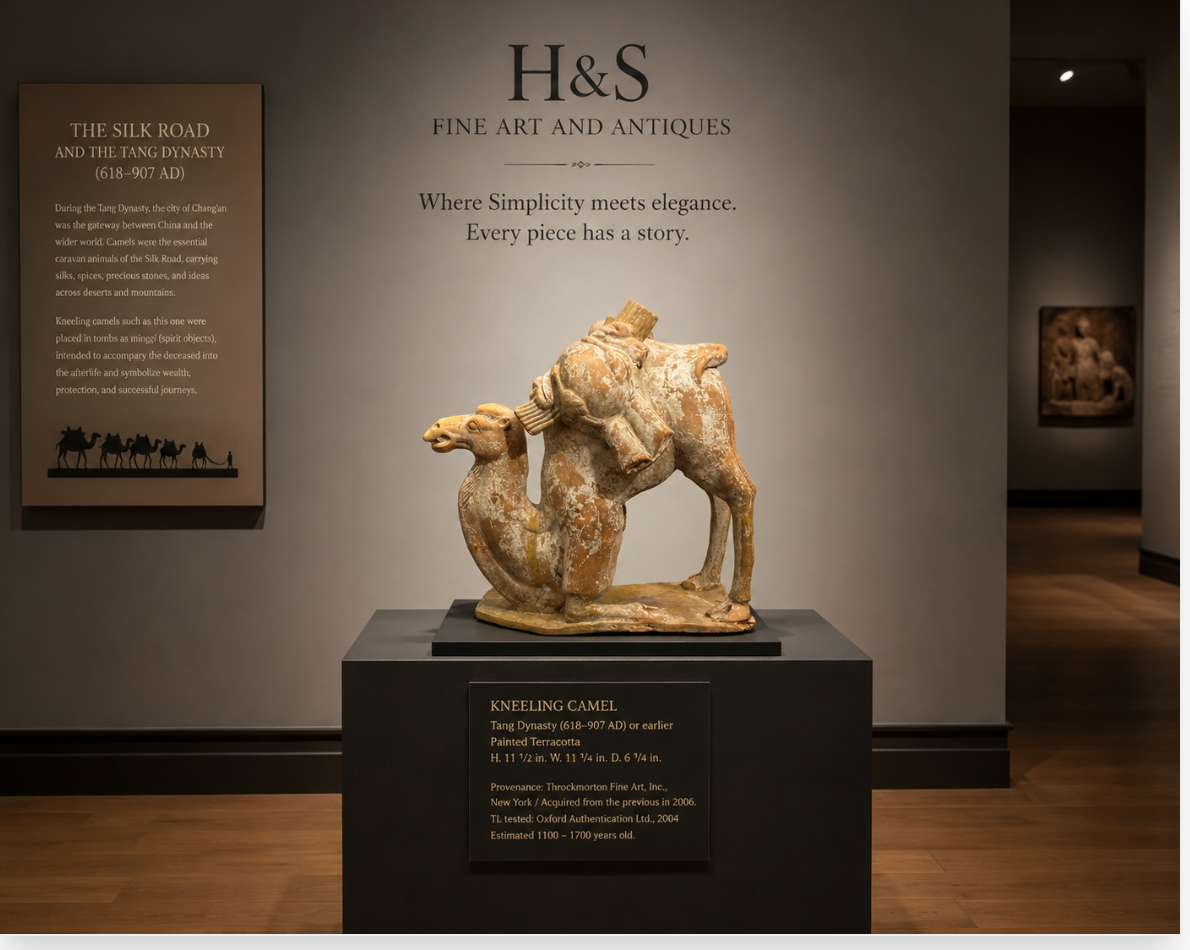 Image 1 of 8
 Image 2 of 8
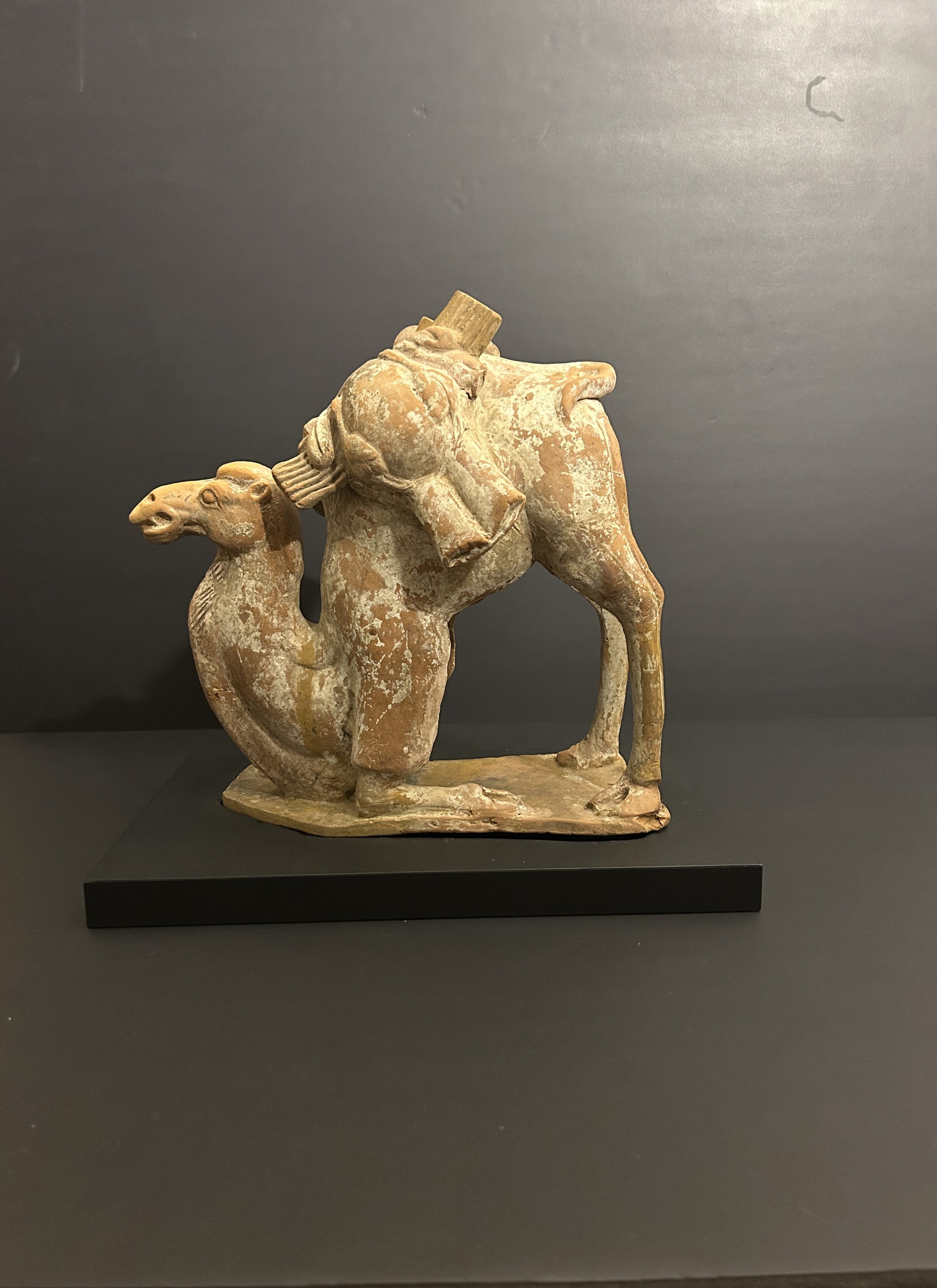 Image 3 of 8
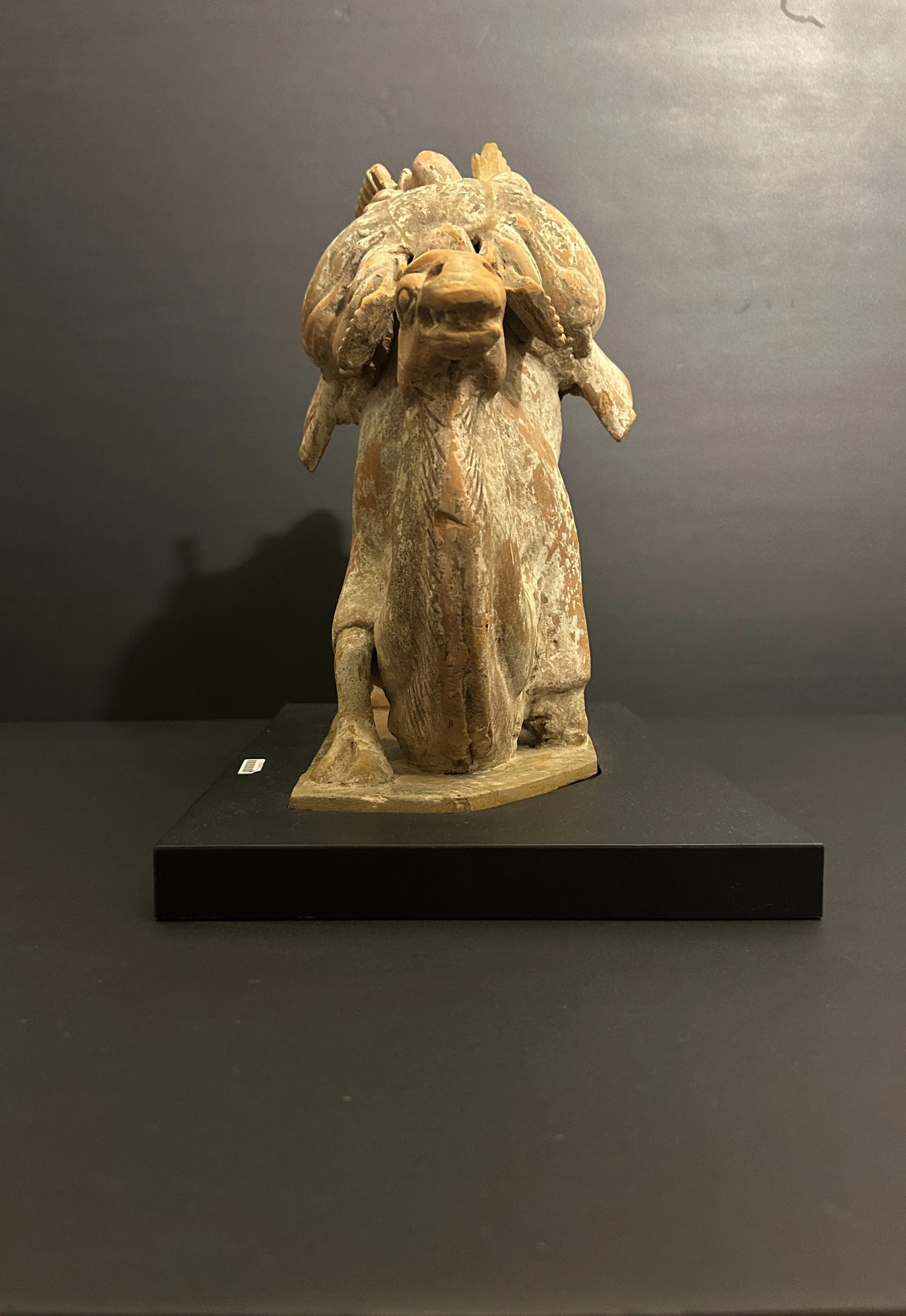 Image 4 of 8
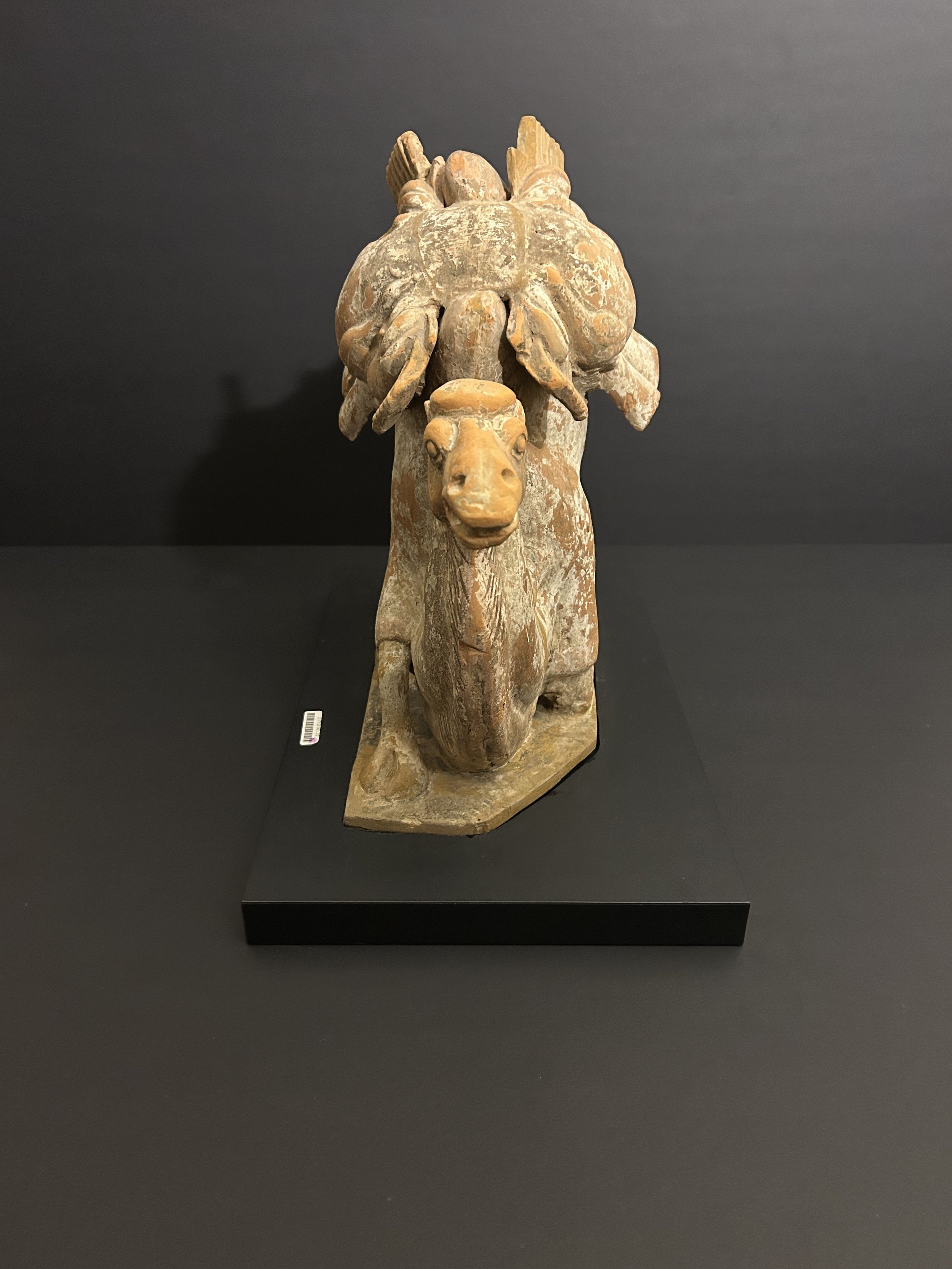 Image 5 of 8
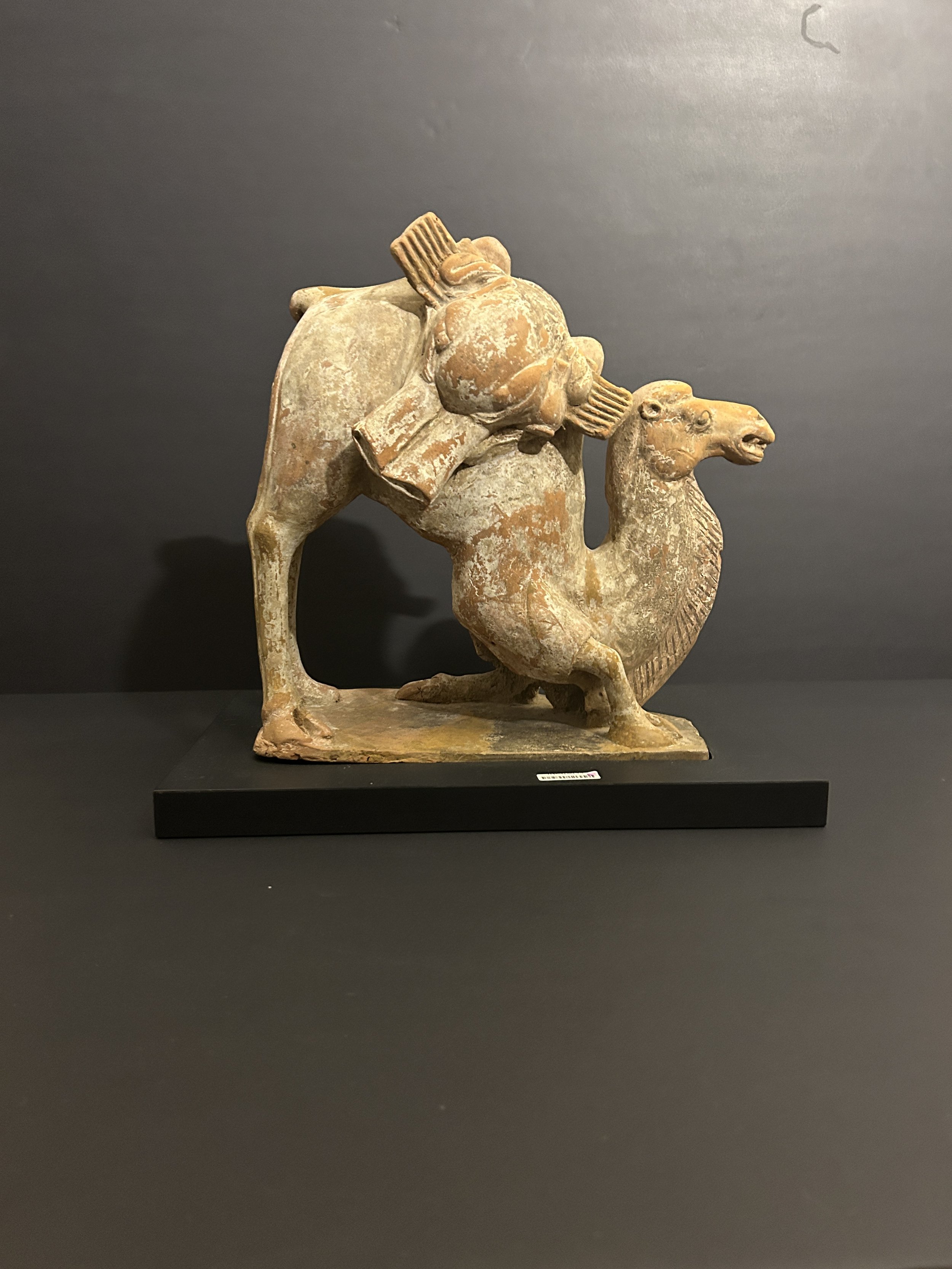 Image 6 of 8
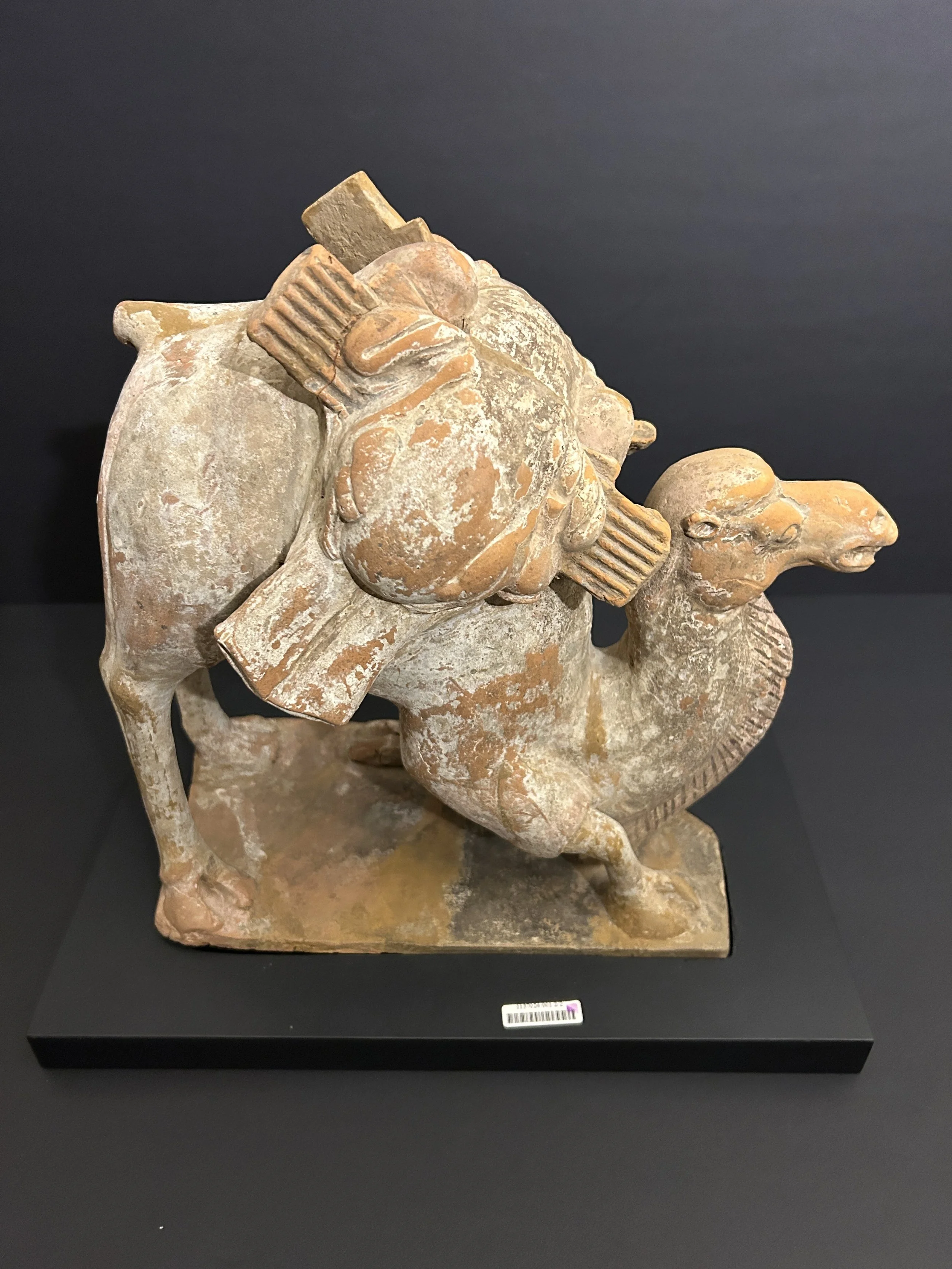 Image 7 of 8
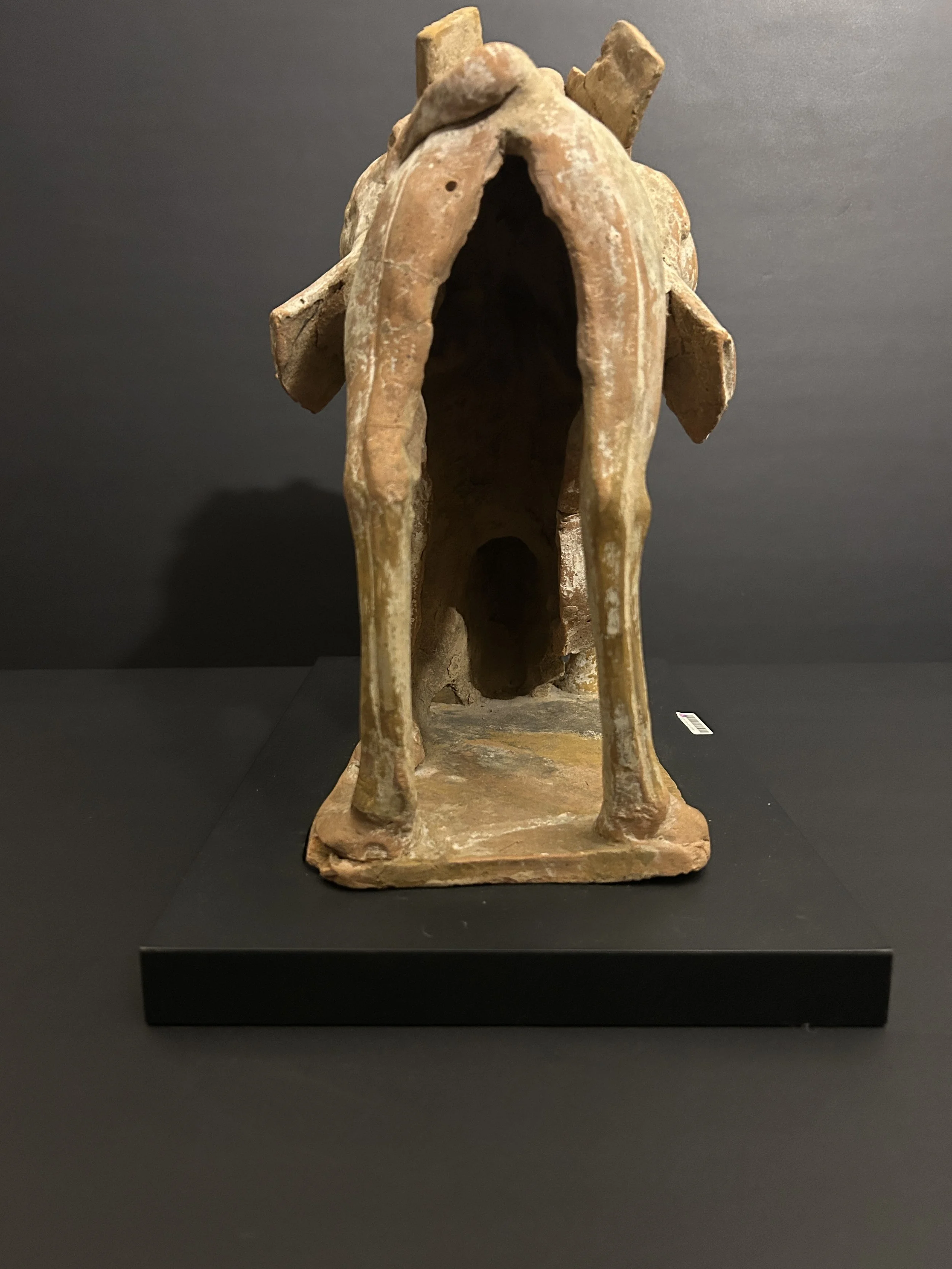 Image 8 of 8