 Image 1 of 6
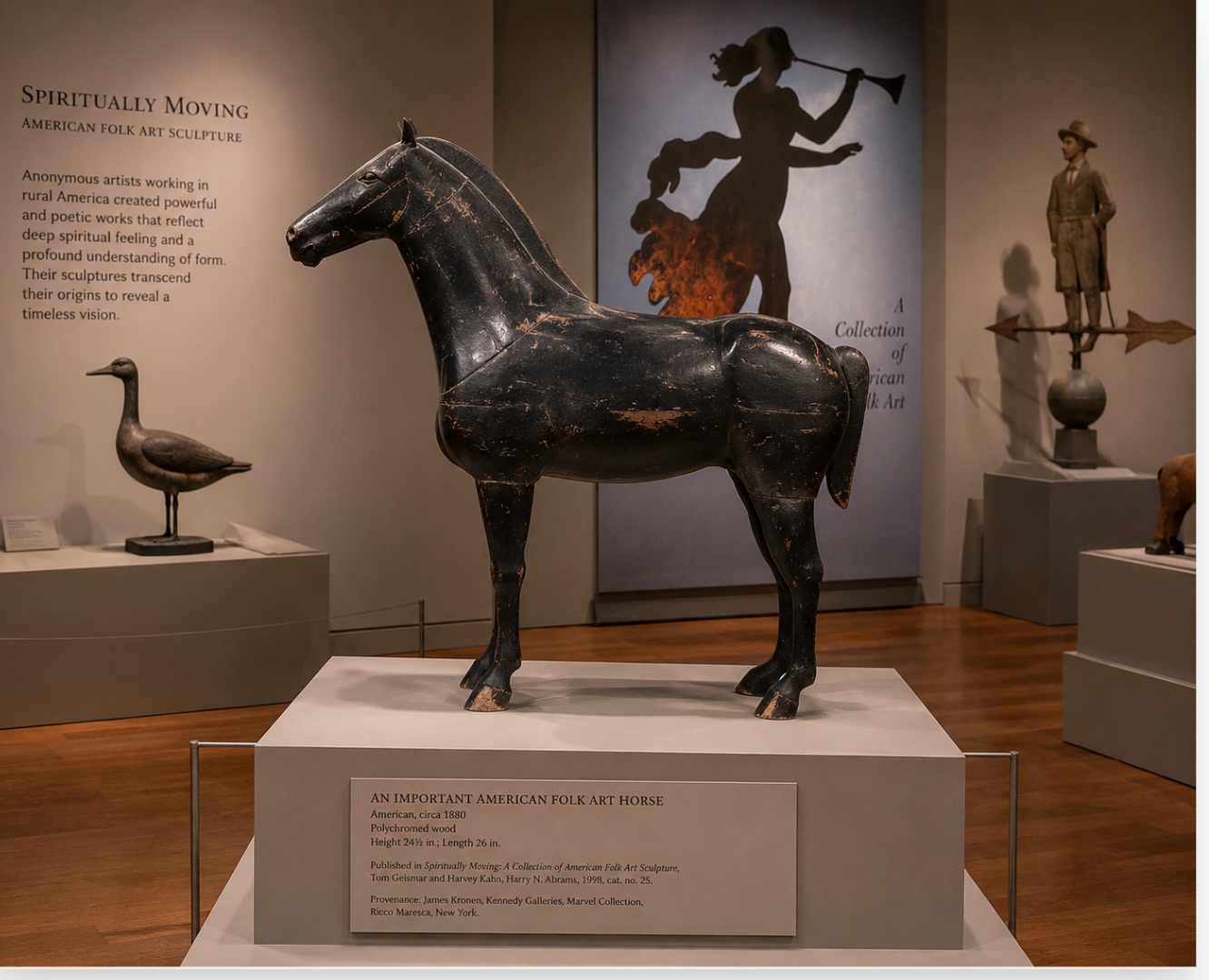 Image 2 of 6
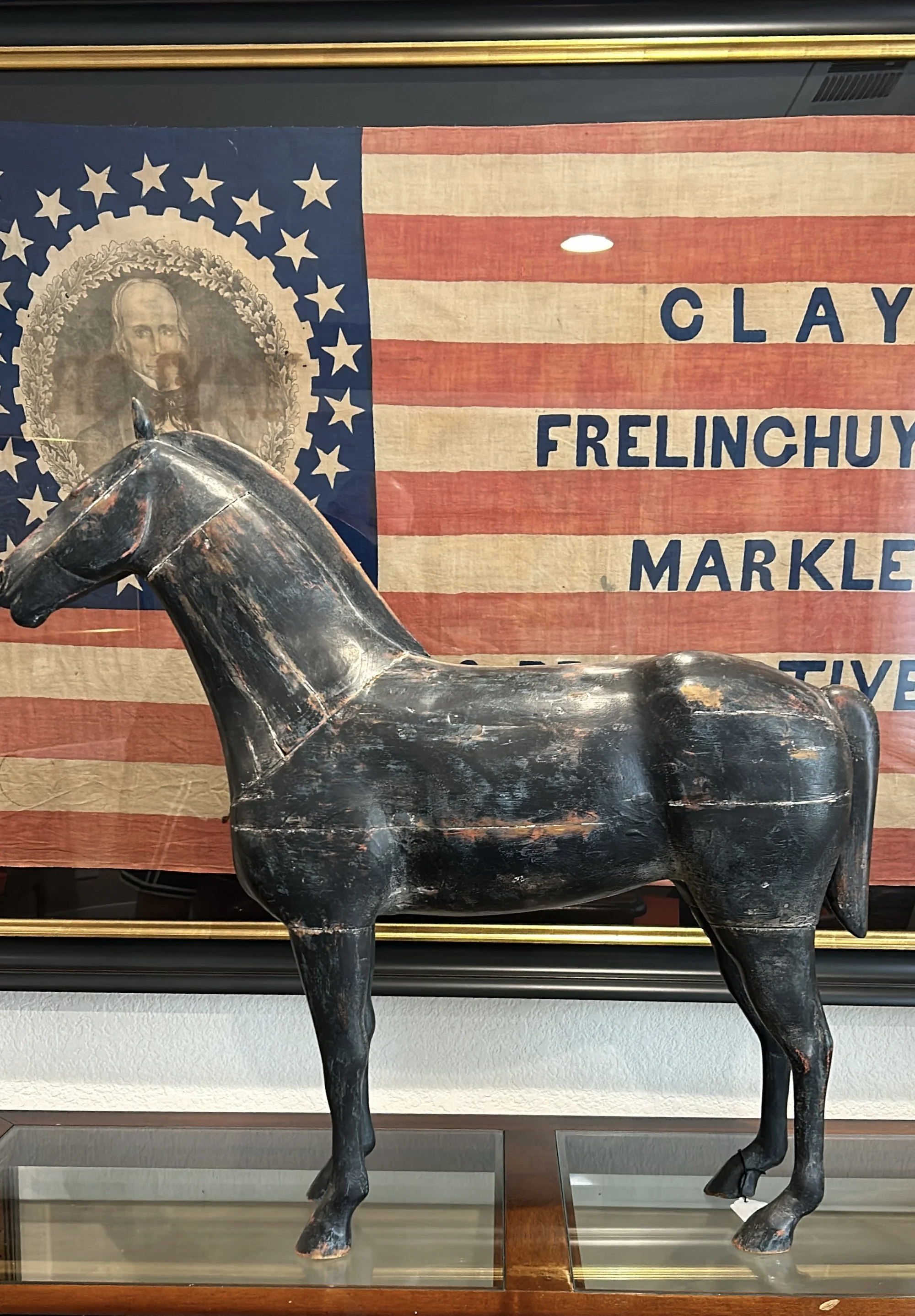 Image 3 of 6
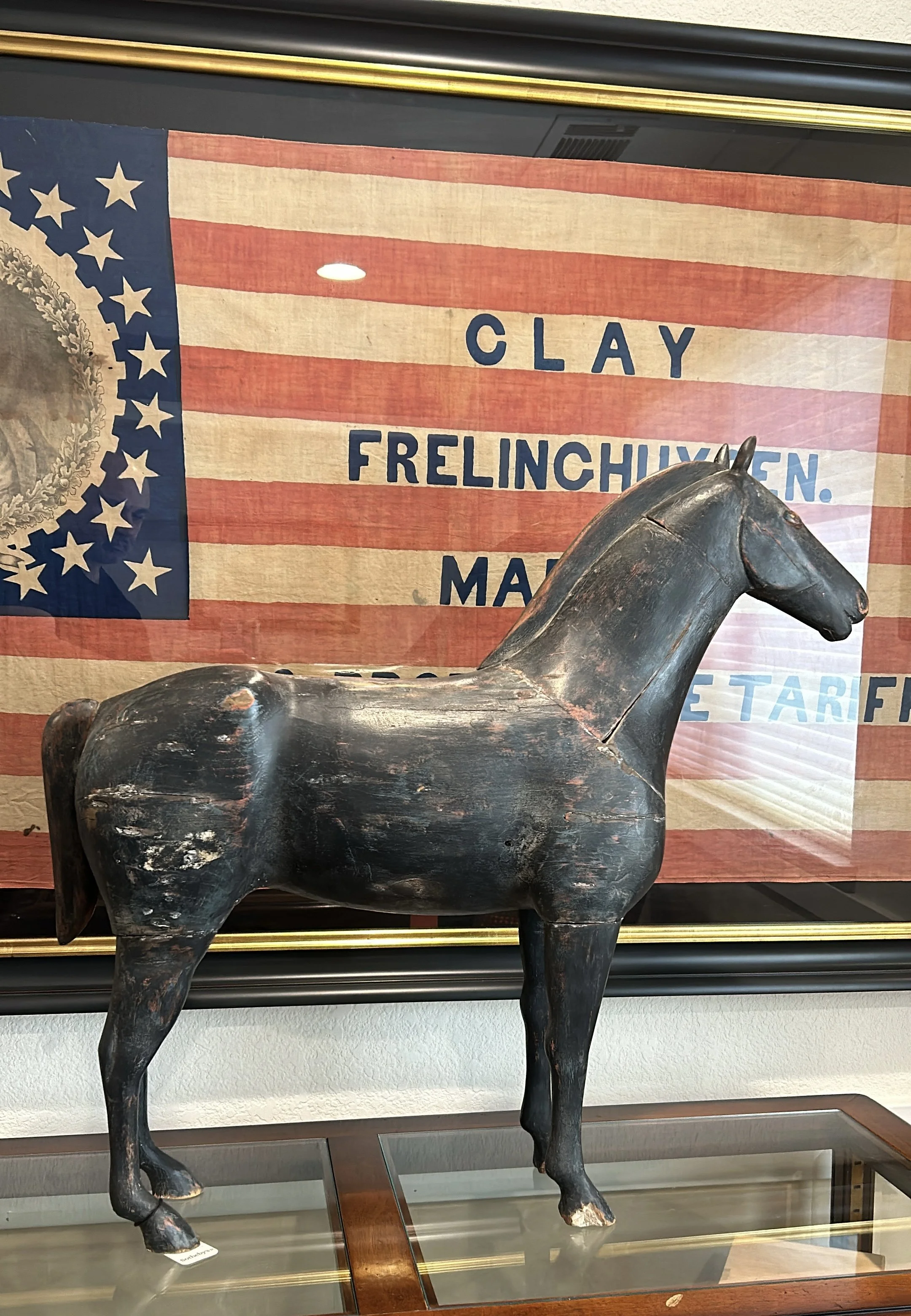 Image 4 of 6
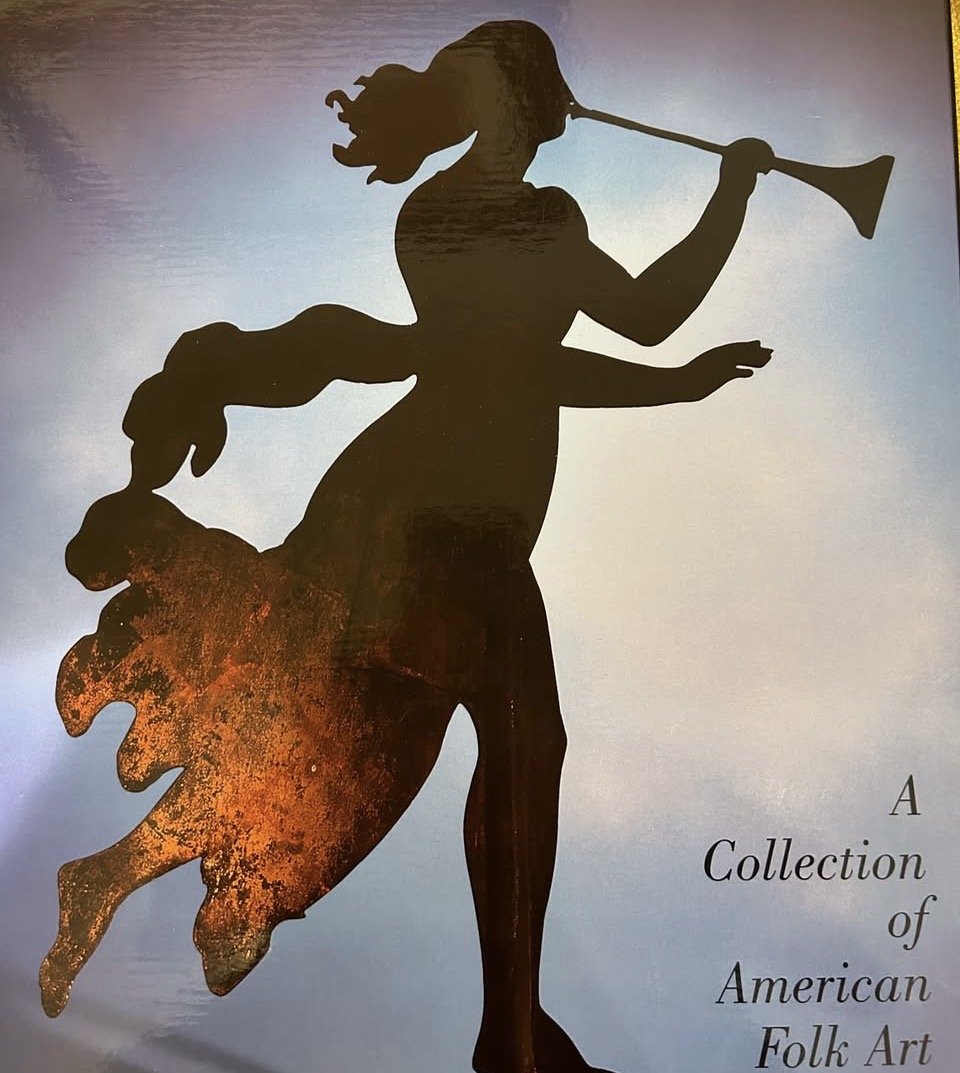 Image 5 of 6
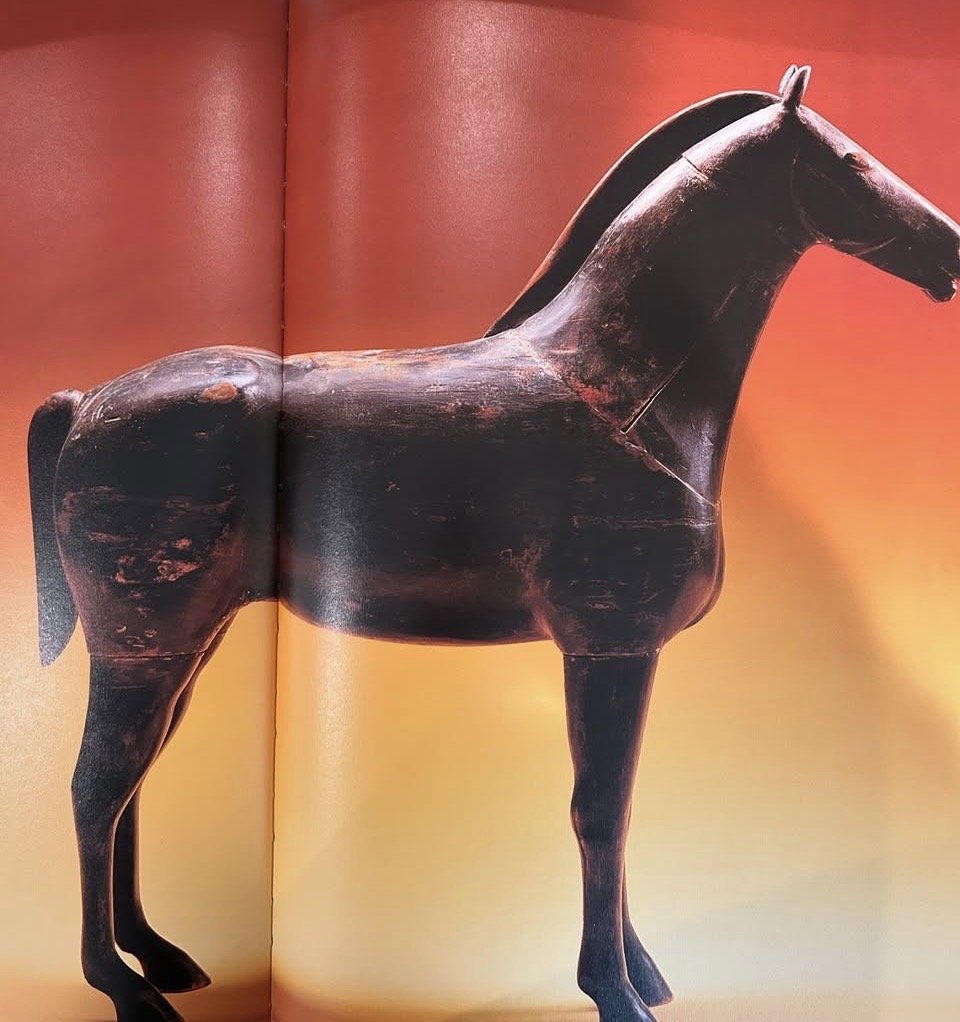 Image 6 of 6
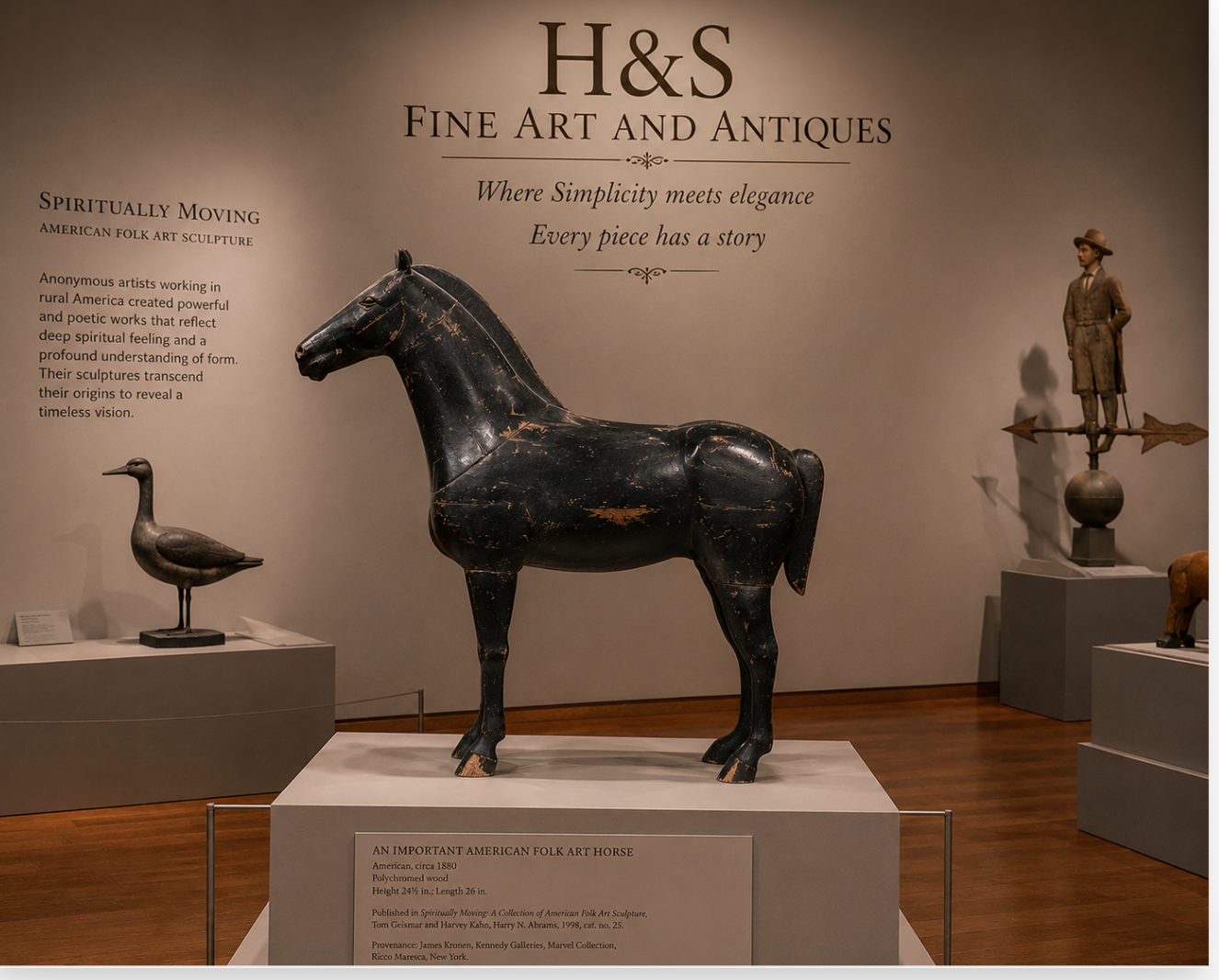
Standing Horse. American school, 19th century. Polychromed wood, New England circa 1880. Formerly in the celebrated David Teiger Collection, one of the finest private collections of American Folk Art
AN IMPORTANT AMERICAN FOLK ART HORSE
American, circa 1880
Polychromed wood
Height 24½ inches; Length 26 inches
Provenance
James Kronen, New York
Kennedy Galleries, New York
Marvel Collection, White Plains, New York
Ricco Maresca, New York
The Important American Folk Art Collection of David Teiger (1929–2014), New York
Sotheby's, New York, The History of Now: The Important American Folk Art Collection of David Teiger, 20 January 2019, Lot 1280.
Literature
The Kennedy Quarterly, Vol. XIII, No. 1, January 1974.
Tom Geismar and Harvey Kahn, Spiritually Moving: A Collection of American Folk Art Sculpture, New York: Harry N. Abrams, 1998, cat. no. 25, illustrated in color.
Exhibition Essay
Form, Memory, and the American Horse
Among the most arresting achievements of nineteenth-century American folk sculpture are carved animal figures whose makers remain unidentified but whose artistic personalities survive vividly in wood. The present Standing Horse, created in America around 1880 and traditionally associated with New England, belongs to this distinguished category. Measuring approximately two feet high and slightly longer from head to tail, it possesses a presence far greater than its physical scale.
The sculpture is constructed from multiple sections of wood and retains a weathered historic painted surface. Its elongated neck, rounded body, narrow legs and restrained anatomical detail reduce the horse to a sequence of essential masses and contours. The maker did not attempt the precise musculature or measured naturalism expected of an academically trained sculptor. Instead, the animal is conveyed through silhouette, proportion and rhythm.
This economy of form is central to the horse’s power. The gently rising neck leads the eye toward the head; the body forms a compact horizontal volume; and the attenuated legs lift the mass above the ground, giving the figure an almost architectural balance. The result is neither fully naturalistic nor naïvely descriptive. It is a highly resolved sculptural interpretation of the horse as an image of strength, patience and contained energy.
The object’s authorship remains unknown. That anonymity should not be understood as an absence of artistic identity. On the contrary, the confidence of the proportions, the controlled simplification and the unusual dignity of the stance reveal the decisions of a distinctive individual hand. The sculpture embodies one of the defining characteristics of American folk art: the transformation of a familiar subject into an image of unexpected originality through direct, nonacademic workmanship.
Date and Historical Setting
The proposed date of approximately 1880 places the horse in the decades following the American Civil War, a period of rapid industrialization, urban growth and transformation in American material culture. Factory production increasingly supplied objects that had once been made locally, yet hand carving remained active in rural communities, workshops, shipyards, sign-making establishments and small commercial trades.
The horse remained indispensable to American life. It powered agriculture, moved goods and passengers, served the military, appeared in public ceremonies and represented prosperity, speed and social standing. It also occupied a central place in the visual language of the period, appearing on weathervanes, trade signs, toys, carousel figures, hitching posts and architectural ornaments.
The exact original purpose of the present carving has not been securely documented. Its scale and construction invite comparison with architectural ornaments, trade figures and other functional forms of folk sculpture, but it should not be identified conclusively as any one of these without documentary or physical evidence. Its surviving significance rests primarily in the strength of the carving itself rather than in an unproven utilitarian designation.
This distinction strengthens the scholarship. The work can be presented confidently as an important nineteenth-century American carved horse while leaving its original setting open to further investigation.
The Horse in American Folk Art
The horse was one of the most enduring subjects in American vernacular art because it was both familiar and symbolic. In daily life it represented labor, travel and agricultural production. In public imagery it could signify speed, military distinction, property, independence and national expansion.
Carved horses also offered folk artists a particularly demanding sculptural subject. The animal’s long neck, projecting head, narrow legs and extended body required the maker to balance structural stability against visual animation. Successful examples had to remain convincing when viewed in profile while preserving enough volume to be read as three-dimensional objects.
The present sculpture resolves that challenge through deliberate compression and simplification. The body is rounded but compact; the legs are reduced to narrow supports; and the head is joined to the body by a long, emphatically curved neck. The maker transformed anatomical complexity into a clear and memorable silhouette.
A Visual Dialogue with Chinese Antiquity
One of the most compelling ways to interpret this sculpture is through comparison with the celebrated ceramic horses of China’s Tang dynasty, which ruled from 618 to 907. The relationship is visual and conceptual rather than historical: there is no evidence that the American carver knew Tang sculpture or consciously imitated Chinese models.
Nevertheless, the comparison is revealing. Tang funerary horses often convey power and dignity through broad masses, proud necks and controlled simplification. Their sculptors were capable of anatomical observation, yet their greatest figures transcend literal description. The horse becomes a concentrated emblem of vitality, rank and controlled movement.
The American carving achieves something comparable through entirely different materials, circumstances and intentions. Its long neck, substantial torso and reduced detail similarly favor formal clarity over anatomical elaboration. Both traditions use the horse’s profile to communicate character. Both recognize that the expressive force of the subject can be heightened when unnecessary detail is removed.
The sculpture has therefore been compared in the gallery’s research with Tang horses in the Metropolitan Museum of Art and the British Museum, including sancai-glazed examples associated with elite burial culture. The comparison should be presented as an exercise in visual analysis, not as a claim of influence. Its value lies in demonstrating that artists working in different cultures and centuries could arrive independently at related solutions to the representation of strength, dignity and equine presence.
This cross-cultural parallel also helps explain why the best American folk sculpture appeals beyond the boundaries of Americana collecting. A work such as this can be understood not only as an artifact of nineteenth-century life but as an independent study of mass, contour and proportion.
Published Recognition
The horse’s documented publication history is unusually strong. It appeared in The Kennedy Quarterly in January 1974, indicating that it had already been singled out for attention within the American art market and scholarly community by that date.
Kennedy Galleries occupied a significant position in the history of American art dealing. Established in New York from a business whose origins reached back to 1874, the gallery specialized in American art of the eighteenth through twentieth centuries. Its historical records are represented in the Smithsonian’s Archives of American Art, while the Frick Art Reference Library identifies it as an important dealer in American art.
The horse was later illustrated in color as catalogue number 25 in Tom Geismar and Harvey Kahn’s Spiritually Moving: A Collection of American Folk Art Sculpture, published by Harry N. Abrams in 1998. The volume focused primarily on nineteenth-century American folk sculpture, with particular attention to weathervanes and related sculptural forms, and remains a major visual reference in the field.
Publication in two widely separated periods—1974 and 1998—demonstrates sustained recognition rather than a recent attribution created solely for the market. The literature securely documents the horse’s visibility within the collecting history of American folk sculpture. Its catalogue number and color illustration in Spiritually Moving are recorded in the object’s documentation.
Provenance
The distinguished history of ownership of this remarkable American folk sculpture is an important part of its significance. Over the past half century, the horse has passed through the hands of some of the most respected collectors, galleries, and connoisseurs responsible for shaping the modern appreciation of American folk art.
The earliest documented owner was James Kronen of New York, a respected collector whose eye for exceptional American folk sculpture helped preserve many important vernacular works during a period when such objects were only beginning to receive scholarly attention.
The horse subsequently entered the renowned Kennedy Galleries, New York, one of America's oldest and most influential art galleries. Founded in the nineteenth century, Kennedy Galleries played a pioneering role in elevating American folk art from regional curiosity to a recognized field of serious collecting. Through important exhibitions, publications, and scholarship, the gallery introduced generations of collectors and museums to the artistic achievements of anonymous American craftsmen. The horse's publication in The Kennedy Quarterly (Vol. XIII, No. 1, January 1974) further established its importance within the field.
The sculpture later entered the celebrated Marvel Collection of White Plains, New York, an important private collection assembled with an emphasis on quality, rarity, and historical significance. During this period, the horse continued to be recognized as one of the finest surviving examples of nineteenth-century American carved animal sculpture.
From the Marvel Collection, the horse was acquired by Ricco/Maresca Gallery, New York, internationally recognized as one of the foremost dealers specializing in American Folk Art, Self-Taught Art, and Outsider Art. Since its founding, Ricco/Maresca has worked closely with major museums, scholars, and advanced collectors, placing many of the country's most important folk art masterpieces into distinguished public and private collections. Their handling of this sculpture further confirms its exceptional artistic and historical importance.
The horse was subsequently acquired by David Teiger (1929–2014), one of the most visionary and influential collectors of American Folk Art assembled during the late twentieth century. Although widely celebrated as a patron of contemporary art through the Teiger Foundation, David Teiger also quietly built an extraordinary collection of museum-quality American folk sculpture distinguished by its sculptural power, originality, and aesthetic refinement. Rather than collecting by category alone, Teiger sought works possessing exceptional artistic presence—objects that transcended their vernacular origins to stand alongside the finest examples of world sculpture. His collection included many iconic masterpieces that had previously resided in the nation's finest private collections and was admired throughout the museum community for its remarkable quality and discerning taste.
Following Teiger's death, the sculpture was offered as Lot 1280 in Sotheby's landmark auction, The History of Now: The Important American Folk Art Collection of David Teiger, held in New York on 20 January 2019. The sale attracted international attention and is widely regarded as one of the most significant dispersals of American Folk Art in recent decades. Bringing together exceptional works assembled over a lifetime, the auction reaffirmed David Teiger's reputation as one of the foremost collectors in the history of the field. The inclusion of this horse in that landmark sale firmly places it among a select group of American folk sculptures recognized for their exceptional artistic merit, distinguished provenance, and enduring historical importance.
Today, the sculpture stands not only as an outstanding example of nineteenth-century American folk art, but also as an object whose remarkable provenance reflects more than fifty years of careful scholarship, distinguished ownership, and continued admiration by many of the leading figures responsible for preserving America's artistic heritage.
Conclusion
This standing horse occupies a distinguished position within American folk sculpture because several forms of evidence reinforce one another. Its silhouette and proportions possess genuine artistic authority. Its publication history extends back to 1974. It was later selected for one of the major late twentieth-century books devoted to American folk sculpture. Its provenance connects it with Kennedy Galleries, Ricco/Maresca and David Teiger, and its appearance in Sotheby’s landmark 2019 Teiger sale provides a secure and public record of that ownership.
The visual comparison with Tang dynasty horses broadens the interpretation without diminishing the sculpture’s American identity. It demonstrates how an anonymous nineteenth-century craftsman, working in wood and outside academic traditions, could arrive at a treatment of the horse that shares universal sculptural principles with works produced in another civilization more than a thousand years earlier.
The horse should therefore be understood on several levels at once: as a product of nineteenth-century American material culture; as an exceptional work of anonymous carving; as an object shaped by the collecting history of American folk art; and as an independent sculpture whose formal clarity allows it to enter a wider conversation about the representation of the horse across cultures and centuries.
Curator’s Note
The lasting power of this horse lies in the distance between the simplicity of its means and the authority of its presence. The maker worked with wood, paint and a limited vocabulary of carved forms. Yet from those modest materials emerged an image of remarkable composure: the long neck rises with quiet dignity, the rounded body carries a convincing sense of weight, and the narrow legs hold the figure in a state of delicate equilibrium.
The sculpture does not depend upon anatomical precision. Its character comes instead from proportion, silhouette and restraint. The horse has been reduced to what is essential without being stripped of personality. This balance between abstraction and recognition is one of the defining achievements of the finest American folk art.
Its weathered surface and small losses remind us that the object has lived a material life extending across nearly a century and a half. They should neither be concealed nor exaggerated. They are part of the sculpture’s physical biography, existing alongside the marks of its maker and the evidence of later care.
The provenance adds another layer of meaning. Through James Kronen, Kennedy Galleries, the Marvel Collection, Ricco/Maresca and David Teiger, the horse passed through a succession of hands that recognized its unusual visual strength. Its publication in The Kennedy Quarterly and Spiritually Moving confirms that this appreciation developed over decades rather than arising only with its most recent appearance on the market.
David Teiger’s ownership is especially resonant. His ability to move intellectually and aesthetically between American folk sculpture and contemporary art provides an appropriate lens through which to view the horse today. Its anonymous authorship and vernacular origins do not limit its importance. They sharpen our awareness that powerful sculpture can emerge outside academies, recognized schools and established hierarchies.
Viewed beside the great ceramic horses of Tang China, the carving enters an even broader conversation. The relationship is not one of influence, but of shared sculptural intelligence: an understanding that strength may be communicated through mass, dignity through posture and vitality through the disciplined simplification of form.
For H&S Fine Art & Antiques, this horse represents the ideal union of visual quality and documented history. It is rare without depending solely on rarity, historically important without becoming merely archaeological, and highly published without losing the direct emotional force that first compels attention. It stands as a quiet monument to the anonymous American craftsman and to the generations of collectors who recognized that the most unassuming materials can carry enduring artistic greatness.
References
Metropolitan Museum of Art, New York:
Horse, Tang dynasty (618–907), late 7th–early 8th century, Department of Asian Art.
Horse, Tang dynasty (618–907), late 7th–first half of the 8th century, earthenware with sancai glaze.
British Museum, London:
Horse Figure from the Tomb of General Liu Tingxun (d. 728), Tang dynasty, sancai-glazed earthenware.
Horse Figure, Tang dynasty, circa 700–750, earthenware with clear glaze. https://www.metmuseum.org/art/collection/search/42189
AN IMPORTANT AMERICAN FOLK ART HORSE
American, circa 1880
Polychromed wood
Height 24½ inches; Length 26 inches
Provenance
James Kronen, New York
Kennedy Galleries, New York
Marvel Collection, White Plains, New York
Ricco Maresca, New York
The Important American Folk Art Collection of David Teiger (1929–2014), New York
Sotheby's, New York, The History of Now: The Important American Folk Art Collection of David Teiger, 20 January 2019, Lot 1280.
Literature
The Kennedy Quarterly, Vol. XIII, No. 1, January 1974.
Tom Geismar and Harvey Kahn, Spiritually Moving: A Collection of American Folk Art Sculpture, New York: Harry N. Abrams, 1998, cat. no. 25, illustrated in color.
Exhibition Essay
Form, Memory, and the American Horse
Among the most arresting achievements of nineteenth-century American folk sculpture are carved animal figures whose makers remain unidentified but whose artistic personalities survive vividly in wood. The present Standing Horse, created in America around 1880 and traditionally associated with New England, belongs to this distinguished category. Measuring approximately two feet high and slightly longer from head to tail, it possesses a presence far greater than its physical scale.
The sculpture is constructed from multiple sections of wood and retains a weathered historic painted surface. Its elongated neck, rounded body, narrow legs and restrained anatomical detail reduce the horse to a sequence of essential masses and contours. The maker did not attempt the precise musculature or measured naturalism expected of an academically trained sculptor. Instead, the animal is conveyed through silhouette, proportion and rhythm.
This economy of form is central to the horse’s power. The gently rising neck leads the eye toward the head; the body forms a compact horizontal volume; and the attenuated legs lift the mass above the ground, giving the figure an almost architectural balance. The result is neither fully naturalistic nor naïvely descriptive. It is a highly resolved sculptural interpretation of the horse as an image of strength, patience and contained energy.
The object’s authorship remains unknown. That anonymity should not be understood as an absence of artistic identity. On the contrary, the confidence of the proportions, the controlled simplification and the unusual dignity of the stance reveal the decisions of a distinctive individual hand. The sculpture embodies one of the defining characteristics of American folk art: the transformation of a familiar subject into an image of unexpected originality through direct, nonacademic workmanship.
Date and Historical Setting
The proposed date of approximately 1880 places the horse in the decades following the American Civil War, a period of rapid industrialization, urban growth and transformation in American material culture. Factory production increasingly supplied objects that had once been made locally, yet hand carving remained active in rural communities, workshops, shipyards, sign-making establishments and small commercial trades.
The horse remained indispensable to American life. It powered agriculture, moved goods and passengers, served the military, appeared in public ceremonies and represented prosperity, speed and social standing. It also occupied a central place in the visual language of the period, appearing on weathervanes, trade signs, toys, carousel figures, hitching posts and architectural ornaments.
The exact original purpose of the present carving has not been securely documented. Its scale and construction invite comparison with architectural ornaments, trade figures and other functional forms of folk sculpture, but it should not be identified conclusively as any one of these without documentary or physical evidence. Its surviving significance rests primarily in the strength of the carving itself rather than in an unproven utilitarian designation.
This distinction strengthens the scholarship. The work can be presented confidently as an important nineteenth-century American carved horse while leaving its original setting open to further investigation.
The Horse in American Folk Art
The horse was one of the most enduring subjects in American vernacular art because it was both familiar and symbolic. In daily life it represented labor, travel and agricultural production. In public imagery it could signify speed, military distinction, property, independence and national expansion.
Carved horses also offered folk artists a particularly demanding sculptural subject. The animal’s long neck, projecting head, narrow legs and extended body required the maker to balance structural stability against visual animation. Successful examples had to remain convincing when viewed in profile while preserving enough volume to be read as three-dimensional objects.
The present sculpture resolves that challenge through deliberate compression and simplification. The body is rounded but compact; the legs are reduced to narrow supports; and the head is joined to the body by a long, emphatically curved neck. The maker transformed anatomical complexity into a clear and memorable silhouette.
A Visual Dialogue with Chinese Antiquity
One of the most compelling ways to interpret this sculpture is through comparison with the celebrated ceramic horses of China’s Tang dynasty, which ruled from 618 to 907. The relationship is visual and conceptual rather than historical: there is no evidence that the American carver knew Tang sculpture or consciously imitated Chinese models.
Nevertheless, the comparison is revealing. Tang funerary horses often convey power and dignity through broad masses, proud necks and controlled simplification. Their sculptors were capable of anatomical observation, yet their greatest figures transcend literal description. The horse becomes a concentrated emblem of vitality, rank and controlled movement.
The American carving achieves something comparable through entirely different materials, circumstances and intentions. Its long neck, substantial torso and reduced detail similarly favor formal clarity over anatomical elaboration. Both traditions use the horse’s profile to communicate character. Both recognize that the expressive force of the subject can be heightened when unnecessary detail is removed.
The sculpture has therefore been compared in the gallery’s research with Tang horses in the Metropolitan Museum of Art and the British Museum, including sancai-glazed examples associated with elite burial culture. The comparison should be presented as an exercise in visual analysis, not as a claim of influence. Its value lies in demonstrating that artists working in different cultures and centuries could arrive independently at related solutions to the representation of strength, dignity and equine presence.
This cross-cultural parallel also helps explain why the best American folk sculpture appeals beyond the boundaries of Americana collecting. A work such as this can be understood not only as an artifact of nineteenth-century life but as an independent study of mass, contour and proportion.
Published Recognition
The horse’s documented publication history is unusually strong. It appeared in The Kennedy Quarterly in January 1974, indicating that it had already been singled out for attention within the American art market and scholarly community by that date.
Kennedy Galleries occupied a significant position in the history of American art dealing. Established in New York from a business whose origins reached back to 1874, the gallery specialized in American art of the eighteenth through twentieth centuries. Its historical records are represented in the Smithsonian’s Archives of American Art, while the Frick Art Reference Library identifies it as an important dealer in American art.
The horse was later illustrated in color as catalogue number 25 in Tom Geismar and Harvey Kahn’s Spiritually Moving: A Collection of American Folk Art Sculpture, published by Harry N. Abrams in 1998. The volume focused primarily on nineteenth-century American folk sculpture, with particular attention to weathervanes and related sculptural forms, and remains a major visual reference in the field.
Publication in two widely separated periods—1974 and 1998—demonstrates sustained recognition rather than a recent attribution created solely for the market. The literature securely documents the horse’s visibility within the collecting history of American folk sculpture. Its catalogue number and color illustration in Spiritually Moving are recorded in the object’s documentation.
Provenance
The distinguished history of ownership of this remarkable American folk sculpture is an important part of its significance. Over the past half century, the horse has passed through the hands of some of the most respected collectors, galleries, and connoisseurs responsible for shaping the modern appreciation of American folk art.
The earliest documented owner was James Kronen of New York, a respected collector whose eye for exceptional American folk sculpture helped preserve many important vernacular works during a period when such objects were only beginning to receive scholarly attention.
The horse subsequently entered the renowned Kennedy Galleries, New York, one of America's oldest and most influential art galleries. Founded in the nineteenth century, Kennedy Galleries played a pioneering role in elevating American folk art from regional curiosity to a recognized field of serious collecting. Through important exhibitions, publications, and scholarship, the gallery introduced generations of collectors and museums to the artistic achievements of anonymous American craftsmen. The horse's publication in The Kennedy Quarterly (Vol. XIII, No. 1, January 1974) further established its importance within the field.
The sculpture later entered the celebrated Marvel Collection of White Plains, New York, an important private collection assembled with an emphasis on quality, rarity, and historical significance. During this period, the horse continued to be recognized as one of the finest surviving examples of nineteenth-century American carved animal sculpture.
From the Marvel Collection, the horse was acquired by Ricco/Maresca Gallery, New York, internationally recognized as one of the foremost dealers specializing in American Folk Art, Self-Taught Art, and Outsider Art. Since its founding, Ricco/Maresca has worked closely with major museums, scholars, and advanced collectors, placing many of the country's most important folk art masterpieces into distinguished public and private collections. Their handling of this sculpture further confirms its exceptional artistic and historical importance.
The horse was subsequently acquired by David Teiger (1929–2014), one of the most visionary and influential collectors of American Folk Art assembled during the late twentieth century. Although widely celebrated as a patron of contemporary art through the Teiger Foundation, David Teiger also quietly built an extraordinary collection of museum-quality American folk sculpture distinguished by its sculptural power, originality, and aesthetic refinement. Rather than collecting by category alone, Teiger sought works possessing exceptional artistic presence—objects that transcended their vernacular origins to stand alongside the finest examples of world sculpture. His collection included many iconic masterpieces that had previously resided in the nation's finest private collections and was admired throughout the museum community for its remarkable quality and discerning taste.
Following Teiger's death, the sculpture was offered as Lot 1280 in Sotheby's landmark auction, The History of Now: The Important American Folk Art Collection of David Teiger, held in New York on 20 January 2019. The sale attracted international attention and is widely regarded as one of the most significant dispersals of American Folk Art in recent decades. Bringing together exceptional works assembled over a lifetime, the auction reaffirmed David Teiger's reputation as one of the foremost collectors in the history of the field. The inclusion of this horse in that landmark sale firmly places it among a select group of American folk sculptures recognized for their exceptional artistic merit, distinguished provenance, and enduring historical importance.
Today, the sculpture stands not only as an outstanding example of nineteenth-century American folk art, but also as an object whose remarkable provenance reflects more than fifty years of careful scholarship, distinguished ownership, and continued admiration by many of the leading figures responsible for preserving America's artistic heritage.
Conclusion
This standing horse occupies a distinguished position within American folk sculpture because several forms of evidence reinforce one another. Its silhouette and proportions possess genuine artistic authority. Its publication history extends back to 1974. It was later selected for one of the major late twentieth-century books devoted to American folk sculpture. Its provenance connects it with Kennedy Galleries, Ricco/Maresca and David Teiger, and its appearance in Sotheby’s landmark 2019 Teiger sale provides a secure and public record of that ownership.
The visual comparison with Tang dynasty horses broadens the interpretation without diminishing the sculpture’s American identity. It demonstrates how an anonymous nineteenth-century craftsman, working in wood and outside academic traditions, could arrive at a treatment of the horse that shares universal sculptural principles with works produced in another civilization more than a thousand years earlier.
The horse should therefore be understood on several levels at once: as a product of nineteenth-century American material culture; as an exceptional work of anonymous carving; as an object shaped by the collecting history of American folk art; and as an independent sculpture whose formal clarity allows it to enter a wider conversation about the representation of the horse across cultures and centuries.
Curator’s Note
The lasting power of this horse lies in the distance between the simplicity of its means and the authority of its presence. The maker worked with wood, paint and a limited vocabulary of carved forms. Yet from those modest materials emerged an image of remarkable composure: the long neck rises with quiet dignity, the rounded body carries a convincing sense of weight, and the narrow legs hold the figure in a state of delicate equilibrium.
The sculpture does not depend upon anatomical precision. Its character comes instead from proportion, silhouette and restraint. The horse has been reduced to what is essential without being stripped of personality. This balance between abstraction and recognition is one of the defining achievements of the finest American folk art.
Its weathered surface and small losses remind us that the object has lived a material life extending across nearly a century and a half. They should neither be concealed nor exaggerated. They are part of the sculpture’s physical biography, existing alongside the marks of its maker and the evidence of later care.
The provenance adds another layer of meaning. Through James Kronen, Kennedy Galleries, the Marvel Collection, Ricco/Maresca and David Teiger, the horse passed through a succession of hands that recognized its unusual visual strength. Its publication in The Kennedy Quarterly and Spiritually Moving confirms that this appreciation developed over decades rather than arising only with its most recent appearance on the market.
David Teiger’s ownership is especially resonant. His ability to move intellectually and aesthetically between American folk sculpture and contemporary art provides an appropriate lens through which to view the horse today. Its anonymous authorship and vernacular origins do not limit its importance. They sharpen our awareness that powerful sculpture can emerge outside academies, recognized schools and established hierarchies.
Viewed beside the great ceramic horses of Tang China, the carving enters an even broader conversation. The relationship is not one of influence, but of shared sculptural intelligence: an understanding that strength may be communicated through mass, dignity through posture and vitality through the disciplined simplification of form.
For H&S Fine Art & Antiques, this horse represents the ideal union of visual quality and documented history. It is rare without depending solely on rarity, historically important without becoming merely archaeological, and highly published without losing the direct emotional force that first compels attention. It stands as a quiet monument to the anonymous American craftsman and to the generations of collectors who recognized that the most unassuming materials can carry enduring artistic greatness.
References
Metropolitan Museum of Art, New York:
Horse, Tang dynasty (618–907), late 7th–early 8th century, Department of Asian Art.
Horse, Tang dynasty (618–907), late 7th–first half of the 8th century, earthenware with sancai glaze.
British Museum, London:
Horse Figure from the Tomb of General Liu Tingxun (d. 728), Tang dynasty, sancai-glazed earthenware.
Horse Figure, Tang dynasty, circa 700–750, earthenware with clear glaze. https://www.metmuseum.org/art/collection/search/42189