 Image 1 of 9
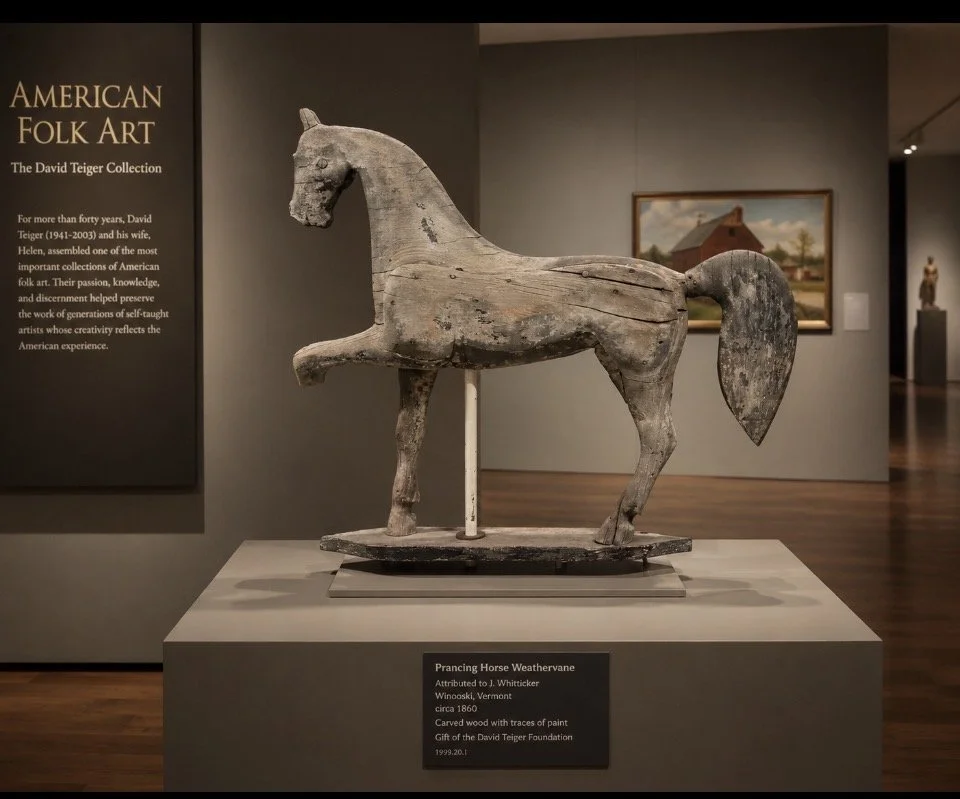 Image 2 of 9
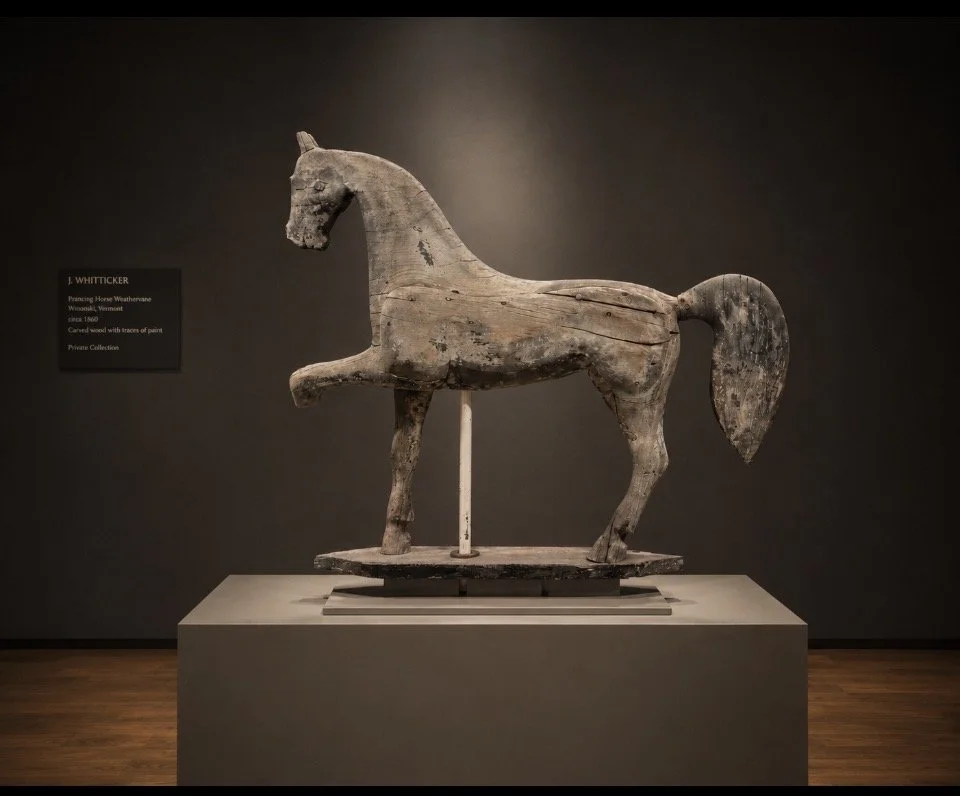 Image 3 of 9
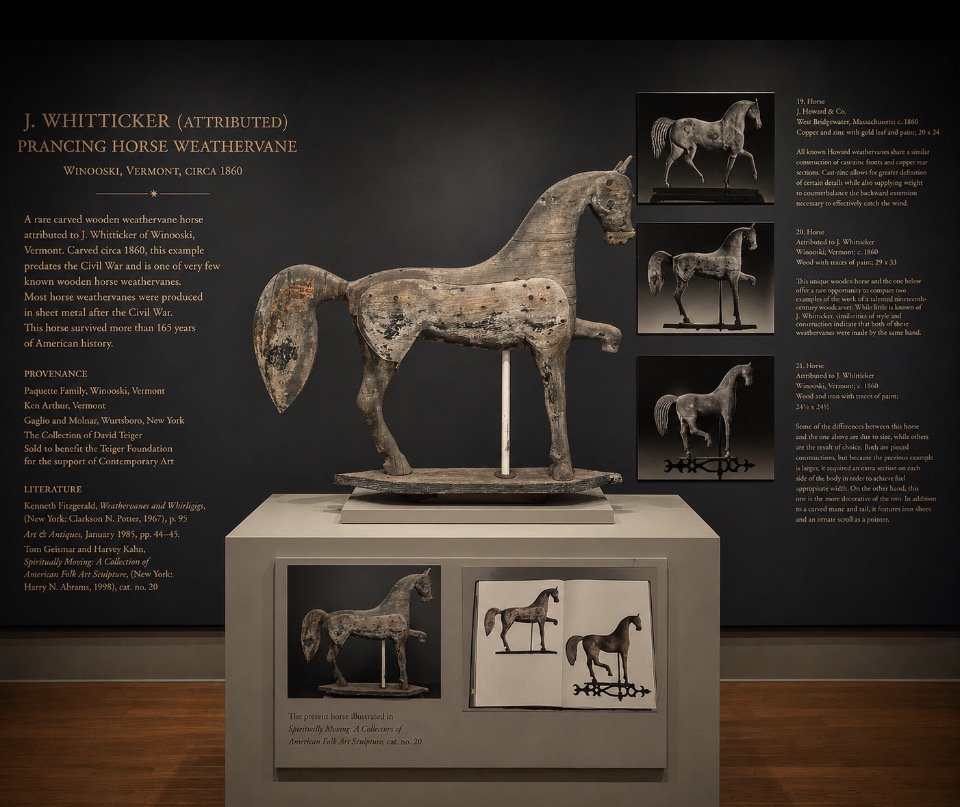 Image 4 of 9
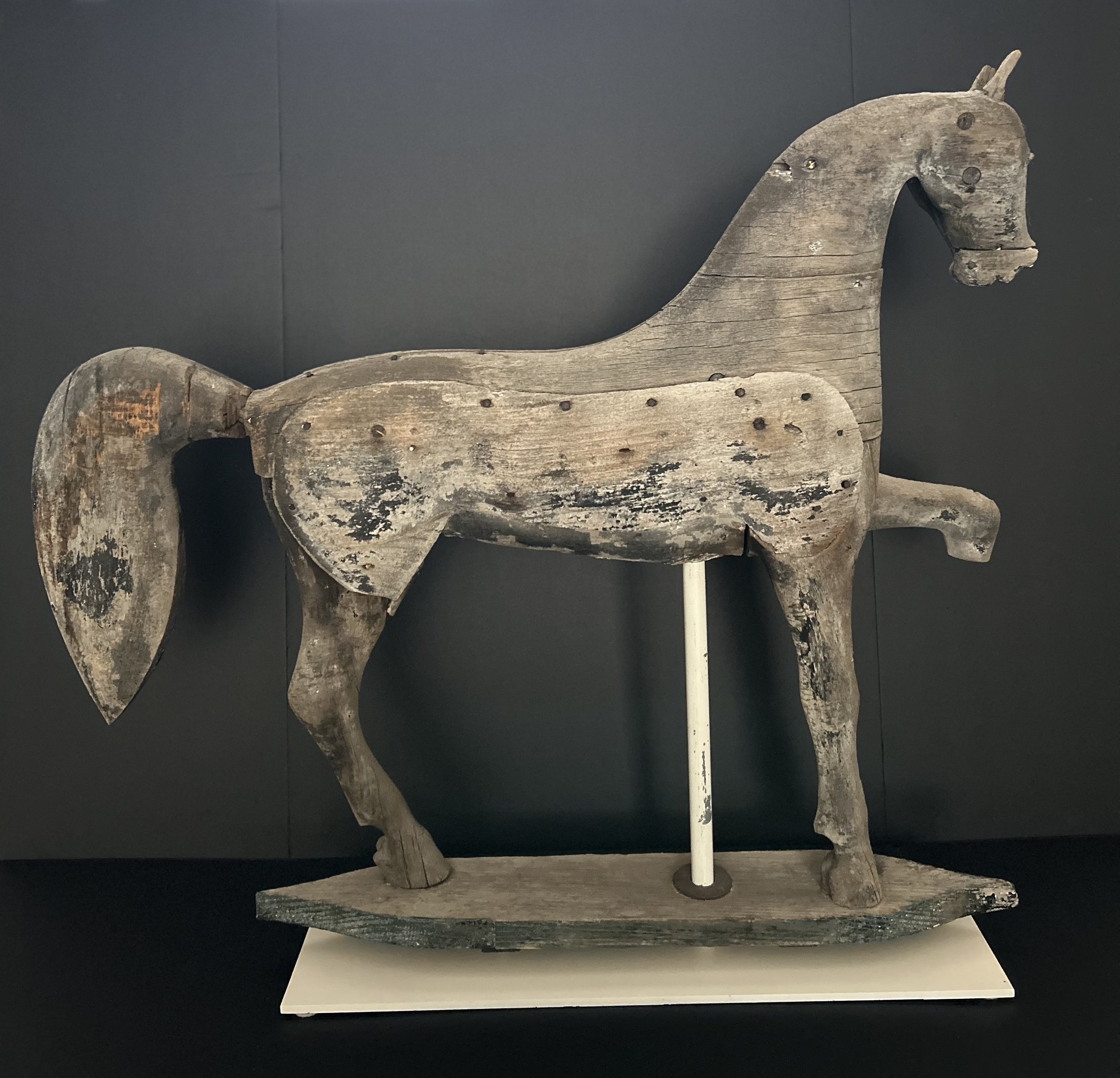 Image 5 of 9
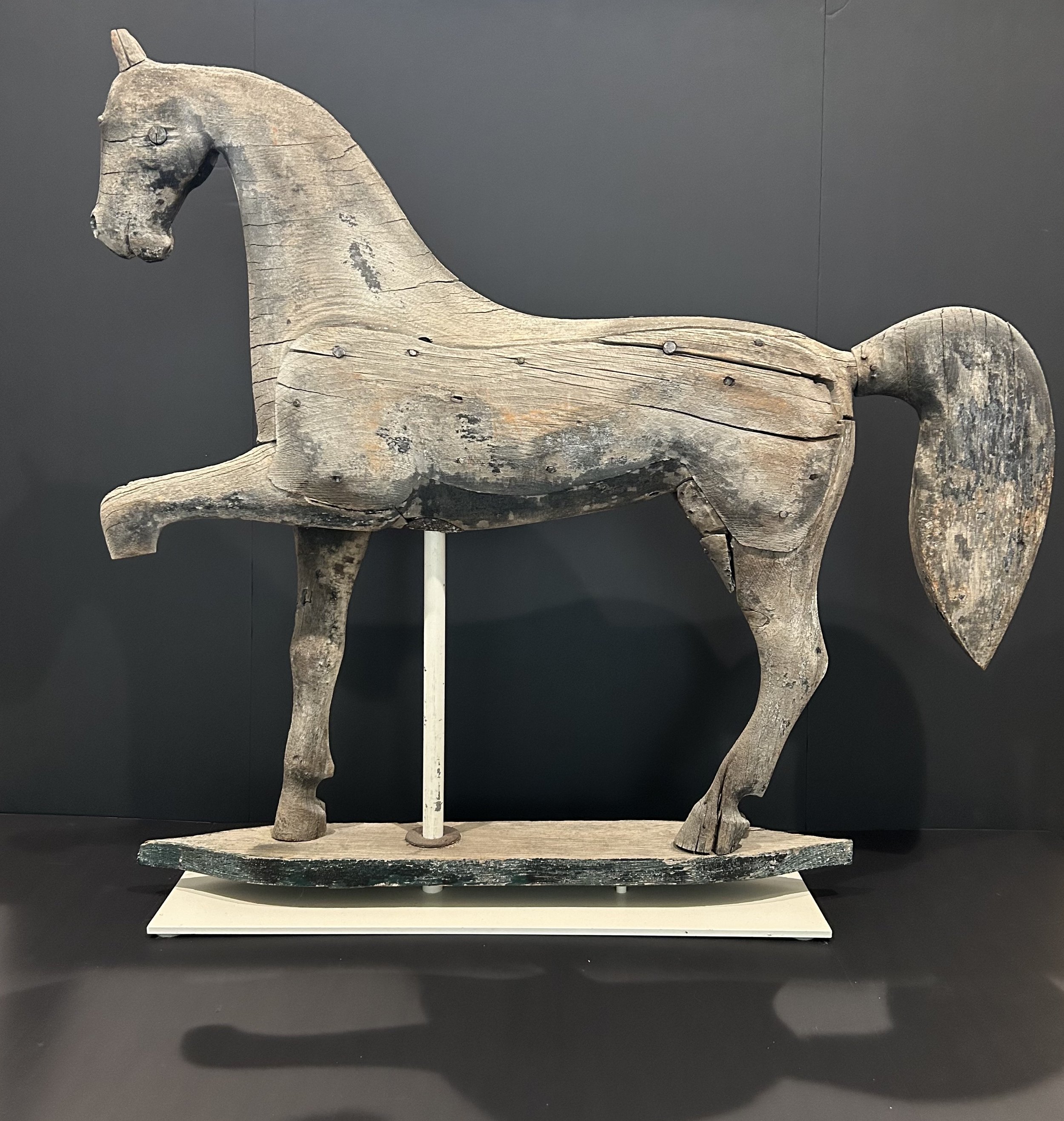 Image 6 of 9
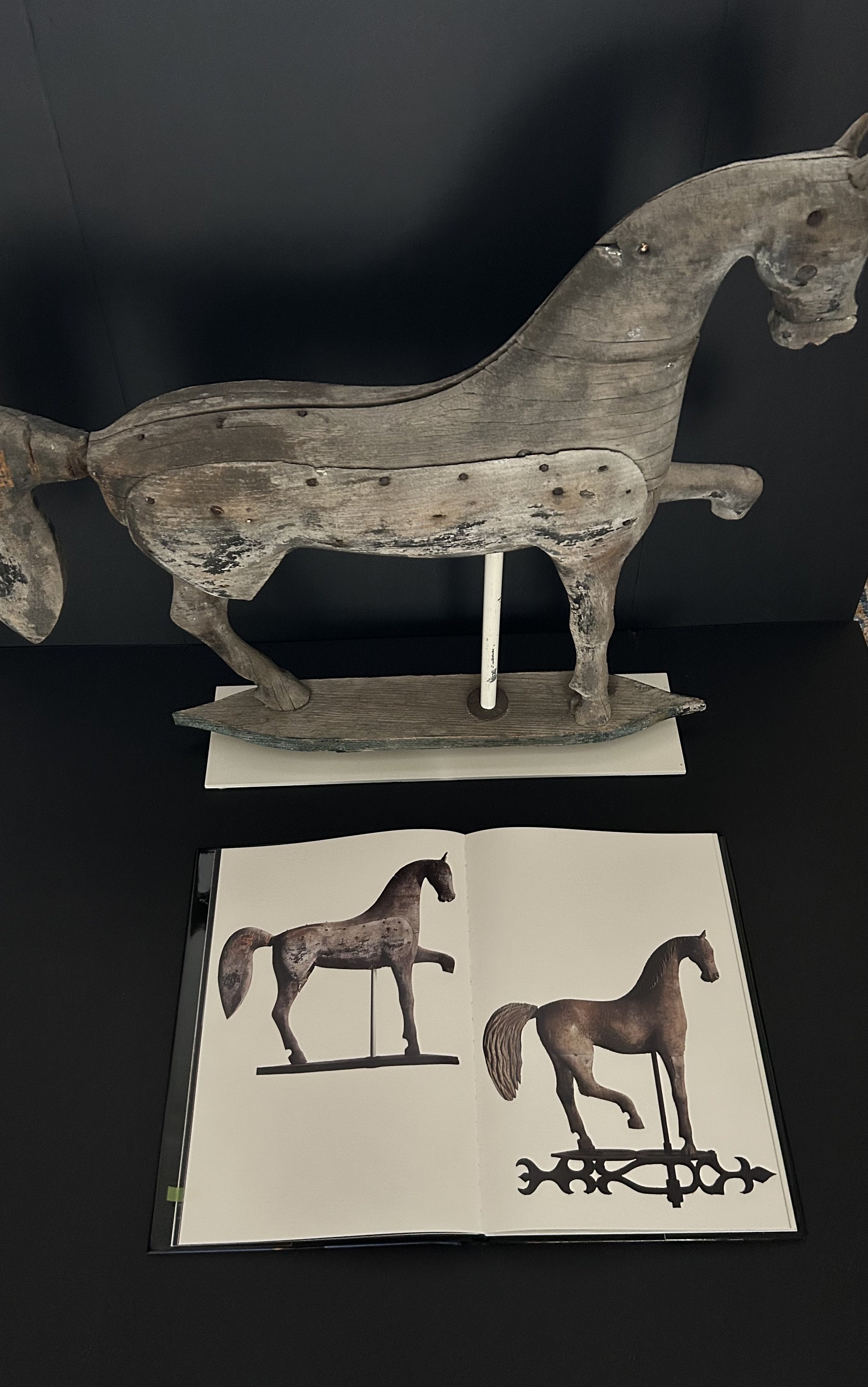 Image 7 of 9
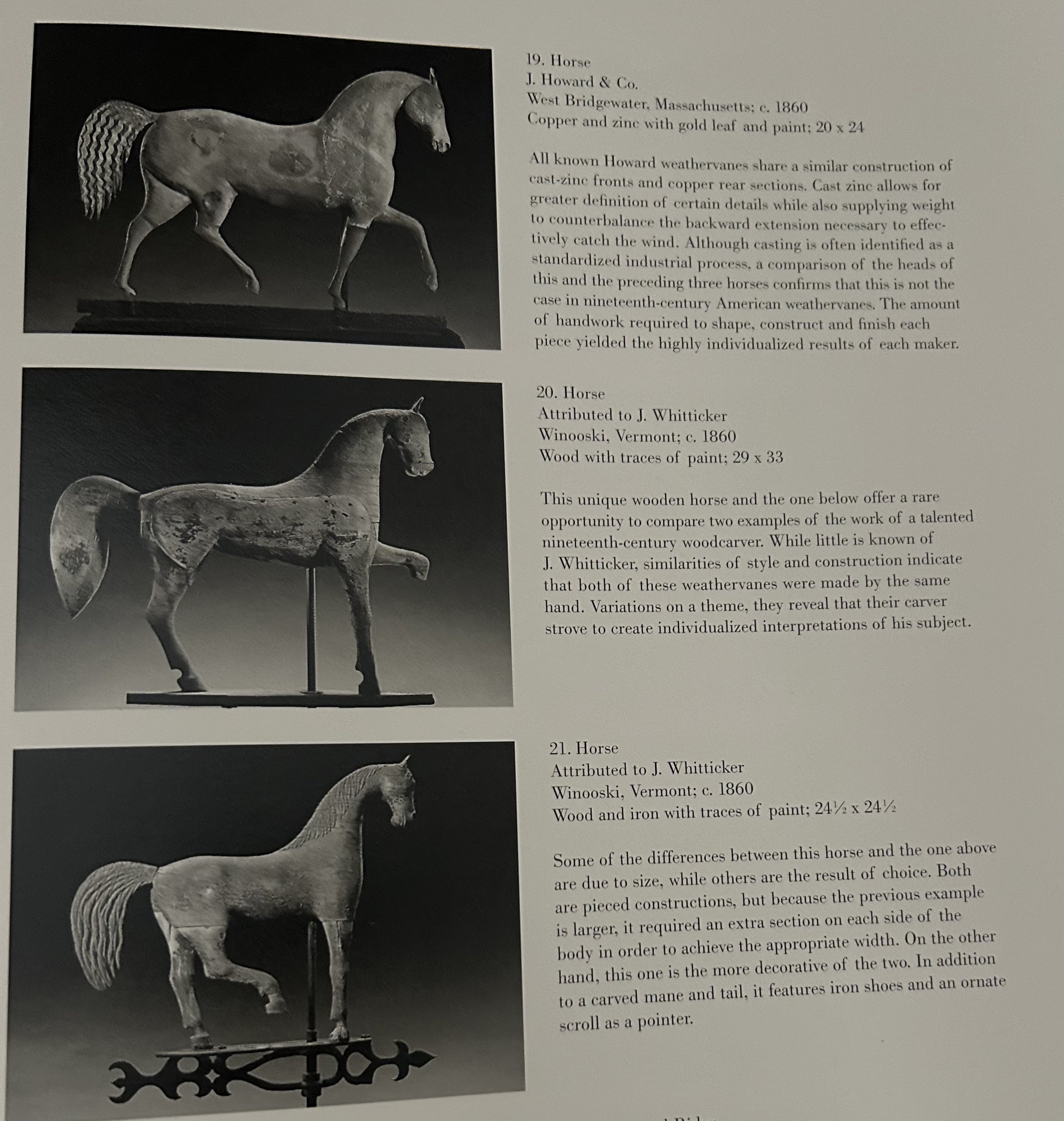 Image 8 of 9
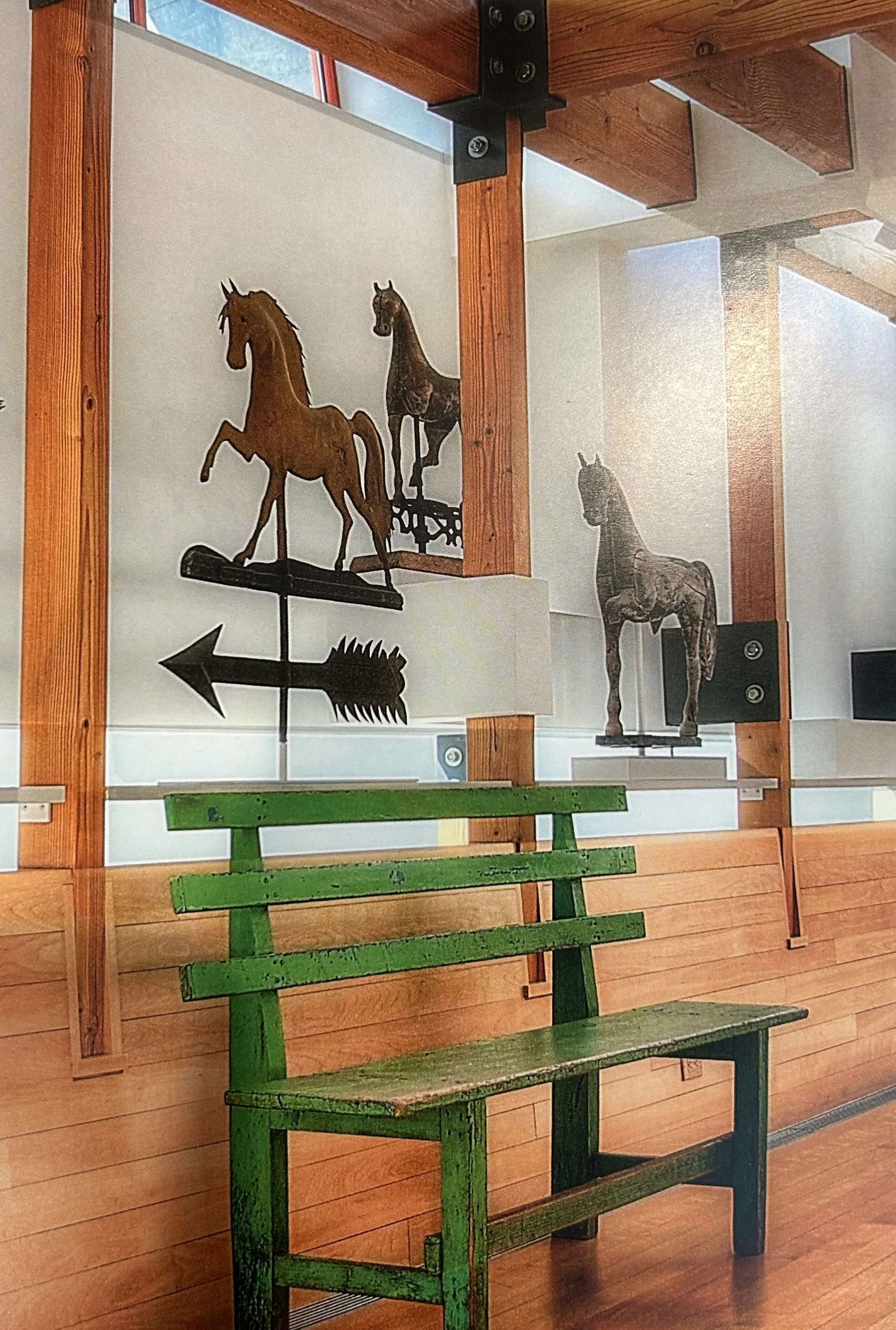 Image 9 of 9
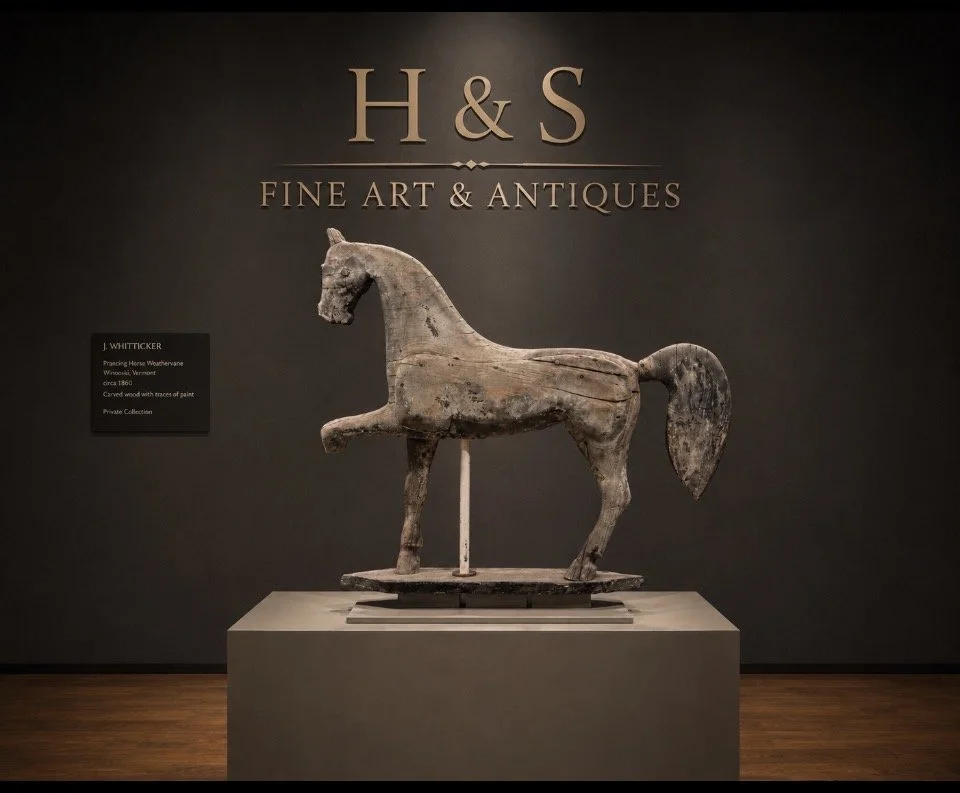
Prancing Horse Attributed to J. Whitticker, Carved wood weathervane circa 1860, height 29 in. by length 33 in. Formerly in the celebrated David Teiger Collection, one of the finest private collections
J. WHITTICKER (ATTRIBUTED)
Prancing Horse Weathervane
Winooski, Vermont, circa 1860
Carved wood with traces of original paint.
Provenance:
Paquette Family, Winooski, Vermont;
Ken Arthur, Vermont;
Gaglio and Molnar, Wurtsboro, New York;
The Important American Folk Art Collection of David Teiger;
Sold to benefit the Teiger Foundation for the support of Contemporary Art.
Literature:
Kenneth Fitzgerald, Weathervanes and Whirligigs (New York: Clarkson N. Potter, 1967), p. 95;
Art & Antiques, January 1985, pp. 44–45;
Tom Geismar and Harvey Kahn, Spiritually Moving: A Collection of American Folk Art Sculpture (New York: Harry N. Abrams, 1998), cat. no. 20, illustrated in color.
Literature
Among the most compelling expressions of nineteenth-century American folk sculpture are the rare surviving wooden weathervanes fashioned by local craftsmen before the rise of commercially produced sheet-metal examples. This remarkable prancing horse, attributed to J. Whitticker of Winooski, Vermont and dating to circa 1860, represents an extraordinary survival from that formative period in American decorative arts.
Carved entirely by hand and retaining traces of its original painted surface, the horse possesses a powerful sculptural presence characterized by its elongated neck, bold profile, and simplified forms. The weathered surface, extensive age cracks, and evidence of long exposure to the elements speak not to deterioration alone, but to a remarkable history of survival spanning more than one hundred and sixty-five years.
Created on the eve of the Civil War, this horse predates the great period of mass-produced sheet-metal weathervanes that came to dominate the American landscape in the decades following the conflict. While metal horse weathervanes are encountered with some frequency, surviving carved wooden examples are exceedingly scarce. In more than three decades of collecting and dealing in American folk art and Americana, comparable wooden horse weathervanes of this quality and character have appeared only rarely.
The present example is particularly distinguished by its provenance and publication history. Formerly part of the renowned David Teiger Collection, one of the most important private collections of American folk art assembled in the twentieth century, the horse is illustrated in several landmark references devoted to American weathervanes and folk sculpture. The Geismar and Kahn publication notes that this example is the larger of two similar horse vanes attributed to Whitticker formerly in the Teiger Collection.
Condition losses and structural wear, including the absence of one leg, are consistent with the object's intended use and long life outdoors. Far from diminishing its appeal, these characteristics testify to the rarity of its survival. Few wooden objects exposed to the harsh New England climate during the nineteenth century have endured with such visual power and authenticity.
Today, this remarkable horse stands not merely as a utilitarian object, but as an important example of American vernacular sculpture—a work embodying the ingenuity, craftsmanship, and enduring spirit of nineteenth-century America. Its rarity, documented provenance, and extraordinary sculptural presence place it among the most desirable forms of American folk art.
Provenance
The remarkable history of ownership of this Prancing Horse Weathervane reflects more than a century of connoisseurship and places the sculpture within one of the most distinguished collecting traditions in American folk art. Each successive owner contributed to the preservation, scholarship, and appreciation of this exceptional work, creating an unbroken chain that connects nineteenth-century rural craftsmanship with many of the leading collectors, dealers, and institutions responsible for elevating American folk art to international recognition.
The Paquette Family, Winooski, Vermont
The earliest documented provenance traces the weathervane to the Paquette family of Winooski, Vermont, where it remained for generations. Its preservation within the community where it was originally created is of considerable historical importance. Unlike many surviving weathervanes that lost their local associations through repeated commercial transactions, this horse retained a direct connection to its Vermont origins. Such uninterrupted regional ownership lends credibility to the traditional attribution to J. Whitticker and provides valuable insight into the cultural landscape from which the sculpture emerged.
Ken Arthur, Vermont
The horse later entered the collection of Ken Arthur, a respected Vermont collector and dealer known for recognizing outstanding examples of early New England folk art. During the second half of the twentieth century, collectors such as Arthur played a vital role in preserving vernacular American objects at a time when many remained underappreciated. Their careful stewardship ensured that important works like the present horse survived to be studied and appreciated by later generations.
Gaglio & Molnar, Wurtsboro, New York
The sculpture subsequently passed through Gaglio & Molnar, one of the country's most respected dealerships specializing in early American folk art and Americana. Throughout the late twentieth century, the firm developed a reputation for discovering and placing museum-quality objects into significant private and institutional collections. Their emphasis on authenticity, scholarship, and historical integrity helped establish many now-celebrated works within the canon of American folk art.
David Teiger (1929–2014)
Perhaps the most distinguished chapter in the horse's history began when it entered the collection of David Teiger, one of the most visionary collectors of American folk art assembled during the late twentieth and early twenty-first centuries.
Although widely recognized for his patronage of contemporary art, Teiger quietly assembled an extraordinary collection of American folk sculpture defined not by quantity but by exceptional artistic quality. He approached collecting with the eye of a modern art connoisseur, selecting objects for their sculptural presence, originality, and aesthetic power rather than solely for their historical importance. His collection united masterpieces of nineteenth-century American folk art with works by leading contemporary artists, demonstrating his belief that great sculpture transcends period, geography, and academic tradition.
Many of the finest objects in the Teiger Collection had already passed through America's most distinguished collections and galleries before entering his possession. His discerning taste earned widespread admiration among museum curators, scholars, and advanced collectors, and today his name is regarded as one of the most respected provenances in the field of American folk art.
Following his death in 2014, the Teiger Foundation continued his philanthropic vision by supporting curators, exhibitions, and innovative museum projects internationally. The proceeds from the sale of his folk art collection were directed toward advancing contemporary art through the Foundation, creating a unique bridge between America's historic vernacular traditions and the art of the present.
Sotheby's, New York
Following Teiger's death, the horse was offered as Lot 1208 in Sotheby's landmark auction:
The History of Now: The Important American Folk Art Collection of David Teiger
New York
20 January 2019
This sale is widely regarded as one of the defining Americana auctions of the twenty-first century. Bringing together masterpieces assembled over decades by one of America's most discerning collectors, the auction attracted museums, major private collectors, and leading dealers from across the United States and abroad. The inclusion of the present horse in this celebrated collection firmly establishes its place among the finest surviving examples of nineteenth-century American folk sculpture.
Published Literature
The sculpture possesses an unusually strong and sustained publication history extending across more than three decades. Its repeated appearance in respected books and periodicals demonstrates that it was recognized as an important work long before its inclusion in the David Teiger Collection.
Kenneth Fitzgerald, Weathervanes and Whirligigs, 1967
The horse was illustrated in Kenneth Fitzgerald’s Weathervanes and Whirligigs, published in New York by Clarkson N. Potter in 1967, page 95. This early publication is important because Fitzgerald’s book was among the pioneering twentieth-century studies devoted specifically to American weathervanes and wind-driven folk objects.
At the time of its publication, American folk sculpture was only gradually being established as an independent field of serious scholarship and collecting. Inclusion in Fitzgerald’s volume documents the horse’s recognition by at least 1967 and provides an important chronological anchor in its modern history. It also demonstrates that the object was already considered sufficiently distinctive to represent the carved wooden weathervane tradition in a specialized reference work.
Art & Antiques, January 1985
The horse was subsequently discussed and illustrated in Art & Antiques, January 1985, pages 44–45. Its appearance in a nationally distributed art publication reflects the expanding appreciation of American folk art during the late twentieth century, when objects once classified primarily as rural artifacts were increasingly evaluated for their formal and sculptural qualities.
This 1985 publication also strengthens the documented history of the horse before its later association with the Geismar and Kahn collection and David Teiger. It establishes that the sculpture was known to the broader art market and scholarly community decades before the Sotheby’s sale.
Tom Geismar and Harvey Kahn, Spiritually Moving, 1998
The sculpture’s most important publication is Tom Geismar and Harvey Kahn’s Spiritually Moving: A Collection of American Folk Art Sculpture, published by Harry N. Abrams in 1998. It appears as catalogue number 20 and is illustrated in color.
This landmark volume presented American folk objects principally as sculpture rather than as quaint survivals or decorative accessories. The selected works were chosen for strength of form, originality, surface, emotional presence, and the ability to stand independently as works of art. Inclusion therefore places the Whitticker horse within a highly selective group of American folk sculptures recognized for exceptional visual and artistic merit.
The book reportedly identifies the present work as the larger of two related carved horse weathervanes attributed to J. Whitticker. That comparison is particularly significant because it helps define a small attributed group through shared characteristics of construction, profile, movement, and regional origin. Until further documentary evidence concerning Whitticker is discovered, the attribution should remain qualified as “attributed to J. Whitticker,” but the long-standing published association carries genuine scholarly weight.
Exhibition and Museum Context
While no formal museum exhibition history for this specific sculpture has presently been documented, closely related American weathervanes have been studied and exhibited by leading institutions as important works of vernacular sculpture and design. The American Folk Art Museum’s landmark exhibition American Weathervanes: The Art of the Winds examined weathervanes as public art, architectural ornament, and sculptural expressions of American identity. The National Gallery of Art has likewise preserved representations of historic weathervanes through the Index of American Design and explored their relationship to American modernism. Within this broader museum context, the present carved wooden horse is especially notable for its early date, Vermont origin, dynamic silhouette, historic surface, and exceptional survival.
Curator’s Note
This Prancing Horse Weathervane, attributed to J. Whitticker and dating to circa 1860, is distinguished not only by its rarity, but by the remarkable clarity of its sculptural conception. The raised foreleg, extended neck, and sweeping tail create a silhouette of unusual vitality, while the weathered surface preserves the visual record of the object’s long life in the open air. It was made to turn with the wind, yet its enduring power lies in the stillness of its form.
The sculpture belongs to an especially scarce group of nineteenth-century carved wooden weathervanes produced before commercially manufactured metal examples became widespread. Its hand-carved construction, regional Vermont history, traces of original paint, and long-established published record place it well beyond the category of architectural ornament. It should be understood as an important work of American vernacular sculpture.
Seen today, the work bridges several worlds. It is at once a functional object, a regional artifact, a record of hand craftsmanship, and an independent sculpture of striking modernity. Its bold reduction of the horse to essential line and mass gives it a timeless quality that allows it to stand comfortably beside both historic folk sculpture and twentieth-century modern art.
For H&S Fine Art & Antiques, this work represents the kind of object around which a serious collection can be built: rare, published, historically grounded, visually commanding, and supported by distinguished provenance. It is not simply an old weathervane. It is a surviving expression of American imagination, shaped by hand, animated by wind, and preserved through generations of connoisseurship.
J. WHITTICKER (ATTRIBUTED)
Prancing Horse Weathervane
Winooski, Vermont, circa 1860
Carved wood with traces of original paint.
Provenance:
Paquette Family, Winooski, Vermont;
Ken Arthur, Vermont;
Gaglio and Molnar, Wurtsboro, New York;
The Important American Folk Art Collection of David Teiger;
Sold to benefit the Teiger Foundation for the support of Contemporary Art.
Literature:
Kenneth Fitzgerald, Weathervanes and Whirligigs (New York: Clarkson N. Potter, 1967), p. 95;
Art & Antiques, January 1985, pp. 44–45;
Tom Geismar and Harvey Kahn, Spiritually Moving: A Collection of American Folk Art Sculpture (New York: Harry N. Abrams, 1998), cat. no. 20, illustrated in color.
Literature
Among the most compelling expressions of nineteenth-century American folk sculpture are the rare surviving wooden weathervanes fashioned by local craftsmen before the rise of commercially produced sheet-metal examples. This remarkable prancing horse, attributed to J. Whitticker of Winooski, Vermont and dating to circa 1860, represents an extraordinary survival from that formative period in American decorative arts.
Carved entirely by hand and retaining traces of its original painted surface, the horse possesses a powerful sculptural presence characterized by its elongated neck, bold profile, and simplified forms. The weathered surface, extensive age cracks, and evidence of long exposure to the elements speak not to deterioration alone, but to a remarkable history of survival spanning more than one hundred and sixty-five years.
Created on the eve of the Civil War, this horse predates the great period of mass-produced sheet-metal weathervanes that came to dominate the American landscape in the decades following the conflict. While metal horse weathervanes are encountered with some frequency, surviving carved wooden examples are exceedingly scarce. In more than three decades of collecting and dealing in American folk art and Americana, comparable wooden horse weathervanes of this quality and character have appeared only rarely.
The present example is particularly distinguished by its provenance and publication history. Formerly part of the renowned David Teiger Collection, one of the most important private collections of American folk art assembled in the twentieth century, the horse is illustrated in several landmark references devoted to American weathervanes and folk sculpture. The Geismar and Kahn publication notes that this example is the larger of two similar horse vanes attributed to Whitticker formerly in the Teiger Collection.
Condition losses and structural wear, including the absence of one leg, are consistent with the object's intended use and long life outdoors. Far from diminishing its appeal, these characteristics testify to the rarity of its survival. Few wooden objects exposed to the harsh New England climate during the nineteenth century have endured with such visual power and authenticity.
Today, this remarkable horse stands not merely as a utilitarian object, but as an important example of American vernacular sculpture—a work embodying the ingenuity, craftsmanship, and enduring spirit of nineteenth-century America. Its rarity, documented provenance, and extraordinary sculptural presence place it among the most desirable forms of American folk art.
Provenance
The remarkable history of ownership of this Prancing Horse Weathervane reflects more than a century of connoisseurship and places the sculpture within one of the most distinguished collecting traditions in American folk art. Each successive owner contributed to the preservation, scholarship, and appreciation of this exceptional work, creating an unbroken chain that connects nineteenth-century rural craftsmanship with many of the leading collectors, dealers, and institutions responsible for elevating American folk art to international recognition.
The Paquette Family, Winooski, Vermont
The earliest documented provenance traces the weathervane to the Paquette family of Winooski, Vermont, where it remained for generations. Its preservation within the community where it was originally created is of considerable historical importance. Unlike many surviving weathervanes that lost their local associations through repeated commercial transactions, this horse retained a direct connection to its Vermont origins. Such uninterrupted regional ownership lends credibility to the traditional attribution to J. Whitticker and provides valuable insight into the cultural landscape from which the sculpture emerged.
Ken Arthur, Vermont
The horse later entered the collection of Ken Arthur, a respected Vermont collector and dealer known for recognizing outstanding examples of early New England folk art. During the second half of the twentieth century, collectors such as Arthur played a vital role in preserving vernacular American objects at a time when many remained underappreciated. Their careful stewardship ensured that important works like the present horse survived to be studied and appreciated by later generations.
Gaglio & Molnar, Wurtsboro, New York
The sculpture subsequently passed through Gaglio & Molnar, one of the country's most respected dealerships specializing in early American folk art and Americana. Throughout the late twentieth century, the firm developed a reputation for discovering and placing museum-quality objects into significant private and institutional collections. Their emphasis on authenticity, scholarship, and historical integrity helped establish many now-celebrated works within the canon of American folk art.
David Teiger (1929–2014)
Perhaps the most distinguished chapter in the horse's history began when it entered the collection of David Teiger, one of the most visionary collectors of American folk art assembled during the late twentieth and early twenty-first centuries.
Although widely recognized for his patronage of contemporary art, Teiger quietly assembled an extraordinary collection of American folk sculpture defined not by quantity but by exceptional artistic quality. He approached collecting with the eye of a modern art connoisseur, selecting objects for their sculptural presence, originality, and aesthetic power rather than solely for their historical importance. His collection united masterpieces of nineteenth-century American folk art with works by leading contemporary artists, demonstrating his belief that great sculpture transcends period, geography, and academic tradition.
Many of the finest objects in the Teiger Collection had already passed through America's most distinguished collections and galleries before entering his possession. His discerning taste earned widespread admiration among museum curators, scholars, and advanced collectors, and today his name is regarded as one of the most respected provenances in the field of American folk art.
Following his death in 2014, the Teiger Foundation continued his philanthropic vision by supporting curators, exhibitions, and innovative museum projects internationally. The proceeds from the sale of his folk art collection were directed toward advancing contemporary art through the Foundation, creating a unique bridge between America's historic vernacular traditions and the art of the present.
Sotheby's, New York
Following Teiger's death, the horse was offered as Lot 1208 in Sotheby's landmark auction:
The History of Now: The Important American Folk Art Collection of David Teiger
New York
20 January 2019
This sale is widely regarded as one of the defining Americana auctions of the twenty-first century. Bringing together masterpieces assembled over decades by one of America's most discerning collectors, the auction attracted museums, major private collectors, and leading dealers from across the United States and abroad. The inclusion of the present horse in this celebrated collection firmly establishes its place among the finest surviving examples of nineteenth-century American folk sculpture.
Published Literature
The sculpture possesses an unusually strong and sustained publication history extending across more than three decades. Its repeated appearance in respected books and periodicals demonstrates that it was recognized as an important work long before its inclusion in the David Teiger Collection.
Kenneth Fitzgerald, Weathervanes and Whirligigs, 1967
The horse was illustrated in Kenneth Fitzgerald’s Weathervanes and Whirligigs, published in New York by Clarkson N. Potter in 1967, page 95. This early publication is important because Fitzgerald’s book was among the pioneering twentieth-century studies devoted specifically to American weathervanes and wind-driven folk objects.
At the time of its publication, American folk sculpture was only gradually being established as an independent field of serious scholarship and collecting. Inclusion in Fitzgerald’s volume documents the horse’s recognition by at least 1967 and provides an important chronological anchor in its modern history. It also demonstrates that the object was already considered sufficiently distinctive to represent the carved wooden weathervane tradition in a specialized reference work.
Art & Antiques, January 1985
The horse was subsequently discussed and illustrated in Art & Antiques, January 1985, pages 44–45. Its appearance in a nationally distributed art publication reflects the expanding appreciation of American folk art during the late twentieth century, when objects once classified primarily as rural artifacts were increasingly evaluated for their formal and sculptural qualities.
This 1985 publication also strengthens the documented history of the horse before its later association with the Geismar and Kahn collection and David Teiger. It establishes that the sculpture was known to the broader art market and scholarly community decades before the Sotheby’s sale.
Tom Geismar and Harvey Kahn, Spiritually Moving, 1998
The sculpture’s most important publication is Tom Geismar and Harvey Kahn’s Spiritually Moving: A Collection of American Folk Art Sculpture, published by Harry N. Abrams in 1998. It appears as catalogue number 20 and is illustrated in color.
This landmark volume presented American folk objects principally as sculpture rather than as quaint survivals or decorative accessories. The selected works were chosen for strength of form, originality, surface, emotional presence, and the ability to stand independently as works of art. Inclusion therefore places the Whitticker horse within a highly selective group of American folk sculptures recognized for exceptional visual and artistic merit.
The book reportedly identifies the present work as the larger of two related carved horse weathervanes attributed to J. Whitticker. That comparison is particularly significant because it helps define a small attributed group through shared characteristics of construction, profile, movement, and regional origin. Until further documentary evidence concerning Whitticker is discovered, the attribution should remain qualified as “attributed to J. Whitticker,” but the long-standing published association carries genuine scholarly weight.
Exhibition and Museum Context
While no formal museum exhibition history for this specific sculpture has presently been documented, closely related American weathervanes have been studied and exhibited by leading institutions as important works of vernacular sculpture and design. The American Folk Art Museum’s landmark exhibition American Weathervanes: The Art of the Winds examined weathervanes as public art, architectural ornament, and sculptural expressions of American identity. The National Gallery of Art has likewise preserved representations of historic weathervanes through the Index of American Design and explored their relationship to American modernism. Within this broader museum context, the present carved wooden horse is especially notable for its early date, Vermont origin, dynamic silhouette, historic surface, and exceptional survival.
Curator’s Note
This Prancing Horse Weathervane, attributed to J. Whitticker and dating to circa 1860, is distinguished not only by its rarity, but by the remarkable clarity of its sculptural conception. The raised foreleg, extended neck, and sweeping tail create a silhouette of unusual vitality, while the weathered surface preserves the visual record of the object’s long life in the open air. It was made to turn with the wind, yet its enduring power lies in the stillness of its form.
The sculpture belongs to an especially scarce group of nineteenth-century carved wooden weathervanes produced before commercially manufactured metal examples became widespread. Its hand-carved construction, regional Vermont history, traces of original paint, and long-established published record place it well beyond the category of architectural ornament. It should be understood as an important work of American vernacular sculpture.
Seen today, the work bridges several worlds. It is at once a functional object, a regional artifact, a record of hand craftsmanship, and an independent sculpture of striking modernity. Its bold reduction of the horse to essential line and mass gives it a timeless quality that allows it to stand comfortably beside both historic folk sculpture and twentieth-century modern art.
For H&S Fine Art & Antiques, this work represents the kind of object around which a serious collection can be built: rare, published, historically grounded, visually commanding, and supported by distinguished provenance. It is not simply an old weathervane. It is a surviving expression of American imagination, shaped by hand, animated by wind, and preserved through generations of connoisseurship.