 Image 1 of 3
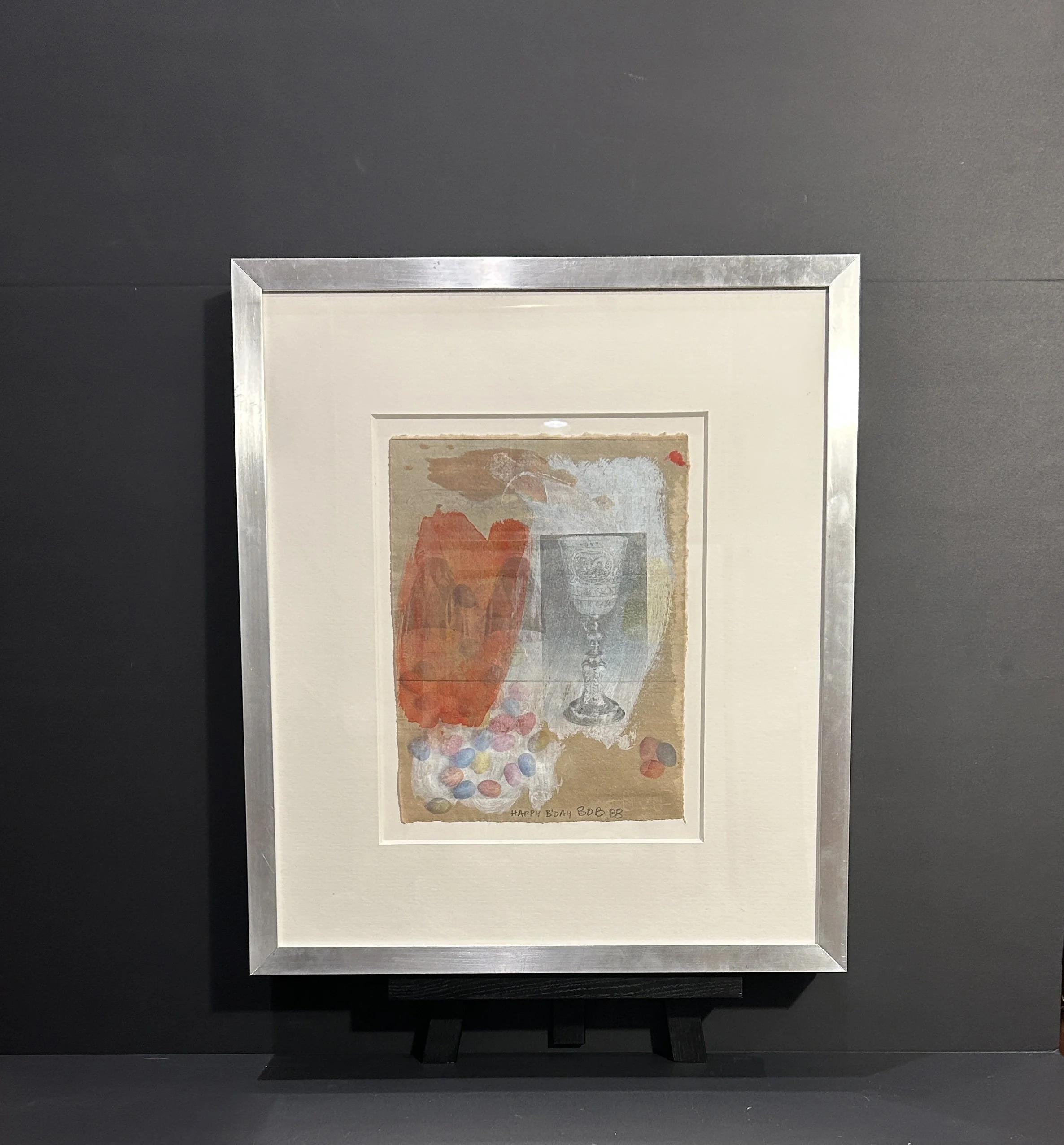 Image 2 of 3
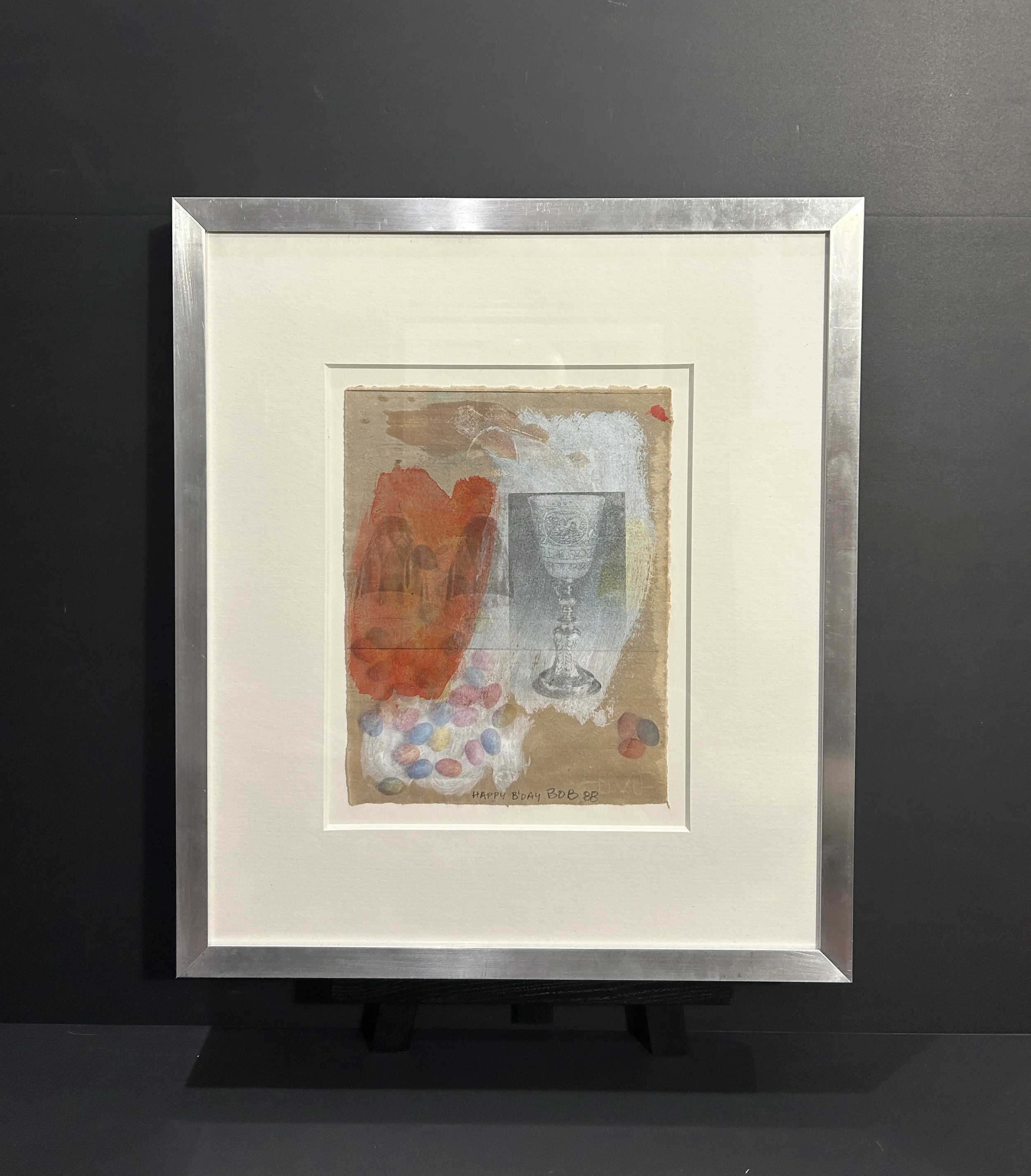 Image 3 of 3
Robert Rauschenberg, 1925-2008. Untitled.
Robert Rauschenberg (1925–2008)
Untitled, 1988
Signed, dated, and inscribed “HAPPY B’ DAY BOB 88” lower center
Acrylic, graphite, and solvent transfer on handmade paper
11 ¾ x 8 ¾ inches
Provenance:
Bradley Jeffries, Florida
Acquired by descent from the above by the present owner
Exhibition History
Exhibited in:
Fort Myers, Florida Southwestern State College, Bob Rauschenberg Gallery
Lexington, University of Kentucky Art Museum
Asheville, Black Mountain College Museum + Art Center
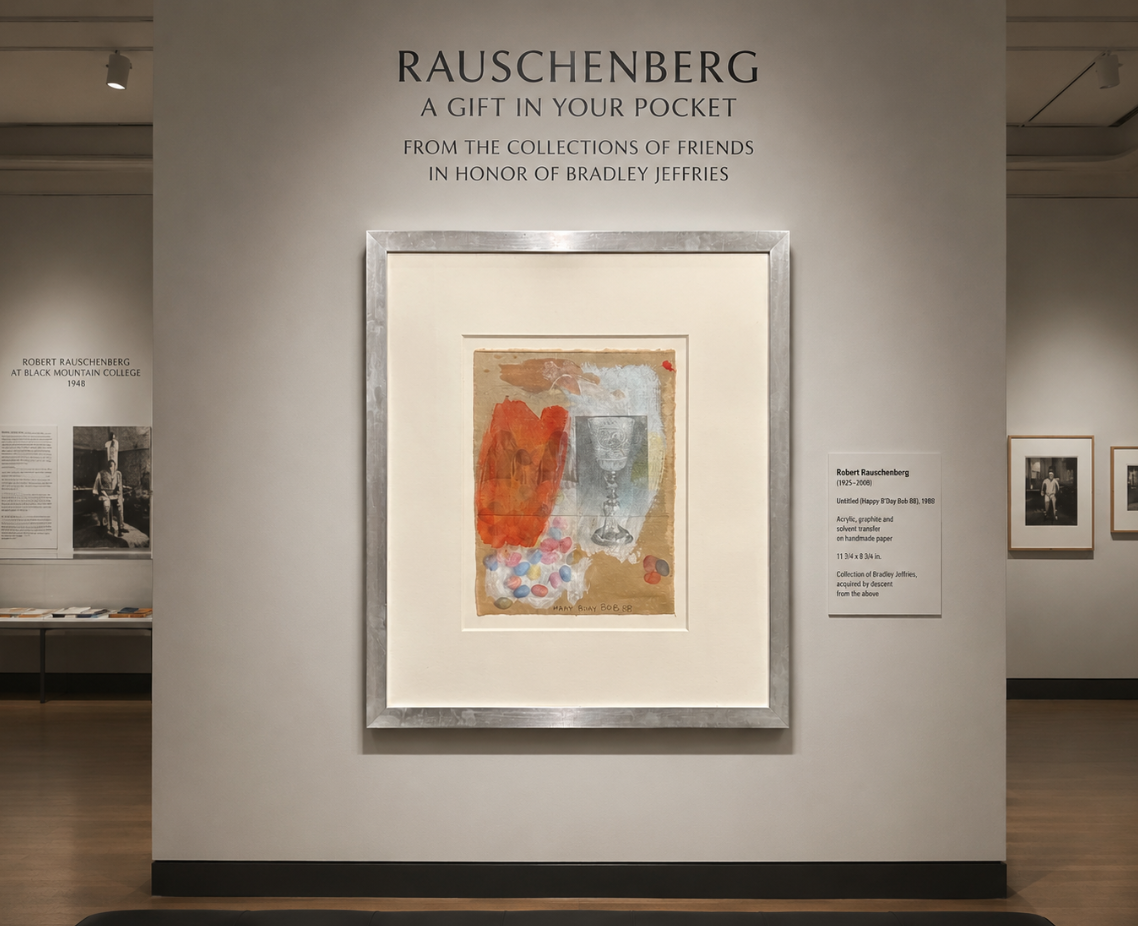
Rauschenberg: A Gift in Your Pocket from the Collections of Friends in Honor of Bradley Jeffries, April 2022–May 2023.
The exhibition brought together rare and previously unseen paintings, drawings, photographs, personal objects, and ephemera gifted to Bradley Jeffries by Rauschenberg. It was curated by Jade Dellinger, Director of the Bob Rauschenberg Gallery.
Exhibition Essay
Robert Rauschenberg: Memory, Celebration, and the Poetry of Objects
This intimate mixed-media work, executed in 1988, exemplifies Robert Rauschenberg's lifelong fascination with layering imagery, personal references, and everyday objects into poetic visual experiences. Though modest in scale, Untitled possesses the visual complexity and conceptual depth that define Rauschenberg's mature works.
The composition presents a translucent silver goblet emerging from a field of expressive brushwork and scattered, jewel-like forms. A broad passage of vibrant orange paint occupies the left side of the sheet, balancing the cooler silver and pale blue tones that surround the chalice. Across the lower register, colorful circular forms evoke confetti, candies, or celebratory petals.
The handwritten inscription, “HAPPY B’ DAY BOB 88,” transforms the work from a purely formal exercise into something deeply personal—a commemorative object, perhaps intended for a friend or associate named Bob. Such inscriptions reveal an important aspect of Rauschenberg's practice: art as a social exchange and as an extension of human relationships.
Artist
Robert Rauschenberg was one of the most important American artists of the postwar period. He worked across painting, drawing, printmaking, photography, sculpture, performance, and collage. He is closely associated with Neo-Dada and helped open the path toward Pop Art by incorporating ordinary images and objects into fine art. He studied at Black Mountain College in North Carolina, an important avant-garde center that shaped his early career.
The Goblet as Symbol
The central image of the goblet carries rich symbolic associations:
Celebration and ceremony
Memory and friendship
Abundance and communion
The transformation of ordinary objects into vessels of meaning
Throughout art history, goblets and chalices have represented both sacred and secular rituals. In Rauschenberg's hands, the goblet becomes less a literal object and more an image suspended between memory and abstraction.
Its ghostly appearance, produced through solvent transfer and translucent layering, suggests an image recalled rather than directly observed—a memory emerging from fragments of experience.
Technique and Process
This work beautifully demonstrates several techniques that became hallmarks of Rauschenberg's mature practice.
Acrylic Paint
The orange passages exhibit the artist's energetic brushwork and spontaneous handling of color. Rather than modeling form conventionally, color operates as an emotional and compositional force.
Graphite
The graphite passages introduce drawing into the composition, creating a dialogue between gesture and structure.
Solvent Transfer
Perhaps most significant is the solvent transfer process. Beginning in the late 1950s, Rauschenberg pioneered methods of transferring photographic imagery onto paper and canvas. These transferred images often appear partially dissolved or faded, creating dreamlike associations and temporal ambiguity.
The chalice in this work appears to hover between presence and disappearance, reinforcing themes of memory and impermanence.
Handmade Paper
The deckled edges and textured handmade paper are integral to the work's physical presence. Rauschenberg frequently embraced materials that retained evidence of their making, allowing the paper itself to participate in the visual composition.
Rauschenberg's Artistic Philosophy
Robert Rauschenberg transformed postwar American art by dissolving the boundaries between painting, sculpture, photography, and everyday life.
He famously remarked:
"Painting relates to both art and life. Neither can be made. I try to act in that gap between the two."
This philosophy led to the revolutionary Combines of the 1950s and informed his later works on paper, where photographs, found imagery, paint, and drawing coexist in dynamic equilibrium.
Even in this small composition, one sees Rauschenberg's enduring belief that art should remain open, fluid, and responsive to lived experience.
Place Within the Artist's Oeuvre
Created in 1988, Untitled belongs to a mature period in Rauschenberg's career. By this time he had:
Represented the United States at the Venice Biennale
Won the Grand Prize at Venice in 1964
Established himself as one of the most influential artists of the twentieth century
Expanded his practice into global cultural collaborations and experimental printmaking
Works from this period often possess a quieter, more contemplative quality than the monumental Combines, emphasizing intimate relationships between images and materials.
This work's modest scale encourages close viewing, inviting the viewer into a private and almost diary-like visual experience.
Literature and References
The work is referenced as illustrated in color in the exhibition publication:
Rauschenberg: A Gift in Your Pocket from the Collections of Friends in Honor of Bradley Jeffries, Bob Rauschenberg Gallery, 2022.
The Black Mountain College Museum notes that the catalogue includes full exhibition documentation, transcribed conversations with friends of Bradley Jeffries, and an essay by Jade Dellinger.
Important references for understanding this work include:
Venice Biennale
Robert Rauschenberg Foundation
Museum Collections Holding Major Works by Robert Rauschenberg
Museum of Modern Art
Whitney Museum of American Art
Solomon R. Guggenheim Museum
Tate Modern
San Francisco Museum of Modern Art
The Broad
Museum Importance
This work has strong institutional relevance because it was shown at three respected venues connected to Rauschenberg’s life and legacy: the Bob Rauschenberg Gallery in Fort Myers, the University of Kentucky Art Museum, and the Black Mountain College Museum + Art Center. The Black Mountain venue is especially meaningful because Rauschenberg studied at Black Mountain College in 1948.
Suggested Gallery Description
Robert Rauschenberg’s Untitled of 1988 is a tender and intimate mixed-media work created as a birthday dedication. Combining acrylic, graphite, and solvent transfer on handmade paper, the composition transforms ordinary celebratory imagery into a poetic meditation on friendship, memory, and artistic exchange. Its Bradley Jeffries provenance and inclusion in the 2022–2023 traveling exhibition Rauschenberg: A Gift in Your Pocket give the work exceptional personal and institutional significance.
Robert Rauschenberg (1925–2008)
Untitled, 1988
Signed, dated, and inscribed “HAPPY B’ DAY BOB 88” lower center
Acrylic, graphite, and solvent transfer on handmade paper
11 ¾ x 8 ¾ inches
Provenance:
Bradley Jeffries, Florida
Acquired by descent from the above by the present owner
Exhibition History
Exhibited in:
Fort Myers, Florida Southwestern State College, Bob Rauschenberg Gallery
Lexington, University of Kentucky Art Museum
Asheville, Black Mountain College Museum + Art Center
Rauschenberg: A Gift in Your Pocket from the Collections of Friends in Honor of Bradley Jeffries, April 2022–May 2023.
The exhibition brought together rare and previously unseen paintings, drawings, photographs, personal objects, and ephemera gifted to Bradley Jeffries by Rauschenberg. It was curated by Jade Dellinger, Director of the Bob Rauschenberg Gallery.
Exhibition Essay
Robert Rauschenberg: Memory, Celebration, and the Poetry of Objects
This intimate mixed-media work, executed in 1988, exemplifies Robert Rauschenberg's lifelong fascination with layering imagery, personal references, and everyday objects into poetic visual experiences. Though modest in scale, Untitled possesses the visual complexity and conceptual depth that define Rauschenberg's mature works.
The composition presents a translucent silver goblet emerging from a field of expressive brushwork and scattered, jewel-like forms. A broad passage of vibrant orange paint occupies the left side of the sheet, balancing the cooler silver and pale blue tones that surround the chalice. Across the lower register, colorful circular forms evoke confetti, candies, or celebratory petals.
The handwritten inscription, “HAPPY B’ DAY BOB 88,” transforms the work from a purely formal exercise into something deeply personal—a commemorative object, perhaps intended for a friend or associate named Bob. Such inscriptions reveal an important aspect of Rauschenberg's practice: art as a social exchange and as an extension of human relationships.
Artist
Robert Rauschenberg was one of the most important American artists of the postwar period. He worked across painting, drawing, printmaking, photography, sculpture, performance, and collage. He is closely associated with Neo-Dada and helped open the path toward Pop Art by incorporating ordinary images and objects into fine art. He studied at Black Mountain College in North Carolina, an important avant-garde center that shaped his early career.
The Goblet as Symbol
The central image of the goblet carries rich symbolic associations:
Celebration and ceremony
Memory and friendship
Abundance and communion
The transformation of ordinary objects into vessels of meaning
Throughout art history, goblets and chalices have represented both sacred and secular rituals. In Rauschenberg's hands, the goblet becomes less a literal object and more an image suspended between memory and abstraction.
Its ghostly appearance, produced through solvent transfer and translucent layering, suggests an image recalled rather than directly observed—a memory emerging from fragments of experience.
Technique and Process
This work beautifully demonstrates several techniques that became hallmarks of Rauschenberg's mature practice.
Acrylic Paint
The orange passages exhibit the artist's energetic brushwork and spontaneous handling of color. Rather than modeling form conventionally, color operates as an emotional and compositional force.
Graphite
The graphite passages introduce drawing into the composition, creating a dialogue between gesture and structure.
Solvent Transfer
Perhaps most significant is the solvent transfer process. Beginning in the late 1950s, Rauschenberg pioneered methods of transferring photographic imagery onto paper and canvas. These transferred images often appear partially dissolved or faded, creating dreamlike associations and temporal ambiguity.
The chalice in this work appears to hover between presence and disappearance, reinforcing themes of memory and impermanence.
Handmade Paper
The deckled edges and textured handmade paper are integral to the work's physical presence. Rauschenberg frequently embraced materials that retained evidence of their making, allowing the paper itself to participate in the visual composition.
Rauschenberg's Artistic Philosophy
Robert Rauschenberg transformed postwar American art by dissolving the boundaries between painting, sculpture, photography, and everyday life.
He famously remarked:
"Painting relates to both art and life. Neither can be made. I try to act in that gap between the two."
This philosophy led to the revolutionary Combines of the 1950s and informed his later works on paper, where photographs, found imagery, paint, and drawing coexist in dynamic equilibrium.
Even in this small composition, one sees Rauschenberg's enduring belief that art should remain open, fluid, and responsive to lived experience.
Place Within the Artist's Oeuvre
Created in 1988, Untitled belongs to a mature period in Rauschenberg's career. By this time he had:
Represented the United States at the Venice Biennale
Won the Grand Prize at Venice in 1964
Established himself as one of the most influential artists of the twentieth century
Expanded his practice into global cultural collaborations and experimental printmaking
Works from this period often possess a quieter, more contemplative quality than the monumental Combines, emphasizing intimate relationships between images and materials.
This work's modest scale encourages close viewing, inviting the viewer into a private and almost diary-like visual experience.
Literature and References
The work is referenced as illustrated in color in the exhibition publication:
Rauschenberg: A Gift in Your Pocket from the Collections of Friends in Honor of Bradley Jeffries, Bob Rauschenberg Gallery, 2022.
The Black Mountain College Museum notes that the catalogue includes full exhibition documentation, transcribed conversations with friends of Bradley Jeffries, and an essay by Jade Dellinger.
Important references for understanding this work include:
Venice Biennale
Robert Rauschenberg Foundation
Museum Collections Holding Major Works by Robert Rauschenberg
Museum of Modern Art
Whitney Museum of American Art
Solomon R. Guggenheim Museum
Tate Modern
San Francisco Museum of Modern Art
The Broad
Museum Importance
This work has strong institutional relevance because it was shown at three respected venues connected to Rauschenberg’s life and legacy: the Bob Rauschenberg Gallery in Fort Myers, the University of Kentucky Art Museum, and the Black Mountain College Museum + Art Center. The Black Mountain venue is especially meaningful because Rauschenberg studied at Black Mountain College in 1948.
Suggested Gallery Description
Robert Rauschenberg’s Untitled of 1988 is a tender and intimate mixed-media work created as a birthday dedication. Combining acrylic, graphite, and solvent transfer on handmade paper, the composition transforms ordinary celebratory imagery into a poetic meditation on friendship, memory, and artistic exchange. Its Bradley Jeffries provenance and inclusion in the 2022–2023 traveling exhibition Rauschenberg: A Gift in Your Pocket give the work exceptional personal and institutional significance.