 Image 1 of 5
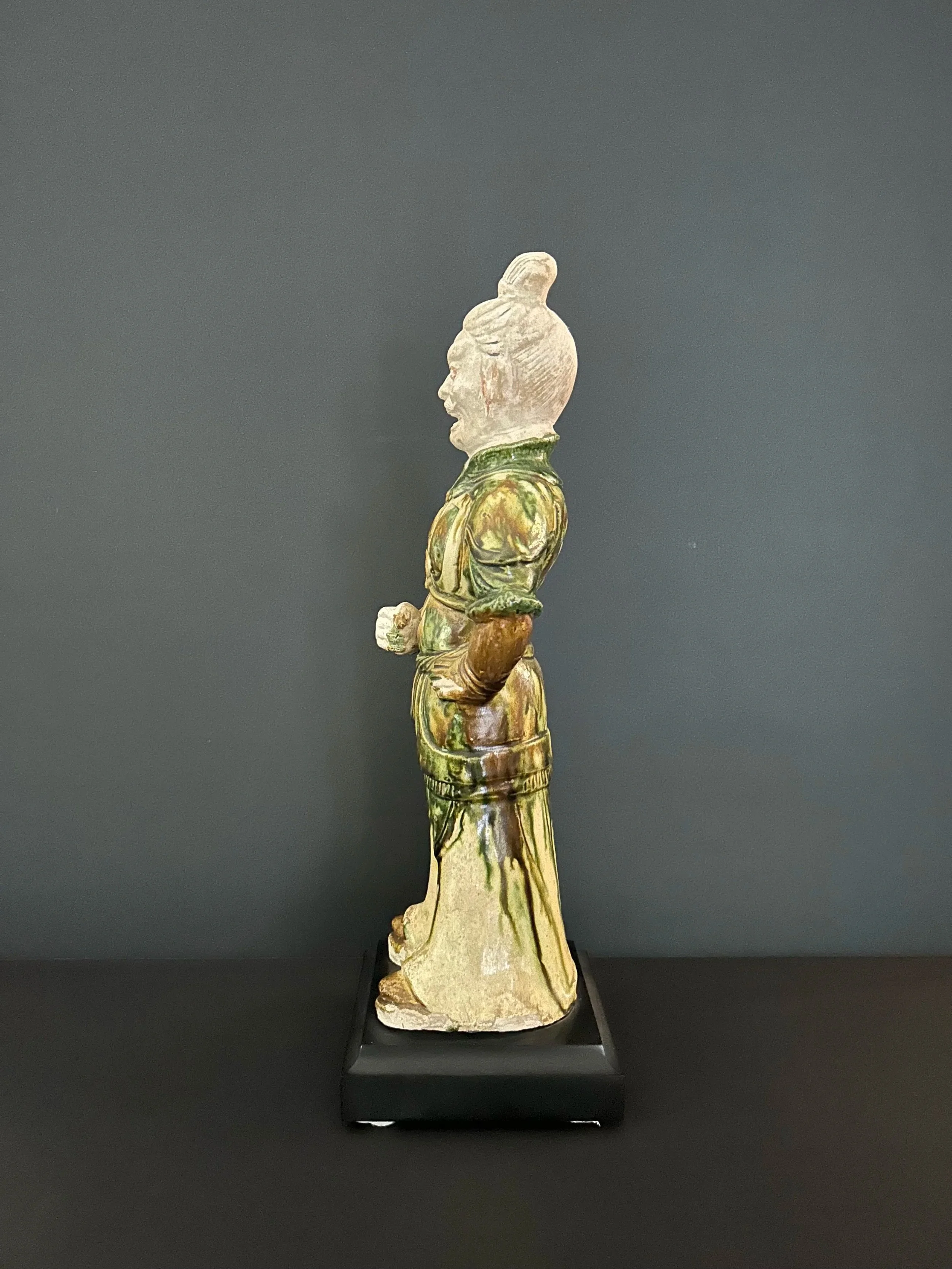 Image 2 of 5
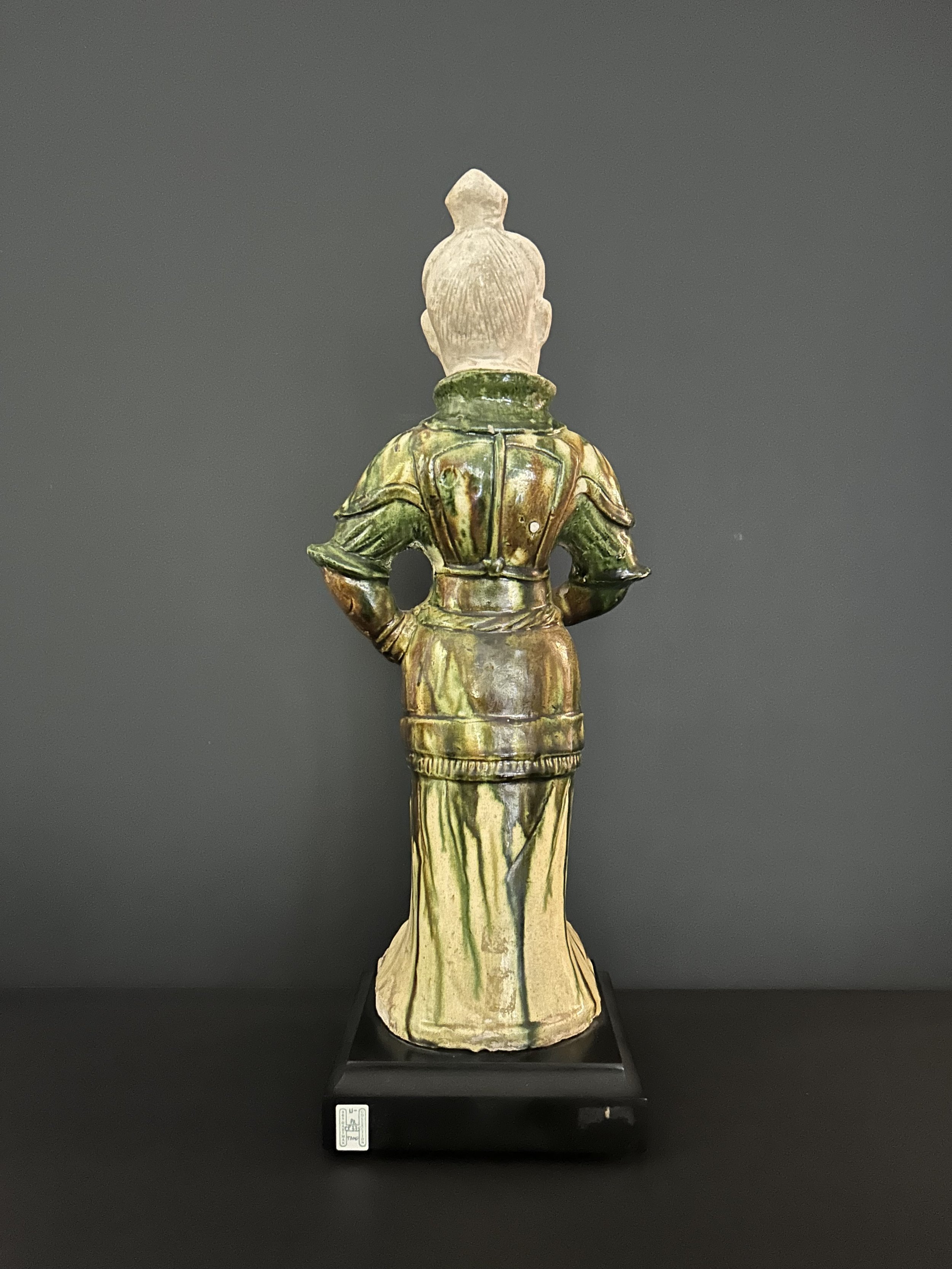 Image 3 of 5
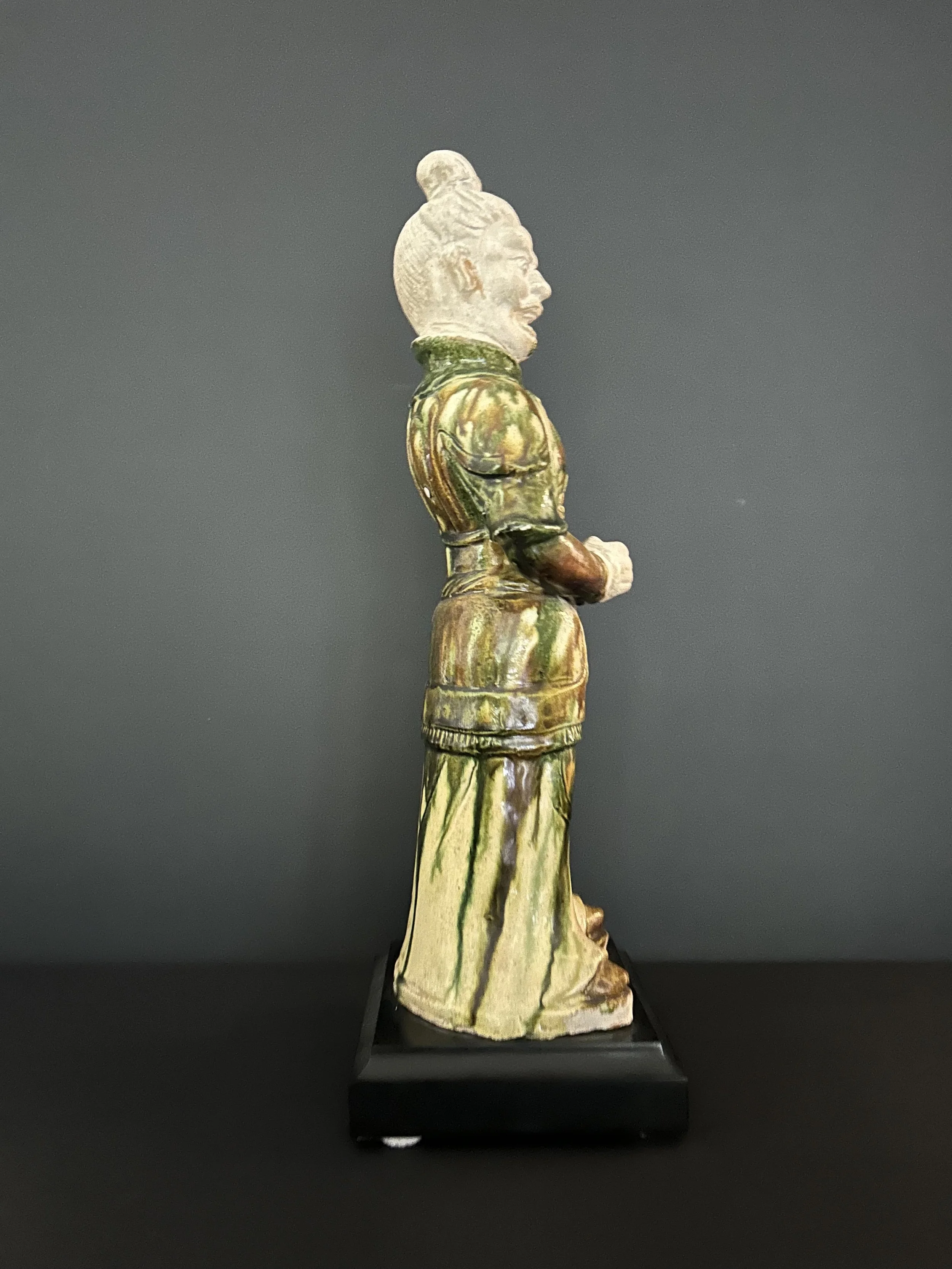 Image 4 of 5
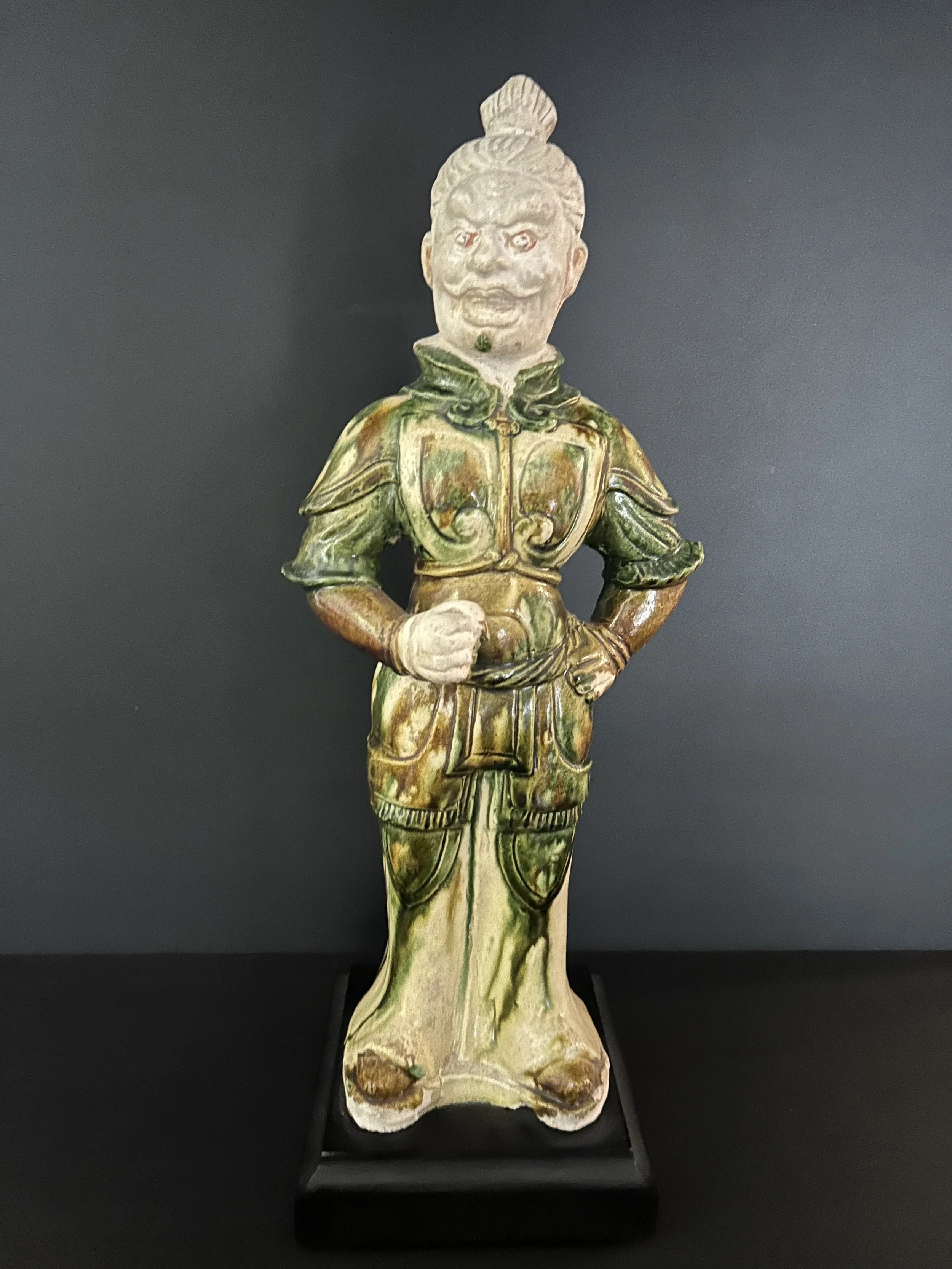 Image 5 of 5
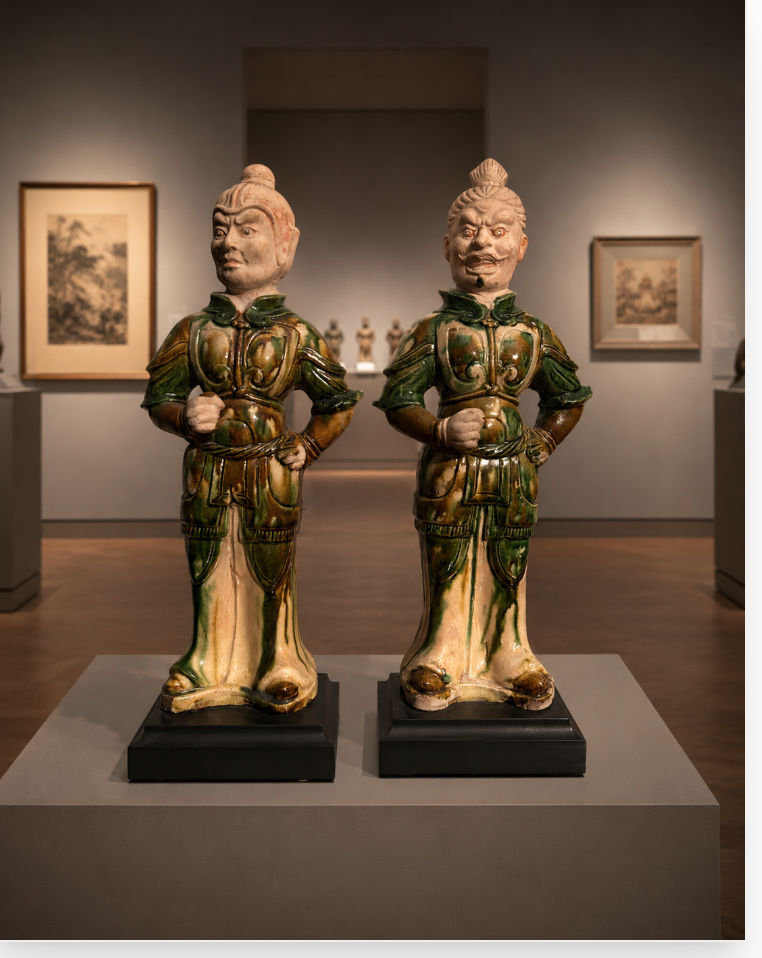
A Pair of Sancai-Glazed Guardian Figures with Breast Plates and Biscuits heads, Tang Dynasty. The Alan and Simone Hartman Collection.
A Pair of Sancai-Glazed Pottery Guardian Warriors
Property from the Alan and Simone Hartman Collection
China | Tang Dynasty (618–907)
Probably late 7th–early 8th century
Glazed earthenware with green, amber, and straw-colored lead glazes; the heads and exposed flesh left principally in the biscuit and originally enhanced with painted pigments.
One figure wearing a close-fitting helmet; each dressed in a low-belted breastplate and collared tunic over layered robes, standing in a commanding frontal pose with the left hand placed upon the hip and the right hand clenched before the body, probably originally intended to hold a weapon or ceremonial implement.
Height: 16 ⅛ in. and 16 ½ in.
Mounted on wood stands
Provenance:
Property from the Alan and Simone Hartman Collection.
EXHIBITION ESSAY
Created more than twelve centuries ago during one of the most prosperous, powerful, and cosmopolitan periods of Chinese civilization, this imposing pair of sancai-glazed guardian warriors represents the extraordinary artistic achievement, international character, and elaborate funerary traditions of the Tang Dynasty.
Standing upright with stern expressions, armored bodies, and clenched fists, the warriors were conceived as eternal sentinels.
They were not created for display in a palace, temple, or domestic interior. They were made specifically for burial and belonged to the important Chinese tradition of mingqi—objects placed within tombs to accompany, protect, and serve the deceased in the afterlife.
Their imposing armor, brilliant green, amber, and straw-colored glazes, individualized facial expressions, and powerful frontal poses embody the political confidence and artistic sophistication of Tang China.
At the same time, the warriors reveal a civilization transformed by international exchange.
Their military costumes and armor belong to the cosmopolitan visual world of Tang China, an empire whose cities, roads, armies, and markets connected East Asia with Central Asia, Persia, India, and the cultures of the western regions.
These figures are therefore both guardians of the dead and witnesses to one of history's greatest periods of cultural exchange.
THE TANG DYNASTY: AN AGE OF EMPIRE AND COSMOPOLITAN CULTURE
The Tang Dynasty, which ruled China from 618 until 907, is widely regarded as one of the great periods of Chinese civilization.
The empire was politically powerful, economically prosperous, and geographically expansive.
The Tang capital of Chang’an, present-day Xi'an, became one of the largest and most culturally diverse cities in the world.
Merchants, diplomats, soldiers, monks, musicians, craftsmen, and travelers arrived in China from Central Asia, Persia, India, Korea, Japan, and other regions.
Trade routes collectively known today as the Silk Roads transported far more than luxury commodities.
Ideas traveled.
Religions traveled.
Technologies traveled.
Musical traditions, clothing styles, military equipment, animals, artistic forms, and cultural practices crossed enormous distances.
Tang artists responded enthusiastically to this international environment.
Foreign merchants, Central Asian musicians, camels, powerful horses, exotic animals, military officers, court ladies, entertainers, and servants became subjects of Tang funerary sculpture.
The guardian warriors presented here emerged from this remarkable artistic environment.
Their costumes and armor demonstrate how Tang artists incorporated foreign and Central Asian influences into distinctly Chinese funerary traditions.
MINGQI: OBJECTS FOR THE AFTERLIFE
The warriors belong to the ancient Chinese tradition of mingqi, often translated as “spirit objects” or “objects for the luminous realm.”
Mingqi were manufactured specifically for burial.
They were placed inside tombs to create a symbolic continuation of the social world inhabited by the deceased during life.
The tomb of an important member of Tang society could contain an elaborate population of ceramic figures.
Horses represented transportation, military power, wealth, and prestige.
Camels evoked international commerce and the great trading routes crossing Central Asia.
Court ladies and attendants represented the aristocratic household.
Musicians and dancers provided entertainment.
Civil officials represented government, administration, and bureaucratic order.
Military guardians represented physical authority and protection.
Fantastic tomb-quelling creatures protected the tomb against malevolent spiritual forces.
Together, these objects transformed the tomb into a symbolic universe.
The deceased entered the afterlife surrounded by the visual language of rank, wealth, authority, service, protection, and social identity.
THE FUNCTION OF THE WARRIORS
The primary function of these figures was protection.
Placed within an elite tomb, guardian warriors created a symbolic defensive presence.
The afterlife was not imagined as an empty or entirely peaceful realm.
The tomb required protection against dangerous supernatural forces, hostile spirits, disturbance, and disorder.
Military guardians therefore stood as representatives of imperial authority and disciplined physical power.
Their stern expressions communicated vigilance.
Their armor communicated strength.
Their commanding poses communicated readiness.
Their weapons, probably originally manufactured separately from the ceramic bodies, communicated the ability to defend the tomb.
The warriors were intended to remain perpetually alert.
Human guards eventually die.
Ceramic guardians remained eternally vigilant.
WHY THE GUARDIANS WERE CREATED AS A PAIR
The survival of the warriors as a pair is especially significant.
Tang tombs were carefully organized ceremonial environments.
Figures were frequently placed according to principles of hierarchy, symmetry, and ritual function.
Pairs created balance.
They marked passageways.
They reinforced the architectural organization of the tomb.
Most importantly, they created a symbolic defensive boundary.
A pair of military guardians could stand on opposite sides of an entrance, passage, or ceremonial route within the tomb.
Together they transformed the physical space into protected territory.
The use of paired figures also reflected the broader Tang funerary hierarchy.
Military officials could represent physical authority.
Civil officials represented administrative order.
Fantastic tomb guardians represented supernatural protection.
The combination created a complete system of defense and authority surrounding the deceased.
The present figures should therefore be understood together.
Although each warrior possesses an individual appearance, their historical meaning is strongest when they are viewed as a pair.
They are two sentinels performing a single ceremonial function.
THE COMMANDING POSE
Each warrior stands upright and faces directly forward.
One hand is firmly positioned against the hip.
The opposite arm is raised before the body.
The hand is tightly clenched.
The shoulders are squared.
The body appears controlled, disciplined, and monumental.
Nothing about the pose is accidental.
Tang funerary sculptors used gesture as a language.
The placement of the hand upon the hip communicates confidence and authority.
The clenched fist suggests readiness and physical strength.
The frontal presentation confronts the approaching viewer.
The figures do not retreat.
They stand their ground.
This controlled posture is particularly characteristic of guardian figures associated with the later seventh century and the transition toward the increasingly animated and elaborate guardian sculptures of the eighth century.
Later Tang guardian figures could become dramatically theatrical.
Bodies twist.
Arms rise.
Faces grimace.
Armor becomes increasingly elaborate.
By comparison, the present warriors retain a solemn dignity and disciplined monumentality.
Their power derives from restraint.
THE LOST WEAPONS
The clenched hands of the warriors probably once held weapons or ceremonial implements.
Weapons associated with Tang ceramic figures were sometimes made separately from the bodies.
Wood and other organic materials deteriorate within burial environments.
Consequently, ceramic figures frequently survive without the objects they originally carried.
A spear, staff, sword, or similar implement would have reinforced the military identity of the warriors.
Their absence today changes our perception of the sculptures.
What would once have been unmistakably armed guardians now appear almost contemplative.
Yet the clenched fists preserve evidence of their original function.
The gesture becomes an archaeological clue.
THE ARMOR: MILITARY AUTHORITY AND INTERNATIONAL EXCHANGE
Among the most visually important features of the warriors is their armor.
Each wears a prominent breastplate over a collared tunic and layered robes.
Projecting shoulder defenses broaden the upper body.
A low belt defines the waist.
The long garments descend toward the feet.
The sculptural treatment of the armor gives the figures a powerful silhouette.
The chest appears broad.
The shoulders appear strong.
The waist appears controlled.
The warriors become physically imposing.
Armor functioned as an immediate visual symbol of military authority.
Tang sculptors were not necessarily creating archaeological records of actual military equipment.
Instead, they created idealized images of the warrior as guardian.
Nevertheless, the appearance of armor in Tang funerary sculpture reflects the international environment of the period.
Tang China maintained extensive military and diplomatic relationships with Central Asian peoples.
Armor, clothing, weapons, horses, and military technologies moved between regions.
Elements of Central Asian and western military traditions entered the visual vocabulary of Tang art.
The present warriors belong to this broader environment of cultural exchange.
Their appearance demonstrates how international influences could be absorbed and transformed into the ceremonial art of imperial China.
THE BISCUIT HEADS AND THE ORIGINAL PAINTED APPEARANCE
One of the most fascinating features of the warriors is the contrast between their brilliantly glazed bodies and unglazed heads.
In ceramic terminology, biscuit refers to fired ceramic material that has not been covered with glaze.
The heads and exposed areas of flesh were intentionally left principally unglazed.
This technique served an important artistic purpose.
Glazes become fluid during firing.
They can move across the ceramic surface and obscure finely modeled details.
By leaving the faces unglazed, Tang craftsmen preserved the delicate modeling of the eyes, eyebrows, nose, mustache, mouth, cheeks, and hairstyle.
After firing, the biscuit surfaces could be decorated with pigments.
The warriors therefore originally appeared considerably more colorful than they do today.
Their eyes could have been painted.
Their eyebrows emphasized.
Their mustaches darkened.
Their complexions colored.
Their hair and helmets further articulated.
Much of this pigment has disappeared during more than twelve centuries of burial and subsequent history.
The pale biscuit surfaces visible today are therefore only remnants of the figures' original appearance.
THE STERN FACES OF THE GUARDIANS
The facial expressions are essential to the meaning of the sculptures.
Prominent eyes.
Strong eyebrows.
Defined cheekbones.
Mustaches.
Controlled mouths.
The warriors stare outward with concentrated attention.
They were not intended to be portraits of identifiable soldiers.
Instead, they represented idealized military authority.
The human face became a vehicle through which the sculptor communicated vigilance, masculinity, discipline, and strength.
The facial hair is especially notable.
Mustaches and beards frequently appear among Tang military figures, foreign attendants, merchants, and guardians.
Within funerary sculpture, facial hair could contribute to the visual characterization of maturity, masculinity, foreignness, or military identity.
Here the mustache strengthens the stern and commanding personality of the guardian.
SOCIAL STATUS AND THE REGULATION OF BURIAL OBJECTS
Tang funerary practices were connected to social hierarchy.
Imperial regulations attempted to control the size of tombs and the number, scale, and character of burial objects according to official rank.
Although archaeological evidence demonstrates that such regulations were not always followed precisely, the presence of substantial sancai-glazed guardian figures generally indicates an elite burial environment.
These warriors were costly objects.
They required specialized workshops.
They required large kilns.
They required skilled sculptors and glaze technicians.
They belonged to a funerary world associated with wealth and status.
Their presence proclaimed the importance of the deceased.
DATING AND STYLISTIC DEVELOPMENT
The present figures are catalogued broadly to the Tang Dynasty, 618–907.
Stylistically, their controlled poses, relatively conservative armor, solemn facial expressions, and upright frontal presentation suggest comparison with guardian figures produced during the later seventh century and the transition into the early eighth century.
Earlier Tang guardians frequently possess a restrained monumentality.
During the eighth century, guardian sculptures often became increasingly animated.
Bodies twisted.
Arms were dramatically raised.
Armor became more elaborate.
Facial expressions became increasingly theatrical.
The present figures stand between these traditions.
They possess the controlled authority associated with earlier Tang funerary sculpture while anticipating the richer surface decoration and elaborate costumes characteristic of the eighth century.
Without archaeological excavation records, scientific testing, or documentary evidence providing a narrower chronology, however, the most responsible catalogue attribution remains:
China, Tang Dynasty (618–907), probably late 7th–early 8th century.
THE ALAN AND SIMONE HARTMAN COLLECTION
The documented provenance of the warriors from the Alan and Simone Hartman Collection is an important part of their modern history.
Alan Hartman and Simone Hartman were associated with the collecting and appreciation of important works of Chinese and Asian art.
The Hartman Collection included Chinese ceramics, jade, sculpture, and works of art spanning numerous periods of Chinese history.
Provenance from an established collection contributes to the historical identity of an object.
It documents the transition of an archaeological or historical work from its ancient cultural environment into the history of modern collecting.
MUSEUM CONTEXT AND COMPARATIVE COLLECTIONS
Tang funerary figures and sancai ceramics are preserved in many of the world's leading museums.
The Metropolitan Museum of Art preserves important examples of Tang ceramic tomb figures, horses, camels, officials, guardians, and sancai-glazed objects.
The British Museum contains significant collections of Tang ceramics and funerary sculpture illustrating the development of mingqi and the cosmopolitan culture of Tang China.
The Victoria and Albert Museum preserves important examples of Tang sancai ceramics demonstrating the technical sophistication of Chinese lead-glazed earthenware.
The Nelson-Atkins Museum of Art holds internationally recognized collections of Chinese art that provide broader context for the development of Chinese funerary sculpture.
The Asian Art Museum provides important comparative material for Chinese ceramics, tomb sculpture, and the visual culture of the Tang Dynasty.
Museums and archaeological institutes in Shaanxi Province, particularly those associated with excavated Tang imperial and aristocratic tombs around Xi'an, provide the most important archaeological evidence for understanding the original placement and function of such figures.
SELECTED LITERATURE AND SCHOLARLY REFERENCES
Important publications for the study of Tang ceramics, funerary sculpture, sancai glazing, and the historical environment of the present warriors include:
William Watson, The Arts of China to AD 900.
An important historical and art-historical survey of early Chinese civilization and Tang material culture.
William Watson, Tang and Liao Ceramics.
A significant study of Tang ceramic production, technology, and stylistic development.
Margaret Medley, T’ang Pottery and Porcelain.
A classic reference for the development of Tang ceramic traditions.
Jane Portal, ed., The First Emperor: China’s Terracotta Army.
Although primarily concerned with Qin funerary sculpture, this publication provides useful historical context for the long development of ceramic guardians and funerary figures in China.
Studies by Virginia Bower concerning Tang dynasty mingqi and funerary sculpture.
Particularly useful for understanding the relationship between ceramic figures, tomb architecture, social hierarchy, and funerary ritual.
Museum collection catalogues and scholarly publications from the Metropolitan Museum of Art, British Museum, Asian Art Museum, and major Chinese archaeological institutions provide additional comparative materia
CURATORIAL CONCLUSION
A Pair of Sancai-Glazed Guardian Warriors represents an exceptional intersection of sculpture, ceramic technology, military imagery, international exchange, and funerary belief.
Created during the Tang Dynasty, probably around the late seventh to early eighth century, the warriors once formed part of an elaborate tomb environment intended to preserve the authority and social identity of an elite individual beyond death.
Their commanding poses and armored bodies transformed them into eternal defenders.
Their brilliant green, amber, and straw-colored glazes demonstrated the sophisticated ceramic technology of Tang workshops.
Their unglazed and originally painted heads allowed the artists to create individualized expressions of vigilance and authority.
Their armor reflects the cosmopolitan artistic environment of an empire connected to the cultures and military traditions of Central Asia and the wider Silk Roads
Their survival together as a pair preserves the essential symmetry and protective function of the original funerary ensemble.
Finally, their provenance from the Alan and Simone Hartman Collection adds an important chapter to their modern collecting history.
More than twelve centuries after their creation, the warriors continue to perform the role for which they were made.
They stand together—silent, disciplined, and eternally vigilant—guardians from one of the greatest ages of Chinese civilization..
A Pair of Sancai-Glazed Pottery Guardian Warriors
Property from the Alan and Simone Hartman Collection
China | Tang Dynasty (618–907)
Probably late 7th–early 8th century
Glazed earthenware with green, amber, and straw-colored lead glazes; the heads and exposed flesh left principally in the biscuit and originally enhanced with painted pigments.
One figure wearing a close-fitting helmet; each dressed in a low-belted breastplate and collared tunic over layered robes, standing in a commanding frontal pose with the left hand placed upon the hip and the right hand clenched before the body, probably originally intended to hold a weapon or ceremonial implement.
Height: 16 ⅛ in. and 16 ½ in.
Mounted on wood stands
Provenance:
Property from the Alan and Simone Hartman Collection.
EXHIBITION ESSAY
Created more than twelve centuries ago during one of the most prosperous, powerful, and cosmopolitan periods of Chinese civilization, this imposing pair of sancai-glazed guardian warriors represents the extraordinary artistic achievement, international character, and elaborate funerary traditions of the Tang Dynasty.
Standing upright with stern expressions, armored bodies, and clenched fists, the warriors were conceived as eternal sentinels.
They were not created for display in a palace, temple, or domestic interior. They were made specifically for burial and belonged to the important Chinese tradition of mingqi—objects placed within tombs to accompany, protect, and serve the deceased in the afterlife.
Their imposing armor, brilliant green, amber, and straw-colored glazes, individualized facial expressions, and powerful frontal poses embody the political confidence and artistic sophistication of Tang China.
At the same time, the warriors reveal a civilization transformed by international exchange.
Their military costumes and armor belong to the cosmopolitan visual world of Tang China, an empire whose cities, roads, armies, and markets connected East Asia with Central Asia, Persia, India, and the cultures of the western regions.
These figures are therefore both guardians of the dead and witnesses to one of history's greatest periods of cultural exchange.
THE TANG DYNASTY: AN AGE OF EMPIRE AND COSMOPOLITAN CULTURE
The Tang Dynasty, which ruled China from 618 until 907, is widely regarded as one of the great periods of Chinese civilization.
The empire was politically powerful, economically prosperous, and geographically expansive.
The Tang capital of Chang’an, present-day Xi'an, became one of the largest and most culturally diverse cities in the world.
Merchants, diplomats, soldiers, monks, musicians, craftsmen, and travelers arrived in China from Central Asia, Persia, India, Korea, Japan, and other regions.
Trade routes collectively known today as the Silk Roads transported far more than luxury commodities.
Ideas traveled.
Religions traveled.
Technologies traveled.
Musical traditions, clothing styles, military equipment, animals, artistic forms, and cultural practices crossed enormous distances.
Tang artists responded enthusiastically to this international environment.
Foreign merchants, Central Asian musicians, camels, powerful horses, exotic animals, military officers, court ladies, entertainers, and servants became subjects of Tang funerary sculpture.
The guardian warriors presented here emerged from this remarkable artistic environment.
Their costumes and armor demonstrate how Tang artists incorporated foreign and Central Asian influences into distinctly Chinese funerary traditions.
MINGQI: OBJECTS FOR THE AFTERLIFE
The warriors belong to the ancient Chinese tradition of mingqi, often translated as “spirit objects” or “objects for the luminous realm.”
Mingqi were manufactured specifically for burial.
They were placed inside tombs to create a symbolic continuation of the social world inhabited by the deceased during life.
The tomb of an important member of Tang society could contain an elaborate population of ceramic figures.
Horses represented transportation, military power, wealth, and prestige.
Camels evoked international commerce and the great trading routes crossing Central Asia.
Court ladies and attendants represented the aristocratic household.
Musicians and dancers provided entertainment.
Civil officials represented government, administration, and bureaucratic order.
Military guardians represented physical authority and protection.
Fantastic tomb-quelling creatures protected the tomb against malevolent spiritual forces.
Together, these objects transformed the tomb into a symbolic universe.
The deceased entered the afterlife surrounded by the visual language of rank, wealth, authority, service, protection, and social identity.
THE FUNCTION OF THE WARRIORS
The primary function of these figures was protection.
Placed within an elite tomb, guardian warriors created a symbolic defensive presence.
The afterlife was not imagined as an empty or entirely peaceful realm.
The tomb required protection against dangerous supernatural forces, hostile spirits, disturbance, and disorder.
Military guardians therefore stood as representatives of imperial authority and disciplined physical power.
Their stern expressions communicated vigilance.
Their armor communicated strength.
Their commanding poses communicated readiness.
Their weapons, probably originally manufactured separately from the ceramic bodies, communicated the ability to defend the tomb.
The warriors were intended to remain perpetually alert.
Human guards eventually die.
Ceramic guardians remained eternally vigilant.
WHY THE GUARDIANS WERE CREATED AS A PAIR
The survival of the warriors as a pair is especially significant.
Tang tombs were carefully organized ceremonial environments.
Figures were frequently placed according to principles of hierarchy, symmetry, and ritual function.
Pairs created balance.
They marked passageways.
They reinforced the architectural organization of the tomb.
Most importantly, they created a symbolic defensive boundary.
A pair of military guardians could stand on opposite sides of an entrance, passage, or ceremonial route within the tomb.
Together they transformed the physical space into protected territory.
The use of paired figures also reflected the broader Tang funerary hierarchy.
Military officials could represent physical authority.
Civil officials represented administrative order.
Fantastic tomb guardians represented supernatural protection.
The combination created a complete system of defense and authority surrounding the deceased.
The present figures should therefore be understood together.
Although each warrior possesses an individual appearance, their historical meaning is strongest when they are viewed as a pair.
They are two sentinels performing a single ceremonial function.
THE COMMANDING POSE
Each warrior stands upright and faces directly forward.
One hand is firmly positioned against the hip.
The opposite arm is raised before the body.
The hand is tightly clenched.
The shoulders are squared.
The body appears controlled, disciplined, and monumental.
Nothing about the pose is accidental.
Tang funerary sculptors used gesture as a language.
The placement of the hand upon the hip communicates confidence and authority.
The clenched fist suggests readiness and physical strength.
The frontal presentation confronts the approaching viewer.
The figures do not retreat.
They stand their ground.
This controlled posture is particularly characteristic of guardian figures associated with the later seventh century and the transition toward the increasingly animated and elaborate guardian sculptures of the eighth century.
Later Tang guardian figures could become dramatically theatrical.
Bodies twist.
Arms rise.
Faces grimace.
Armor becomes increasingly elaborate.
By comparison, the present warriors retain a solemn dignity and disciplined monumentality.
Their power derives from restraint.
THE LOST WEAPONS
The clenched hands of the warriors probably once held weapons or ceremonial implements.
Weapons associated with Tang ceramic figures were sometimes made separately from the bodies.
Wood and other organic materials deteriorate within burial environments.
Consequently, ceramic figures frequently survive without the objects they originally carried.
A spear, staff, sword, or similar implement would have reinforced the military identity of the warriors.
Their absence today changes our perception of the sculptures.
What would once have been unmistakably armed guardians now appear almost contemplative.
Yet the clenched fists preserve evidence of their original function.
The gesture becomes an archaeological clue.
THE ARMOR: MILITARY AUTHORITY AND INTERNATIONAL EXCHANGE
Among the most visually important features of the warriors is their armor.
Each wears a prominent breastplate over a collared tunic and layered robes.
Projecting shoulder defenses broaden the upper body.
A low belt defines the waist.
The long garments descend toward the feet.
The sculptural treatment of the armor gives the figures a powerful silhouette.
The chest appears broad.
The shoulders appear strong.
The waist appears controlled.
The warriors become physically imposing.
Armor functioned as an immediate visual symbol of military authority.
Tang sculptors were not necessarily creating archaeological records of actual military equipment.
Instead, they created idealized images of the warrior as guardian.
Nevertheless, the appearance of armor in Tang funerary sculpture reflects the international environment of the period.
Tang China maintained extensive military and diplomatic relationships with Central Asian peoples.
Armor, clothing, weapons, horses, and military technologies moved between regions.
Elements of Central Asian and western military traditions entered the visual vocabulary of Tang art.
The present warriors belong to this broader environment of cultural exchange.
Their appearance demonstrates how international influences could be absorbed and transformed into the ceremonial art of imperial China.
THE BISCUIT HEADS AND THE ORIGINAL PAINTED APPEARANCE
One of the most fascinating features of the warriors is the contrast between their brilliantly glazed bodies and unglazed heads.
In ceramic terminology, biscuit refers to fired ceramic material that has not been covered with glaze.
The heads and exposed areas of flesh were intentionally left principally unglazed.
This technique served an important artistic purpose.
Glazes become fluid during firing.
They can move across the ceramic surface and obscure finely modeled details.
By leaving the faces unglazed, Tang craftsmen preserved the delicate modeling of the eyes, eyebrows, nose, mustache, mouth, cheeks, and hairstyle.
After firing, the biscuit surfaces could be decorated with pigments.
The warriors therefore originally appeared considerably more colorful than they do today.
Their eyes could have been painted.
Their eyebrows emphasized.
Their mustaches darkened.
Their complexions colored.
Their hair and helmets further articulated.
Much of this pigment has disappeared during more than twelve centuries of burial and subsequent history.
The pale biscuit surfaces visible today are therefore only remnants of the figures' original appearance.
THE STERN FACES OF THE GUARDIANS
The facial expressions are essential to the meaning of the sculptures.
Prominent eyes.
Strong eyebrows.
Defined cheekbones.
Mustaches.
Controlled mouths.
The warriors stare outward with concentrated attention.
They were not intended to be portraits of identifiable soldiers.
Instead, they represented idealized military authority.
The human face became a vehicle through which the sculptor communicated vigilance, masculinity, discipline, and strength.
The facial hair is especially notable.
Mustaches and beards frequently appear among Tang military figures, foreign attendants, merchants, and guardians.
Within funerary sculpture, facial hair could contribute to the visual characterization of maturity, masculinity, foreignness, or military identity.
Here the mustache strengthens the stern and commanding personality of the guardian.
SOCIAL STATUS AND THE REGULATION OF BURIAL OBJECTS
Tang funerary practices were connected to social hierarchy.
Imperial regulations attempted to control the size of tombs and the number, scale, and character of burial objects according to official rank.
Although archaeological evidence demonstrates that such regulations were not always followed precisely, the presence of substantial sancai-glazed guardian figures generally indicates an elite burial environment.
These warriors were costly objects.
They required specialized workshops.
They required large kilns.
They required skilled sculptors and glaze technicians.
They belonged to a funerary world associated with wealth and status.
Their presence proclaimed the importance of the deceased.
DATING AND STYLISTIC DEVELOPMENT
The present figures are catalogued broadly to the Tang Dynasty, 618–907.
Stylistically, their controlled poses, relatively conservative armor, solemn facial expressions, and upright frontal presentation suggest comparison with guardian figures produced during the later seventh century and the transition into the early eighth century.
Earlier Tang guardians frequently possess a restrained monumentality.
During the eighth century, guardian sculptures often became increasingly animated.
Bodies twisted.
Arms were dramatically raised.
Armor became more elaborate.
Facial expressions became increasingly theatrical.
The present figures stand between these traditions.
They possess the controlled authority associated with earlier Tang funerary sculpture while anticipating the richer surface decoration and elaborate costumes characteristic of the eighth century.
Without archaeological excavation records, scientific testing, or documentary evidence providing a narrower chronology, however, the most responsible catalogue attribution remains:
China, Tang Dynasty (618–907), probably late 7th–early 8th century.
THE ALAN AND SIMONE HARTMAN COLLECTION
The documented provenance of the warriors from the Alan and Simone Hartman Collection is an important part of their modern history.
Alan Hartman and Simone Hartman were associated with the collecting and appreciation of important works of Chinese and Asian art.
The Hartman Collection included Chinese ceramics, jade, sculpture, and works of art spanning numerous periods of Chinese history.
Provenance from an established collection contributes to the historical identity of an object.
It documents the transition of an archaeological or historical work from its ancient cultural environment into the history of modern collecting.
MUSEUM CONTEXT AND COMPARATIVE COLLECTIONS
Tang funerary figures and sancai ceramics are preserved in many of the world's leading museums.
The Metropolitan Museum of Art preserves important examples of Tang ceramic tomb figures, horses, camels, officials, guardians, and sancai-glazed objects.
The British Museum contains significant collections of Tang ceramics and funerary sculpture illustrating the development of mingqi and the cosmopolitan culture of Tang China.
The Victoria and Albert Museum preserves important examples of Tang sancai ceramics demonstrating the technical sophistication of Chinese lead-glazed earthenware.
The Nelson-Atkins Museum of Art holds internationally recognized collections of Chinese art that provide broader context for the development of Chinese funerary sculpture.
The Asian Art Museum provides important comparative material for Chinese ceramics, tomb sculpture, and the visual culture of the Tang Dynasty.
Museums and archaeological institutes in Shaanxi Province, particularly those associated with excavated Tang imperial and aristocratic tombs around Xi'an, provide the most important archaeological evidence for understanding the original placement and function of such figures.
SELECTED LITERATURE AND SCHOLARLY REFERENCES
Important publications for the study of Tang ceramics, funerary sculpture, sancai glazing, and the historical environment of the present warriors include:
William Watson, The Arts of China to AD 900.
An important historical and art-historical survey of early Chinese civilization and Tang material culture.
William Watson, Tang and Liao Ceramics.
A significant study of Tang ceramic production, technology, and stylistic development.
Margaret Medley, T’ang Pottery and Porcelain.
A classic reference for the development of Tang ceramic traditions.
Jane Portal, ed., The First Emperor: China’s Terracotta Army.
Although primarily concerned with Qin funerary sculpture, this publication provides useful historical context for the long development of ceramic guardians and funerary figures in China.
Studies by Virginia Bower concerning Tang dynasty mingqi and funerary sculpture.
Particularly useful for understanding the relationship between ceramic figures, tomb architecture, social hierarchy, and funerary ritual.
Museum collection catalogues and scholarly publications from the Metropolitan Museum of Art, British Museum, Asian Art Museum, and major Chinese archaeological institutions provide additional comparative materia
CURATORIAL CONCLUSION
A Pair of Sancai-Glazed Guardian Warriors represents an exceptional intersection of sculpture, ceramic technology, military imagery, international exchange, and funerary belief.
Created during the Tang Dynasty, probably around the late seventh to early eighth century, the warriors once formed part of an elaborate tomb environment intended to preserve the authority and social identity of an elite individual beyond death.
Their commanding poses and armored bodies transformed them into eternal defenders.
Their brilliant green, amber, and straw-colored glazes demonstrated the sophisticated ceramic technology of Tang workshops.
Their unglazed and originally painted heads allowed the artists to create individualized expressions of vigilance and authority.
Their armor reflects the cosmopolitan artistic environment of an empire connected to the cultures and military traditions of Central Asia and the wider Silk Roads
Their survival together as a pair preserves the essential symmetry and protective function of the original funerary ensemble.
Finally, their provenance from the Alan and Simone Hartman Collection adds an important chapter to their modern collecting history.
More than twelve centuries after their creation, the warriors continue to perform the role for which they were made.
They stand together—silent, disciplined, and eternally vigilant—guardians from one of the greatest ages of Chinese civilization..