 Image 1 of 5
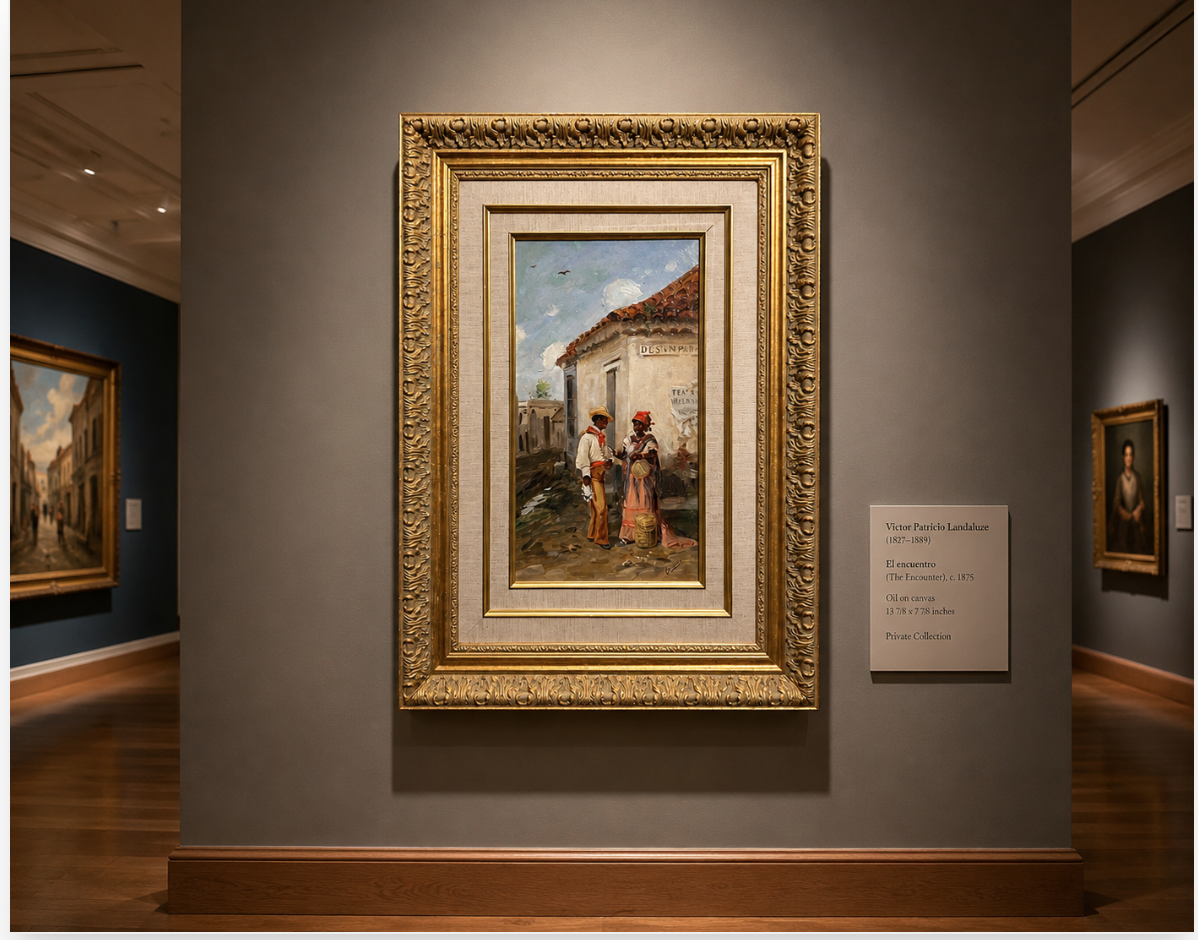 Image 2 of 5
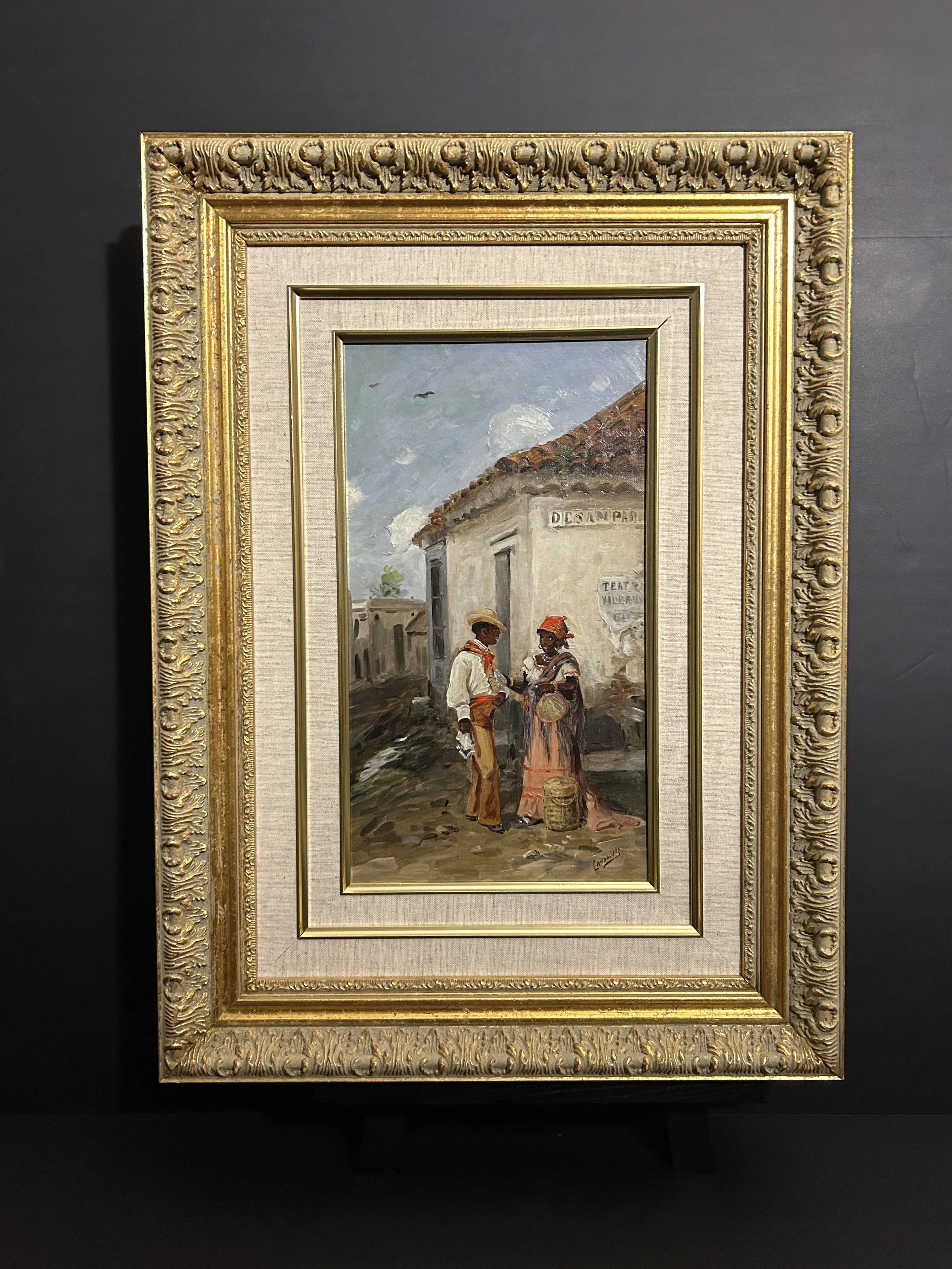 Image 3 of 5
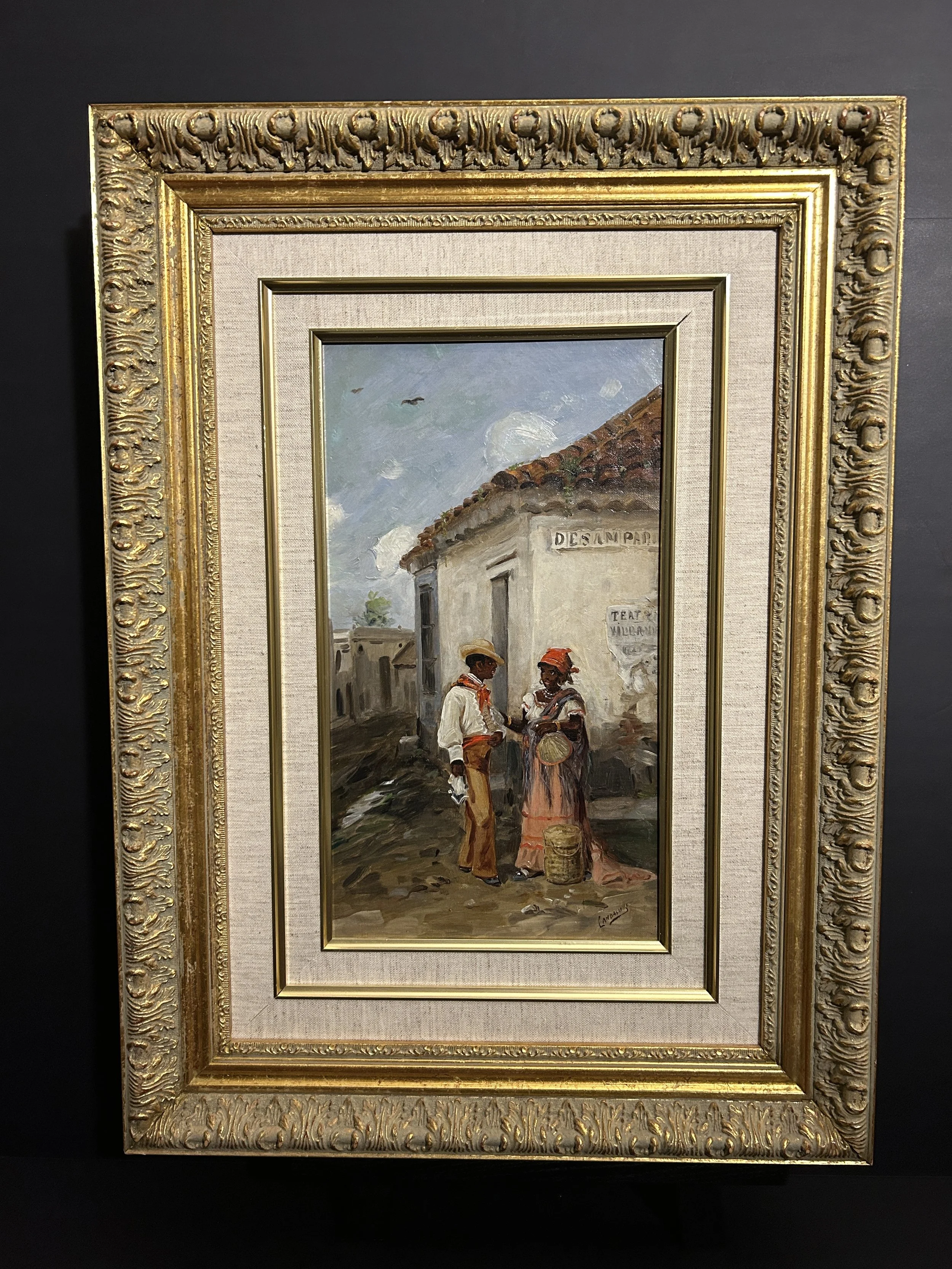 Image 4 of 5
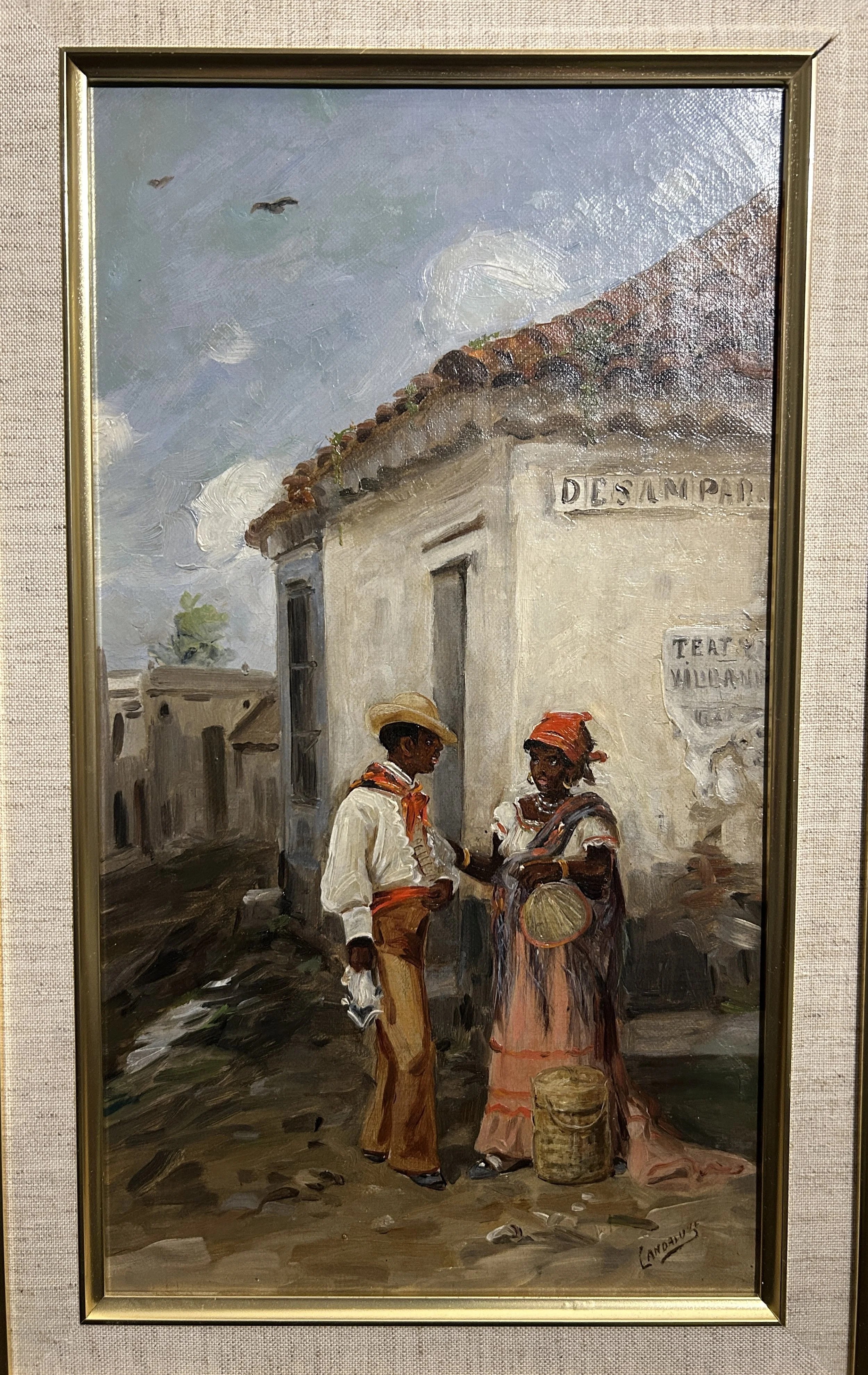 Image 5 of 5
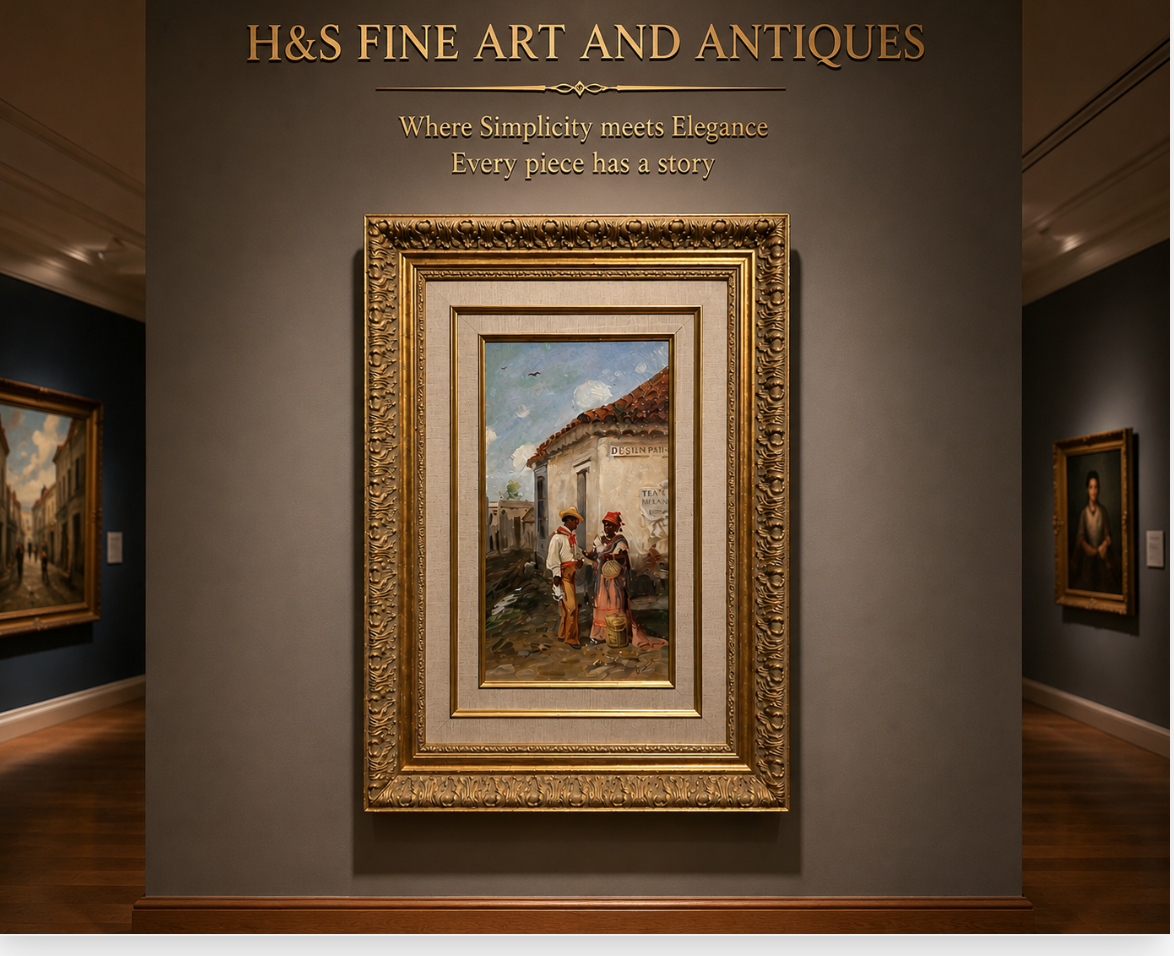
Patricio Landaluze. (1827-1889). EL encuentro, signed 'Landaluze' lower right.
El encuentro ("The Encounter"), circa 1875
Artist: Victor Patricio Landaluze (1827–1889)
Title: El encuentro
Date: Circa 1875
Medium: Oil on canvas
Dimensions: 13⅞ × 7⅞ inches
Signature: Signed lower right, "Landaluze"
Provenance
Private Collection, Miami
Anonymous Sale
Christie's, New York, 24 November 1992, Lot 86
Private Collection, New Jersey
Anonymous Sale
Christie's, New York, 20 November 2002, Lot 66
Acquired from the above sale
This provenance is particularly desirable because the painting has:
Two documented appearances at Christie's
Continuous private ownership history
Established market presence and scholarly traceability
Victor Patricio Landaluze (1828/1830–1889): Chronicler of Colonial Cuba
Victor Patricio de Landaluze was born in Bilbao, Spain, and received a sophisticated education that included literature and several languages. He spent time in Paris before arriving in Cuba around 1850, where he would spend nearly forty years documenting Cuban life. He became one of the leading painters and illustrators of nineteenth-century Cuba and was associated with the Academy of Fine Arts of San Alejandro in Havana, eventually serving as its director.
Landaluze is regarded as the foremost practitioner of Cuban costumbrismo, a movement dedicated to recording local customs, occupations, and social types. His paintings depict guajiros (Cuban peasants), market vendors, landowners, enslaved Africans, and urban residents, creating a remarkably detailed visual record of colonial Cuba.
At the same time, his political views were conservative and strongly pro-Spanish. He opposed Cuban independence and frequently presented plantation society in an idealized and harmonious manner. Modern scholars therefore view his paintings both as invaluable historical documents and as works shaped by the colonial ideologies of their time.
The title itself—The Encounter—suggests a brief but meaningful human exchange. The painting portrays two figures meeting in a narrow street of colonial Havana before a simple stucco building covered by terracotta roof tiles.
The gentleman wears:
White shirt
Red neckerchief
Straw hat
Light trousers
The woman wears:
Bright headscarf
Flowing skirt
Apron-like garment
Carries woven baskets associated with street vending
The figures stand close together, their gestures suggesting conversation, commerce, or the exchange of local news.
Meaning and Symbolism
Unlike grand historical paintings, Landaluze focused on ordinary moments.
The Street as Social Space
Nineteenth-century Havana functioned through public interactions. Streets served as markets, meeting places, and centers of daily life.
The Encounter
The painting captures a fleeting instant between two individuals who may represent:
Vendor and customer
Friends meeting by chance
Neighbors exchanging information
Participants in everyday commerce
The absence of drama is intentional. The ordinary moment itself becomes the subject.
Cultural Documentation
The baskets, clothing, and architecture are historically important. Landaluze painted these details carefully because they defined Cuban identity and distinguished Havana from European cities.
The Human Scale of History
El encuentro reminds viewers that history is composed not only of wars and political events but also of countless daily interactions that formed the fabric of society.
Architecture and Setting
The whitewashed building with its weathered surface and clay roof tiles is characteristic of nineteenth-century Havana architecture.
The partially visible signs painted onto the wall are particularly interesting. Landaluze frequently incorporated:
Shop names
Street signs
Commercial advertisements
These details transform his paintings into visual archives of colonial urban life.
The narrow perspective and subdued palette also evoke the warm Caribbean atmosphere and strong tropical light.
Historical Context: Cuba in 1875
When this painting was executed, Cuba was undergoing enormous social and political change.
The island remained a Spanish colony, yet:
The Ten Years' War (1868–1878) was in progress.
Questions of independence were intensifying.
Slavery was approaching its final years.
Urban modernization was gradually altering traditional life.
While political upheaval surrounded him, Landaluze often chose to paint scenes of apparent tranquility and social harmony. His work can therefore be read simultaneously as documentary observation and nostalgic preservation of a disappearing colonial order.
Museums and Public Collections
Numerous works by Landaluze reside in the:
Museo Nacional de Bellas Artes de Cuba
The museum's Cuban Art Building contains important examples of nineteenth-century costumbrista painting, including Landaluze's celebrated Día de Reyes en La Habana (Three Kings Day in Havana), one of the defining images of colonial Cuban society.
His works have also appeared in major exhibitions and publications on:
Cuban colonial art
Caribbean art history
Nineteenth-century Latin American painting
Afro-Cuban cultural representation
Literature and Scholarly References
Recommended references for your catalogue include:
Marta Garsd
"Victor Patricio de Landaluze," Encyclopedia of Latin American History and Culture.Adelaida de Juan
Pintura Cubana: Temas y Variaciones.Veerle Poupeye
Caribbean Art. London: Thames & Hudson, 1998.Dawn Ades
Art in Latin America: The Modern Era, 1820–1980. Exhibition catalogue.Evelyn Carmen Ramos
A Painter of Cuban Life: Víctor Patricio de Landaluze and Nineteenth-Century Cuban Politics (1850–1889). Doctoral Dissertation, University of Chicago.Museum Exhibition Label
Victor Patricio Landaluze (1828/1830–1889)
El encuentro (The Encounter), circa 1875
Oil on canvas
13⅞ × 7⅞ inchesPainted during the final decades of Spanish colonial rule in Cuba, El encuentro transforms an ordinary street conversation into a timeless image of nineteenth-century Havana. Through luminous brushwork and meticulous observation of architecture, dress, and gesture, Landaluze preserved the rhythms of daily Cuban life. Although shaped by the artist's conservative colonial worldview, the painting remains one of the most compelling visual documents of Cuba's multicultural society and urban traditions.
El encuentro ("The Encounter"), circa 1875
Artist: Victor Patricio Landaluze (1827–1889)
Title: El encuentro
Date: Circa 1875
Medium: Oil on canvas
Dimensions: 13⅞ × 7⅞ inches
Signature: Signed lower right, "Landaluze"
Provenance
Private Collection, Miami
Anonymous Sale
Christie's, New York, 24 November 1992, Lot 86
Private Collection, New Jersey
Anonymous Sale
Christie's, New York, 20 November 2002, Lot 66
Acquired from the above sale
This provenance is particularly desirable because the painting has:
Two documented appearances at Christie's
Continuous private ownership history
Established market presence and scholarly traceability
Victor Patricio Landaluze (1828/1830–1889): Chronicler of Colonial Cuba
Victor Patricio de Landaluze was born in Bilbao, Spain, and received a sophisticated education that included literature and several languages. He spent time in Paris before arriving in Cuba around 1850, where he would spend nearly forty years documenting Cuban life. He became one of the leading painters and illustrators of nineteenth-century Cuba and was associated with the Academy of Fine Arts of San Alejandro in Havana, eventually serving as its director.
Landaluze is regarded as the foremost practitioner of Cuban costumbrismo, a movement dedicated to recording local customs, occupations, and social types. His paintings depict guajiros (Cuban peasants), market vendors, landowners, enslaved Africans, and urban residents, creating a remarkably detailed visual record of colonial Cuba.
At the same time, his political views were conservative and strongly pro-Spanish. He opposed Cuban independence and frequently presented plantation society in an idealized and harmonious manner. Modern scholars therefore view his paintings both as invaluable historical documents and as works shaped by the colonial ideologies of their time.
The title itself—The Encounter—suggests a brief but meaningful human exchange. The painting portrays two figures meeting in a narrow street of colonial Havana before a simple stucco building covered by terracotta roof tiles.
The gentleman wears:
White shirt
Red neckerchief
Straw hat
Light trousers
The woman wears:
Bright headscarf
Flowing skirt
Apron-like garment
Carries woven baskets associated with street vending
The figures stand close together, their gestures suggesting conversation, commerce, or the exchange of local news.
Meaning and Symbolism
Unlike grand historical paintings, Landaluze focused on ordinary moments.
The Street as Social Space
Nineteenth-century Havana functioned through public interactions. Streets served as markets, meeting places, and centers of daily life.
The Encounter
The painting captures a fleeting instant between two individuals who may represent:
Vendor and customer
Friends meeting by chance
Neighbors exchanging information
Participants in everyday commerce
The absence of drama is intentional. The ordinary moment itself becomes the subject.
Cultural Documentation
The baskets, clothing, and architecture are historically important. Landaluze painted these details carefully because they defined Cuban identity and distinguished Havana from European cities.
The Human Scale of History
El encuentro reminds viewers that history is composed not only of wars and political events but also of countless daily interactions that formed the fabric of society.
Architecture and Setting
The whitewashed building with its weathered surface and clay roof tiles is characteristic of nineteenth-century Havana architecture.
The partially visible signs painted onto the wall are particularly interesting. Landaluze frequently incorporated:
Shop names
Street signs
Commercial advertisements
These details transform his paintings into visual archives of colonial urban life.
The narrow perspective and subdued palette also evoke the warm Caribbean atmosphere and strong tropical light.
Historical Context: Cuba in 1875
When this painting was executed, Cuba was undergoing enormous social and political change.
The island remained a Spanish colony, yet:
The Ten Years' War (1868–1878) was in progress.
Questions of independence were intensifying.
Slavery was approaching its final years.
Urban modernization was gradually altering traditional life.
While political upheaval surrounded him, Landaluze often chose to paint scenes of apparent tranquility and social harmony. His work can therefore be read simultaneously as documentary observation and nostalgic preservation of a disappearing colonial order.
Museums and Public Collections
Numerous works by Landaluze reside in the:
Museo Nacional de Bellas Artes de Cuba
The museum's Cuban Art Building contains important examples of nineteenth-century costumbrista painting, including Landaluze's celebrated Día de Reyes en La Habana (Three Kings Day in Havana), one of the defining images of colonial Cuban society.
His works have also appeared in major exhibitions and publications on:
Cuban colonial art
Caribbean art history
Nineteenth-century Latin American painting
Afro-Cuban cultural representation
Literature and Scholarly References
Recommended references for your catalogue include:
Marta Garsd
"Victor Patricio de Landaluze," Encyclopedia of Latin American History and Culture.Adelaida de Juan
Pintura Cubana: Temas y Variaciones.Veerle Poupeye
Caribbean Art. London: Thames & Hudson, 1998.Dawn Ades
Art in Latin America: The Modern Era, 1820–1980. Exhibition catalogue.Evelyn Carmen Ramos
A Painter of Cuban Life: Víctor Patricio de Landaluze and Nineteenth-Century Cuban Politics (1850–1889). Doctoral Dissertation, University of Chicago.Museum Exhibition Label
Victor Patricio Landaluze (1828/1830–1889)
El encuentro (The Encounter), circa 1875
Oil on canvas
13⅞ × 7⅞ inchesPainted during the final decades of Spanish colonial rule in Cuba, El encuentro transforms an ordinary street conversation into a timeless image of nineteenth-century Havana. Through luminous brushwork and meticulous observation of architecture, dress, and gesture, Landaluze preserved the rhythms of daily Cuban life. Although shaped by the artist's conservative colonial worldview, the painting remains one of the most compelling visual documents of Cuba's multicultural society and urban traditions.