 Image 1 of 6
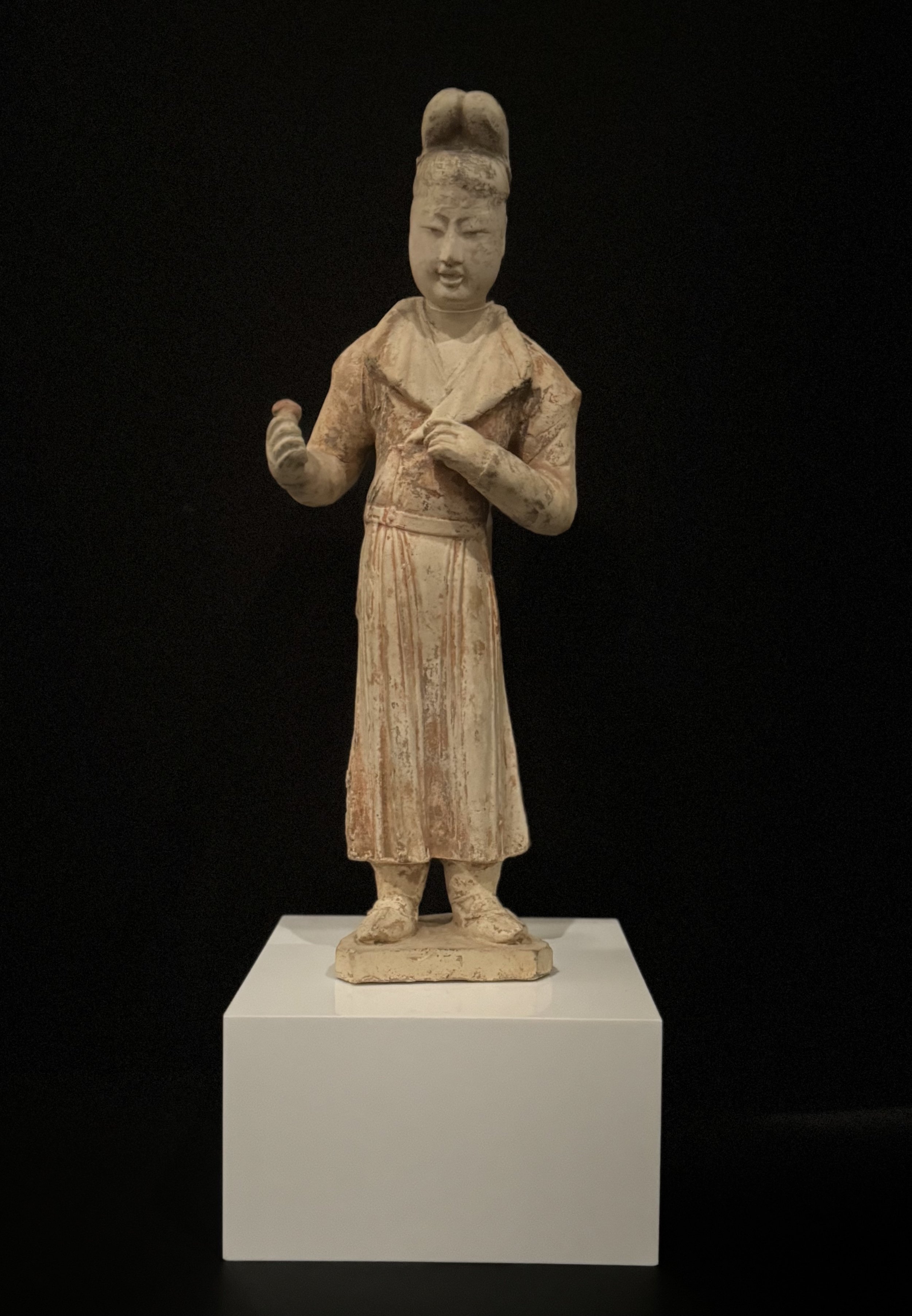 Image 2 of 6
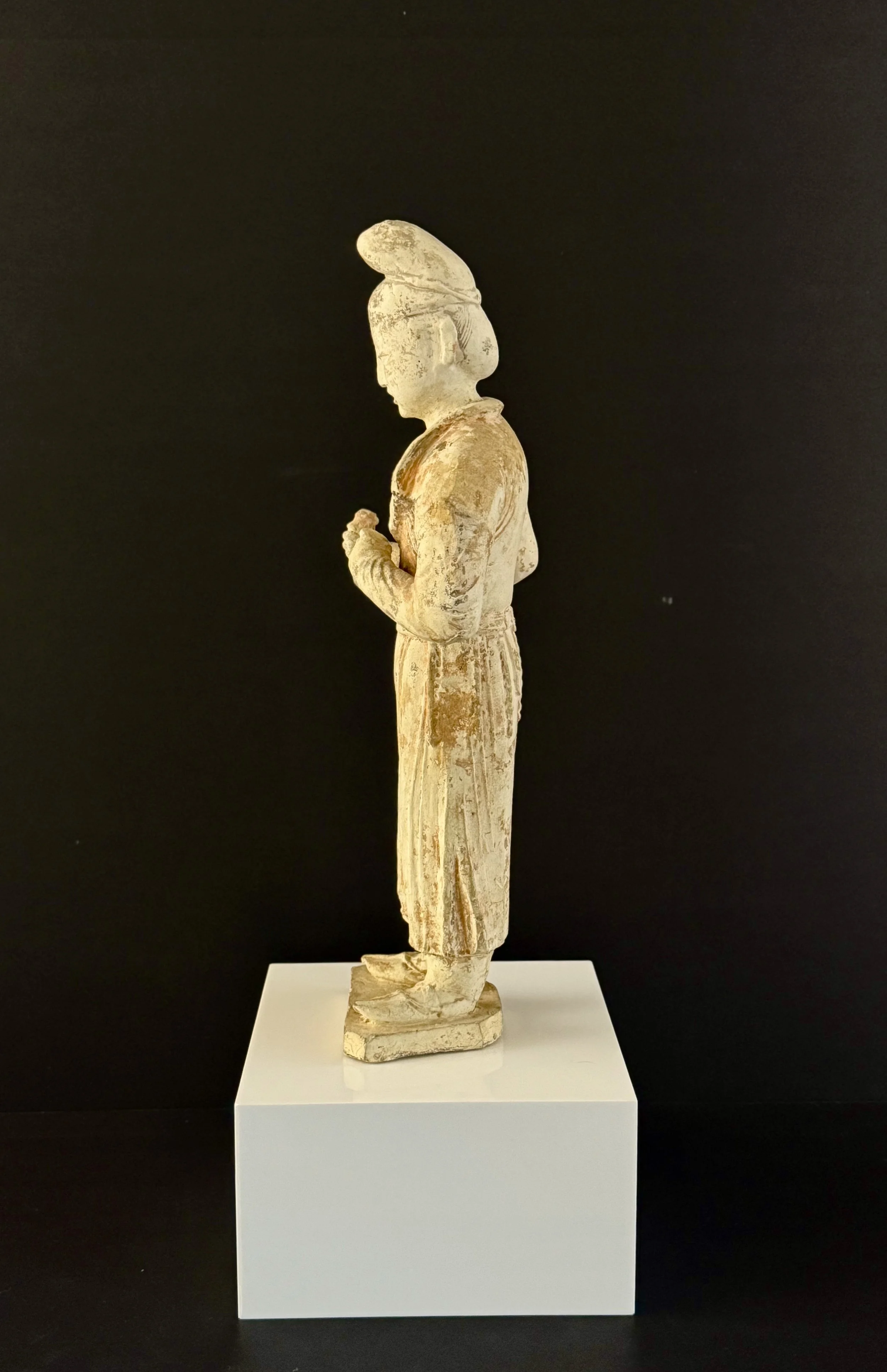 Image 3 of 6
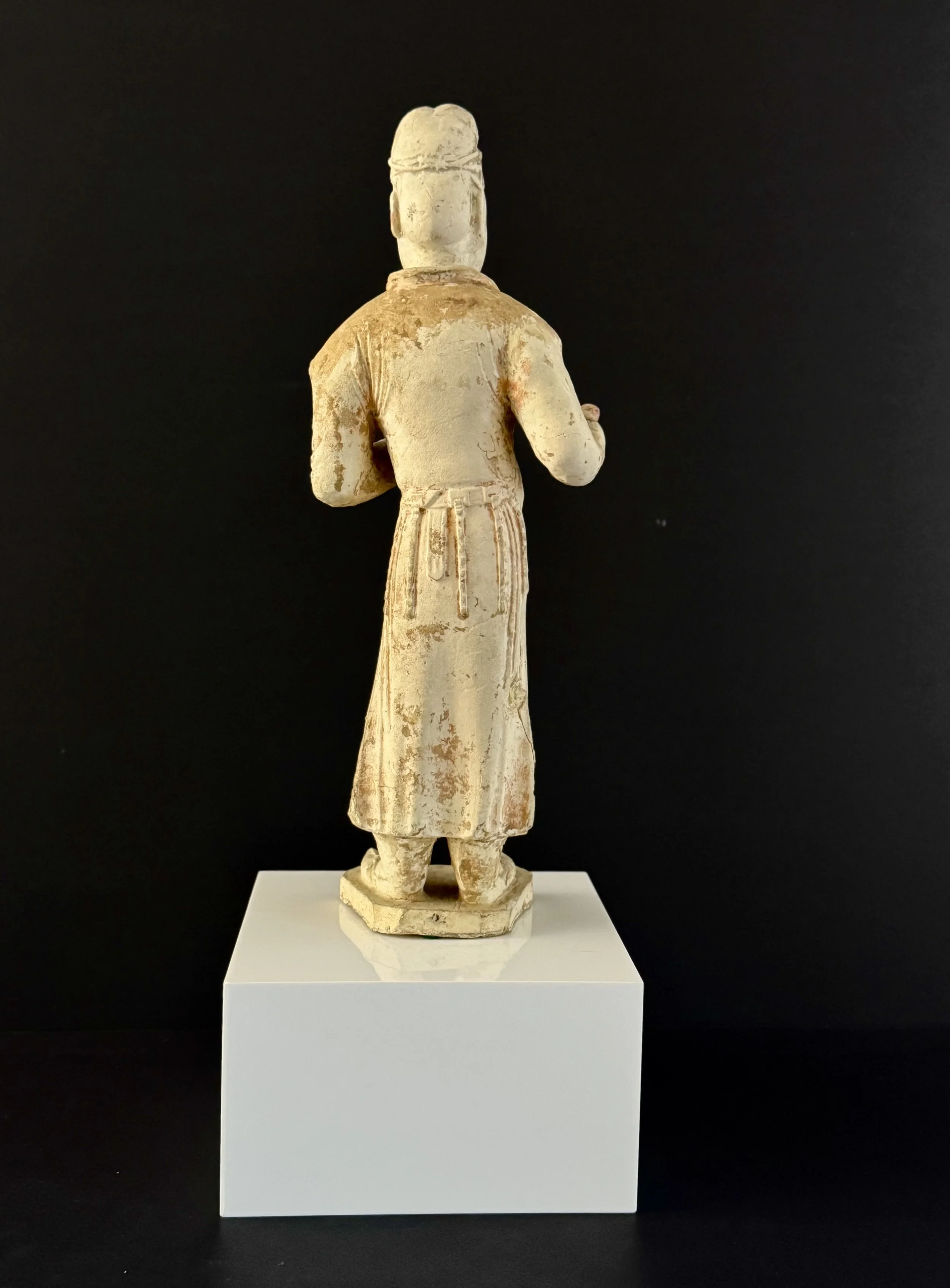 Image 4 of 6
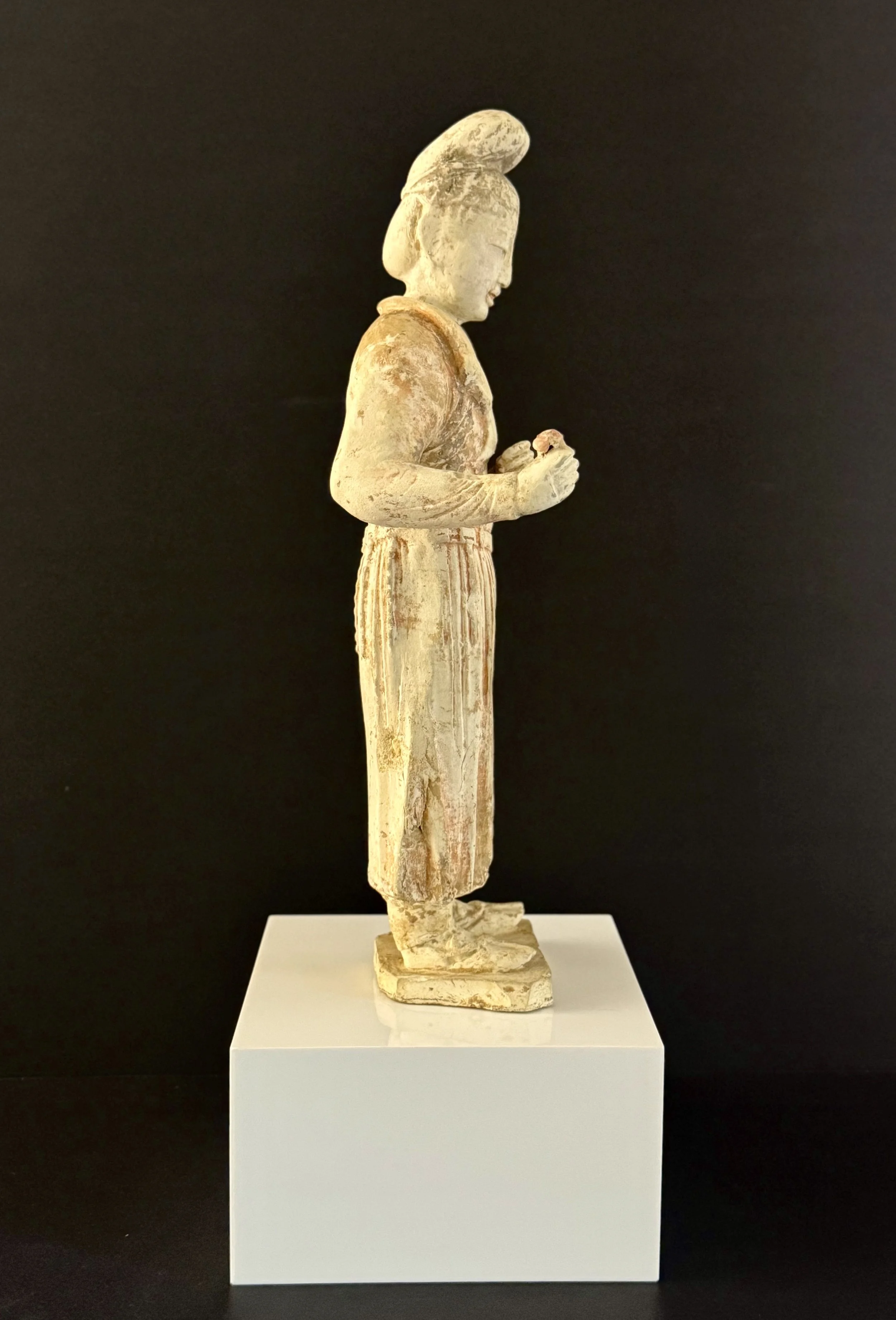 Image 5 of 6
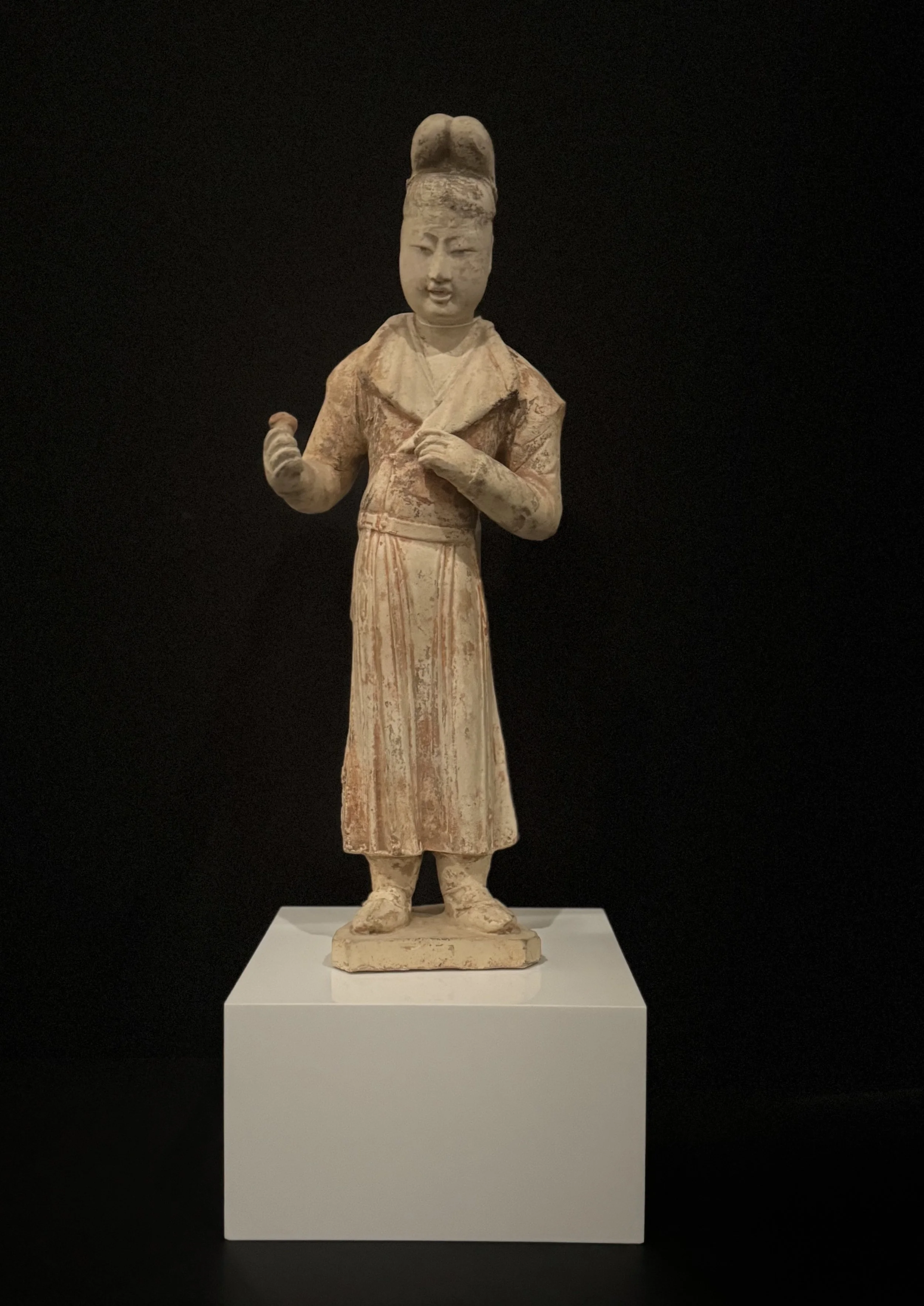 Image 6 of 6
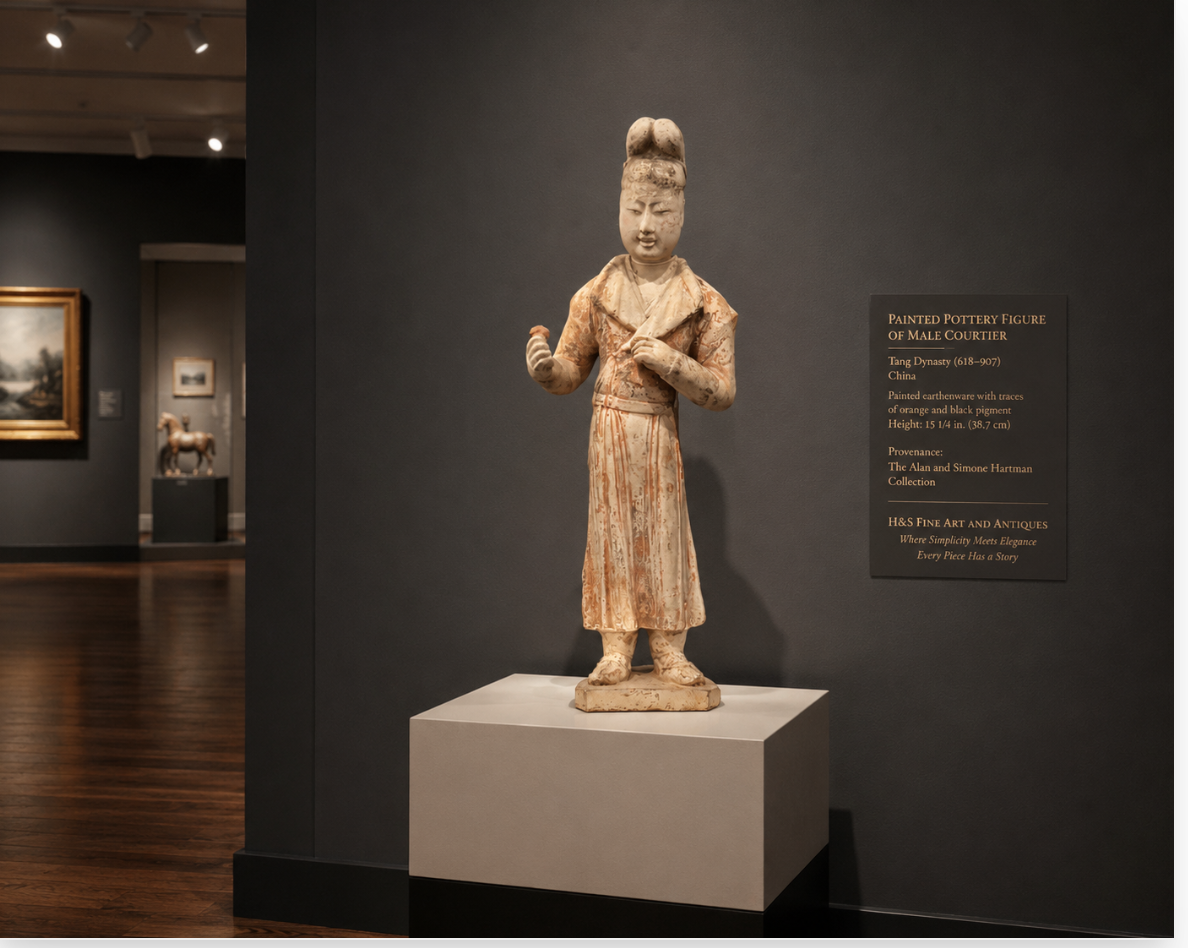
Painted Pottery Figure of Male Courtier, Tang Dynasty. The Alan and Simone Hartman collection.
A COURTIER FOR ETERNITY
Painted Pottery Figure of a Male Courtier
China, Tang Dynasty (618–907)
Painted earthenware with traces of orange and black pigment
Height: 15¼ in. (38.7 cm)
Provenance: The Alan and Simone Hartman Collection
The present Painted Pottery Figure of a Male Courtier is a refined example of the ceramic funerary sculpture produced during the Tang dynasty, one of the most cosmopolitan, prosperous, and artistically accomplished periods in the history of China.
Standing more than fifteen inches high, the figure represents an elegantly dressed male attendant or courtier. He wears a long, open-collared tunic secured at the waist by a belt, with the folds of the garment falling vertically toward the rectangular base. Traces of orange and black pigment preserve evidence of the figure's original painted decoration.
His tall coiffure or headdress, carefully modeled facial features, elongated body, formal clothing, and expressive arrangement of the hands distinguish him from the more standardized figures of servants, grooms, and laborers that also populated Tang tombs.
The figure is particularly compelling because of its gesture. The left hand is held close to the chest, while the right hand appears to have originally supported or presented a small object, perhaps a flower, bird, vessel, or other offering.
The precise identity of the lost object cannot presently be established, and it would be prudent not to identify it definitively without further physical examination or comparison with closely related excavated figures.
The sculpture belongs to the important tradition of Chinese funerary objects known as mingqi, or “spirit objects.” These figures were created specifically for placement within tombs, where they formed a symbolic household and court intended to accompany and serve the deceased in the afterlife.
THE TANG DYNASTY: AN AGE OF COURTS, CAPITALS, AND INTERNATIONAL EXCHANGE
The Tang dynasty ruled China from 618 until 907 and presided over one of the great periods of Chinese imperial civilization.
The empire's principal capitals were Chang'an, present-day Xi'an, and the eastern capital of Luoyang.
Chang'an was among the largest and most internationally connected cities in the world. Merchants, diplomats, monks, musicians, craftsmen, and travelers arrived from Central Asia, Persia, India, Korea, Japan, and regions connected by the Silk Roads.
This cosmopolitan environment transformed Tang art.
The clothing, hairstyles, facial types, musical instruments, animals, and occupations represented in Tang tomb sculpture provide an extraordinary visual record of imperial society.
Within this context, the present figure represents the sophisticated world of the Tang elite.
His carefully arranged clothing and restrained demeanor suggest that he belongs not to the world of manual labor but to the ceremonial environment of an aristocratic household or court.
REGION OF PRODUCTION
The precise archaeological origin of the present figure is not recorded in the published provenance.
Therefore, a specific kiln site or tomb location should not be assigned to the sculpture without additional documentation.
Nevertheless, comparable Tang pottery tomb figures are strongly associated with the principal aristocratic burial regions of northern China, particularly Shaanxi and Henan provinces, surrounding Chang'an and Luoyang.
Large workshops operating around these political centers produced extensive groups of pottery figures for imperial and aristocratic tombs.
A closely related cultural context can be seen in Tang tomb figures associated with Henan province and possibly Luoyang in the collection of the Smithsonian Institution, while major excavated tomb ensembles from Luoyang demonstrate the importance of the region as a center for the production and burial of ceramic funerary figures.
For cataloguing purposes, I would describe the geographical origin conservatively as:
China, Tang Dynasty (618–907), probably northern China.
THE MALE COURTIER
The identity of the figure deserves particular attention.
Tang funerary sculpture frequently distinguished individuals according to their position within the hierarchy of the household and imperial administration.
Tombs could contain ceramic representations of:
court officials,
civil servants,
military officers,
grooms,
foreign merchants,
Central Asian attendants,
musicians,
dancers,
and members of the aristocratic household.
The present figure appears to belong to the broader category of court attendants or courtiers.
Several characteristics support this interpretation.
His clothing is sophisticated.
The long tunic is carefully modeled and secured by a narrow belt. The open collar creates a layered arrangement across the chest, while the long vertical folds emphasize the figure's height and elegance.
The facial expression is composed and introspective.
Unlike the dramatic expressions sometimes encountered on Tang guardians, foreign grooms, and entertainers, this figure possesses a quiet psychological presence.
The slightly lowered eyes, delicately modeled mouth, and controlled gestures of the hands create an atmosphere of ceremonial attentiveness.
This quality is characteristic of some of the finest Tang funerary figures.
The sculptor was not merely representing an occupation.
He was creating an idealized member of an aristocratic court.
THE MYSTERY OF THE OBJECT HELD IN THE HAND
One of the most intriguing aspects of the sculpture is the position of the right hand.
The hand appears designed to hold or present an object.
The auction description associated with the figure suggests that this object may have been a bird or flower. The object is now absent, and its original identity remains uncertain.
Several possibilities exist.
A flower might have carried associations with court ceremony, refinement, gardens, or seasonal celebrations.
A bird could have represented a falcon, exotic pet, or other animal associated with aristocratic life.
Tang aristocrats were famously enthusiastic participants in hunting, falconry, polo, music, banquets, and garden culture.
Alternatively, the figure may have held a vessel, ceremonial implement, or another small object associated with service to the deceased.
Until a closely matching excavated example is identified, the interpretation should remain open.
That uncertainty contributes to the figure's visual interest.
The gesture allows the modern viewer to imagine an original tomb ensemble in which the figure participated in a larger ceremonial scene.
PURPOSE: A SERVANT IN THE ETERNAL COURT
The figure was not originally created as an independent sculpture for display.
It was a funerary sculpture.
Tang aristocratic tombs were conceived as extensions of the social world occupied by the deceased during life.
The tomb became an eternal residence.
Ceramic figures represented the attendants, officials, servants, musicians, soldiers, horses, camels, and guardians necessary to maintain the status and comfort of the deceased.
These objects are known as mingqi.
The number, size, and quality of the figures placed within a tomb could reflect the rank and wealth of its occupant.
The present courtier therefore participated in a much larger symbolic world.
He may originally have stood among other attendants awaiting the commands of his deceased master.
Nearby might have been pottery horses.
Camels carrying merchandise from distant regions.
Musicians and dancers.
Civil and military officials.
Tomb guardians.
Servants carrying vessels and offerings.
Together these figures created an idealized representation of Tang aristocratic society.
The figure was therefore both a work of art and an instrument of immortality.
MATERIAL AND TECHNIQUE
The sculpture is made of fired earthenware.
Tang pottery figures were commonly produced through a combination of mold construction and hand finishing.
Different sections of the body could be formed separately and joined before firing.
After firing, pigments were applied to the surface.
The present sculpture preserves traces of orange and black pigment.
Originally, the appearance of the figure would have been considerably more colorful.
The garments, facial details, hair, belt, and accessories may have been differentiated through painted decoration.
Because these pigments were often applied after firing, they were vulnerable to moisture, burial conditions, handling, and the passage of time.
The survival of even fragmentary pigments is therefore important evidence for understanding the original appearance of Tang funerary sculpture. The Penn Museum's discussion of Tang mortuary ceramics similarly notes the extensive original use—and frequent subsequent loss—of painted pigments on unglazed pottery figures.
PROVENANCE
The Alan and Simone Hartman Collection
The documented provenance of the present figure places it in the collection of Alan and Simone Hartman.
The Hartmans were prominent New York collectors and dealers associated with the study and collecting of Chinese works of art.
Their interests extended across Chinese jade, ceramics, and archaeological material.
The importance of their engagement with Tang art is demonstrated by their substantial gift of seventy-two works of Chinese Tang dynasty art to the McClung Museum of Natural History and Culture in 2003.
Those objects became the subject of the museum exhibition Chinese Tang Dynasty Art, held from September 11, 2004, through January 3, 2005.
This documented institutional relationship provides valuable context for the Hartman provenance.
It should be emphasized, however, that I have not found evidence that this specific male courtier formed part of the seventy-two objects donated to the McClung Museum or appeared in that exhibition.
MUSEUM COMPARISONS
Important museum collections preserve comparable Tang dynasty pottery figures representing attendants, officials, and members of aristocratic households.
The Metropolitan Museum of Art preserves a Figure of a Standing Man, dated to the seventh–eighth century, made of earthenware with pigments and classified by the museum as Tang dynasty tomb pottery. The work provides a useful comparison for the tradition of painted standing male figures intended for funerary contexts.
The Penn Museum preserves and has published important groups of Tang mortuary figures demonstrating the range of animals, attendants, and figures placed within elite tombs.
The British Museum houses the celebrated Tang tomb figures associated with the tomb of Liu Tingxun, who died in 728. The ensemble—including officials, guardians, horses, camels, and grooms—provides one of the clearest museum contexts for understanding how individual pottery figures originally functioned as parts of elaborate funerary programs.
The National Museum of Asian Art of the Smithsonian Institution preserves important Tang tomb figures, including figures associated with Henan province and possibly Luoyang, illustrating the international and aristocratic character of Tang funerary art.
ART-HISTORICAL SIGNIFICANCE
The present figure possesses several qualities that make it especially effective as a gallery object.
First is its scale.
At 15¼ inches high, it has sufficient presence to stand independently while retaining the intimacy associated with Tang funerary sculpture.
Second is the preservation of pigment.
The surviving orange and black decoration provides evidence of the figure's original polychromy.
Third is the expressive gesture.
The placement of the hands creates narrative ambiguity and suggests that the figure once participated in a larger ceremonial activity.
Fourth is the figure's provenance.
The association with the Alan and Simone Hartman Collection places the sculpture within a distinguished modern history of collecting and studying Chinese art.
Finally, the sculpture embodies one of the central achievements of Tang funerary art: the transformation of everyday human observation into representations intended for eternity.
The sculptor created neither a portrait nor a generic servant.
He created an ideal member of the aristocratic household—elegant, composed, attentive, and eternally prepared to serve.
SELECTED LITERATURE AND REFERENCES
For an H&S Fine Art & Antiques catalogue entry, I recommend citing the following publications:
Watson, William. The Genius of China: An Exhibition of Archaeological Finds of the People's Republic of China. London: Royal Academy of Arts, 1973.
Watson, William. Tang and Liao Ceramics. New York: Rizzoli, 1984.
Medley, Margaret. T'ang Pottery and Porcelain. London: Faber and Faber, 1981.
Michaelson, Carol. Gilded Dragons: Buried Treasures from China's Golden Ages. London: British Museum Press, 1999.
Howard, Angela Falco, Wu Hung, Song Li, and Yang Hong. Chinese Sculpture. New Haven and London: Yale University Press, 2006.
The Quest for Eternity: Chinese Ceramic Sculptures from the People's Republic of China. Los Angeles County Museum of Art, 1987.
China: Dawn of a Golden Age, 200–750 AD. New York: The Metropolitan Museum of Art, 2004.
Bonhams, New York, March 18, 2024, lot 276, A Painted Pottery Figure of Male Courtier, Tang Dynasty.
A COURTIER FOR ETERNITY
Painted Pottery Figure of a Male Courtier
China, Tang Dynasty (618–907)
Painted earthenware with traces of orange and black pigment
Height: 15¼ in. (38.7 cm)
Provenance: The Alan and Simone Hartman Collection
The present Painted Pottery Figure of a Male Courtier is a refined example of the ceramic funerary sculpture produced during the Tang dynasty, one of the most cosmopolitan, prosperous, and artistically accomplished periods in the history of China.
Standing more than fifteen inches high, the figure represents an elegantly dressed male attendant or courtier. He wears a long, open-collared tunic secured at the waist by a belt, with the folds of the garment falling vertically toward the rectangular base. Traces of orange and black pigment preserve evidence of the figure's original painted decoration.
His tall coiffure or headdress, carefully modeled facial features, elongated body, formal clothing, and expressive arrangement of the hands distinguish him from the more standardized figures of servants, grooms, and laborers that also populated Tang tombs.
The figure is particularly compelling because of its gesture. The left hand is held close to the chest, while the right hand appears to have originally supported or presented a small object, perhaps a flower, bird, vessel, or other offering.
The precise identity of the lost object cannot presently be established, and it would be prudent not to identify it definitively without further physical examination or comparison with closely related excavated figures.
The sculpture belongs to the important tradition of Chinese funerary objects known as mingqi, or “spirit objects.” These figures were created specifically for placement within tombs, where they formed a symbolic household and court intended to accompany and serve the deceased in the afterlife.
THE TANG DYNASTY: AN AGE OF COURTS, CAPITALS, AND INTERNATIONAL EXCHANGE
The Tang dynasty ruled China from 618 until 907 and presided over one of the great periods of Chinese imperial civilization.
The empire's principal capitals were Chang'an, present-day Xi'an, and the eastern capital of Luoyang.
Chang'an was among the largest and most internationally connected cities in the world. Merchants, diplomats, monks, musicians, craftsmen, and travelers arrived from Central Asia, Persia, India, Korea, Japan, and regions connected by the Silk Roads.
This cosmopolitan environment transformed Tang art.
The clothing, hairstyles, facial types, musical instruments, animals, and occupations represented in Tang tomb sculpture provide an extraordinary visual record of imperial society.
Within this context, the present figure represents the sophisticated world of the Tang elite.
His carefully arranged clothing and restrained demeanor suggest that he belongs not to the world of manual labor but to the ceremonial environment of an aristocratic household or court.
REGION OF PRODUCTION
The precise archaeological origin of the present figure is not recorded in the published provenance.
Therefore, a specific kiln site or tomb location should not be assigned to the sculpture without additional documentation.
Nevertheless, comparable Tang pottery tomb figures are strongly associated with the principal aristocratic burial regions of northern China, particularly Shaanxi and Henan provinces, surrounding Chang'an and Luoyang.
Large workshops operating around these political centers produced extensive groups of pottery figures for imperial and aristocratic tombs.
A closely related cultural context can be seen in Tang tomb figures associated with Henan province and possibly Luoyang in the collection of the Smithsonian Institution, while major excavated tomb ensembles from Luoyang demonstrate the importance of the region as a center for the production and burial of ceramic funerary figures.
For cataloguing purposes, I would describe the geographical origin conservatively as:
China, Tang Dynasty (618–907), probably northern China.
THE MALE COURTIER
The identity of the figure deserves particular attention.
Tang funerary sculpture frequently distinguished individuals according to their position within the hierarchy of the household and imperial administration.
Tombs could contain ceramic representations of:
court officials,
civil servants,
military officers,
grooms,
foreign merchants,
Central Asian attendants,
musicians,
dancers,
and members of the aristocratic household.
The present figure appears to belong to the broader category of court attendants or courtiers.
Several characteristics support this interpretation.
His clothing is sophisticated.
The long tunic is carefully modeled and secured by a narrow belt. The open collar creates a layered arrangement across the chest, while the long vertical folds emphasize the figure's height and elegance.
The facial expression is composed and introspective.
Unlike the dramatic expressions sometimes encountered on Tang guardians, foreign grooms, and entertainers, this figure possesses a quiet psychological presence.
The slightly lowered eyes, delicately modeled mouth, and controlled gestures of the hands create an atmosphere of ceremonial attentiveness.
This quality is characteristic of some of the finest Tang funerary figures.
The sculptor was not merely representing an occupation.
He was creating an idealized member of an aristocratic court.
THE MYSTERY OF THE OBJECT HELD IN THE HAND
One of the most intriguing aspects of the sculpture is the position of the right hand.
The hand appears designed to hold or present an object.
The auction description associated with the figure suggests that this object may have been a bird or flower. The object is now absent, and its original identity remains uncertain.
Several possibilities exist.
A flower might have carried associations with court ceremony, refinement, gardens, or seasonal celebrations.
A bird could have represented a falcon, exotic pet, or other animal associated with aristocratic life.
Tang aristocrats were famously enthusiastic participants in hunting, falconry, polo, music, banquets, and garden culture.
Alternatively, the figure may have held a vessel, ceremonial implement, or another small object associated with service to the deceased.
Until a closely matching excavated example is identified, the interpretation should remain open.
That uncertainty contributes to the figure's visual interest.
The gesture allows the modern viewer to imagine an original tomb ensemble in which the figure participated in a larger ceremonial scene.
PURPOSE: A SERVANT IN THE ETERNAL COURT
The figure was not originally created as an independent sculpture for display.
It was a funerary sculpture.
Tang aristocratic tombs were conceived as extensions of the social world occupied by the deceased during life.
The tomb became an eternal residence.
Ceramic figures represented the attendants, officials, servants, musicians, soldiers, horses, camels, and guardians necessary to maintain the status and comfort of the deceased.
These objects are known as mingqi.
The number, size, and quality of the figures placed within a tomb could reflect the rank and wealth of its occupant.
The present courtier therefore participated in a much larger symbolic world.
He may originally have stood among other attendants awaiting the commands of his deceased master.
Nearby might have been pottery horses.
Camels carrying merchandise from distant regions.
Musicians and dancers.
Civil and military officials.
Tomb guardians.
Servants carrying vessels and offerings.
Together these figures created an idealized representation of Tang aristocratic society.
The figure was therefore both a work of art and an instrument of immortality.
MATERIAL AND TECHNIQUE
The sculpture is made of fired earthenware.
Tang pottery figures were commonly produced through a combination of mold construction and hand finishing.
Different sections of the body could be formed separately and joined before firing.
After firing, pigments were applied to the surface.
The present sculpture preserves traces of orange and black pigment.
Originally, the appearance of the figure would have been considerably more colorful.
The garments, facial details, hair, belt, and accessories may have been differentiated through painted decoration.
Because these pigments were often applied after firing, they were vulnerable to moisture, burial conditions, handling, and the passage of time.
The survival of even fragmentary pigments is therefore important evidence for understanding the original appearance of Tang funerary sculpture. The Penn Museum's discussion of Tang mortuary ceramics similarly notes the extensive original use—and frequent subsequent loss—of painted pigments on unglazed pottery figures.
PROVENANCE
The Alan and Simone Hartman Collection
The documented provenance of the present figure places it in the collection of Alan and Simone Hartman.
The Hartmans were prominent New York collectors and dealers associated with the study and collecting of Chinese works of art.
Their interests extended across Chinese jade, ceramics, and archaeological material.
The importance of their engagement with Tang art is demonstrated by their substantial gift of seventy-two works of Chinese Tang dynasty art to the McClung Museum of Natural History and Culture in 2003.
Those objects became the subject of the museum exhibition Chinese Tang Dynasty Art, held from September 11, 2004, through January 3, 2005.
This documented institutional relationship provides valuable context for the Hartman provenance.
It should be emphasized, however, that I have not found evidence that this specific male courtier formed part of the seventy-two objects donated to the McClung Museum or appeared in that exhibition.
MUSEUM COMPARISONS
Important museum collections preserve comparable Tang dynasty pottery figures representing attendants, officials, and members of aristocratic households.
The Metropolitan Museum of Art preserves a Figure of a Standing Man, dated to the seventh–eighth century, made of earthenware with pigments and classified by the museum as Tang dynasty tomb pottery. The work provides a useful comparison for the tradition of painted standing male figures intended for funerary contexts.
The Penn Museum preserves and has published important groups of Tang mortuary figures demonstrating the range of animals, attendants, and figures placed within elite tombs.
The British Museum houses the celebrated Tang tomb figures associated with the tomb of Liu Tingxun, who died in 728. The ensemble—including officials, guardians, horses, camels, and grooms—provides one of the clearest museum contexts for understanding how individual pottery figures originally functioned as parts of elaborate funerary programs.
The National Museum of Asian Art of the Smithsonian Institution preserves important Tang tomb figures, including figures associated with Henan province and possibly Luoyang, illustrating the international and aristocratic character of Tang funerary art.
ART-HISTORICAL SIGNIFICANCE
The present figure possesses several qualities that make it especially effective as a gallery object.
First is its scale.
At 15¼ inches high, it has sufficient presence to stand independently while retaining the intimacy associated with Tang funerary sculpture.
Second is the preservation of pigment.
The surviving orange and black decoration provides evidence of the figure's original polychromy.
Third is the expressive gesture.
The placement of the hands creates narrative ambiguity and suggests that the figure once participated in a larger ceremonial activity.
Fourth is the figure's provenance.
The association with the Alan and Simone Hartman Collection places the sculpture within a distinguished modern history of collecting and studying Chinese art.
Finally, the sculpture embodies one of the central achievements of Tang funerary art: the transformation of everyday human observation into representations intended for eternity.
The sculptor created neither a portrait nor a generic servant.
He created an ideal member of the aristocratic household—elegant, composed, attentive, and eternally prepared to serve.
SELECTED LITERATURE AND REFERENCES
For an H&S Fine Art & Antiques catalogue entry, I recommend citing the following publications:
Watson, William. The Genius of China: An Exhibition of Archaeological Finds of the People's Republic of China. London: Royal Academy of Arts, 1973.
Watson, William. Tang and Liao Ceramics. New York: Rizzoli, 1984.
Medley, Margaret. T'ang Pottery and Porcelain. London: Faber and Faber, 1981.
Michaelson, Carol. Gilded Dragons: Buried Treasures from China's Golden Ages. London: British Museum Press, 1999.
Howard, Angela Falco, Wu Hung, Song Li, and Yang Hong. Chinese Sculpture. New Haven and London: Yale University Press, 2006.
The Quest for Eternity: Chinese Ceramic Sculptures from the People's Republic of China. Los Angeles County Museum of Art, 1987.
China: Dawn of a Golden Age, 200–750 AD. New York: The Metropolitan Museum of Art, 2004.
Bonhams, New York, March 18, 2024, lot 276, A Painted Pottery Figure of Male Courtier, Tang Dynasty.