 Image 1 of 5
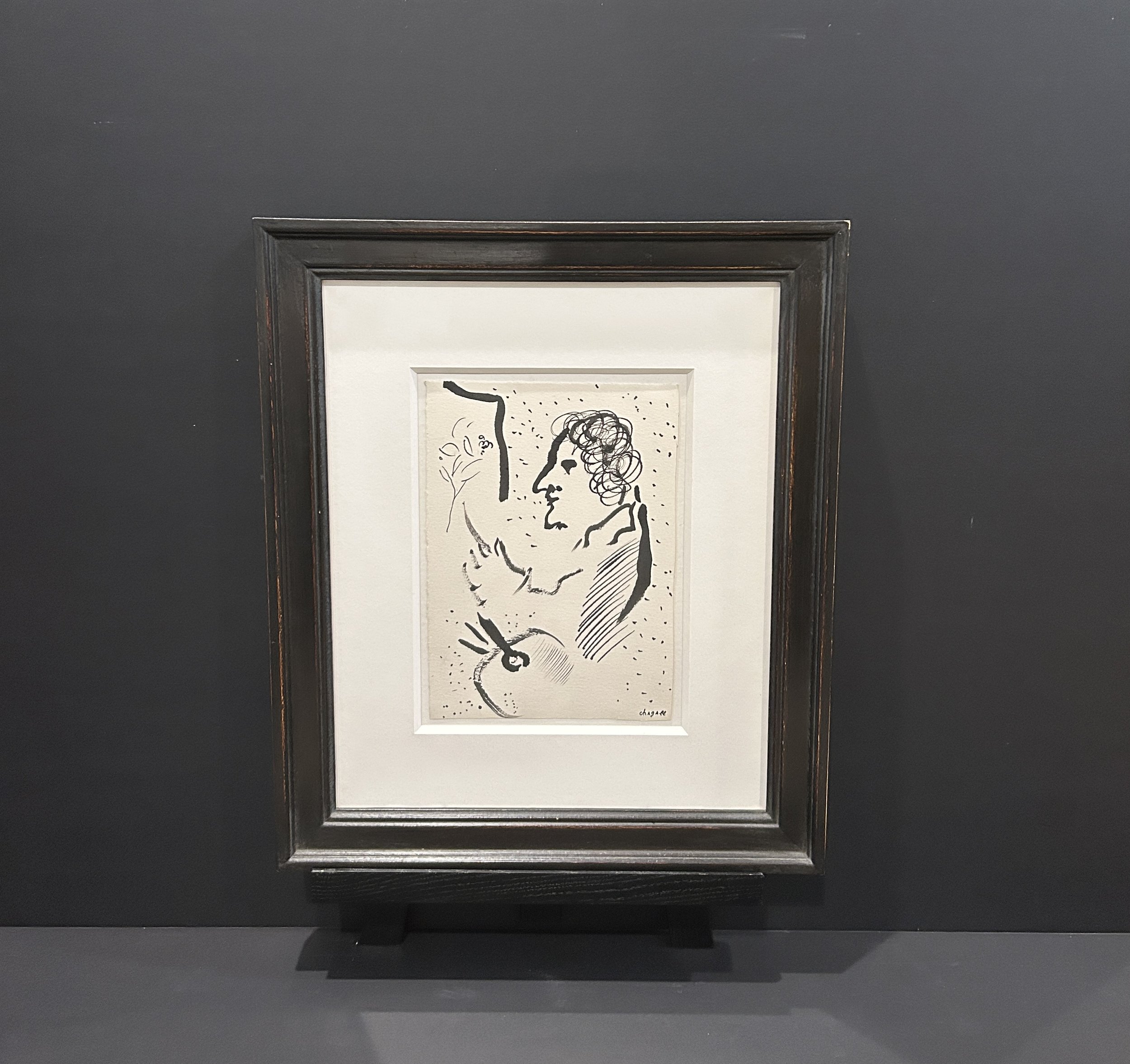 Image 2 of 5
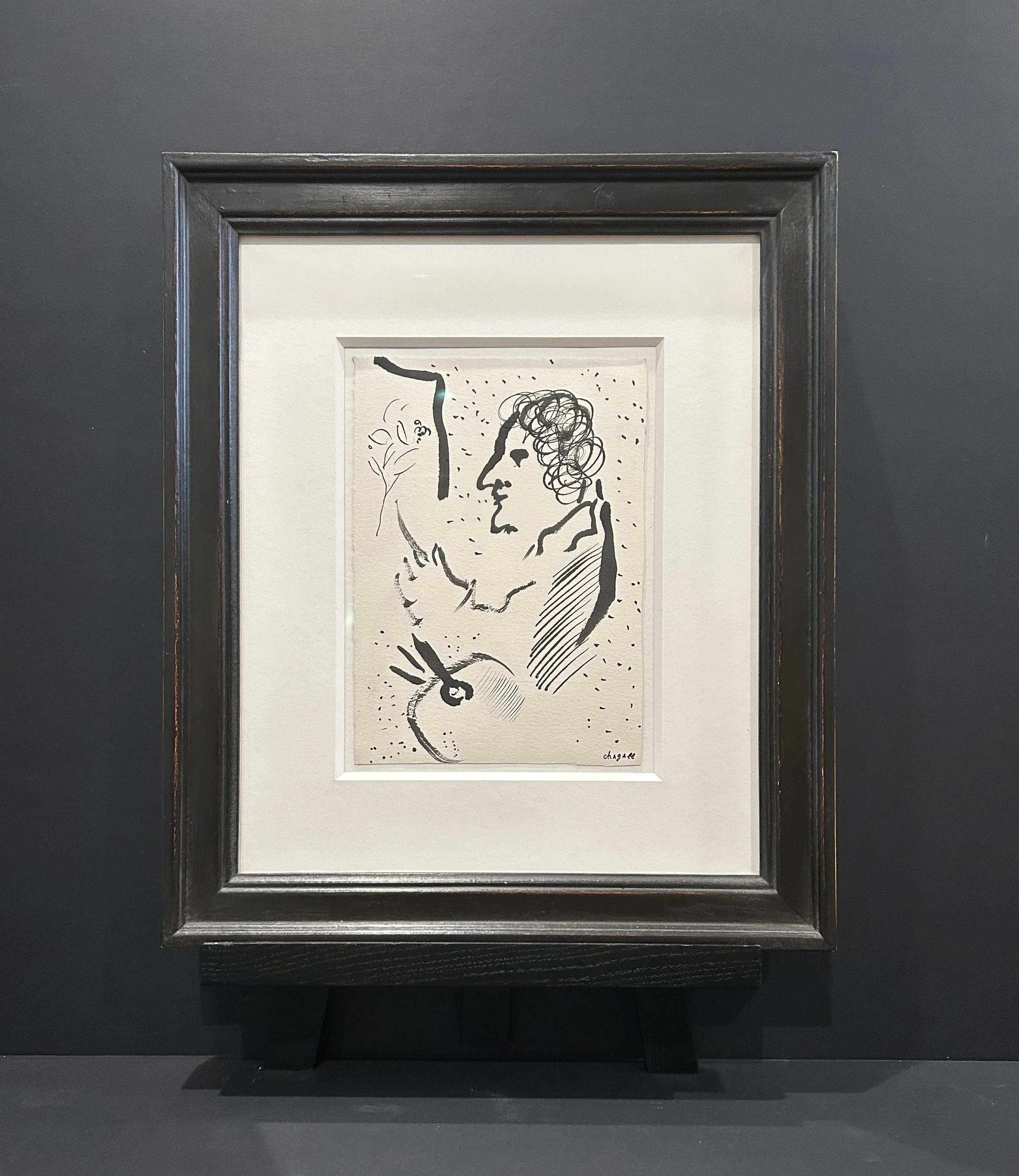 Image 3 of 5
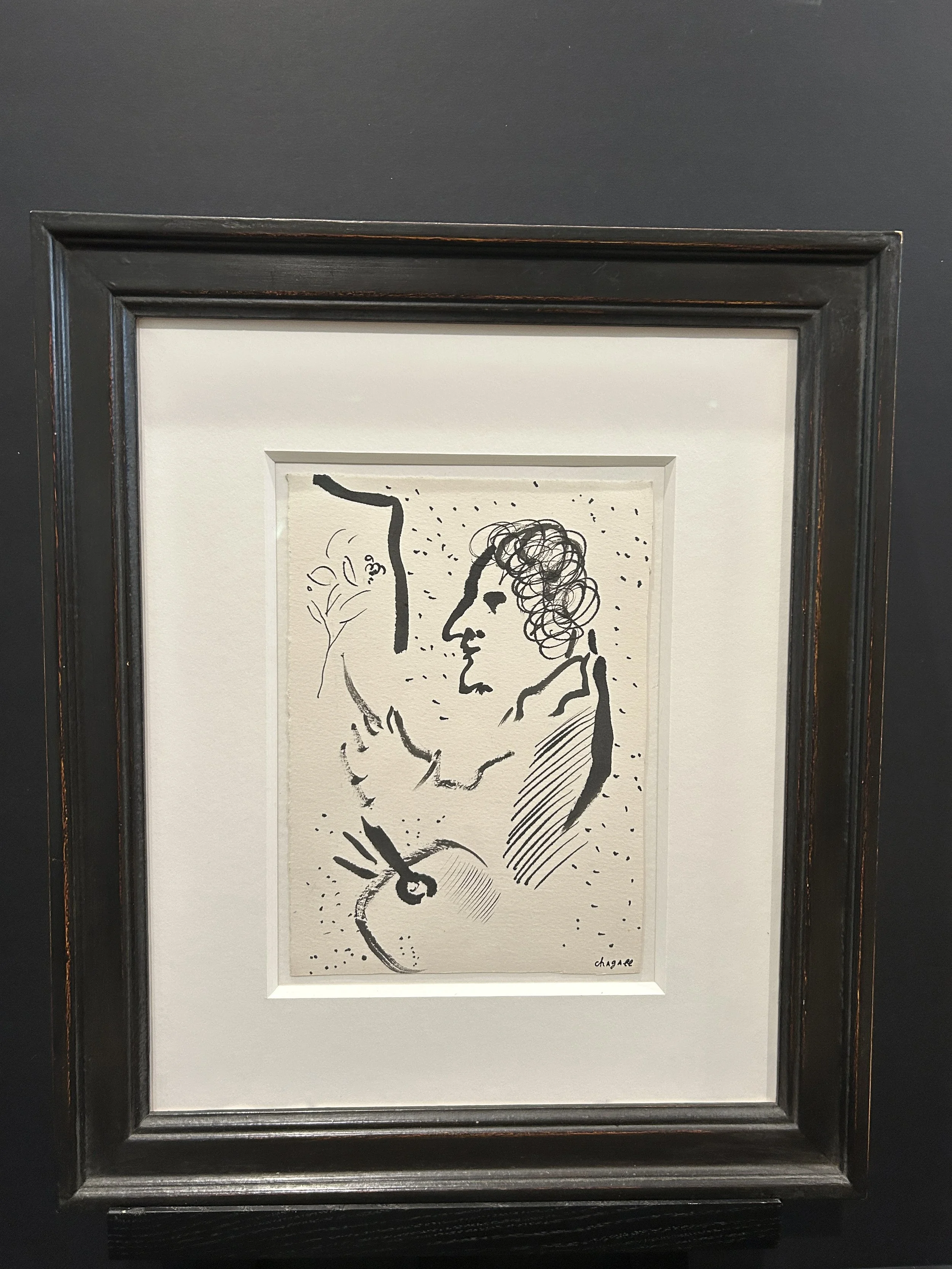 Image 4 of 5
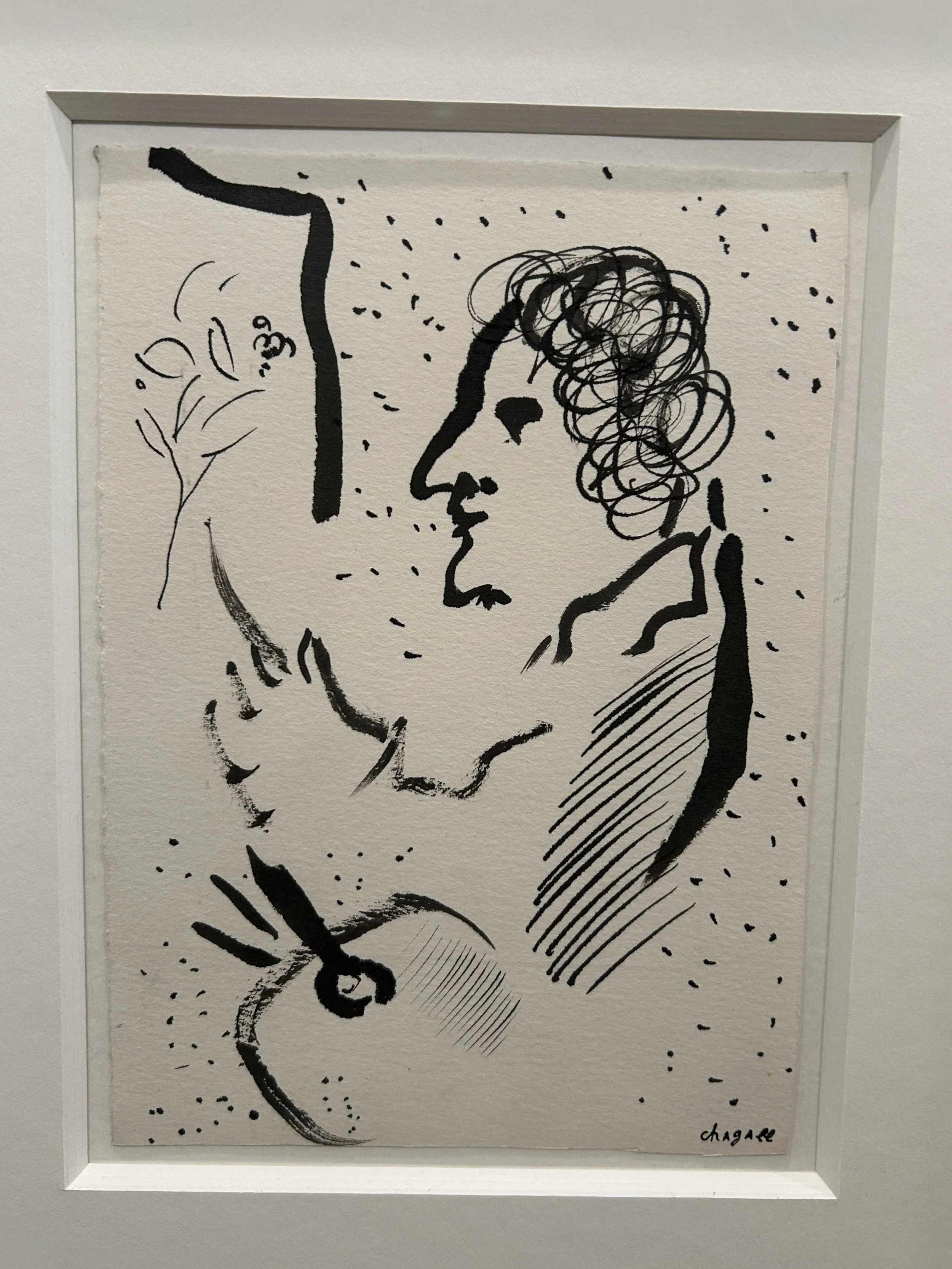 Image 5 of 5
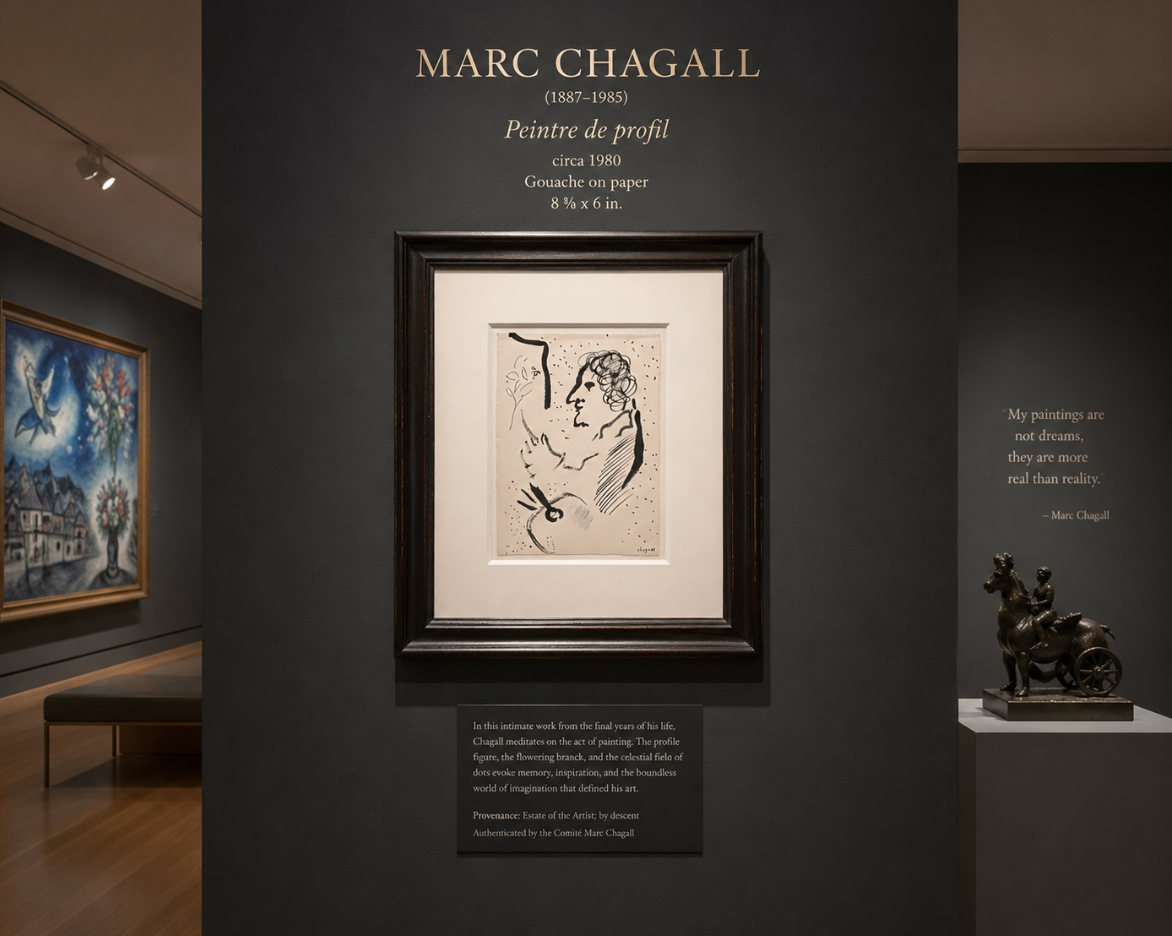
Marc Chagall (1887-1985), Peintre de profil. The signature 'Chagall' (lower right) Gouache on paper. Formerly from the Artist's Estate.
Marc Chagall (1887–1985)
Peintre de profil (Painter in Profile)
Executed circa 1980
Gouache on paper
8⅜ x 6 in. (21.3 x 15.2 cm.)
Signed lower right: Chagall
Provenance: Estate of the Artist; by descent
Authentication: Confirmed by the Comité Marc Chagall; accompanied by a certificate of authenticity.
Exhibition Essay
"The Artist as Memory, Dream, and Creation"
In the final years of his remarkable life, Marc Chagall created works that distilled an artistic language developed over more than seven decades. Peintre de profil (Painter in Profile), executed around 1980, belongs to this profoundly lyrical late period, when Chagall, then in his nineties, increasingly turned inward, producing poetic meditations on memory, artistic identity, and the transcendence of human experience.
Although modest in scale, this intimate gouache possesses extraordinary emotional and symbolic depth. The work demonstrates the remarkable freedom of Chagall's mature style, in which a few fluid lines and expressive marks evoke an entire universe of memories and emotions.
The Artist
Marc Chagall was born on July 7, 1887, in the town of Vitebsk, then part of the Russian Empire. Raised in a traditional Jewish household, Chagall absorbed the customs, folklore, religious rituals, and communal life of Eastern European Jewry. These experiences remained an inexhaustible source of inspiration throughout his life.
Following studies in Saint Petersburg and later in Paris, Chagall emerged as one of the twentieth century's most original artistic voices. Unlike many of his contemporaries, who pursued abstraction or formal experimentation, Chagall remained committed to poetry, symbolism, and emotional expression.
His art became populated by recurring motifs:
Lovers suspended in the sky
Bouquets of flowers
Roosters and farm animals
Violinists and musicians
Rabbis and biblical figures
Circus performers
Artists and self-portraits
Memories of Vitebsk
Chagall's paintings and drawings are not illustrations of reality but visual poems in which memory, imagination, and spirituality coexist.
The Composition
The composition centers upon a solitary profile figure rendered in bold black gouache.
The figure's curly hair, elongated nose, and contemplative expression immediately command attention. The profile emerges from a constellation of dots and floating lines that dissolve the boundaries between figure and space.
Chagall intentionally rejects academic modeling and perspective. Instead, forms appear suspended in an undefined atmosphere, somewhere between memory and dream.
Several symbolic elements enrich the composition:
The Profile Figure
The title, Peintre de profil, identifies the figure as a painter.
Throughout his career, Chagall repeatedly represented artists as metaphors for creative consciousness itself. The profile likely serves as a symbolic self-image. By 1980, Chagall had become one of the last living masters of European modernism, having survived revolution, exile, world wars, and the destruction of the Jewish communities that shaped his childhood.
This profile can therefore be interpreted as:
The artist contemplating his life's work
A symbolic self-portrait
A universal representation of artistic creation
A meditation on memory and imagination
The profile appears both youthful and ancient, embodying the timeless character of artistic creativity.
The Raised Arm
The raised arm is among the most expressive elements of the composition.
It may represent:
The act of painting
A gesture of inspiration
An invocation of memory
An act of creation itself
Throughout Chagall's oeuvre, upward gestures frequently symbolize transcendence and spiritual ascent. Figures often float, rise, or reach beyond the earthly realm.
Here, the painter's raised arm suggests the eternal creative impulse—the artist reaching toward imagination and memory.
The Floral Motif
To the left appears a delicate flowering branch.
Flowers occupy an exceptionally important place in Chagall's iconography.
For Chagall, flowers represented:
Love
Memory
Beauty
Renewal
Emotional abundance
The endurance of affection
Flowers frequently accompany lovers and artists in Chagall's paintings because they symbolize the ability of beauty and love to transcend time.
Even in this abbreviated form, the flowering branch functions as a poetic symbol of life's fleeting beauty.
The Circular Form
At the bottom of the composition appears a circular shape that may be interpreted as:
An artist's palette
A fruit
A celestial body
An abstract symbol of creation
Chagall deliberately cultivated ambiguity in his imagery.
He once observed that the logic of representation mattered less than emotional truth. Consequently, forms often possess multiple meanings simultaneously.
The Speckled Background
The scattered dots that surround the figure resemble stars.
This celestial atmosphere appears throughout Chagall's late works and serves several symbolic functions:
The universe of memory
Infinite space
Dream imagery
Spiritual transcendence
The mystery of existence
The painter does not inhabit an earthly studio. Instead, he occupies an imaginative realm where memory and creation become inseparable.
The Artist and Self-Reflection
The late decades of Chagall's career were characterized by introspection.
Works from the 1970s and early 1980s increasingly revisit themes that had occupied him throughout his life:
The artist at work
Lovers
Flowers
Reminiscences of Vitebsk
Dreams
Spiritual transcendence
Numerous late paintings and works on paper depict painters and easels as symbols of artistic memory and self-reflection. These works reveal an elderly master looking backward upon a lifetime of creativity while simultaneously affirming the continuing vitality of imagination.
Chagall's Late Style
By approximately 1980, Chagall's style had undergone a remarkable simplification.
Characteristics of his late works include:
Calligraphic line
Fluid brushwork
Economy of means
Floating composition
Symbolic imagery
Poetic ambiguity
Emotional directness
Rather than describing forms with precision, Chagall suggests them with extraordinary freedom.
A few strokes of black gouache become sufficient to convey:
A human presence
An emotional state
A universe of memory
The mystery of artistic creation
This ability to express profound ideas through simplicity is among the hallmarks of great late style.
Literature
Important scholarly references concerning Chagall's late works and symbolic imagery include:
Marc Chagall – generally regarded as the definitive biography and critical study of the artist.
Marc Chagall and the Lost Jewish World – an important examination of memory, symbolism, and Jewish cultural identity in Chagall's art.
Marc Chagall: Works on Paper – documenting Chagall's drawings, gouaches, and graphic works.
Marc Chagall – an influential study discussing the artist's poetic and symbolic language.
Collections
Works by Marc Chagall are held in major public collections including:
Musée National Marc Chagall
Museum of Modern Art
Solomon R. Guggenheim Museum
Centre Pompidou
The Art Institute of Chicago
Tate
Curatorial Statement
Peintre de profil is far more than a profile study. Executed during the final years of Marc Chagall's life, it stands as a poetic meditation upon the nature of artistic creation itself. Through an economy of line and a dreamlike constellation of symbols—the painter, the flower, and the celestial atmosphere—Chagall transforms a modest sheet of paper into a reflection upon memory, love, imagination, and the enduring power of human creativity.
In this intimate gouache, one senses the presence of the artist himself: an aging master who never ceased to dream and who continued, even in his final years, to transform personal memory into universal poetry.
Marc Chagall (1887–1985)
Peintre de profil (Painter in Profile)
Executed circa 1980
Gouache on paper
8⅜ x 6 in. (21.3 x 15.2 cm.)
Signed lower right: Chagall
Provenance: Estate of the Artist; by descent
Authentication: Confirmed by the Comité Marc Chagall; accompanied by a certificate of authenticity.
Exhibition Essay
"The Artist as Memory, Dream, and Creation"
In the final years of his remarkable life, Marc Chagall created works that distilled an artistic language developed over more than seven decades. Peintre de profil (Painter in Profile), executed around 1980, belongs to this profoundly lyrical late period, when Chagall, then in his nineties, increasingly turned inward, producing poetic meditations on memory, artistic identity, and the transcendence of human experience.
Although modest in scale, this intimate gouache possesses extraordinary emotional and symbolic depth. The work demonstrates the remarkable freedom of Chagall's mature style, in which a few fluid lines and expressive marks evoke an entire universe of memories and emotions.
The Artist
Marc Chagall was born on July 7, 1887, in the town of Vitebsk, then part of the Russian Empire. Raised in a traditional Jewish household, Chagall absorbed the customs, folklore, religious rituals, and communal life of Eastern European Jewry. These experiences remained an inexhaustible source of inspiration throughout his life.
Following studies in Saint Petersburg and later in Paris, Chagall emerged as one of the twentieth century's most original artistic voices. Unlike many of his contemporaries, who pursued abstraction or formal experimentation, Chagall remained committed to poetry, symbolism, and emotional expression.
His art became populated by recurring motifs:
Lovers suspended in the sky
Bouquets of flowers
Roosters and farm animals
Violinists and musicians
Rabbis and biblical figures
Circus performers
Artists and self-portraits
Memories of Vitebsk
Chagall's paintings and drawings are not illustrations of reality but visual poems in which memory, imagination, and spirituality coexist.
The Composition
The composition centers upon a solitary profile figure rendered in bold black gouache.
The figure's curly hair, elongated nose, and contemplative expression immediately command attention. The profile emerges from a constellation of dots and floating lines that dissolve the boundaries between figure and space.
Chagall intentionally rejects academic modeling and perspective. Instead, forms appear suspended in an undefined atmosphere, somewhere between memory and dream.
Several symbolic elements enrich the composition:
The Profile Figure
The title, Peintre de profil, identifies the figure as a painter.
Throughout his career, Chagall repeatedly represented artists as metaphors for creative consciousness itself. The profile likely serves as a symbolic self-image. By 1980, Chagall had become one of the last living masters of European modernism, having survived revolution, exile, world wars, and the destruction of the Jewish communities that shaped his childhood.
This profile can therefore be interpreted as:
The artist contemplating his life's work
A symbolic self-portrait
A universal representation of artistic creation
A meditation on memory and imagination
The profile appears both youthful and ancient, embodying the timeless character of artistic creativity.
The Raised Arm
The raised arm is among the most expressive elements of the composition.
It may represent:
The act of painting
A gesture of inspiration
An invocation of memory
An act of creation itself
Throughout Chagall's oeuvre, upward gestures frequently symbolize transcendence and spiritual ascent. Figures often float, rise, or reach beyond the earthly realm.
Here, the painter's raised arm suggests the eternal creative impulse—the artist reaching toward imagination and memory.
The Floral Motif
To the left appears a delicate flowering branch.
Flowers occupy an exceptionally important place in Chagall's iconography.
For Chagall, flowers represented:
Love
Memory
Beauty
Renewal
Emotional abundance
The endurance of affection
Flowers frequently accompany lovers and artists in Chagall's paintings because they symbolize the ability of beauty and love to transcend time.
Even in this abbreviated form, the flowering branch functions as a poetic symbol of life's fleeting beauty.
The Circular Form
At the bottom of the composition appears a circular shape that may be interpreted as:
An artist's palette
A fruit
A celestial body
An abstract symbol of creation
Chagall deliberately cultivated ambiguity in his imagery.
He once observed that the logic of representation mattered less than emotional truth. Consequently, forms often possess multiple meanings simultaneously.
The Speckled Background
The scattered dots that surround the figure resemble stars.
This celestial atmosphere appears throughout Chagall's late works and serves several symbolic functions:
The universe of memory
Infinite space
Dream imagery
Spiritual transcendence
The mystery of existence
The painter does not inhabit an earthly studio. Instead, he occupies an imaginative realm where memory and creation become inseparable.
The Artist and Self-Reflection
The late decades of Chagall's career were characterized by introspection.
Works from the 1970s and early 1980s increasingly revisit themes that had occupied him throughout his life:
The artist at work
Lovers
Flowers
Reminiscences of Vitebsk
Dreams
Spiritual transcendence
Numerous late paintings and works on paper depict painters and easels as symbols of artistic memory and self-reflection. These works reveal an elderly master looking backward upon a lifetime of creativity while simultaneously affirming the continuing vitality of imagination.
Chagall's Late Style
By approximately 1980, Chagall's style had undergone a remarkable simplification.
Characteristics of his late works include:
Calligraphic line
Fluid brushwork
Economy of means
Floating composition
Symbolic imagery
Poetic ambiguity
Emotional directness
Rather than describing forms with precision, Chagall suggests them with extraordinary freedom.
A few strokes of black gouache become sufficient to convey:
A human presence
An emotional state
A universe of memory
The mystery of artistic creation
This ability to express profound ideas through simplicity is among the hallmarks of great late style.
Literature
Important scholarly references concerning Chagall's late works and symbolic imagery include:
Marc Chagall – generally regarded as the definitive biography and critical study of the artist.
Marc Chagall and the Lost Jewish World – an important examination of memory, symbolism, and Jewish cultural identity in Chagall's art.
Marc Chagall: Works on Paper – documenting Chagall's drawings, gouaches, and graphic works.
Marc Chagall – an influential study discussing the artist's poetic and symbolic language.
Collections
Works by Marc Chagall are held in major public collections including:
Musée National Marc Chagall
Museum of Modern Art
Solomon R. Guggenheim Museum
Centre Pompidou
The Art Institute of Chicago
Tate
Curatorial Statement
Peintre de profil is far more than a profile study. Executed during the final years of Marc Chagall's life, it stands as a poetic meditation upon the nature of artistic creation itself. Through an economy of line and a dreamlike constellation of symbols—the painter, the flower, and the celestial atmosphere—Chagall transforms a modest sheet of paper into a reflection upon memory, love, imagination, and the enduring power of human creativity.
In this intimate gouache, one senses the presence of the artist himself: an aging master who never ceased to dream and who continued, even in his final years, to transform personal memory into universal poetry.