 Image 1 of 5
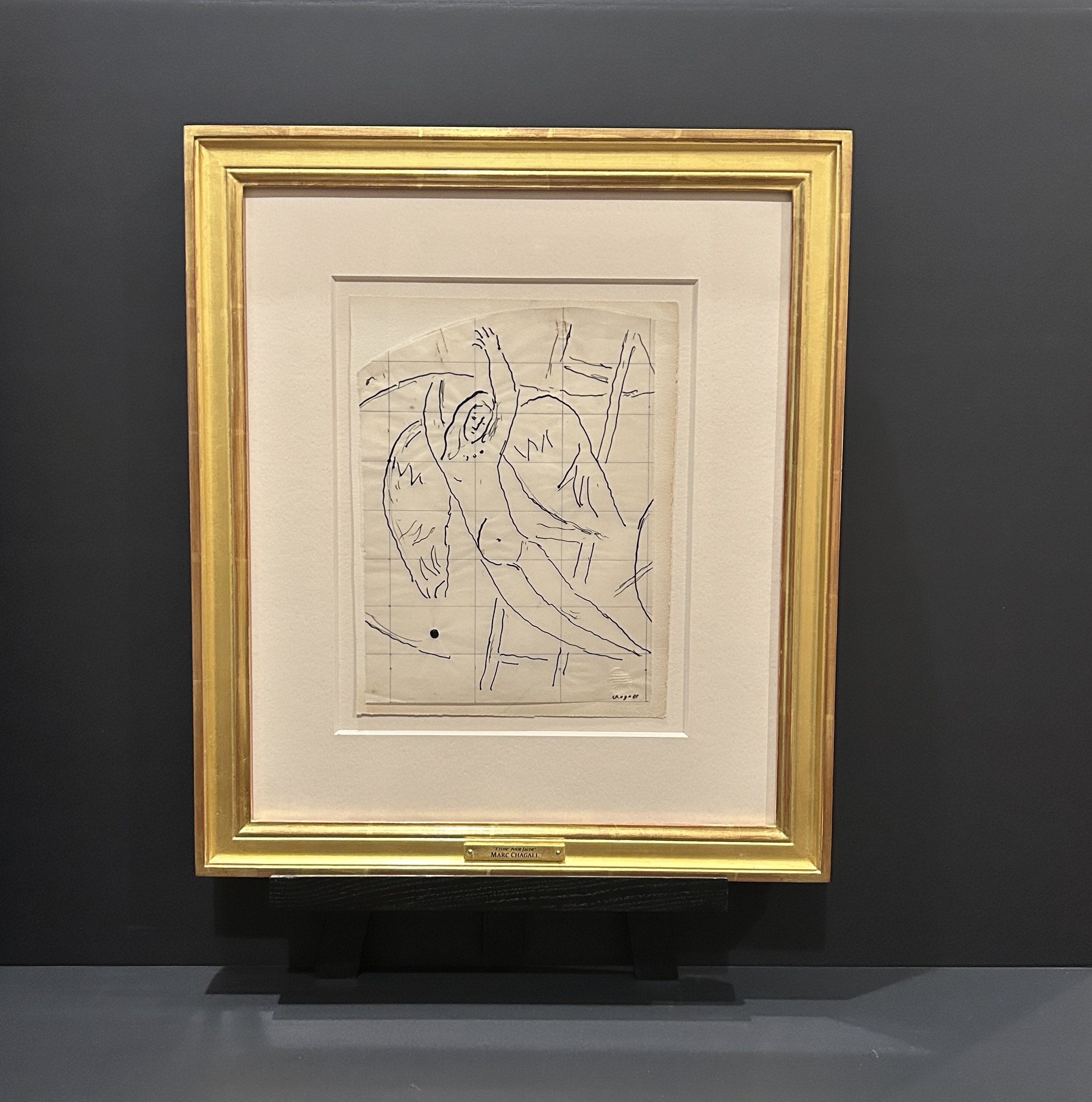 Image 2 of 5
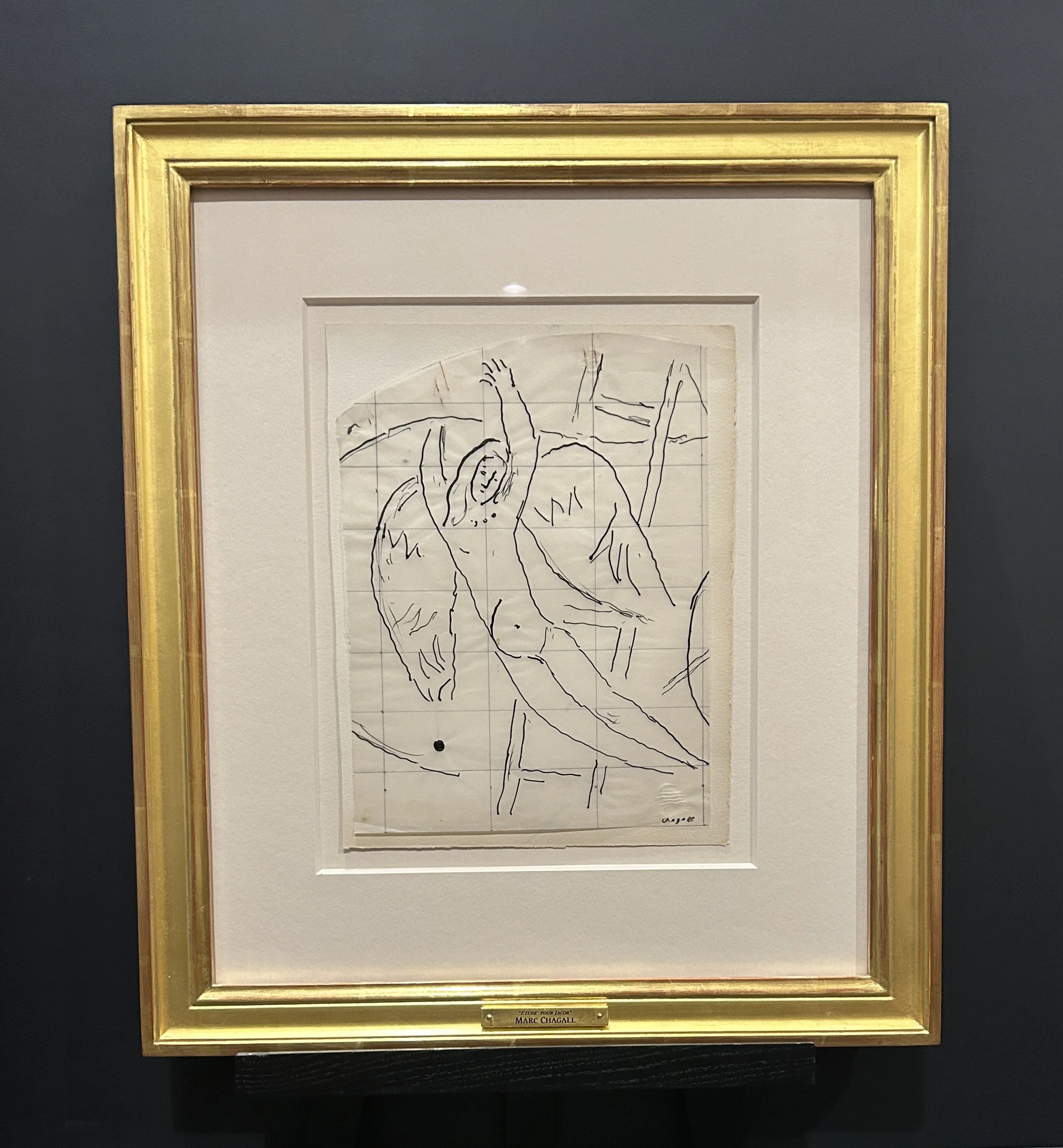 Image 3 of 5
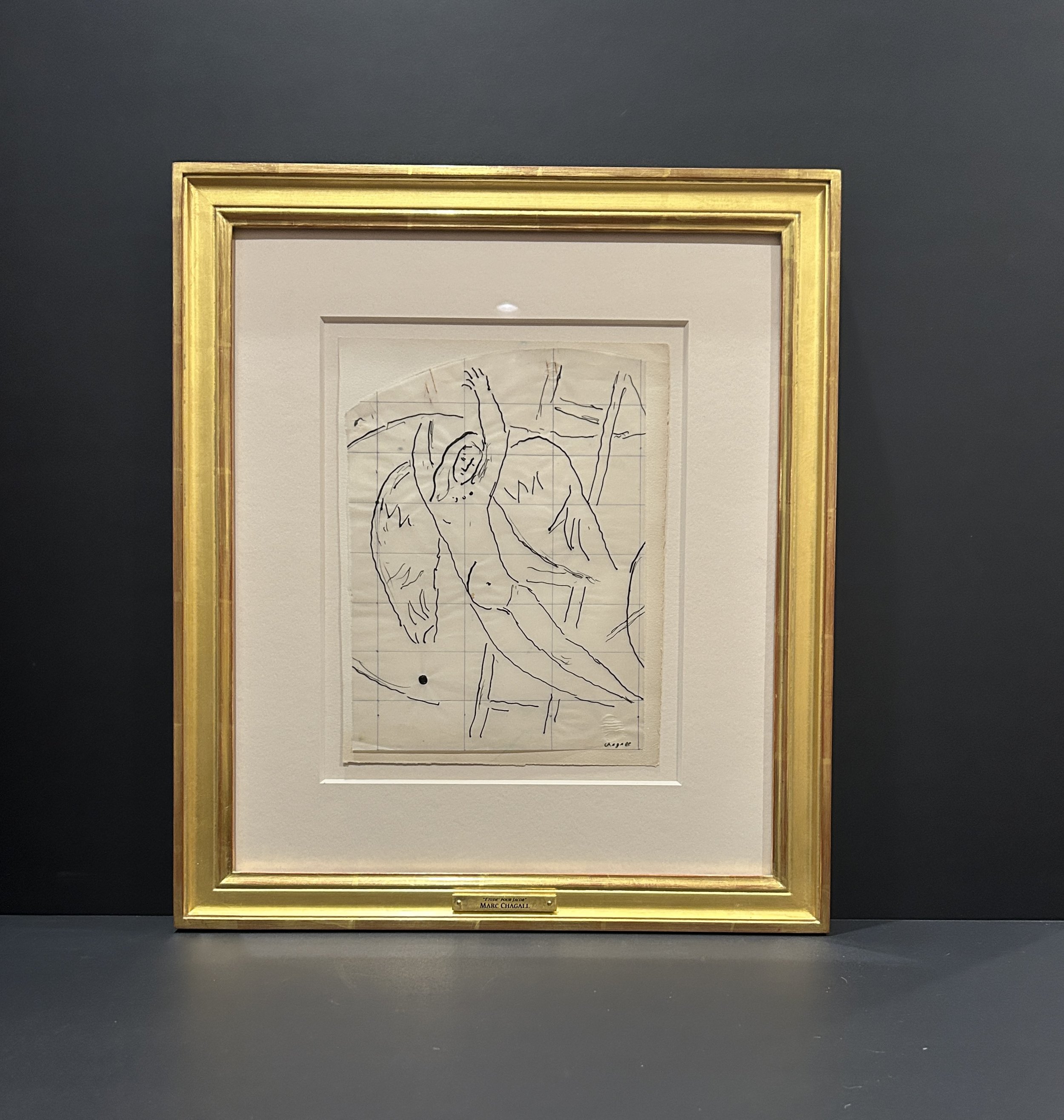 Image 4 of 5
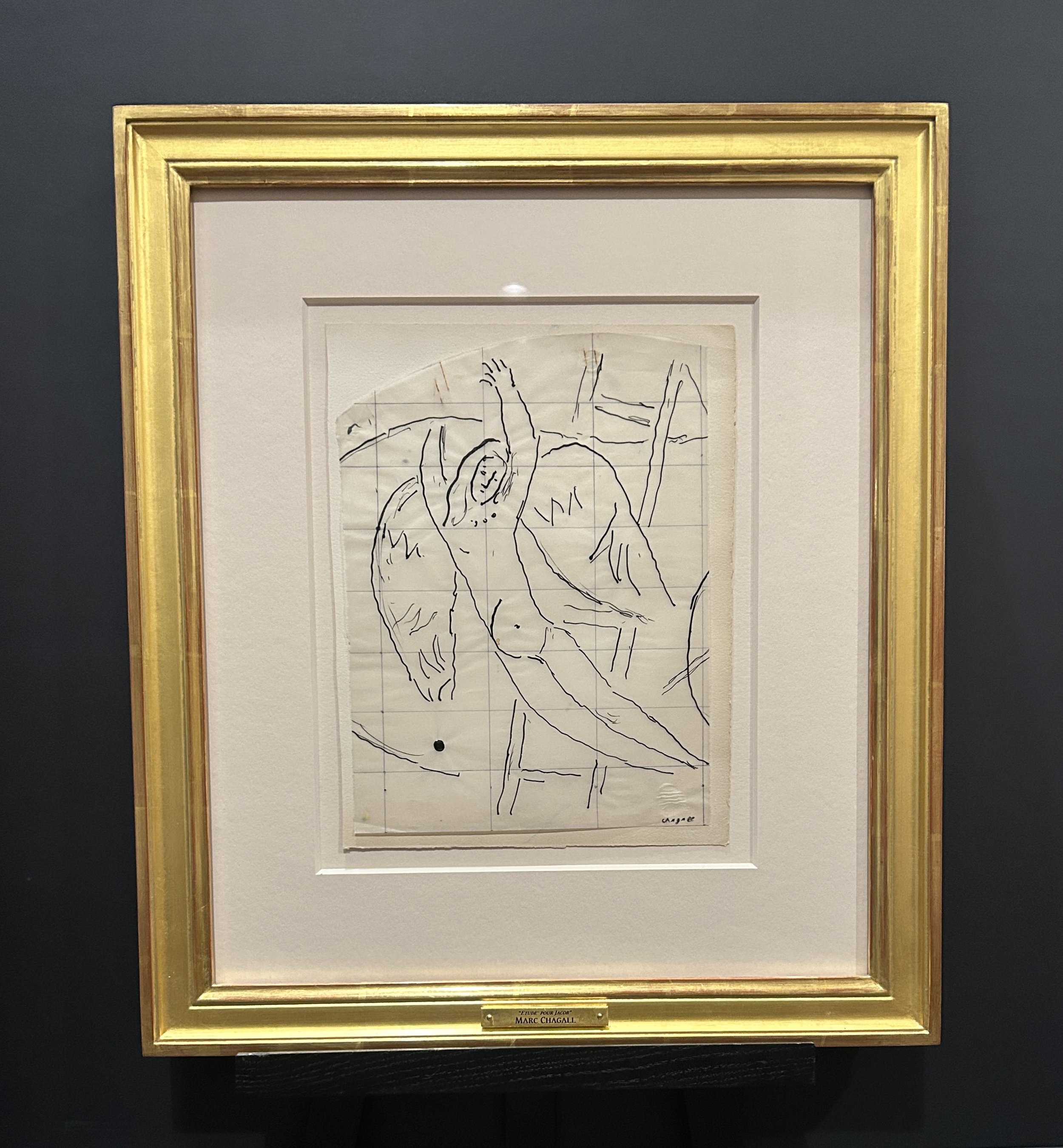 Image 5 of 5
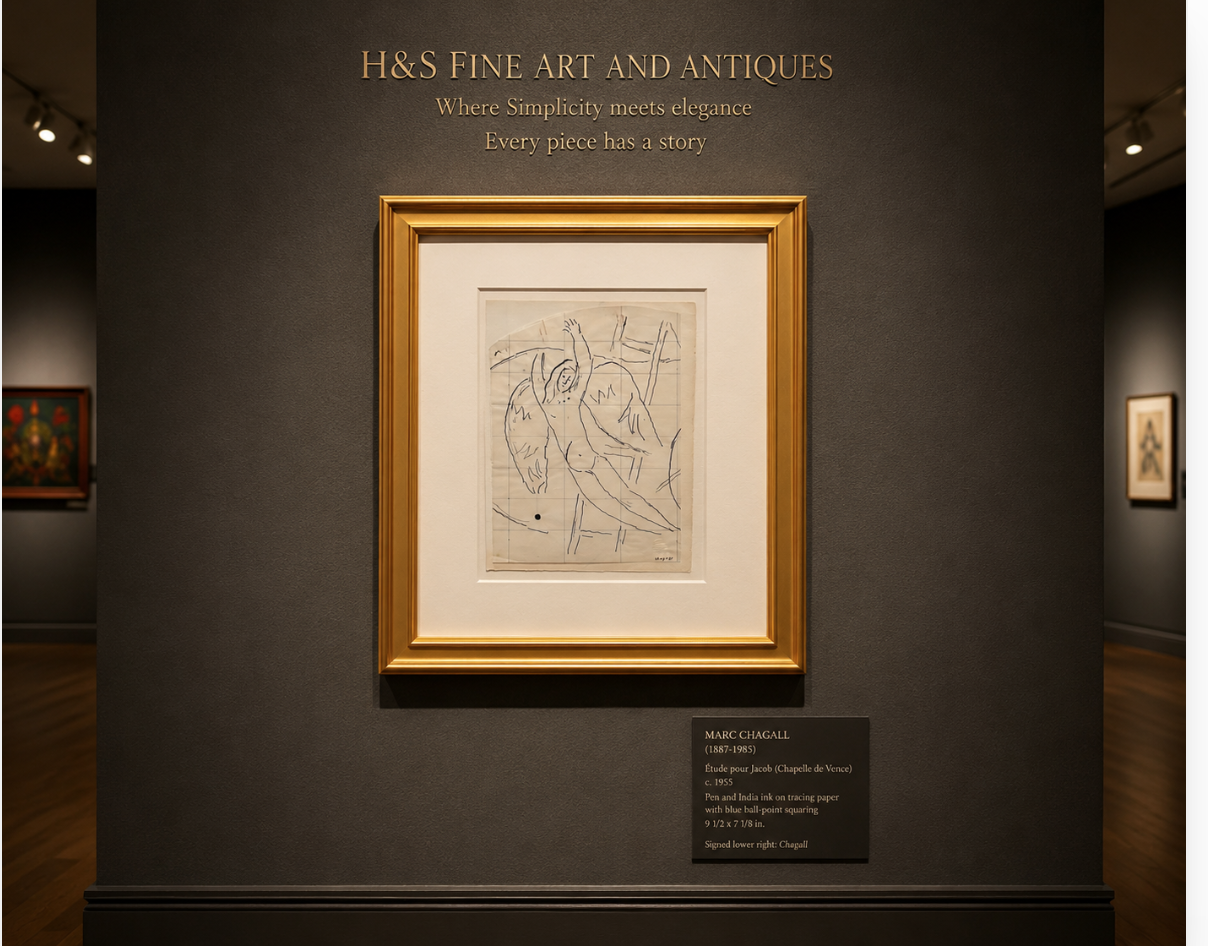
Marc Chagall ( 1887-1985 ). Etude pour Jacob ( Chapelle de Vence ). Committee Chagall has confirmed the authenticity of the drawing
Exhibition Essay
Marc Chagall (1887–1985)
Étude pour Jacob (Chapelle de Vence)
Circa 1955
Pen and India ink on tracing paper with blue ball-point squaring
9 ½ × 7 ⅛ inches (24.1 × 18.1 cm)
Signed lower right: Chagall
Provenance:
Atelier de l'artiste (Artist's Studio)
By descent to the present owner
Accompanied by a Certificate of Authenticity from the Comité Marc Chagall.
https://www.centrepompidou.fr/en/ressources/oeuvre/cbkGp9?utm
Between Heaven and Earth:
Jacob's Dream in the Imagination of Marc Chagall
Few twentieth-century artists succeeded in uniting personal memory, religious faith, and poetic imagination as profoundly as Marc Chagall. Étude pour Jacob (Chapelle de Vence) belongs to one of the most spiritually important periods of his career and offers an extraordinarily intimate glimpse into the artist's creative process.
The drawing depicts the biblical story commonly known as Jacob's Dream, one of the foundational narratives of the Book of Genesis.
After fleeing from his brother Esau, Jacob sleeps in the wilderness and dreams of a ladder extending from earth to heaven:
"And behold a ladder set up on the earth, and the top of it reached to heaven: and behold the angels of God ascending and descending on it."
— Genesis 28:12
Upon awakening, Jacob declares:
"Surely the Lord is in this place."
This vision represents the meeting of the human and divine realms and became one of Judaism's most enduring symbols of spiritual revelation.
For Chagall, this biblical episode held profound personal meaning.
Chagall and the Story of Exile
Marc Chagall
Born in the Jewish quarter of Vitebsk in 1887, Chagall lived through some of the most turbulent events of modern history.
He experienced:
The fall of Imperial Russia
The Russian Revolution
Two World Wars
The Holocaust
Forced exile to America
The loss of family and homeland
Throughout his life, Chagall often identified with biblical figures who wandered, suffered, and ultimately found redemption.
Jacob's journey mirrored Chagall's own.
Both were:
Exiles
Dreamers
Pilgrims
Men sustained by faith and memory
Jacob's ladder therefore became much more than a biblical object. For Chagall it symbolized humanity's eternal longing to bridge the distance between earthly suffering and divine promise.
Description of the Composition
At first glance, the drawing appears remarkably simple.
Upon closer examination, however, it reveals extraordinary complexity.
A slender figure rises diagonally through the composition, its body elongated and almost weightless. One arm reaches upward while flowing lines envelop the figure in an atmosphere of movement and spiritual ascent.
The composition possesses no conventional perspective.
There is:
no horizon,
no architectural setting,
no fixed gravity.
Instead, everything floats.
This suspension between worlds is one of Chagall's greatest inventions.
The image exists in a realm between:
dream and reality,
memory and vision,
earth and heaven.
The Meaning of the Ladder
The vertical elements throughout the composition evoke the ladder described in Genesis.
The ladder is perhaps one of Chagall's most important recurring symbols.
It signifies:
Communication between heaven and earth
Spiritual transformation
Divine protection
Faith amid suffering
The soul's ascent toward transcendence
Throughout his career, ladders appear repeatedly in paintings, gouaches, stained-glass windows, and biblical illustrations.
In Chagall's visual language, ladders are never merely structures.
They are pathways of revelation.
The Meaning of the Angels
The winged forms surrounding the central figure are almost certainly angels.
Angels occupy a central place in Chagall's art.
They are symbols of:
hope,
consolation,
divine intervention,
love,
memory,
eternity.
Unlike traditional religious painting, Chagall's angels do not descend with dramatic force.
Instead, they float.
They emerge gently from dream and memory.
Their presence suggests that divine grace exists quietly within human experience.
The angel here appears almost inseparable from Jacob himself, suggesting that revelation transforms the dreamer into a participant in the divine mystery.
The Meaning of the Raised Arm
The raised arm may symbolize:
prayer,
surrender,
aspiration,
communication with heaven.
Throughout Chagall's religious works, uplifted hands frequently indicate moments of revelation.
The gesture recalls figures found in Byzantine icons and medieval stained glass, where raised arms signify openness to divine presence.
The Significance of the Blue Grid
One of the most fascinating aspects of this drawing is the visible blue squaring.
The grid demonstrates that this was not merely a sketch.
It was a working cartoon intended for enlargement.
Artists have traditionally employed squaring techniques when preparing:
frescoes,
murals,
tapestries,
stained-glass windows,
monumental paintings.
The presence of this grid provides rare insight into Chagall's artistic method.
Preparatory studies are often among the most revealing works an artist leaves behind because they preserve the exact moment of invention.
Here we witness Chagall thinking through line itself.
The drawing records inspiration in its purest state.
Vence and the Mediterranean Light
After returning to France following World War II, Chagall settled in Vence in 1949.
The Mediterranean transformed his work.
The extraordinary light of southern France inspired some of his greatest religious achievements. In Vence, Chagall developed major biblical projects and envisioned a monumental cycle dedicated to the books of Genesis and Exodus. These ambitions eventually evolved into the celebrated Biblical Message series.
The artistic atmosphere surrounding Vence was extraordinary.
Nearby worked:
Henri Matisse
Pablo PicassoChagall closely followed Matisse's work on the famous:
Chapelle du Rosaire de Vence.
Inspired by the monumental possibilities of sacred art, Chagall envisioned his own biblical cycle in Vence. Those plans ultimately led to one of the most important religious museums of the twentieth century.
The Biblical Message and the Museum in Nice
Musée National Marc Chagall
The monumental biblical works conceived during Chagall's years in Vence eventually became the foundation of the Musée National Marc Chagall in Nice.
Opened in 1973 during the artist's lifetime, it remains the world's largest public collection devoted to Chagall's religious and spiritual works. The museum houses the celebrated Biblical Message cycle together with preparatory drawings, gouaches, stained glass, and studies related to his biblical projects.
Your drawing belongs intellectually and spiritually to this remarkable body of work.
Although intimate in scale, it embodies the same concerns:
revelation,
exile,
faith,
hope,
humanity's relationship with God.
Literature and References
Important references for understanding this drawing include:
Franz Meyer
Marc Chagall: Life and WorkJacob Baal-Teshuva
Marc Chagall, 1887–1985Jean-Louis Prat
Chagall ou le rêve partagéSusan Compton
ChagallCatalogues and publications of the
Musée National Marc ChagallThese studies consistently emphasize that Chagall considered the Bible to be "the greatest source of poetry of all time," and his biblical works transformed sacred stories into universal meditations on love, exile, suffering, and redemption.
Exhibition Label
Marc Chagall (1887–1985)
Étude pour Jacob (Chapelle de Vence)
Circa 1955
Pen and India ink on tracing paper with blue ball-point squaring
Signed lower rightCreated during the artist's years in Vence, this preparatory study depicts Jacob's vision of the heavenly ladder described in Genesis 28. Executed with spontaneous, calligraphic line and carefully squared for transfer to a larger composition, the drawing reveals Chagall's working process and his lifelong engagement with biblical themes. The ascending figure and surrounding angelic forms transform a sacred narrative into a poetic meditation on exile, revelation, and the union of heaven and earth. Originating from the artist's studio and authenticated by the Comité Marc Chagall, the work stands as a rare and intimate witness to one of the twentieth century's most profound interpreters of spiritual experience.
https://www.centrepompidou.fr/en/ressources/oeuvre/cbkGp9?utm
Exhibition Essay
Marc Chagall (1887–1985)
Étude pour Jacob (Chapelle de Vence)
Circa 1955
Pen and India ink on tracing paper with blue ball-point squaring
9 ½ × 7 ⅛ inches (24.1 × 18.1 cm)
Signed lower right: Chagall
Provenance:
Atelier de l'artiste (Artist's Studio)
By descent to the present owner
Accompanied by a Certificate of Authenticity from the Comité Marc Chagall.
https://www.centrepompidou.fr/en/ressources/oeuvre/cbkGp9?utm
Between Heaven and Earth:
Jacob's Dream in the Imagination of Marc Chagall
Few twentieth-century artists succeeded in uniting personal memory, religious faith, and poetic imagination as profoundly as Marc Chagall. Étude pour Jacob (Chapelle de Vence) belongs to one of the most spiritually important periods of his career and offers an extraordinarily intimate glimpse into the artist's creative process.
The drawing depicts the biblical story commonly known as Jacob's Dream, one of the foundational narratives of the Book of Genesis.
After fleeing from his brother Esau, Jacob sleeps in the wilderness and dreams of a ladder extending from earth to heaven:
"And behold a ladder set up on the earth, and the top of it reached to heaven: and behold the angels of God ascending and descending on it."
— Genesis 28:12
Upon awakening, Jacob declares:
"Surely the Lord is in this place."
This vision represents the meeting of the human and divine realms and became one of Judaism's most enduring symbols of spiritual revelation.
For Chagall, this biblical episode held profound personal meaning.
Chagall and the Story of Exile
Marc Chagall
Born in the Jewish quarter of Vitebsk in 1887, Chagall lived through some of the most turbulent events of modern history.
He experienced:
The fall of Imperial Russia
The Russian Revolution
Two World Wars
The Holocaust
Forced exile to America
The loss of family and homeland
Throughout his life, Chagall often identified with biblical figures who wandered, suffered, and ultimately found redemption.
Jacob's journey mirrored Chagall's own.
Both were:
Exiles
Dreamers
Pilgrims
Men sustained by faith and memory
Jacob's ladder therefore became much more than a biblical object. For Chagall it symbolized humanity's eternal longing to bridge the distance between earthly suffering and divine promise.
Description of the Composition
At first glance, the drawing appears remarkably simple.
Upon closer examination, however, it reveals extraordinary complexity.
A slender figure rises diagonally through the composition, its body elongated and almost weightless. One arm reaches upward while flowing lines envelop the figure in an atmosphere of movement and spiritual ascent.
The composition possesses no conventional perspective.
There is:
no horizon,
no architectural setting,
no fixed gravity.
Instead, everything floats.
This suspension between worlds is one of Chagall's greatest inventions.
The image exists in a realm between:
dream and reality,
memory and vision,
earth and heaven.
The Meaning of the Ladder
The vertical elements throughout the composition evoke the ladder described in Genesis.
The ladder is perhaps one of Chagall's most important recurring symbols.
It signifies:
Communication between heaven and earth
Spiritual transformation
Divine protection
Faith amid suffering
The soul's ascent toward transcendence
Throughout his career, ladders appear repeatedly in paintings, gouaches, stained-glass windows, and biblical illustrations.
In Chagall's visual language, ladders are never merely structures.
They are pathways of revelation.
The Meaning of the Angels
The winged forms surrounding the central figure are almost certainly angels.
Angels occupy a central place in Chagall's art.
They are symbols of:
hope,
consolation,
divine intervention,
love,
memory,
eternity.
Unlike traditional religious painting, Chagall's angels do not descend with dramatic force.
Instead, they float.
They emerge gently from dream and memory.
Their presence suggests that divine grace exists quietly within human experience.
The angel here appears almost inseparable from Jacob himself, suggesting that revelation transforms the dreamer into a participant in the divine mystery.
The Meaning of the Raised Arm
The raised arm may symbolize:
prayer,
surrender,
aspiration,
communication with heaven.
Throughout Chagall's religious works, uplifted hands frequently indicate moments of revelation.
The gesture recalls figures found in Byzantine icons and medieval stained glass, where raised arms signify openness to divine presence.
The Significance of the Blue Grid
One of the most fascinating aspects of this drawing is the visible blue squaring.
The grid demonstrates that this was not merely a sketch.
It was a working cartoon intended for enlargement.
Artists have traditionally employed squaring techniques when preparing:
frescoes,
murals,
tapestries,
stained-glass windows,
monumental paintings.
The presence of this grid provides rare insight into Chagall's artistic method.
Preparatory studies are often among the most revealing works an artist leaves behind because they preserve the exact moment of invention.
Here we witness Chagall thinking through line itself.
The drawing records inspiration in its purest state.
Vence and the Mediterranean Light
After returning to France following World War II, Chagall settled in Vence in 1949.
The Mediterranean transformed his work.
The extraordinary light of southern France inspired some of his greatest religious achievements. In Vence, Chagall developed major biblical projects and envisioned a monumental cycle dedicated to the books of Genesis and Exodus. These ambitions eventually evolved into the celebrated Biblical Message series.
The artistic atmosphere surrounding Vence was extraordinary.
Nearby worked:
Henri Matisse
Pablo PicassoChagall closely followed Matisse's work on the famous:
Chapelle du Rosaire de Vence.
Inspired by the monumental possibilities of sacred art, Chagall envisioned his own biblical cycle in Vence. Those plans ultimately led to one of the most important religious museums of the twentieth century.
The Biblical Message and the Museum in Nice
Musée National Marc Chagall
The monumental biblical works conceived during Chagall's years in Vence eventually became the foundation of the Musée National Marc Chagall in Nice.
Opened in 1973 during the artist's lifetime, it remains the world's largest public collection devoted to Chagall's religious and spiritual works. The museum houses the celebrated Biblical Message cycle together with preparatory drawings, gouaches, stained glass, and studies related to his biblical projects.
Your drawing belongs intellectually and spiritually to this remarkable body of work.
Although intimate in scale, it embodies the same concerns:
revelation,
exile,
faith,
hope,
humanity's relationship with God.
Literature and References
Important references for understanding this drawing include:
Franz Meyer
Marc Chagall: Life and WorkJacob Baal-Teshuva
Marc Chagall, 1887–1985Jean-Louis Prat
Chagall ou le rêve partagéSusan Compton
ChagallCatalogues and publications of the
Musée National Marc ChagallThese studies consistently emphasize that Chagall considered the Bible to be "the greatest source of poetry of all time," and his biblical works transformed sacred stories into universal meditations on love, exile, suffering, and redemption.
Exhibition Label
Marc Chagall (1887–1985)
Étude pour Jacob (Chapelle de Vence)
Circa 1955
Pen and India ink on tracing paper with blue ball-point squaring
Signed lower rightCreated during the artist's years in Vence, this preparatory study depicts Jacob's vision of the heavenly ladder described in Genesis 28. Executed with spontaneous, calligraphic line and carefully squared for transfer to a larger composition, the drawing reveals Chagall's working process and his lifelong engagement with biblical themes. The ascending figure and surrounding angelic forms transform a sacred narrative into a poetic meditation on exile, revelation, and the union of heaven and earth. Originating from the artist's studio and authenticated by the Comité Marc Chagall, the work stands as a rare and intimate witness to one of the twentieth century's most profound interpreters of spiritual experience.
https://www.centrepompidou.fr/en/ressources/oeuvre/cbkGp9?utm