 Image 1 of 3
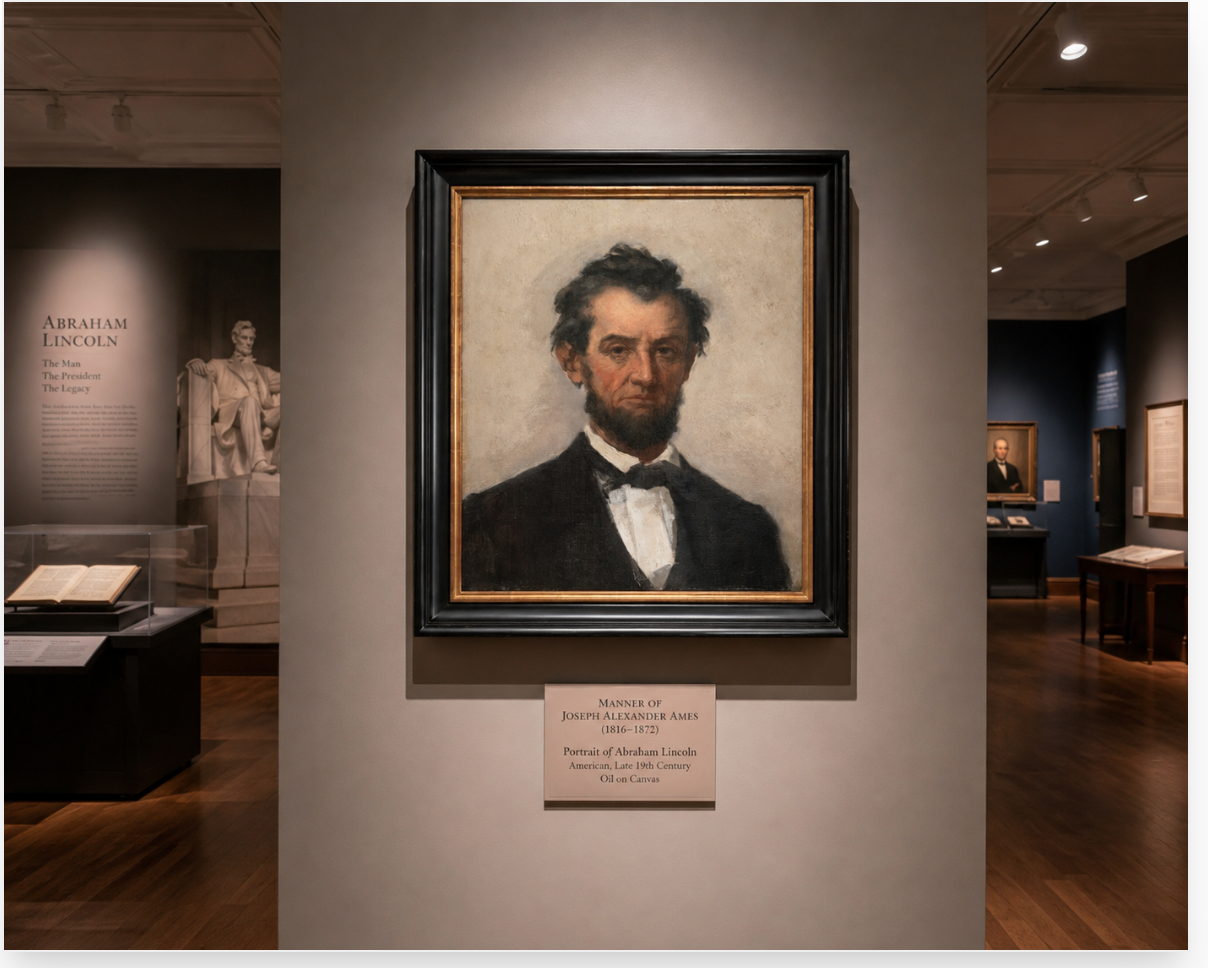 Image 2 of 3
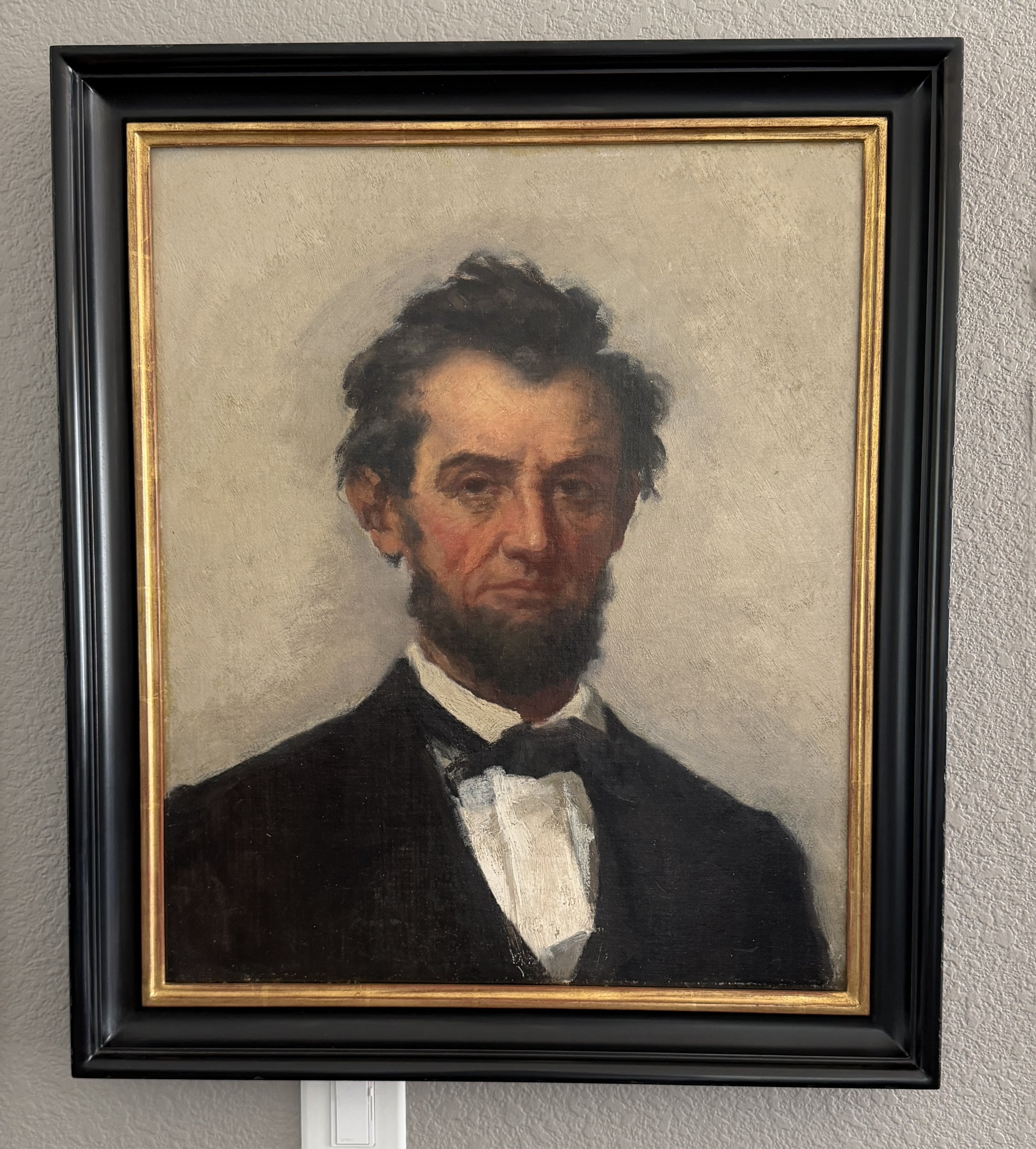 Image 3 of 3
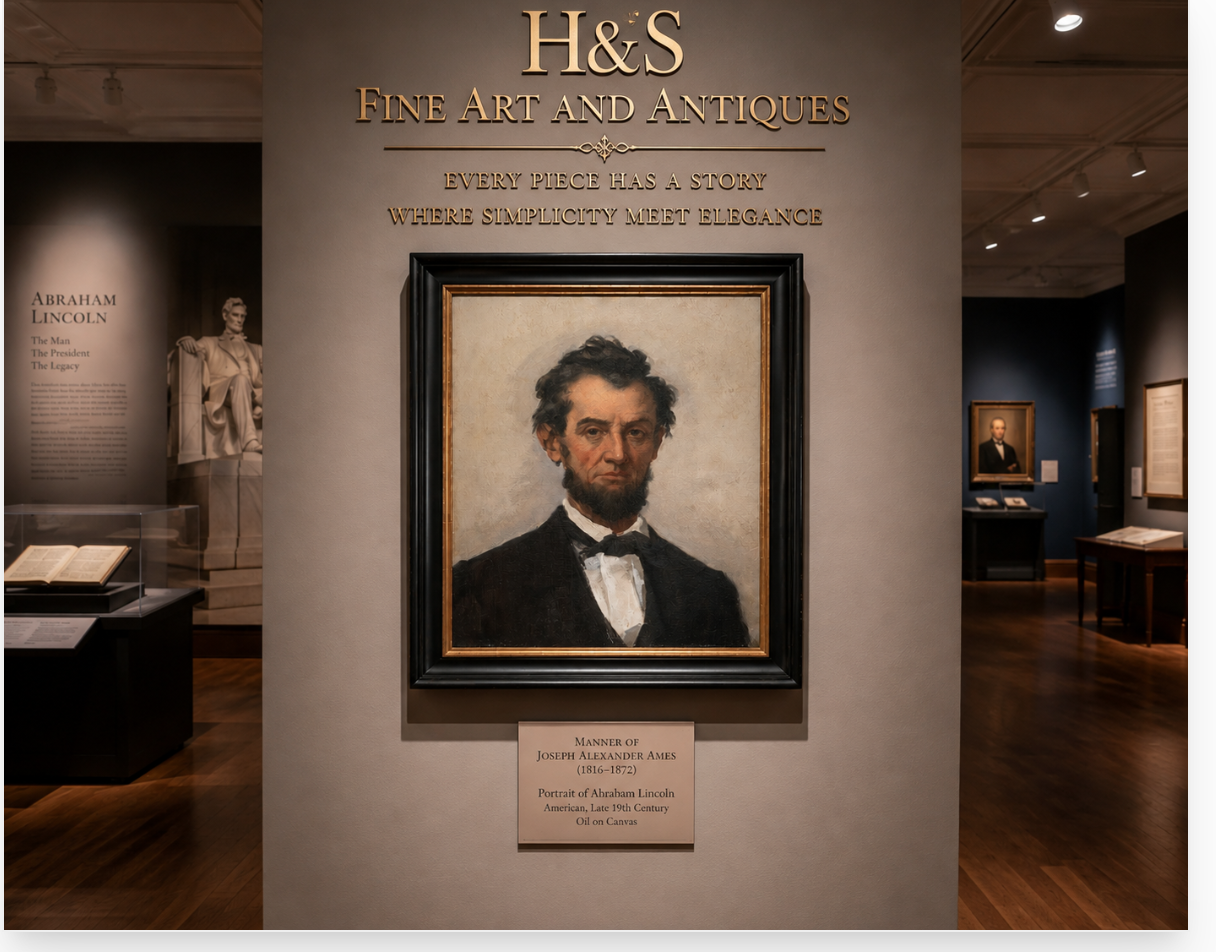
Manner of Joseph Alexander Ames (1816–1872) Portrait of Abraham Lincoln American, Late 19th Century.
Manner of Joseph Alexander Ames (1816–1872)
Portrait of Abraham Lincoln
American, Late 19th Century
Oil on Canvas
24 × 20 inches
Framed: 28½ × 24¼ inches
Gallery Research Essay
Few Americans have inspired more artistic interpretation than Abraham Lincoln. From his own lifetime through the late nineteenth century, painters sought not merely to reproduce his likeness, but to capture the moral strength, humility, and quiet determination that defined his presidency.
This portrait, executed in the manner of Joseph Alexander Ames, belongs to that tradition. Although catalogued as a later nineteenth-century work rather than an autograph painting by Ames himself, it reflects the visual language established by one of Lincoln's most respected portraitists.
More importantly, it succeeds on its own artistic merits.
Unlike many Victorian portraits that emphasize meticulous finish and photographic accuracy, this painting possesses an immediacy and expressive freedom that feels remarkably contemporary. It bridges two centuries—firmly rooted in nineteenth-century portraiture while anticipating the aesthetic sensibilities appreciated by today's collectors.
Joseph Alexander Ames (1816–1872)
Joseph Alexander Ames was among the finest American portrait painters working during the Civil War era.
Born in Roxbury, New Hampshire, Ames studied in Boston before traveling to Italy, where he refined his artistic vocabulary under the influence of European portraiture. Returning to America, he established a successful portrait practice, receiving commissions from prominent politicians, military leaders, jurists, and businessmen. He later exhibited at the Boston Athenaeum, the National Academy of Design, and the Pennsylvania Academy of the Fine Arts.
Ames became particularly associated with Abraham Lincoln during the final years of the President's life.
Contemporary accounts state that Ames had personally seen Lincoln, spoken with him, and carefully studied his features. This direct familiarity distinguished his portraits from the many derivative images based solely upon photographs. Christie's notes that Ames produced several portraits of Lincoln between 1864 and 1865, characterized by free brushwork and expressive handling.
Sarah Fisher Ames
Joseph's wife, Sarah Fisher Ames (1817–1901), was herself an accomplished sculptor and one of the foremost artists to model Lincoln from life.
Serving as a Civil War nurse in Washington, she developed access to the President and produced several marble busts that remain among the finest sculptural representations of Lincoln. Examples survive in the United States Senate Collection and other museums.
Together, Joseph and Sarah Ames formed one of the most important artistic partnerships associated with Lincoln during and immediately after the Civil War.
Abraham Lincoln
No American statesman occupies a more central place in the nation's historical memory.
As the sixteenth President of the United States, Lincoln preserved the Union during the Civil War, issued the Emancipation Proclamation, encouraged passage of the Thirteenth Amendment, and redefined the ideals of American democracy.
Following his assassination in April 1865, Lincoln became not simply a historical figure but a national icon. Portraits such as this one served both commemorative and educational purposes, appearing in courthouses, veterans' halls, schools, libraries, and private collections across America.
Artistic Style
This portrait departs from the polished academic realism common in nineteenth-century presidential portraiture.
Instead, it embraces a painterly approach characterized by:
visible, confident brushwork
restrained modeling
tonal harmony
psychological intensity
simplified composition
Rather than recording every physical detail, the artist emphasizes Lincoln's humanity.
His weary eyes, slightly asymmetrical features, unruly hair, and loosely painted beard create an image of introspection rather than political grandeur.
A Surprisingly Modern Vision
One of the painting's greatest strengths is its remarkable visual modernity.
Viewed without context, many visitors would assume the work dates from the early twentieth century or even later.
Several qualities contribute to this impression:
simplified composition
absence of symbolic props
neutral background
expressive brushwork
broad handling of paint
emphasis on mood over finish
These are precisely the qualities admired by many contemporary collectors.
The portrait does not overwhelm the viewer with patriotic symbolism. There are no flags, columns, books, or elaborate interiors.
There is only Lincoln.
That simplicity gives the painting extraordinary visual power.
It is, in many respects, closer in spirit to twentieth-century expressive portraiture than to the formal Victorian tradition from which it emerged.
The Ames Connection
The attribution "Manner of Joseph Alexander Ames" is significant because Ames genuinely established one of the defining painted images of Abraham Lincoln.
Christie's describes an authenticated Ames portrait as one of several executed between 1864 and 1865 and notes the artist's "free style with expressive paint handling." Those observations resonate strongly with the painterly qualities visible in the present work.
While the present painting cannot presently be attributed directly to Ames, it clearly belongs to the artistic lineage established by his Lincoln portraits.
Comparable Works
Christie's
In 2009, Christie's sold an authenticated Joseph Alexander Ames, Portrait of Abraham Lincoln, measuring 22⅛ × 16 inches.
The catalogue emphasized:
Ames personally studied Lincoln.
The painting was one of several portraits executed during 1864–65.
Its expressive brushwork distinguished it from more academic presidential portraits.
It descended through the collection of Martin Parry Kennard and Wilfred Buckley
Freeman's
Freeman's offered another important Ames Lincoln, described as the artist's original study of Lincoln's head.
Documentation accompanying the painting stated that Ames used this study as the basis for additional Lincoln portraits. The catalogue also recorded that another version resided at Kykuit, the Rockefeller estate.
This establishes that Ames himself painted multiple related Lincoln compositions rather than a single definitive portrait.
Related Museum Examples
Comparable Ames Lincoln portraits may be found in several important institutions.
Faneuil Hall
Boston, Massachusetts
Commissioned by the City of Boston shortly after Lincoln's assassination, Ames's monumental portrait remains displayed in the Great Hall.
Contemporary Massachusetts senators Charles Sumner and Henry Wilson reportedly regarded it as the finest likeness of Lincoln then in existence.
Morris Museum
Morristown, New Jersey
Another Lincoln portrait associated with Ames's circle was formerly in the Buckley Collection before entering the Morris Museum.
Christie's specifically compares its stylistic qualities to the authenticated Ames portrait sold in 2009.
Kykuit
Rockefeller Estate, Pocantico Hills, New York
According to Freeman's documentation, another Ames version of Lincoln's portrait remained in the Rockefeller collection at Kykuit, illustrating the continued prestige of Ames's interpretation among distinguished American collectors.
Literature
The Ames tradition is documented in important Lincoln scholarship, including:
Lincoln in Portraiture by Rufus Rockwell Wilson.
Lincoln Financial Foundation archives devoted specifically to Joseph Alexander Ames and Lincoln portraiture.
Christie's catalogue essay for the authenticated Ames portrait.
Boston National Historical Park research concerning the Ames portrait at Faneuil Hall.
Visual Appeal
What distinguishes this portrait is not historical importance alone.
It is its ability to appeal simultaneously to two different audiences.
For collectors of Americana, it represents one of the nation's most enduring historical figures interpreted within the Ames tradition.
For collectors of fine art, it functions as a compelling expressive portrait whose painterly handling transcends historical subject matter.
The portrait possesses a calm visual rhythm.
Muted grays dissolve into warm flesh tones.
The black coat anchors the composition.
The face emerges from the surrounding paint with remarkable immediacy.
It is an image designed less to impress than to engage.
Exhibition Context
This portrait would be equally at home in exhibitions devoted to:
Abraham Lincoln and the American Presidency
Faces of the Civil War
American Presidential Portraiture
Icons of Democracy
American Memory after the Civil War
The Evolution of Lincoln's Image in American Art
Nineteenth-Century American Portraiture
Curator's Note
Among the countless painted images of Abraham Lincoln produced during the nineteenth century, relatively few continue to resonate with modern audiences as works of art independent of their historical subject. This portrait is one of those exceptions.
Its power lies in restraint. The artist dispenses with patriotic spectacle and instead presents Lincoln through expressive brushwork, subtle tonal harmony, and psychological depth. The resulting image feels unexpectedly contemporary, anticipating aesthetic qualities often associated with twentieth-century painting while remaining firmly rooted in nineteenth-century American portraiture.
Although catalogued as executed in the manner of Joseph Alexander Ames, the painting succeeds on more than attribution alone. It reflects the visual legacy established by one of Lincoln's most admired portraitists while offering an interpretation that feels intimate rather than ceremonial.
For today's collector, this dual identity is perhaps its greatest strength. It is simultaneously an object of historical significance and a visually compelling work of art—equally suited to a collection of Lincolniana, American portraiture, or a thoughtfully curated contemporary interior. More than 150 years after Lincoln's death, the portrait continues to do what the finest portraits always accomplish: it invites the viewer into the presence of the sitter rather than merely recording his appearance.
Manner of Joseph Alexander Ames (1816–1872)
Portrait of Abraham Lincoln
American, Late 19th Century
Oil on Canvas
24 × 20 inches
Framed: 28½ × 24¼ inches
Gallery Research Essay
Few Americans have inspired more artistic interpretation than Abraham Lincoln. From his own lifetime through the late nineteenth century, painters sought not merely to reproduce his likeness, but to capture the moral strength, humility, and quiet determination that defined his presidency.
This portrait, executed in the manner of Joseph Alexander Ames, belongs to that tradition. Although catalogued as a later nineteenth-century work rather than an autograph painting by Ames himself, it reflects the visual language established by one of Lincoln's most respected portraitists.
More importantly, it succeeds on its own artistic merits.
Unlike many Victorian portraits that emphasize meticulous finish and photographic accuracy, this painting possesses an immediacy and expressive freedom that feels remarkably contemporary. It bridges two centuries—firmly rooted in nineteenth-century portraiture while anticipating the aesthetic sensibilities appreciated by today's collectors.
Joseph Alexander Ames (1816–1872)
Joseph Alexander Ames was among the finest American portrait painters working during the Civil War era.
Born in Roxbury, New Hampshire, Ames studied in Boston before traveling to Italy, where he refined his artistic vocabulary under the influence of European portraiture. Returning to America, he established a successful portrait practice, receiving commissions from prominent politicians, military leaders, jurists, and businessmen. He later exhibited at the Boston Athenaeum, the National Academy of Design, and the Pennsylvania Academy of the Fine Arts.
Ames became particularly associated with Abraham Lincoln during the final years of the President's life.
Contemporary accounts state that Ames had personally seen Lincoln, spoken with him, and carefully studied his features. This direct familiarity distinguished his portraits from the many derivative images based solely upon photographs. Christie's notes that Ames produced several portraits of Lincoln between 1864 and 1865, characterized by free brushwork and expressive handling.
Sarah Fisher Ames
Joseph's wife, Sarah Fisher Ames (1817–1901), was herself an accomplished sculptor and one of the foremost artists to model Lincoln from life.
Serving as a Civil War nurse in Washington, she developed access to the President and produced several marble busts that remain among the finest sculptural representations of Lincoln. Examples survive in the United States Senate Collection and other museums.
Together, Joseph and Sarah Ames formed one of the most important artistic partnerships associated with Lincoln during and immediately after the Civil War.
Abraham Lincoln
No American statesman occupies a more central place in the nation's historical memory.
As the sixteenth President of the United States, Lincoln preserved the Union during the Civil War, issued the Emancipation Proclamation, encouraged passage of the Thirteenth Amendment, and redefined the ideals of American democracy.
Following his assassination in April 1865, Lincoln became not simply a historical figure but a national icon. Portraits such as this one served both commemorative and educational purposes, appearing in courthouses, veterans' halls, schools, libraries, and private collections across America.
Artistic Style
This portrait departs from the polished academic realism common in nineteenth-century presidential portraiture.
Instead, it embraces a painterly approach characterized by:
visible, confident brushwork
restrained modeling
tonal harmony
psychological intensity
simplified composition
Rather than recording every physical detail, the artist emphasizes Lincoln's humanity.
His weary eyes, slightly asymmetrical features, unruly hair, and loosely painted beard create an image of introspection rather than political grandeur.
A Surprisingly Modern Vision
One of the painting's greatest strengths is its remarkable visual modernity.
Viewed without context, many visitors would assume the work dates from the early twentieth century or even later.
Several qualities contribute to this impression:
simplified composition
absence of symbolic props
neutral background
expressive brushwork
broad handling of paint
emphasis on mood over finish
These are precisely the qualities admired by many contemporary collectors.
The portrait does not overwhelm the viewer with patriotic symbolism. There are no flags, columns, books, or elaborate interiors.
There is only Lincoln.
That simplicity gives the painting extraordinary visual power.
It is, in many respects, closer in spirit to twentieth-century expressive portraiture than to the formal Victorian tradition from which it emerged.
The Ames Connection
The attribution "Manner of Joseph Alexander Ames" is significant because Ames genuinely established one of the defining painted images of Abraham Lincoln.
Christie's describes an authenticated Ames portrait as one of several executed between 1864 and 1865 and notes the artist's "free style with expressive paint handling." Those observations resonate strongly with the painterly qualities visible in the present work.
While the present painting cannot presently be attributed directly to Ames, it clearly belongs to the artistic lineage established by his Lincoln portraits.
Comparable Works
Christie's
In 2009, Christie's sold an authenticated Joseph Alexander Ames, Portrait of Abraham Lincoln, measuring 22⅛ × 16 inches.
The catalogue emphasized:
Ames personally studied Lincoln.
The painting was one of several portraits executed during 1864–65.
Its expressive brushwork distinguished it from more academic presidential portraits.
It descended through the collection of Martin Parry Kennard and Wilfred Buckley
Freeman's
Freeman's offered another important Ames Lincoln, described as the artist's original study of Lincoln's head.
Documentation accompanying the painting stated that Ames used this study as the basis for additional Lincoln portraits. The catalogue also recorded that another version resided at Kykuit, the Rockefeller estate.
This establishes that Ames himself painted multiple related Lincoln compositions rather than a single definitive portrait.
Related Museum Examples
Comparable Ames Lincoln portraits may be found in several important institutions.
Faneuil Hall
Boston, Massachusetts
Commissioned by the City of Boston shortly after Lincoln's assassination, Ames's monumental portrait remains displayed in the Great Hall.
Contemporary Massachusetts senators Charles Sumner and Henry Wilson reportedly regarded it as the finest likeness of Lincoln then in existence.
Morris Museum
Morristown, New Jersey
Another Lincoln portrait associated with Ames's circle was formerly in the Buckley Collection before entering the Morris Museum.
Christie's specifically compares its stylistic qualities to the authenticated Ames portrait sold in 2009.
Kykuit
Rockefeller Estate, Pocantico Hills, New York
According to Freeman's documentation, another Ames version of Lincoln's portrait remained in the Rockefeller collection at Kykuit, illustrating the continued prestige of Ames's interpretation among distinguished American collectors.
Literature
The Ames tradition is documented in important Lincoln scholarship, including:
Lincoln in Portraiture by Rufus Rockwell Wilson.
Lincoln Financial Foundation archives devoted specifically to Joseph Alexander Ames and Lincoln portraiture.
Christie's catalogue essay for the authenticated Ames portrait.
Boston National Historical Park research concerning the Ames portrait at Faneuil Hall.
Visual Appeal
What distinguishes this portrait is not historical importance alone.
It is its ability to appeal simultaneously to two different audiences.
For collectors of Americana, it represents one of the nation's most enduring historical figures interpreted within the Ames tradition.
For collectors of fine art, it functions as a compelling expressive portrait whose painterly handling transcends historical subject matter.
The portrait possesses a calm visual rhythm.
Muted grays dissolve into warm flesh tones.
The black coat anchors the composition.
The face emerges from the surrounding paint with remarkable immediacy.
It is an image designed less to impress than to engage.
Exhibition Context
This portrait would be equally at home in exhibitions devoted to:
Abraham Lincoln and the American Presidency
Faces of the Civil War
American Presidential Portraiture
Icons of Democracy
American Memory after the Civil War
The Evolution of Lincoln's Image in American Art
Nineteenth-Century American Portraiture
Curator's Note
Among the countless painted images of Abraham Lincoln produced during the nineteenth century, relatively few continue to resonate with modern audiences as works of art independent of their historical subject. This portrait is one of those exceptions.
Its power lies in restraint. The artist dispenses with patriotic spectacle and instead presents Lincoln through expressive brushwork, subtle tonal harmony, and psychological depth. The resulting image feels unexpectedly contemporary, anticipating aesthetic qualities often associated with twentieth-century painting while remaining firmly rooted in nineteenth-century American portraiture.
Although catalogued as executed in the manner of Joseph Alexander Ames, the painting succeeds on more than attribution alone. It reflects the visual legacy established by one of Lincoln's most admired portraitists while offering an interpretation that feels intimate rather than ceremonial.
For today's collector, this dual identity is perhaps its greatest strength. It is simultaneously an object of historical significance and a visually compelling work of art—equally suited to a collection of Lincolniana, American portraiture, or a thoughtfully curated contemporary interior. More than 150 years after Lincoln's death, the portrait continues to do what the finest portraits always accomplish: it invites the viewer into the presence of the sitter rather than merely recording his appearance.