 Image 1 of 4
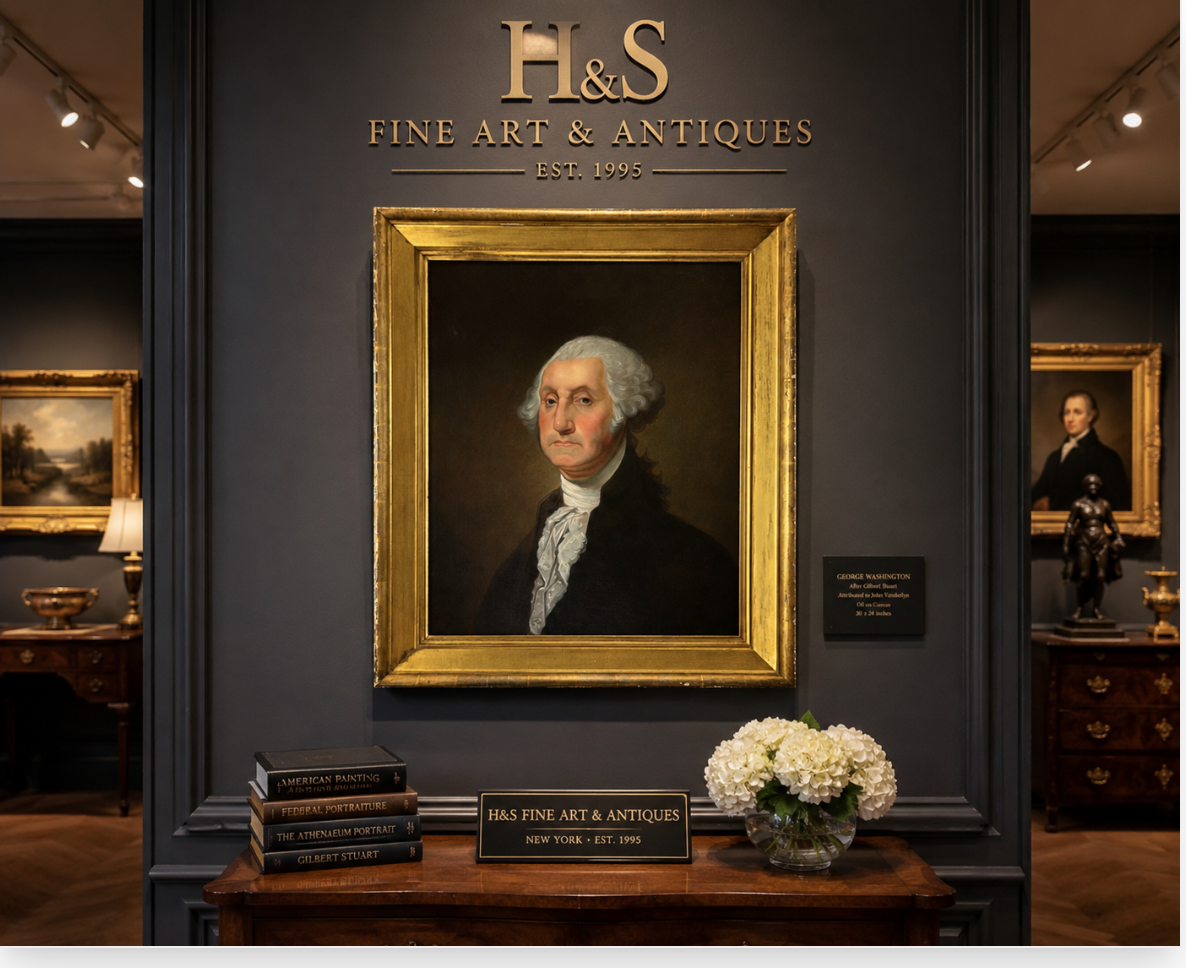 Image 2 of 4
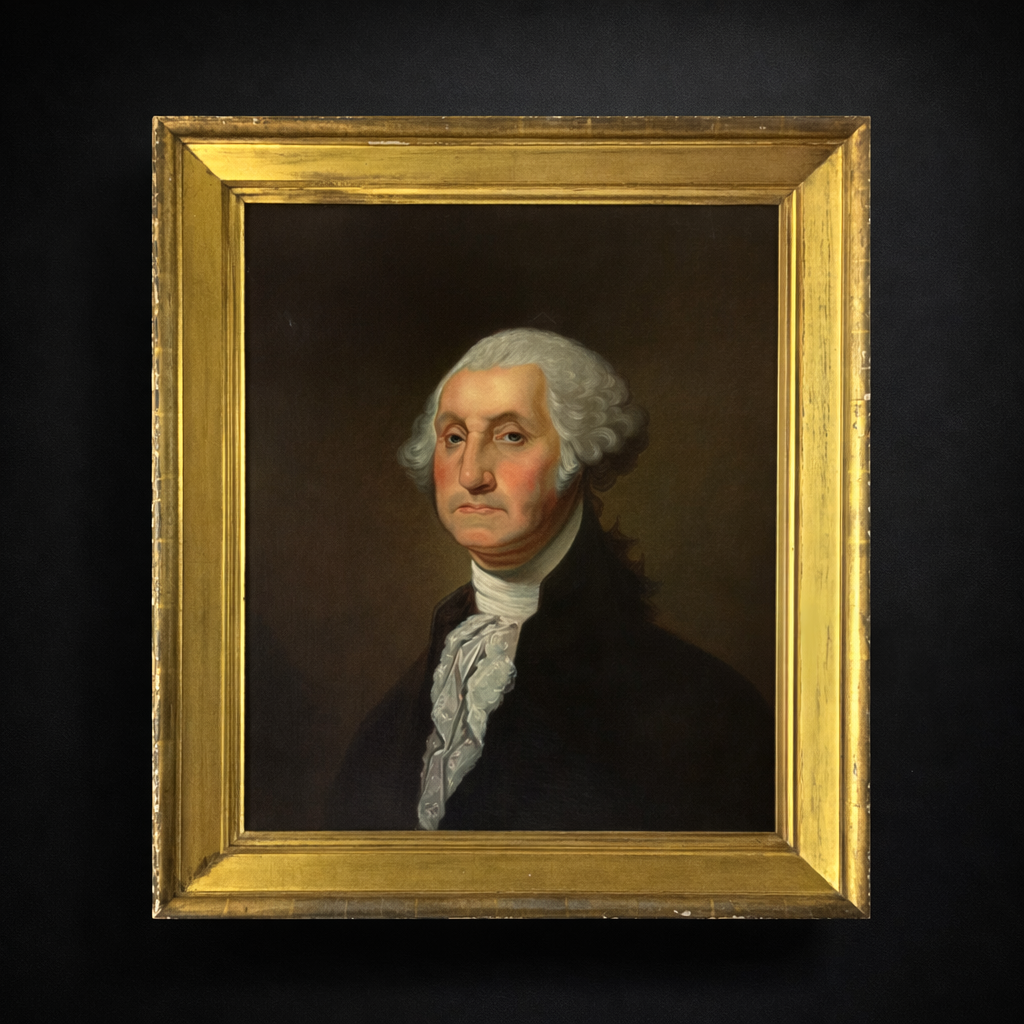 Image 3 of 4
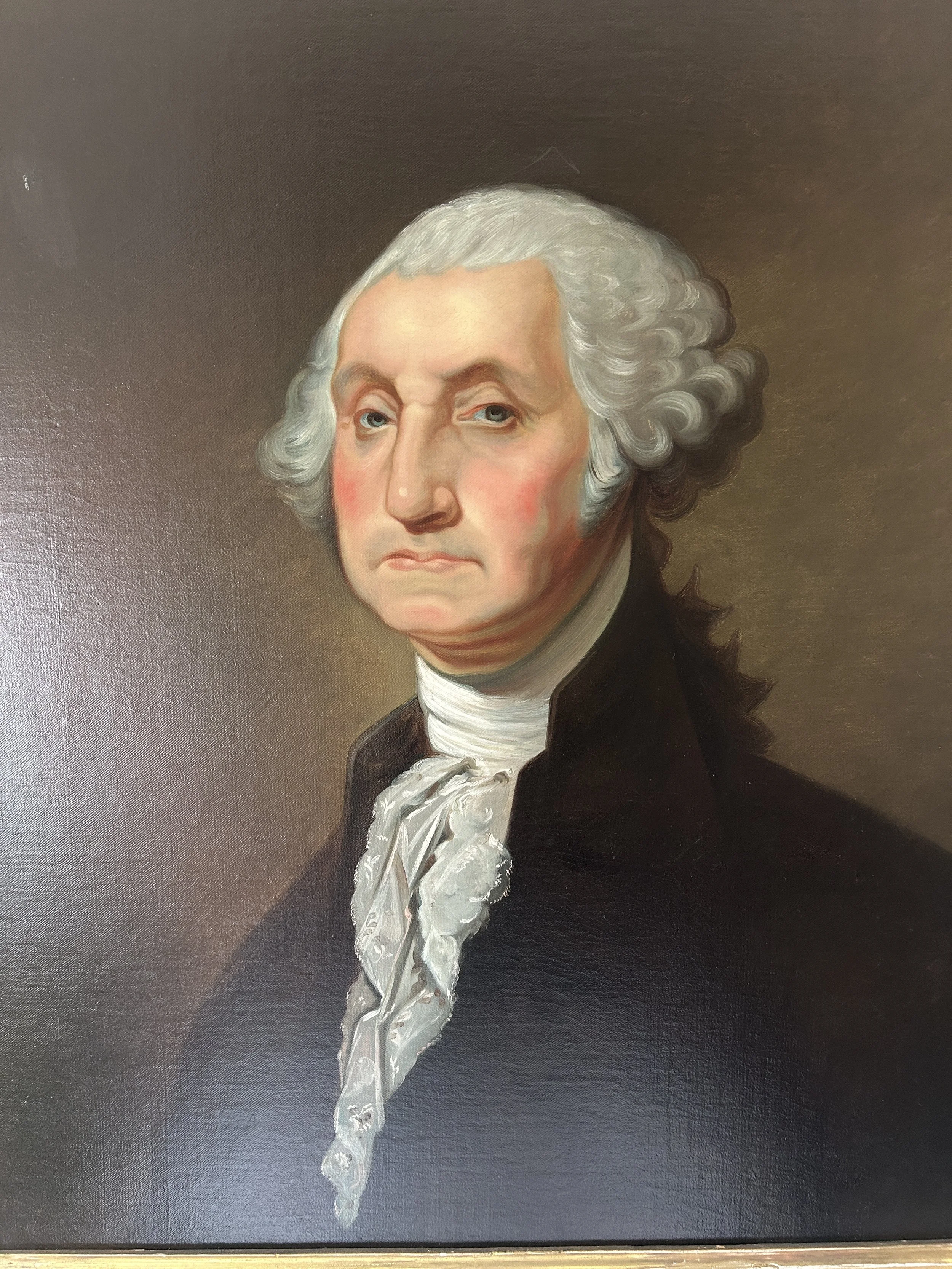 Image 4 of 4
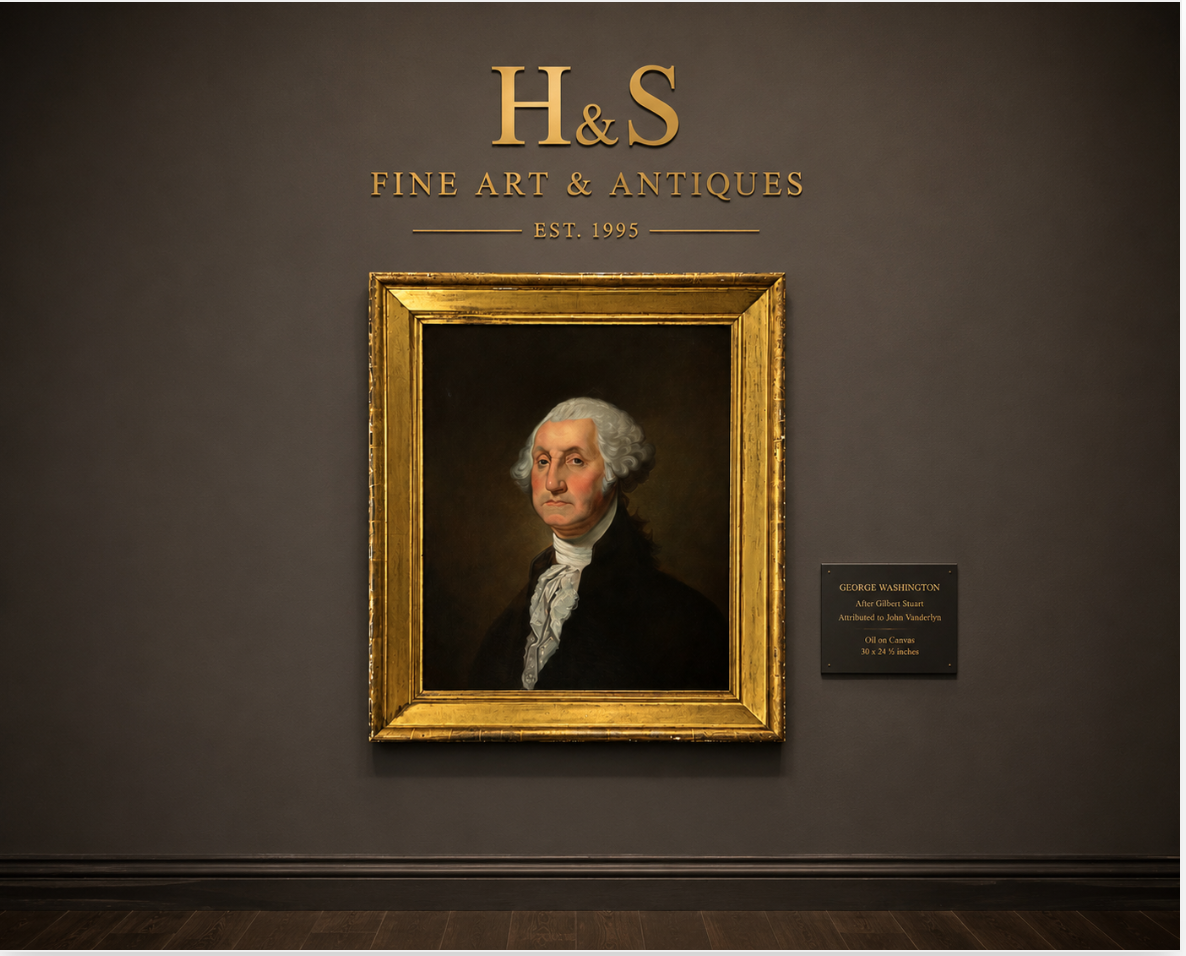
John Vanderlyn (American, 1775-1852), attrib. Portrait of George Washington after the "Athenaeum Portrait" of George Washington by Gilbert Stuart (1755-1828).
GEORGE WASHINGTON
Attributed to John Vanderlyn (American, 1775–1852)
After Gilbert Stuart's Athenaeum Portrait, 1796
Oil on Canvas
30 x 24 ½ inches
Provenance:
Berry-Hill Galleries, Inc., New York, New York
Private Collection
EXHIBITION ESSAY
The Face of a Nation
Few images in American history possess the enduring power and cultural significance of Gilbert Stuart's celebrated Athenaeum Portrait of George Washington. Painted in 1796 during the final years of Washington's presidency, Stuart's likeness became the definitive image of the first President and remains one of the most recognizable portraits ever produced in the United States. The present work, attributed to the distinguished American painter John Vanderlyn, stands within that remarkable tradition and reflects the reverence with which Washington was regarded throughout the nineteenth century.
Depicted in bust-length format against a restrained dark background, Washington appears with the calm dignity, self-command, and moral authority that became hallmarks of Stuart's conception. Unlike European portraits of monarchs adorned with crowns, armor, or regalia, Stuart presented Washington as the embodiment of republican virtue—a citizen-statesman whose authority derived from service rather than hereditary privilege. This revolutionary visual language helped define how Americans viewed both their first President and the nation itself.
Gilbert Stuart's original Athenaeum Portrait occupies a singular place in American art history. Painted from life in Philadelphia in 1796, the unfinished canvas remained in Stuart's possession and became the model from which he produced numerous replicas and variations. The image ultimately served as the basis for the engraved likeness of Washington that appears on the United States one-dollar bill. Today the original Athenaeum Portrait is jointly owned by the National Portrait Gallery, Smithsonian Institution, and the Museum of Fine Arts, Boston. Stuart's portrait became the most widely disseminated image of Washington and inspired generations of artists who sought to preserve the likeness of the nation's founding hero.
THE ARTIST
John Vanderlyn occupies a distinguished place among the founders of American art. Born in Kingston, New York, in 1775, the same year the American Revolution began, Vanderlyn emerged as one of the earliest American painters to receive formal academic training in Europe. Encouraged by influential patrons and recognized for his exceptional talent, he traveled to Paris and studied at the prestigious École des Beaux-Arts, becoming one of the first American artists to master the principles of French Neoclassicism. His European training elevated him above many of his contemporaries and helped establish a new level of sophistication in American painting.
Vanderlyn's career bridged the Revolutionary generation and the emerging American Republic. He painted many of the nation's leading statesmen, including Presidents James Monroe, James Madison, Andrew Jackson, and Zachary Taylor. His work reflects both European refinement and a distinctly American sensibility, making him one of the most important painters of the Federal and Early Republic periods. Today his paintings reside in major public collections, including the National Gallery of Art and the Smithsonian American Art Museum.
GEORGE WASHINGTON AS AMERICAN ICON
Following Washington's death in 1799, portraits of the first President assumed a role unlike that of any other American image. Washington became both historical figure and national symbol. His likeness appeared in government buildings, banks, courthouses, schools, military academies, and private homes across the expanding nation.
The demand for Washington portraits was extraordinary. Gilbert Stuart's original likeness inspired scores of replicas, adaptations, engravings, and painted copies. Mount Vernon estimates that approximately seventy-five Athenaeum-type portraits survive, while many more versions and derivations were produced throughout the nineteenth century.
To early Americans, these portraits were more than decorative objects; they were expressions of national identity and civic virtue. They reminded viewers of the sacrifices of the Revolutionary generation and embodied ideals of leadership, duty, integrity, and public service.
integrity, and public service.
ARTISTIC SIGNIFICANCE
This portrait demonstrates the enduring influence of Stuart's masterpiece while revealing the academic refinement associated with Vanderlyn and his generation. The carefully modeled facial features, subtle flesh tones, and controlled handling of light create a powerful yet restrained image of Washington. The simplicity of the composition directs the viewer's attention entirely to the face, emphasizing character over spectacle.
Works of this type occupy a significant place within the history of American portraiture. They connect two of the most influential artists of the early Republic—Gilbert Stuart and John Vanderlyn—while preserving the likeness of the individual most responsible for the founding of the United States.
For collectors of presidential history, Federal-era Americana, and early American art, portraits derived from the Athenaeum likeness remain among the most enduring and sought-after images in the history of American painting.
ought-after images in the history of American painting.
LITERATURE
Carrie Rebora Barratt and Ellen G. Miles, Gilbert Stuart, Metropolitan Museum of Art, New York, 2004.
Ellen G. Miles, George and Martha Washington: Portraits from the Presidential Years, Smithsonian Institution Press, Washington, D.C., 1999.
William L. Pressly, The Life and Art of John Vanderlyn, Hudson Hills Press, New York, 1990.
National Portrait Gallery, George Washington (The Athenaeum Portrait), Smithsonian Institution, Washington, D.C.
Mount Vernon, George Washington Portrait by Gilbert Stuart, Collections and Research Department.
National Gallery of Art, Washington, D.C., John Vanderlyn Artist Biography.
llection
PROVENANCE DISCUSSION
The present portrait was formerly handled by Berry-Hill Galleries, Inc., New York, one of the most respected dealers in American art during the second half of the twentieth century. Founded in 1954 and located on East 67th Street in Manhattan, Berry-Hill became internationally recognized for its scholarship and expertise in American painting, sculpture, and historical portraiture. Over several decades the gallery was instrumental in placing important works into major public and private collections throughout the United States.
Berry-Hill's reputation was built upon rigorous connoisseurship and careful research. The gallery specialized in works by many of America's most significant artists, including Gilbert Stuart, John Singleton Copley, Thomas Sully, Rembrandt Peale, Charles Willson Peale, Thomas Cole, Frederic Edwin Church, Winslow Homer, and John Singer Sargent. Their exhibitions and scholarly catalogues helped establish standards for the study and collecting of American art.
The association of the present portrait with Berry-Hill Galleries is particularly noteworthy given the gallery's long-standing involvement with important portraits of the Revolutionary and Federal periods. The firm's handling of the painting suggests that it was recognized as a work of historical and artistic significance within the field of American portraiture.
Following its tenure with Berry-Hill Galleries, the portrait entered a private collection, where it has remained preserved as an example of early American presidential imagery. Although the complete chain of ownership prior to Berry-Hill Galleries has yet to be established, the documented provenance provides an important link to one of the foremost specialists in American fine art and historical portraiture.
The portrait belongs to a long tradition of Washington imagery that traces directly to Gilbert Stuart's celebrated Athenaeum Portrait of 1796. Works of this quality were frequently acquired by prominent collectors, historical societies, institutions, and patriotic organizations seeking to preserve and display the likeness of the nation's founding leader. As such, the painting stands not only as a work of art but also as a document of American cultural memory and national identity.
RESEARCH NOTES
Further research may reveal additional ownership history through:
• Berry-Hill Gallery records and exhibition catalogues.
• Historical auction databases.
• Institutional loan records.
• Early collection inventories.
• Published literature relating to John Vanderlyn and nineteenth-century Washington portraits.
The possibility of uncovering earlier ownership remains an exciting avenue for future scholarship and may further enhance the historical significance of the painting.
GEORGE WASHINGTON
Attributed to John Vanderlyn (American, 1775–1852)
After Gilbert Stuart's Athenaeum Portrait, 1796
Oil on Canvas
30 x 24 ½ inches
Provenance:
Berry-Hill Galleries, Inc., New York, New York
Private Collection
EXHIBITION ESSAY
The Face of a Nation
Few images in American history possess the enduring power and cultural significance of Gilbert Stuart's celebrated Athenaeum Portrait of George Washington. Painted in 1796 during the final years of Washington's presidency, Stuart's likeness became the definitive image of the first President and remains one of the most recognizable portraits ever produced in the United States. The present work, attributed to the distinguished American painter John Vanderlyn, stands within that remarkable tradition and reflects the reverence with which Washington was regarded throughout the nineteenth century.
Depicted in bust-length format against a restrained dark background, Washington appears with the calm dignity, self-command, and moral authority that became hallmarks of Stuart's conception. Unlike European portraits of monarchs adorned with crowns, armor, or regalia, Stuart presented Washington as the embodiment of republican virtue—a citizen-statesman whose authority derived from service rather than hereditary privilege. This revolutionary visual language helped define how Americans viewed both their first President and the nation itself.
Gilbert Stuart's original Athenaeum Portrait occupies a singular place in American art history. Painted from life in Philadelphia in 1796, the unfinished canvas remained in Stuart's possession and became the model from which he produced numerous replicas and variations. The image ultimately served as the basis for the engraved likeness of Washington that appears on the United States one-dollar bill. Today the original Athenaeum Portrait is jointly owned by the National Portrait Gallery, Smithsonian Institution, and the Museum of Fine Arts, Boston. Stuart's portrait became the most widely disseminated image of Washington and inspired generations of artists who sought to preserve the likeness of the nation's founding hero.
THE ARTIST
John Vanderlyn occupies a distinguished place among the founders of American art. Born in Kingston, New York, in 1775, the same year the American Revolution began, Vanderlyn emerged as one of the earliest American painters to receive formal academic training in Europe. Encouraged by influential patrons and recognized for his exceptional talent, he traveled to Paris and studied at the prestigious École des Beaux-Arts, becoming one of the first American artists to master the principles of French Neoclassicism. His European training elevated him above many of his contemporaries and helped establish a new level of sophistication in American painting.
Vanderlyn's career bridged the Revolutionary generation and the emerging American Republic. He painted many of the nation's leading statesmen, including Presidents James Monroe, James Madison, Andrew Jackson, and Zachary Taylor. His work reflects both European refinement and a distinctly American sensibility, making him one of the most important painters of the Federal and Early Republic periods. Today his paintings reside in major public collections, including the National Gallery of Art and the Smithsonian American Art Museum.
GEORGE WASHINGTON AS AMERICAN ICON
Following Washington's death in 1799, portraits of the first President assumed a role unlike that of any other American image. Washington became both historical figure and national symbol. His likeness appeared in government buildings, banks, courthouses, schools, military academies, and private homes across the expanding nation.
The demand for Washington portraits was extraordinary. Gilbert Stuart's original likeness inspired scores of replicas, adaptations, engravings, and painted copies. Mount Vernon estimates that approximately seventy-five Athenaeum-type portraits survive, while many more versions and derivations were produced throughout the nineteenth century.
To early Americans, these portraits were more than decorative objects; they were expressions of national identity and civic virtue. They reminded viewers of the sacrifices of the Revolutionary generation and embodied ideals of leadership, duty, integrity, and public service.
integrity, and public service.
ARTISTIC SIGNIFICANCE
This portrait demonstrates the enduring influence of Stuart's masterpiece while revealing the academic refinement associated with Vanderlyn and his generation. The carefully modeled facial features, subtle flesh tones, and controlled handling of light create a powerful yet restrained image of Washington. The simplicity of the composition directs the viewer's attention entirely to the face, emphasizing character over spectacle.
Works of this type occupy a significant place within the history of American portraiture. They connect two of the most influential artists of the early Republic—Gilbert Stuart and John Vanderlyn—while preserving the likeness of the individual most responsible for the founding of the United States.
For collectors of presidential history, Federal-era Americana, and early American art, portraits derived from the Athenaeum likeness remain among the most enduring and sought-after images in the history of American painting.
ought-after images in the history of American painting.
LITERATURE
Carrie Rebora Barratt and Ellen G. Miles, Gilbert Stuart, Metropolitan Museum of Art, New York, 2004.
Ellen G. Miles, George and Martha Washington: Portraits from the Presidential Years, Smithsonian Institution Press, Washington, D.C., 1999.
William L. Pressly, The Life and Art of John Vanderlyn, Hudson Hills Press, New York, 1990.
National Portrait Gallery, George Washington (The Athenaeum Portrait), Smithsonian Institution, Washington, D.C.
Mount Vernon, George Washington Portrait by Gilbert Stuart, Collections and Research Department.
National Gallery of Art, Washington, D.C., John Vanderlyn Artist Biography.
llection
PROVENANCE DISCUSSION
The present portrait was formerly handled by Berry-Hill Galleries, Inc., New York, one of the most respected dealers in American art during the second half of the twentieth century. Founded in 1954 and located on East 67th Street in Manhattan, Berry-Hill became internationally recognized for its scholarship and expertise in American painting, sculpture, and historical portraiture. Over several decades the gallery was instrumental in placing important works into major public and private collections throughout the United States.
Berry-Hill's reputation was built upon rigorous connoisseurship and careful research. The gallery specialized in works by many of America's most significant artists, including Gilbert Stuart, John Singleton Copley, Thomas Sully, Rembrandt Peale, Charles Willson Peale, Thomas Cole, Frederic Edwin Church, Winslow Homer, and John Singer Sargent. Their exhibitions and scholarly catalogues helped establish standards for the study and collecting of American art.
The association of the present portrait with Berry-Hill Galleries is particularly noteworthy given the gallery's long-standing involvement with important portraits of the Revolutionary and Federal periods. The firm's handling of the painting suggests that it was recognized as a work of historical and artistic significance within the field of American portraiture.
Following its tenure with Berry-Hill Galleries, the portrait entered a private collection, where it has remained preserved as an example of early American presidential imagery. Although the complete chain of ownership prior to Berry-Hill Galleries has yet to be established, the documented provenance provides an important link to one of the foremost specialists in American fine art and historical portraiture.
The portrait belongs to a long tradition of Washington imagery that traces directly to Gilbert Stuart's celebrated Athenaeum Portrait of 1796. Works of this quality were frequently acquired by prominent collectors, historical societies, institutions, and patriotic organizations seeking to preserve and display the likeness of the nation's founding leader. As such, the painting stands not only as a work of art but also as a document of American cultural memory and national identity.
RESEARCH NOTES
Further research may reveal additional ownership history through:
• Berry-Hill Gallery records and exhibition catalogues.
• Historical auction databases.
• Institutional loan records.
• Early collection inventories.
• Published literature relating to John Vanderlyn and nineteenth-century Washington portraits.
The possibility of uncovering earlier ownership remains an exciting avenue for future scholarship and may further enhance the historical significance of the painting.
.