 Image 1 of 6
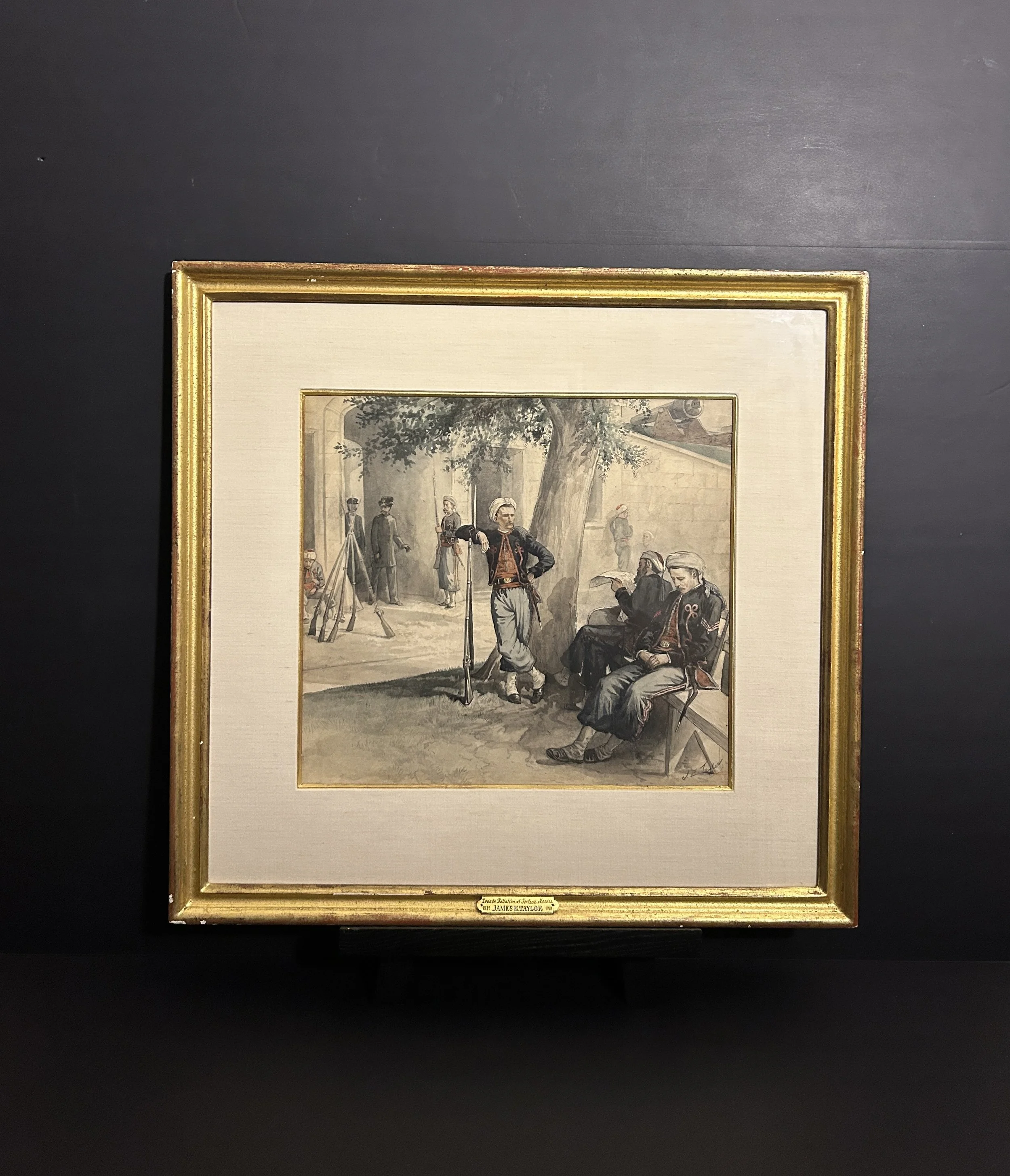 Image 2 of 6
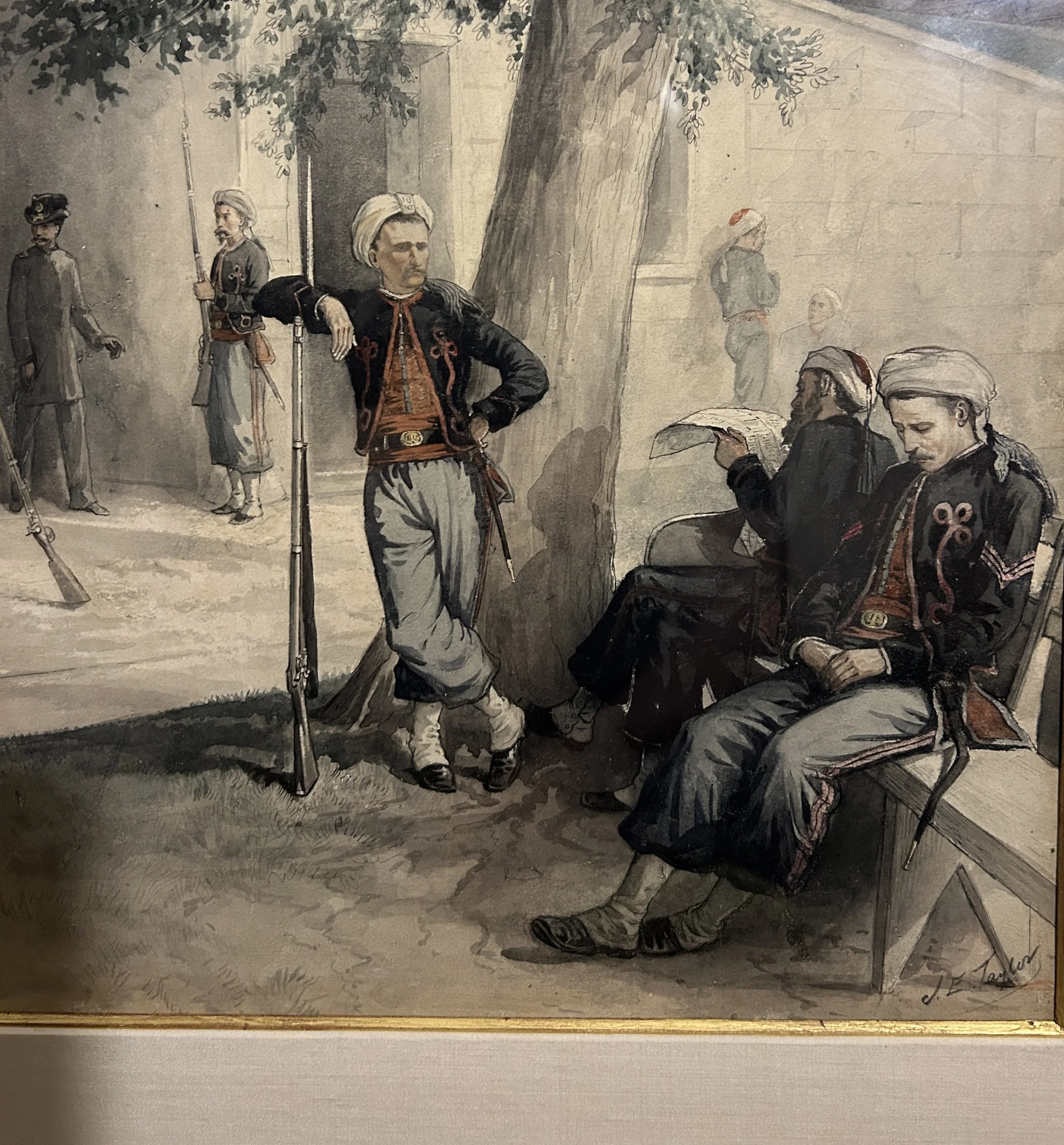 Image 3 of 6
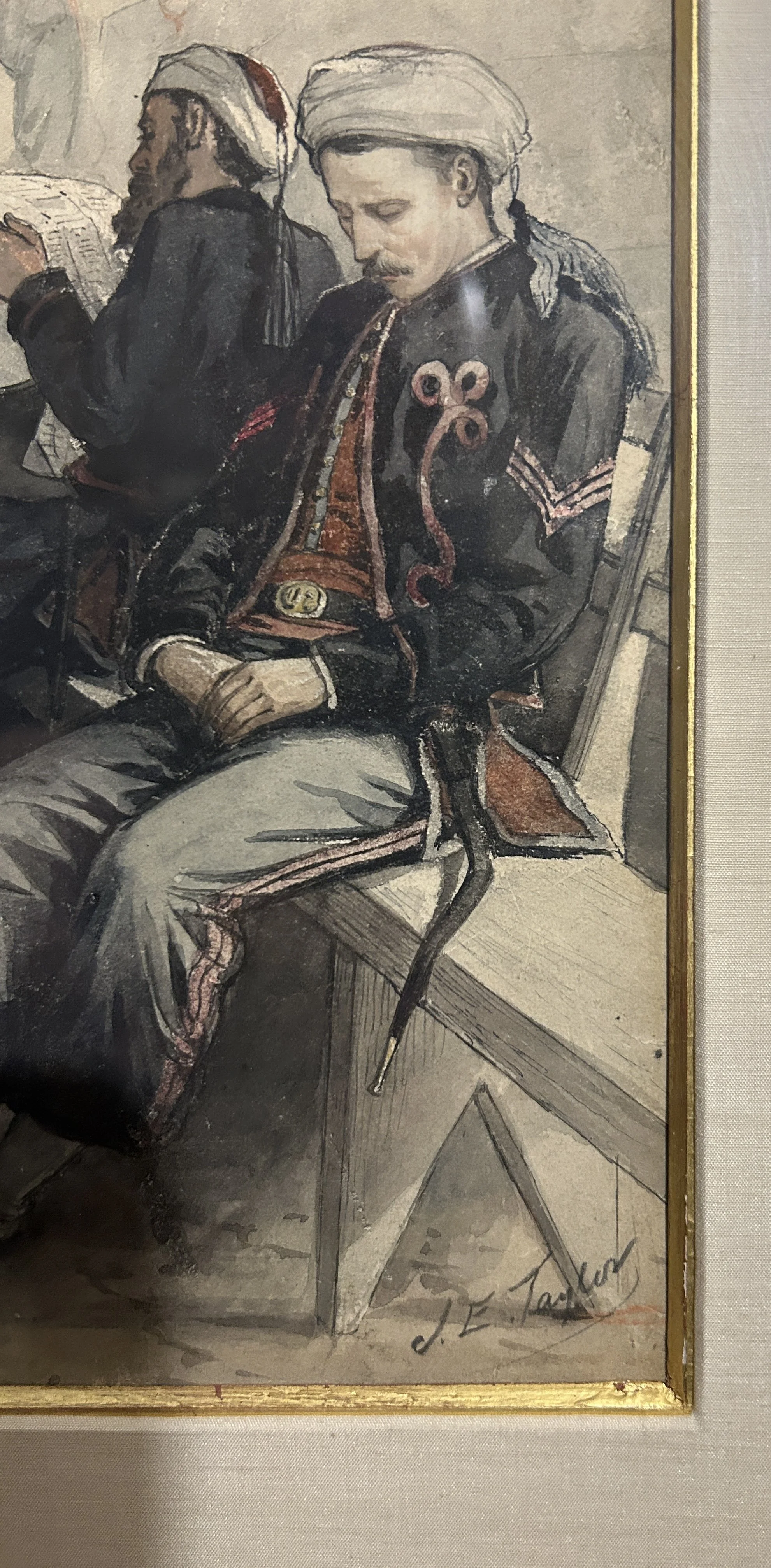 Image 4 of 6
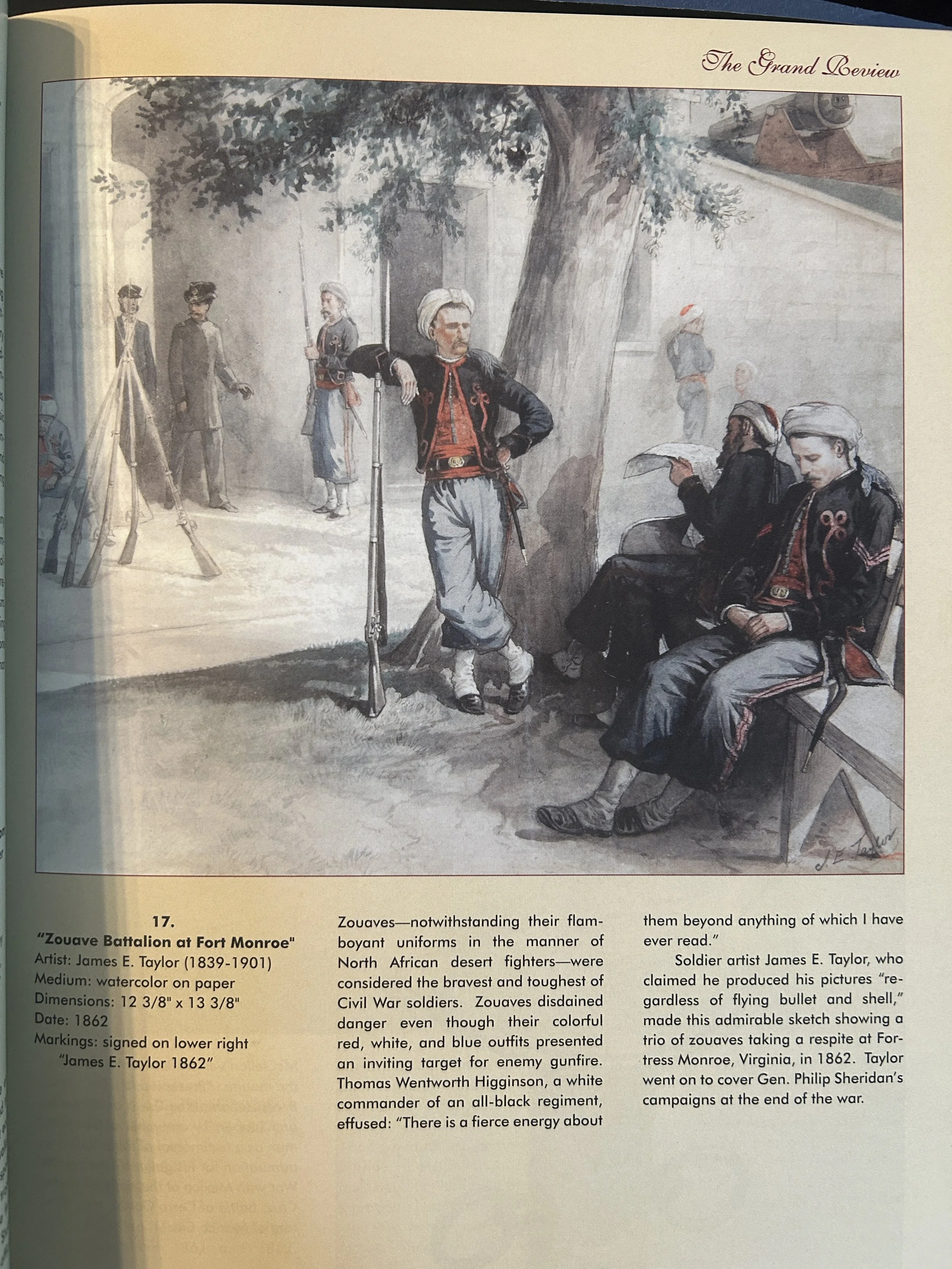 Image 5 of 6
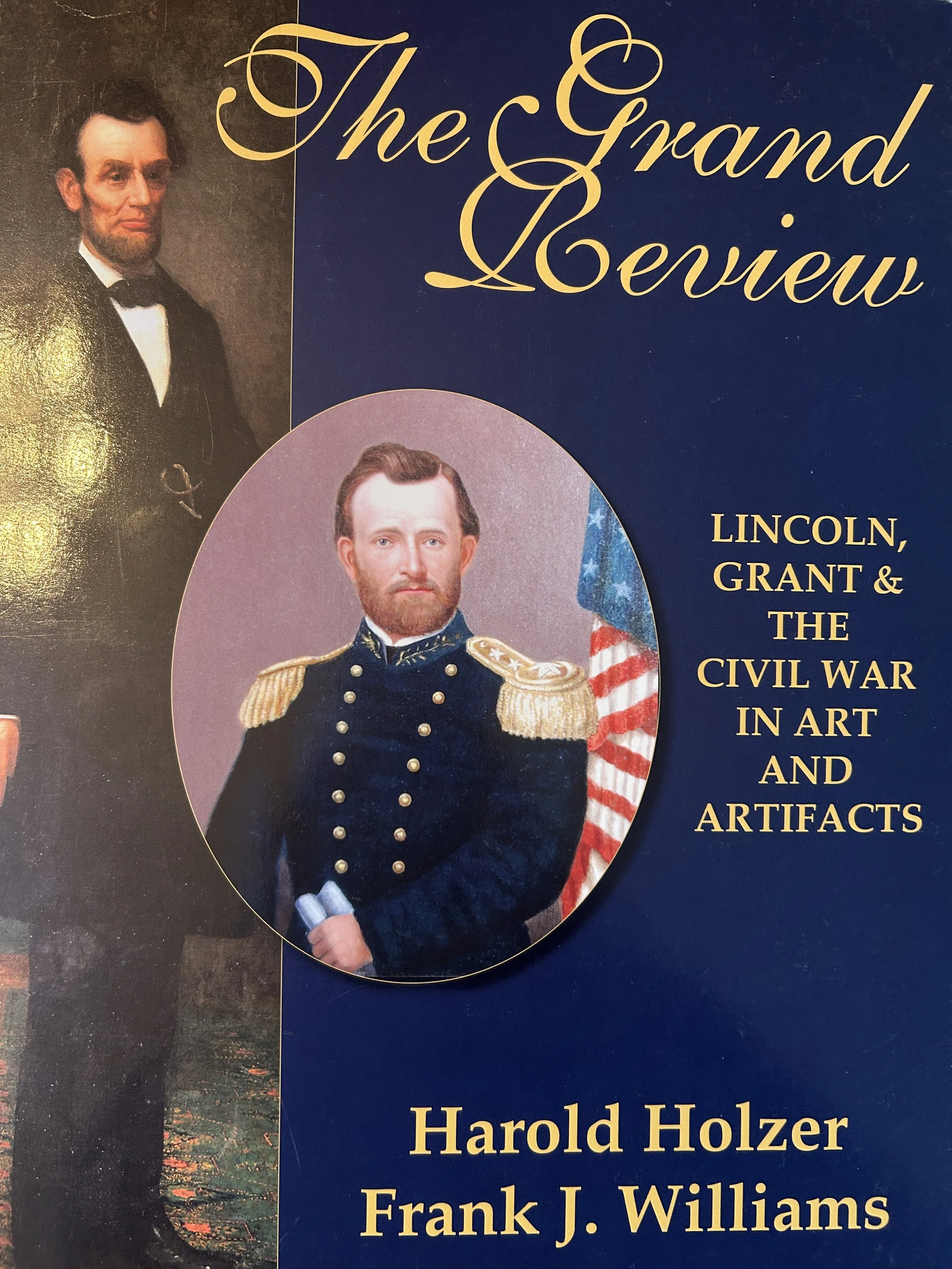 Image 6 of 6
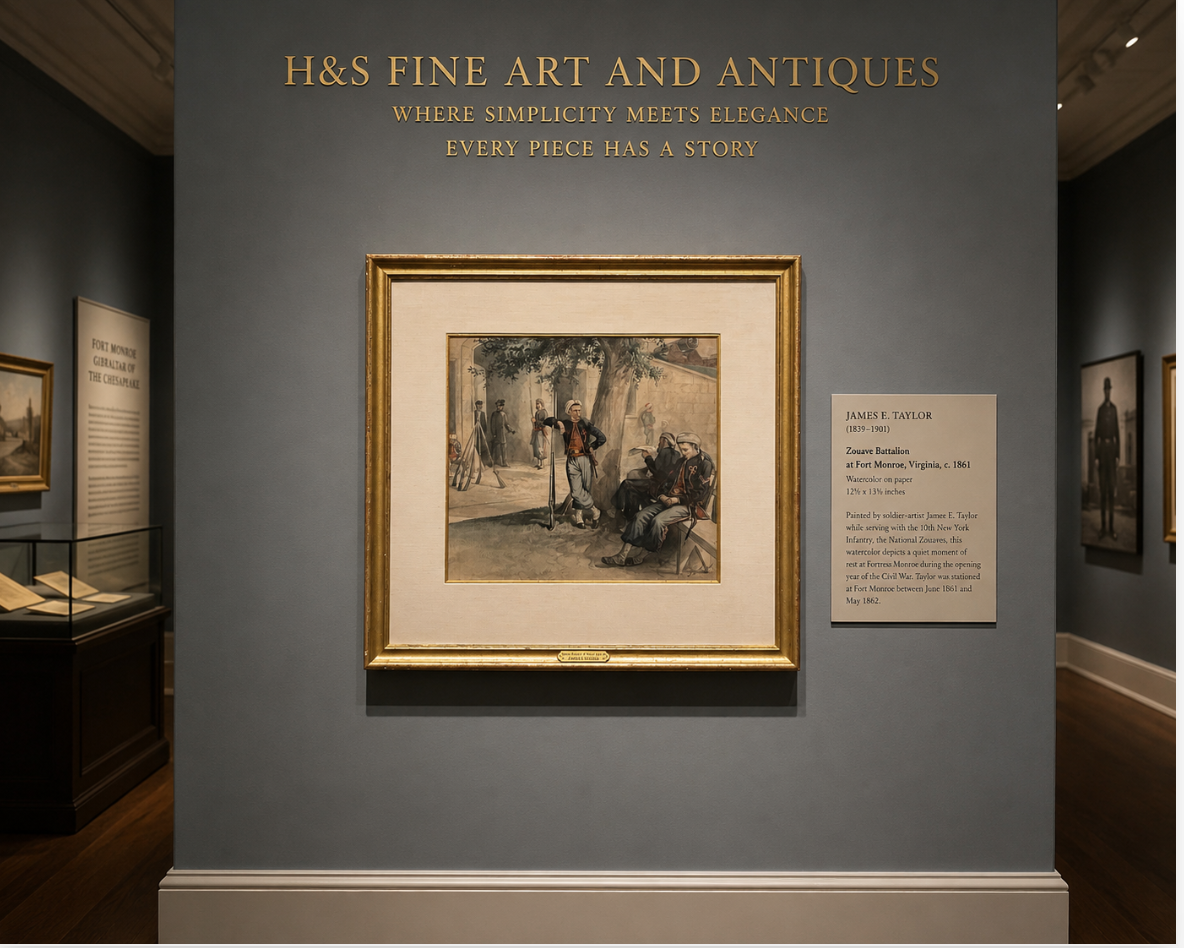
James E. Taylor (1839-1901) Civil War, " Zouave Battalion at Fort Monroe, c. 1861."
James E. Taylor (1839–1901)
Zouave Battalion at Fort Monroe, Virginia, c. 1861
Watercolor on paper
Sight: 12½ x 13¾ inches
Provenance: Private Collection, South Carolina; ex-Heritage Auctions, 12 November 2011, Lot 52132; with Kennedy Galleries, New York.
Published: Harold Holzer and Frank J. Williams, The Grand Review: Lincoln, Grant & The Civil War in Art and Artifacts, Orange, Virginia: Publisher's Press, 2014, cat. no. 17, p. 35.
Exhibition Essay
Soldiers at Rest: The National Zouaves at Fortress Monroe
This remarkable watercolor by James E. Taylor stands among the most authentic and intimate visual records of the opening year of the American Civil War. Painted by an artist who was simultaneously a soldier and eyewitness participant, Zouave Battalion at Fort Monroe captures a quiet, contemplative moment of military life during the summer of 1861, just months after the outbreak of hostilities.
Unlike grand battle scenes filled with smoke and heroic charges, Taylor's composition focuses upon the human experience of war. Three National Zouaves, members of the famed 10th New York Volunteer Infantry, pause beneath the shade of a large tree within the grounds of Fortress Monroe. One soldier leans casually upon his rifle while two companions rest nearby, their conversation and body language suggesting camaraderie and temporary relief from military duties.
The watercolor possesses a remarkable sense of immediacy. Every figure is rendered with the precision of observation rather than memory. The composition feels almost photographic, preserving a fleeting moment that would otherwise have disappeared from history.
The work is especially significant because James E. Taylor himself was one of the National Zouaves stationed at Fortress Monroe between June 1861 and May 1862. He painted not anonymous soldiers but his comrades and fellow volunteers. As both participant an and artist, Taylor produced one of the most compelling firsthand visual records of the early Union Army.
The Artist
James E. Taylor (1839–1901)
James Edward Taylor was born in Cincinnati, Ohio, in 1839. Demonstrating artistic talent at an early age, he graduated from the University of Notre Dame at only sixteen years of age and, by eighteen, had completed an ambitious panorama of the American Revolution.
Following the outbreak of the Civil War in 1861, Taylor enlisted in Company B of the 10th New York Infantry, the celebrated National Zouaves. Even as an enlisted soldier, he began sending sketches to Frank Leslie's Illustrated Newspaper, whose editors quickly recognized his talent.
After leaving military service in 1863, Taylor became one of the Civil War's foremost artist-correspondents. Traveling alongside Union armies in Virginia, West Virginia, South Carolina, and North Carolina, he documented military campaigns, landscapes, architecture, and everyday soldier life. Frank Leslie's published approximately sixty-one of his wartime illustrations. Taylor later accompanied the Indian Peace Commission in the American West and produced some of the earliest nationally circulated images of frontier life and the cattle industry. He died in New York City in 1901.
The National Zouaves
The 10th New York Volunteer Infantry
Few regiments of the Civil War enjoyed the fame of the National Zouaves.
Organized in New York City in April 1861, the regiment was modeled after the elite French Zouave units serving in North Africa. Their exotic uniforms made them among the most recognizable soldiers of the nineteenth century.
Their uniforms consisted of:
Red fez or turban
Short dark blue jacket trimmed with braid
Red sash
Baggy blue trousers
White gaiters
The regiment developed an almost legendary reputation for discipline, athleticism, and courage. Newspapers of the period frequently referred to the Zouaves as among the toughest and most daring soldiers in the Union Army.
Taylor's watercolor is particularly important because it accurately records these distinctive uniforms while simultaneously showing the regiment not in battle but in moments of ordinary camp life. Such scenes are comparatively rare in Civil War art and provide invaluable documentary evidence concerning appearance, equipment, and military culture during the first year of the conflict
Fortress Monroe
The Gibraltar of the Chesapeake
Fortress Monroe occupies a singular position in American history.
Constructed between 1819 and 1834, it was the largest masonry fortification ever built in the United States and became known as the "Gibraltar of the Chesapeake." During the Civil War it remained securely under Union control despite being surrounded by Confederate territory.
The fort served as:
Headquarters for Union operations in southeastern Virginia;
Gateway to the Virginia Peninsula Campaign;
A major supply and troop staging center;
Refuge for thousands of formerly enslaved people seeking freedom.
In May 1861, General Benjamin Butler declared escaped enslaved persons arriving at the fort to be "contraband of war." This historic decision effectively transformed Fortress Monroe into one of the earliest centers of emancipation and earned it the enduring title, the "Freedom Fortress."
Thus, Taylor's watercolor depicts soldiers resting at one of the most historically significant places of the entire Civil War—a site where military strategy, emancipation, and national transformation converged.
Artistic Significance
The watercolor exemplifies Taylor's extraordinary gifts as a documentary artist.
Several characteristics distinguish the work:
Firsthand observation by a participant;
Accurate depiction of uniforms and equipment;
Natural, unposed interactions among soldiers;
Sophisticated use of light and shade;
Emphasis on the psychological reality of military life.
The standing Zouave leaning upon his rifle functions almost as an informal portrait of the citizen-soldier—confident yet reflective, ready for service yet momentarily removed from war's hardships.
The seated figures similarly evoke the monotony and fraternity of camp existence. These ordinary experiences constituted the overwhelming majority of a soldier's wartime life, yet they are seldom depicted in Civil War art.
For this reason, the watercolor possesses exceptional historical and scholarly importance.
Museum Significance
Original Civil War watercolors by James E. Taylor are highly sought after because they exist simultaneously as:
Works of American art
Eyewitness historical documents
Military records
Social histories of soldier life
Visual archives of the American Civil War
The inclusion of this watercolor in Harold Holzer and Frank J. Williams's landmark publication, The Grand Review: Lincoln, Grant & The Civil War in Art and Artifacts, further confirms its scholarly importance and exhibition value. Published and documented Civil War works with direct military associations are comparatively uncommon and are particularly prized by museums and collectors of Americana.
James E. Taylor (1839–1901)
Zouave Battalion at Fort Monroe, Virginia, c. 1861
Watercolor on paper
Sight: 12½ x 13¾ inches
Provenance: Private Collection, South Carolina; ex-Heritage Auctions, 12 November 2011, Lot 52132; with Kennedy Galleries, New York.
Published: Harold Holzer and Frank J. Williams, The Grand Review: Lincoln, Grant & The Civil War in Art and Artifacts, Orange, Virginia: Publisher's Press, 2014, cat. no. 17, p. 35.
Exhibition Essay
Soldiers at Rest: The National Zouaves at Fortress Monroe
This remarkable watercolor by James E. Taylor stands among the most authentic and intimate visual records of the opening year of the American Civil War. Painted by an artist who was simultaneously a soldier and eyewitness participant, Zouave Battalion at Fort Monroe captures a quiet, contemplative moment of military life during the summer of 1861, just months after the outbreak of hostilities.
Unlike grand battle scenes filled with smoke and heroic charges, Taylor's composition focuses upon the human experience of war. Three National Zouaves, members of the famed 10th New York Volunteer Infantry, pause beneath the shade of a large tree within the grounds of Fortress Monroe. One soldier leans casually upon his rifle while two companions rest nearby, their conversation and body language suggesting camaraderie and temporary relief from military duties.
The watercolor possesses a remarkable sense of immediacy. Every figure is rendered with the precision of observation rather than memory. The composition feels almost photographic, preserving a fleeting moment that would otherwise have disappeared from history.
The work is especially significant because James E. Taylor himself was one of the National Zouaves stationed at Fortress Monroe between June 1861 and May 1862. He painted not anonymous soldiers but his comrades and fellow volunteers. As both participant an and artist, Taylor produced one of the most compelling firsthand visual records of the early Union Army.
The Artist
James E. Taylor (1839–1901)
James Edward Taylor was born in Cincinnati, Ohio, in 1839. Demonstrating artistic talent at an early age, he graduated from the University of Notre Dame at only sixteen years of age and, by eighteen, had completed an ambitious panorama of the American Revolution.
Following the outbreak of the Civil War in 1861, Taylor enlisted in Company B of the 10th New York Infantry, the celebrated National Zouaves. Even as an enlisted soldier, he began sending sketches to Frank Leslie's Illustrated Newspaper, whose editors quickly recognized his talent.
After leaving military service in 1863, Taylor became one of the Civil War's foremost artist-correspondents. Traveling alongside Union armies in Virginia, West Virginia, South Carolina, and North Carolina, he documented military campaigns, landscapes, architecture, and everyday soldier life. Frank Leslie's published approximately sixty-one of his wartime illustrations. Taylor later accompanied the Indian Peace Commission in the American West and produced some of the earliest nationally circulated images of frontier life and the cattle industry. He died in New York City in 1901.
The National Zouaves
The 10th New York Volunteer Infantry
Few regiments of the Civil War enjoyed the fame of the National Zouaves.
Organized in New York City in April 1861, the regiment was modeled after the elite French Zouave units serving in North Africa. Their exotic uniforms made them among the most recognizable soldiers of the nineteenth century.
Their uniforms consisted of:
Red fez or turban
Short dark blue jacket trimmed with braid
Red sash
Baggy blue trousers
White gaiters
The regiment developed an almost legendary reputation for discipline, athleticism, and courage. Newspapers of the period frequently referred to the Zouaves as among the toughest and most daring soldiers in the Union Army.
Taylor's watercolor is particularly important because it accurately records these distinctive uniforms while simultaneously showing the regiment not in battle but in moments of ordinary camp life. Such scenes are comparatively rare in Civil War art and provide invaluable documentary evidence concerning appearance, equipment, and military culture during the first year of the conflict
Fortress Monroe
The Gibraltar of the Chesapeake
Fortress Monroe occupies a singular position in American history.
Constructed between 1819 and 1834, it was the largest masonry fortification ever built in the United States and became known as the "Gibraltar of the Chesapeake." During the Civil War it remained securely under Union control despite being surrounded by Confederate territory.
The fort served as:
Headquarters for Union operations in southeastern Virginia;
Gateway to the Virginia Peninsula Campaign;
A major supply and troop staging center;
Refuge for thousands of formerly enslaved people seeking freedom.
In May 1861, General Benjamin Butler declared escaped enslaved persons arriving at the fort to be "contraband of war." This historic decision effectively transformed Fortress Monroe into one of the earliest centers of emancipation and earned it the enduring title, the "Freedom Fortress."
Thus, Taylor's watercolor depicts soldiers resting at one of the most historically significant places of the entire Civil War—a site where military strategy, emancipation, and national transformation converged.
Artistic Significance
The watercolor exemplifies Taylor's extraordinary gifts as a documentary artist.
Several characteristics distinguish the work:
Firsthand observation by a participant;
Accurate depiction of uniforms and equipment;
Natural, unposed interactions among soldiers;
Sophisticated use of light and shade;
Emphasis on the psychological reality of military life.
The standing Zouave leaning upon his rifle functions almost as an informal portrait of the citizen-soldier—confident yet reflective, ready for service yet momentarily removed from war's hardships.
The seated figures similarly evoke the monotony and fraternity of camp existence. These ordinary experiences constituted the overwhelming majority of a soldier's wartime life, yet they are seldom depicted in Civil War art.
For this reason, the watercolor possesses exceptional historical and scholarly importance.
Museum Significance
Original Civil War watercolors by James E. Taylor are highly sought after because they exist simultaneously as:
Works of American art
Eyewitness historical documents
Military records
Social histories of soldier life
Visual archives of the American Civil War
The inclusion of this watercolor in Harold Holzer and Frank J. Williams's landmark publication, The Grand Review: Lincoln, Grant & The Civil War in Art and Artifacts, further confirms its scholarly importance and exhibition value. Published and documented Civil War works with direct military associations are comparatively uncommon and are particularly prized by museums and collectors of Americana.