 Image 1 of 2
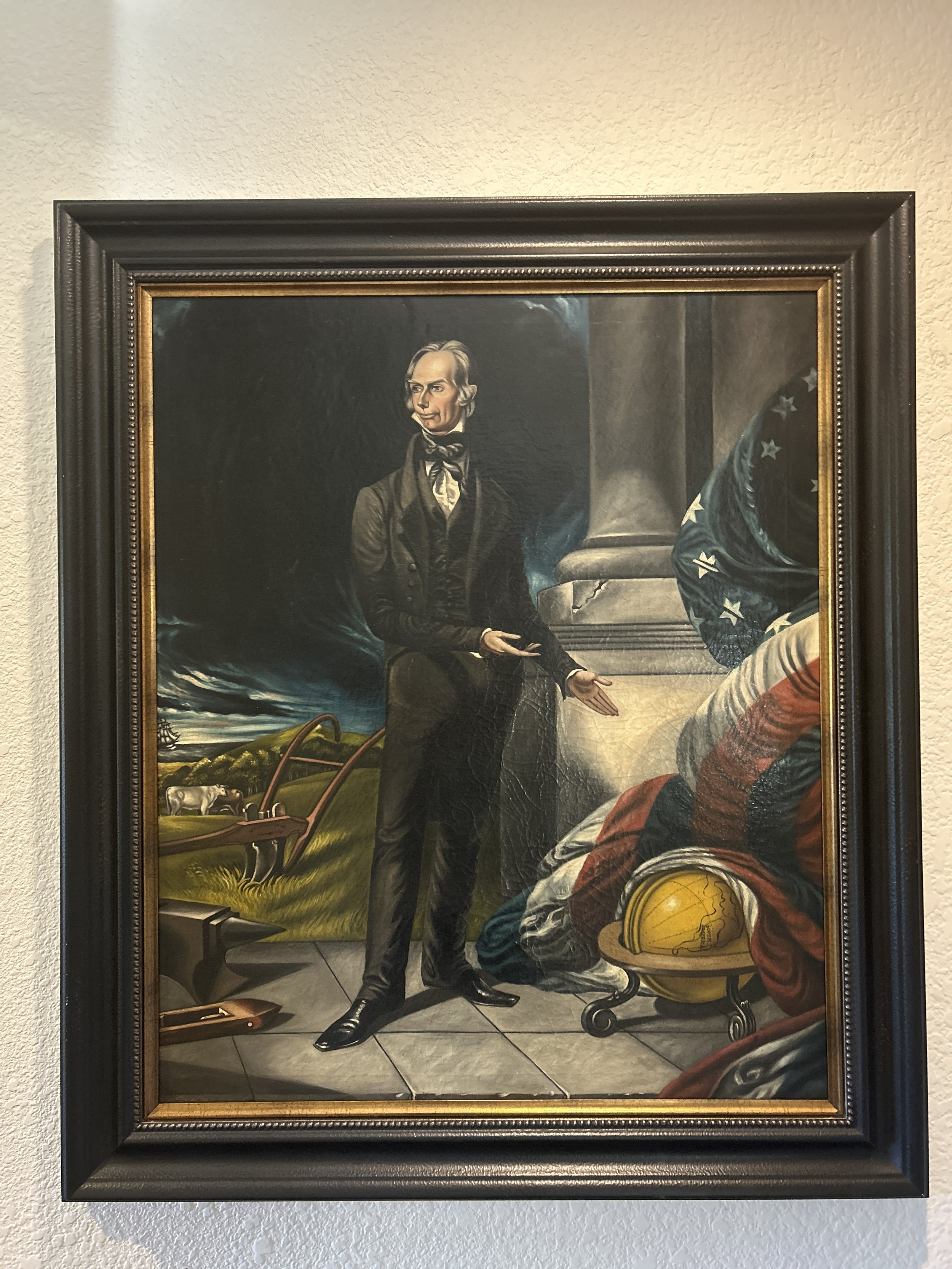 Image 2 of 2
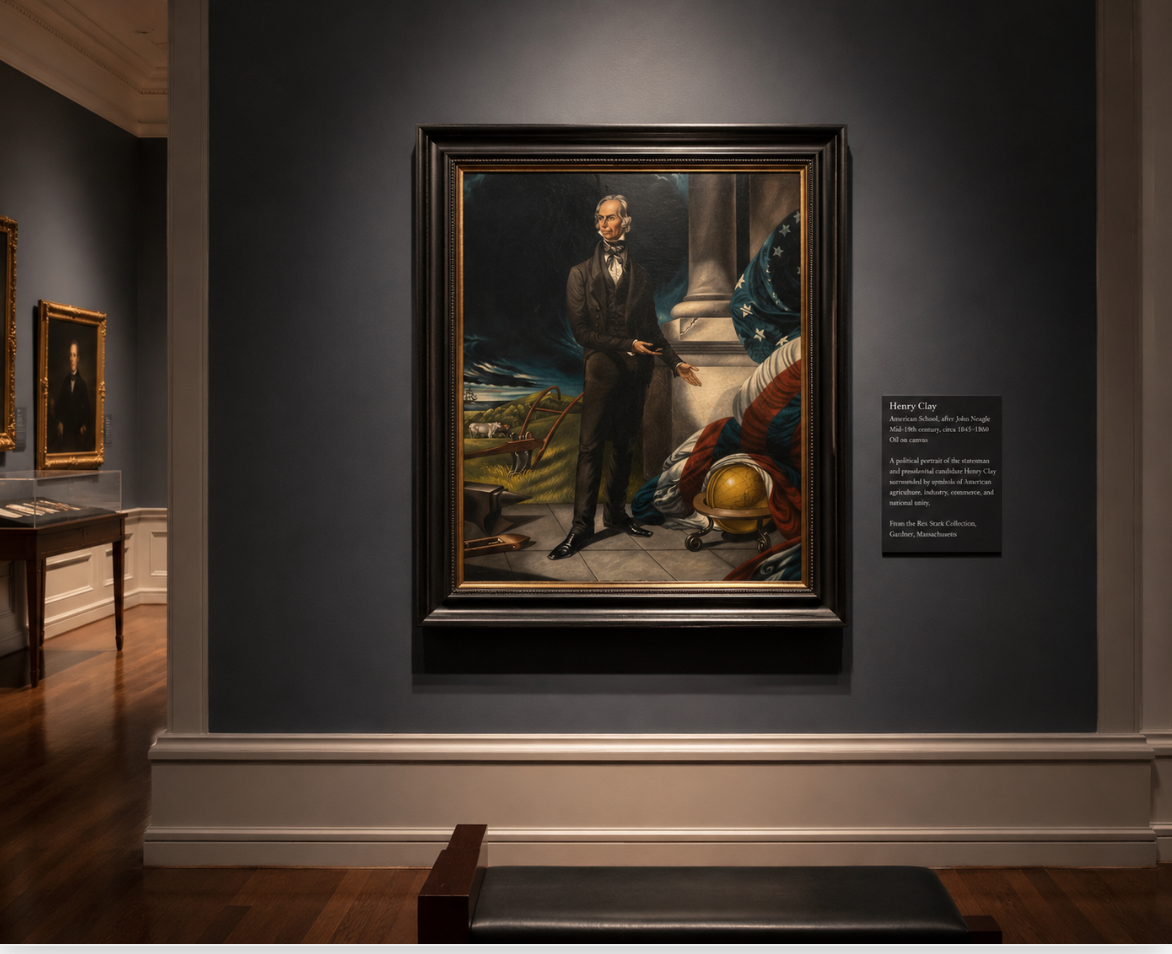
Henry Clay and the American System A Mid-Nineteenth-Century American Folk Art Political Portrait American School, after John Neagle Circa 1845–1860
Henry Clay and the American System
A Mid-Nineteenth-Century American Folk Art Political Portrait
American School, after John Neagle
Circa 1845–1860
Oil on canvas; relined, restretched, and framed
Sight: 30¼ × 25¼ in.
Overall: 38½ × 33½ in.
Provenance: From the Rex Stark Collection, Gardner, Massachusetts.
Exhibition Essay
This imposing mid-nineteenth-century portrait presents Henry Clay of Kentucky, one of the most influential American statesmen of the antebellum era, surrounded by a carefully constructed group of patriotic, agricultural, industrial, and international symbols. Painted by an unidentified American artist after a celebrated portrait by John Neagle, the composition is both a likeness and a political allegory. It does not merely show Clay as an individual; it presents him as the public embodiment of national unity, commerce, agriculture, manufacturing, and republican government.
The painting belongs to a tradition of American political imagery produced during the intensely partisan decades of the 1840s and 1850s. Its visual language would have been readily understood by contemporary viewers. The American flag, globe, classical column, plow, livestock, ship, anvil, and cultivated landscape all communicate aspects of Clay’s political philosophy and public reputation.
Although sometimes described as a “presidential portrait,” Henry Clay never served as president. A more accurate designation is a political portrait of the statesman and presidential candidate Henry Clay. Clay sought the presidency several times and was the Whig Party nominee in the election of 1844. The composition on which this painting is based was created in direct connection with his national political ambitions.
Henry Clay: Statesman, Orator, and Presidential Candidate
Henry Clay was born in Hanover County, Virginia, in 1777 and established his legal and political career in Kentucky. Over the course of nearly half a century, he served in both houses of Congress, became Speaker of the House of Representatives, served as secretary of state under President John Quincy Adams, and repeatedly sought the presidency.
Clay became one of the most celebrated political orators of his generation. His commanding public presence, persuasive speaking style, and skill in legislative negotiation earned him the title “The Great Compromiser.” He played a major role in several attempts to resolve sectional disputes that threatened the Union, including the Missouri Compromise of 1820, the Compromise Tariff of 1833, and the negotiations surrounding the Compromise of 1850.
His legacy, however, is complex. Clay frequently spoke of national union and described slavery as a moral evil, yet he was himself an enslaver. Modern museum interpretation has increasingly addressed this contradiction as an essential part of understanding both Clay and the political compromises of the antebellum period. The Smithsonian National Portrait Gallery similarly presents him as a statesman dedicated to preserving the Union while acknowledging the moral limitations of compromise in a nation divided by slavery.
The Original Composition by John Neagle
The present painting derives from a full-length portrait of Clay painted by the Philadelphia artist John Neagle in 1843. The original commission originated with Philadelphia Whigs who anticipated Clay’s candidacy in the 1844 presidential election.
Neagle first painted Clay from life and subsequently developed the full-length allegorical composition. The United States Senate notes that the portrait was commissioned in 1842 by Philadelphia Whigs and that a second full-length version entered the United States Capitol collection. Clay himself reportedly praised Neagle for capturing both his physical appearance and his character.
The image was quickly reproduced and circulated. In 1843, John Sartain engraved the composition in mezzotint with etching. The Library of Congress identifies Sartain’s print as a formal campaign portrait commissioned with the approval of Clay’s political supporters. Its circulation made Neagle’s composition accessible to a much wider national audience and provided a model from which later artists could produce painted copies and adaptations.
The unknown artist responsible for the present work probably relied upon such an engraving, another painted version, or a combination of visual sources rather than working directly from Neagle’s original canvas.
John Neagle and American Portraiture
John Neagle was born in 1796 and became one of Philadelphia’s leading portrait painters. His artistic career was closely connected with that of Thomas Sully, whose family Neagle joined through marriage. Neagle’s sitters included politicians, merchants, military officers, artists, laborers, and prominent civic figures.
His most celebrated works combine close observation with strong psychological presence. Neagle was capable of producing refined academic portraits for elite patrons, but his compositions were also widely circulated through engravings, thereby entering the larger world of popular imagery.
The transformation of Neagle’s Henry Clay portrait into prints and painted repetitions illustrates the fluid relationship between fine art, political propaganda, commercial reproduction, and American folk painting. A formally commissioned portrait could be copied by professional engravers, distributed nationally, and then reinterpreted by regional or self-trained painters for private display.
Historical Context: America in the 1840s and 1850s
A date of approximately 1845–1860 is appropriate for the present painting.
The composition was first established by Neagle in 1843 and circulated widely through Sartain’s engraved version. Later painters could therefore reproduce it during and after Clay’s 1844 presidential campaign.
The decades in which the present work was likely painted were marked by extraordinary national change:
Westward territorial expansion
The annexation of Texas
The Mexican-American War
Debates over protective tariffs
Expansion of railroads and canals
Increasing conflict over slavery
The Compromise of 1850
The breakdown of the Whig Party
The approach of the Civil War
The painting would have retained meaning even after Clay’s death in 1852. To later viewers, his image represented a vanished period of national statesmanship and an increasingly fragile hope that compromise might preserve the Union.
Provenance: The Rex Stark Collection
.Rexford Addison Stark was a respected dealer and collector specializing in historic and political Americana. Based in Gardner, Massachusetts, he was a familiar presence at political memorabilia, numismatic, militaria, and Americana events. His interests included political ceramics, campaign material, paintings, folk art, textiles, broadsides, medals, autographs, and other objects related to American history.
Museum and Institutional References
the composition and subject are represented in important institutional collections.
Library of Congress
The Library of Congress preserves John Sartain’s 1843 mezzotint and etching after Neagle’s portrait. Its catalogue entry provides the most detailed contemporary interpretation of the composition, identifying the American flag, globe, anvil, spindle, plow, cattle, and ship as symbols of Clay’s political values, American industry, agriculture, commerce, internal improvements, and support for Latin American republics.
United States Senate Collection
The Senate holds an 1844 hand-colored mezzotint derived from Neagle’s portrait. Its curatorial record explains the portrait’s connection to the Philadelphia Whigs and the 1844 presidential campaign.
United States Capitol
The Senate’s documentation states that a second full-length version of Neagle’s composition is in the United States Capitol.
Smithsonian National Portrait Gallery
The National Portrait Gallery preserves several portraits of Clay and maintains additional records in its Catalog of American Portraits. These holdings demonstrate the extraordinary variety of Clay imagery produced during his lifetime and after his death. The museum also interprets his role in the Missouri Compromise and the Compromise of 1850 while addressing his relationship to slavery.
Ashland, The Henry Clay Estate
Clay’s Lexington, Kentucky, estate provides the essential historical setting for understanding his identity as a Kentucky statesman, agricultural landowner, and national political figure. Neagle’s original portrait was painted in connection with Clay and his Ashland estate, as documented by the Library of Congress.
Selected Literature and References
Library of Congress, Prints and Photographs Division.
Henry Clay / Ino. Neagle, pinxit, 1843; engraved by John Sartain from the original picture. Philadelphia, 1843. This is the principal visual and iconographic reference for the composition.United States Senate Collection.
Henry Clay, 1844, William Warner Jr. and William B. Lane, after John Neagle. The institutional record discusses the original commission, Clay’s sitting for Neagle, and the relationship of the portrait to the 1844 campaign.National Portrait Gallery, Smithsonian Institution.
Henry Clay portrait and biographical records. These sources provide institutional context for Clay’s political career, public image, and historical legacy.Robert Wilson Torchia.
John Neagle: Philadelphia Portrait Painter. Historical Society of Pennsylvania, 1989. An important scholarly reference for Neagle’s career and portrait practice.Bernard F. Reilly Jr.
American Political Prints, 1766–1876. Boston: G.K. Hall, 1991. The Library of Congress associates the Sartain image with this standard reference on American political prints.The Papers of Henry Clay, edited by Robert Seager and others. University Press of Kentucky. This documentary series contains Clay’s correspondence and political writings and is cited by the United States Senate in connection with Clay’s response to Neagle’s portrait.
Henry Clay and the American System
A Mid-Nineteenth-Century American Folk Art Political Portrait
American School, after John Neagle
Circa 1845–1860
Oil on canvas; relined, restretched, and framed
Sight: 30¼ × 25¼ in.
Overall: 38½ × 33½ in.
Provenance: From the Rex Stark Collection, Gardner, Massachusetts.
Exhibition Essay
This imposing mid-nineteenth-century portrait presents Henry Clay of Kentucky, one of the most influential American statesmen of the antebellum era, surrounded by a carefully constructed group of patriotic, agricultural, industrial, and international symbols. Painted by an unidentified American artist after a celebrated portrait by John Neagle, the composition is both a likeness and a political allegory. It does not merely show Clay as an individual; it presents him as the public embodiment of national unity, commerce, agriculture, manufacturing, and republican government.
The painting belongs to a tradition of American political imagery produced during the intensely partisan decades of the 1840s and 1850s. Its visual language would have been readily understood by contemporary viewers. The American flag, globe, classical column, plow, livestock, ship, anvil, and cultivated landscape all communicate aspects of Clay’s political philosophy and public reputation.
Although sometimes described as a “presidential portrait,” Henry Clay never served as president. A more accurate designation is a political portrait of the statesman and presidential candidate Henry Clay. Clay sought the presidency several times and was the Whig Party nominee in the election of 1844. The composition on which this painting is based was created in direct connection with his national political ambitions.
Henry Clay: Statesman, Orator, and Presidential Candidate
Henry Clay was born in Hanover County, Virginia, in 1777 and established his legal and political career in Kentucky. Over the course of nearly half a century, he served in both houses of Congress, became Speaker of the House of Representatives, served as secretary of state under President John Quincy Adams, and repeatedly sought the presidency.
Clay became one of the most celebrated political orators of his generation. His commanding public presence, persuasive speaking style, and skill in legislative negotiation earned him the title “The Great Compromiser.” He played a major role in several attempts to resolve sectional disputes that threatened the Union, including the Missouri Compromise of 1820, the Compromise Tariff of 1833, and the negotiations surrounding the Compromise of 1850.
His legacy, however, is complex. Clay frequently spoke of national union and described slavery as a moral evil, yet he was himself an enslaver. Modern museum interpretation has increasingly addressed this contradiction as an essential part of understanding both Clay and the political compromises of the antebellum period. The Smithsonian National Portrait Gallery similarly presents him as a statesman dedicated to preserving the Union while acknowledging the moral limitations of compromise in a nation divided by slavery.
The Original Composition by John Neagle
The present painting derives from a full-length portrait of Clay painted by the Philadelphia artist John Neagle in 1843. The original commission originated with Philadelphia Whigs who anticipated Clay’s candidacy in the 1844 presidential election.
Neagle first painted Clay from life and subsequently developed the full-length allegorical composition. The United States Senate notes that the portrait was commissioned in 1842 by Philadelphia Whigs and that a second full-length version entered the United States Capitol collection. Clay himself reportedly praised Neagle for capturing both his physical appearance and his character.
The image was quickly reproduced and circulated. In 1843, John Sartain engraved the composition in mezzotint with etching. The Library of Congress identifies Sartain’s print as a formal campaign portrait commissioned with the approval of Clay’s political supporters. Its circulation made Neagle’s composition accessible to a much wider national audience and provided a model from which later artists could produce painted copies and adaptations.
The unknown artist responsible for the present work probably relied upon such an engraving, another painted version, or a combination of visual sources rather than working directly from Neagle’s original canvas.
John Neagle and American Portraiture
John Neagle was born in 1796 and became one of Philadelphia’s leading portrait painters. His artistic career was closely connected with that of Thomas Sully, whose family Neagle joined through marriage. Neagle’s sitters included politicians, merchants, military officers, artists, laborers, and prominent civic figures.
His most celebrated works combine close observation with strong psychological presence. Neagle was capable of producing refined academic portraits for elite patrons, but his compositions were also widely circulated through engravings, thereby entering the larger world of popular imagery.
The transformation of Neagle’s Henry Clay portrait into prints and painted repetitions illustrates the fluid relationship between fine art, political propaganda, commercial reproduction, and American folk painting. A formally commissioned portrait could be copied by professional engravers, distributed nationally, and then reinterpreted by regional or self-trained painters for private display.
Historical Context: America in the 1840s and 1850s
A date of approximately 1845–1860 is appropriate for the present painting.
The composition was first established by Neagle in 1843 and circulated widely through Sartain’s engraved version. Later painters could therefore reproduce it during and after Clay’s 1844 presidential campaign.
The decades in which the present work was likely painted were marked by extraordinary national change:
Westward territorial expansion
The annexation of Texas
The Mexican-American War
Debates over protective tariffs
Expansion of railroads and canals
Increasing conflict over slavery
The Compromise of 1850
The breakdown of the Whig Party
The approach of the Civil War
The painting would have retained meaning even after Clay’s death in 1852. To later viewers, his image represented a vanished period of national statesmanship and an increasingly fragile hope that compromise might preserve the Union.
Provenance: The Rex Stark Collection
.Rexford Addison Stark was a respected dealer and collector specializing in historic and political Americana. Based in Gardner, Massachusetts, he was a familiar presence at political memorabilia, numismatic, militaria, and Americana events. His interests included political ceramics, campaign material, paintings, folk art, textiles, broadsides, medals, autographs, and other objects related to American history.
Museum and Institutional References
the composition and subject are represented in important institutional collections.
Library of Congress
The Library of Congress preserves John Sartain’s 1843 mezzotint and etching after Neagle’s portrait. Its catalogue entry provides the most detailed contemporary interpretation of the composition, identifying the American flag, globe, anvil, spindle, plow, cattle, and ship as symbols of Clay’s political values, American industry, agriculture, commerce, internal improvements, and support for Latin American republics.
United States Senate Collection
The Senate holds an 1844 hand-colored mezzotint derived from Neagle’s portrait. Its curatorial record explains the portrait’s connection to the Philadelphia Whigs and the 1844 presidential campaign.
United States Capitol
The Senate’s documentation states that a second full-length version of Neagle’s composition is in the United States Capitol.
Smithsonian National Portrait Gallery
The National Portrait Gallery preserves several portraits of Clay and maintains additional records in its Catalog of American Portraits. These holdings demonstrate the extraordinary variety of Clay imagery produced during his lifetime and after his death. The museum also interprets his role in the Missouri Compromise and the Compromise of 1850 while addressing his relationship to slavery.
Ashland, The Henry Clay Estate
Clay’s Lexington, Kentucky, estate provides the essential historical setting for understanding his identity as a Kentucky statesman, agricultural landowner, and national political figure. Neagle’s original portrait was painted in connection with Clay and his Ashland estate, as documented by the Library of Congress.
Selected Literature and References
Library of Congress, Prints and Photographs Division.
Henry Clay / Ino. Neagle, pinxit, 1843; engraved by John Sartain from the original picture. Philadelphia, 1843. This is the principal visual and iconographic reference for the composition.United States Senate Collection.
Henry Clay, 1844, William Warner Jr. and William B. Lane, after John Neagle. The institutional record discusses the original commission, Clay’s sitting for Neagle, and the relationship of the portrait to the 1844 campaign.National Portrait Gallery, Smithsonian Institution.
Henry Clay portrait and biographical records. These sources provide institutional context for Clay’s political career, public image, and historical legacy.Robert Wilson Torchia.
John Neagle: Philadelphia Portrait Painter. Historical Society of Pennsylvania, 1989. An important scholarly reference for Neagle’s career and portrait practice.Bernard F. Reilly Jr.
American Political Prints, 1766–1876. Boston: G.K. Hall, 1991. The Library of Congress associates the Sartain image with this standard reference on American political prints.The Papers of Henry Clay, edited by Robert Seager and others. University Press of Kentucky. This documentary series contains Clay’s correspondence and political writings and is cited by the United States Senate in connection with Clay’s response to Neagle’s portrait.