 Image 1 of 6
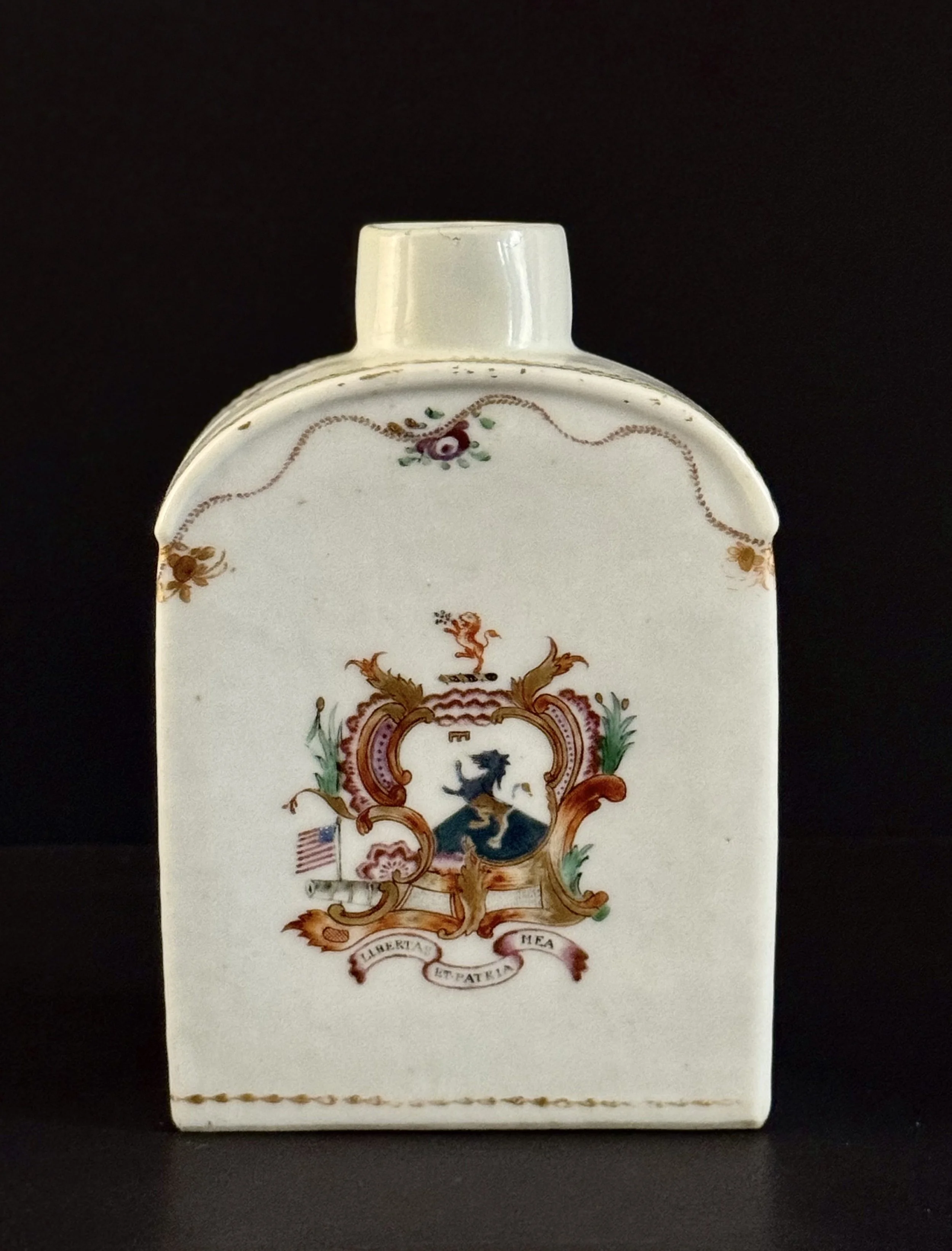 Image 2 of 6
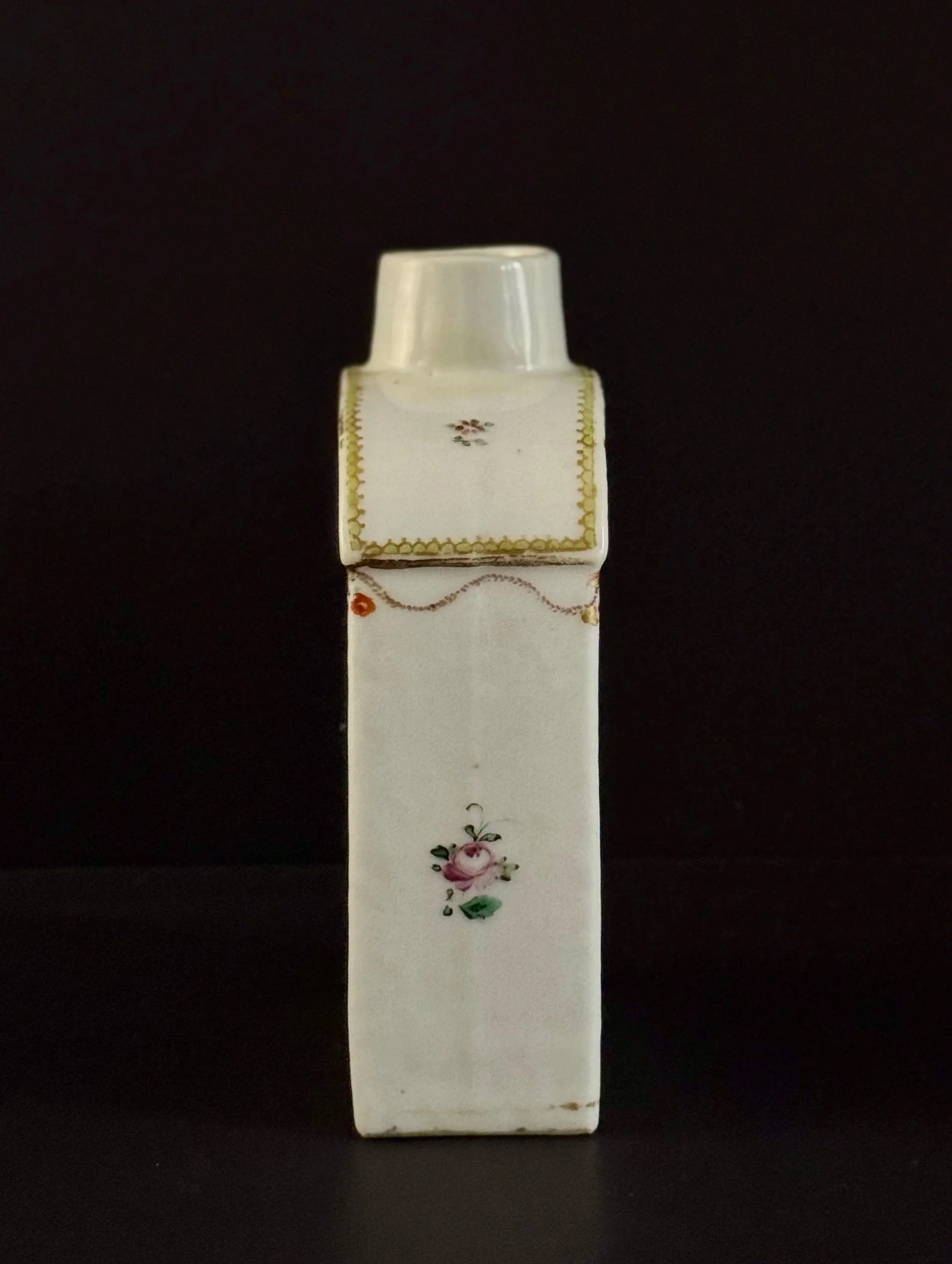 Image 3 of 6
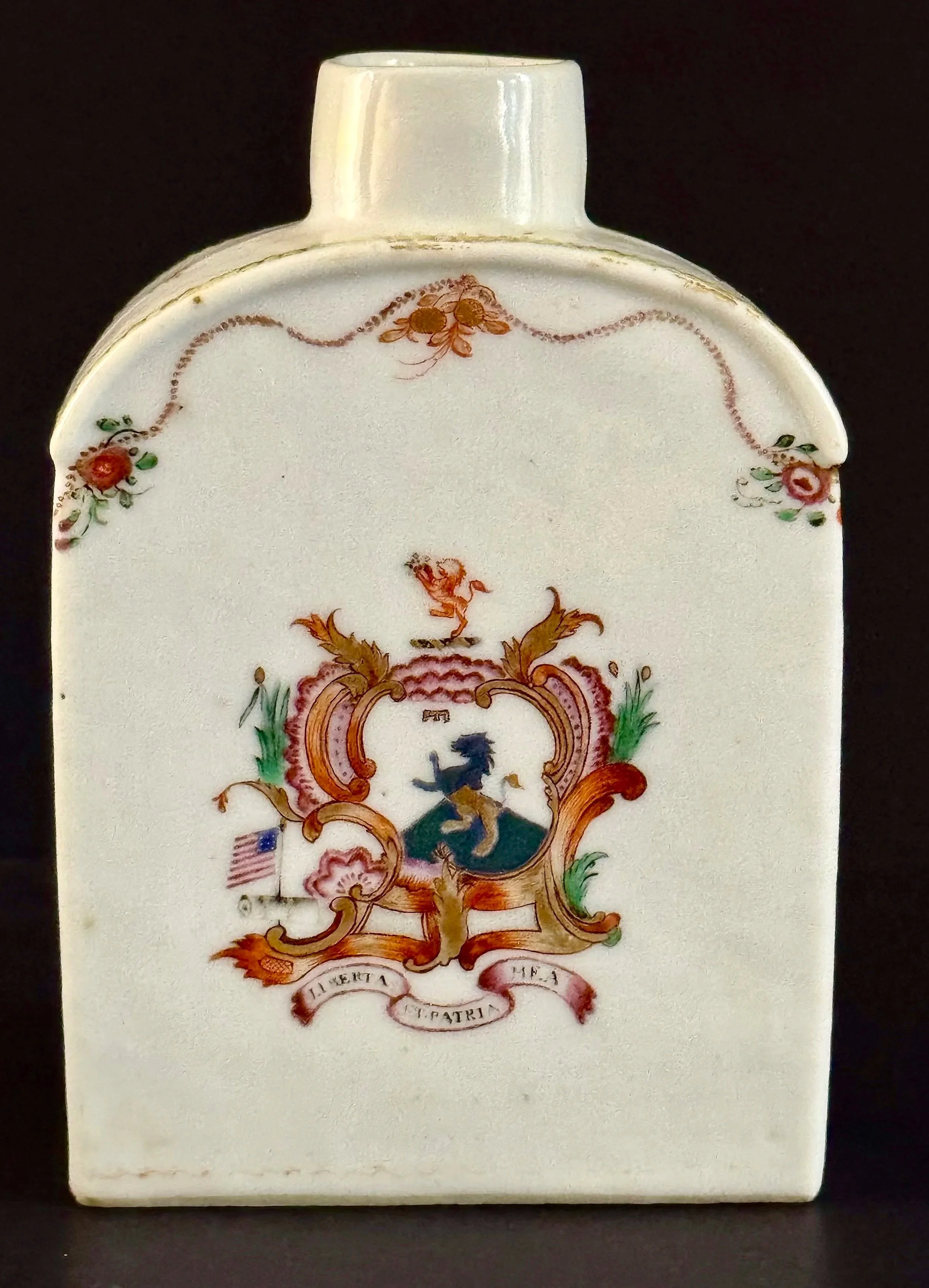 Image 4 of 6
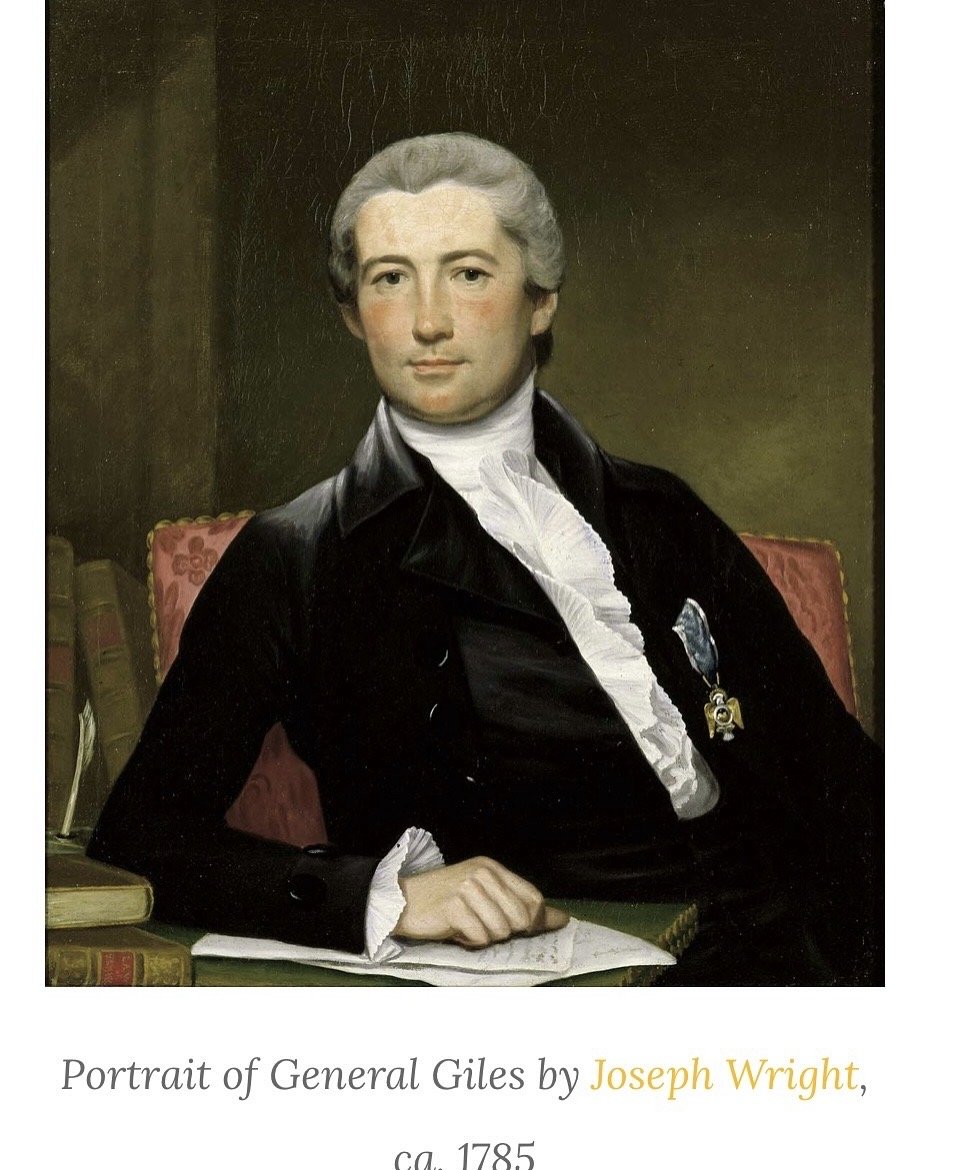 Image 5 of 6
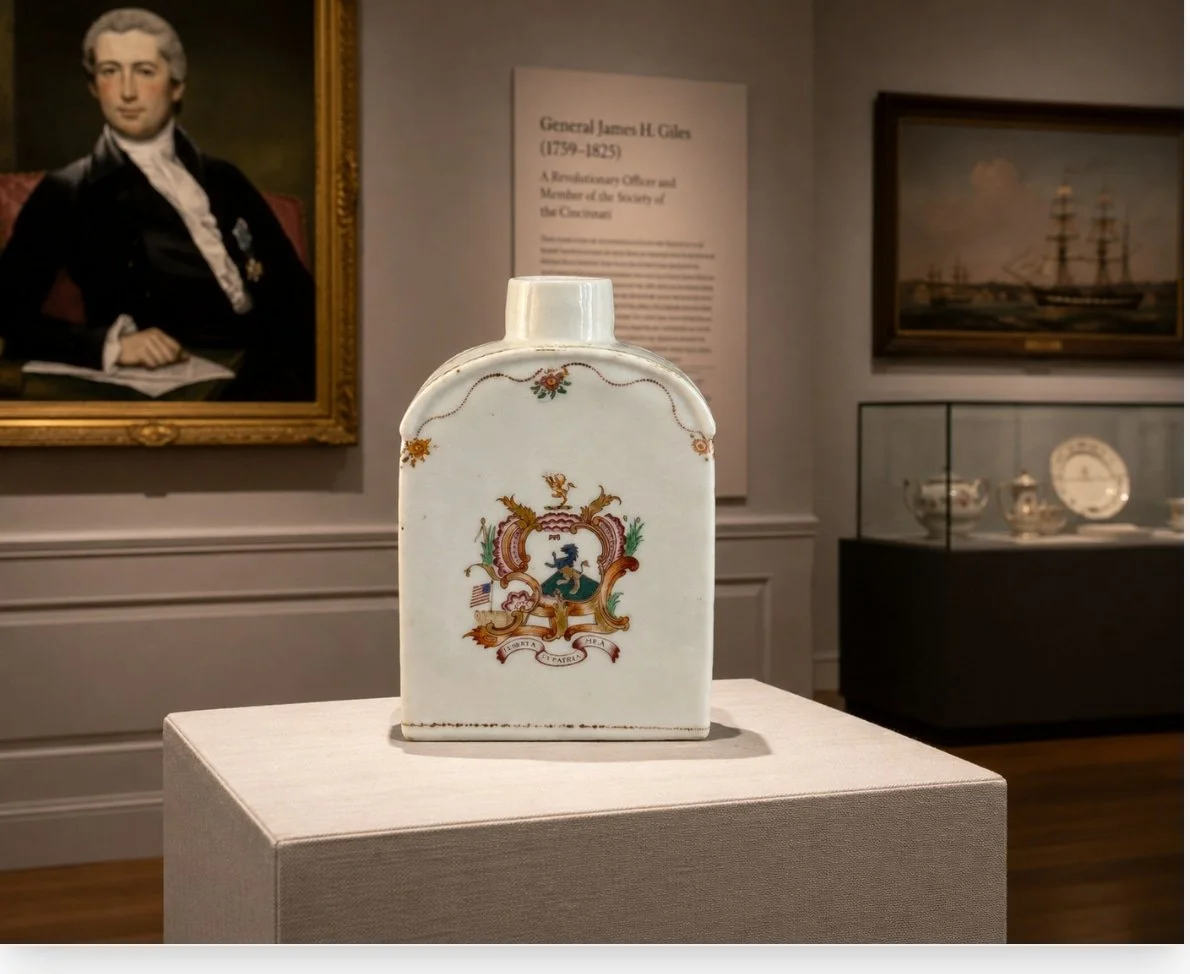 Image 6 of 6
LIBERTY AND MY COUNTRY A Chinese Export Armorial Tea Caddy Made for Brigadier General James H. Giles and the Early American Republic
LIBERTY AND MY COUNTRY
A Chinese Export Armorial Tea Caddy Made for Brigadier General James H. Giles and the Early American Republic
Chinese Export Porcelain for the American Market
Qing Dynasty, Qianlong Period, circa 1785
China, probably Jingdezhen, with decoration executed for the Western export market
Porcelain painted in polychrome overglaze enamels with traces of gilding
Height: 4¾ inches (12.1 cm)
Provenance:
Commissioned for Brigadier General James H. Giles (1759–1825), New York and later New Jersey, circa 1785; originally part of a Chinese Export porcelain armorial tea service made for Giles and decorated with his personal arms, an early American flag, cannon, and the motto LIBERTAS ET PATRIA MEA.
Related Museum Object:
A sugar bowl from the same Chinese Export porcelain service, bearing the arms and patriotic devices of James H. Giles, is preserved in the Reeves Collection at Washington and Lee University, accession no. 2014.19.1.
EXHIBITION ESSAY
Small in scale yet exceptional in historical resonance, this Chinese Export porcelain tea caddy brings together the history of the American Revolution, the emergence of the United States as an independent trading nation, the luxury trade between China and the West, and the personal story of a Continental Army officer who served under the Marquis de Lafayette.
Made in China during the Qianlong period of the Qing dynasty, circa 1785, the caddy was commissioned for Brigadier General James H. Giles (1759–1825), a Revolutionary War veteran, lawyer, militia officer, Freemason, and member of the Society of the Cincinnati.
The caddy originally formed part of a personalized porcelain tea service bearing Giles's coat of arms. More unusually, the traditional heraldic composition was augmented with distinctly American patriotic imagery: an early American flag, a cannon, military trophies, and the motto:
LIBERTAS ET PATRIA MEA
“Liberty and My Country.”
Through this remarkable combination of Chinese craftsmanship, European heraldic traditions, and American Revolutionary symbolism, the Giles service documents a transformative moment in history: the emergence of a new nation and the desire of members of its founding generation to express their identity through the objects they commissioned, owned, and displayed.
CHINA, THE QIANLONG PERIOD, AND THE EXPORT PORCELAIN TRADE
The tea caddy was produced in China during the reign of the Qianlong Emperor, one of the most prosperous periods in the history of Chinese ceramic production and international commerce.
Its porcelain body was most probably manufactured at Jingdezhen in Jiangxi province, China's principal center for porcelain production.
For centuries, the kilns of Jingdezhen produced porcelain for the Chinese imperial court, the domestic market, and international trade.
Porcelain intended for export was transported from the interior of China to the southern port of Guangzhou, historically known in the West as Canton.
There, specialized workshops decorated porcelain according to designs supplied by European and, increasingly after the American Revolution, American merchants.
These designs could include family coats of arms, initials, monograms, ships, military emblems, landscapes, portraits, and patriotic symbols.
Foreign merchants frequently supplied drawings, prints, bookplates, engravings, or watercolor designs that Chinese craftsmen translated into enamel decoration.
The Giles tea service belongs to this fascinating artistic and commercial exchange.
The porcelain itself was Chinese.
The heraldic traditions were largely European.
The patriotic imagery was distinctly American.
The resulting object represents the intersection of three cultures and traditions within a single work of decorative art.
THE FUNCTION OF THE TEA CADDY
The caddy was made to store valuable loose-leaf tea.
During the eighteenth century, tea was an expensive imported commodity and an important symbol of refinement, hospitality, and social standing.
Tea was often stored in small locked chests or specialized porcelain, silver, or wooden containers known as tea caddies.
In affluent households, the preparation and serving of tea developed into an important social ritual.
Tea services might include teapots, cups and saucers, slop bowls, cream jugs, sugar bowls, spoon trays, and tea caddies.
The present object originally belonged to such a personalized service.
The caddy would have been used to store tea leaves before they were measured and placed into a teapot.
Its rectangular body, gently rounded shoulders, short cylindrical neck, and compact proportions are characteristic of Chinese Export porcelain tea canisters produced during the eighteenth century.
The caddy originally would almost certainly have possessed a fitted porcelain cover or stopper.
Yet the importance of this particular object extends far beyond its domestic function.
For Giles and his family, the tea service also represented military service, patriotism, personal identity, prosperity, and participation in the international commercial world of the newly independent United States.
THE DECORATION AND THE ARMS OF JAMES H. GILES
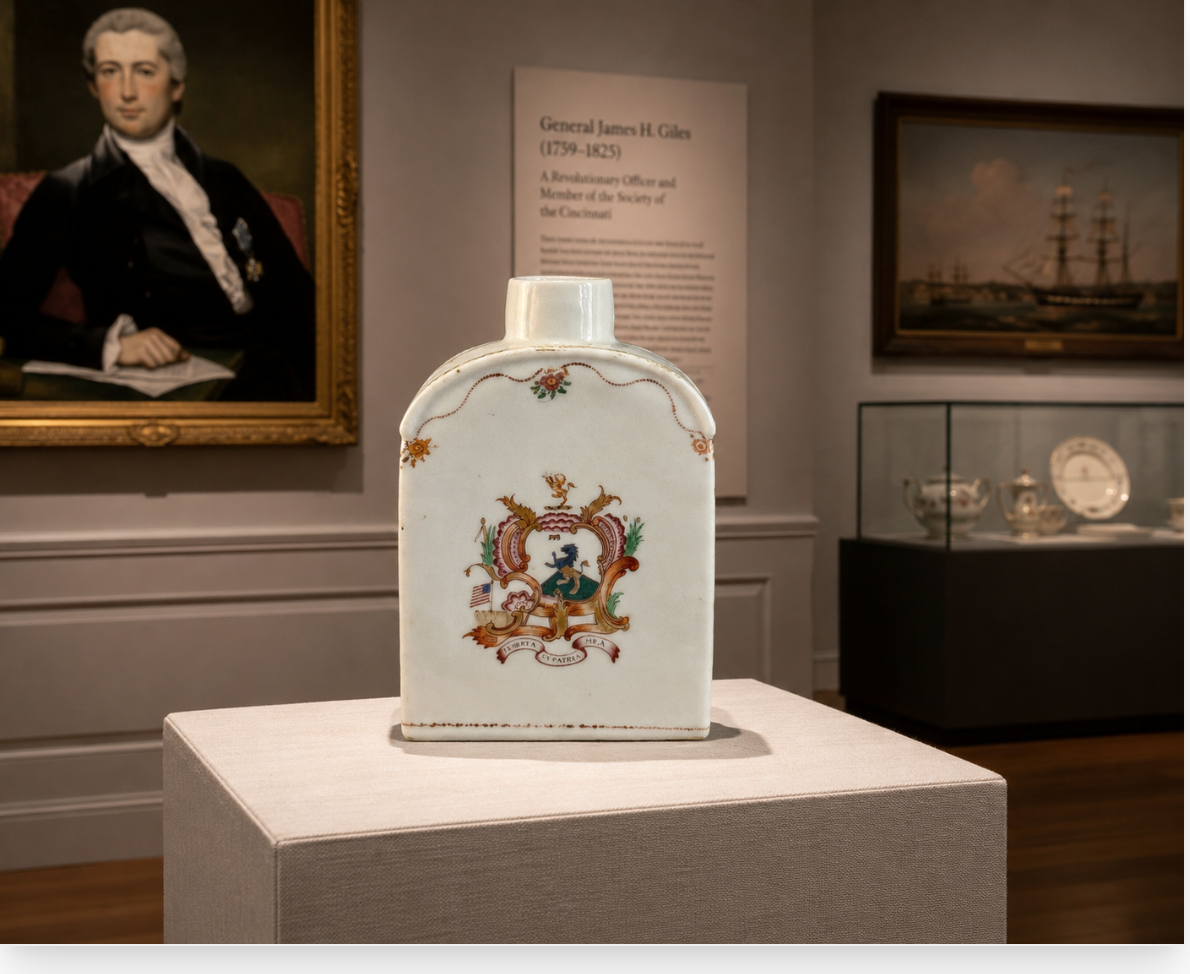
Both principal faces of the tea caddy are decorated with the armorial composition associated with James H. Giles.
At the center appears a heraldic shield containing a lion and surmounted by a key.
The shield is enclosed within an elaborate Rococo-inspired cartouche of scrolling ornament, foliage, and decorative flourishes.
A crest appears above.
Beside and beneath the traditional heraldic composition are objects that distinguish the Giles service from conventional European armorial porcelain.
They include an American flag and a cannon accompanied by military equipment.
Below the arms appears the motto:
LIBERTAS ET PATRIA MEA
“Liberty and My Country.”
The combination of these symbols transforms the decoration from a simple statement of family identity into a personal declaration of Revolutionary patriotism.
The cannon recalls Giles's military career and the armed struggle for American independence.
The American flag represents the newly established United States.
The Latin motto unites these symbols into a powerful expression of personal loyalty to the ideals of liberty and nationhood.
Together they communicate a remarkably direct message:
Military Service. Liberty. Independence. Country. Identity.
The tea caddy can therefore be understood as more than a domestic object.
It is a small porcelain monument to the American Revolution and to the generation that fought to establish the United States.
THE EARLY AMERICAN FLAG
Among the most historically compelling elements of the decoration is the small American flag painted beside the Giles arms.
The flag appears to have thirteen stripes representing the original thirteen states.
Its canton contains a stylized interpretation of the stars of the new American nation.
Such variations are characteristic of Chinese Export porcelain.
Chinese artists often worked from small drawings, prints, engravings, bookplates, or written instructions supplied by foreign merchants.
As designs passed through different hands and across enormous geographic distances, heraldic devices, animals, inscriptions, and national symbols were sometimes interpreted in distinctive ways.
These variations are not simply errors.
They provide evidence of the extraordinary cultural exchange that occurred between China and the West during the eighteenth century.
The American flag on the Giles caddy is particularly significant because the service was commissioned during the formative years of the United States.
The American Revolution had ended only recently.
The Treaty of Paris formally recognized American independence in 1783.
The United States Constitution had not yet been drafted.
George Washington had not yet become president.
The country represented by the small flag on this porcelain object was still a young and evolving republic.
AMERICA AND THE BEGINNING OF DIRECT TRADE WITH CHINA
The date of the Giles service, circa 1785, places it at the beginning of direct commercial relations between the United States and China.
Before the American Revolution, trade between the American colonies and China was largely conducted through British commercial networks.
Independence changed this situation dramatically.
In February 1784, the American merchant vessel Empress of China departed New York for Canton.
The ship returned to New York in May 1785 carrying tea, porcelain, silk, and other Chinese commodities.
The voyage demonstrated that the newly independent United States could participate directly in international commerce.
The Giles tea service dates from approximately this same historic moment.
The caddy therefore belongs to the first generation of Chinese Export porcelain associated with the emergence of an independent American market.
Its historical importance rests not only in the identity of its owner but also in its relationship to the development of American commercial relations with China.
BRIGADIER GENERAL JAMES H. GILES
James H. Giles was born in 1759.
Trained as a lawyer, he volunteered for service in the Continental Army during the American Revolution.
He began his military career as a lieutenant in approximately 1777.
Giles subsequently served under one of the most celebrated figures of the American Revolution, the Marquis de Lafayette.
The young French aristocrat and military officer had traveled to America to support the struggle for independence.
Lafayette became a trusted associate of George Washington and a powerful symbol of the alliance between France and the American cause.
In 1780, Lafayette reportedly presented Giles with a sword in recognition of his gallantry in action.
The survival of this sword provides an important material connection between Giles, Lafayette, and the American Revolution.
After resigning from military service in 1782, Giles returned to civilian life and practiced law in New York City.
In 1784, he married Hannah Bloomfield.
The Giles porcelain service was commissioned around 1785, approximately one year after their marriage.
It is therefore possible that the service was associated with the establishment of the Giles household following his marriage, although no documentary evidence presently confirms that hypothesis.
Giles subsequently moved to New Jersey, where he continued his legal career and became involved in the military and civic affairs of the new republic.
From approximately 1793 until 1805, he served as Brigadier General of the Cumberland Brigade of the New Jersey Militia.
A contemporary description remembered Giles as:
“A small man, precise in his dress, and remarkably erect and graceful, but very slow in his movement, and in all he did.”
The same account described him as one of the most genial and delightful companions and emphasized his kindness and friendly character.
These descriptions provide an unusually personal impression of the original owner of the tea caddy.
THE SOCIETY OF THE CINCINNATI
James H. Giles was also a member of the Society of the Cincinnati.
Established in 1783 by officers of the Continental Army, the Society was created to preserve the memory of the American Revolution, maintain friendships formed during military service, and support officers and their families.
Membership in the Society connected Giles directly to the generation of military officers responsible for establishing American independence.
Giles was initially associated with the New York Society of the Cincinnati before transferring to the New Jersey branch on July 4, 1789.
His membership provides another important context for understanding the imagery on his porcelain service.
The American flag, cannon, military devices, and the motto LIBERTAS ET PATRIA MEA were not abstract decorations.
They represented Giles's personal experiences, military service, social identity, and continuing association with the Revolutionary officer corps.
GILES AND THE MARQUIS DE LAFAYETTE
One of the most moving episodes in Giles's biography occurred more than forty years after the American Revolution.
In 1824, Lafayette returned to the United States as the “Guest of the Nation.”
His tour of America became one of the greatest public celebrations of Revolutionary memory in the early nineteenth century.
Thousands of Americans gathered to see one of the last surviving major leaders of the Revolution.
When Lafayette returned to New Jersey, Giles reportedly greeted his former commander.
During their reunion, Giles showed Lafayette the sword that Lafayette had presented to him more than four decades earlier.
The episode connects the youthful Continental Army officer of the Revolutionary era with the elderly American citizen who lived long enough to witness the transformation of the United States from a group of rebellious colonies into an established nation.
The tea caddy survives as a tangible artifact from the years between these two historical moments.
PROVENANCE AND THE ORIGINAL GILES SERVICE
The tea caddy was commissioned for James H. Giles circa 1785 and originally formed part of an extensive Chinese Export porcelain armorial tea service.
The service was decorated with Giles's arms, American patriotic imagery, and the motto LIBERTAS ET PATRIA MEA.
Personalized armorial services were expensive luxury commissions.
Designs had to be prepared, transported to China, interpreted by Chinese craftsmen, painted onto porcelain, fired, packed, and transported across the oceans before reaching their owners.
The commission of such a service reflected social status, prosperity, international connections, and personal identity.
Over the centuries, complete services were frequently dispersed through inheritance, sale, and changes in ownership.
Individual objects surviving from identifiable services are therefore important historical documents.
The survival of another object from the Giles service in an institutional collection provides a particularly valuable comparison.
THE REEVES COLLECTION AT WASHINGTON AND LEE UNIVERSITY
A sugar bowl from the same Chinese Export porcelain service is preserved in the Reeves Collection at Washington and Lee University.
Accession Number: 2014.19.1.
The sugar bowl bears the same Giles armorial decoration and patriotic iconography.
This institutional comparison is important because it establishes the existence of multiple surviving components from the circa-1785 Giles service.
The Reeves Collection is recognized for its holdings of Chinese Export porcelain and ceramics associated with American history and international trade.
The presence of the related sugar bowl in the collection provides an important scholarly and museum reference for the present tea caddy.
Together, the two objects provide evidence of a larger personalized service commissioned during the first years of the American Republic.
HISTORICAL AND CULTURAL SIGNIFICANCE
The General James H. Giles tea caddy is historically important on several interconnected levels.
First, it is associated with a documented officer of the American Revolution who served under Lafayette.
Second, it represents the emergence of a distinct American national identity during the years immediately following independence.
Third, the American flag, cannon, and patriotic motto make the caddy an unusually personal expression of Revolutionary identity.
Fourth, its date places the Giles service at the beginning of direct commercial relations between the United States and China.
Fifth, it demonstrates the extraordinary artistic exchange that occurred when Chinese craftsmen translated Western heraldic designs and American patriotic symbols into porcelain decoration.
Sixth, the survival of a sugar bowl from the same service in the Reeves Collection provides a significant institutional comparison.
Finally, the caddy connects domestic life with major historical events.
Tea drinking, international trade, the American Revolution, the Society of the Cincinnati, Lafayette, American heraldry, and the emergence of the United States as an independent nation converge within a single porcelain object measuring less than five inches high.
RELATED MUSEUM COLLECTIONS AND COMPARATIVE MATERIAL
The Giles tea caddy may be studied within the broader context of major museum collections of Chinese Export porcelain and American-market ceramics.
Important collections include the Reeves Collection at Washington and Lee University, which preserves the related Giles sugar bowl.
The Peabody Essex Museum holds one of the most important collections of Chinese Export art in the United States, including porcelain associated with American merchants, families, ships, and the China Trade.
The Metropolitan Museum of Art preserves significant examples of eighteenth- and nineteenth-century Chinese Export porcelain.
Winterthur Museum, Garden and Library holds extensive collections relating to Chinese Export porcelain, American decorative arts, tea culture, and elite domestic life.
The U.S. Department of State Diplomatic Reception Rooms preserve important examples of Chinese Export porcelain associated with American history and diplomacy.
These collections provide valuable comparative material for understanding the Giles tea caddy within the broader history of Chinese Export porcelain and the cultural formation of the early American Republic.
SELECTED LITERATURE AND REFERENCES
The Giles tea caddy should be studied within the broader scholarship devoted to Chinese Export porcelain, armorial porcelain, and porcelain made for the American market.
David Sanctuary Howard, Chinese Armorial Porcelain, remains a foundational reference for the identification and study of Chinese Export armorial services.
Howard's Chinese Armorial Porcelain, Volume II expands the documentary study of armorial commissions and related services.
Jean McClure Mudge, Chinese Export Porcelain in North America, provides essential context for understanding the ownership, importation, and use of Chinese porcelain in American households.
Mudge's Chinese Export Porcelain for the American Trade, 1785–1835 is particularly relevant for placing the Giles service within the emergence of direct American commercial relations with China.
John Goldsmith Phillips, China-Trade Porcelain, remains an important reference for Chinese Export porcelain preserved in American collections.
Margaret Jourdain and R. Soame Jenyns, Chinese Export Art in the Eighteenth Century, provides broader SELECTED LITERATURE AND REFERENCES
EXHIBITION THEMES
The General James H. Giles tea caddy would be particularly appropriate for exhibitions devoted to:
Chinese Export Porcelain for the American Market; Art and the American Revolution; Lafayette and Revolutionary Memory; The Society of the Cincinnati; Tea and Luxury in Early America; American Heraldry and National Identity; The Birth of the American China Trade; The Material Culture of the Founding Generation; and China and the Early American Republic.
CONCLUSION
Small objects can carry extraordinary histories.
Made in China around 1785, transported across oceans, decorated for an American Revolutionary War officer, and preserved for more than two centuries, this tea caddy represents the remarkable interconnectedness of the eighteenth-century world.
Its porcelain body reflects the technical mastery of Chinese craftsmen.
Its heraldic decoration reflects centuries-old European traditions.
Its American flag, cannon, and patriotic motto announce the creation of a new national identity.
Its original owner, Brigadier General James H. Giles, belonged to the generation that fought for American independence, served under Lafayette, participated in the Society of the Cincinnati, and witnessed the transformation of the United States from revolution to republic.
The motto painted beneath his arms expresses the meaning of the object with remarkable clarity:
LIBERTAS ET PATRIA MEA
“LIBERTY AND MY COUNTRY.”
The General James H. Giles armorial tea caddy is therefore more than an example of Chinese Export porcelain. It is a rare surviving document of the American founding generation—an intimate domestic object transformed through patronage, heraldry, and patriotic symbolism into a testament to military service, international trade, Revolutionary memory, and the emergence of the United States as an independent nation.
LIBERTY AND MY COUNTRY
A Chinese Export Armorial Tea Caddy Made for Brigadier General James H. Giles and the Early American Republic
Chinese Export Porcelain for the American Market
Qing Dynasty, Qianlong Period, circa 1785
China, probably Jingdezhen, with decoration executed for the Western export market
Porcelain painted in polychrome overglaze enamels with traces of gilding
Height: 4¾ inches (12.1 cm)
Provenance:
Commissioned for Brigadier General James H. Giles (1759–1825), New York and later New Jersey, circa 1785; originally part of a Chinese Export porcelain armorial tea service made for Giles and decorated with his personal arms, an early American flag, cannon, and the motto LIBERTAS ET PATRIA MEA.
Related Museum Object:
A sugar bowl from the same Chinese Export porcelain service, bearing the arms and patriotic devices of James H. Giles, is preserved in the Reeves Collection at Washington and Lee University, accession no. 2014.19.1.
EXHIBITION ESSAY
Small in scale yet exceptional in historical resonance, this Chinese Export porcelain tea caddy brings together the history of the American Revolution, the emergence of the United States as an independent trading nation, the luxury trade between China and the West, and the personal story of a Continental Army officer who served under the Marquis de Lafayette.
Made in China during the Qianlong period of the Qing dynasty, circa 1785, the caddy was commissioned for Brigadier General James H. Giles (1759–1825), a Revolutionary War veteran, lawyer, militia officer, Freemason, and member of the Society of the Cincinnati.
The caddy originally formed part of a personalized porcelain tea service bearing Giles's coat of arms. More unusually, the traditional heraldic composition was augmented with distinctly American patriotic imagery: an early American flag, a cannon, military trophies, and the motto:
LIBERTAS ET PATRIA MEA
“Liberty and My Country.”
Through this remarkable combination of Chinese craftsmanship, European heraldic traditions, and American Revolutionary symbolism, the Giles service documents a transformative moment in history: the emergence of a new nation and the desire of members of its founding generation to express their identity through the objects they commissioned, owned, and displayed.
CHINA, THE QIANLONG PERIOD, AND THE EXPORT PORCELAIN TRADE
The tea caddy was produced in China during the reign of the Qianlong Emperor, one of the most prosperous periods in the history of Chinese ceramic production and international commerce.
Its porcelain body was most probably manufactured at Jingdezhen in Jiangxi province, China's principal center for porcelain production.
For centuries, the kilns of Jingdezhen produced porcelain for the Chinese imperial court, the domestic market, and international trade.
Porcelain intended for export was transported from the interior of China to the southern port of Guangzhou, historically known in the West as Canton.
There, specialized workshops decorated porcelain according to designs supplied by European and, increasingly after the American Revolution, American merchants.
These designs could include family coats of arms, initials, monograms, ships, military emblems, landscapes, portraits, and patriotic symbols.
Foreign merchants frequently supplied drawings, prints, bookplates, engravings, or watercolor designs that Chinese craftsmen translated into enamel decoration.
The Giles tea service belongs to this fascinating artistic and commercial exchange.
The porcelain itself was Chinese.
The heraldic traditions were largely European.
The patriotic imagery was distinctly American.
The resulting object represents the intersection of three cultures and traditions within a single work of decorative art.
THE FUNCTION OF THE TEA CADDY
The caddy was made to store valuable loose-leaf tea.
During the eighteenth century, tea was an expensive imported commodity and an important symbol of refinement, hospitality, and social standing.
Tea was often stored in small locked chests or specialized porcelain, silver, or wooden containers known as tea caddies.
In affluent households, the preparation and serving of tea developed into an important social ritual.
Tea services might include teapots, cups and saucers, slop bowls, cream jugs, sugar bowls, spoon trays, and tea caddies.
The present object originally belonged to such a personalized service.
The caddy would have been used to store tea leaves before they were measured and placed into a teapot.
Its rectangular body, gently rounded shoulders, short cylindrical neck, and compact proportions are characteristic of Chinese Export porcelain tea canisters produced during the eighteenth century.
The caddy originally would almost certainly have possessed a fitted porcelain cover or stopper.
Yet the importance of this particular object extends far beyond its domestic function.
For Giles and his family, the tea service also represented military service, patriotism, personal identity, prosperity, and participation in the international commercial world of the newly independent United States.
THE DECORATION AND THE ARMS OF JAMES H. GILES
Both principal faces of the tea caddy are decorated with the armorial composition associated with James H. Giles.
At the center appears a heraldic shield containing a lion and surmounted by a key.
The shield is enclosed within an elaborate Rococo-inspired cartouche of scrolling ornament, foliage, and decorative flourishes.
A crest appears above.
Beside and beneath the traditional heraldic composition are objects that distinguish the Giles service from conventional European armorial porcelain.
They include an American flag and a cannon accompanied by military equipment.
Below the arms appears the motto:
LIBERTAS ET PATRIA MEA
“Liberty and My Country.”
The combination of these symbols transforms the decoration from a simple statement of family identity into a personal declaration of Revolutionary patriotism.
The cannon recalls Giles's military career and the armed struggle for American independence.
The American flag represents the newly established United States.
The Latin motto unites these symbols into a powerful expression of personal loyalty to the ideals of liberty and nationhood.
Together they communicate a remarkably direct message:
Military Service. Liberty. Independence. Country. Identity.
The tea caddy can therefore be understood as more than a domestic object.
It is a small porcelain monument to the American Revolution and to the generation that fought to establish the United States.
THE EARLY AMERICAN FLAG
Among the most historically compelling elements of the decoration is the small American flag painted beside the Giles arms.
The flag appears to have thirteen stripes representing the original thirteen states.
Its canton contains a stylized interpretation of the stars of the new American nation.
Such variations are characteristic of Chinese Export porcelain.
Chinese artists often worked from small drawings, prints, engravings, bookplates, or written instructions supplied by foreign merchants.
As designs passed through different hands and across enormous geographic distances, heraldic devices, animals, inscriptions, and national symbols were sometimes interpreted in distinctive ways.
These variations are not simply errors.
They provide evidence of the extraordinary cultural exchange that occurred between China and the West during the eighteenth century.
The American flag on the Giles caddy is particularly significant because the service was commissioned during the formative years of the United States.
The American Revolution had ended only recently.
The Treaty of Paris formally recognized American independence in 1783.
The United States Constitution had not yet been drafted.
George Washington had not yet become president.
The country represented by the small flag on this porcelain object was still a young and evolving republic.
AMERICA AND THE BEGINNING OF DIRECT TRADE WITH CHINA
The date of the Giles service, circa 1785, places it at the beginning of direct commercial relations between the United States and China.
Before the American Revolution, trade between the American colonies and China was largely conducted through British commercial networks.
Independence changed this situation dramatically.
In February 1784, the American merchant vessel Empress of China departed New York for Canton.
The ship returned to New York in May 1785 carrying tea, porcelain, silk, and other Chinese commodities.
The voyage demonstrated that the newly independent United States could participate directly in international commerce.
The Giles tea service dates from approximately this same historic moment.
The caddy therefore belongs to the first generation of Chinese Export porcelain associated with the emergence of an independent American market.
Its historical importance rests not only in the identity of its owner but also in its relationship to the development of American commercial relations with China.
BRIGADIER GENERAL JAMES H. GILES
James H. Giles was born in 1759.
Trained as a lawyer, he volunteered for service in the Continental Army during the American Revolution.
He began his military career as a lieutenant in approximately 1777.
Giles subsequently served under one of the most celebrated figures of the American Revolution, the Marquis de Lafayette.
The young French aristocrat and military officer had traveled to America to support the struggle for independence.
Lafayette became a trusted associate of George Washington and a powerful symbol of the alliance between France and the American cause.
In 1780, Lafayette reportedly presented Giles with a sword in recognition of his gallantry in action.
The survival of this sword provides an important material connection between Giles, Lafayette, and the American Revolution.
After resigning from military service in 1782, Giles returned to civilian life and practiced law in New York City.
In 1784, he married Hannah Bloomfield.
The Giles porcelain service was commissioned around 1785, approximately one year after their marriage.
It is therefore possible that the service was associated with the establishment of the Giles household following his marriage, although no documentary evidence presently confirms that hypothesis.
Giles subsequently moved to New Jersey, where he continued his legal career and became involved in the military and civic affairs of the new republic.
From approximately 1793 until 1805, he served as Brigadier General of the Cumberland Brigade of the New Jersey Militia.
A contemporary description remembered Giles as:
“A small man, precise in his dress, and remarkably erect and graceful, but very slow in his movement, and in all he did.”
The same account described him as one of the most genial and delightful companions and emphasized his kindness and friendly character.
These descriptions provide an unusually personal impression of the original owner of the tea caddy.
THE SOCIETY OF THE CINCINNATI
James H. Giles was also a member of the Society of the Cincinnati.
Established in 1783 by officers of the Continental Army, the Society was created to preserve the memory of the American Revolution, maintain friendships formed during military service, and support officers and their families.
Membership in the Society connected Giles directly to the generation of military officers responsible for establishing American independence.
Giles was initially associated with the New York Society of the Cincinnati before transferring to the New Jersey branch on July 4, 1789.
His membership provides another important context for understanding the imagery on his porcelain service.
The American flag, cannon, military devices, and the motto LIBERTAS ET PATRIA MEA were not abstract decorations.
They represented Giles's personal experiences, military service, social identity, and continuing association with the Revolutionary officer corps.
GILES AND THE MARQUIS DE LAFAYETTE
One of the most moving episodes in Giles's biography occurred more than forty years after the American Revolution.
In 1824, Lafayette returned to the United States as the “Guest of the Nation.”
His tour of America became one of the greatest public celebrations of Revolutionary memory in the early nineteenth century.
Thousands of Americans gathered to see one of the last surviving major leaders of the Revolution.
When Lafayette returned to New Jersey, Giles reportedly greeted his former commander.
During their reunion, Giles showed Lafayette the sword that Lafayette had presented to him more than four decades earlier.
The episode connects the youthful Continental Army officer of the Revolutionary era with the elderly American citizen who lived long enough to witness the transformation of the United States from a group of rebellious colonies into an established nation.
The tea caddy survives as a tangible artifact from the years between these two historical moments.
PROVENANCE AND THE ORIGINAL GILES SERVICE
The tea caddy was commissioned for James H. Giles circa 1785 and originally formed part of an extensive Chinese Export porcelain armorial tea service.
The service was decorated with Giles's arms, American patriotic imagery, and the motto LIBERTAS ET PATRIA MEA.
Personalized armorial services were expensive luxury commissions.
Designs had to be prepared, transported to China, interpreted by Chinese craftsmen, painted onto porcelain, fired, packed, and transported across the oceans before reaching their owners.
The commission of such a service reflected social status, prosperity, international connections, and personal identity.
Over the centuries, complete services were frequently dispersed through inheritance, sale, and changes in ownership.
Individual objects surviving from identifiable services are therefore important historical documents.
The survival of another object from the Giles service in an institutional collection provides a particularly valuable comparison.
THE REEVES COLLECTION AT WASHINGTON AND LEE UNIVERSITY
A sugar bowl from the same Chinese Export porcelain service is preserved in the Reeves Collection at Washington and Lee University.
Accession Number: 2014.19.1.
The sugar bowl bears the same Giles armorial decoration and patriotic iconography.
This institutional comparison is important because it establishes the existence of multiple surviving components from the circa-1785 Giles service.
The Reeves Collection is recognized for its holdings of Chinese Export porcelain and ceramics associated with American history and international trade.
The presence of the related sugar bowl in the collection provides an important scholarly and museum reference for the present tea caddy.
Together, the two objects provide evidence of a larger personalized service commissioned during the first years of the American Republic.
HISTORICAL AND CULTURAL SIGNIFICANCE
The General James H. Giles tea caddy is historically important on several interconnected levels.
First, it is associated with a documented officer of the American Revolution who served under Lafayette.
Second, it represents the emergence of a distinct American national identity during the years immediately following independence.
Third, the American flag, cannon, and patriotic motto make the caddy an unusually personal expression of Revolutionary identity.
Fourth, its date places the Giles service at the beginning of direct commercial relations between the United States and China.
Fifth, it demonstrates the extraordinary artistic exchange that occurred when Chinese craftsmen translated Western heraldic designs and American patriotic symbols into porcelain decoration.
Sixth, the survival of a sugar bowl from the same service in the Reeves Collection provides a significant institutional comparison.
Finally, the caddy connects domestic life with major historical events.
Tea drinking, international trade, the American Revolution, the Society of the Cincinnati, Lafayette, American heraldry, and the emergence of the United States as an independent nation converge within a single porcelain object measuring less than five inches high.
RELATED MUSEUM COLLECTIONS AND COMPARATIVE MATERIAL
The Giles tea caddy may be studied within the broader context of major museum collections of Chinese Export porcelain and American-market ceramics.
Important collections include the Reeves Collection at Washington and Lee University, which preserves the related Giles sugar bowl.
The Peabody Essex Museum holds one of the most important collections of Chinese Export art in the United States, including porcelain associated with American merchants, families, ships, and the China Trade.
The Metropolitan Museum of Art preserves significant examples of eighteenth- and nineteenth-century Chinese Export porcelain.
Winterthur Museum, Garden and Library holds extensive collections relating to Chinese Export porcelain, American decorative arts, tea culture, and elite domestic life.
The U.S. Department of State Diplomatic Reception Rooms preserve important examples of Chinese Export porcelain associated with American history and diplomacy.
These collections provide valuable comparative material for understanding the Giles tea caddy within the broader history of Chinese Export porcelain and the cultural formation of the early American Republic.
SELECTED LITERATURE AND REFERENCES
The Giles tea caddy should be studied within the broader scholarship devoted to Chinese Export porcelain, armorial porcelain, and porcelain made for the American market.
David Sanctuary Howard, Chinese Armorial Porcelain, remains a foundational reference for the identification and study of Chinese Export armorial services.
Howard's Chinese Armorial Porcelain, Volume II expands the documentary study of armorial commissions and related services.
Jean McClure Mudge, Chinese Export Porcelain in North America, provides essential context for understanding the ownership, importation, and use of Chinese porcelain in American households.
Mudge's Chinese Export Porcelain for the American Trade, 1785–1835 is particularly relevant for placing the Giles service within the emergence of direct American commercial relations with China.
John Goldsmith Phillips, China-Trade Porcelain, remains an important reference for Chinese Export porcelain preserved in American collections.
Margaret Jourdain and R. Soame Jenyns, Chinese Export Art in the Eighteenth Century, provides broader SELECTED LITERATURE AND REFERENCES
EXHIBITION THEMES
The General James H. Giles tea caddy would be particularly appropriate for exhibitions devoted to:
Chinese Export Porcelain for the American Market; Art and the American Revolution; Lafayette and Revolutionary Memory; The Society of the Cincinnati; Tea and Luxury in Early America; American Heraldry and National Identity; The Birth of the American China Trade; The Material Culture of the Founding Generation; and China and the Early American Republic.
CONCLUSION
Small objects can carry extraordinary histories.
Made in China around 1785, transported across oceans, decorated for an American Revolutionary War officer, and preserved for more than two centuries, this tea caddy represents the remarkable interconnectedness of the eighteenth-century world.
Its porcelain body reflects the technical mastery of Chinese craftsmen.
Its heraldic decoration reflects centuries-old European traditions.
Its American flag, cannon, and patriotic motto announce the creation of a new national identity.
Its original owner, Brigadier General James H. Giles, belonged to the generation that fought for American independence, served under Lafayette, participated in the Society of the Cincinnati, and witnessed the transformation of the United States from revolution to republic.
The motto painted beneath his arms expresses the meaning of the object with remarkable clarity:
LIBERTAS ET PATRIA MEA
“LIBERTY AND MY COUNTRY.”
The General James H. Giles armorial tea caddy is therefore more than an example of Chinese Export porcelain. It is a rare surviving document of the American founding generation—an intimate domestic object transformed through patronage, heraldry, and patriotic symbolism into a testament to military service, international trade, Revolutionary memory, and the emergence of the United States as an independent nation.