 Image 1 of 3
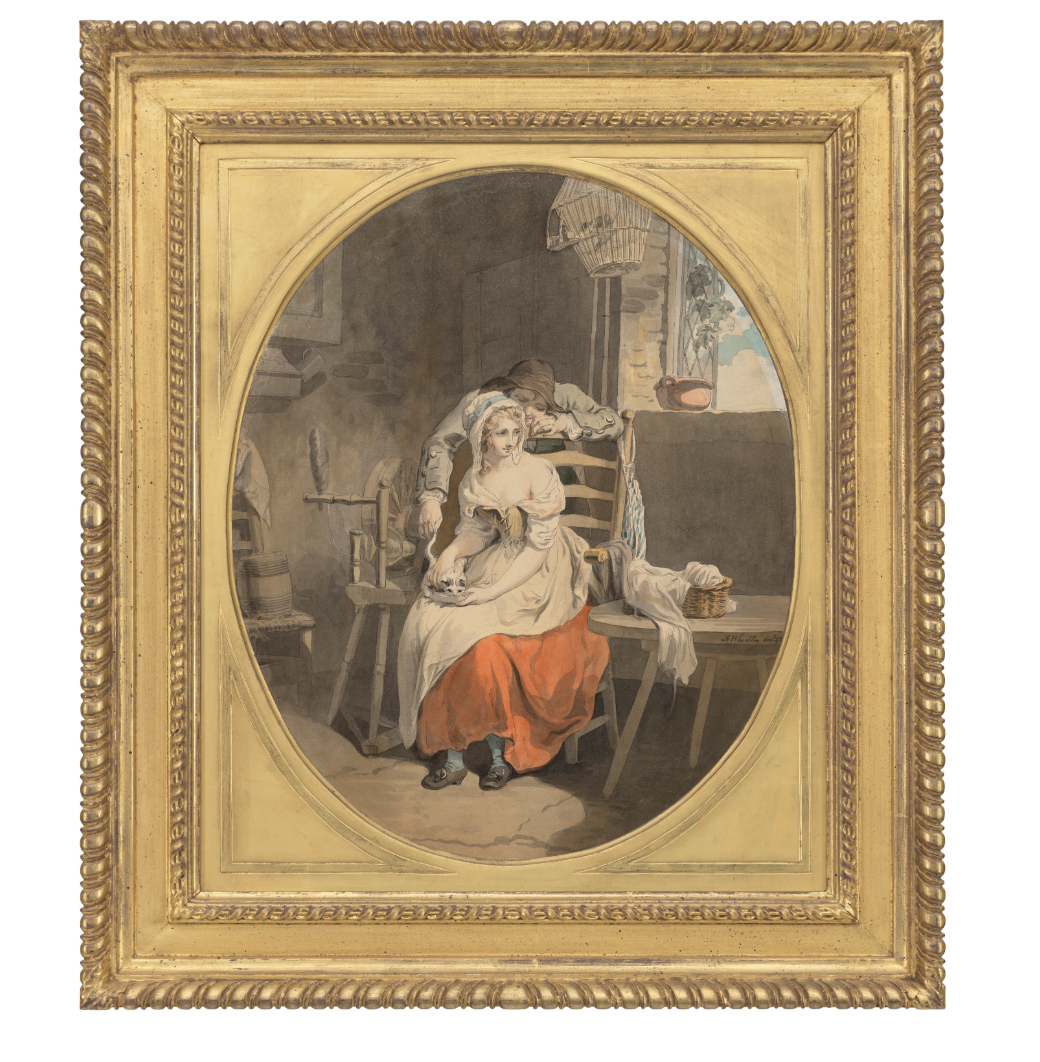 Image 2 of 3
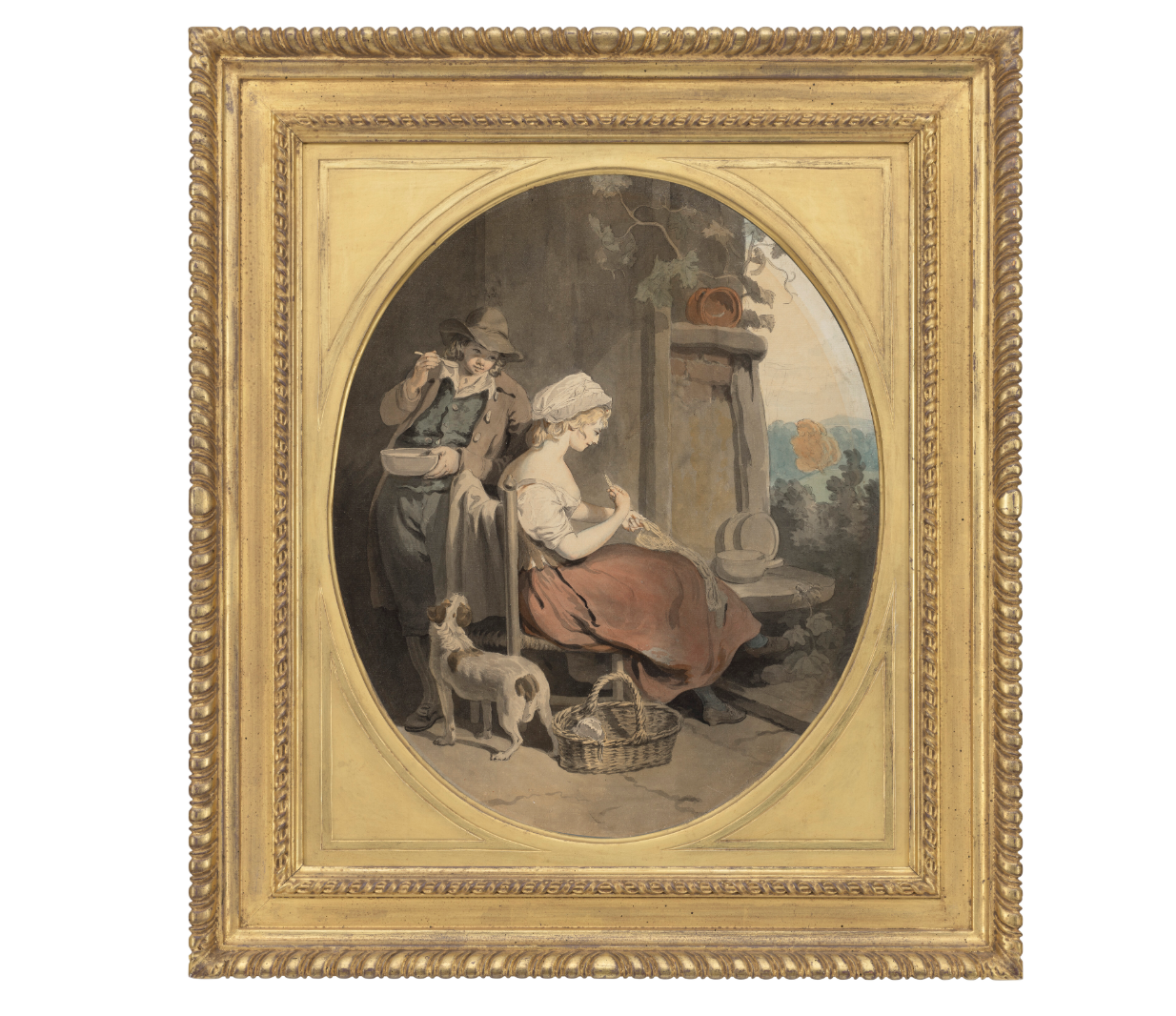 Image 3 of 3
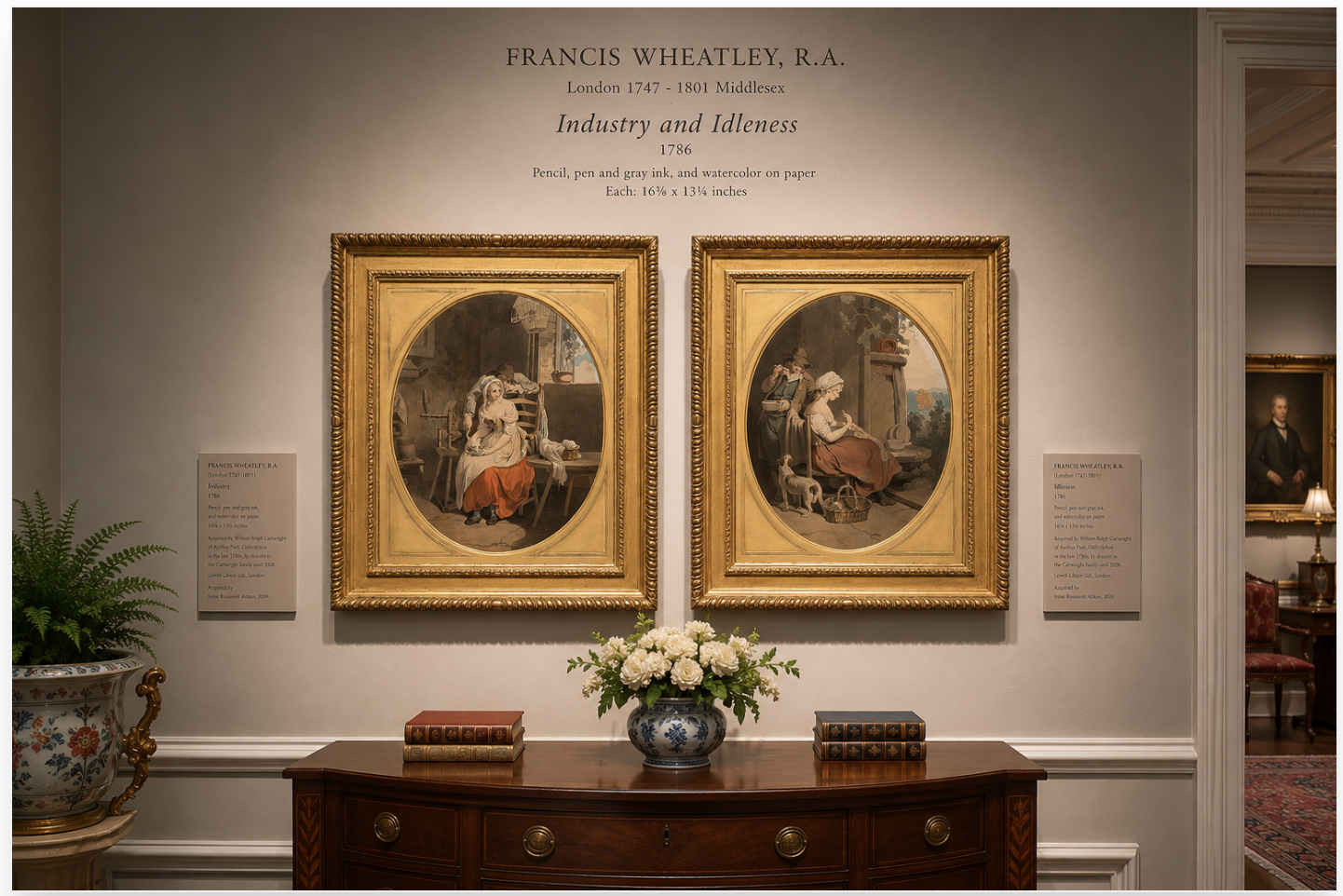
Francis Wheatley, R.A. Industry and Idleness, 1786 Pencil, pen and gray ink, and watercolor on paper Each 16⅜ × 13¼ inches (41.3 × 33.7 cm) Oval compositions; a pair
Francis Wheatley, R.A.
Industry and Idleness, 1786
Pencil, pen and gray ink, and watercolor on paper
Each 16⅜ × 13¼ inches (41.3 × 33.7 cm)
Oval compositions; a pair
One signed and dated lower right: F. Wheatley delt. 1786
The reverse inscriptions include: No. 1 and No. 2 and Mr. Cartwright 1 Suffolk Place
Provenance
William Ralph Cartwright of Aynhoe Park, Oxfordshire, acquired directly from the artist in the late 1780s;
By descent in the Cartwright family until 2008;
Lowell Libson Ltd., London; https://www.libson-yarker.com/about-us/?utm
Acquired from the above by Irene Roosevelt Aitken, 2009;
The Collection of Irene Roosevelt Aitken, 990 Fifth Avenue, New York;
Christie’s, New York, Irene Roosevelt Aitken: The Library, Bedrooms and Objects of Vertu, Lot 492; https://www.christies.com/en/lot/lot-6569623?ldp_breadcrumb=back
Literature:
Walter Roberts, F. Wheatley, R.A.: His Life and Works, with a Catalogue of His Engraved Pictures, London, 1910, p. 39, plate VI, relating to the engraved composition.
Mary Webster, Francis Wheatley, London, 1970, pp. 72–73 and 164, fig. 90, relating to the engraved composition.
Engraved
Both compositions were engraved by Charles Knight.
The first was initially published on March 31, 1787, and subsequently circulated under the titles Industry and The Industrious Cottager.
A French version of the composition was published under the title La Bonne Ménagère, or “The Good Housekeeper.”
The companion subject, Idleness, was engraved in 1787 under the title The Rustic Lover
Catalogue Essay
Created in 1786, Industry and Idleness is an exceptionally refined and historically significant pair of watercolors by Francis Wheatley, R.A., one of the most accomplished British painters of sentimental genre subjects during the reign of George III. Conceived as pendants and preserved together for nearly two and a half centuries, the works unite delicate draftsmanship, social observation, moral symbolism and romantic narrative.
The pair belongs to a defining period in Wheatley’s career. Having returned to London from Ireland in 1783, the artist increasingly turned toward rural and domestic subjects that could appeal both to private collectors and to the rapidly expanding market for reproductive prints. These intimate scenes, often referred to in the eighteenth century as “fancy pictures,” presented idealized episodes of everyday life rather than portraits of specific individuals. Through gesture, costume and domestic detail, Wheatley transformed ordinary rural activity into elegant reflections on character, virtue and human affection.
In Industry, a young woman remains absorbed in her work while a male admirer attempts to gain her attention. She sits outside a modest cottage, surrounded by the familiar objects of rural domestic life: a basket, simple furniture, household vessels and a small dog standing nearby. Her posture is composed and her gaze remains directed toward the task in her hands. Although the young man leans toward her, she does not abandon her occupation. The scene presents diligence not as drudgery, but as a form of self-command and moral steadiness.
The young woman is not known to represent an identifiable sitter. Like the other figures in the pair, she is best understood as an idealized character created to embody a recognizable social and moral role. Her modest clothing, lowered gaze and disciplined attention identify her as the industrious heroine of the narrative. The man behind her functions as a suitor and a source of distraction, yet Wheatley avoids portraying him as threatening. His courtship provides the test through which her restraint becomes visible.
The small dog may be understood as a traditional emblem of fidelity and domestic attachment, although it also contributes to the naturalism and intimacy of the composition. Wheatley frequently used animals and household objects to make his scenes appear observed from life, even when their moral structure had been carefully constructed in the studio.
The companion watercolor, Idleness, presents the same theme in a more intimate and uncertain form. A young woman has allowed her attention to drift from her domestic occupation while a man bends closely over the back of her chair and whispers near her ear. The spinning wheel and nearby textiles indicate interrupted labor. Her relaxed posture and partly loosened clothing introduce a restrained note of sensuality, suggesting that romantic attention has displaced productive activity.
Yet the work is not a harsh condemnation. Wheatley does not portray the woman as disgraced or morally ruined. Instead, he captures a moment of hesitation, emotional vulnerability and temptation. The power of the image lies in its ambiguity: the woman has become distracted, but her future conduct remains unresolved.
Above the couple hangs a birdcage. In eighteenth-century visual culture, a caged bird could symbolize chastity, innocence and protected virtue. An escaped bird, by contrast, was frequently understood as a sign of lost innocence. In Wheatley’s composition, the bird remains inside the cage. The woman’s virtue is therefore threatened, but not definitively surrendered. This subtle distinction reveals the sophistication of Wheatley’s narrative method. Rather than illustrating a fixed moral verdict, he invites the viewer to consider an unfolding psychological moment.
The title Industry and Idleness recalls one of the most familiar moral oppositions in eighteenth-century British culture. William Hogarth had treated the theme dramatically in his famous print series of 1747, in which an industrious apprentice achieves prosperity while his idle companion descends toward crime and punishment. Wheatley’s interpretation is gentler and more intimate. He replaces Hogarth’s public consequences with private emotion, reducing the moral drama to moments of courtship, attention and choice.
The two compositions depend upon one another. In Industry, work continues despite romantic distraction; in Idleness, work has been suspended. One woman maintains control over her attention, while the other yields to the pleasure of whispered affection. Clothing, gesture, furniture and tools reinforce the contrast. The numbered inscriptions on the reverse further confirm that the sheets were conceived and retained as a deliberate pair.
Technically, the works demonstrate Wheatley’s command of mixed drawing media. Pencil established the initial arrangement of the figures, architecture and furnishings. Pen and gray ink supplied precise contours and delicate interior details without the severity of heavy black line. Transparent watercolor was then applied to the flesh, garments, landscape and domestic setting.
The restricted palette is particularly effective. Muted browns and grays establish the humble rural environment, while warmer reds, soft blues and flesh tones bring the figures forward. The repeated red garments visually connect the two scenes and strengthen their identity as pendants. The oval format concentrates the narrative and gives each image the appearance of an intimate theatrical vignette.
The medium also reflects the expanding status of watercolor in late eighteenth-century Britain. Once used primarily for preparatory studies, topographical records or private sketches, watercolor was increasingly appreciated as a finished artistic form. Wheatley’s pair was clearly intended for sophisticated display. Their scale, elaborate handling and carefully balanced compositions place them well beyond the category of preliminary sketches.
Francis Wheatley was born in London in 1747, the son of a master tailor. He studied at William Shipley’s drawing school and later at the Royal Academy Schools. Early in his career, he worked as a portraitist and painter of conversation pieces, a genre that depicted families and social groups in informal domestic or landscape settings.
Around 1779, Wheatley traveled to Ireland, where he painted portraits, political events, military gatherings and scenes of local life. His Irish experience appears to have deepened his interest in rural workers and everyday subjects. After returning to London, he developed a successful body of sentimental genre pictures that combined British naturalism with the emotional appeal associated with contemporary French art.
In 1785, Wheatley exhibited The Amorous Sportsman at the Royal Academy, one of his earliest recorded fancy pictures. In 1786, the year the present pair was executed, he exhibited subjects including Brickmakers and Girl Making Cabbage Nets at a Cottage Door. The latter may have been an oil version related to the composition now known as Industry or The Industrious Cottager. The connection is compelling, although the exact identity of the Royal Academy work has not been conclusively established.
Wheatley was elected an Associate of the Royal Academy in 1790 and a full Royal Academician the following year. His later fame rested especially upon The Cries of London, a celebrated series depicting idealized street vendors and laborers. Through paintings and engravings, these images became among the most recognizable representations of ordinary urban life in Georgian Britain.
The present pair is especially important because both compositions were translated into engravings by Charles Knight. Reproductive printmaking allowed Wheatley’s images to reach an audience far larger than the number of collectors who could acquire original watercolors or oil paintings.
The first composition was published in 1787 and became known as Industry or The Industrious Cottager. A French version circulated under the title La Bonne Ménagère, or “The Good Housekeeper,” emphasizing the woman as a model of domestic virtue. The companion composition was engraved under the title The Rustic Lover. These prints helped establish Wheatley’s reputation internationally and demonstrate the broad appeal of his combination of sentiment, courtship and moral instruction.
An engraved version of The Industrious Cottager is preserved in the Metropolitan Museum of Art. The Yale Center for British Art owns a related watercolor version of Idleness, dated 1787 and executed in a paler palette. These related works confirm the importance and continuing development of the compositions within Wheatley’s oeuvre.
The Yale Center for British Art also organized the exhibition The Worlds of Francis Wheatley in 2005, examining the full range of the artist’s career, including his portraits, Irish subjects, rural genre scenes, watercolors and works created for engraving. The present pair is not presently documented as having appeared in that exhibition. Because the watercolors remained in the Cartwright family until 2008, they may not have been available to the organizers. The Yale exhibition should therefore be understood as important scholarly context rather than as a confirmed exhibition history for these exact sheets.
The provenance of the pair is unusually distinguished and continuous. William Ralph Cartwright of Aynhoe Park, Oxfordshire, acquired the watercolors in the late 1780s, apparently directly from Wheatley. The inscription Mr. Cartwright 1 Suffolk Place provides an important contemporary link between the artist and the original owner.
William Ralph Cartwright was born in 1771 into the prominent Cartwright family of Aynhoe Park. He later became a long-serving Member of Parliament and represented Northamptonshire and South Northamptonshire for many years. He also served as a lieutenant-colonel in the local militia during the Napoleonic period.
At the time he acquired the Wheatley watercolors, however, Cartwright was still a young gentleman. His purchase suggests an early engagement with the artistic and cultural life of Georgian London. The refinement, moral subject matter and fashionable rural sentiment of the pair would have made them especially suitable for a cultivated private collection.
Aynhoe Park was the Cartwright family’s country seat. The house was developed over successive generations, with architectural work associated with Thomas Archer and Sir John Soane, while its landscape was shaped in the eighteenth century by Capability Brown. The residence formed the kind of aristocratic and intellectual environment in which works such as Wheatley’s watercolors were collected and displayed.
After their acquisition, Industry and Idleness descended within the Cartwright family until 2008, a period of approximately 220 years. This long continuity of ownership is particularly significant for works on paper, which are often separated, reframed, damaged or stripped of their original identities. In this instance, the pair remained together and retained the inscriptions that connect them to their earliest documented owner.
After leaving the Cartwright collection, the works passed through Lowell Libson Ltd. in London. Lowell Libson is among the most respected specialists in British paintings, drawings and watercolors from the seventeenth through the nineteenth centuries. The gallery is known for scholarly research, carefully documented provenance and the placement of important works with museums and major private collections.
The presence of Lowell Libson in the provenance adds considerable scholarly and commercial distinction. Although dealer ownership alone does not constitute a formal certificate of authenticity, handling by a leading specialist in British works on paper reinforces the established attribution and historical importance of the pair.
In 2009, the watercolors were acquired from Lowell Libson by Irene Roosevelt Aitken. Aitken assembled one of the most refined American private collections of eighteenth-century British and French paintings, drawings, furniture, porcelain and decorative arts. Her New York residence at 990 Fifth Avenue became known for its carefully integrated interiors, in which works of art were displayed alongside historically sympathetic furnishings.
The Wheatley pair was ideally suited to Aitken’s taste. Their elegant Georgian character, intimate scale, sophisticated provenance and balance of sentiment and moral narrative corresponded closely to the broader character of her collection. They were not isolated decorative objects, but part of a carefully constructed cultural environment devoted to eighteenth-century taste and connoisseurship.
The works subsequently appeared at Christie’s in the sale of the Irene Roosevelt Aitken Collection. Their inclusion in that celebrated collection further distinguishes their modern provenance and provides an important public record following more than two centuries of private family ownership.
The scholarly literature relating to the compositions includes Walter Roberts’s 1910 study, F. Wheatley, R.A.: His Life and Works, with a Catalogue of His Engraved Pictures, and Mary Webster’s authoritative 1970 monograph on the artist. These publications discuss the engraved compositions and establish their position within Wheatley’s recognized body of work.
Although the exact pair has no confirmed museum exhibition history currently known, its wider institutional and scholarly connections are substantial. Related versions and engravings are held by the Yale Center for British Art and the Metropolitan Museum of Art. The subject may also be connected to Wheatley’s Royal Academy exhibition of 1786. Its engraved history is recorded in the principal literature on the artist, and its provenance includes one of England’s important country-house families, a leading London specialist and a distinguished American collector.
Industry and Idleness survives as an unusually complete expression of Georgian visual culture. It connects the private world of country-house collecting with the public world of reproductive printmaking. It reflects eighteenth-century ideals of labor, modesty and domestic virtue, while also acknowledging the emotional and sensual complexity of courtship.
The pair’s distinction lies not only in its beauty, but also in the survival of its original relationship. Neither composition is fully understood without the other. Together, they present two possible responses to romantic distraction: discipline and surrender, concentration and reverie, social expectation and private desire.
Preserved together since the late eighteenth century, documented from the artist’s first patron through distinguished modern ownership, and related to compositions held in major museum collections, Francis Wheatley’s Industry and Idleness represents a rare and highly accomplished pair of British Georgian watercolors.
Literature
Walter Roberts, F. Wheatley, R.A.: His Life and Works with a Catalogue of His Engraved Pictures, London, 1910, p. 39, pl. VI.
Mary Webster, Francis Wheatley, London, 1970, pp. 72–73, 164, fig. 90.
Related Museum Holdings
The Metropolitan Museum of Art, New York – Charles Knight's engraving The Industrious Cottager after Wheatley.
Yale Center for British Art – Related watercolor version of Idleness (1787).
Royal Academy, London – Related exhibited composition, Girl Making Cabbage Nets at a Cottage Door (1786).
Francis Wheatley, R.A.
Industry and Idleness, 1786
Pencil, pen and gray ink, and watercolor on paper
Each 16⅜ × 13¼ inches (41.3 × 33.7 cm)
Oval compositions; a pair
One signed and dated lower right: F. Wheatley delt. 1786
The reverse inscriptions include: No. 1 and No. 2 and Mr. Cartwright 1 Suffolk Place
Provenance
William Ralph Cartwright of Aynhoe Park, Oxfordshire, acquired directly from the artist in the late 1780s;
By descent in the Cartwright family until 2008;
Lowell Libson Ltd., London; https://www.libson-yarker.com/about-us/?utm
Acquired from the above by Irene Roosevelt Aitken, 2009;
The Collection of Irene Roosevelt Aitken, 990 Fifth Avenue, New York;
Christie’s, New York, Irene Roosevelt Aitken: The Library, Bedrooms and Objects of Vertu, Lot 492; https://www.christies.com/en/lot/lot-6569623?ldp_breadcrumb=back
Literature:
Walter Roberts, F. Wheatley, R.A.: His Life and Works, with a Catalogue of His Engraved Pictures, London, 1910, p. 39, plate VI, relating to the engraved composition.
Mary Webster, Francis Wheatley, London, 1970, pp. 72–73 and 164, fig. 90, relating to the engraved composition.
Engraved
Both compositions were engraved by Charles Knight.
The first was initially published on March 31, 1787, and subsequently circulated under the titles Industry and The Industrious Cottager.
A French version of the composition was published under the title La Bonne Ménagère, or “The Good Housekeeper.”
The companion subject, Idleness, was engraved in 1787 under the title The Rustic Lover
Catalogue Essay
Created in 1786, Industry and Idleness is an exceptionally refined and historically significant pair of watercolors by Francis Wheatley, R.A., one of the most accomplished British painters of sentimental genre subjects during the reign of George III. Conceived as pendants and preserved together for nearly two and a half centuries, the works unite delicate draftsmanship, social observation, moral symbolism and romantic narrative.
The pair belongs to a defining period in Wheatley’s career. Having returned to London from Ireland in 1783, the artist increasingly turned toward rural and domestic subjects that could appeal both to private collectors and to the rapidly expanding market for reproductive prints. These intimate scenes, often referred to in the eighteenth century as “fancy pictures,” presented idealized episodes of everyday life rather than portraits of specific individuals. Through gesture, costume and domestic detail, Wheatley transformed ordinary rural activity into elegant reflections on character, virtue and human affection.
In Industry, a young woman remains absorbed in her work while a male admirer attempts to gain her attention. She sits outside a modest cottage, surrounded by the familiar objects of rural domestic life: a basket, simple furniture, household vessels and a small dog standing nearby. Her posture is composed and her gaze remains directed toward the task in her hands. Although the young man leans toward her, she does not abandon her occupation. The scene presents diligence not as drudgery, but as a form of self-command and moral steadiness.
The young woman is not known to represent an identifiable sitter. Like the other figures in the pair, she is best understood as an idealized character created to embody a recognizable social and moral role. Her modest clothing, lowered gaze and disciplined attention identify her as the industrious heroine of the narrative. The man behind her functions as a suitor and a source of distraction, yet Wheatley avoids portraying him as threatening. His courtship provides the test through which her restraint becomes visible.
The small dog may be understood as a traditional emblem of fidelity and domestic attachment, although it also contributes to the naturalism and intimacy of the composition. Wheatley frequently used animals and household objects to make his scenes appear observed from life, even when their moral structure had been carefully constructed in the studio.
The companion watercolor, Idleness, presents the same theme in a more intimate and uncertain form. A young woman has allowed her attention to drift from her domestic occupation while a man bends closely over the back of her chair and whispers near her ear. The spinning wheel and nearby textiles indicate interrupted labor. Her relaxed posture and partly loosened clothing introduce a restrained note of sensuality, suggesting that romantic attention has displaced productive activity.
Yet the work is not a harsh condemnation. Wheatley does not portray the woman as disgraced or morally ruined. Instead, he captures a moment of hesitation, emotional vulnerability and temptation. The power of the image lies in its ambiguity: the woman has become distracted, but her future conduct remains unresolved.
Above the couple hangs a birdcage. In eighteenth-century visual culture, a caged bird could symbolize chastity, innocence and protected virtue. An escaped bird, by contrast, was frequently understood as a sign of lost innocence. In Wheatley’s composition, the bird remains inside the cage. The woman’s virtue is therefore threatened, but not definitively surrendered. This subtle distinction reveals the sophistication of Wheatley’s narrative method. Rather than illustrating a fixed moral verdict, he invites the viewer to consider an unfolding psychological moment.
The title Industry and Idleness recalls one of the most familiar moral oppositions in eighteenth-century British culture. William Hogarth had treated the theme dramatically in his famous print series of 1747, in which an industrious apprentice achieves prosperity while his idle companion descends toward crime and punishment. Wheatley’s interpretation is gentler and more intimate. He replaces Hogarth’s public consequences with private emotion, reducing the moral drama to moments of courtship, attention and choice.
The two compositions depend upon one another. In Industry, work continues despite romantic distraction; in Idleness, work has been suspended. One woman maintains control over her attention, while the other yields to the pleasure of whispered affection. Clothing, gesture, furniture and tools reinforce the contrast. The numbered inscriptions on the reverse further confirm that the sheets were conceived and retained as a deliberate pair.
Technically, the works demonstrate Wheatley’s command of mixed drawing media. Pencil established the initial arrangement of the figures, architecture and furnishings. Pen and gray ink supplied precise contours and delicate interior details without the severity of heavy black line. Transparent watercolor was then applied to the flesh, garments, landscape and domestic setting.
The restricted palette is particularly effective. Muted browns and grays establish the humble rural environment, while warmer reds, soft blues and flesh tones bring the figures forward. The repeated red garments visually connect the two scenes and strengthen their identity as pendants. The oval format concentrates the narrative and gives each image the appearance of an intimate theatrical vignette.
The medium also reflects the expanding status of watercolor in late eighteenth-century Britain. Once used primarily for preparatory studies, topographical records or private sketches, watercolor was increasingly appreciated as a finished artistic form. Wheatley’s pair was clearly intended for sophisticated display. Their scale, elaborate handling and carefully balanced compositions place them well beyond the category of preliminary sketches.
Francis Wheatley was born in London in 1747, the son of a master tailor. He studied at William Shipley’s drawing school and later at the Royal Academy Schools. Early in his career, he worked as a portraitist and painter of conversation pieces, a genre that depicted families and social groups in informal domestic or landscape settings.
Around 1779, Wheatley traveled to Ireland, where he painted portraits, political events, military gatherings and scenes of local life. His Irish experience appears to have deepened his interest in rural workers and everyday subjects. After returning to London, he developed a successful body of sentimental genre pictures that combined British naturalism with the emotional appeal associated with contemporary French art.
In 1785, Wheatley exhibited The Amorous Sportsman at the Royal Academy, one of his earliest recorded fancy pictures. In 1786, the year the present pair was executed, he exhibited subjects including Brickmakers and Girl Making Cabbage Nets at a Cottage Door. The latter may have been an oil version related to the composition now known as Industry or The Industrious Cottager. The connection is compelling, although the exact identity of the Royal Academy work has not been conclusively established.
Wheatley was elected an Associate of the Royal Academy in 1790 and a full Royal Academician the following year. His later fame rested especially upon The Cries of London, a celebrated series depicting idealized street vendors and laborers. Through paintings and engravings, these images became among the most recognizable representations of ordinary urban life in Georgian Britain.
The present pair is especially important because both compositions were translated into engravings by Charles Knight. Reproductive printmaking allowed Wheatley’s images to reach an audience far larger than the number of collectors who could acquire original watercolors or oil paintings.
The first composition was published in 1787 and became known as Industry or The Industrious Cottager. A French version circulated under the title La Bonne Ménagère, or “The Good Housekeeper,” emphasizing the woman as a model of domestic virtue. The companion composition was engraved under the title The Rustic Lover. These prints helped establish Wheatley’s reputation internationally and demonstrate the broad appeal of his combination of sentiment, courtship and moral instruction.
An engraved version of The Industrious Cottager is preserved in the Metropolitan Museum of Art. The Yale Center for British Art owns a related watercolor version of Idleness, dated 1787 and executed in a paler palette. These related works confirm the importance and continuing development of the compositions within Wheatley’s oeuvre.
The Yale Center for British Art also organized the exhibition The Worlds of Francis Wheatley in 2005, examining the full range of the artist’s career, including his portraits, Irish subjects, rural genre scenes, watercolors and works created for engraving. The present pair is not presently documented as having appeared in that exhibition. Because the watercolors remained in the Cartwright family until 2008, they may not have been available to the organizers. The Yale exhibition should therefore be understood as important scholarly context rather than as a confirmed exhibition history for these exact sheets.
The provenance of the pair is unusually distinguished and continuous. William Ralph Cartwright of Aynhoe Park, Oxfordshire, acquired the watercolors in the late 1780s, apparently directly from Wheatley. The inscription Mr. Cartwright 1 Suffolk Place provides an important contemporary link between the artist and the original owner.
William Ralph Cartwright was born in 1771 into the prominent Cartwright family of Aynhoe Park. He later became a long-serving Member of Parliament and represented Northamptonshire and South Northamptonshire for many years. He also served as a lieutenant-colonel in the local militia during the Napoleonic period.
At the time he acquired the Wheatley watercolors, however, Cartwright was still a young gentleman. His purchase suggests an early engagement with the artistic and cultural life of Georgian London. The refinement, moral subject matter and fashionable rural sentiment of the pair would have made them especially suitable for a cultivated private collection.
Aynhoe Park was the Cartwright family’s country seat. The house was developed over successive generations, with architectural work associated with Thomas Archer and Sir John Soane, while its landscape was shaped in the eighteenth century by Capability Brown. The residence formed the kind of aristocratic and intellectual environment in which works such as Wheatley’s watercolors were collected and displayed.
After their acquisition, Industry and Idleness descended within the Cartwright family until 2008, a period of approximately 220 years. This long continuity of ownership is particularly significant for works on paper, which are often separated, reframed, damaged or stripped of their original identities. In this instance, the pair remained together and retained the inscriptions that connect them to their earliest documented owner.
After leaving the Cartwright collection, the works passed through Lowell Libson Ltd. in London. Lowell Libson is among the most respected specialists in British paintings, drawings and watercolors from the seventeenth through the nineteenth centuries. The gallery is known for scholarly research, carefully documented provenance and the placement of important works with museums and major private collections.
The presence of Lowell Libson in the provenance adds considerable scholarly and commercial distinction. Although dealer ownership alone does not constitute a formal certificate of authenticity, handling by a leading specialist in British works on paper reinforces the established attribution and historical importance of the pair.
In 2009, the watercolors were acquired from Lowell Libson by Irene Roosevelt Aitken. Aitken assembled one of the most refined American private collections of eighteenth-century British and French paintings, drawings, furniture, porcelain and decorative arts. Her New York residence at 990 Fifth Avenue became known for its carefully integrated interiors, in which works of art were displayed alongside historically sympathetic furnishings.
The Wheatley pair was ideally suited to Aitken’s taste. Their elegant Georgian character, intimate scale, sophisticated provenance and balance of sentiment and moral narrative corresponded closely to the broader character of her collection. They were not isolated decorative objects, but part of a carefully constructed cultural environment devoted to eighteenth-century taste and connoisseurship.
The works subsequently appeared at Christie’s in the sale of the Irene Roosevelt Aitken Collection. Their inclusion in that celebrated collection further distinguishes their modern provenance and provides an important public record following more than two centuries of private family ownership.
The scholarly literature relating to the compositions includes Walter Roberts’s 1910 study, F. Wheatley, R.A.: His Life and Works, with a Catalogue of His Engraved Pictures, and Mary Webster’s authoritative 1970 monograph on the artist. These publications discuss the engraved compositions and establish their position within Wheatley’s recognized body of work.
Although the exact pair has no confirmed museum exhibition history currently known, its wider institutional and scholarly connections are substantial. Related versions and engravings are held by the Yale Center for British Art and the Metropolitan Museum of Art. The subject may also be connected to Wheatley’s Royal Academy exhibition of 1786. Its engraved history is recorded in the principal literature on the artist, and its provenance includes one of England’s important country-house families, a leading London specialist and a distinguished American collector.
Industry and Idleness survives as an unusually complete expression of Georgian visual culture. It connects the private world of country-house collecting with the public world of reproductive printmaking. It reflects eighteenth-century ideals of labor, modesty and domestic virtue, while also acknowledging the emotional and sensual complexity of courtship.
The pair’s distinction lies not only in its beauty, but also in the survival of its original relationship. Neither composition is fully understood without the other. Together, they present two possible responses to romantic distraction: discipline and surrender, concentration and reverie, social expectation and private desire.
Preserved together since the late eighteenth century, documented from the artist’s first patron through distinguished modern ownership, and related to compositions held in major museum collections, Francis Wheatley’s Industry and Idleness represents a rare and highly accomplished pair of British Georgian watercolors.
Literature
Walter Roberts, F. Wheatley, R.A.: His Life and Works with a Catalogue of His Engraved Pictures, London, 1910, p. 39, pl. VI.
Mary Webster, Francis Wheatley, London, 1970, pp. 72–73, 164, fig. 90.
Related Museum Holdings
The Metropolitan Museum of Art, New York – Charles Knight's engraving The Industrious Cottager after Wheatley.
Yale Center for British Art – Related watercolor version of Idleness (1787).
Royal Academy, London – Related exhibited composition, Girl Making Cabbage Nets at a Cottage Door (1786).