 Image 1 of 10
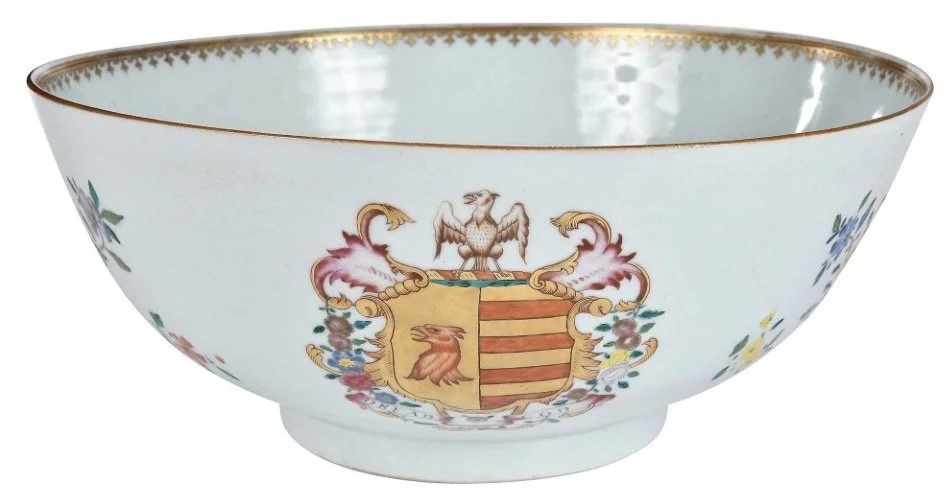 Image 2 of 10
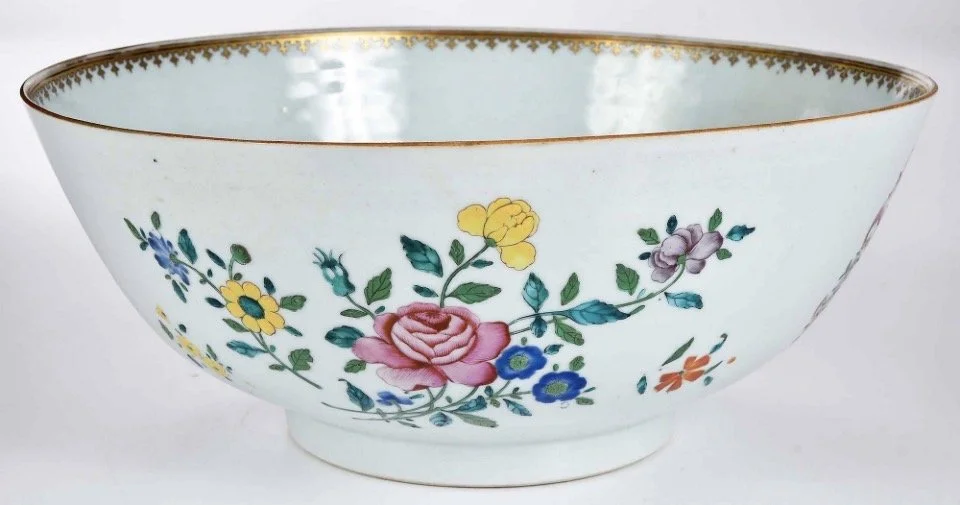 Image 3 of 10
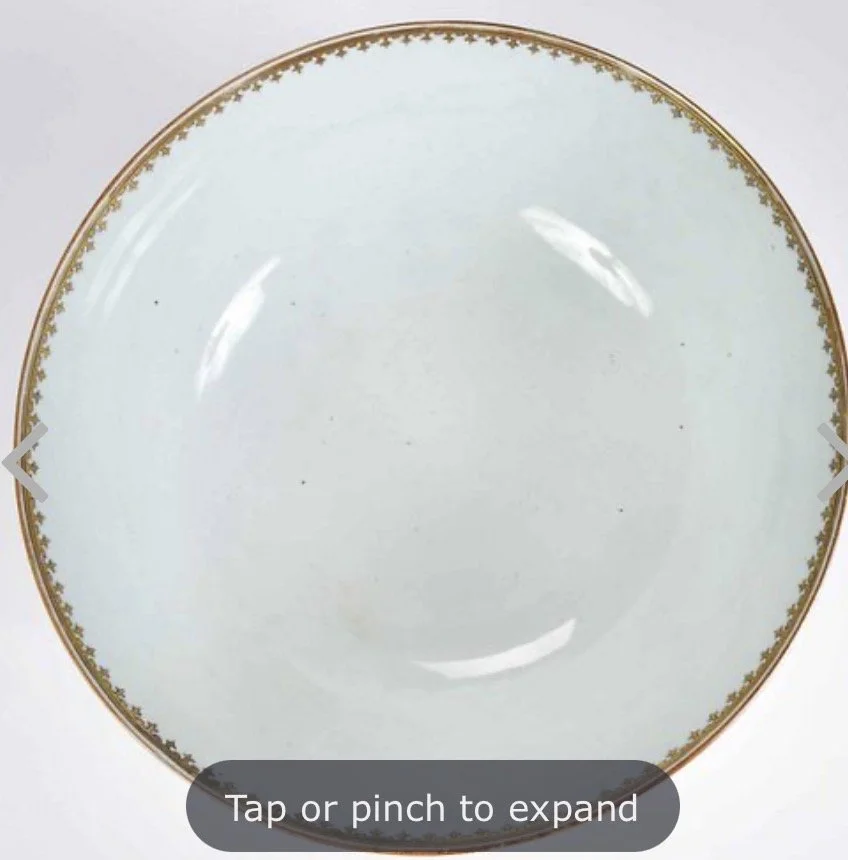 Image 4 of 10
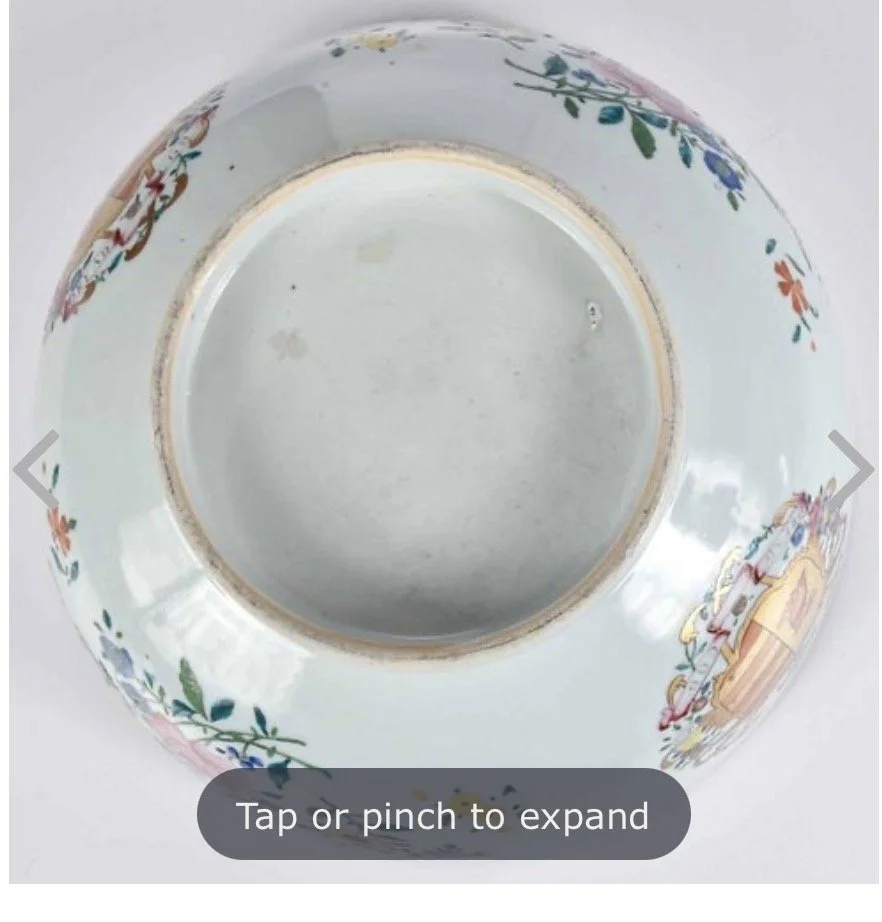 Image 5 of 10
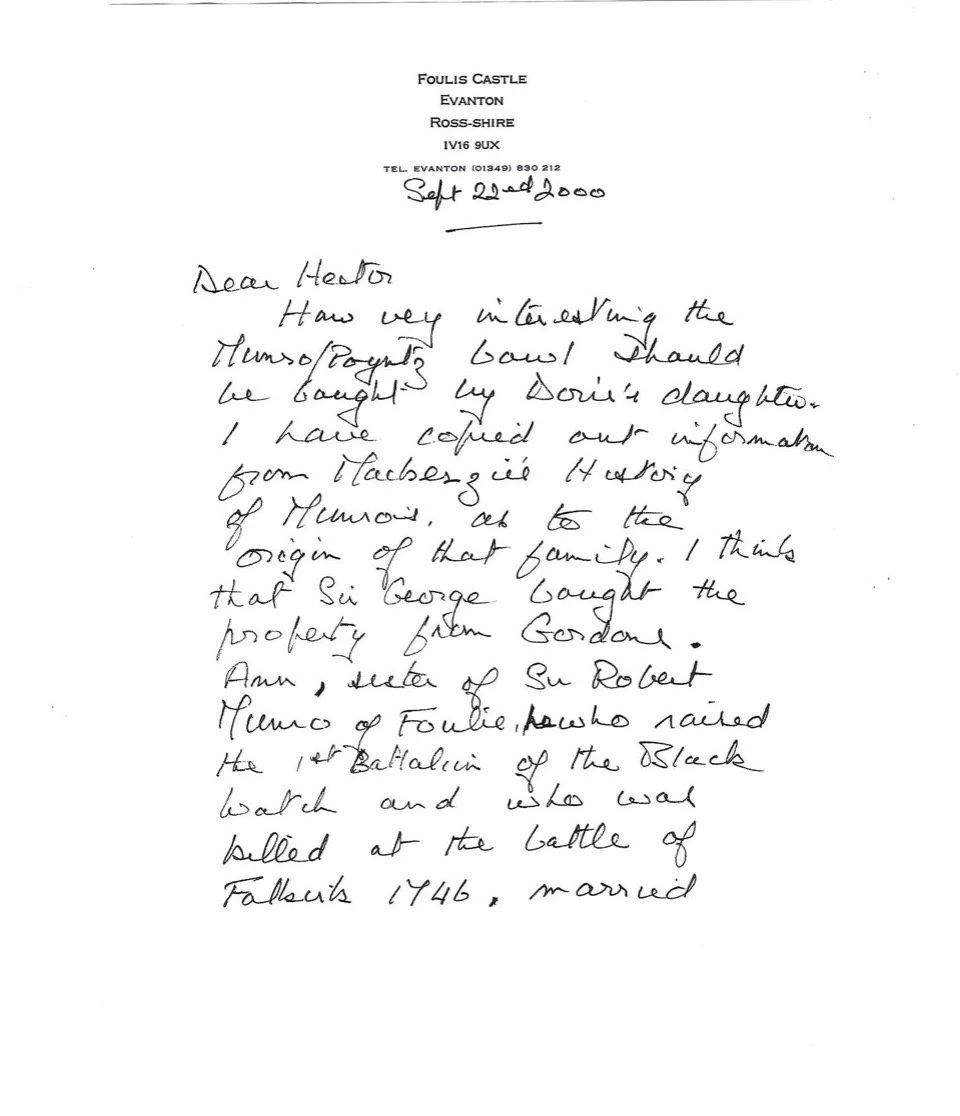 Image 6 of 10
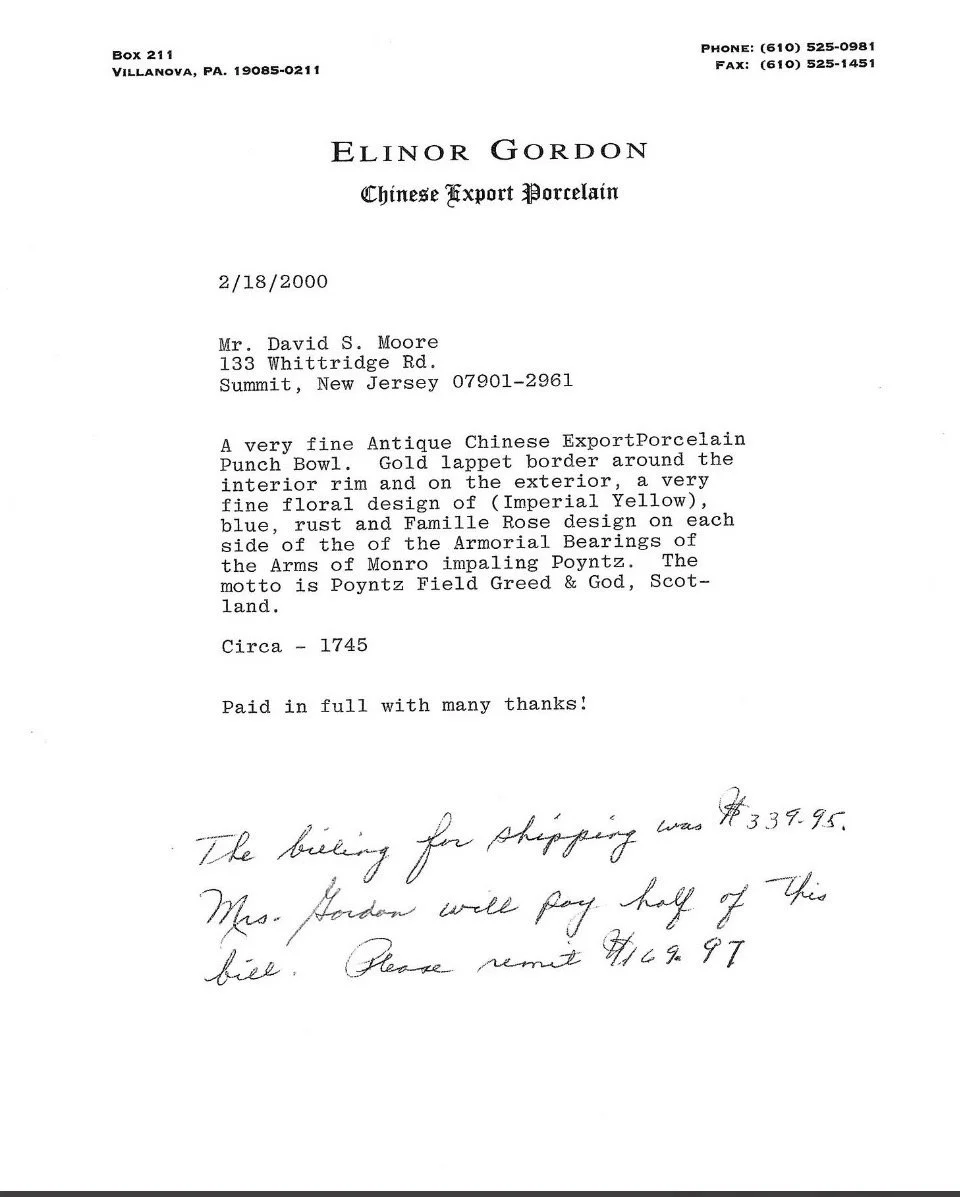 Image 7 of 10
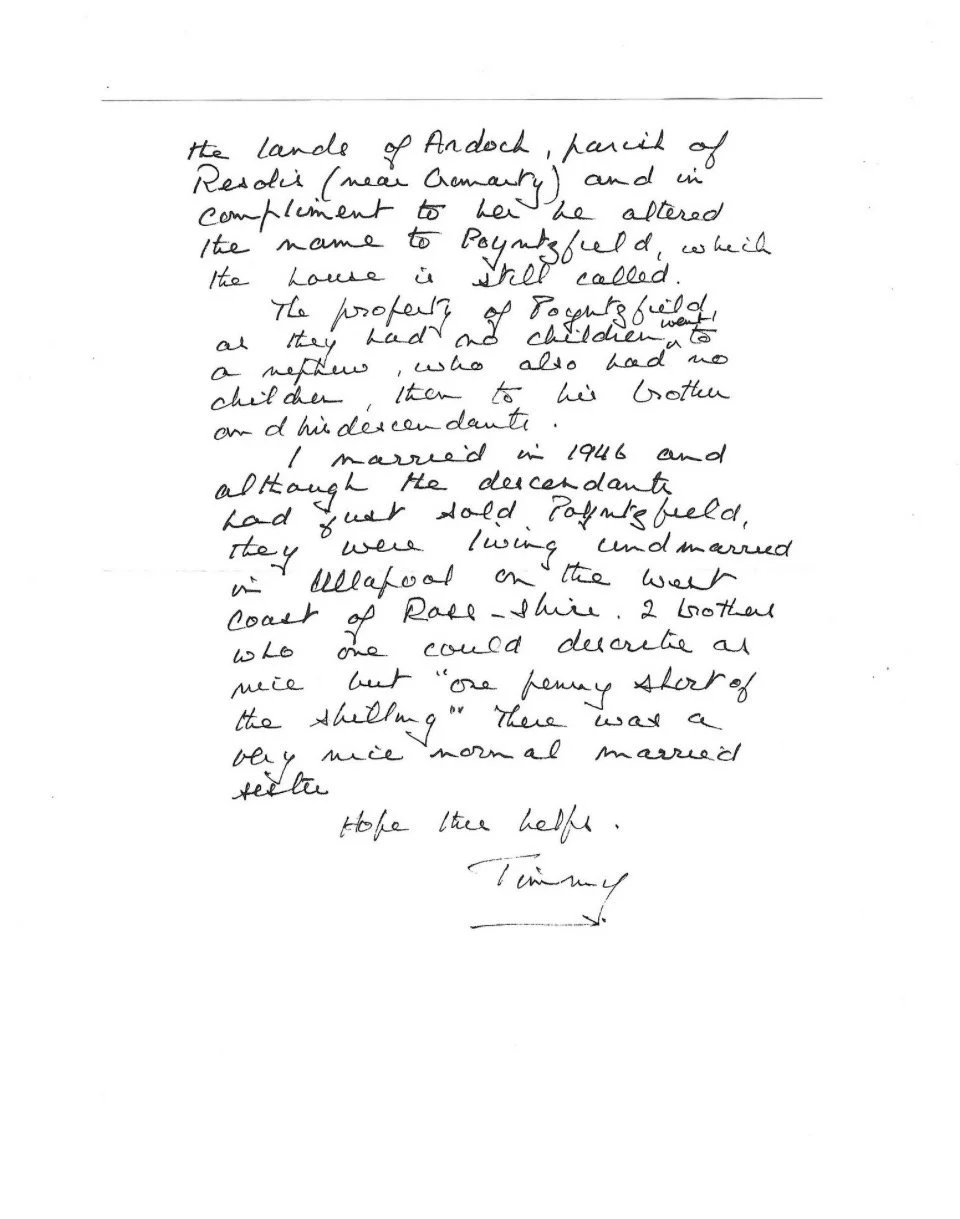 Image 8 of 10
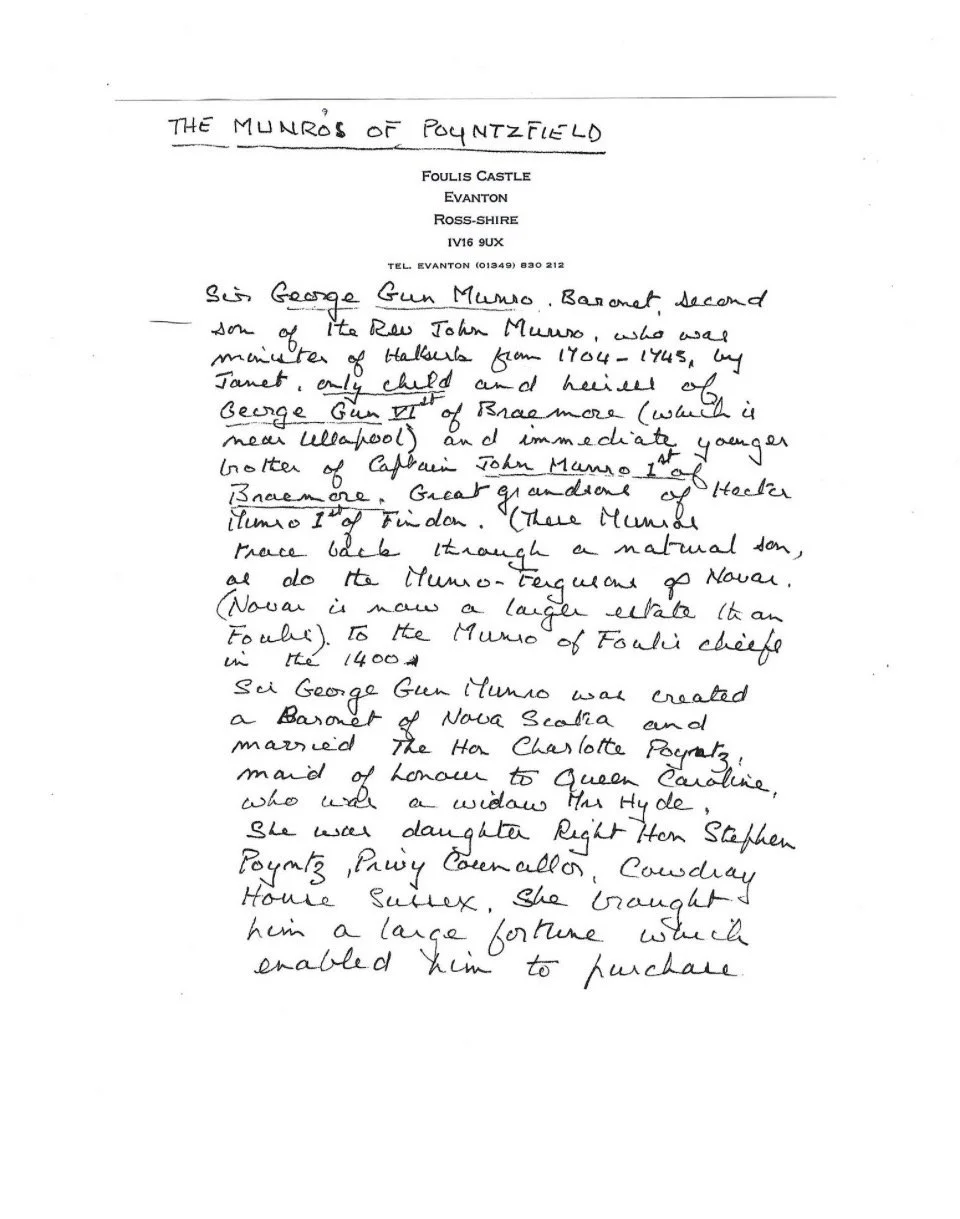 Image 9 of 10
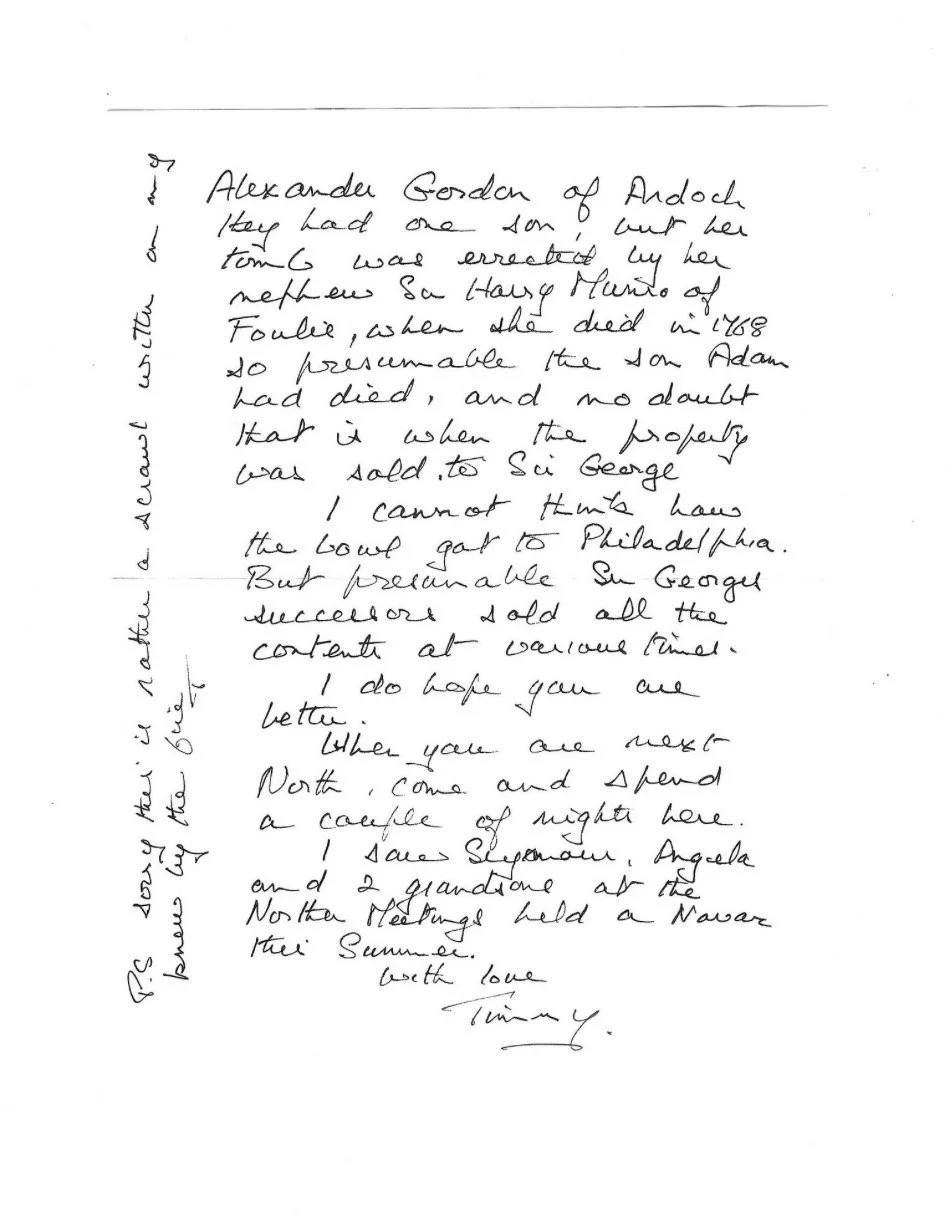 Image 10 of 10
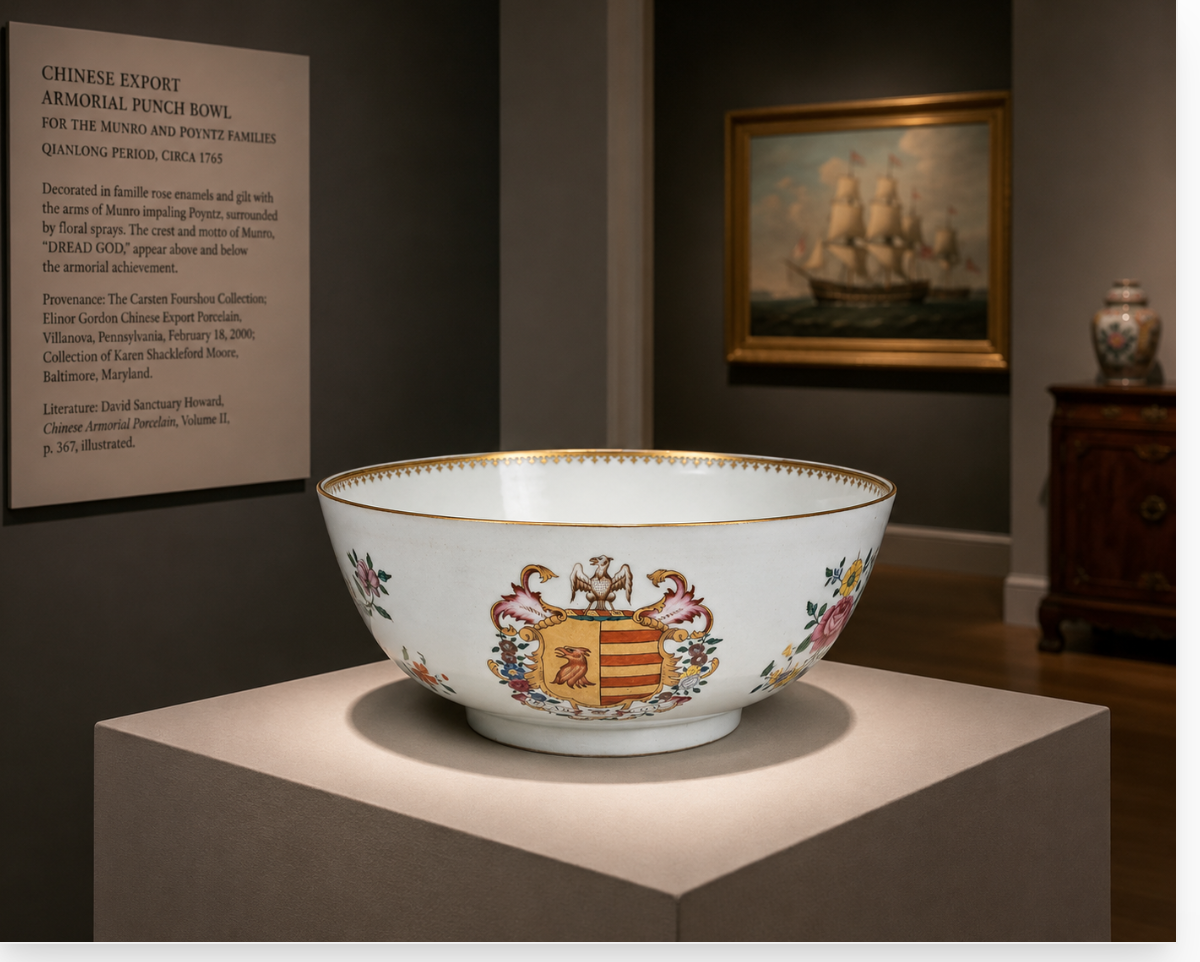
David Howard Illustrated Chinese Export Armorial Porcelain Bowl, Munro and Poyntz circa 1765.
A Published Chinese Export Armorial Punch Bowl for the Munro and Poyntz Families
Qing Dynasty, Qianlong Period, circa 1765
Chinese porcelain, decorated in famille rose enamels and gilt
Dimensions: 6 ⅞ in. high × approximately 13 ⅝–13 ⅞ in. diameter
Heraldry: Arms of Munro impaling Poyntz; Munro crest and motto, “DREAD GOD.”
Provenance:
The Carsten Fourshou Collection;
Elinor Gordon Chinese Export Porcelain, Villanova, Pennsylvania, acquired 18 February 2000, accompanied by the original receipt and dealer label;
Collection of Karen Shackleford Moore, Baltimore, Maryland.
Literature:
David Sanctuary Howard, Chinese Armorial Porcelain, Volume II, p. 367, illustrated.
Accompanied by:
Correspondence from Mrs. Eleanor “Timmy” Munro of Foulis, wife of the late Clan Chief Captain Patrick Munro and mother of the succeeding chief, Hector Munro of Foulis, discussing the history of the Munro family, Poyntzfield, and the family's historical connection with the Poyntz family.
AN OBJECT AT THE CROSSROADS OF CHINA, SCOTLAND, FAMILY HISTORY, AND THE MARITIME TRADE
This impressive Chinese export armorial punch bowl is a remarkable survival from the international world of eighteenth-century trade, collecting, genealogy, and aristocratic patronage. Made in China during the Qianlong period, circa 1765, the bowl was commissioned for a European family and decorated with the arms of Munro impaling Poyntz, commemorating the union of two historic families.
More than two and a half centuries after its manufacture, the bowl survives not only as a beautiful example of Chinese export porcelain but as an unusually well-documented historical object.
Its importance rests upon several interconnected elements: the identifiable heraldry; the historic Munro and Poyntz families; its publication by the distinguished scholar David Sanctuary Howard; its provenance through the noted Chinese export porcelain dealer and scholar Elinor Gordon; its history in named private collections; and, most unusually, the survival of correspondence from members of the Munro family discussing the genealogy represented by the arms.
Together, the bowl and its documentary archive illuminate a fascinating story extending from the kilns and decorating workshops of Qing-dynasty China to the country houses of Britain, the historic seat of the Munros of Foulis in Scotland, and the collecting world of twentieth-century America.
CHINESE EXPORT PORCELAIN AND THE EIGHTEENTH-CENTURY WORLD
During the eighteenth century, Chinese porcelain was among the most admired luxury commodities in Europe and America.
European aristocrats, wealthy merchants, military officers, maritime families, diplomats, and members of the landed gentry commissioned extensive porcelain services bearing their coats of arms.
The process required extraordinary coordination.
A European patron would provide a drawing, engraving, bookplate, seal impression, or painted representation of the family coat of arms. The design traveled thousands of miles by sea to China.
The porcelain itself was generally manufactured at Jingdezhen, the great center of Chinese porcelain production.
Pieces intended for the export market were transported southward to Guangzhou—historically known to Western merchants as Canton—where specialized workshops decorated porcelain according to the designs and instructions supplied by foreign merchants and patrons.
Chinese artists, working within a completely different artistic and cultural tradition, reproduced the complicated heraldic vocabulary of European coats of arms: shields, crests, coronets, supporters, mantling, mottoes, and insignia.
The decorated porcelain was then fired again before being shipped back to Europe aboard East India Company vessels and private merchant ships.
The entire process could require several years.
The resulting objects are remarkable documents of early globalization.
They combine Chinese materials and craftsmanship with European heraldry, genealogy, maritime commerce, and social history.
The present bowl belongs to this extraordinary artistic and commercial tradition.
THE FORM: AN ARMORIAL PUNCH BOWL
The considerable size and deep rounded form of the present vessel identify it as a punch bowl.
Punch bowls occupied an important place in eighteenth-century social culture.
Punch—usually prepared from spirits, citrus juice, sugar, water, and spices—was served communally at dinners, clubs, taverns, political gatherings, military celebrations, and private social occasions.
Large porcelain punch bowls could occupy the center of a dining table or sideboard.
When decorated with a family's coat of arms, such objects performed an additional function.
They became highly visible expressions of lineage, marriage, property, and social position.
The heraldic decoration of the present bowl would have immediately identified the family connection represented by the marriage of Munro and Poyntz.
Unlike individual plates from an extensive dinner service, the punch bowl was a monumental and highly visible object.
It was both functional and ceremonial.
THE PORCELAIN AND DECORATION
The bowl is made of finely potted Chinese porcelain with a luminous white ground characteristic of high-quality export porcelain produced during the Qianlong period.
The exterior is decorated with delicately painted European-style floral sprays.
Roses and other blossoms are rendered in the characteristic palette of famille rose enamels, including pink, yellow, blue, iron-red, green, and turquoise.
The asymmetrical placement of the flowers gives the decoration a light and graceful appearance.
Rather than overwhelming the porcelain surface with ornament, the Chinese decorators allowed large areas of the luminous white porcelain body to remain visible.
The result is a sophisticated visual balance between the floral decoration and the monumental heraldic achievement.
The delicacy of the floral sprays contrasts with the formality and symbolic importance of the coat of arms.
THE GILT SPEARHEAD BORDER
The interior rim is surrounded by an elegant gilt spearhead border.
This decorative device was frequently employed on high-quality Chinese export porcelain during the eighteenth century.
The repeating pointed forms create a continuous architectural rhythm around the circumference of the bowl.
Because the interior remains largely undecorated, the gilded border draws attention to the impressive scale and purity of the porcelain body.
The use of gold also reinforces the prestigious character of the commission.
THE HERALDRY: THE ARMS OF MUNRO IMPALING POYNTZ
The central historical feature of the bowl is the large heraldic achievement painted prominently on the exterior.
The shield displays the arms of Munro impaling Poyntz.
In European heraldry, impalement refers to the division of a shield vertically to display two coats of arms.
This arrangement was commonly used to commemorate marriage.
Traditionally, the husband's arms appear on the heraldic dexter side of the shield, while the wife's arms appear on the sinister side.
The present bowl therefore records a marriage alliance between members of the Munro and Poyntz families.
The shield is surrounded by elaborate rococo mantling painted in famille rose enamels and enriched with gilding.
Above the shield appears the Munro crest.
The crest takes the form of an eagle.
Below the armorial achievement appears the historic Munro motto:
DREAD GOD
The motto has long been associated with the Munros of Foulis.
The heraldry transforms the bowl from a decorative porcelain vessel into a genealogical document.
It records family identity, ancestry, marriage, alliance, property, and social status.
THE MUNROS OF FOULIS
The Munros of Foulis are one of the historic families of the Scottish Highlands.
For centuries, the chiefs of Clan Munro have been associated with Foulis Castle in Ross-shire, Scotland.
The history of the Munros includes military service, land ownership, political activity, and connections through marriage to numerous British families.
The survival of correspondence from Mrs. Eleanor “Timmy” Munro of Foulis gives the present bowl an unusual documentary dimension.
The letters were written from Foulis Castle and discuss the history of the Munro family and its relationship with the Poyntz family.
Mrs. Munro was the wife of Captain Patrick Munro of Foulis and mother of Hector Munro of Foulis.
Her correspondence provides a twentieth-century connection between the porcelain and descendants of the family whose history is represented by the heraldry.
SIR GEORGE GUN MUNRO AND THE POYNTZ FAMILY
The accompanying correspondence discusses Sir George Gun Munro, second son of the Reverend John Munro.
According to the family account contained in the correspondence, Sir George married Charlotte Poyntz.
The marriage provides the genealogical foundation for the combined Munro and Poyntz arms displayed on the bowl.
The letters describe the relationship between the Munro family and the Poyntz family and discuss the descent of property associated with the family.
They refer specifically to the estate later known as Poyntzfield.
The correspondence indicates that the property's name reflected the family's connection with the Poyntz family.
The survival of these letters is particularly significant.
Many Chinese armorial porcelains have become separated from the families for whom they were originally commissioned.
Over generations, dinner services were dispersed, individual objects entered the art market, and the historical identities represented by their heraldry were forgotten.
In the case of the present bowl, however, the heraldic identity has been preserved through scholarship and further illuminated through correspondence with members of the historic Munro family.
POYNTZFIELD AND THE FAMILY HISTORY
The letters from Mrs. Munro provide an account of the descent of the estate known as Poyntzfield.
According to the correspondence, family property passed through various descendants of the Munro and Poyntz families.
The letters discuss marriages, inheritances, and the transmission of the estate through several generations.
Mrs. Munro also refers to research conducted through Mackenzie's History of the Munros, demonstrating an attempt to reconstruct the historical relationship between the families.
This documentation provides an important interpretive context for the bowl.
The heraldry painted on the porcelain was not merely decorative.
It represented real people, marriages, landholdings, inheritances, and family alliances.
The bowl therefore survives as material evidence of an eighteenth-century family network extending across generations.
DAVID SANCTUARY HOWARD AND THE SCHOLARLY RECORD
The most important published reference for the present bowl is its inclusion in the monumental scholarship of David Sanctuary Howard.
Howard was the leading twentieth-century authority on Chinese armorial porcelain.
His extensive research attempted to identify the European and American families who commissioned Chinese porcelain services bearing coats of arms.
Through the study of surviving porcelain, heraldry, genealogical records, family archives, auction catalogues, and private collections, Howard documented thousands of armorial services.
The present Munro-Poyntz bowl is illustrated in:
David Sanctuary Howard, Chinese Armorial Porcelain, Volume II, p. 367.
Publication in Howard's standard reference work is an important element of the bowl's scholarly history.
It provides an established reference for the identification of the heraldry and places the bowl within the broader history of Chinese armorial porcelain.
For collectors, museums, scholars, and dealers, published provenance and scholarly references significantly enhance the historical importance of an object.
The bowl is therefore not merely attributed to an armorial service through modern market scholarship.
It is a published example within the principal scholarly literature devoted to Chinese armorial porcelain.
ELINOR GORDON: SCHOLAR, DEALER, AND CONNOISSEUR
The provenance of the bowl through Elinor Gordon Chinese Export Porcelain represents another important chapter in its collecting history.
Elinor Gordon was among the leading American dealers and authorities specializing in Chinese export porcelain during the twentieth century.
Operating from Villanova, Pennsylvania, Gordon helped develop the appreciation and scholarly understanding of Chinese export porcelain among American collectors and museums.
Her career extended for approximately half a century.
Through her scholarship, exhibitions, publications, and dealership, she contributed significantly to the formation of important private and institutional collections.
Gordon was also the author of Collecting Chinese Export Porcelain, an influential introductory reference for collectors.
Objects handled by her entered major museum collections.
Her business records and archival material are preserved at Winterthur Museum, Garden and Library, reflecting her importance to the history of the American market for Chinese export porcelain.
The present bowl was acquired from Elinor Gordon on 18 February 2000.
The original invoice survives.
It describes the object as:
“A very fine Antique Chinese Export Porcelain Punch Bowl.”
The invoice records the gold border, famille rose floral decoration, arms of Munro impaling Poyntz, and the motto associated with the family.
The survival of the original dealer invoice and label provides valuable documentary provenance.
The invoice dates the bowl circa 1745, whereas the Howard-based cataloguing and later descriptions date the service circa 1765. This discrepancy should be preserved in the object archive rather than concealed. The bowl may appropriately be catalogued circa 1765 when following Howard's published reference, while the earlier Gordon attribution should remain recorded in the provenance documentation.
THE CARSTEN FOURSHOU COLLECTION
The earliest named modern collection associated with the bowl is the Carsten Fourshou Collection.
The identification of named collectors in an object's provenance is important because it allows the history of ownership and collecting to be reconstructed.
At present, further biographical claims regarding Carsten Fourshou should not be made without additional documentary research.
Nevertheless, the documented provenance should be preserved precisely as recorded:
The Carsten Fourshou Collection
followed by:
Elinor Gordon Chinese Export Porcelain
and subsequently:
The Collection of Karen Shackleford Moore.
THE COLLECTION OF KAREN SHACKLEFORD MOORE
The bowl later formed part of the collection of Karen Shackleford Moore of Baltimore, Maryland.
Particularly important is the preservation of the documentation accompanying the object.
The Gordon invoice and dealer label, Howard publication reference, collection history, and correspondence from the Munro family appear to have remained associated with the bowl.
This documentary archive significantly strengthens the historical character of the object.
The careful preservation of provenance documents is especially important for Chinese armorial porcelain because the historical meaning of such objects depends heavily upon the identification of the families represented by their heraldry.
THE ACCOMPANYING MUNRO FAMILY CORRESPONDENCE
Among the most unusual and historically engaging aspects of the present bowl is the survival of letters from Mrs. Eleanor “Timmy” Munro of Foulis.
The correspondence discusses the genealogy of the Munro and Poyntz families and the history of Poyntzfield.
The letters mention Sir George Gun Munro, Charlotte Poyntz, the Munros of Foulis, family marriages, inheritances, and the descent of property.
The correspondence appears to have been written in response to an inquiry regarding the history of the armorial porcelain.
These letters are valuable because they demonstrate the continuing historical interest of the family in understanding the genealogy represented by the bowl.
They create a bridge between an eighteenth-century Chinese export porcelain commission and twentieth-century descendants of the family whose history is recorded by its heraldry.
The letters should remain permanently associated with the bowl.
Together, the porcelain and documentary material constitute what might appropriately be called an object archive.
MUSEUM CONTEXT
Chinese export porcelain occupies an important position in major museum collections because it documents the extraordinary cultural and commercial exchanges that developed between China and the Western world.
Important collections of Chinese export porcelain are preserved by institutions including Peabody Essex Museum, Winterthur Museum, Garden and Library, The Metropolitan Museum of Art, and Victoria and Albert Museum.
The Peabody Essex Museum is especially important in the study of maritime trade between China and the Western world.
Winterthur preserves extensive collections and archival resources relating to American decorative arts, collecting history, and Chinese export porcelain.
The Metropolitan Museum of Art has published important scholarship concerning Chinese export porcelain and the history of the China trade.
The Victoria and Albert Museum preserves extensive collections of Chinese porcelain made for European markets.
The present bowl may appropriately be discussed within this broader museum context.
However, no claim should be made that the Munro-Poyntz bowl itself was exhibited at any of these institutions unless documentary evidence confirming such an exhibition is located.
EXHIBITION HISTORY
At present, no specific historic museum exhibition for the bowl has been documented in the surviving material described here.
Its known scholarly and collecting history is instead distinguished by:
its publication in David Sanctuary Howard's Chinese Armorial Porcelain, Volume II;
its provenance through Elinor Gordon;
its history in named private collections;
and the survival of correspondence from members of the Munro family.
For H&S Fine Art & Antiques, the bowl can therefore be presented as a published and documented Chinese export armorial porcelain object, rather than as an object with an unverified museum exhibition history.
SELECTED LITERATURE AND REFERENCES
David Sanctuary Howard, Chinese Armorial Porcelain, London, 1974.
David Sanctuary Howard, Chinese Armorial Porcelain, Volume II, Chippenham, 2003, p. 367, illustrated.
David Sanctuary Howard and John Ayers, China for the West: Chinese Porcelain and Other Decorative Arts for Export Illustrated from the Mottahedeh Collection, London and New York, 1978.
Elinor Gordon, Collecting Chinese Export Porcelain, New York, 1977.
Clare Le Corbeiller, China Trade Porcelain: Patterns of Exchange, The Metropolitan Museum of Art, New York, 1974.
Mackenzie's History of the Munros, referenced in the accompanying correspondence from Mrs. Eleanor “Timmy” Munro of Foulis.
CONCLUSION: A DOCUMENTED SURVIVAL OF THE EIGHTEENTH-CENTURY CHINA TRADE
The Munro-Poyntz armorial punch bowl is an exceptional historical object whose significance extends far beyond its decorative beauty.
Made in China during the Qianlong period for a Western patron, the bowl embodies the extraordinary international networks of commerce and artistic production that connected China with Europe during the eighteenth century.
Its porcelain body represents the technical sophistication of Chinese ceramic production.
Its famille rose floral decoration reflects the skill of Chinese artists working for Western export markets.
Its heraldry records the marriage alliance between the Munro and Poyntz families.
Its motto, “DREAD GOD,” connects the object with the historic identity of the Munros of Foulis.
Its publication by David Sanctuary Howard places the bowl within the established scholarly literature of Chinese armorial porcelain.
Its provenance through Elinor Gordon connects it with one of the most influential American scholars and dealers in the field.
The survival of Gordon's original invoice and label provides valuable documentary provenance.
The named private collections of Carsten Fourshou and Karen Shackleford Moore further establish its modern collecting history.
Most unusually, the letters from Mrs. Eleanor “Timmy” Munro of Foulis provide a direct documentary connection to the family history represented by the heraldry.
Together, the bowl and its archive tell a story spanning approximately 260 years.
It is a story of Chinese craftsmanship, maritime trade, Scottish clan history, marriage and inheritance, heraldry, scholarship, connoisseurship, and collecting.
The bowl survives not merely as an impressive example of Chinese export porcelain, but as a material document of the interconnected eighteenth-century world.
H&S FINE ART & ANTIQUES
Where Simplicity meets elegance.
Every piece has a story.
A Published Chinese Export Armorial Punch Bowl for the Munro and Poyntz Families
Qing Dynasty, Qianlong Period, circa 1765
Chinese porcelain, decorated in famille rose enamels and gilt
Dimensions: 6 ⅞ in. high × approximately 13 ⅝–13 ⅞ in. diameter
Heraldry: Arms of Munro impaling Poyntz; Munro crest and motto, “DREAD GOD.”
Provenance:
The Carsten Fourshou Collection;
Elinor Gordon Chinese Export Porcelain, Villanova, Pennsylvania, acquired 18 February 2000, accompanied by the original receipt and dealer label;
Collection of Karen Shackleford Moore, Baltimore, Maryland.
Literature:
David Sanctuary Howard, Chinese Armorial Porcelain, Volume II, p. 367, illustrated.
Accompanied by:
Correspondence from Mrs. Eleanor “Timmy” Munro of Foulis, wife of the late Clan Chief Captain Patrick Munro and mother of the succeeding chief, Hector Munro of Foulis, discussing the history of the Munro family, Poyntzfield, and the family's historical connection with the Poyntz family.
AN OBJECT AT THE CROSSROADS OF CHINA, SCOTLAND, FAMILY HISTORY, AND THE MARITIME TRADE
This impressive Chinese export armorial punch bowl is a remarkable survival from the international world of eighteenth-century trade, collecting, genealogy, and aristocratic patronage. Made in China during the Qianlong period, circa 1765, the bowl was commissioned for a European family and decorated with the arms of Munro impaling Poyntz, commemorating the union of two historic families.
More than two and a half centuries after its manufacture, the bowl survives not only as a beautiful example of Chinese export porcelain but as an unusually well-documented historical object.
Its importance rests upon several interconnected elements: the identifiable heraldry; the historic Munro and Poyntz families; its publication by the distinguished scholar David Sanctuary Howard; its provenance through the noted Chinese export porcelain dealer and scholar Elinor Gordon; its history in named private collections; and, most unusually, the survival of correspondence from members of the Munro family discussing the genealogy represented by the arms.
Together, the bowl and its documentary archive illuminate a fascinating story extending from the kilns and decorating workshops of Qing-dynasty China to the country houses of Britain, the historic seat of the Munros of Foulis in Scotland, and the collecting world of twentieth-century America.
CHINESE EXPORT PORCELAIN AND THE EIGHTEENTH-CENTURY WORLD
During the eighteenth century, Chinese porcelain was among the most admired luxury commodities in Europe and America.
European aristocrats, wealthy merchants, military officers, maritime families, diplomats, and members of the landed gentry commissioned extensive porcelain services bearing their coats of arms.
The process required extraordinary coordination.
A European patron would provide a drawing, engraving, bookplate, seal impression, or painted representation of the family coat of arms. The design traveled thousands of miles by sea to China.
The porcelain itself was generally manufactured at Jingdezhen, the great center of Chinese porcelain production.
Pieces intended for the export market were transported southward to Guangzhou—historically known to Western merchants as Canton—where specialized workshops decorated porcelain according to the designs and instructions supplied by foreign merchants and patrons.
Chinese artists, working within a completely different artistic and cultural tradition, reproduced the complicated heraldic vocabulary of European coats of arms: shields, crests, coronets, supporters, mantling, mottoes, and insignia.
The decorated porcelain was then fired again before being shipped back to Europe aboard East India Company vessels and private merchant ships.
The entire process could require several years.
The resulting objects are remarkable documents of early globalization.
They combine Chinese materials and craftsmanship with European heraldry, genealogy, maritime commerce, and social history.
The present bowl belongs to this extraordinary artistic and commercial tradition.
THE FORM: AN ARMORIAL PUNCH BOWL
The considerable size and deep rounded form of the present vessel identify it as a punch bowl.
Punch bowls occupied an important place in eighteenth-century social culture.
Punch—usually prepared from spirits, citrus juice, sugar, water, and spices—was served communally at dinners, clubs, taverns, political gatherings, military celebrations, and private social occasions.
Large porcelain punch bowls could occupy the center of a dining table or sideboard.
When decorated with a family's coat of arms, such objects performed an additional function.
They became highly visible expressions of lineage, marriage, property, and social position.
The heraldic decoration of the present bowl would have immediately identified the family connection represented by the marriage of Munro and Poyntz.
Unlike individual plates from an extensive dinner service, the punch bowl was a monumental and highly visible object.
It was both functional and ceremonial.
THE PORCELAIN AND DECORATION
The bowl is made of finely potted Chinese porcelain with a luminous white ground characteristic of high-quality export porcelain produced during the Qianlong period.
The exterior is decorated with delicately painted European-style floral sprays.
Roses and other blossoms are rendered in the characteristic palette of famille rose enamels, including pink, yellow, blue, iron-red, green, and turquoise.
The asymmetrical placement of the flowers gives the decoration a light and graceful appearance.
Rather than overwhelming the porcelain surface with ornament, the Chinese decorators allowed large areas of the luminous white porcelain body to remain visible.
The result is a sophisticated visual balance between the floral decoration and the monumental heraldic achievement.
The delicacy of the floral sprays contrasts with the formality and symbolic importance of the coat of arms.
THE GILT SPEARHEAD BORDER
The interior rim is surrounded by an elegant gilt spearhead border.
This decorative device was frequently employed on high-quality Chinese export porcelain during the eighteenth century.
The repeating pointed forms create a continuous architectural rhythm around the circumference of the bowl.
Because the interior remains largely undecorated, the gilded border draws attention to the impressive scale and purity of the porcelain body.
The use of gold also reinforces the prestigious character of the commission.
THE HERALDRY: THE ARMS OF MUNRO IMPALING POYNTZ
The central historical feature of the bowl is the large heraldic achievement painted prominently on the exterior.
The shield displays the arms of Munro impaling Poyntz.
In European heraldry, impalement refers to the division of a shield vertically to display two coats of arms.
This arrangement was commonly used to commemorate marriage.
Traditionally, the husband's arms appear on the heraldic dexter side of the shield, while the wife's arms appear on the sinister side.
The present bowl therefore records a marriage alliance between members of the Munro and Poyntz families.
The shield is surrounded by elaborate rococo mantling painted in famille rose enamels and enriched with gilding.
Above the shield appears the Munro crest.
The crest takes the form of an eagle.
Below the armorial achievement appears the historic Munro motto:
DREAD GOD
The motto has long been associated with the Munros of Foulis.
The heraldry transforms the bowl from a decorative porcelain vessel into a genealogical document.
It records family identity, ancestry, marriage, alliance, property, and social status.
THE MUNROS OF FOULIS
The Munros of Foulis are one of the historic families of the Scottish Highlands.
For centuries, the chiefs of Clan Munro have been associated with Foulis Castle in Ross-shire, Scotland.
The history of the Munros includes military service, land ownership, political activity, and connections through marriage to numerous British families.
The survival of correspondence from Mrs. Eleanor “Timmy” Munro of Foulis gives the present bowl an unusual documentary dimension.
The letters were written from Foulis Castle and discuss the history of the Munro family and its relationship with the Poyntz family.
Mrs. Munro was the wife of Captain Patrick Munro of Foulis and mother of Hector Munro of Foulis.
Her correspondence provides a twentieth-century connection between the porcelain and descendants of the family whose history is represented by the heraldry.
SIR GEORGE GUN MUNRO AND THE POYNTZ FAMILY
The accompanying correspondence discusses Sir George Gun Munro, second son of the Reverend John Munro.
According to the family account contained in the correspondence, Sir George married Charlotte Poyntz.
The marriage provides the genealogical foundation for the combined Munro and Poyntz arms displayed on the bowl.
The letters describe the relationship between the Munro family and the Poyntz family and discuss the descent of property associated with the family.
They refer specifically to the estate later known as Poyntzfield.
The correspondence indicates that the property's name reflected the family's connection with the Poyntz family.
The survival of these letters is particularly significant.
Many Chinese armorial porcelains have become separated from the families for whom they were originally commissioned.
Over generations, dinner services were dispersed, individual objects entered the art market, and the historical identities represented by their heraldry were forgotten.
In the case of the present bowl, however, the heraldic identity has been preserved through scholarship and further illuminated through correspondence with members of the historic Munro family.
POYNTZFIELD AND THE FAMILY HISTORY
The letters from Mrs. Munro provide an account of the descent of the estate known as Poyntzfield.
According to the correspondence, family property passed through various descendants of the Munro and Poyntz families.
The letters discuss marriages, inheritances, and the transmission of the estate through several generations.
Mrs. Munro also refers to research conducted through Mackenzie's History of the Munros, demonstrating an attempt to reconstruct the historical relationship between the families.
This documentation provides an important interpretive context for the bowl.
The heraldry painted on the porcelain was not merely decorative.
It represented real people, marriages, landholdings, inheritances, and family alliances.
The bowl therefore survives as material evidence of an eighteenth-century family network extending across generations.
DAVID SANCTUARY HOWARD AND THE SCHOLARLY RECORD
The most important published reference for the present bowl is its inclusion in the monumental scholarship of David Sanctuary Howard.
Howard was the leading twentieth-century authority on Chinese armorial porcelain.
His extensive research attempted to identify the European and American families who commissioned Chinese porcelain services bearing coats of arms.
Through the study of surviving porcelain, heraldry, genealogical records, family archives, auction catalogues, and private collections, Howard documented thousands of armorial services.
The present Munro-Poyntz bowl is illustrated in:
David Sanctuary Howard, Chinese Armorial Porcelain, Volume II, p. 367.
Publication in Howard's standard reference work is an important element of the bowl's scholarly history.
It provides an established reference for the identification of the heraldry and places the bowl within the broader history of Chinese armorial porcelain.
For collectors, museums, scholars, and dealers, published provenance and scholarly references significantly enhance the historical importance of an object.
The bowl is therefore not merely attributed to an armorial service through modern market scholarship.
It is a published example within the principal scholarly literature devoted to Chinese armorial porcelain.
ELINOR GORDON: SCHOLAR, DEALER, AND CONNOISSEUR
The provenance of the bowl through Elinor Gordon Chinese Export Porcelain represents another important chapter in its collecting history.
Elinor Gordon was among the leading American dealers and authorities specializing in Chinese export porcelain during the twentieth century.
Operating from Villanova, Pennsylvania, Gordon helped develop the appreciation and scholarly understanding of Chinese export porcelain among American collectors and museums.
Her career extended for approximately half a century.
Through her scholarship, exhibitions, publications, and dealership, she contributed significantly to the formation of important private and institutional collections.
Gordon was also the author of Collecting Chinese Export Porcelain, an influential introductory reference for collectors.
Objects handled by her entered major museum collections.
Her business records and archival material are preserved at Winterthur Museum, Garden and Library, reflecting her importance to the history of the American market for Chinese export porcelain.
The present bowl was acquired from Elinor Gordon on 18 February 2000.
The original invoice survives.
It describes the object as:
“A very fine Antique Chinese Export Porcelain Punch Bowl.”
The invoice records the gold border, famille rose floral decoration, arms of Munro impaling Poyntz, and the motto associated with the family.
The survival of the original dealer invoice and label provides valuable documentary provenance.
The invoice dates the bowl circa 1745, whereas the Howard-based cataloguing and later descriptions date the service circa 1765. This discrepancy should be preserved in the object archive rather than concealed. The bowl may appropriately be catalogued circa 1765 when following Howard's published reference, while the earlier Gordon attribution should remain recorded in the provenance documentation.
THE CARSTEN FOURSHOU COLLECTION
The earliest named modern collection associated with the bowl is the Carsten Fourshou Collection.
The identification of named collectors in an object's provenance is important because it allows the history of ownership and collecting to be reconstructed.
At present, further biographical claims regarding Carsten Fourshou should not be made without additional documentary research.
Nevertheless, the documented provenance should be preserved precisely as recorded:
The Carsten Fourshou Collection
followed by:
Elinor Gordon Chinese Export Porcelain
and subsequently:
The Collection of Karen Shackleford Moore.
THE COLLECTION OF KAREN SHACKLEFORD MOORE
The bowl later formed part of the collection of Karen Shackleford Moore of Baltimore, Maryland.
Particularly important is the preservation of the documentation accompanying the object.
The Gordon invoice and dealer label, Howard publication reference, collection history, and correspondence from the Munro family appear to have remained associated with the bowl.
This documentary archive significantly strengthens the historical character of the object.
The careful preservation of provenance documents is especially important for Chinese armorial porcelain because the historical meaning of such objects depends heavily upon the identification of the families represented by their heraldry.
THE ACCOMPANYING MUNRO FAMILY CORRESPONDENCE
Among the most unusual and historically engaging aspects of the present bowl is the survival of letters from Mrs. Eleanor “Timmy” Munro of Foulis.
The correspondence discusses the genealogy of the Munro and Poyntz families and the history of Poyntzfield.
The letters mention Sir George Gun Munro, Charlotte Poyntz, the Munros of Foulis, family marriages, inheritances, and the descent of property.
The correspondence appears to have been written in response to an inquiry regarding the history of the armorial porcelain.
These letters are valuable because they demonstrate the continuing historical interest of the family in understanding the genealogy represented by the bowl.
They create a bridge between an eighteenth-century Chinese export porcelain commission and twentieth-century descendants of the family whose history is recorded by its heraldry.
The letters should remain permanently associated with the bowl.
Together, the porcelain and documentary material constitute what might appropriately be called an object archive.
MUSEUM CONTEXT
Chinese export porcelain occupies an important position in major museum collections because it documents the extraordinary cultural and commercial exchanges that developed between China and the Western world.
Important collections of Chinese export porcelain are preserved by institutions including Peabody Essex Museum, Winterthur Museum, Garden and Library, The Metropolitan Museum of Art, and Victoria and Albert Museum.
The Peabody Essex Museum is especially important in the study of maritime trade between China and the Western world.
Winterthur preserves extensive collections and archival resources relating to American decorative arts, collecting history, and Chinese export porcelain.
The Metropolitan Museum of Art has published important scholarship concerning Chinese export porcelain and the history of the China trade.
The Victoria and Albert Museum preserves extensive collections of Chinese porcelain made for European markets.
The present bowl may appropriately be discussed within this broader museum context.
However, no claim should be made that the Munro-Poyntz bowl itself was exhibited at any of these institutions unless documentary evidence confirming such an exhibition is located.
EXHIBITION HISTORY
At present, no specific historic museum exhibition for the bowl has been documented in the surviving material described here.
Its known scholarly and collecting history is instead distinguished by:
its publication in David Sanctuary Howard's Chinese Armorial Porcelain, Volume II;
its provenance through Elinor Gordon;
its history in named private collections;
and the survival of correspondence from members of the Munro family.
For H&S Fine Art & Antiques, the bowl can therefore be presented as a published and documented Chinese export armorial porcelain object, rather than as an object with an unverified museum exhibition history.
SELECTED LITERATURE AND REFERENCES
David Sanctuary Howard, Chinese Armorial Porcelain, London, 1974.
David Sanctuary Howard, Chinese Armorial Porcelain, Volume II, Chippenham, 2003, p. 367, illustrated.
David Sanctuary Howard and John Ayers, China for the West: Chinese Porcelain and Other Decorative Arts for Export Illustrated from the Mottahedeh Collection, London and New York, 1978.
Elinor Gordon, Collecting Chinese Export Porcelain, New York, 1977.
Clare Le Corbeiller, China Trade Porcelain: Patterns of Exchange, The Metropolitan Museum of Art, New York, 1974.
Mackenzie's History of the Munros, referenced in the accompanying correspondence from Mrs. Eleanor “Timmy” Munro of Foulis.
CONCLUSION: A DOCUMENTED SURVIVAL OF THE EIGHTEENTH-CENTURY CHINA TRADE
The Munro-Poyntz armorial punch bowl is an exceptional historical object whose significance extends far beyond its decorative beauty.
Made in China during the Qianlong period for a Western patron, the bowl embodies the extraordinary international networks of commerce and artistic production that connected China with Europe during the eighteenth century.
Its porcelain body represents the technical sophistication of Chinese ceramic production.
Its famille rose floral decoration reflects the skill of Chinese artists working for Western export markets.
Its heraldry records the marriage alliance between the Munro and Poyntz families.
Its motto, “DREAD GOD,” connects the object with the historic identity of the Munros of Foulis.
Its publication by David Sanctuary Howard places the bowl within the established scholarly literature of Chinese armorial porcelain.
Its provenance through Elinor Gordon connects it with one of the most influential American scholars and dealers in the field.
The survival of Gordon's original invoice and label provides valuable documentary provenance.
The named private collections of Carsten Fourshou and Karen Shackleford Moore further establish its modern collecting history.
Most unusually, the letters from Mrs. Eleanor “Timmy” Munro of Foulis provide a direct documentary connection to the family history represented by the heraldry.
Together, the bowl and its archive tell a story spanning approximately 260 years.
It is a story of Chinese craftsmanship, maritime trade, Scottish clan history, marriage and inheritance, heraldry, scholarship, connoisseurship, and collecting.
The bowl survives not merely as an impressive example of Chinese export porcelain, but as a material document of the interconnected eighteenth-century world.