 Image 1 of 3
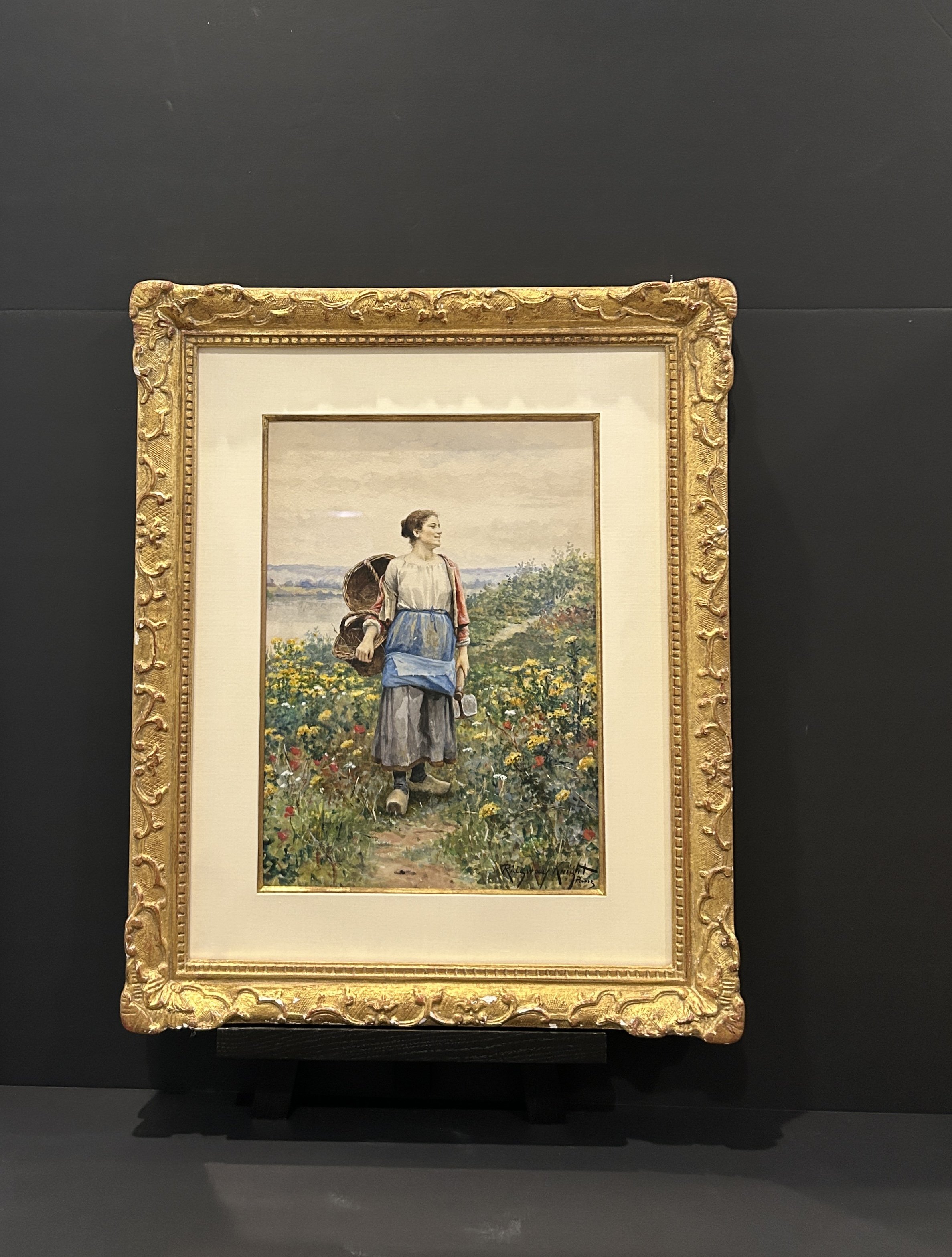 Image 2 of 3
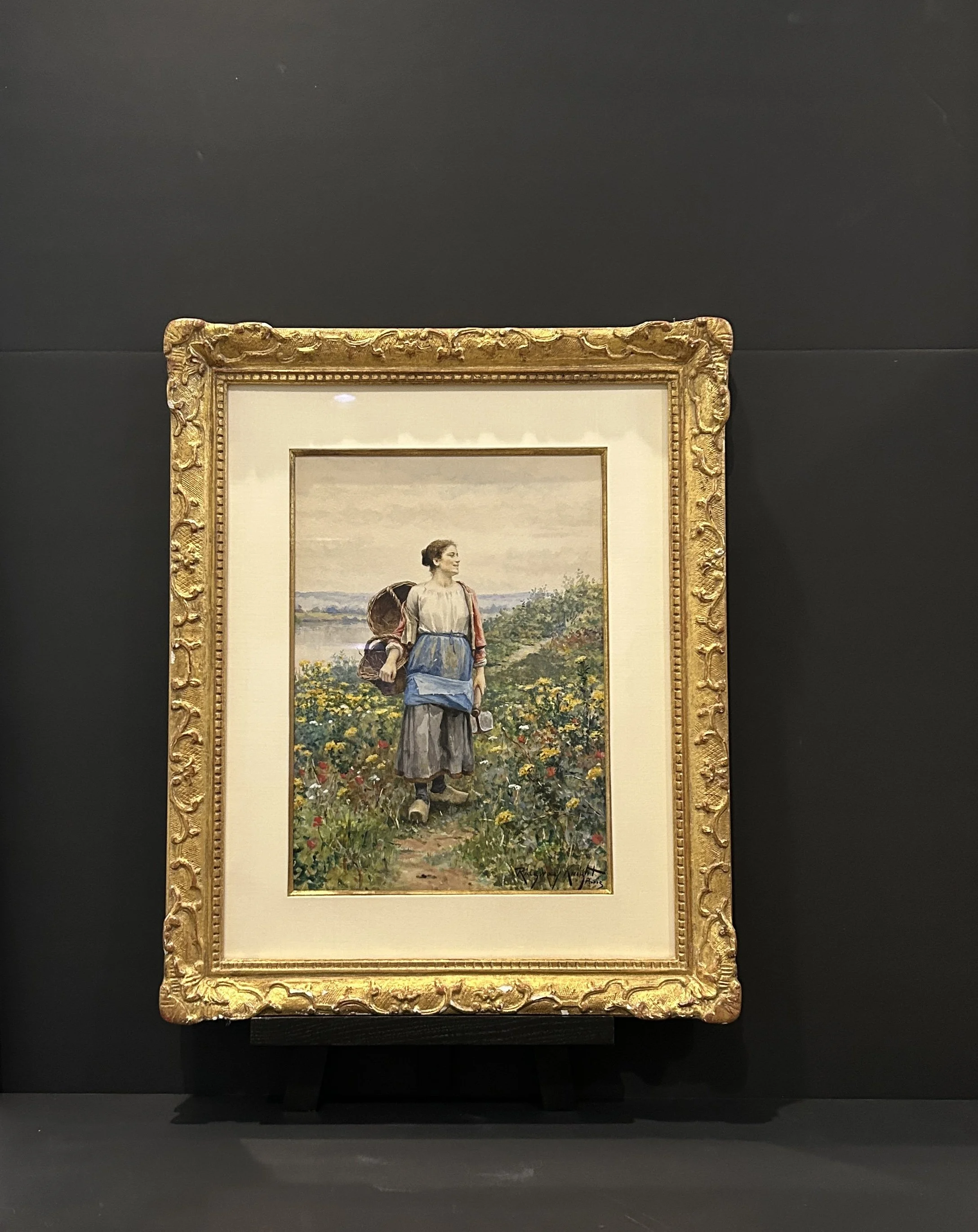 Image 3 of 3
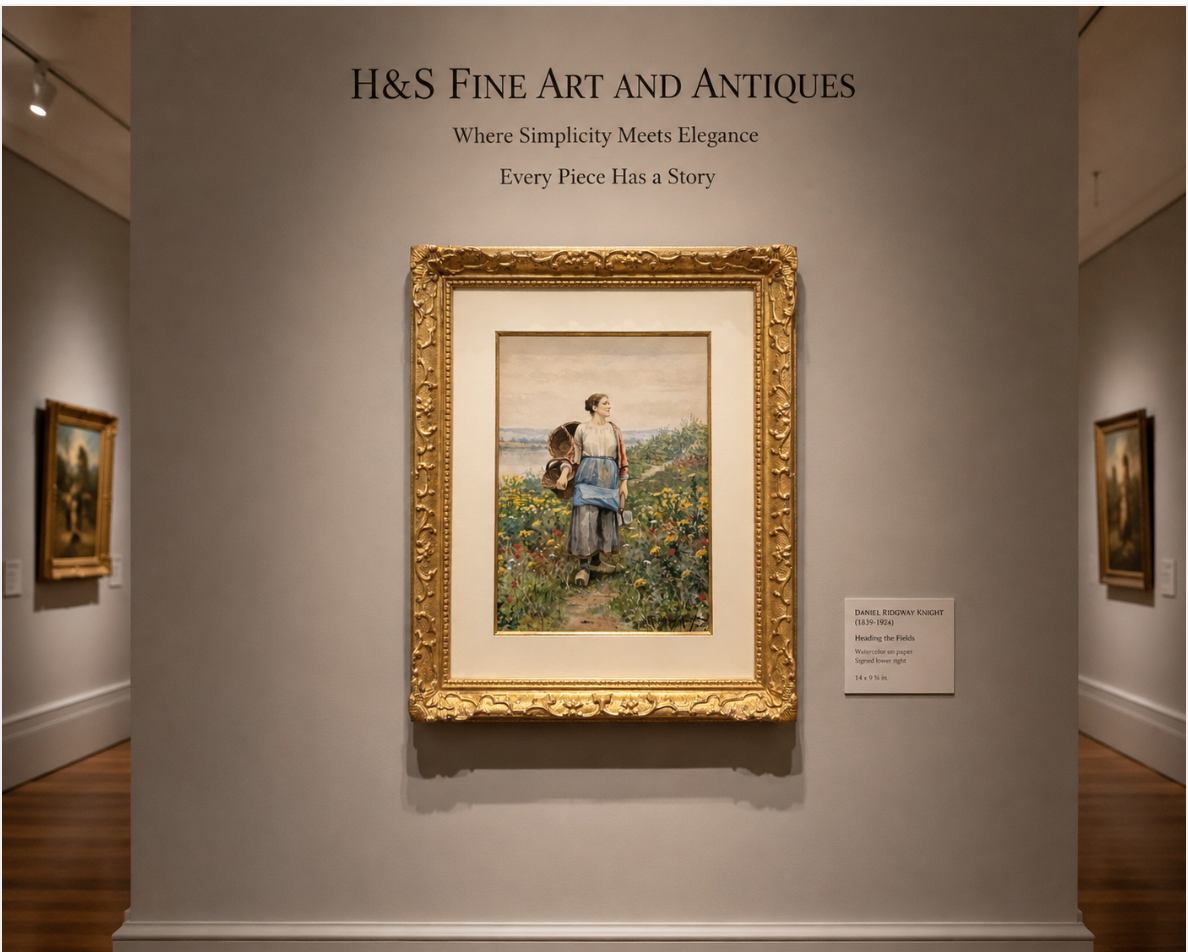
Daniel Ridgway Knight. American 1839-1924. Heading the Fields.
Daniel Ridgway Knight (1839–1924)
Heading the Fields
Signed and inscribed lower right: Ridgway Knight / Paris
Watercolor on paper
Sheet: 14 × 9¾ inches
Framed: 21¾ × 17⅝ inches
Provenance:
Private Collection
With Rehs Galleries, Inc., New York
Property of a Private Midwest Collection
Exhibition Essay
Heading the Fields: Daniel Ridgway Knight and the Poetry of Rural France
Few artists of the nineteenth century succeeded in transforming the ordinary rhythms of rural life into images of such enduring beauty as the American expatriate painter Daniel Ridgway Knight. In Heading the Fields, Knight presents an unassuming yet profoundly evocative vision of a young peasant woman crossing a flowering meadow on her way to work. Executed with exceptional delicacy and luminosity, this watercolor encapsulates the qualities that made Knight one of the most admired American artists working in France during the late nineteenth and early twentieth centuries.
The work is both intimate and monumental. Though modest in scale, it carries the emotional weight of a much larger composition. Every element—the figure, the landscape, the atmosphere, and even the direction of the sitter's gaze—has been carefully orchestrated to create an image that transcends simple genre painting and becomes a meditation on labor, nature, and human dignity.
The Artist
An American Master in France
Daniel Ridgway Knight was born in Philadelphia in 1839, a period in which American art was still seeking an identity separate from European traditions. Demonstrating artistic talent at an early age, he enrolled at the Pennsylvania Academy of the Fine Arts, one of America's oldest and most respected institutions.
His studies were interrupted by the outbreak of the American Civil War. Like many young men of his generation, Knight served briefly before returning to pursue his artistic ambitions.
Recognizing that the highest level of artistic training remained centered in Europe, Knight traveled to Paris, then unquestionably the artistic capital of the Western world. There he entered the prestigious École des Beaux-Arts and studied under Charles Gleyre, one of the most influential academic instructors of the period.
Gleyre's studio had trained many important artists, including Claude Monet, Pierre-Auguste Renoir, and Alfred Sisley. While these painters eventually became pioneers of Impressionism, Knight remained devoted to the academic traditions of drawing, composition, and technical refinement.
Knight subsequently entered the private atelier of Jean-Louis-Ernest Meissonier, arguably the most celebrated painter in France during the Second Empire. Meissonier was renowned for his extraordinarily detailed and meticulously finished paintings. Under his guidance, Knight developed the technical precision and disciplined draftsmanship that remained hallmarks of his work throughout his career.
Establishing a Life in France
Poissy and the Seine Valley
Following his marriage to Rebecca Morris Webster in 1871, Knight permanently settled in France. By 1872, he had established his residence and studio in the historic town of Poissy on the Seine River.
Poissy became far more than a place of residence. It became Knight's artistic universe.
Located northwest of Paris, Poissy remained largely agricultural during the nineteenth century. The region was characterized by:
Rolling meadows
Wildflower-covered fields
Orchards and gardens
Rural pathways
Wooded hillsides
The gentle landscape of the Seine Valley
The countryside around Poissy supplied Knight with an inexhaustible source of inspiration.
Rather than seeking dramatic historical subjects or urban scenes, he devoted himself to depicting the people who worked the land around him. The peasant women of Poissy became his principal subjects and appeared repeatedly in his paintings and watercolors.
Many were local villagers who posed for him over many years. Consequently, his pictures possess an unusual degree of authenticity in costume, gesture, and atmosphere.
Heading the Fields
The Composition
At the center of the watercolor stands a young peasant woman.
She occupies the composition with remarkable confidence and self-possession.
Dressed in traditional country attire, she wears:
A white blouse
A blue apron
A gray skirt
Sturdy shoes
A red shawl draped over her shoulders
Balanced upon her shoulder is a large woven basket, likely intended for gathering flowers, vegetables, or produce.
The basket serves both practical and symbolic functions. It identifies her occupation while simultaneously functioning as a compositional device that balances the figure and gives the composition a rhythmic asymmetry.
The figure is not static.
She moves gently along a narrow footpath through a meadow bursting with flowers.
Her gaze is directed toward the distance.
This simple gesture transforms the painting from mere description into narrative.
One senses that she is beginning her day, contemplating the work ahead, or perhaps quietly admiring the beauty of the landscape that surrounds her.
Knight deliberately leaves the story unresolved.
This ambiguity invites the viewer to participate in the painting's emotional world.
The Landscape
The Fields of Poissy
The landscape is not simply background.
It is an active participant in the composition.
The meadow is animated by countless touches of color:
Yellow blossoms
Red flowers
White wildflowers
Deep green vegetation
Soft blue horizons
The distant hills dissolve into atmospheric light.
The horizon line remains low, allowing the expansive sky to suggest openness and freedom.
The entire scene is infused with calm and harmony.
The landscape reflects nineteenth-century ideals concerning nature as a place of renewal and spiritual balance.
To industrialized urban audiences in Paris, London, and New York, these images represented a nostalgic vision of simplicity and permanence.
The Meaning of the Painting
Dignity of Labor
The woman is a worker.
Yet Knight presents her with nobility.
There is no suggestion of hardship or poverty.
Instead, she appears poised, self-assured, and graceful.
This treatment reflects an important nineteenth-century ideal:
that honest labor possesses intrinsic dignity.
Harmony Between Humanity and Nature
The figure emerges organically from the landscape.
Her clothing echoes the colors of the field and sky.
Her movement follows the contours of the path.
The basket and flowers establish visual rhythms throughout the composition.
Humanity and nature exist in complete equilibrium.
This relationship became one of the defining characteristics of Knight's art.
Rural Idealism
By the late nineteenth century, France and America were undergoing rapid industrialization.
Cities expanded.
Factories multiplied.
Traditional agricultural life was disappearing.
Knight's paintings offered an alternative vision:
a world of simplicity, beauty, and timeless human values.
His art became enormously popular precisely because it provided viewers with a poetic escape from modern life.
The Feminine Ideal
Knight's peasant women are among the most recognizable figures in nineteenth-century academic painting.
They are not portrayed as fragile or passive.
Rather, they possess:
Strength
Self-reliance
Intelligence
Grace
Quiet determination
The woman in Heading the Fields embodies these qualities completely.
Technique
Watercolor as Poetry
Although Daniel Ridgway Knight is best known for his oil paintings, his watercolors reveal some of his most remarkable abilities.
In this work:
Transparent washes establish atmosphere.
Controlled brushstrokes model the figure.
Small touches of color create floral brilliance.
Delicate gradations suggest distance and light.
The watercolor medium allows spontaneity and freshness that would be difficult to achieve in oil.
One can almost feel the summer air moving through the meadow.
The work possesses both immediacy and refinement.
International Recognition
Knight's artistic achievements earned him extraordinary recognition during his lifetime.
Among his distinctions were:
Paris Salon Distinction (1882)
For his celebrated painting Un Deuil.
Silver Medal
Exposition Universelle, Paris, 1889.
Cross of the Legion of Honor
One of France's highest artistic distinctions.
Knight of the Royal Order of St. Michael of Bavaria
Munich, 1893.
Gold Medal of Honor
Pennsylvania Academy of the Fine Arts.
These honors established Daniel Ridgway Knight as one of the most successful American painters working abroad.
Museums and Public Collections
Works by Daniel Ridgway Knight are represented in numerous public collections, including:
Pennsylvania Academy of the Fine Arts, Philadelphia
Philadelphia Museum of Art
Brooklyn Museum, New York
Carnegie Museum of Art, Pittsburgh
Reading Public Museum, Pennsylvania
His paintings have also appeared in numerous exhibitions dedicated to:
American expatriate painters in France
Nineteenth-century academic painting
American art of the Gilded Age
Genre painting and rural imagery
Literature and References
This work may be considered in relation to the following references:
Benezit Dictionary of Artists
Mantle Fielding's Dictionary of American Painters, Sculptors and Engravers
Who Was Who in American Art
Paris Salon exhibition records
Pennsylvania Academy of the Fine Arts exhibition catalogues
Publications concerning American painters in France during the nineteenth century
Studies of French rural genre painting and American expatriate artists
Curatorial Statement
Daniel Ridgway Knight's Heading the Fields stands as a poetic tribute to rural France and to the dignity of ordinary life. Painted in the countryside surrounding Poissy and signed from Paris, the watercolor unites academic precision with lyrical naturalism. The solitary figure, pausing amidst a field of wildflowers beneath an open sky, becomes more than a peasant woman setting out to work; she becomes an enduring symbol of humanity's connection to the land, of labor ennobled by grace, and of the timeless beauty found in everyday existence. In its modest scale and extraordinary sensitivity, Heading the Fields encapsulates the very qualities that made Daniel Ridgway Knight one of the most beloved American artists of his generation.
Daniel Ridgway Knight (1839–1924)
Heading the Fields
Signed and inscribed lower right: Ridgway Knight / Paris
Watercolor on paper
Sheet: 14 × 9¾ inches
Framed: 21¾ × 17⅝ inches
Provenance:
Private Collection
With Rehs Galleries, Inc., New York
Property of a Private Midwest Collection
Exhibition Essay
Heading the Fields: Daniel Ridgway Knight and the Poetry of Rural France
Few artists of the nineteenth century succeeded in transforming the ordinary rhythms of rural life into images of such enduring beauty as the American expatriate painter Daniel Ridgway Knight. In Heading the Fields, Knight presents an unassuming yet profoundly evocative vision of a young peasant woman crossing a flowering meadow on her way to work. Executed with exceptional delicacy and luminosity, this watercolor encapsulates the qualities that made Knight one of the most admired American artists working in France during the late nineteenth and early twentieth centuries.
The work is both intimate and monumental. Though modest in scale, it carries the emotional weight of a much larger composition. Every element—the figure, the landscape, the atmosphere, and even the direction of the sitter's gaze—has been carefully orchestrated to create an image that transcends simple genre painting and becomes a meditation on labor, nature, and human dignity.
The Artist
An American Master in France
Daniel Ridgway Knight was born in Philadelphia in 1839, a period in which American art was still seeking an identity separate from European traditions. Demonstrating artistic talent at an early age, he enrolled at the Pennsylvania Academy of the Fine Arts, one of America's oldest and most respected institutions.
His studies were interrupted by the outbreak of the American Civil War. Like many young men of his generation, Knight served briefly before returning to pursue his artistic ambitions.
Recognizing that the highest level of artistic training remained centered in Europe, Knight traveled to Paris, then unquestionably the artistic capital of the Western world. There he entered the prestigious École des Beaux-Arts and studied under Charles Gleyre, one of the most influential academic instructors of the period.
Gleyre's studio had trained many important artists, including Claude Monet, Pierre-Auguste Renoir, and Alfred Sisley. While these painters eventually became pioneers of Impressionism, Knight remained devoted to the academic traditions of drawing, composition, and technical refinement.
Knight subsequently entered the private atelier of Jean-Louis-Ernest Meissonier, arguably the most celebrated painter in France during the Second Empire. Meissonier was renowned for his extraordinarily detailed and meticulously finished paintings. Under his guidance, Knight developed the technical precision and disciplined draftsmanship that remained hallmarks of his work throughout his career.
Establishing a Life in France
Poissy and the Seine Valley
Following his marriage to Rebecca Morris Webster in 1871, Knight permanently settled in France. By 1872, he had established his residence and studio in the historic town of Poissy on the Seine River.
Poissy became far more than a place of residence. It became Knight's artistic universe.
Located northwest of Paris, Poissy remained largely agricultural during the nineteenth century. The region was characterized by:
Rolling meadows
Wildflower-covered fields
Orchards and gardens
Rural pathways
Wooded hillsides
The gentle landscape of the Seine Valley
The countryside around Poissy supplied Knight with an inexhaustible source of inspiration.
Rather than seeking dramatic historical subjects or urban scenes, he devoted himself to depicting the people who worked the land around him. The peasant women of Poissy became his principal subjects and appeared repeatedly in his paintings and watercolors.
Many were local villagers who posed for him over many years. Consequently, his pictures possess an unusual degree of authenticity in costume, gesture, and atmosphere.
Heading the Fields
The Composition
At the center of the watercolor stands a young peasant woman.
She occupies the composition with remarkable confidence and self-possession.
Dressed in traditional country attire, she wears:
A white blouse
A blue apron
A gray skirt
Sturdy shoes
A red shawl draped over her shoulders
Balanced upon her shoulder is a large woven basket, likely intended for gathering flowers, vegetables, or produce.
The basket serves both practical and symbolic functions. It identifies her occupation while simultaneously functioning as a compositional device that balances the figure and gives the composition a rhythmic asymmetry.
The figure is not static.
She moves gently along a narrow footpath through a meadow bursting with flowers.
Her gaze is directed toward the distance.
This simple gesture transforms the painting from mere description into narrative.
One senses that she is beginning her day, contemplating the work ahead, or perhaps quietly admiring the beauty of the landscape that surrounds her.
Knight deliberately leaves the story unresolved.
This ambiguity invites the viewer to participate in the painting's emotional world.
The Landscape
The Fields of Poissy
The landscape is not simply background.
It is an active participant in the composition.
The meadow is animated by countless touches of color:
Yellow blossoms
Red flowers
White wildflowers
Deep green vegetation
Soft blue horizons
The distant hills dissolve into atmospheric light.
The horizon line remains low, allowing the expansive sky to suggest openness and freedom.
The entire scene is infused with calm and harmony.
The landscape reflects nineteenth-century ideals concerning nature as a place of renewal and spiritual balance.
To industrialized urban audiences in Paris, London, and New York, these images represented a nostalgic vision of simplicity and permanence.
The Meaning of the Painting
Dignity of Labor
The woman is a worker.
Yet Knight presents her with nobility.
There is no suggestion of hardship or poverty.
Instead, she appears poised, self-assured, and graceful.
This treatment reflects an important nineteenth-century ideal:
that honest labor possesses intrinsic dignity.
Harmony Between Humanity and Nature
The figure emerges organically from the landscape.
Her clothing echoes the colors of the field and sky.
Her movement follows the contours of the path.
The basket and flowers establish visual rhythms throughout the composition.
Humanity and nature exist in complete equilibrium.
This relationship became one of the defining characteristics of Knight's art.
Rural Idealism
By the late nineteenth century, France and America were undergoing rapid industrialization.
Cities expanded.
Factories multiplied.
Traditional agricultural life was disappearing.
Knight's paintings offered an alternative vision:
a world of simplicity, beauty, and timeless human values.
His art became enormously popular precisely because it provided viewers with a poetic escape from modern life.
The Feminine Ideal
Knight's peasant women are among the most recognizable figures in nineteenth-century academic painting.
They are not portrayed as fragile or passive.
Rather, they possess:
Strength
Self-reliance
Intelligence
Grace
Quiet determination
The woman in Heading the Fields embodies these qualities completely.
Technique
Watercolor as Poetry
Although Daniel Ridgway Knight is best known for his oil paintings, his watercolors reveal some of his most remarkable abilities.
In this work:
Transparent washes establish atmosphere.
Controlled brushstrokes model the figure.
Small touches of color create floral brilliance.
Delicate gradations suggest distance and light.
The watercolor medium allows spontaneity and freshness that would be difficult to achieve in oil.
One can almost feel the summer air moving through the meadow.
The work possesses both immediacy and refinement.
International Recognition
Knight's artistic achievements earned him extraordinary recognition during his lifetime.
Among his distinctions were:
Paris Salon Distinction (1882)
For his celebrated painting Un Deuil.
Silver Medal
Exposition Universelle, Paris, 1889.
Cross of the Legion of Honor
One of France's highest artistic distinctions.
Knight of the Royal Order of St. Michael of Bavaria
Munich, 1893.
Gold Medal of Honor
Pennsylvania Academy of the Fine Arts.
These honors established Daniel Ridgway Knight as one of the most successful American painters working abroad.
Museums and Public Collections
Works by Daniel Ridgway Knight are represented in numerous public collections, including:
Pennsylvania Academy of the Fine Arts, Philadelphia
Philadelphia Museum of Art
Brooklyn Museum, New York
Carnegie Museum of Art, Pittsburgh
Reading Public Museum, Pennsylvania
His paintings have also appeared in numerous exhibitions dedicated to:
American expatriate painters in France
Nineteenth-century academic painting
American art of the Gilded Age
Genre painting and rural imagery
Literature and References
This work may be considered in relation to the following references:
Benezit Dictionary of Artists
Mantle Fielding's Dictionary of American Painters, Sculptors and Engravers
Who Was Who in American Art
Paris Salon exhibition records
Pennsylvania Academy of the Fine Arts exhibition catalogues
Publications concerning American painters in France during the nineteenth century
Studies of French rural genre painting and American expatriate artists
Curatorial Statement
Daniel Ridgway Knight's Heading the Fields stands as a poetic tribute to rural France and to the dignity of ordinary life. Painted in the countryside surrounding Poissy and signed from Paris, the watercolor unites academic precision with lyrical naturalism. The solitary figure, pausing amidst a field of wildflowers beneath an open sky, becomes more than a peasant woman setting out to work; she becomes an enduring symbol of humanity's connection to the land, of labor ennobled by grace, and of the timeless beauty found in everyday existence. In its modest scale and extraordinary sensitivity, Heading the Fields encapsulates the very qualities that made Daniel Ridgway Knight one of the most beloved American artists of his generation.