 Image 1 of 4
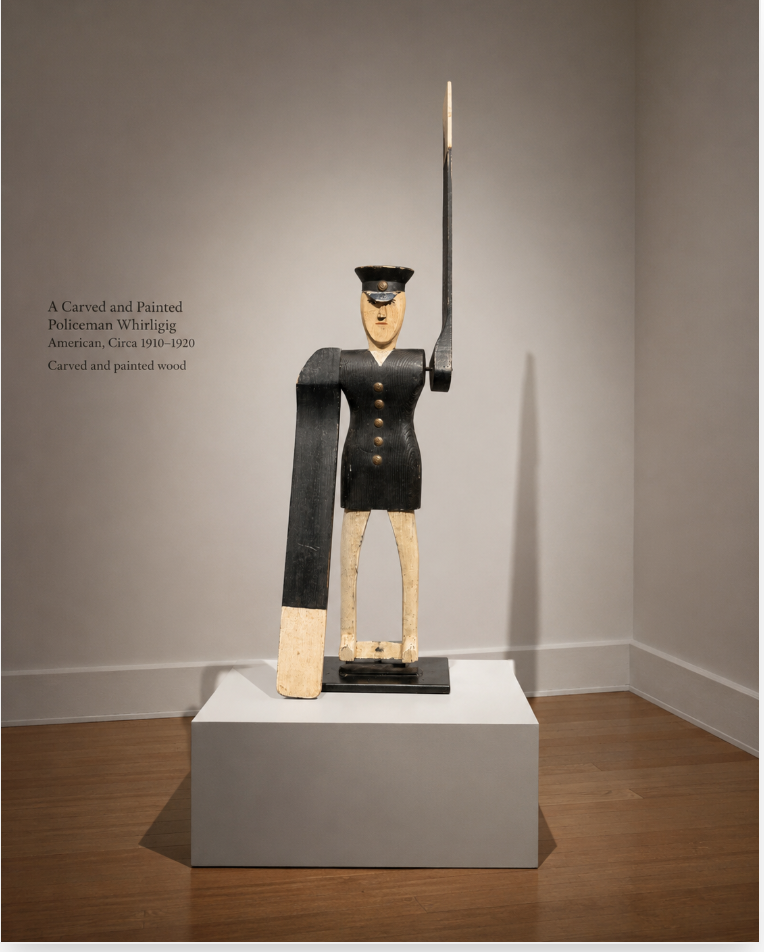 Image 2 of 4
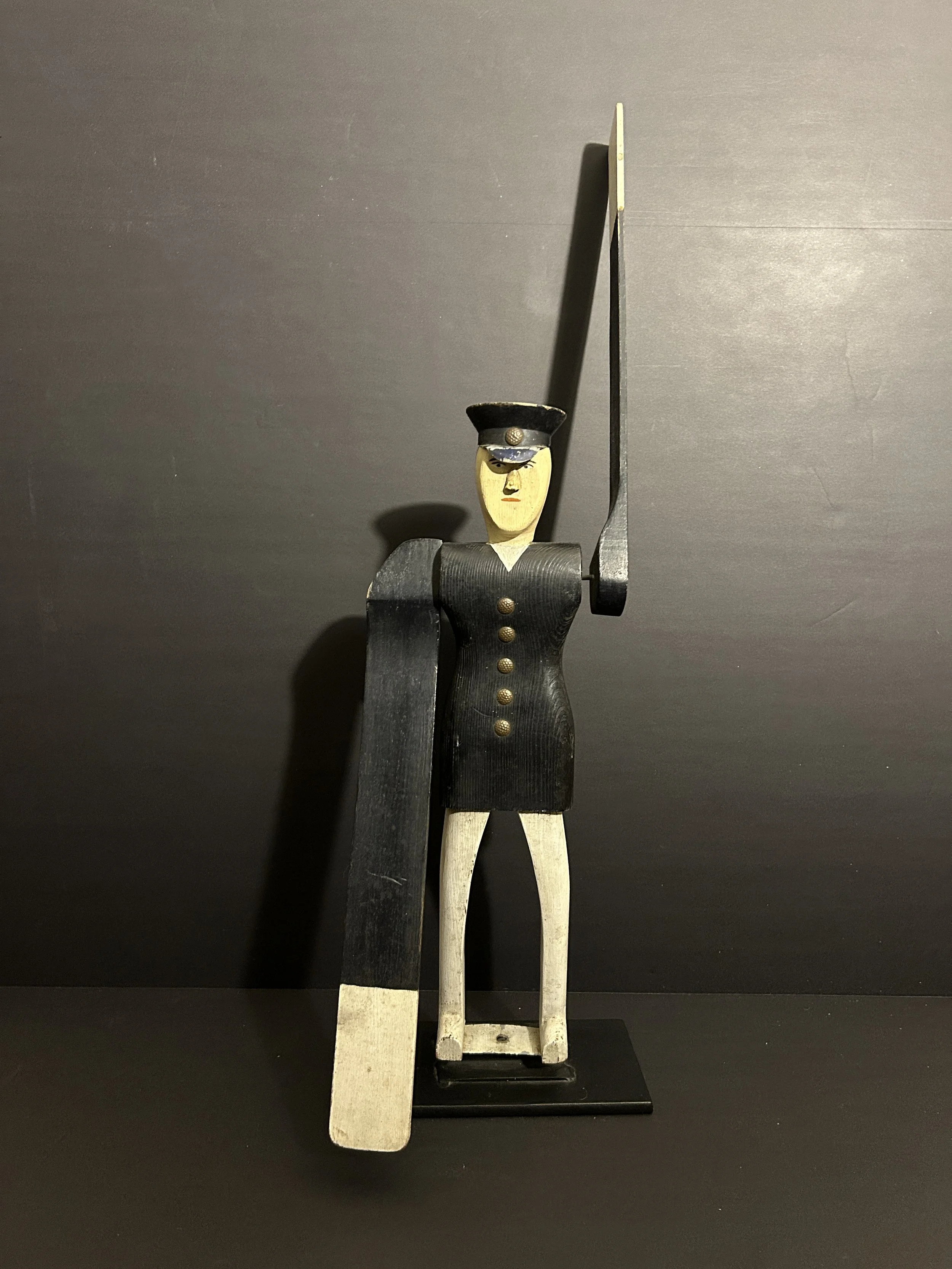 Image 3 of 4
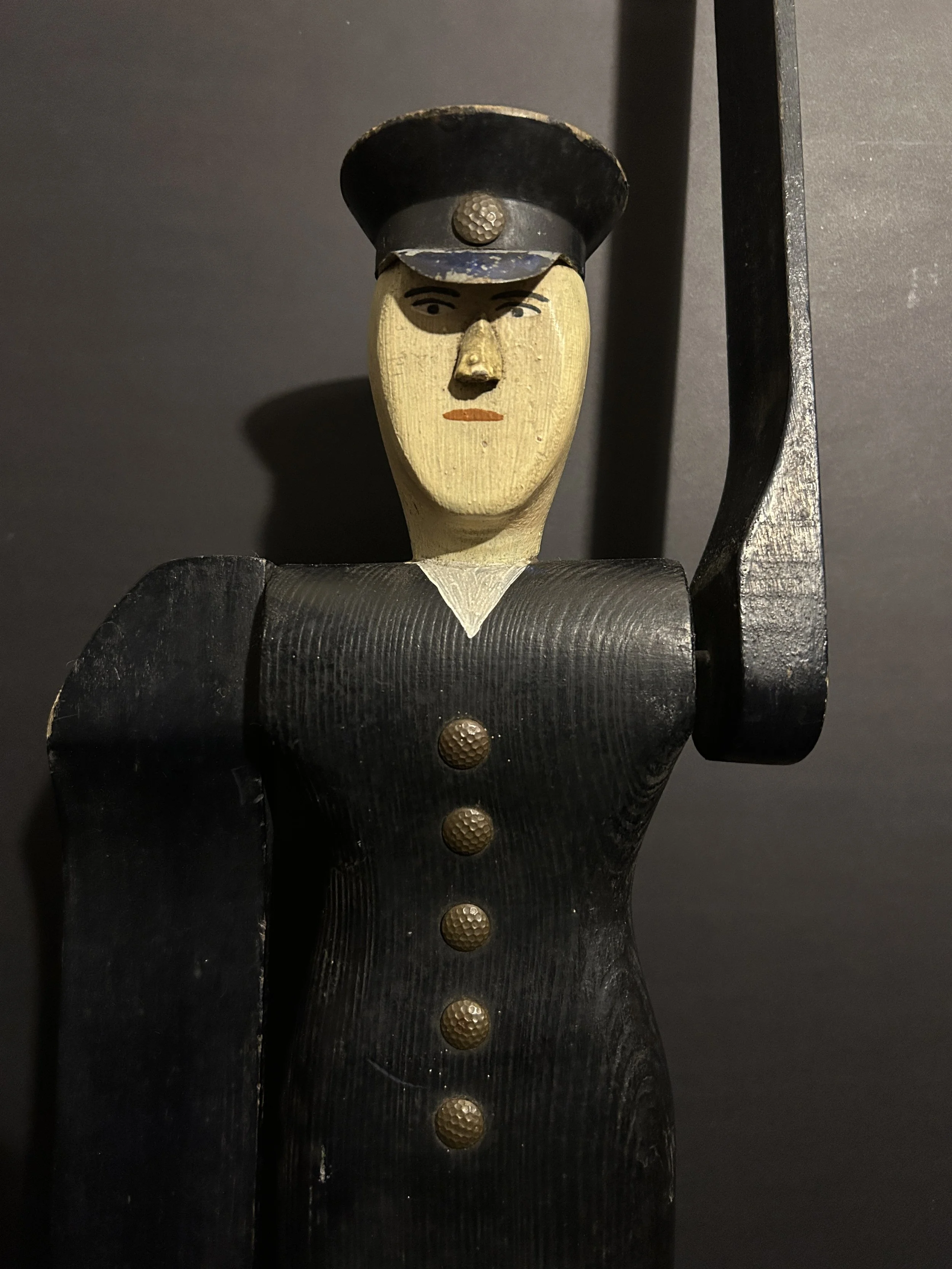 Image 4 of 4
A Carved Whirligig of a Policeman (1910-1920).
A Carved and Painted Policeman Whirligig
American, Circa 1910–1920
Carved and painted wood with rotating paddle arms
Height: 27”
Every Piece Has a Story
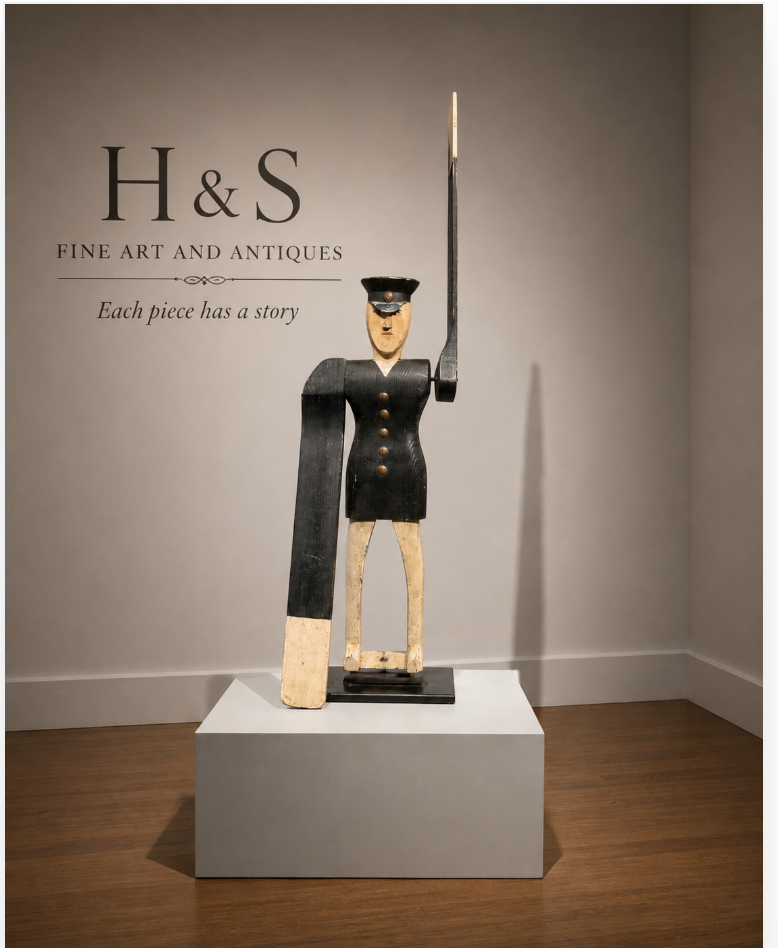
Standing rigidly at attention, his long black arms poised to spin in the wind, this carved Policeman Whirligig is an exceptional example of early twentieth-century American folk sculpture and kinetic art. Fashioned from simple pieces of wood and enlivened with black, cream, and flesh-colored paint, the figure embodies the ingenuity, humor, and visual directness that define the finest traditions of American folk art. The elongated body, stylized face, and exaggerated paddle arms were not intended to achieve realism but rather to capture character and movement. The maker distilled the image of the American policeman into its most recognizable elements: the formal cap, the brass-buttoned tunic, and the upright bearing of civic authority. The result is a figure that is both sculptural and animated—a work of art transformed by the invisible force of the wind.
The Policeman in Early Twentieth-Century America
The period between 1910 and 1920 was one of profound transformation in American society. Cities expanded rapidly due to industrialization and immigration, and municipal police forces assumed increasingly visible roles in public life. During these years, police uniforms became standardized throughout the country. The dark double-breasted coat, peaked cap, and brass buttons became symbols of civic order and modern urban identity.
To Americans of the period, the policeman represented authority, security, and community responsibility. Figures of policemen appeared in popular illustrations, toys, parade decorations, and folk carvings. Within this context, the subject would have been instantly recognizable and held both decorative and symbolic appeal.
Unlike military whirligigs or representations of farmers and sailors, surviving examples depicting policemen are relatively uncommon, making this figure particularly appealing to collectors of Americana and occupational folk art.
Form and Construction
The whirligig is carved from multiple sections of wood and retains its hand-painted surface. The elongated arms function as wind paddles and would have rotated when exposed to a breeze, creating movement and bringing the figure to life.
The face possesses a remarkable simplicity. The elongated nose, painted eyes, and understated mouth were executed with a few confident strokes by an anonymous craftsman whose concern was expression rather than academic precision. The resulting countenance conveys dignity and calm authority.
Its silhouette is exceptionally strong. The broad cap, narrow torso, and dramatically extended arms create an immediately recognizable and highly graphic form, qualities highly prized by collectors and museums today.
Surface and Patina
Perhaps the most appealing aspect of this sculpture is its surviving painted surface and age-developed patina. The black paint of the uniform has softened through time and handling, producing a rich, matte surface impossible to replicate artificially.
The exposed wood of the face and legs has mellowed to warm cream tones, and the minor abrasions and wear throughout the figure bear witness to decades of exposure and use. Such evidence of age and honest wear is highly desirable among collectors of folk art, as it records the object's life and confirms its authenticity.
The dry, untouched surface and naturally oxidized paint contribute enormously to the object's sculptural presence and visual appeal.
Whirligigs and American Folk Art
Whirligigs occupy a unique position in the history of American art. They are among the nation's earliest forms of kinetic sculpture, combining carving, painting, mechanics, and movement.
Originally mounted on barns, porches, sheds, and garden posts, whirligigs served both decorative and practical functions. They entertained viewers, indicated wind direction, and reflected the personalities and interests of their makers. Their subjects frequently represented familiar figures from daily life: soldiers, sailors, farmers, firemen, and policemen.
Today, whirligigs are recognized as one of the most distinctive forms of American folk art and are represented in major museum collections throughout the United States.
Literature and References
Herbert W. Hemphill, Jr., Folk Sculpture U.S.A., exhibition catalogue, Brooklyn Museum and Los Angeles County Museum of Art, 1976.
The Guennol Collection, Vol. II, The Metropolitan Museum of Art, New York, 1982, pp. 236–238.
Gerard C. Wertkin, Encyclopedia of American Folk Art, Routledge, 2004.
Anne Gilbert, “Whimsical Whirligigs Caught in the Winds of Folk Art Collectors,” Sunday News, Lancaster, Pennsylvania.
Comparable Examples
A carved and painted American Policeman Whirligig from the celebrated Guennol Collection was exhibited at the Brooklyn Museum in Folk Sculpture U.S.A. in 1976 and subsequently discussed in The Guennol Collection published by The Metropolitan Museum of Art.
Another late nineteenth-century American Policeman Whirligig retaining original blue, white, and black paint survives in a private collection and demonstrates the enduring appeal and rarity of the subject.
Comparable American whirligigs have appeared regularly at major Americana auctions, reflecting the sustained interest among collectors and institutions in kinetic folk sculpture.
This Policeman Whirligig stands as both sculpture and artifact—an object that captures the spirit of early twentieth-century America and transforms the ordinary figure of a local policeman into a whimsical, animated work of enduring artistic charm.
A Carved and Painted Policeman Whirligig
American, Circa 1910–1920
Carved and painted wood with rotating paddle arms
Height: 27”
Every Piece Has a Story
Standing rigidly at attention, his long black arms poised to spin in the wind, this carved Policeman Whirligig is an exceptional example of early twentieth-century American folk sculpture and kinetic art. Fashioned from simple pieces of wood and enlivened with black, cream, and flesh-colored paint, the figure embodies the ingenuity, humor, and visual directness that define the finest traditions of American folk art. The elongated body, stylized face, and exaggerated paddle arms were not intended to achieve realism but rather to capture character and movement. The maker distilled the image of the American policeman into its most recognizable elements: the formal cap, the brass-buttoned tunic, and the upright bearing of civic authority. The result is a figure that is both sculptural and animated—a work of art transformed by the invisible force of the wind.
The Policeman in Early Twentieth-Century America
The period between 1910 and 1920 was one of profound transformation in American society. Cities expanded rapidly due to industrialization and immigration, and municipal police forces assumed increasingly visible roles in public life. During these years, police uniforms became standardized throughout the country. The dark double-breasted coat, peaked cap, and brass buttons became symbols of civic order and modern urban identity.
To Americans of the period, the policeman represented authority, security, and community responsibility. Figures of policemen appeared in popular illustrations, toys, parade decorations, and folk carvings. Within this context, the subject would have been instantly recognizable and held both decorative and symbolic appeal.
Unlike military whirligigs or representations of farmers and sailors, surviving examples depicting policemen are relatively uncommon, making this figure particularly appealing to collectors of Americana and occupational folk art.
Form and Construction
The whirligig is carved from multiple sections of wood and retains its hand-painted surface. The elongated arms function as wind paddles and would have rotated when exposed to a breeze, creating movement and bringing the figure to life.
The face possesses a remarkable simplicity. The elongated nose, painted eyes, and understated mouth were executed with a few confident strokes by an anonymous craftsman whose concern was expression rather than academic precision. The resulting countenance conveys dignity and calm authority.
Its silhouette is exceptionally strong. The broad cap, narrow torso, and dramatically extended arms create an immediately recognizable and highly graphic form, qualities highly prized by collectors and museums today.
Surface and Patina
Perhaps the most appealing aspect of this sculpture is its surviving painted surface and age-developed patina. The black paint of the uniform has softened through time and handling, producing a rich, matte surface impossible to replicate artificially.
The exposed wood of the face and legs has mellowed to warm cream tones, and the minor abrasions and wear throughout the figure bear witness to decades of exposure and use. Such evidence of age and honest wear is highly desirable among collectors of folk art, as it records the object's life and confirms its authenticity.
The dry, untouched surface and naturally oxidized paint contribute enormously to the object's sculptural presence and visual appeal.
Whirligigs and American Folk Art
Whirligigs occupy a unique position in the history of American art. They are among the nation's earliest forms of kinetic sculpture, combining carving, painting, mechanics, and movement.
Originally mounted on barns, porches, sheds, and garden posts, whirligigs served both decorative and practical functions. They entertained viewers, indicated wind direction, and reflected the personalities and interests of their makers. Their subjects frequently represented familiar figures from daily life: soldiers, sailors, farmers, firemen, and policemen.
Today, whirligigs are recognized as one of the most distinctive forms of American folk art and are represented in major museum collections throughout the United States.
Literature and References
Herbert W. Hemphill, Jr., Folk Sculpture U.S.A., exhibition catalogue, Brooklyn Museum and Los Angeles County Museum of Art, 1976.
The Guennol Collection, Vol. II, The Metropolitan Museum of Art, New York, 1982, pp. 236–238.
Gerard C. Wertkin, Encyclopedia of American Folk Art, Routledge, 2004.
Anne Gilbert, “Whimsical Whirligigs Caught in the Winds of Folk Art Collectors,” Sunday News, Lancaster, Pennsylvania.
Comparable Examples
A carved and painted American Policeman Whirligig from the celebrated Guennol Collection was exhibited at the Brooklyn Museum in Folk Sculpture U.S.A. in 1976 and subsequently discussed in The Guennol Collection published by The Metropolitan Museum of Art.
Another late nineteenth-century American Policeman Whirligig retaining original blue, white, and black paint survives in a private collection and demonstrates the enduring appeal and rarity of the subject.
Comparable American whirligigs have appeared regularly at major Americana auctions, reflecting the sustained interest among collectors and institutions in kinetic folk sculpture.
This Policeman Whirligig stands as both sculpture and artifact—an object that captures the spirit of early twentieth-century America and transforms the ordinary figure of a local policeman into a whimsical, animated work of enduring artistic charm.