 Image 1 of 8
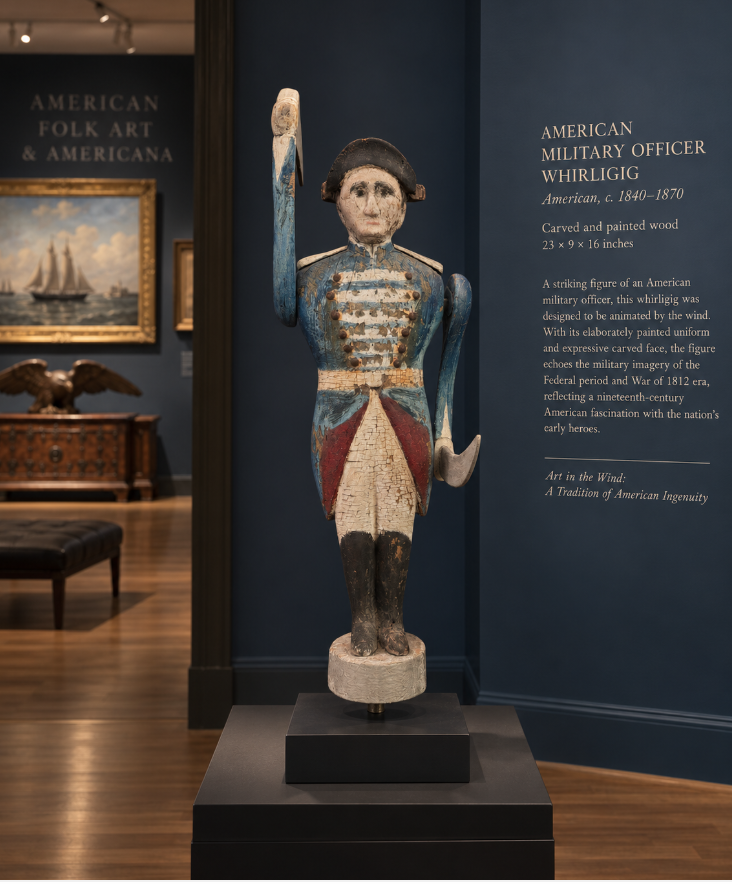 Image 2 of 8
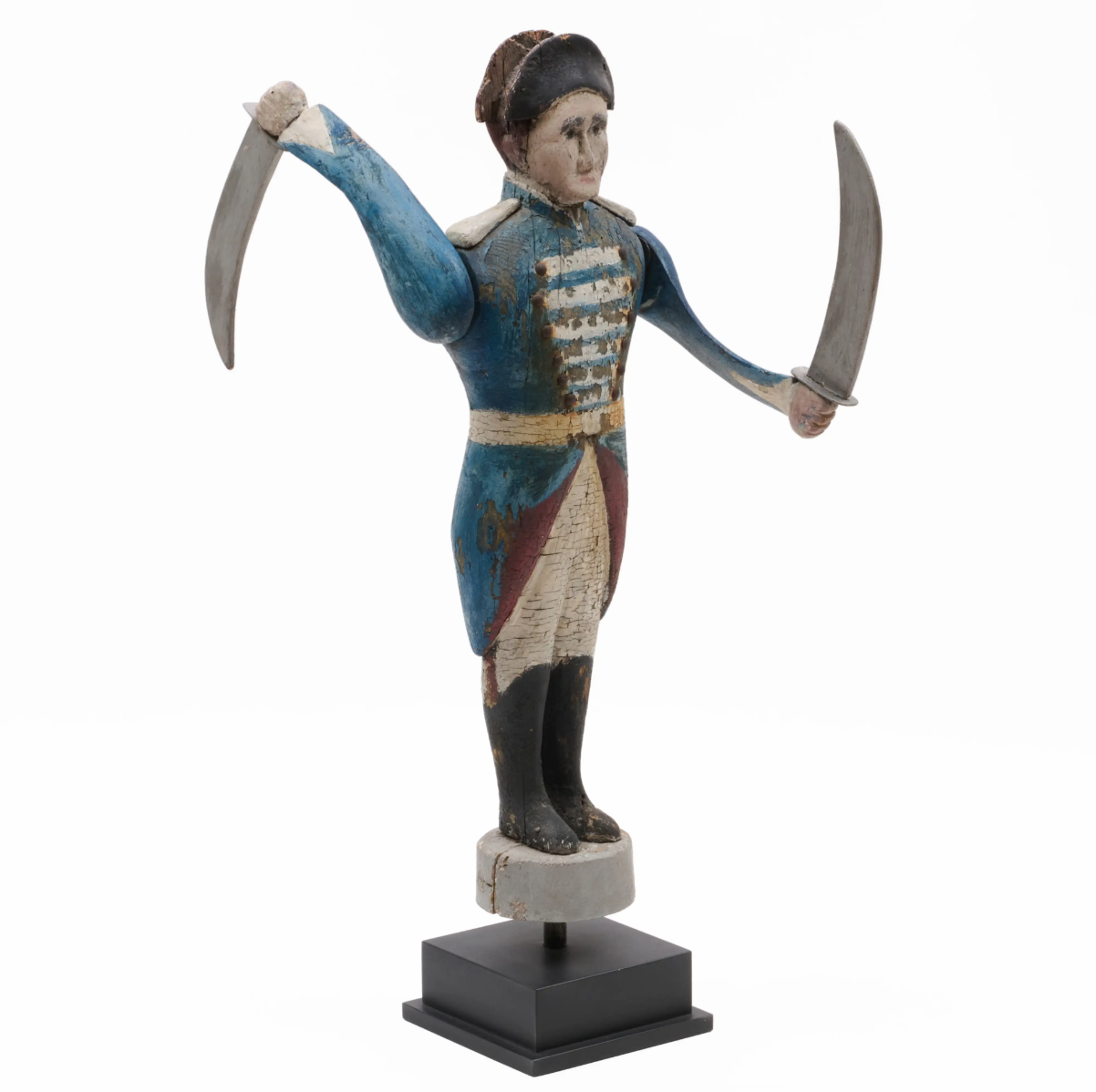 Image 3 of 8
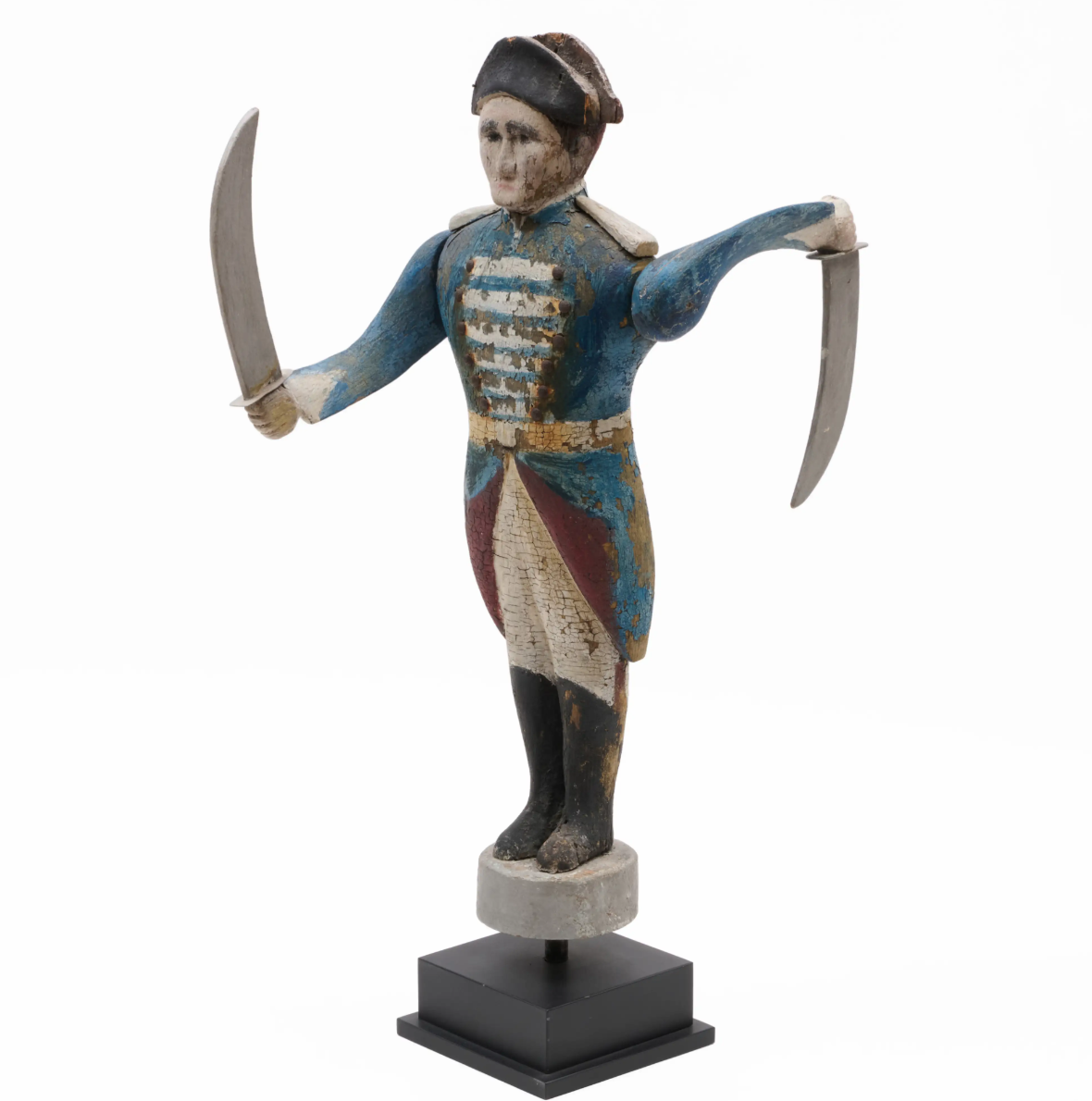 Image 4 of 8
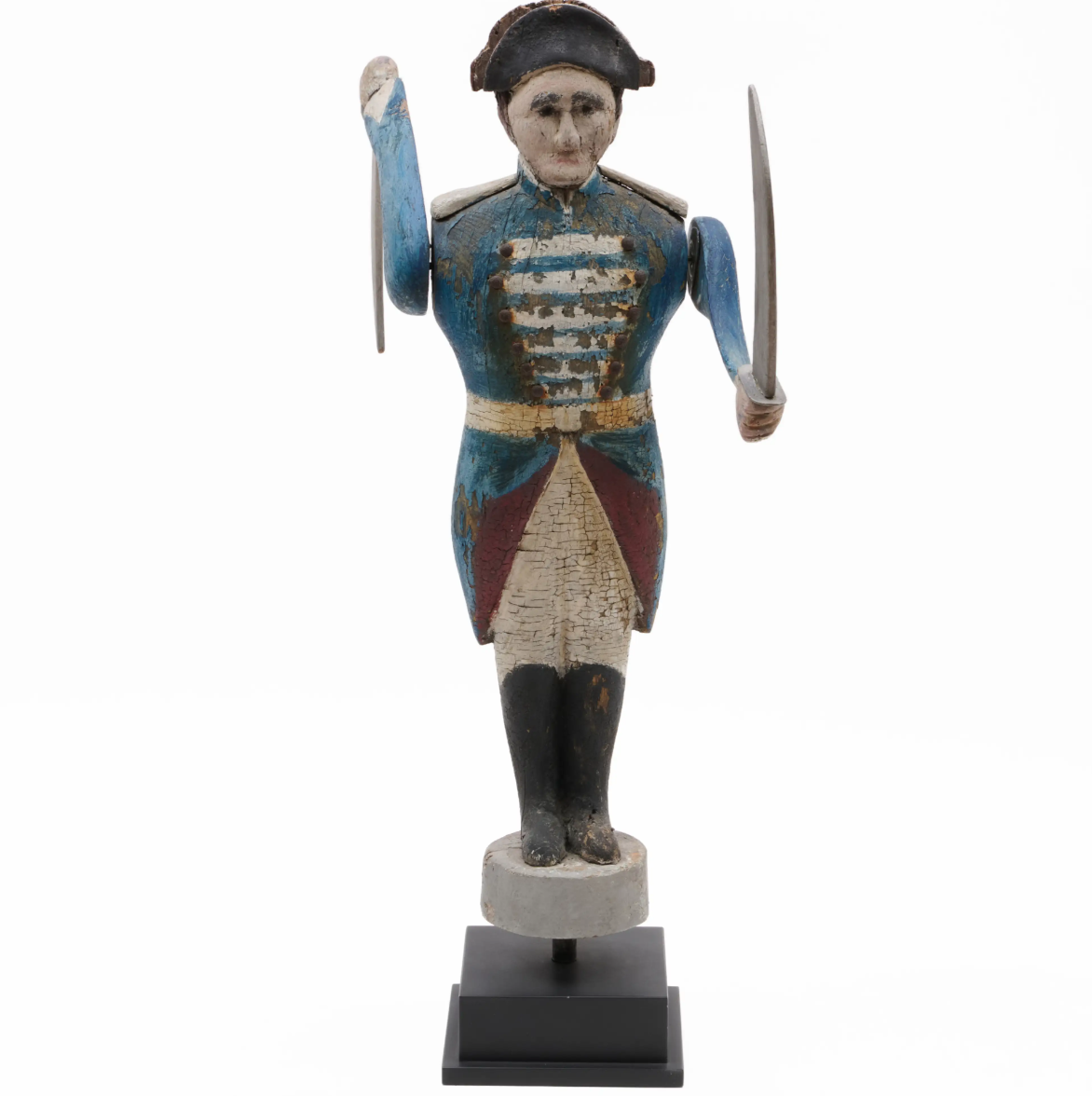 Image 5 of 8
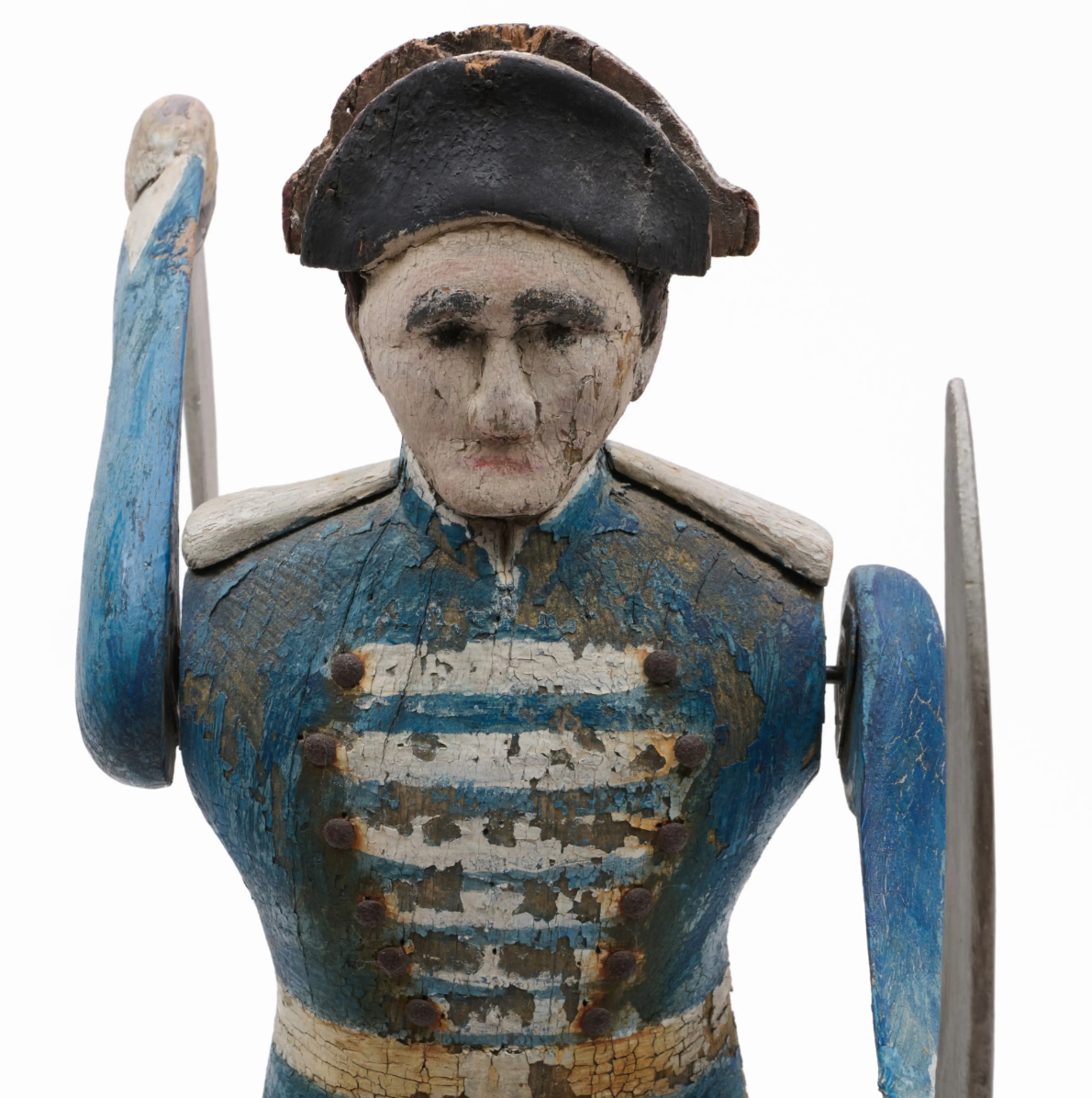 Image 6 of 8
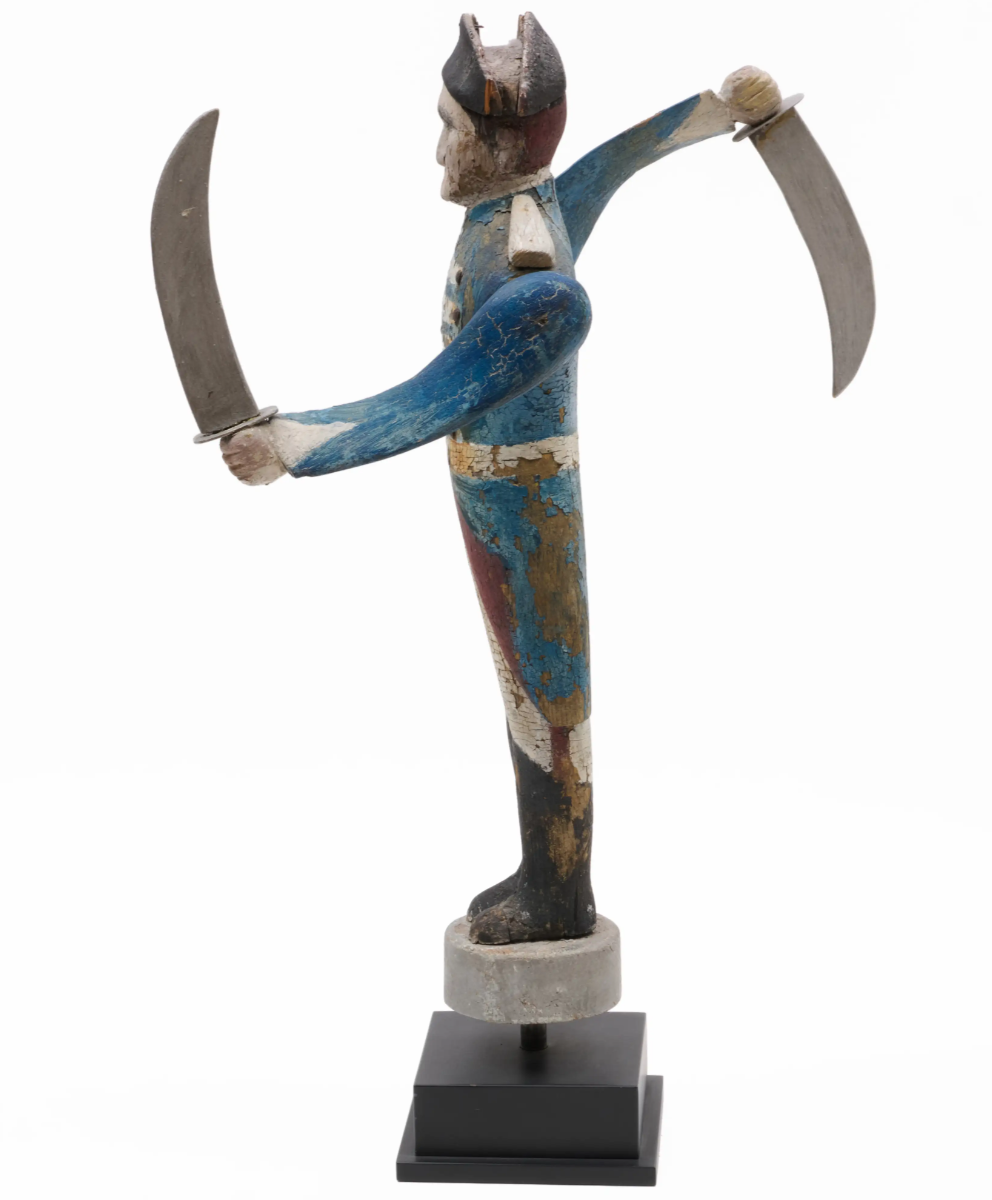 Image 7 of 8
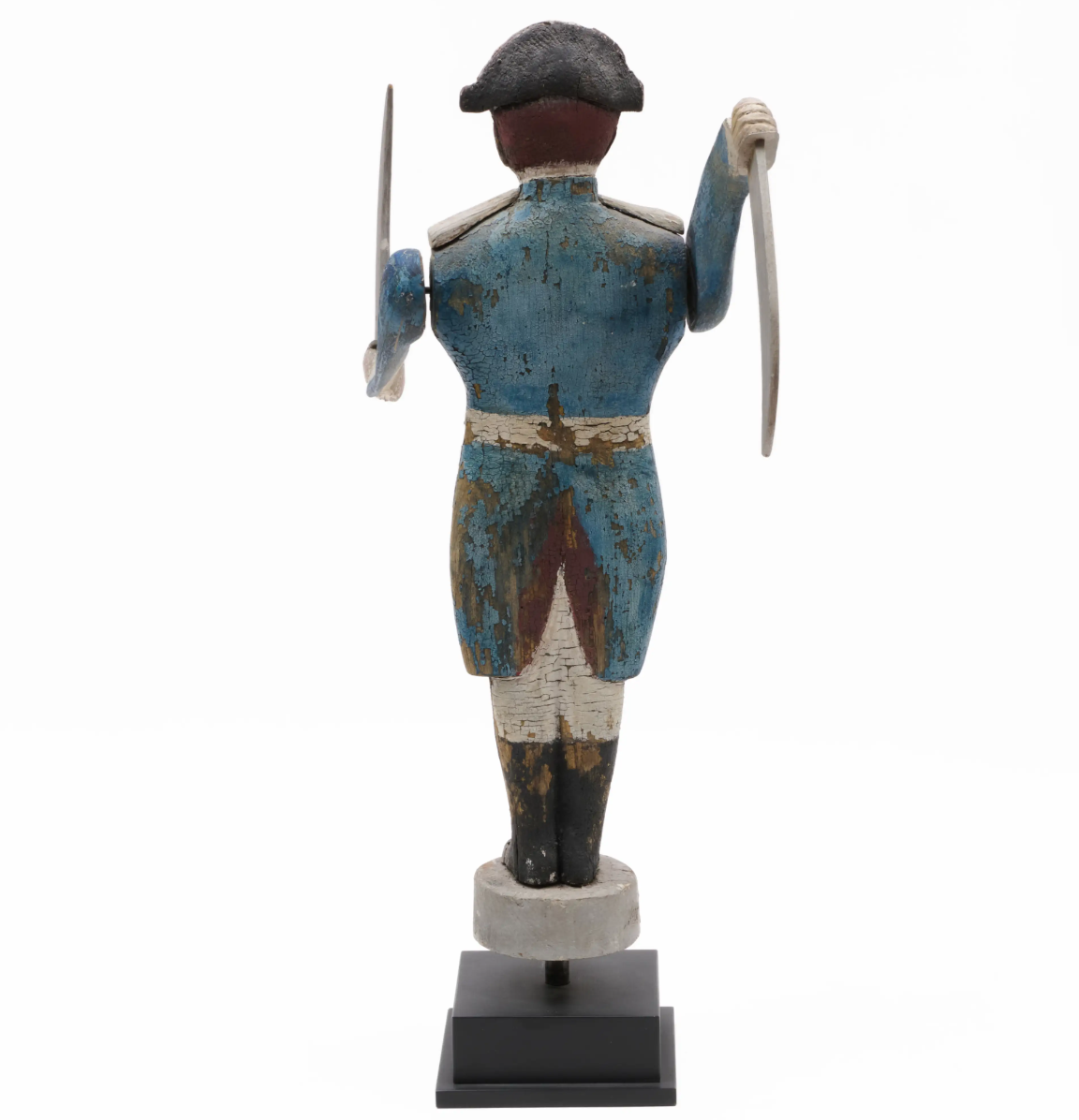 Image 8 of 8
American Military Officer Whirligig An Important Example of Nineteenth-Century, American, circa, 1840-1870.
American, probably Northeastern United States
Probably second or third quarter of the nineteenth century, c. 1840–1870
Representing an American military officer or militia figure in the tradition of c. 1810–1825 military dress
Carved and painted wood with applied wooden and metal elements
23 × 9 × 16 inches.
Provenance: Allan Katz Americana, Woodbridge, Connecticut, 1998
Collection of Dr. Lawrence Gordon, New York
Private Collection.
The Soldier in the Wind
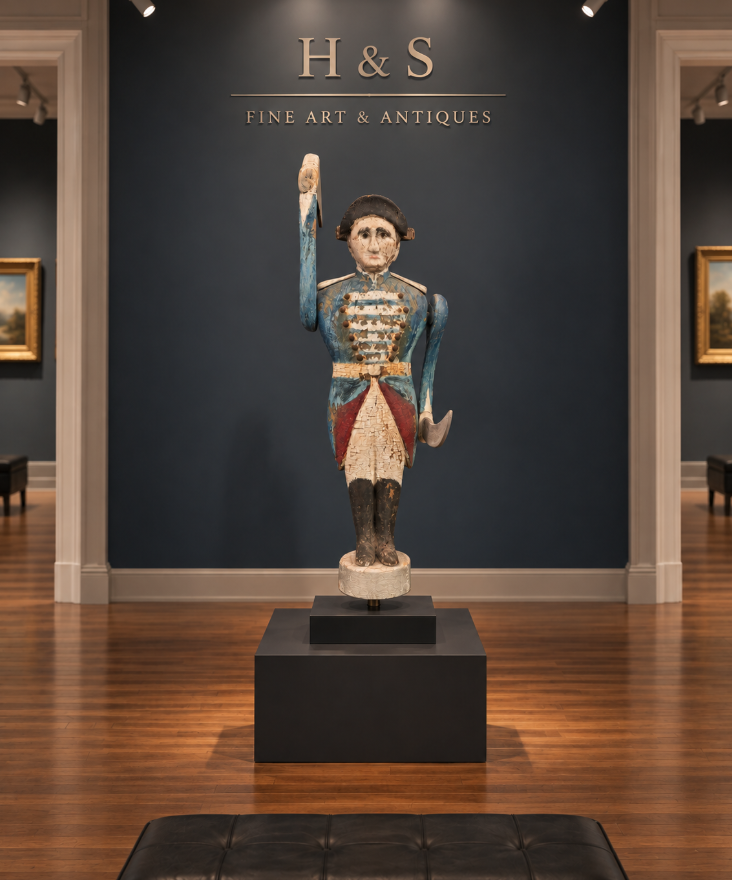
Among the most imaginative creations of nineteenth-century American folk art is the figural whirligig: an object conceived simultaneously as sculpture, mechanical device, outdoor ornament and popular entertainment. Driven by the wind, these figures transformed ordinary people and familiar characters—soldiers, sailors, policemen, farmers and national symbols—into animated presences within the American landscape. The present military figure is an unusually ambitious expression of that tradition. Carved in the round and retaining an extensive early painted surface, the figure represents a military officer standing erect in an elaborate blue uniform. His pale face is individually modeled, his eyes and eyebrows strongly delineated, and his small red mouth gives the otherwise formal figure a remarkably human expression. A black cocked hat crowns the head. White shoulder pieces broaden his silhouette, while rows of raised buttons and horizontal white decoration articulate the chest. A pale belt encircles the waist; red coat panels descend over light-colored trousers; tall black boots anchor the figure to its circular wooden base. His arms are articulated at the shoulders. Attached curved paddles were intended to catch the wind and rotate around the body. The sculpture therefore cannot be understood entirely as a stationary object. Movement was part of its original design. When installed outdoors and viewed against the sky, the rigid military officer would suddenly spring into motion as the wind turned his arms. The effect must have been simultaneously commanding, amusing and theatrical. It is this union of sculpture and movement that gives the American whirligig its distinctive character.
The Uniform and the Early American Military Tradition
The costume provides one of the most fascinating clues to the meaning of the sculpture.
The figure wears a fitted blue coat with a high collar, white shoulder elements, multiple horizontal bands across the breast terminating in applied buttons, a pale waist belt, red lower facings, light trousers, tall black boots and a low black hat resembling a simplified bicorn or cocked hat. This is not the conventional appearance of a Civil War infantryman. Instead, the costume reaches backward toward the elaborate military vocabulary of the Federal period, War of 1812 era and early nineteenth-century American militia tradition.
American military uniforms during the opening decades of the nineteenth century frequently employed dark blue coats, standing collars, contrasting trim, metal buttons and highly visible ornamental elements. Officers and certain specialized units could display significantly more elaborate decoration than ordinary enlisted soldiers. The U.S. Army Center of Military History documents blue coats with ornamental buttonholes and other decorative elements among officers of the War of 1812 period.
Dating the Whirligig
On present evidence, a cautious working date of approximately 1840–1870 is appropriate. The American Folk Art Museum similarly preserves a large American Soldier Whirligig dated 1860–1880, demonstrating that military figures remained established subjects for American whirligig makers well into the second half of the nineteenth century. The present figure could consequently have been created decades after the military era it evokes. This phenomenon was hardly unusual in nineteenth-century America. Images of soldiers from the Revolution and War of 1812 remained powerful symbols of patriotism, national independence and historical memory long after those conflicts had ended.
Purpose: Sculpture Designed to Move
Before entering collections and museums, whirligigs belonged to the outdoors. They were mounted on buildings, barns, workshops, fences, posts and other exposed locations where moving air could operate their mechanisms. Some served as decorative wind indicators; others were advertisements or simply expressions of humor and ingenuity. The principle was beautifully simple. The Wind struck the paddles attached to the articulated arms. The resulting pressure caused the arms to rotate around their axis, bringing the otherwise stationary figure to life. In this example the transformation would have been particularly effective because of the contrast between the soldier's rigid posture and the movement of his arms. The body remains at attention. The wind supplies the action. That juxtaposition may even have contained an element of humor. The authority and discipline represented by the military uniform were subjected to an uncontrollable natural force, causing the dignified officer to perform continuously whenever the wind blew. At the same time, his strong colors and recognizable silhouette would have made him highly visible from a considerable distance. The whirligig therefore existed at the intersection of folk sculpture, mechanical ingenuity, outdoor decoration and public performance.
The Anonymous Carver
The identity of the maker is presently unknown, yet the sculpture reveals considerable information about the person who created it. This was not merely someone cutting a functional wind device from a board. The maker understood the human figure. The torso expands through the shoulders and narrows toward the waist. The legs are integrated into the lower body while remaining individually readable. The boots are carefully differentiated. The head projects convincingly from the torso, and the face has been genuinely carved rather than simply painted onto a flat surface. Particular attention was given to the face. The nose projects strongly. Eyes occupy shallow recesses. Eyebrows are individually painted. Cheeks and chin are modeled, and the restrained red mouth introduces an unexpectedly delicate note into an otherwise robust sculpture. Viewed in profile, the sophistication becomes even more apparent. The projecting face, hat, torso, articulated arms and long curved paddles create a complex silhouette intended to be understood from several directions. The maker also exploited applied ornament. Rows of raised buttons give physical relief to the uniform. Shoulder pieces extend beyond the torso. The painted belt establishes the waist, while red panels emphasize the transition from coat to trousers. The result possesses the immediacy characteristic of exceptional folk sculpture: sophisticated observation translated through remarkably economical means.
Color as Part of the Sculpture
The surviving painted surface is among the object's most compelling qualities. Blue dominates the composition, establishing the military coat and giving the figure its strongest visual identity. White decoration crosses the breast and reappears on the shoulders, belt and trousers. Deep red provides controlled accents along the lower coat. Black defines the hat and boots, while the pale face emerges dramatically from the darker uniform. The palette was not merely decorative. These contrasts would have allowed the figure to be recognized at a distance when originally displayed outdoors. Time has profoundly altered the surface. The paint now exhibits craquelure, abrasion, fading and areas of loss. Different passages of blue have weathered into subtly varying tonalities. White surfaces reveal extensive age cracking, while areas of exposed wood interrupt the original colors. These changes should not automatically be considered defects. They constitute part of the object's biography. A whirligig was made to confront sunlight, rain, wind, changing temperatures and repeated mechanical movement. Its surface consequently records its original existence in a way that a sculpture intended exclusively for an interior does not.
The Soldier as American Symbol
Military figures held a particularly powerful place within nineteenth-century American visual culture.
The young nation repeatedly looked backward toward the Revolution and the War of 1812 as foundational episodes in the creation and defense of American independence. Soldiers consequently appeared in paintings, prints, parade banners, trade signs, toys, carved figures and other forms of popular imagery. The present whirligig belongs to that broader tradition. Whether its maker intended to portray a particular officer may never be known. More important is the recognizable idea of the American soldier that the figure embodies. The cocked hat recalls the early Republic. The elaborate blue uniform communicates military authority. The upright stance suggests discipline. Red, white and blue dominate the surviving palette. Yet all of these formal elements have been filtered through the imagination of an anonymous folk artist. The result is not an academic portrait of military life. It is a vernacular interpretation of it.
From Wind Toy to American Folk Sculpture
Objects such as this were not originally made for museums. Their elevation into the history of American art occurred gradually during the twentieth century, when collectors, artists, dealers and curators began reconsidering objects previously classified simply as crafts, toys, signs or rural curiosities. Among the most influential figures in this reassessment was Abby Aldrich Rockefeller, whose extraordinary collection helped establish American folk art as a serious field of collecting and scholarship. Today, important whirligigs are represented in major institutional collections. The American Folk Art Museum owns an American Soldier Whirligig dated 1860–1880, constructed of painted wood and metal and measuring an impressive 48 × 23 inches. The museum's long-standing scholarly interest in the form is demonstrated by its 1980 exhibition Whirligigs & Wind Toys: Promised Bequest from the Collection of Dorothy and Leo Rabkin. The Abby Aldrich Rockefeller Folk Art Museum at Colonial Williamsburg preserves the particularly relevant military example discussed above, whose early nineteenth-century-inspired costume provides an important interpretive comparison for the present sculpture. These institutional examples demonstrate why the finest whirligigs are now considered within the broader history of American vernacular sculpture, rather than merely as mechanical toys.
Quality and Rarity
Military whirligigs survive in a range of qualities, from simple flat-board figures to highly developed sculptural examples. The importance of the present figure lies not simply in the fact that it represents a soldier, but in the convergence of numerous desirable characteristics within one object. It possesses substantial scale at approximately 23 × 9 × 16 inches; a fully modeled human body; an individually carved face; an unusually elaborate military costume; dimensional shoulder elements and applied buttons; articulated arms; dramatically curved paddles; a powerful profile; extensive surviving early paint; and a surface that retains visible evidence of prolonged age and use. Its military costume provides an additional dimension of historical interest because it appears to preserve imagery substantially earlier than the probable manufacture of the object itself.
Provenance and Collecting History
The modern history of the sculpture can be traced to Allan Katz Americana in 1998, after which it entered the collection of Dr. Lawrence Gordon of New York. Its emergence from a long-established collection is significant. Many important examples of American folk art spent decades outside the marketplace after being recognized and collected during the twentieth century. When such pieces reappear, their documented collecting histories can contribute materially to our understanding of their place within the development of the field.
Selected Museum and Historical References
American Folk Art Museum, New York, Soldier Whirligig, American, 1860–1880, Gift of Frances and Paul Martinson.
Abby Aldrich Rockefeller Folk Art Museum, Colonial Williamsburg Foundation, Whirligig: Soldier, probably New England, 1850–1900, Bequest of Effie Thixton Arthur.
American Folk Art Museum, Whirligigs & Wind Toys: Promised Bequest from the Collection of Dorothy and Leo Rabkin, 1980.
U.S. Army Center of Military History, historical survey of American military uniforms and accoutrements, particularly War of 1812-era officer dress.
American Folk Art Museum, exhibitions and collection literature concerning American vernacular sculpture, patriotic imagery and wind-driven folk art.
Curator's Note
Perhaps the most compelling way to understand this figure is to imagine it not as it appears today—motionless on an exhibition stand—but as its anonymous maker intended it to be seen.
The soldier stood outdoors. Above him was the sky rather than a gallery ceiling. His blue coat, white trousers, red facings and black hat made him visible from a distance. When the air was still, he remained at attention. When the wind rose, his arms began to turn. Suddenly the carved figure became animated. That transformation is fundamental to the sculpture. The maker combined an image associated with discipline, military authority and national memory with one of nature's least controllable forces. The wind determined when the soldier moved, how rapidly he moved and when he became still again. More than a century later, the mechanism is secondary to another kind of movement—the movement of the object through American history. The uniform adds still another layer. Although probably created during the middle decades of the nineteenth century, the figure appears to look backward toward the military imagery of approximately 1810–1825. Like the comparable soldier preserved at Colonial Williamsburg, it may embody a later generation's memory of the soldiers of the early American Republic. Its unknown maker left neither signature nor written explanation. Yet through carving, color, mechanics and extraordinary economy of form, he created something immediately understandable nearly two centuries later.
American, probably Northeastern United States
Probably second or third quarter of the nineteenth century, c. 1840–1870
Representing an American military officer or militia figure in the tradition of c. 1810–1825 military dress
Carved and painted wood with applied wooden and metal elements
23 × 9 × 16 inches.
Provenance: Allan Katz Americana, Woodbridge, Connecticut, 1998
Collection of Dr. Lawrence Gordon, New York
Private Collection.
The Soldier in the Wind
Among the most imaginative creations of nineteenth-century American folk art is the figural whirligig: an object conceived simultaneously as sculpture, mechanical device, outdoor ornament and popular entertainment. Driven by the wind, these figures transformed ordinary people and familiar characters—soldiers, sailors, policemen, farmers and national symbols—into animated presences within the American landscape. The present military figure is an unusually ambitious expression of that tradition. Carved in the round and retaining an extensive early painted surface, the figure represents a military officer standing erect in an elaborate blue uniform. His pale face is individually modeled, his eyes and eyebrows strongly delineated, and his small red mouth gives the otherwise formal figure a remarkably human expression. A black cocked hat crowns the head. White shoulder pieces broaden his silhouette, while rows of raised buttons and horizontal white decoration articulate the chest. A pale belt encircles the waist; red coat panels descend over light-colored trousers; tall black boots anchor the figure to its circular wooden base. His arms are articulated at the shoulders. Attached curved paddles were intended to catch the wind and rotate around the body. The sculpture therefore cannot be understood entirely as a stationary object. Movement was part of its original design. When installed outdoors and viewed against the sky, the rigid military officer would suddenly spring into motion as the wind turned his arms. The effect must have been simultaneously commanding, amusing and theatrical. It is this union of sculpture and movement that gives the American whirligig its distinctive character.
The Uniform and the Early American Military Tradition
The costume provides one of the most fascinating clues to the meaning of the sculpture.
The figure wears a fitted blue coat with a high collar, white shoulder elements, multiple horizontal bands across the breast terminating in applied buttons, a pale waist belt, red lower facings, light trousers, tall black boots and a low black hat resembling a simplified bicorn or cocked hat. This is not the conventional appearance of a Civil War infantryman. Instead, the costume reaches backward toward the elaborate military vocabulary of the Federal period, War of 1812 era and early nineteenth-century American militia tradition.
American military uniforms during the opening decades of the nineteenth century frequently employed dark blue coats, standing collars, contrasting trim, metal buttons and highly visible ornamental elements. Officers and certain specialized units could display significantly more elaborate decoration than ordinary enlisted soldiers. The U.S. Army Center of Military History documents blue coats with ornamental buttonholes and other decorative elements among officers of the War of 1812 period.
Dating the Whirligig
On present evidence, a cautious working date of approximately 1840–1870 is appropriate. The American Folk Art Museum similarly preserves a large American Soldier Whirligig dated 1860–1880, demonstrating that military figures remained established subjects for American whirligig makers well into the second half of the nineteenth century. The present figure could consequently have been created decades after the military era it evokes. This phenomenon was hardly unusual in nineteenth-century America. Images of soldiers from the Revolution and War of 1812 remained powerful symbols of patriotism, national independence and historical memory long after those conflicts had ended.
Purpose: Sculpture Designed to Move
Before entering collections and museums, whirligigs belonged to the outdoors. They were mounted on buildings, barns, workshops, fences, posts and other exposed locations where moving air could operate their mechanisms. Some served as decorative wind indicators; others were advertisements or simply expressions of humor and ingenuity. The principle was beautifully simple. The Wind struck the paddles attached to the articulated arms. The resulting pressure caused the arms to rotate around their axis, bringing the otherwise stationary figure to life. In this example the transformation would have been particularly effective because of the contrast between the soldier's rigid posture and the movement of his arms. The body remains at attention. The wind supplies the action. That juxtaposition may even have contained an element of humor. The authority and discipline represented by the military uniform were subjected to an uncontrollable natural force, causing the dignified officer to perform continuously whenever the wind blew. At the same time, his strong colors and recognizable silhouette would have made him highly visible from a considerable distance. The whirligig therefore existed at the intersection of folk sculpture, mechanical ingenuity, outdoor decoration and public performance.
The Anonymous Carver
The identity of the maker is presently unknown, yet the sculpture reveals considerable information about the person who created it. This was not merely someone cutting a functional wind device from a board. The maker understood the human figure. The torso expands through the shoulders and narrows toward the waist. The legs are integrated into the lower body while remaining individually readable. The boots are carefully differentiated. The head projects convincingly from the torso, and the face has been genuinely carved rather than simply painted onto a flat surface. Particular attention was given to the face. The nose projects strongly. Eyes occupy shallow recesses. Eyebrows are individually painted. Cheeks and chin are modeled, and the restrained red mouth introduces an unexpectedly delicate note into an otherwise robust sculpture. Viewed in profile, the sophistication becomes even more apparent. The projecting face, hat, torso, articulated arms and long curved paddles create a complex silhouette intended to be understood from several directions. The maker also exploited applied ornament. Rows of raised buttons give physical relief to the uniform. Shoulder pieces extend beyond the torso. The painted belt establishes the waist, while red panels emphasize the transition from coat to trousers. The result possesses the immediacy characteristic of exceptional folk sculpture: sophisticated observation translated through remarkably economical means.
Color as Part of the Sculpture
The surviving painted surface is among the object's most compelling qualities. Blue dominates the composition, establishing the military coat and giving the figure its strongest visual identity. White decoration crosses the breast and reappears on the shoulders, belt and trousers. Deep red provides controlled accents along the lower coat. Black defines the hat and boots, while the pale face emerges dramatically from the darker uniform. The palette was not merely decorative. These contrasts would have allowed the figure to be recognized at a distance when originally displayed outdoors. Time has profoundly altered the surface. The paint now exhibits craquelure, abrasion, fading and areas of loss. Different passages of blue have weathered into subtly varying tonalities. White surfaces reveal extensive age cracking, while areas of exposed wood interrupt the original colors. These changes should not automatically be considered defects. They constitute part of the object's biography. A whirligig was made to confront sunlight, rain, wind, changing temperatures and repeated mechanical movement. Its surface consequently records its original existence in a way that a sculpture intended exclusively for an interior does not.
The Soldier as American Symbol
Military figures held a particularly powerful place within nineteenth-century American visual culture.
The young nation repeatedly looked backward toward the Revolution and the War of 1812 as foundational episodes in the creation and defense of American independence. Soldiers consequently appeared in paintings, prints, parade banners, trade signs, toys, carved figures and other forms of popular imagery. The present whirligig belongs to that broader tradition. Whether its maker intended to portray a particular officer may never be known. More important is the recognizable idea of the American soldier that the figure embodies. The cocked hat recalls the early Republic. The elaborate blue uniform communicates military authority. The upright stance suggests discipline. Red, white and blue dominate the surviving palette. Yet all of these formal elements have been filtered through the imagination of an anonymous folk artist. The result is not an academic portrait of military life. It is a vernacular interpretation of it.
From Wind Toy to American Folk Sculpture
Objects such as this were not originally made for museums. Their elevation into the history of American art occurred gradually during the twentieth century, when collectors, artists, dealers and curators began reconsidering objects previously classified simply as crafts, toys, signs or rural curiosities. Among the most influential figures in this reassessment was Abby Aldrich Rockefeller, whose extraordinary collection helped establish American folk art as a serious field of collecting and scholarship. Today, important whirligigs are represented in major institutional collections. The American Folk Art Museum owns an American Soldier Whirligig dated 1860–1880, constructed of painted wood and metal and measuring an impressive 48 × 23 inches. The museum's long-standing scholarly interest in the form is demonstrated by its 1980 exhibition Whirligigs & Wind Toys: Promised Bequest from the Collection of Dorothy and Leo Rabkin. The Abby Aldrich Rockefeller Folk Art Museum at Colonial Williamsburg preserves the particularly relevant military example discussed above, whose early nineteenth-century-inspired costume provides an important interpretive comparison for the present sculpture. These institutional examples demonstrate why the finest whirligigs are now considered within the broader history of American vernacular sculpture, rather than merely as mechanical toys.
Quality and Rarity
Military whirligigs survive in a range of qualities, from simple flat-board figures to highly developed sculptural examples. The importance of the present figure lies not simply in the fact that it represents a soldier, but in the convergence of numerous desirable characteristics within one object. It possesses substantial scale at approximately 23 × 9 × 16 inches; a fully modeled human body; an individually carved face; an unusually elaborate military costume; dimensional shoulder elements and applied buttons; articulated arms; dramatically curved paddles; a powerful profile; extensive surviving early paint; and a surface that retains visible evidence of prolonged age and use. Its military costume provides an additional dimension of historical interest because it appears to preserve imagery substantially earlier than the probable manufacture of the object itself.
Provenance and Collecting History
The modern history of the sculpture can be traced to Allan Katz Americana in 1998, after which it entered the collection of Dr. Lawrence Gordon of New York. Its emergence from a long-established collection is significant. Many important examples of American folk art spent decades outside the marketplace after being recognized and collected during the twentieth century. When such pieces reappear, their documented collecting histories can contribute materially to our understanding of their place within the development of the field.
Selected Museum and Historical References
American Folk Art Museum, New York, Soldier Whirligig, American, 1860–1880, Gift of Frances and Paul Martinson.
Abby Aldrich Rockefeller Folk Art Museum, Colonial Williamsburg Foundation, Whirligig: Soldier, probably New England, 1850–1900, Bequest of Effie Thixton Arthur.
American Folk Art Museum, Whirligigs & Wind Toys: Promised Bequest from the Collection of Dorothy and Leo Rabkin, 1980.
U.S. Army Center of Military History, historical survey of American military uniforms and accoutrements, particularly War of 1812-era officer dress.
American Folk Art Museum, exhibitions and collection literature concerning American vernacular sculpture, patriotic imagery and wind-driven folk art.
Curator's Note
Perhaps the most compelling way to understand this figure is to imagine it not as it appears today—motionless on an exhibition stand—but as its anonymous maker intended it to be seen.
The soldier stood outdoors. Above him was the sky rather than a gallery ceiling. His blue coat, white trousers, red facings and black hat made him visible from a distance. When the air was still, he remained at attention. When the wind rose, his arms began to turn. Suddenly the carved figure became animated. That transformation is fundamental to the sculpture. The maker combined an image associated with discipline, military authority and national memory with one of nature's least controllable forces. The wind determined when the soldier moved, how rapidly he moved and when he became still again. More than a century later, the mechanism is secondary to another kind of movement—the movement of the object through American history. The uniform adds still another layer. Although probably created during the middle decades of the nineteenth century, the figure appears to look backward toward the military imagery of approximately 1810–1825. Like the comparable soldier preserved at Colonial Williamsburg, it may embody a later generation's memory of the soldiers of the early American Republic. Its unknown maker left neither signature nor written explanation. Yet through carving, color, mechanics and extraordinary economy of form, he created something immediately understandable nearly two centuries later.