 Image 1 of 3
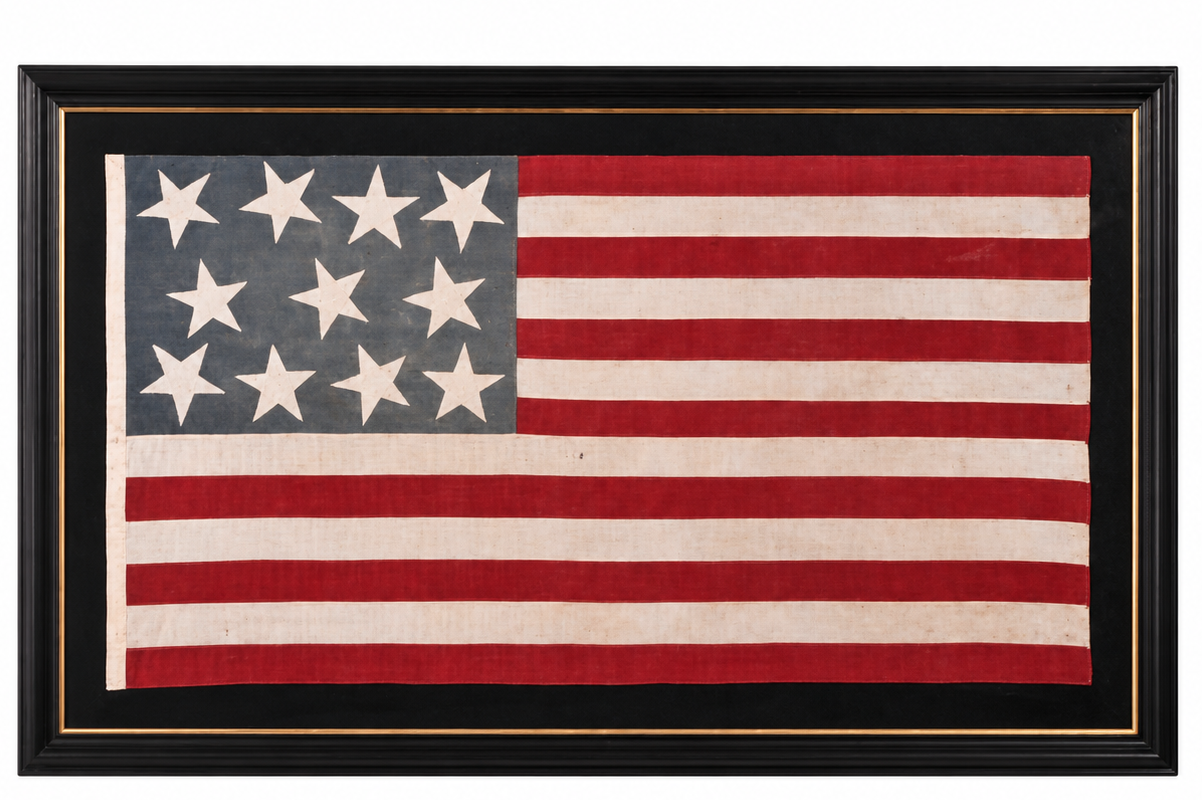 Image 2 of 3
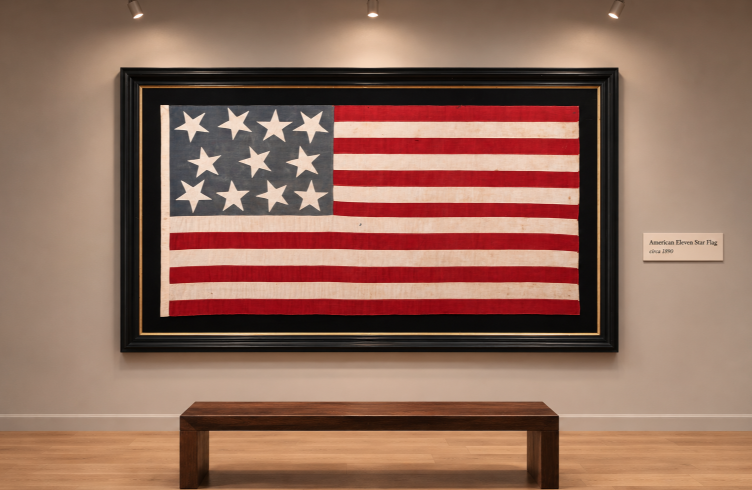 Image 3 of 3
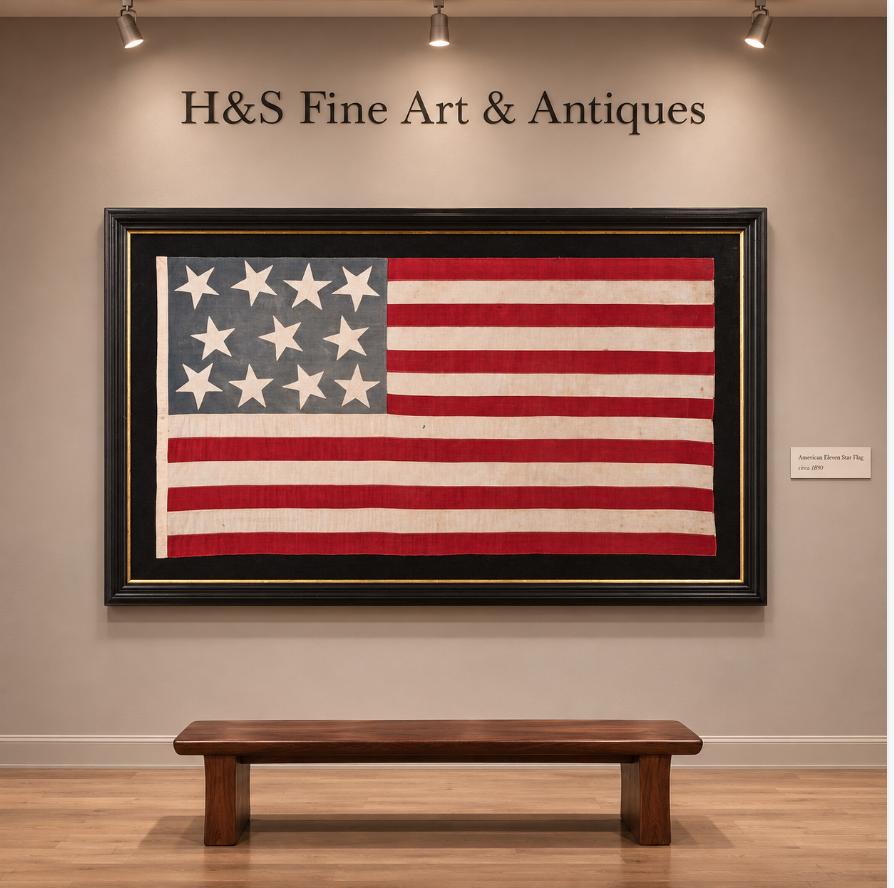
American Eleven Star Flag United States, circa 1890. Provenance Jeff R. Bridgman Antiques, Inc., York County, Pennsylvania.
American Eleven Star Flag
United States, circa 1890
Cotton with machine-sewn stars and stripes
Framed size: 35 × 64 inches.
Provenance
Jeff R. Bridgman Antiques, Inc., York County, Pennsylvania, bearing the firm’s descriptive label on the reverse.
Description:
Eleven large white stars animate the blue canton of this unusual late nineteenth-century American flag. Arranged in three staggered rows of four, three, and four, they create an open, balanced composition above thirteen alternating red and white stripes. Their generous scale and varied orientations give the canton a lively character, while the long horizontal bands establish a measured rhythm across the textile. The stars differ subtly in the proportions of their points and in their angles of rotation. These variations are especially apparent in the close photograph of the canton, where the individual silhouettes interrupt the regularity of the rows. The resulting design has considerable visual presence: recognizable as the Stars and Stripes, yet immediately distinctive in the number and disposition of its stars. The flag retains seven red stripes and six white stripes, beginning and ending with red. A narrow white heading runs along the hoist, or staff edge. The canton occupies the upper seven stripe positions and terminates above the broad white stripe extending across the flag below it. In its present mounting, the softened blue, warm white, and red are set against a black background, framed by a narrow gilt liner.
Materials and Stitching
According to the Bridgman label, the flag is made entirely of cotton. The white stars are separate pieces of fabric attached to the canton by linear machine stitching. The red and white stripes are individually pieced and joined with the same type of stitch.
This construction distinguishes the flag from a printed parade flag, in which the stars and stripes are reproduced on a continuous sheet of cloth. Here, the design is built through the cutting, placement, and joining of separate textile elements. The seams and appliqué contribute to its texture as well as its appearance.
Machine sewing is integral to the existing specialist description. The flag should therefore be catalogued as machine sewn rather than hand sewn. The slightly irregular star shapes do not establish hand stitching: the shape of a cut textile element and the method used to attach it are separate matters.
The Eleven Stars
The eleven-star canton is the flag's defining historical feature. Eleven was never an official United States national flag star count. The Flag Resolution of 1777 began with thirteen stars, and the 1818 Flag Act established thirteen stripes with a star for each state, new stars becoming effective on the Fourth of July following admission. [1]
This flag consequently belongs to the broader category of American national flag variants. Its star count cannot be read as a straightforward date of statehood. Nor does the arrangement identify a particular state, military unit, political campaign, or commemorative event.
The eleven stars occupy a coherent 4–3–4 arrangement in the visible canton. Their spacing reads as a complete composition, although photographs alone cannot exclude earlier alterations or establish the maker's intention. The accompanying Bridgman label addresses the possibility of a Southern association. It notes that some eleven-star versions of the Stars and Stripes were made during and after the Civil War with Confederate sympathies, but concludes that this flag's later date and thirteen-stripe construction do not provide the expected evidence for that interpretation. Its original purpose remains unresolved.
That distinction is central to an accurate presentation. The label does not attribute this flag to Confederate use, and the number eleven alone is insufficient to do so. Its established identity is an American Stars and Stripes variant of approximately 1890.
Period and Historical Context
The specialist dating places the textile in the late nineteenth century, within the period commonly described as the Gilded Age. It belongs to a time when national emblems appeared throughout public and domestic life, and when flags could carry historical, commemorative, and personal meanings beyond a current state count.
Benjamin Harrison, the twenty-third president of the United States, served from 1889 to 1893 and was president in 1890, the approximate date assigned to this flag. Because the attribution is circa 1890 rather than an inscribed manufacturing date, his presidency provides historical context rather than proof of the exact administration in which the flag was made. [8]
The years surrounding 1890 brought striking changes to the map of the nation. North Dakota, South Dakota, Montana, and Washington entered the Union in November 1889; Idaho and Wyoming followed in July 1890. Six states were admitted during Harrison's presidency. Under the flag law's July Fourth timetable, the official national flag changed from thirty-eight to forty-three stars on July 4, 1890, and to forty-four on July 4, 1891. The present eleven-star canton thus stands apart from the current state counts of its attributed period. [1, 8]
This was also an age of expanding industry, transportation, and communications, accompanied by deep disparities in wealth and working conditions. Concern about concentrated corporate power helped produce the Sherman Antitrust Act, signed by Harrison on July 2, 1890. The flag's machine stitching belongs to the material world of this industrial era, although it does not identify a factory, workshop, or particular maker. [9, 10]
The 1890 census marked another transition: the Census Bureau reported that settlement had become too dispersed for a single frontier line to be drawn. That statistical description later became a familiar symbol of a changing American West. These events establish the wider setting of the flag's attributed manufacture; no direct association between this textile and a statehood celebration, political campaign, or other event has been documented. [11]
Earlier star counts continued in use long after the admission of additional states. Grace Rogers Cooper's Smithsonian study, Thirteen-Star Flags: Keys to Identification, documents the persistence of thirteen-star flags into the later nineteenth and early twentieth centuries. Her work demonstrates why a reduced star count cannot, by itself, establish an early manufacturing date. It does not, however, provide an explanation for this flag's eleven stars. [2]
The present example is best understood within that wider history of variation. Its machine-sewn construction and accompanying specialist assessment support a late nineteenth-century attribution; its unusual canton preserves a question about use and meaning that the surviving documentation does not answer.
Museum and Collection Comparisons
The following examples provide historical and material context. None is presented as an exact eleven-star counterpart, and none forms part of this flag's provenance.
National Museum of American History, Smithsonian Institution — United States National 34-Star Flag, object nmah_506840. The museum describes a blue canton with thirty-four white stars and thirteen stripes, and notes that flag makers employed multiple designs for the thirty-four-star flag. The comparison places the present textile within a broader tradition of nineteenth-century flag design variation, while differing in date and star count. [3]
National Museum of African American History and Culture, Smithsonian Institution — Flag for a reunion of 54th Massachusetts Infantry survivors of Fort Wagner, object 2024.32.4. This muslin flag has forty-two stars and thirteen stripes and commemorates an 1890 Boston reunion. Its documented occasion offers a useful comparison near the present flag's attributed date. It demonstrates the importance of inscriptions and associated records in connecting a flag to an event; no comparable event documentation has yet been identified for the H&S flag. [4]
Zaricor Flag Collection — Thirteen-Star Centennial Commemorative Flag, ZFC0605. This flag combines a wool field with cotton stars in an unusual arrangement of ten stars around three central stars. The collection associates it with the Centennial era and records its display at the Presidio of San Francisco's Officers' Club in 2003 and the Star-Spangled Banner Flag House in Baltimore in 2004. It offers a comparison for the continuing use of reduced star counts and for designs whose precise symbolism remains uncertain. It differs from the present example in materials, arrangement, and star count. [5]
Collector's Note
The interest of this flag lies in the relationship between a familiar national design and an unresolved variation. Its thirteen stripes preserve the recognizable structure of the American flag, while the eleven large stars give the canton an individual character. The changing angles of their points and the open spacing of the 4–3–4 arrangement reward close looking.
For collectors of Americana and historic textiles, it offers a distinctive combination of sewn construction, strong graphic presence, and an accompanying specialist label. Its unidentified purpose is part of its surviving history. Presented with that uncertainty intact, it invites consideration both as a late nineteenth-century textile and as an individual expression of America's most recognizable emblem.
Comparative literature and institutional references
Smithsonian Institution. “Facts about the United States Flag.” Historical summary of the Flag Resolutions and Acts. https://www.si.edu/spotlight/flag-day/flag-facts
Cooper, Grace Rogers. Thirteen-Star Flags: Keys to Identification. Smithsonian Studies in History and Technology, no. 21. Washington, D.C.: Smithsonian Institution Press, 1973, pp. 1–62. https://doi.org/10.5479/si.00810258.21.1
National Museum of American History. “United States National 34-Star Flag.” Object nmah_506840. https://americanhistory.si.edu/collections/object/nmah_506840
National Museum of African American History and Culture. “Flag for a reunion of 54th Massachusetts Infantry survivors of Fort Wagner.” Object 2024.32.4. https://nmaahc.si.edu/object/nmaahc_2024.32.4
Zaricor Flag Collection. “U.S. 13 Stars Flag, Commemorative Centennial 1876.” ZFC0605. https://www.flagcollection.com/itemdetails-print.php?CollectionItem_ID=2576
SFO Museum. American Folk Art: An Enduring Legacy. November 18, 2017–July 15, 2018. https://www.sfomuseum.org/exhibitions/american-folk-art-enduring-legacy
Mastai, Boleslaw, and Marie-Louise d'Otrange Mastai. The Stars and the Stripes: The American Flag as Art and as History from the Birth of the Republic to the Present. New York: Alfred A. Knopf, 1973. General comparative reading on flags as historical objects and folk art; no claim is made that the present flag is illustrated or discussed in this volume.
.
.