 Image 1 of 6
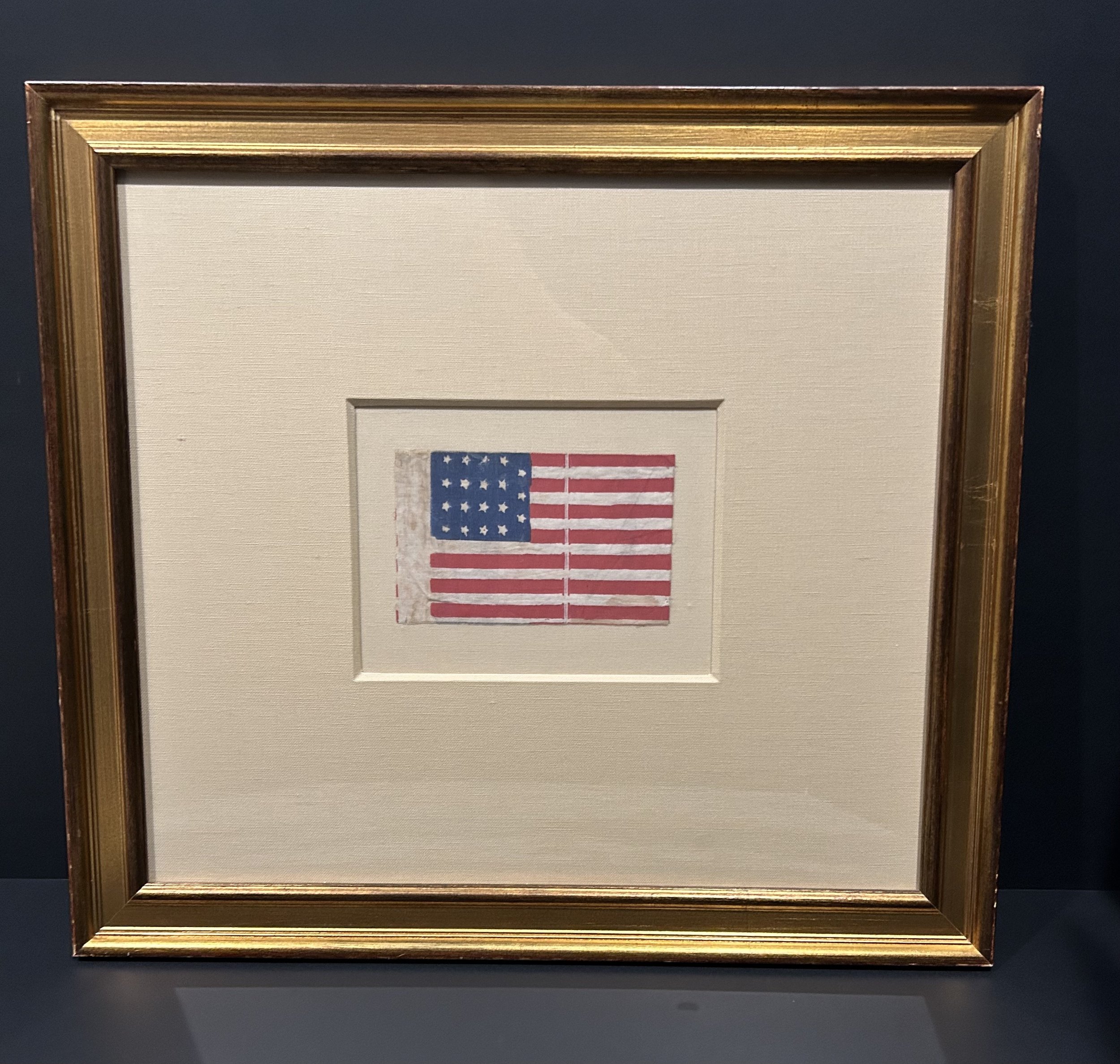 Image 2 of 6
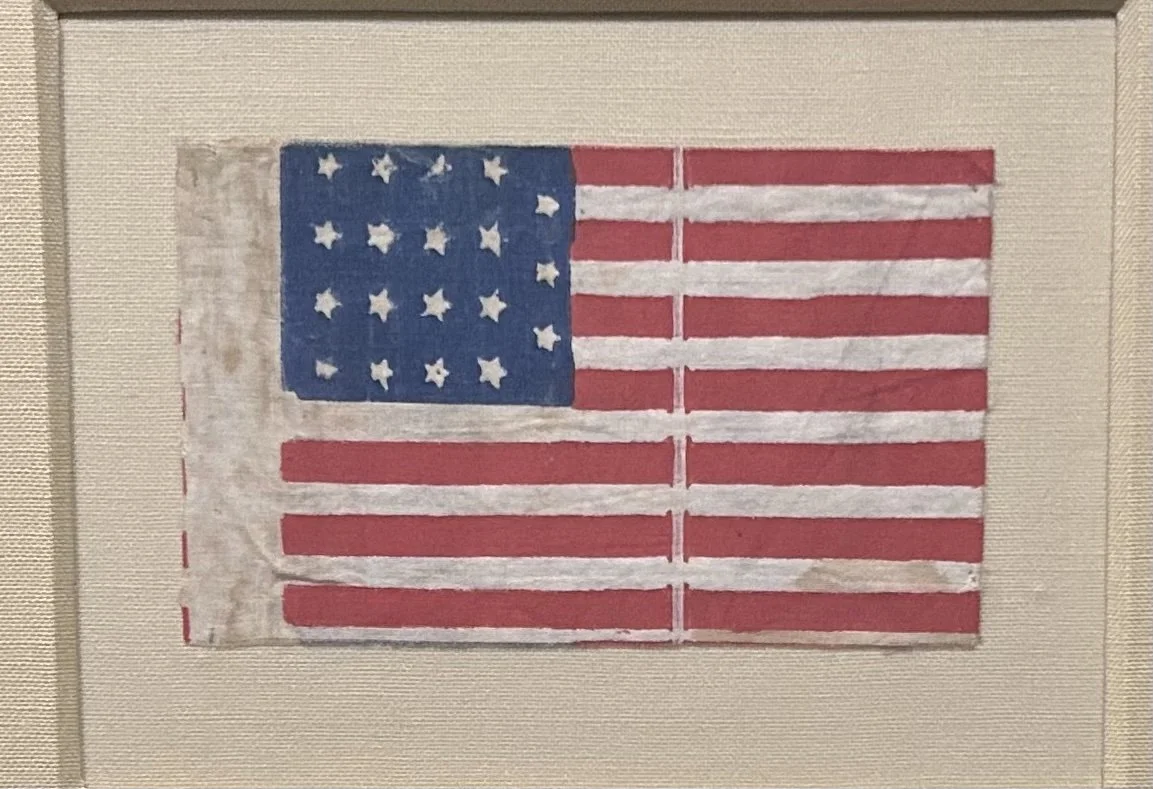 Image 3 of 6
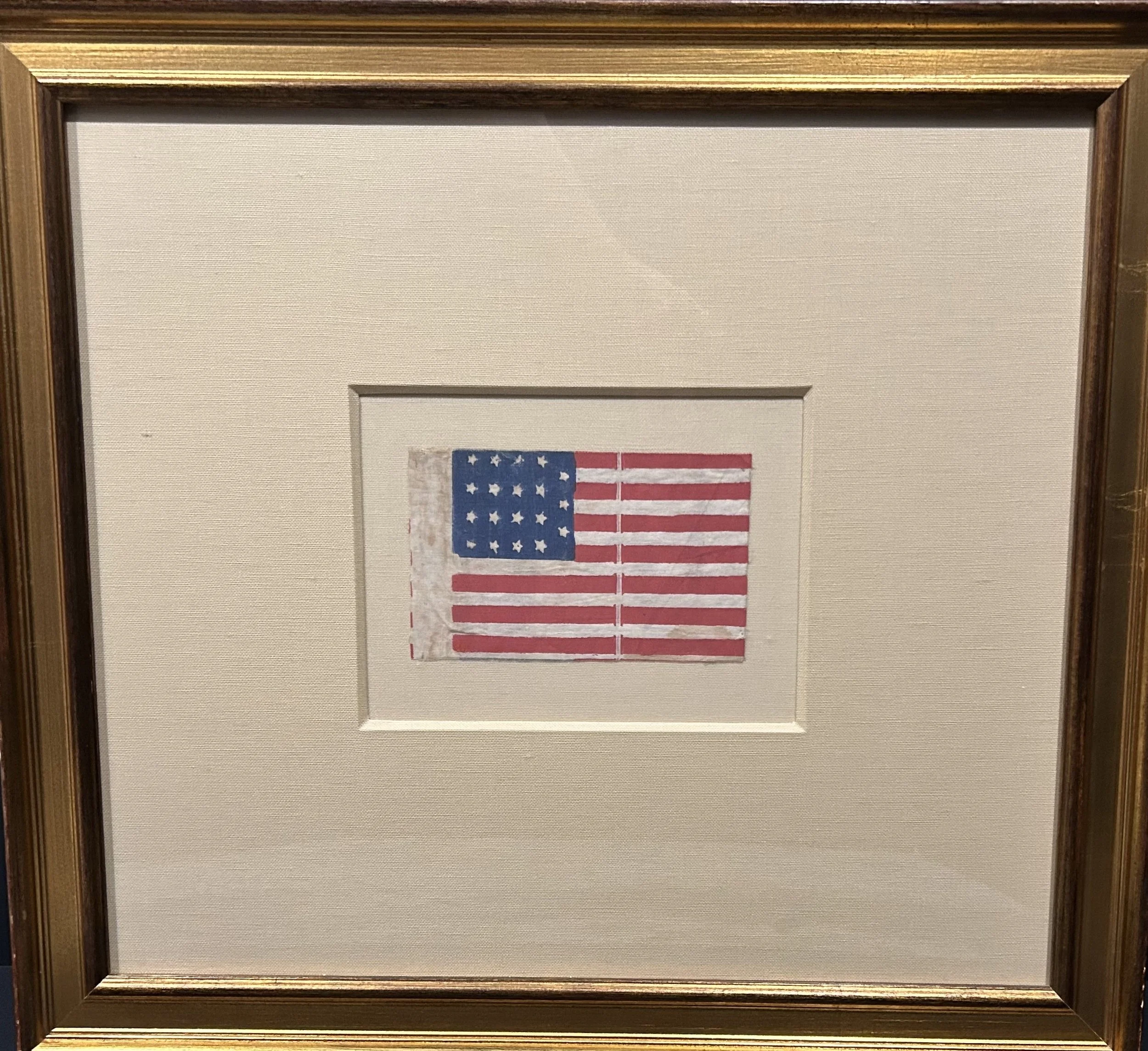 Image 4 of 6
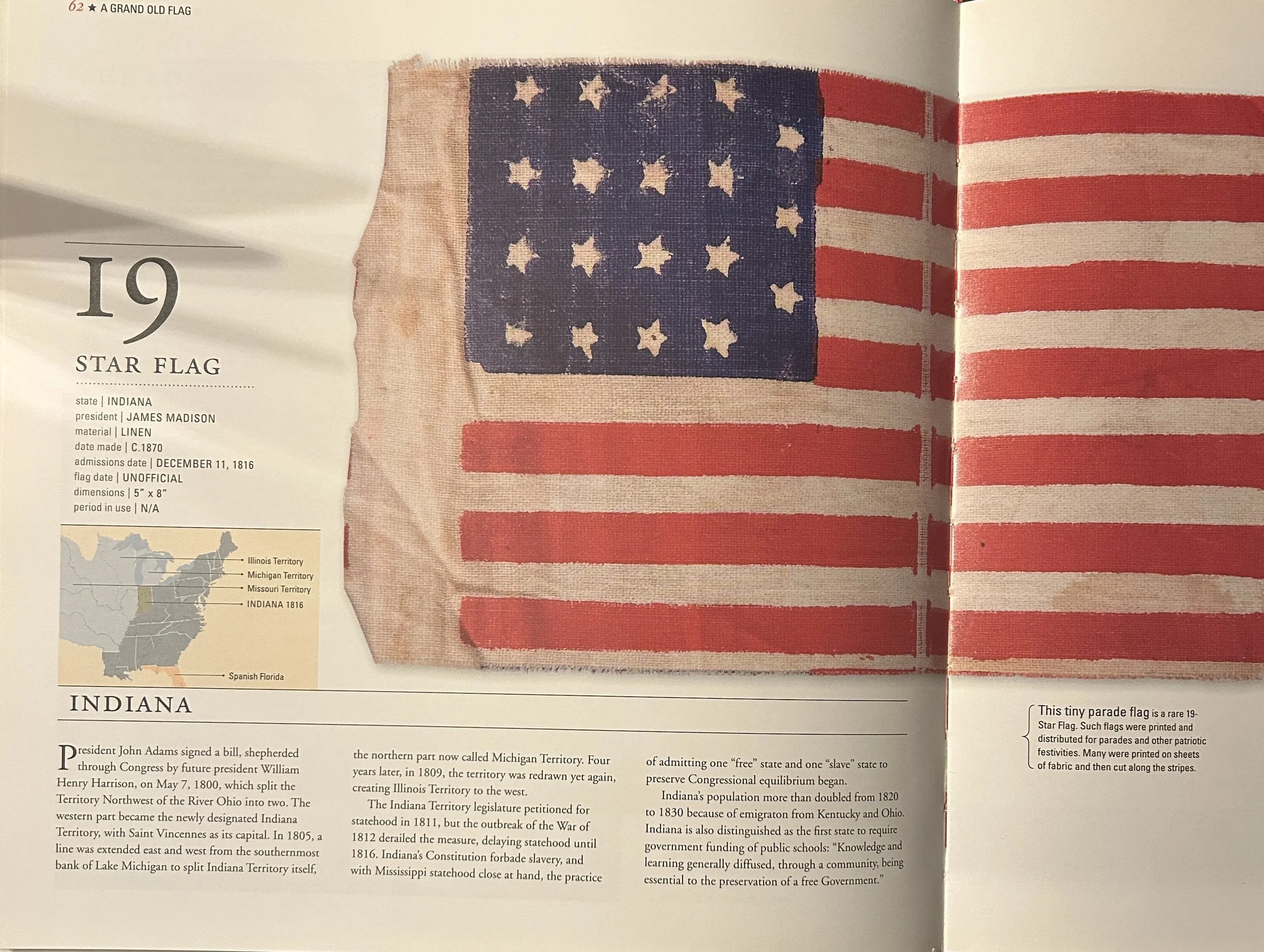 Image 5 of 6
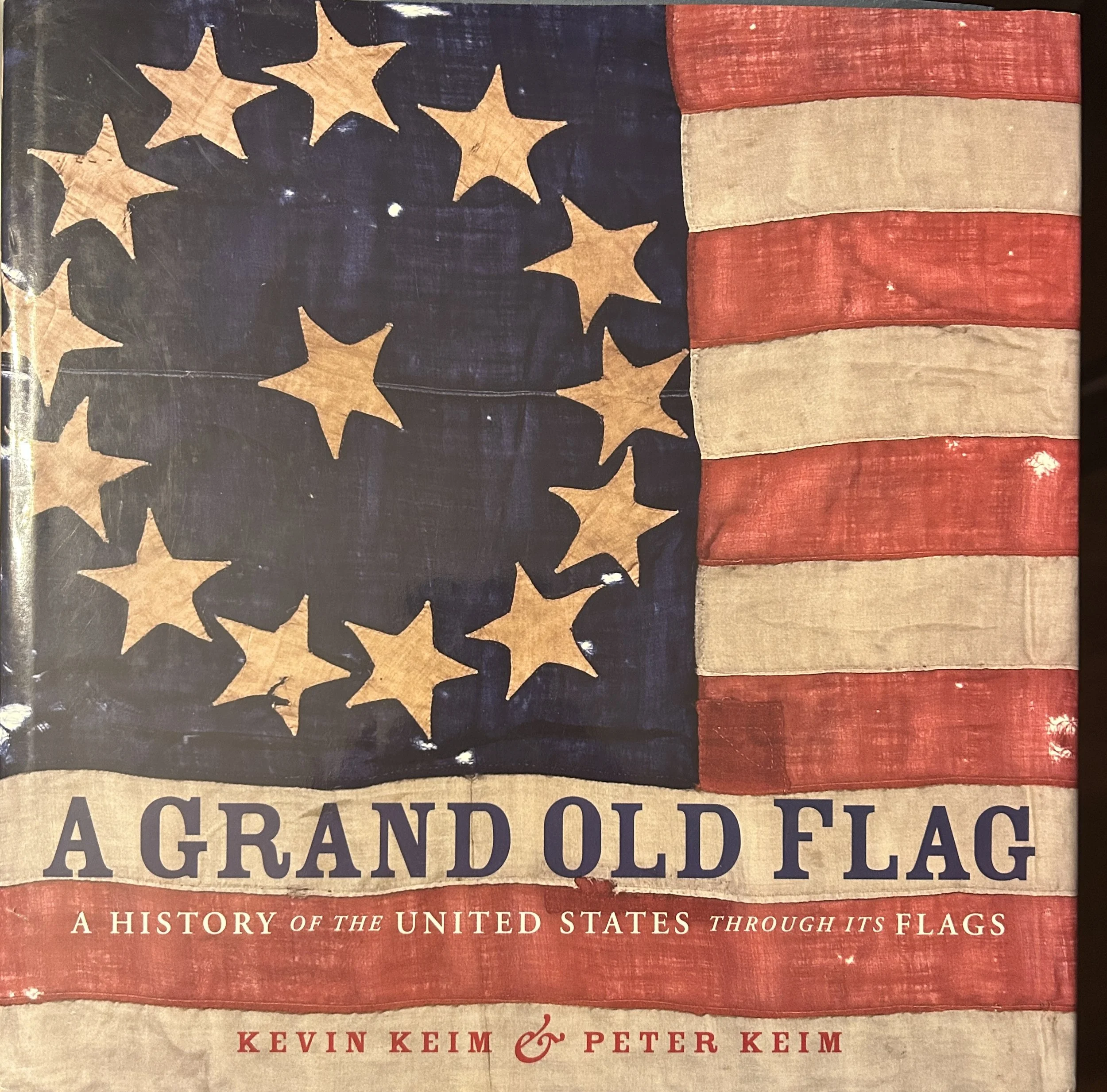 Image 6 of 6
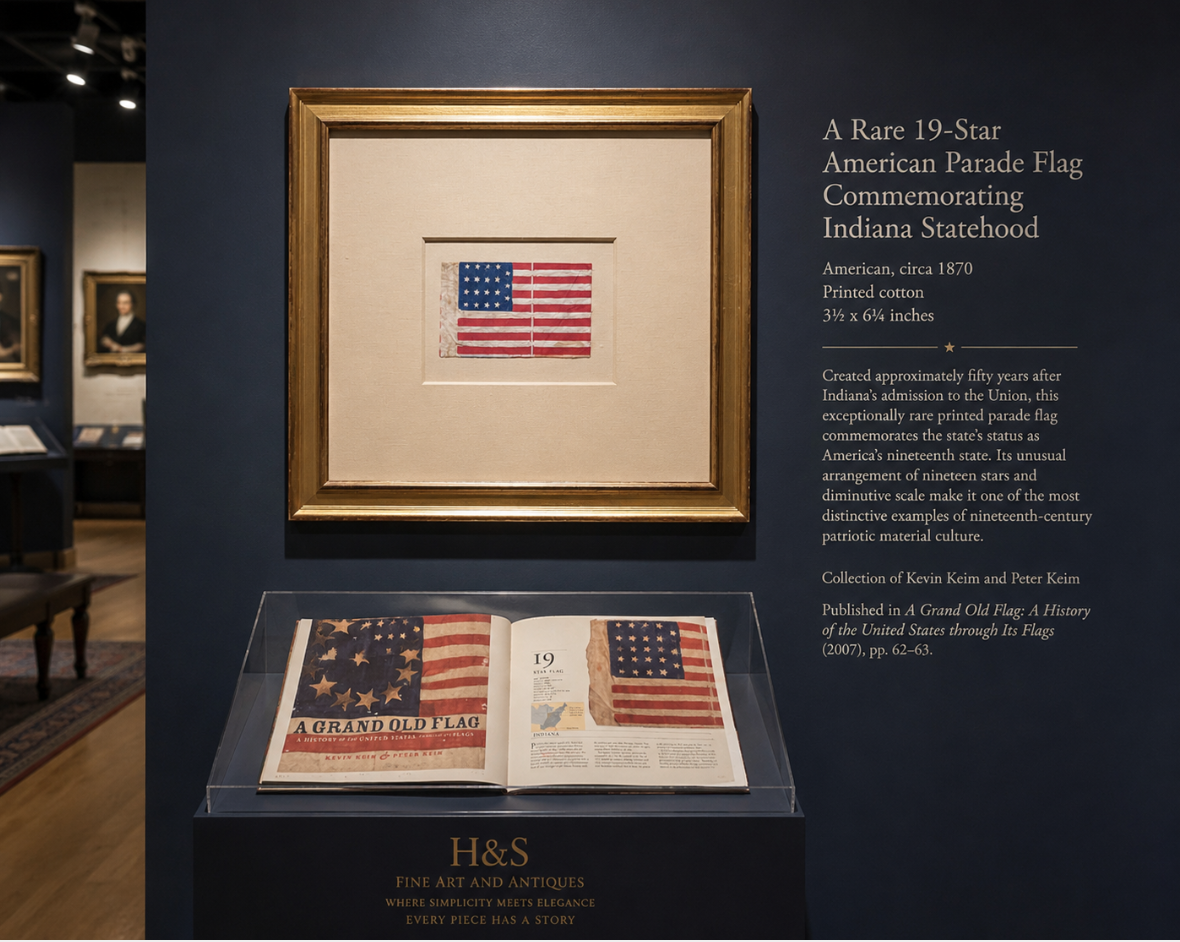
A Rare 19-Star American Parade Flag commemorating Indiana Statehood, circa 1870. Collection of Kevin Keim and Peter Keim.
A Rare 19-Star American Parade Flag Commemorating Indiana Statehood
American, Circa 1870
Printed cotton parade flag
Dimensions: 3½ × 6¼ inches
Provenance: Collection of Kevin Keim and Peter Keim
Published: A Grand Old Flag: A History of the United States through Its Flags (2007), pp. 62–63
Exhibition Essay
Nineteen Stars for the Nineteenth State: Indiana and the Memory of Union
Among the most elusive and historically intriguing forms of American patriotica are the tiny printed parade flags produced during the nineteenth century. Though modest in scale, these ephemeral objects often preserve extraordinary stories of statehood, national identity, and collective memory. This exceedingly rare 19-star American parade flag, created around 1870 to commemorate the admission of Indiana into the Union, is one such artifact.
Measuring only 3½ by 6¼ inches, the flag is printed on cotton and possesses a charming simplicity that belies its historical significance. Intended to be waved during civic celebrations and patriotic festivities, this small textile represents one of the rarest star counts found among surviving American flags.
Indiana: The Nineteenth State
On December 11, 1816, during the presidency of James Madison, Indiana was admitted as the nineteenth state of the United States.
Indiana's admission occurred during one of the most delicate political periods in early American history. The nation was rapidly expanding westward, and each new state's admission carried profound political implications. Indiana entered the Union as a free state, reviving the practice of admitting free and slave states in relative succession in order to preserve balance within the United States Senate.
Indiana's constitution was itself remarkably progressive for the period. It:
Prohibited slavery;
Required governmental support for public education;
Declared that knowledge and learning were essential to preserving republican government.
The constitution proclaimed:
"Knowledge and learning generally diffused through a community being essential to the preservation of a free Government."
This commitment distinguished Indiana as one of America's earliest states to enshrine public education as a fundamental civic responsibility.
The Nineteenth Star
Although Indiana joined the Union in December 1816, the nineteenth star was officially added to the national flag on July 4, 1818, following the provisions of the Flag Act of 1818.
The 19-star count was therefore in official use for only a brief period, from July 4, 1818, until July 3, 1819, when Illinois became the twentieth state and necessitated another star.
Because of this short official lifespan, original 19-star flags are extraordinarily rare. Few were made and even fewer survived.
A Commemorative Flag of the Reconstruction Era
Interestingly, this example was not produced during Indiana's statehood period itself but approximately fifty years later, around 1870.
The decades following the Civil War witnessed an explosion of patriotic remembrance throughout the United States. Americans increasingly looked backward to celebrate the nation's founding, the growth of the Union, and the sacrifices that had preserved it.
The production of commemorative flags during this period reflected:
Renewed national pride after Union victory;
Interest in state anniversaries and local history;
Growing historical consciousness leading toward the Centennial celebrations of 1876;
The rise of collecting and preserving historical relics.
This tiny flag was likely distributed during patriotic festivities, public commemorations, civic events, or educational celebrations honoring Indiana's place within the Union.
An Unusual and Highly Distinctive Star Configuration
The canton contains one of the most unusual and visually compelling arrangements found on nineteenth-century American flags.
The stars are arranged:
In four rows of four stars (16 stars)
With three additional stars positioned vertically along the fly side of the canton
This asymmetrical arrangement creates a total of nineteen stars.
During the nineteenth century there were no federal regulations governing how stars were to be arranged. Printers and flag makers exercised considerable artistic freedom, producing extraordinary designs that ranged from circles and medallions to diamonds, shields, and highly imaginative asymmetrical compositions.
This inventive arrangement is one of the characteristics that makes this flag so desirable to collectors and historians alike.
Parade Flags and Popular Patriotism
Parade flags were among the most democratic expressions of nineteenth-century American patriotism.
Unlike large sewn flags flown from ships or government buildings, these printed flags were inexpensive and intended for ordinary citizens. They were carried by children, waved during processions, displayed during political campaigns, and distributed at civic festivities.
Most were:
Printed on cotton or silk;
Produced in large sheets;
Cut apart into individual examples;
Used briefly and discarded.
Their survival rates are therefore exceptionally low.
Because they were never intended to be permanent objects, surviving examples possess a remarkable immediacy. They preserve the spirit of public celebrations and reveal how Americans visually expressed their patriotism.
Provenance
This flag comes from the distinguished collection of Kevin Keim and Peter Keim, among the foremost scholars and collectors of historic American flags.
Their collection has significantly contributed to the scholarship of American vexillology and has introduced many previously unknown flag forms to both scholars and museum audiences.
The inclusion of this flag in the Keim Collection elevates its importance considerably. Its publication and exhibition history establishes it as one of the documented examples of this exceedingly rare star count.
Literature
Kevin Keim and Peter Keim
A Grand Old Flag: A History of the United States through Its Flags
DK Publishing, New York, 2007.
Illustrated and discussed on pages 62–63.
This important publication traces the development of the United States through the evolution of its flags and remains one of the finest surveys of American flag history available to collectors and institutions.
The authors describe this example as:
"This tiny parade flag is a rare 19-Star Flag."
The publication further notes that such flags were printed and distributed for patriotic festivities and that many examples were originally printed on larger sheets of fabric and cut apart.
Exhibition History
This remarkable flag has been exhibited in several important museum presentations devoted to American history and material culture:
American Flag Festival
Heinz History Center
Pittsburgh, Pennsylvania, 2002
To Build and Sustain
National Heritage Museum
Lexington, Massachusetts, 2002
These Tattered Flags
National Civil War Museum
Harrisburg, Pennsylvania, 2005
American Flags
Bullock Texas State History Museum
Austin, Texas
Its repeated appearance in museum exhibitions underscores its importance not only as a textile artifact but also as a symbol of American memory and identity.
A Rare 19-Star American Parade Flag Commemorating Indiana Statehood
American, Circa 1870
Printed cotton parade flag
Dimensions: 3½ × 6¼ inches
Provenance: Collection of Kevin Keim and Peter Keim
Published: A Grand Old Flag: A History of the United States through Its Flags (2007), pp. 62–63
Exhibition Essay
Nineteen Stars for the Nineteenth State: Indiana and the Memory of Union
Among the most elusive and historically intriguing forms of American patriotica are the tiny printed parade flags produced during the nineteenth century. Though modest in scale, these ephemeral objects often preserve extraordinary stories of statehood, national identity, and collective memory. This exceedingly rare 19-star American parade flag, created around 1870 to commemorate the admission of Indiana into the Union, is one such artifact.
Measuring only 3½ by 6¼ inches, the flag is printed on cotton and possesses a charming simplicity that belies its historical significance. Intended to be waved during civic celebrations and patriotic festivities, this small textile represents one of the rarest star counts found among surviving American flags.
Indiana: The Nineteenth State
On December 11, 1816, during the presidency of James Madison, Indiana was admitted as the nineteenth state of the United States.
Indiana's admission occurred during one of the most delicate political periods in early American history. The nation was rapidly expanding westward, and each new state's admission carried profound political implications. Indiana entered the Union as a free state, reviving the practice of admitting free and slave states in relative succession in order to preserve balance within the United States Senate.
Indiana's constitution was itself remarkably progressive for the period. It:
Prohibited slavery;
Required governmental support for public education;
Declared that knowledge and learning were essential to preserving republican government.
The constitution proclaimed:
"Knowledge and learning generally diffused through a community being essential to the preservation of a free Government."
This commitment distinguished Indiana as one of America's earliest states to enshrine public education as a fundamental civic responsibility.
The Nineteenth Star
Although Indiana joined the Union in December 1816, the nineteenth star was officially added to the national flag on July 4, 1818, following the provisions of the Flag Act of 1818.
The 19-star count was therefore in official use for only a brief period, from July 4, 1818, until July 3, 1819, when Illinois became the twentieth state and necessitated another star.
Because of this short official lifespan, original 19-star flags are extraordinarily rare. Few were made and even fewer survived.
A Commemorative Flag of the Reconstruction Era
Interestingly, this example was not produced during Indiana's statehood period itself but approximately fifty years later, around 1870.
The decades following the Civil War witnessed an explosion of patriotic remembrance throughout the United States. Americans increasingly looked backward to celebrate the nation's founding, the growth of the Union, and the sacrifices that had preserved it.
The production of commemorative flags during this period reflected:
Renewed national pride after Union victory;
Interest in state anniversaries and local history;
Growing historical consciousness leading toward the Centennial celebrations of 1876;
The rise of collecting and preserving historical relics.
This tiny flag was likely distributed during patriotic festivities, public commemorations, civic events, or educational celebrations honoring Indiana's place within the Union.
An Unusual and Highly Distinctive Star Configuration
The canton contains one of the most unusual and visually compelling arrangements found on nineteenth-century American flags.
The stars are arranged:
In four rows of four stars (16 stars)
With three additional stars positioned vertically along the fly side of the canton
This asymmetrical arrangement creates a total of nineteen stars.
During the nineteenth century there were no federal regulations governing how stars were to be arranged. Printers and flag makers exercised considerable artistic freedom, producing extraordinary designs that ranged from circles and medallions to diamonds, shields, and highly imaginative asymmetrical compositions.
This inventive arrangement is one of the characteristics that makes this flag so desirable to collectors and historians alike.
Parade Flags and Popular Patriotism
Parade flags were among the most democratic expressions of nineteenth-century American patriotism.
Unlike large sewn flags flown from ships or government buildings, these printed flags were inexpensive and intended for ordinary citizens. They were carried by children, waved during processions, displayed during political campaigns, and distributed at civic festivities.
Most were:
Printed on cotton or silk;
Produced in large sheets;
Cut apart into individual examples;
Used briefly and discarded.
Their survival rates are therefore exceptionally low.
Because they were never intended to be permanent objects, surviving examples possess a remarkable immediacy. They preserve the spirit of public celebrations and reveal how Americans visually expressed their patriotism.
Provenance
This flag comes from the distinguished collection of Kevin Keim and Peter Keim, among the foremost scholars and collectors of historic American flags.
Their collection has significantly contributed to the scholarship of American vexillology and has introduced many previously unknown flag forms to both scholars and museum audiences.
The inclusion of this flag in the Keim Collection elevates its importance considerably. Its publication and exhibition history establishes it as one of the documented examples of this exceedingly rare star count.
Literature
Kevin Keim and Peter Keim
A Grand Old Flag: A History of the United States through Its Flags
DK Publishing, New York, 2007.
Illustrated and discussed on pages 62–63.
This important publication traces the development of the United States through the evolution of its flags and remains one of the finest surveys of American flag history available to collectors and institutions.
The authors describe this example as:
"This tiny parade flag is a rare 19-Star Flag."
The publication further notes that such flags were printed and distributed for patriotic festivities and that many examples were originally printed on larger sheets of fabric and cut apart.
Exhibition History
This remarkable flag has been exhibited in several important museum presentations devoted to American history and material culture:
American Flag Festival
Heinz History Center
Pittsburgh, Pennsylvania, 2002
To Build and Sustain
National Heritage Museum
Lexington, Massachusetts, 2002
These Tattered Flags
National Civil War Museum
Harrisburg, Pennsylvania, 2005
American Flags
Bullock Texas State History Museum
Austin, Texas
Its repeated appearance in museum exhibitions underscores its importance not only as a textile artifact but also as a symbol of American memory and identity.