 Image 1 of 3
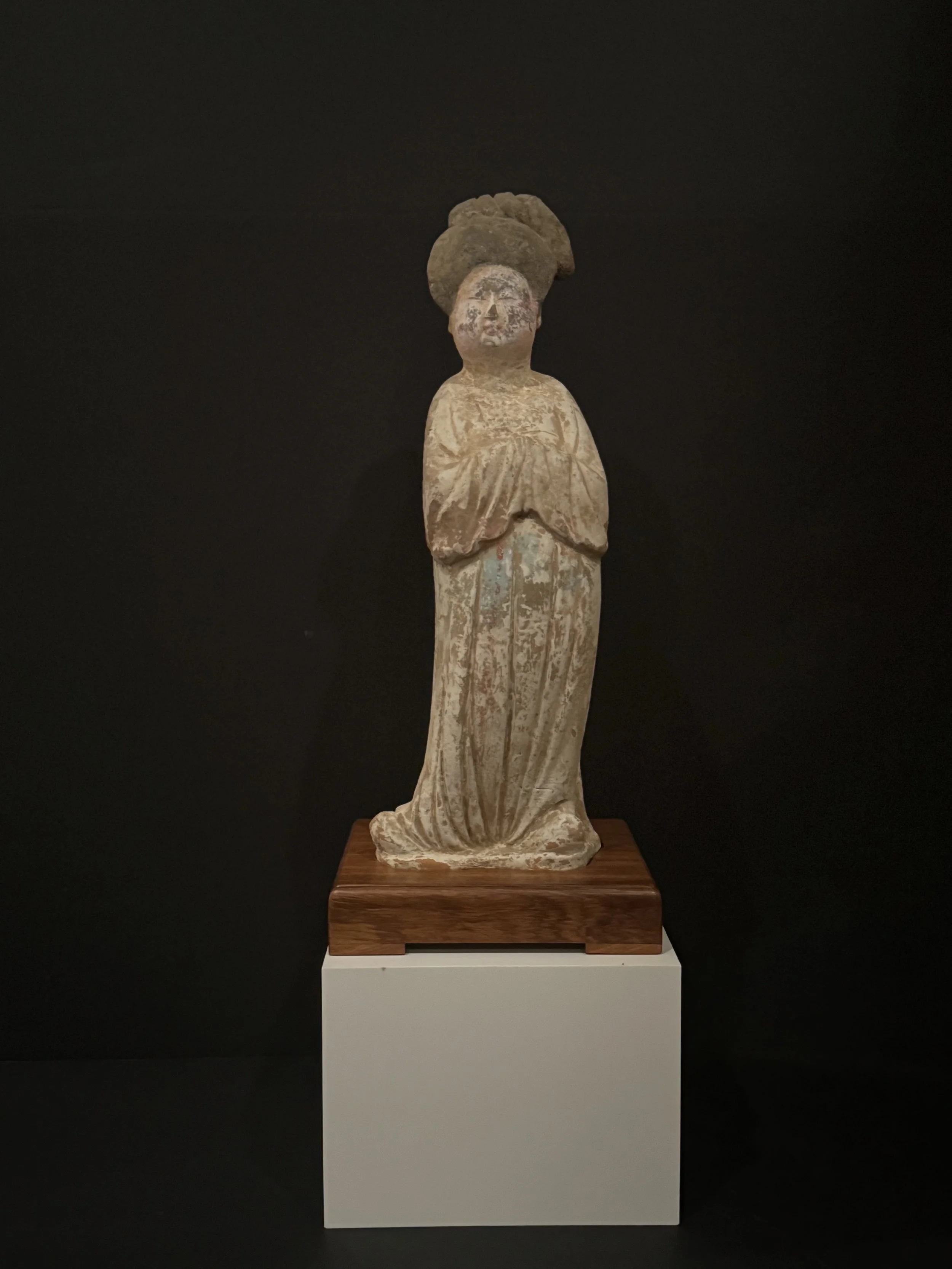 Image 2 of 3
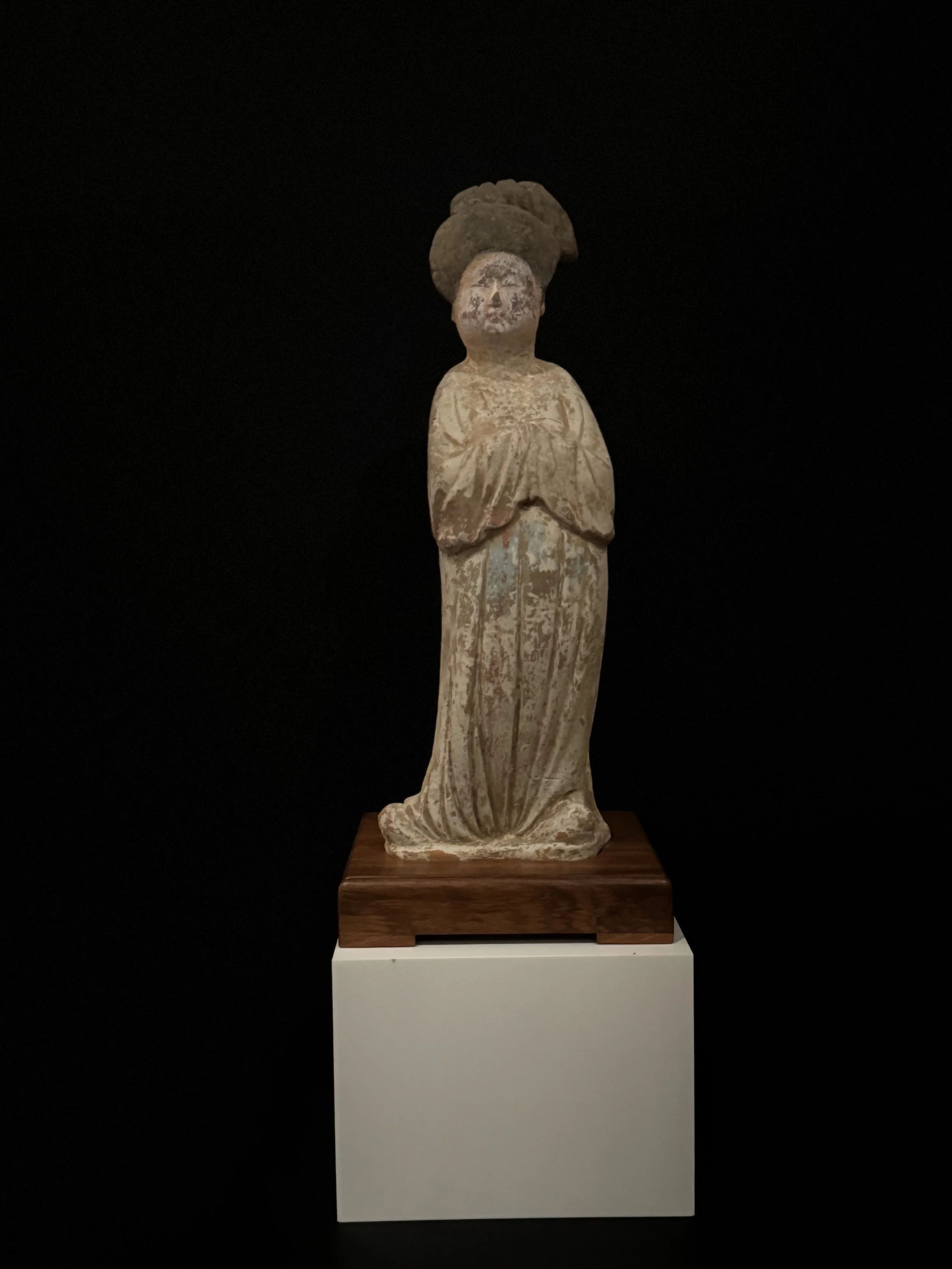 Image 3 of 3
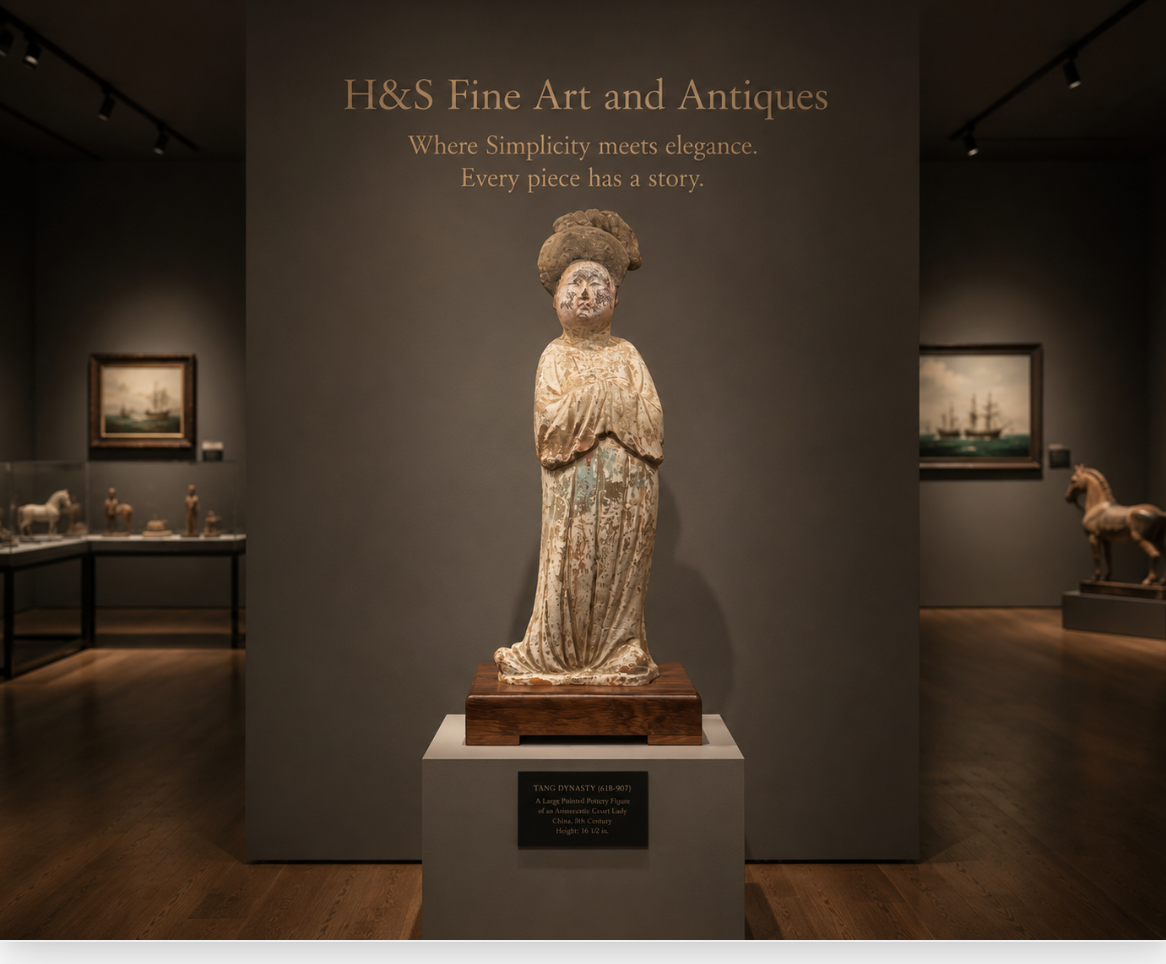
A large painted Pottery Tomb figure of a Corpulent lady with retained color. Tang Dynasty (618-906). TL tested.
BEAUTY, ABUNDANCE, AND ETERNITY
A Large Painted Pottery Figure of an Aristocratic Court Lady
China, Tang Dynasty (618–907 CE), probably first half to mid-8th century
Painted earthenware with surviving polychrome decoration
Height: 16¼ inches (41.3 cm)
Thermoluminescence tested
Mounted on a later wood stand
Provenance:
E & J Frankel Ltd., Oriental Art, New York
Private Collection, Pacific Palisades, California
Exhibition History:
No museum exhibition history for this specific figure is presently documented.
Literature and Museum Comparanda:
Comparable Tang dynasty painted pottery court ladies and female tomb attendants are preserved in the collections of the Metropolitan Museum of Art, Brooklyn Museum, and Cleveland Museum of Art. These museum examples provide important evidence for the dating, costume, hairstyles, funerary function, and changing ideals of feminine beauty represented by the present figure.
BEAUTY, ABUNDANCE, AND ETERNITY: THE ARISTOCRATIC WOMAN IN TANG CHINA
Standing with quiet dignity, her hands concealed within the ample sleeves of her robe and her body crowned by an elaborate coiffure, this imposing painted pottery figure represents one of the most recognizable and compelling sculptural types of the Tang dynasty: the aristocratic court lady created to accompany the deceased into the afterlife.
At 16¼ inches high, the present figure is of substantial scale for a Tang pottery female attendant. Her rounded face, full body, long flowing garments, elaborate hairstyle, restrained posture, and surviving polychrome decoration embody the changing ideals of beauty, prosperity, and aristocratic refinement that characterized the visual culture of eighth-century China.
The sculpture was not created as an independent decorative work of art, nor was it intended to represent a specific historical woman. It was a funerary object, created for placement within the tomb of an individual belonging to the privileged levels of Tang society.
Known in Chinese as mingqi—objects made specifically for the tomb—such sculptures were intended to perpetuate the social world of the deceased beyond death.
Court ladies, officials, servants, musicians, dancers, soldiers, horses, camels, foreign merchants, grooms, guardians, and fantastic protective creatures could together form an elaborate ceramic entourage.
Within this carefully ordered world, the present figure represented refinement, status, service, prosperity, and the continuation of aristocratic life in eternity.
The Tang dynasty was one of the great periods of Chinese civilization. Its enormous capital at Chang’an, present-day Xi’an, stood at the eastern terminus of the Silk Roads and became one of the most cosmopolitan cities of the medieval world. International trade, diplomatic exchange, foreign religions, music, textiles, precious materials, horses, and artistic traditions contributed to the extraordinary cultural vitality of Tang China. Museum scholarship emphasizes that Tang funerary figures provide particularly vivid evidence for this prosperous and internationally connected society.
THE LADY: AN IMAGE OF PRIVILEGE AND ARISTOCRATIC REFINEMENT
The identity of the woman represented by this figure is unknown and, in all probability, was never intended to be specific.
She should therefore not be described as the portrait of an individual woman.
Instead, she represents an idealized aristocratic woman, court lady, or female attendant belonging to the social world of the Tang elite.
The visual vocabulary is unmistakable.
The figure possesses a rounded face, small facial features, substantial physical proportions, a monumental coiffure, long garments descending almost to the ground, and hands concealed within the sleeves.
These characteristics transformed the human figure into an expression of social position.
Her appearance suggests that she belongs to a world removed from physical labor.
The hidden hands, enveloping robes, carefully arranged hair, and controlled posture emphasize refinement, composure, and privilege.
A closely related conceptual interpretation is provided by the Tomb Figure of a Court Lady in the Brooklyn Museum. That museum describes its figure as representing a mid-Tang ideal of feminine beauty through her rounded face, delicate features, elegant coiffure, and flowing gown. The museum also explains that such female attendants were placed within the side chambers of aristocratic tombs, symbolically waiting to serve the deceased.
The present figure belongs to this same broad cultural and artistic tradition.
THE CHANGING IDEAL OF FEMALE BEAUTY
One of the most fascinating aspects of Tang dynasty female tomb figures is the transformation of the ideal female body during the dynasty.
Female figures produced during the seventh century and the opening decades of the eighth century are frequently slender, elongated, and relatively restrained in physical proportions.
By the middle decades of the eighth century, however, representations of aristocratic women became increasingly substantial.
Faces became rounder.
Cheeks became fuller.
Bodies became heavier.
Garments became increasingly voluminous.
Hairstyles grew more elaborate and architecturally ambitious.
This change should not be interpreted simply as a representation of body weight.
Within the visual culture of the Tang court, physical fullness could communicate prosperity, abundance, health, leisure, privilege, and aristocratic status.
The present figure belongs to this important tradition.
Her body possesses a sense of physical presence and monumentality. The heavy garments descend toward the ground, creating an almost columnar silhouette. Her rounded face and elaborate coiffure reinforce the impression of abundance and refinement.
The famous imperial consort Yang Guifei is frequently associated with the popularity of the fuller female ideal.
Yang Guifei became celebrated in Chinese literature as one of the great beauties of Chinese history, and her appearance has long been associated with the aesthetic preference for substantial female forms.
The relationship, however, should be treated cautiously.
The present sculpture does not represent Yang Guifei, and the development of the fuller female type was a broader cultural phenomenon.
The importance of the comparison lies in demonstrating that ideals of feminine beauty changed considerably during the Tang dynasty.
The Metropolitan Museum's interpretation of a Tang Figure of a Seated Court Lady similarly places such sculptures within the historical development of changing ideas about human beauty.
THE MONUMENTAL COIFFURE: FASHION, STATUS, AND IDENTITY
Perhaps the most immediately recognizable characteristic of the present sculpture is the extraordinary coiffure.
Hair was an important marker of fashion and social identity among elite Tang women.
Aristocratic hairstyles could be arranged into towering buns, elaborate loops, projecting masses, and complex architectural configurations.
The coiffure of the present figure dramatically enlarges the silhouette of the head.
Its scale is significant.
Visually, it balances the substantial mass of the woman's long garments.
Socially, it communicates wealth, refinement, and participation in aristocratic fashion.
Comparable evidence may be seen in the Court Lady with Tall Headdress: Tomb Figurine, circa 700–750, in the Cleveland Museum of Art. That painted earthenware sculpture similarly combines elaborate headwear, surviving polychromy, long garments, and a restrained pose. The museum identifies such figures as valuable archaeological evidence for fashion, social life, and the position of aristocratic women in eighth-century China.
The hairstyle of the present figure should therefore be understood as more than ornament.
It is an indication of identity and social position.
THE GARMENTS AND THE CONCEALED HANDS
The lady wears long, enveloping garments that descend in vertical folds toward the ground.
The sculptor has intentionally minimized the description of the body beneath the robes.
This approach is characteristic of many Tang female tomb figures.
The human body becomes a framework upon which costume, posture, and social identity are expressed.
The hands are concealed within the sleeves and held respectfully before the body.
This pose communicates dignity, composure, and courtly etiquette.
The figure does not appear to be engaged in physical activity.
She waits.
Her function is one of eternal attendance.
This quiet psychological quality is among the most powerful aspects of Tang funerary sculpture.
The figure was created to remain forever within the enclosed architecture of the tomb.
She is simultaneously a servant, an aristocratic ideal, a representation of earthly prosperity, and a participant in the imagined continuation of life after death.
THE MATERIAL: PAINTED EARTHENWARE AND SURVIVING COLOR
The sculpture was made from fired earthenware and subsequently decorated with pigments.
This technique must be distinguished from the celebrated Tang sancai, or “three-color,” glazed ceramic tradition.
In sancai ceramics, lead-based glazes were applied to the surface of the object and fused to the ceramic body during firing.
Painted pottery figures followed a different process.
After firing, the surface could be covered with a pale slip and then decorated with mineral pigments.
The pigments were not permanently fused to the ceramic surface.
As a result, painted Tang pottery figures are particularly vulnerable to deterioration.
Burial conditions, moisture, mineral deposits, excavation, cleaning, restoration, handling, and environmental changes can result in significant pigment loss.
The surviving coloration of the present figure is therefore an important part of its historical and aesthetic character.
Traces of pigment remain visible on the face, garments, and other areas of the sculpture, allowing the modern viewer to imagine the far more colorful appearance the figure originally possessed.
A Standing Court Lady in the Metropolitan Museum of Art, dated to the seventh–eighth century, provides a particularly useful museum comparison. Like the present sculpture, it is made of earthenware with pigment, is classified as tomb pottery, and is of comparable scale at slightly over fifteen inches high.
THE PURPOSE OF THE FIGURE: LIFE AFTER DEATH
To understand the sculpture fully, it is necessary to understand Tang beliefs concerning death, status, and the afterlife.
Chinese funerary traditions had long included the placement of objects within tombs.
Over centuries, pottery models and figures increasingly served as symbolic substitutes for the actual people, animals, buildings, and possessions that surrounded an individual during life.
By the Tang dynasty, this tradition had developed into one of the great sculptural achievements of Chinese art.
Elite tombs could contain elaborate ceramic populations.
Officials represented government authority and bureaucratic rank.
Military figures symbolized protection.
Guardians and fantastic creatures defended the tomb from malevolent forces.
Horses represented transportation, military power, aristocratic status, and the passion of the Tang elite for riding and polo.
Camels and foreign grooms reflected international commerce and the Silk Roads.
Musicians and dancers provided entertainment.
Servants maintained the household.
Female attendants and court ladies, including figures such as the present sculpture, symbolically continued their service to the deceased.
The tomb thus became a reconstructed social universe.
The deceased did not enter eternity alone.
He or she remained surrounded by the symbols, privileges, relationships, and comforts that had defined earthly existence.
TANG CHINA AND THE SILK ROADS
The world that produced the present figure was exceptionally cosmopolitan.
The Tang capital of Chang’an was among the greatest cities of its age.
Chinese officials, aristocrats, Buddhist monks, merchants, diplomats, entertainers, craftsmen, and travelers from across Asia interacted within the empire.
Persian and Sogdian merchants were present in China.
Central Asian horses were highly valued.
Foreign musical instruments and styles of performance became fashionable.
Textiles, precious metals, glass, spices, religious traditions, and artistic ideas circulated along the Silk Roads.
Tang funerary sculpture provides extraordinary archaeological evidence for this multicultural society.
Foreign grooms appear beside Chinese officials.
Bactrian camels stand beside aristocratic horses.
Musicians and dancers reflect international traditions.
Court ladies display the changing fashions of elite Chinese society.
The present sculpture belongs to this extraordinary cultural environment.
THERMOLUMINESCENCE TESTING AND SCIENTIFIC DOCUMENTATION
The present figure is accompanied by thermoluminescence testing.
Thermoluminescence, commonly abbreviated as TL, is an important scientific dating method used in the study of ancient ceramics.
Clay contains naturally occurring crystalline materials that accumulate energy from environmental radiation after firing.
When a sample is reheated under controlled laboratory conditions, part of this stored energy is released as light.
Measurement of the resulting thermoluminescence signal can assist in estimating the approximate period that has elapsed since the ceramic was last fired.
TL testing does not replace connoisseurship, archaeological context, provenance research, technical examination, or condition analysis.
It does, however, provide an important additional layer of scientific evidence.
Because Tang pottery has been extensively reproduced and imitated, the presence of a credible TL test is particularly valuable.
For exhibition and future sale, the original laboratory certificate should remain permanently associated with the sculpture.
Provenance:
E & J Frankel Ltd., Oriental Art, New York.
Private Collection, Pacific Palisades, California.
MUSEUM COMPARISONS
The present figure can be understood within a substantial body of related Tang dynasty female funerary sculptures preserved in international museum collections.
The Metropolitan Museum of Art, New York
The Metropolitan Museum preserves a Standing Court Lady, China, Tang dynasty, seventh–eighth century, made of earthenware with pigment and measuring 15⅛ inches high.
The similarity in material, scale, period, and funerary classification makes the sculpture an especially useful institutional comparison for the present figure.
The Brooklyn Museum, New York
The Brooklyn Museum's Tomb Figure of a Court Lady, Tang dynasty, is an important comparison for the interpretation of female beauty and funerary function.
The museum specifically connects the figure's rounded face, elegant coiffure, flowing garments, and delicate features with the mid-Tang ideal of beauty and explains the symbolic role of attendants waiting to serve the deceased.
The Cleveland Museum of Art
The Cleveland Museum of Art preserves the Court Lady with Tall Headdress: Tomb Figurine, circa 700–750.
The sculpture is made of earthenware with polychromy and demonstrates the importance of elaborate hairstyles, costume, and surviving pigments in the study of Tang aristocratic female figures. It is currently listed by the museum in its gallery of Chinese Ceramics and Metalwork.
RELATED MUSEUM AND GALLERY EXHIBITIONS
No museum exhibition history for the present sculpture is presently documented.
However, Tang dynasty court ladies and related funerary sculptures have appeared in important museum installations and exhibitions that provide broader scholarly context.
The Brooklyn Museum displays its Tomb Figure of a Court Lady within its Asian Galleries, where the figure is interpreted through Tang burial practices and ideals of feminine beauty.
The Cleveland Museum of Art displays its comparable Court Lady with Tall Headdress in its Chinese Ceramics and Metalwork galleries.
An expansive Tang dynasty exhibition presented by Throckmorton Fine Art brought together approximately fifty objects associated with Tang culture, including sculptures of court ladies, tomb guardians, horses, Buddhist figures, and other works. The exhibition demonstrates how Tang court ladies can be presented within the broader context of prosperity, international exchange, religion, burial culture, and artistic production.
These exhibitions and permanent museum installations provide appropriate comparative context, but they should not be listed as exhibition history for the present figure unless documentary evidence establishes that this specific sculpture was included.
SELECTED LITERATURE
The following publications are recommended for the H&S Fine Art and Antiques research archive and for preparation of a scholarly catalogue entry:
Michaelson, Carol. Gilded Dragons: Buried Treasures from China's Golden Ages. London: British Museum Press, 1999.
A useful reference for Chinese burial culture, funerary objects, Tang society, and archaeological discoveries.
Watson, William. The Arts of China to AD 900. New Haven and London: Yale University Press, 1995.
An important broad scholarly study of Chinese art through the Tang dynasty.
Watson, William. The Genius of China: An Exhibition of Archaeological Finds of the People's Republic of China. London, 1973.
A significant reference for archaeological discoveries and the study of ancient Chinese material culture.
Valenstein, Suzanne G. A Handbook of Chinese Ceramics. New York: The Metropolitan Museum of Art.
An important introductory and scholarly reference for the history, materials, production, and development of Chinese ceramics.
Michael Sullivan. The Arts of China.
A standard survey of Chinese art providing historical and cultural context for Tang dynasty artistic production.
Medley, Margaret. The Chinese Potter: A Practical History of Chinese Ceramics.
A useful reference for ceramic production, materials, techniques, and the historical development of Chinese pottery.
MacGregor, Neil. A History of the World in 100 Objects.
Includes discussion of the famous Tang dynasty tomb figures associated with Liu Tingxun and provides broader interpretation of Tang burial culture and ceramic funerary sculpture.
Museum collection catalogues devoted to Chinese ceramics and Tang dynasty art at the Metropolitan Museum of Art, British Museum, Brooklyn Museum, Cleveland Museum of Art, and National Museum of Asian Art should also be consulted when preparing the final scholarly dossier.
CATALOGUE CONCLUSION
This large painted pottery figure of an aristocratic court lady is an evocative survival from one of the greatest periods of Chinese civilization.
Created during the Tang dynasty, probably during the eighth century, the sculpture embodies the extraordinary convergence of art, fashion, social hierarchy, prosperity, and funerary belief that characterized the culture of Tang China.
Her substantial physical proportions reflect the changing ideals of feminine beauty associated with the mature Tang court.
Her elaborate coiffure communicates fashion and aristocratic identity.
Her long robes and concealed hands express dignity, privilege, and courtly refinement.
Her surviving pigments preserve traces of the once-colorful appearance of Tang funerary sculpture.
Her presence within the tomb would have contributed to an imagined continuation of earthly life beyond death.
She was created to wait eternally.
To serve eternally.
To preserve the order and refinement of the aristocratic household beyond the boundaries of mortal existence.
Today, removed from the darkness of the tomb and presented as an independent work of sculpture, the figure possesses a different but equally compelling presence.
She stands as a witness to the wealth, confidence, cosmopolitanism, and artistic sophistication of Tang China.
The most appropriate interpretation of the sculpture is therefore not simply as a “corpulent lady,” but as a powerful material expression of beauty, abundance, privilege, fashion, social identity, and the ancient Chinese desire to carry the familiar world of life into eternity.
BEAUTY, ABUNDANCE, AND ETERNITY
A Large Painted Pottery Figure of an Aristocratic Court Lady
China, Tang Dynasty (618–907 CE), probably first half to mid-8th century
Painted earthenware with surviving polychrome decoration
Height: 16¼ inches (41.3 cm)
Thermoluminescence tested
Mounted on a later wood stand
Provenance:
E & J Frankel Ltd., Oriental Art, New York
Private Collection, Pacific Palisades, California
Exhibition History:
No museum exhibition history for this specific figure is presently documented.
Literature and Museum Comparanda:
Comparable Tang dynasty painted pottery court ladies and female tomb attendants are preserved in the collections of the Metropolitan Museum of Art, Brooklyn Museum, and Cleveland Museum of Art. These museum examples provide important evidence for the dating, costume, hairstyles, funerary function, and changing ideals of feminine beauty represented by the present figure.
BEAUTY, ABUNDANCE, AND ETERNITY: THE ARISTOCRATIC WOMAN IN TANG CHINA
Standing with quiet dignity, her hands concealed within the ample sleeves of her robe and her body crowned by an elaborate coiffure, this imposing painted pottery figure represents one of the most recognizable and compelling sculptural types of the Tang dynasty: the aristocratic court lady created to accompany the deceased into the afterlife.
At 16¼ inches high, the present figure is of substantial scale for a Tang pottery female attendant. Her rounded face, full body, long flowing garments, elaborate hairstyle, restrained posture, and surviving polychrome decoration embody the changing ideals of beauty, prosperity, and aristocratic refinement that characterized the visual culture of eighth-century China.
The sculpture was not created as an independent decorative work of art, nor was it intended to represent a specific historical woman. It was a funerary object, created for placement within the tomb of an individual belonging to the privileged levels of Tang society.
Known in Chinese as mingqi—objects made specifically for the tomb—such sculptures were intended to perpetuate the social world of the deceased beyond death.
Court ladies, officials, servants, musicians, dancers, soldiers, horses, camels, foreign merchants, grooms, guardians, and fantastic protective creatures could together form an elaborate ceramic entourage.
Within this carefully ordered world, the present figure represented refinement, status, service, prosperity, and the continuation of aristocratic life in eternity.
The Tang dynasty was one of the great periods of Chinese civilization. Its enormous capital at Chang’an, present-day Xi’an, stood at the eastern terminus of the Silk Roads and became one of the most cosmopolitan cities of the medieval world. International trade, diplomatic exchange, foreign religions, music, textiles, precious materials, horses, and artistic traditions contributed to the extraordinary cultural vitality of Tang China. Museum scholarship emphasizes that Tang funerary figures provide particularly vivid evidence for this prosperous and internationally connected society.
THE LADY: AN IMAGE OF PRIVILEGE AND ARISTOCRATIC REFINEMENT
The identity of the woman represented by this figure is unknown and, in all probability, was never intended to be specific.
She should therefore not be described as the portrait of an individual woman.
Instead, she represents an idealized aristocratic woman, court lady, or female attendant belonging to the social world of the Tang elite.
The visual vocabulary is unmistakable.
The figure possesses a rounded face, small facial features, substantial physical proportions, a monumental coiffure, long garments descending almost to the ground, and hands concealed within the sleeves.
These characteristics transformed the human figure into an expression of social position.
Her appearance suggests that she belongs to a world removed from physical labor.
The hidden hands, enveloping robes, carefully arranged hair, and controlled posture emphasize refinement, composure, and privilege.
A closely related conceptual interpretation is provided by the Tomb Figure of a Court Lady in the Brooklyn Museum. That museum describes its figure as representing a mid-Tang ideal of feminine beauty through her rounded face, delicate features, elegant coiffure, and flowing gown. The museum also explains that such female attendants were placed within the side chambers of aristocratic tombs, symbolically waiting to serve the deceased.
The present figure belongs to this same broad cultural and artistic tradition.
THE CHANGING IDEAL OF FEMALE BEAUTY
One of the most fascinating aspects of Tang dynasty female tomb figures is the transformation of the ideal female body during the dynasty.
Female figures produced during the seventh century and the opening decades of the eighth century are frequently slender, elongated, and relatively restrained in physical proportions.
By the middle decades of the eighth century, however, representations of aristocratic women became increasingly substantial.
Faces became rounder.
Cheeks became fuller.
Bodies became heavier.
Garments became increasingly voluminous.
Hairstyles grew more elaborate and architecturally ambitious.
This change should not be interpreted simply as a representation of body weight.
Within the visual culture of the Tang court, physical fullness could communicate prosperity, abundance, health, leisure, privilege, and aristocratic status.
The present figure belongs to this important tradition.
Her body possesses a sense of physical presence and monumentality. The heavy garments descend toward the ground, creating an almost columnar silhouette. Her rounded face and elaborate coiffure reinforce the impression of abundance and refinement.
The famous imperial consort Yang Guifei is frequently associated with the popularity of the fuller female ideal.
Yang Guifei became celebrated in Chinese literature as one of the great beauties of Chinese history, and her appearance has long been associated with the aesthetic preference for substantial female forms.
The relationship, however, should be treated cautiously.
The present sculpture does not represent Yang Guifei, and the development of the fuller female type was a broader cultural phenomenon.
The importance of the comparison lies in demonstrating that ideals of feminine beauty changed considerably during the Tang dynasty.
The Metropolitan Museum's interpretation of a Tang Figure of a Seated Court Lady similarly places such sculptures within the historical development of changing ideas about human beauty.
THE MONUMENTAL COIFFURE: FASHION, STATUS, AND IDENTITY
Perhaps the most immediately recognizable characteristic of the present sculpture is the extraordinary coiffure.
Hair was an important marker of fashion and social identity among elite Tang women.
Aristocratic hairstyles could be arranged into towering buns, elaborate loops, projecting masses, and complex architectural configurations.
The coiffure of the present figure dramatically enlarges the silhouette of the head.
Its scale is significant.
Visually, it balances the substantial mass of the woman's long garments.
Socially, it communicates wealth, refinement, and participation in aristocratic fashion.
Comparable evidence may be seen in the Court Lady with Tall Headdress: Tomb Figurine, circa 700–750, in the Cleveland Museum of Art. That painted earthenware sculpture similarly combines elaborate headwear, surviving polychromy, long garments, and a restrained pose. The museum identifies such figures as valuable archaeological evidence for fashion, social life, and the position of aristocratic women in eighth-century China.
The hairstyle of the present figure should therefore be understood as more than ornament.
It is an indication of identity and social position.
THE GARMENTS AND THE CONCEALED HANDS
The lady wears long, enveloping garments that descend in vertical folds toward the ground.
The sculptor has intentionally minimized the description of the body beneath the robes.
This approach is characteristic of many Tang female tomb figures.
The human body becomes a framework upon which costume, posture, and social identity are expressed.
The hands are concealed within the sleeves and held respectfully before the body.
This pose communicates dignity, composure, and courtly etiquette.
The figure does not appear to be engaged in physical activity.
She waits.
Her function is one of eternal attendance.
This quiet psychological quality is among the most powerful aspects of Tang funerary sculpture.
The figure was created to remain forever within the enclosed architecture of the tomb.
She is simultaneously a servant, an aristocratic ideal, a representation of earthly prosperity, and a participant in the imagined continuation of life after death.
THE MATERIAL: PAINTED EARTHENWARE AND SURVIVING COLOR
The sculpture was made from fired earthenware and subsequently decorated with pigments.
This technique must be distinguished from the celebrated Tang sancai, or “three-color,” glazed ceramic tradition.
In sancai ceramics, lead-based glazes were applied to the surface of the object and fused to the ceramic body during firing.
Painted pottery figures followed a different process.
After firing, the surface could be covered with a pale slip and then decorated with mineral pigments.
The pigments were not permanently fused to the ceramic surface.
As a result, painted Tang pottery figures are particularly vulnerable to deterioration.
Burial conditions, moisture, mineral deposits, excavation, cleaning, restoration, handling, and environmental changes can result in significant pigment loss.
The surviving coloration of the present figure is therefore an important part of its historical and aesthetic character.
Traces of pigment remain visible on the face, garments, and other areas of the sculpture, allowing the modern viewer to imagine the far more colorful appearance the figure originally possessed.
A Standing Court Lady in the Metropolitan Museum of Art, dated to the seventh–eighth century, provides a particularly useful museum comparison. Like the present sculpture, it is made of earthenware with pigment, is classified as tomb pottery, and is of comparable scale at slightly over fifteen inches high.
THE PURPOSE OF THE FIGURE: LIFE AFTER DEATH
To understand the sculpture fully, it is necessary to understand Tang beliefs concerning death, status, and the afterlife.
Chinese funerary traditions had long included the placement of objects within tombs.
Over centuries, pottery models and figures increasingly served as symbolic substitutes for the actual people, animals, buildings, and possessions that surrounded an individual during life.
By the Tang dynasty, this tradition had developed into one of the great sculptural achievements of Chinese art.
Elite tombs could contain elaborate ceramic populations.
Officials represented government authority and bureaucratic rank.
Military figures symbolized protection.
Guardians and fantastic creatures defended the tomb from malevolent forces.
Horses represented transportation, military power, aristocratic status, and the passion of the Tang elite for riding and polo.
Camels and foreign grooms reflected international commerce and the Silk Roads.
Musicians and dancers provided entertainment.
Servants maintained the household.
Female attendants and court ladies, including figures such as the present sculpture, symbolically continued their service to the deceased.
The tomb thus became a reconstructed social universe.
The deceased did not enter eternity alone.
He or she remained surrounded by the symbols, privileges, relationships, and comforts that had defined earthly existence.
TANG CHINA AND THE SILK ROADS
The world that produced the present figure was exceptionally cosmopolitan.
The Tang capital of Chang’an was among the greatest cities of its age.
Chinese officials, aristocrats, Buddhist monks, merchants, diplomats, entertainers, craftsmen, and travelers from across Asia interacted within the empire.
Persian and Sogdian merchants were present in China.
Central Asian horses were highly valued.
Foreign musical instruments and styles of performance became fashionable.
Textiles, precious metals, glass, spices, religious traditions, and artistic ideas circulated along the Silk Roads.
Tang funerary sculpture provides extraordinary archaeological evidence for this multicultural society.
Foreign grooms appear beside Chinese officials.
Bactrian camels stand beside aristocratic horses.
Musicians and dancers reflect international traditions.
Court ladies display the changing fashions of elite Chinese society.
The present sculpture belongs to this extraordinary cultural environment.
THERMOLUMINESCENCE TESTING AND SCIENTIFIC DOCUMENTATION
The present figure is accompanied by thermoluminescence testing.
Thermoluminescence, commonly abbreviated as TL, is an important scientific dating method used in the study of ancient ceramics.
Clay contains naturally occurring crystalline materials that accumulate energy from environmental radiation after firing.
When a sample is reheated under controlled laboratory conditions, part of this stored energy is released as light.
Measurement of the resulting thermoluminescence signal can assist in estimating the approximate period that has elapsed since the ceramic was last fired.
TL testing does not replace connoisseurship, archaeological context, provenance research, technical examination, or condition analysis.
It does, however, provide an important additional layer of scientific evidence.
Because Tang pottery has been extensively reproduced and imitated, the presence of a credible TL test is particularly valuable.
For exhibition and future sale, the original laboratory certificate should remain permanently associated with the sculpture.
Provenance:
E & J Frankel Ltd., Oriental Art, New York.
Private Collection, Pacific Palisades, California.
MUSEUM COMPARISONS
The present figure can be understood within a substantial body of related Tang dynasty female funerary sculptures preserved in international museum collections.
The Metropolitan Museum of Art, New York
The Metropolitan Museum preserves a Standing Court Lady, China, Tang dynasty, seventh–eighth century, made of earthenware with pigment and measuring 15⅛ inches high.
The similarity in material, scale, period, and funerary classification makes the sculpture an especially useful institutional comparison for the present figure.
The Brooklyn Museum, New York
The Brooklyn Museum's Tomb Figure of a Court Lady, Tang dynasty, is an important comparison for the interpretation of female beauty and funerary function.
The museum specifically connects the figure's rounded face, elegant coiffure, flowing garments, and delicate features with the mid-Tang ideal of beauty and explains the symbolic role of attendants waiting to serve the deceased.
The Cleveland Museum of Art
The Cleveland Museum of Art preserves the Court Lady with Tall Headdress: Tomb Figurine, circa 700–750.
The sculpture is made of earthenware with polychromy and demonstrates the importance of elaborate hairstyles, costume, and surviving pigments in the study of Tang aristocratic female figures. It is currently listed by the museum in its gallery of Chinese Ceramics and Metalwork.
RELATED MUSEUM AND GALLERY EXHIBITIONS
No museum exhibition history for the present sculpture is presently documented.
However, Tang dynasty court ladies and related funerary sculptures have appeared in important museum installations and exhibitions that provide broader scholarly context.
The Brooklyn Museum displays its Tomb Figure of a Court Lady within its Asian Galleries, where the figure is interpreted through Tang burial practices and ideals of feminine beauty.
The Cleveland Museum of Art displays its comparable Court Lady with Tall Headdress in its Chinese Ceramics and Metalwork galleries.
An expansive Tang dynasty exhibition presented by Throckmorton Fine Art brought together approximately fifty objects associated with Tang culture, including sculptures of court ladies, tomb guardians, horses, Buddhist figures, and other works. The exhibition demonstrates how Tang court ladies can be presented within the broader context of prosperity, international exchange, religion, burial culture, and artistic production.
These exhibitions and permanent museum installations provide appropriate comparative context, but they should not be listed as exhibition history for the present figure unless documentary evidence establishes that this specific sculpture was included.
SELECTED LITERATURE
The following publications are recommended for the H&S Fine Art and Antiques research archive and for preparation of a scholarly catalogue entry:
Michaelson, Carol. Gilded Dragons: Buried Treasures from China's Golden Ages. London: British Museum Press, 1999.
A useful reference for Chinese burial culture, funerary objects, Tang society, and archaeological discoveries.
Watson, William. The Arts of China to AD 900. New Haven and London: Yale University Press, 1995.
An important broad scholarly study of Chinese art through the Tang dynasty.
Watson, William. The Genius of China: An Exhibition of Archaeological Finds of the People's Republic of China. London, 1973.
A significant reference for archaeological discoveries and the study of ancient Chinese material culture.
Valenstein, Suzanne G. A Handbook of Chinese Ceramics. New York: The Metropolitan Museum of Art.
An important introductory and scholarly reference for the history, materials, production, and development of Chinese ceramics.
Michael Sullivan. The Arts of China.
A standard survey of Chinese art providing historical and cultural context for Tang dynasty artistic production.
Medley, Margaret. The Chinese Potter: A Practical History of Chinese Ceramics.
A useful reference for ceramic production, materials, techniques, and the historical development of Chinese pottery.
MacGregor, Neil. A History of the World in 100 Objects.
Includes discussion of the famous Tang dynasty tomb figures associated with Liu Tingxun and provides broader interpretation of Tang burial culture and ceramic funerary sculpture.
Museum collection catalogues devoted to Chinese ceramics and Tang dynasty art at the Metropolitan Museum of Art, British Museum, Brooklyn Museum, Cleveland Museum of Art, and National Museum of Asian Art should also be consulted when preparing the final scholarly dossier.
CATALOGUE CONCLUSION
This large painted pottery figure of an aristocratic court lady is an evocative survival from one of the greatest periods of Chinese civilization.
Created during the Tang dynasty, probably during the eighth century, the sculpture embodies the extraordinary convergence of art, fashion, social hierarchy, prosperity, and funerary belief that characterized the culture of Tang China.
Her substantial physical proportions reflect the changing ideals of feminine beauty associated with the mature Tang court.
Her elaborate coiffure communicates fashion and aristocratic identity.
Her long robes and concealed hands express dignity, privilege, and courtly refinement.
Her surviving pigments preserve traces of the once-colorful appearance of Tang funerary sculpture.
Her presence within the tomb would have contributed to an imagined continuation of earthly life beyond death.
She was created to wait eternally.
To serve eternally.
To preserve the order and refinement of the aristocratic household beyond the boundaries of mortal existence.
Today, removed from the darkness of the tomb and presented as an independent work of sculpture, the figure possesses a different but equally compelling presence.
She stands as a witness to the wealth, confidence, cosmopolitanism, and artistic sophistication of Tang China.
The most appropriate interpretation of the sculpture is therefore not simply as a “corpulent lady,” but as a powerful material expression of beauty, abundance, privilege, fashion, social identity, and the ancient Chinese desire to carry the familiar world of life into eternity.