 Image 1 of 6
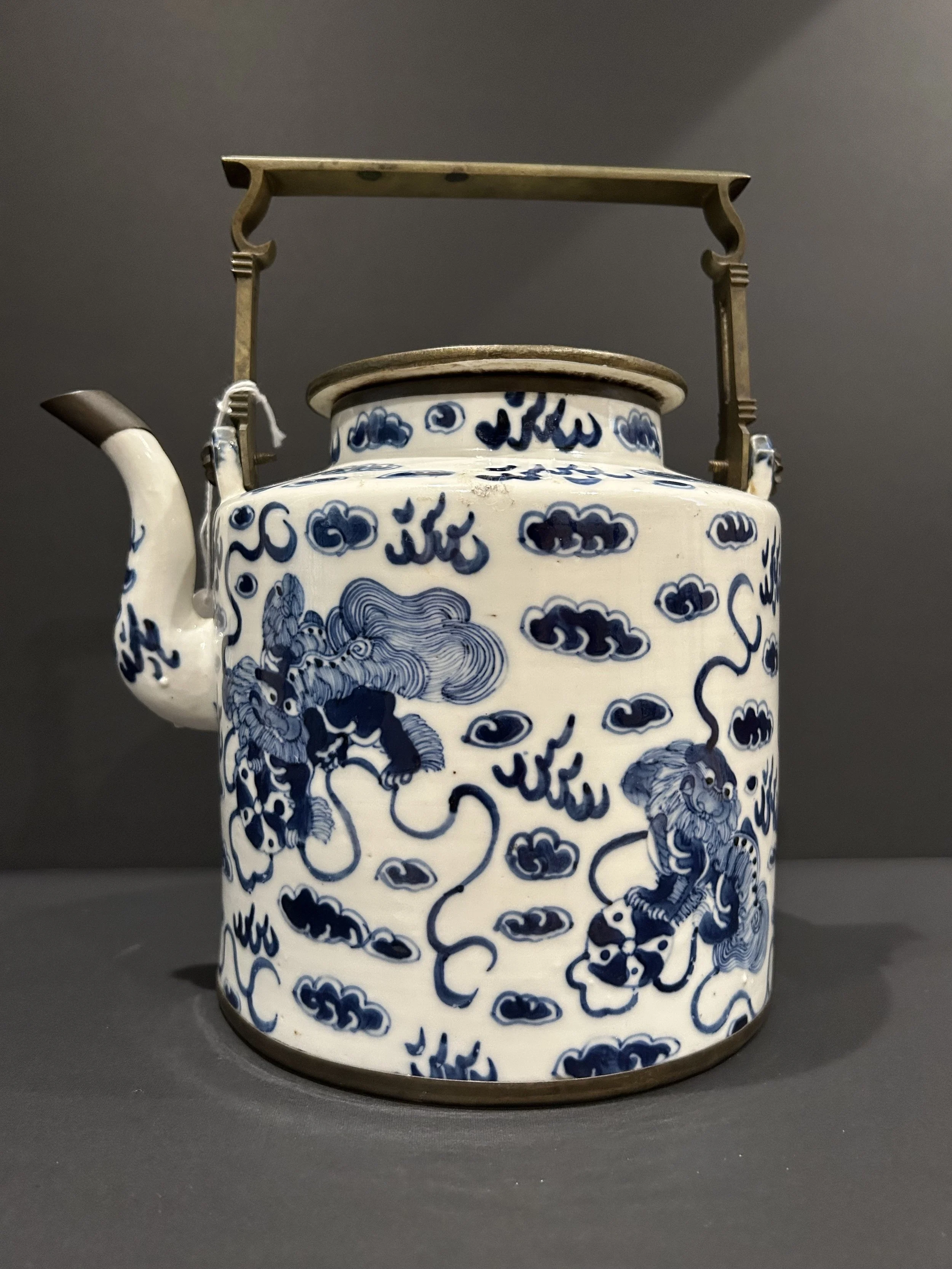 Image 2 of 6
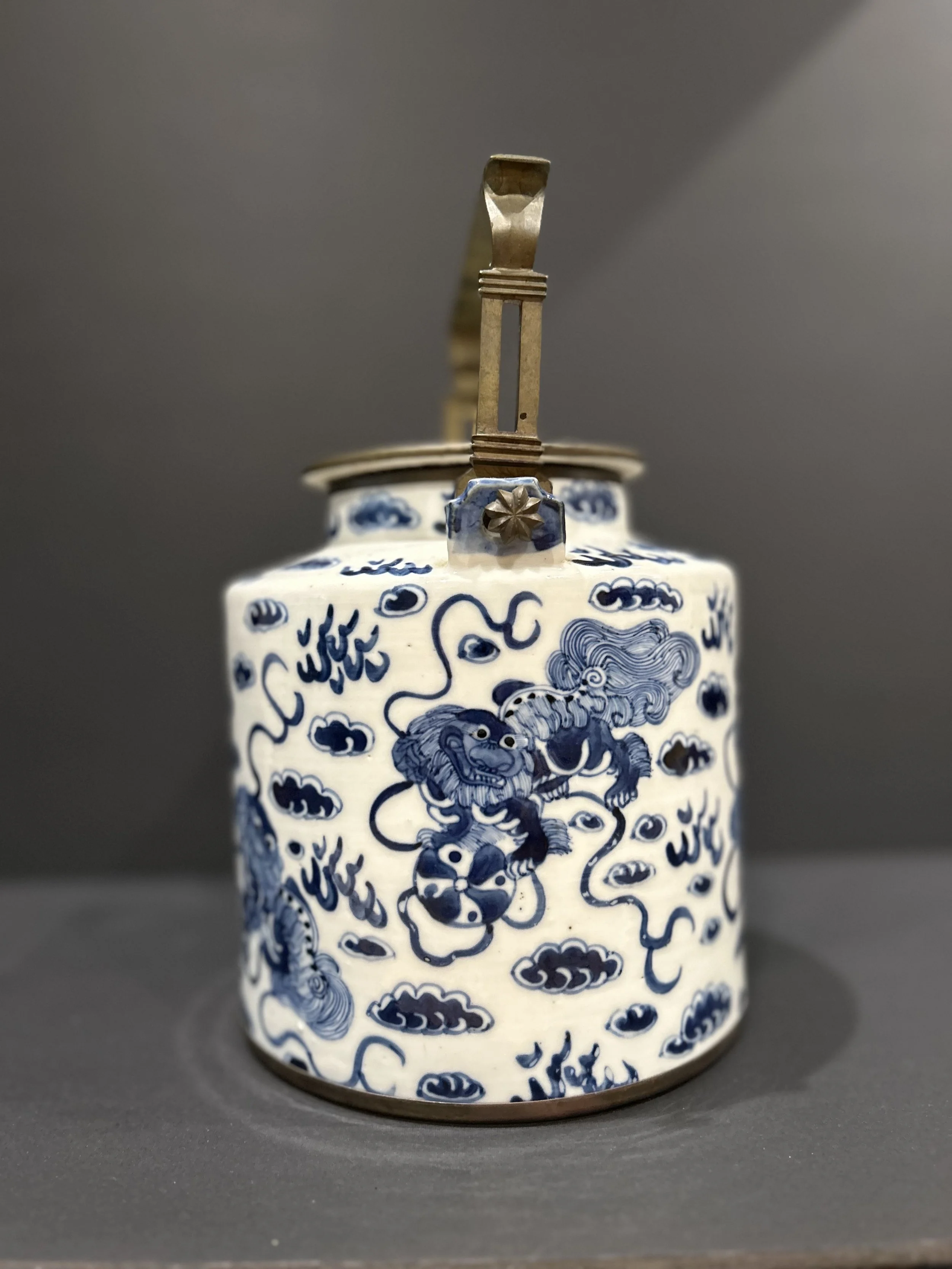 Image 3 of 6
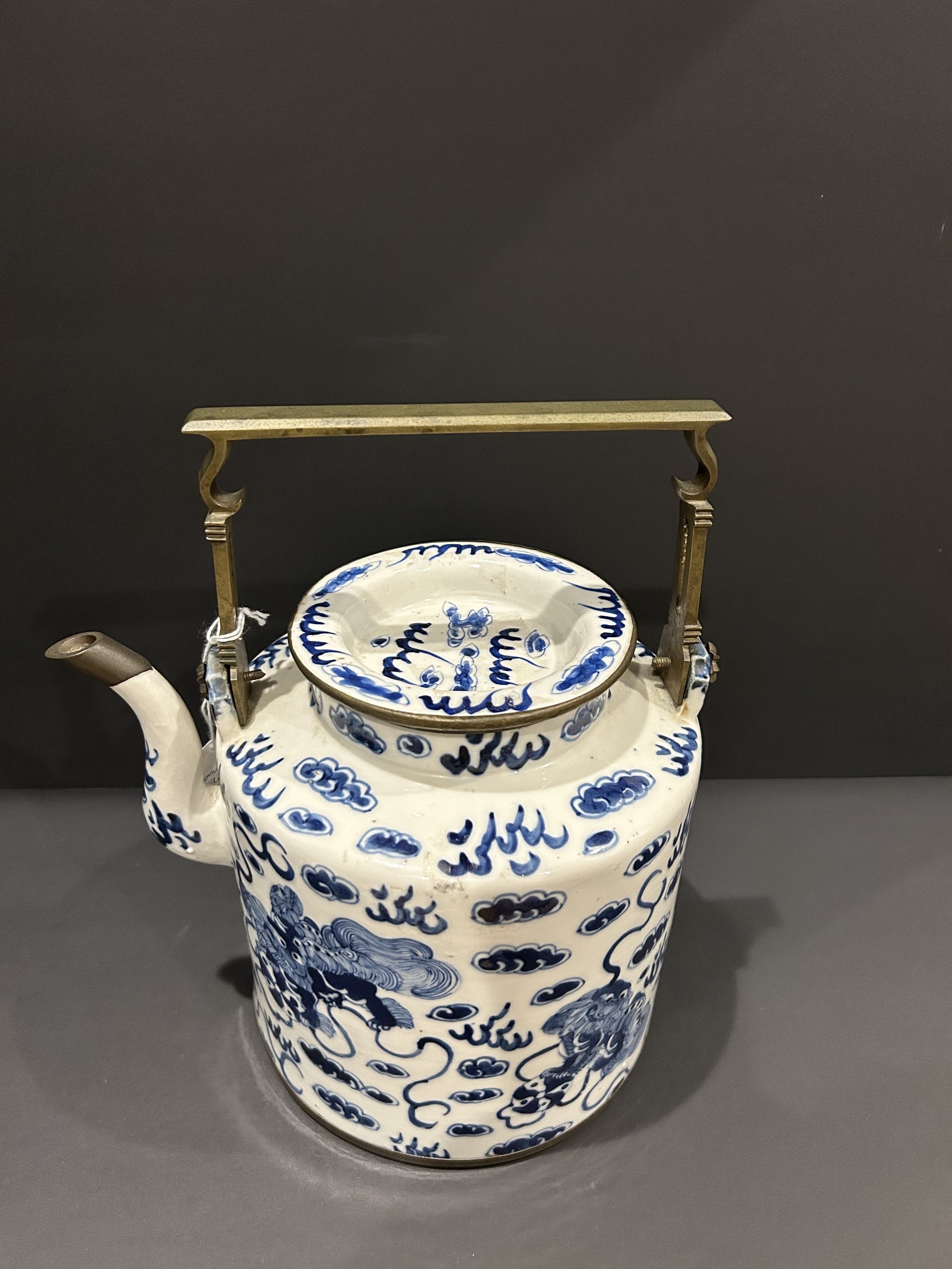 Image 4 of 6
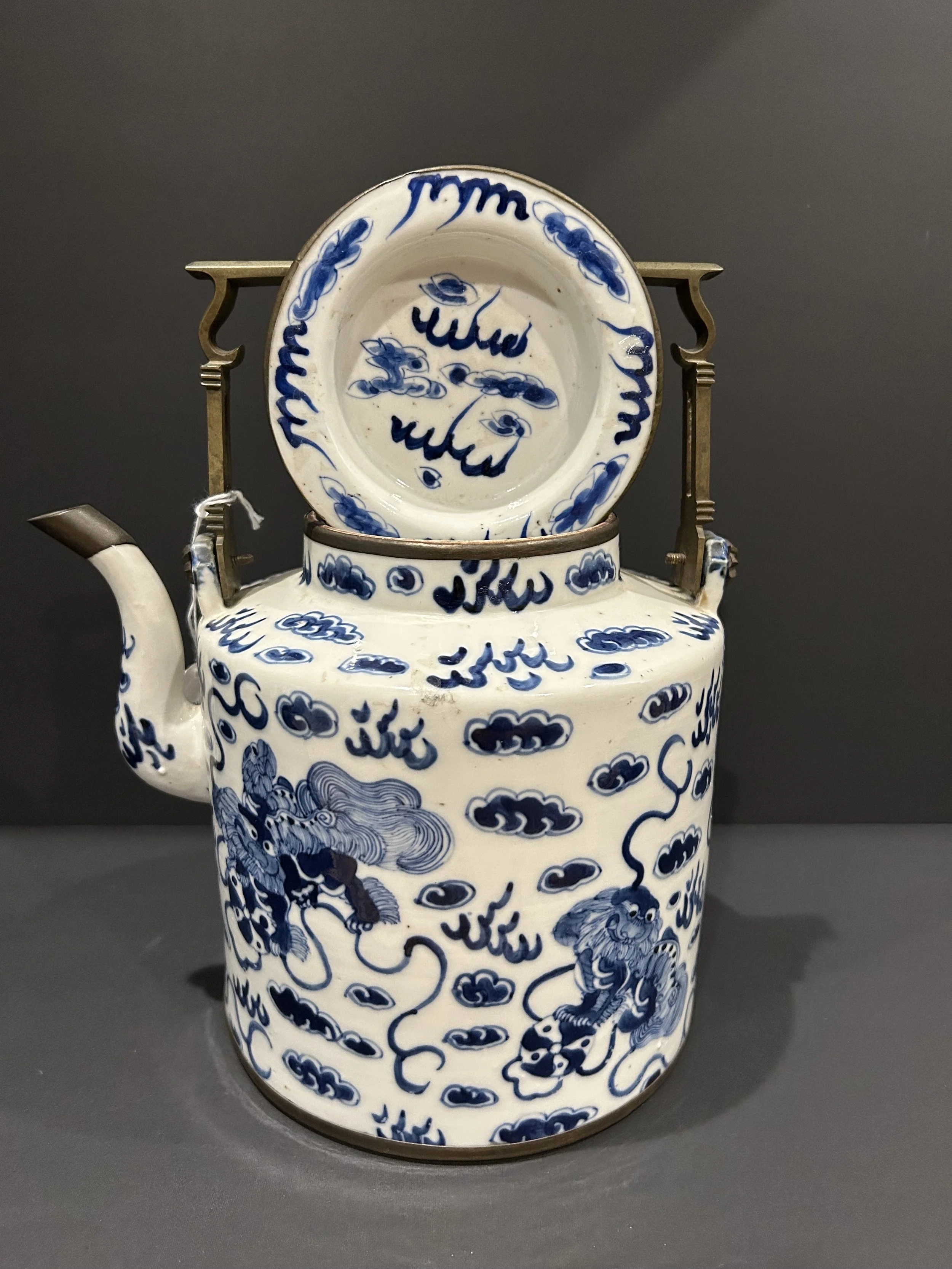 Image 5 of 6
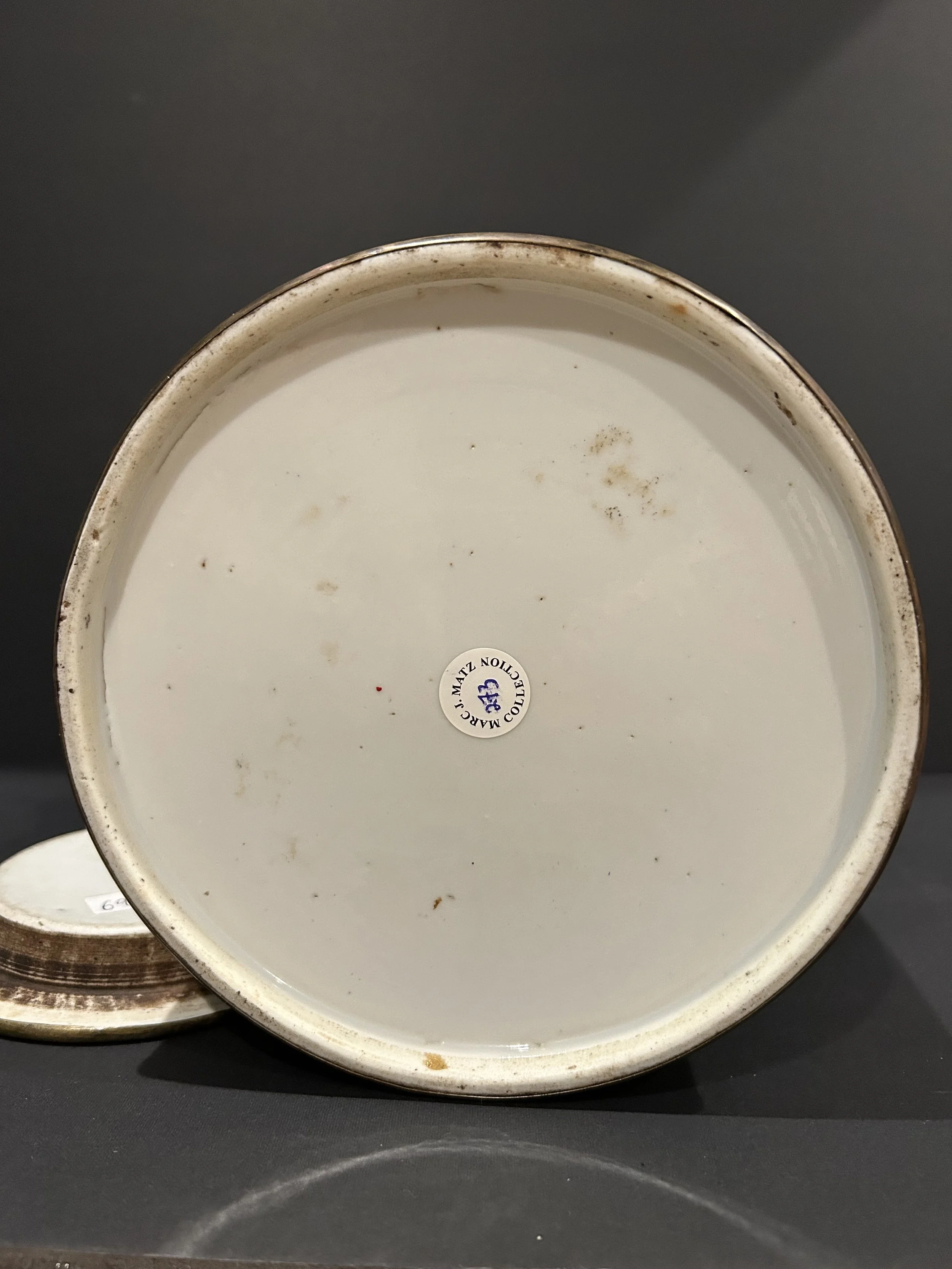 Image 6 of 6
A Large Blue and White Underglazed Porcelain Teapot. Chinese export Porcelain Late 18th-early 19th century.
DRAGONS AMONG THE CLOUDS: A MONUMENTAL CHINESE BLUE-AND-WHITE TEAPOT
China, Qing Dynasty, Late 18th–Early 19th Century
Chinese Export Porcelain
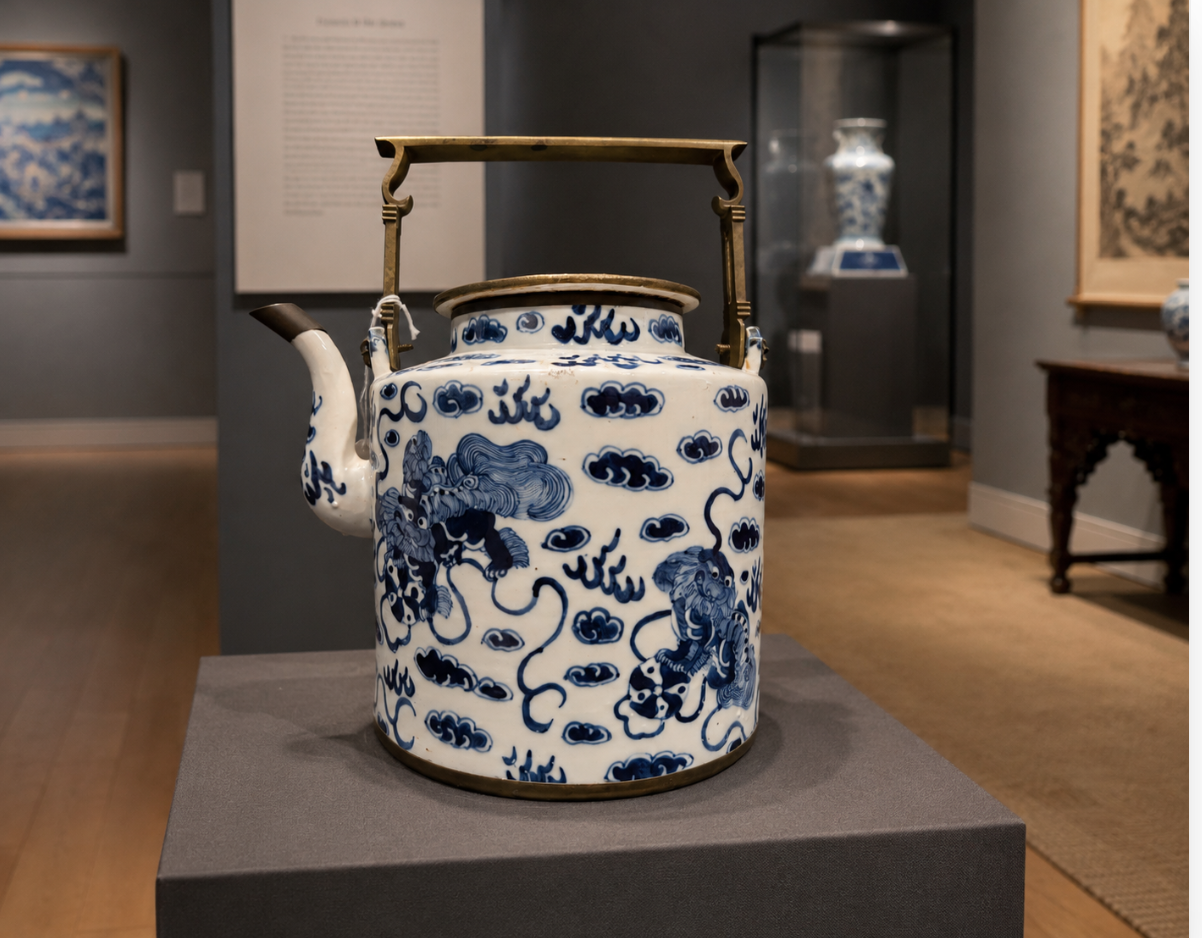
Underglaze cobalt-blue decorated porcelain with brass-mounted cover, overhead handle, and foot rim
Height 10 ½ in. (including handle); Width 9 ½ in.
Provenance: The Marc J. Matz Collection
Commanding in scale and vigorously decorated, this large Chinese blue-and-white porcelain teapot belongs to the long tradition of ceramic production and international trade that made Chinese porcelain one of the most influential artistic commodities in world history.
The substantial cylindrical vessel is painted in underglaze cobalt blue with animated dragons moving among stylized cloud formations. The powerful bodies of the dragons and the rhythmic distribution of clouds create continuous movement across the surface of the vessel.
Within Chinese visual culture, the dragon was an auspicious creature associated with strength, vitality, water, rainfall, and cosmic power. Closely connected with imperial authority during the Ming and Qing dynasties, dragon imagery also circulated widely beyond the imperial court and became an important decorative subject on ceramics produced for domestic consumption and international trade.
The surrounding clouds reinforce the supernatural character of the composition. Associated with the heavens, transformation, good fortune, and immortality, clouds frequently accompany dragons in Chinese art, suggesting the creature's ability to travel between the terrestrial and celestial worlds.
The decoration was executed in cobalt pigment directly upon the porcelain body before the application of a transparent glaze and high-temperature firing. This technically sophisticated process protected the painted decoration beneath the glaze and contributed to the extraordinary durability of Chinese blue-and-white porcelain.
The vessel's monumental proportions distinguish it from smaller teapots intended for individual domestic use. Its capacity suggests service in a communal, commercial, or institutional environment where substantial quantities of tea or hot water were required.
The brass-mounted cover, tall overhead handle, and protective lower rim contribute to the distinctive appearance of the vessel and reflect the practical requirements of handling a large porcelain container. Whether all of these metal fittings are original to the vessel or represent later adaptations should be determined through further examination.
Produced during the late eighteenth or early nineteenth century, the vessel belongs to the great era of international commerce when Chinese tea and porcelain traveled aboard merchant ships to Southeast Asia, Europe, and the Americas.
In this remarkable object, material, function, symbolism, and global trade converge. The dragon represents the enduring power of Chinese visual tradition; the blue-and-white palette reflects centuries of technological mastery; the monumental form speaks to the social ritual of tea drinking; and the vessel's export history recalls the commercial networks that connected China with the wider world.
Chinese Export Porcelain and the Tea Trade
Tea and porcelain were two of China's most important exports during the eighteenth century.
European and American ships transported enormous quantities of Chinese tea accompanied by porcelain, silk, lacquerware, and other luxury goods.
Porcelain teapots therefore occupied a particularly interesting position within this trade: they were Chinese manufactured objects used to prepare and serve another Chinese export commodity—tea.
By the late eighteenth century, Chinese export porcelain could be found in households throughout Europe and the newly independent United States.
Major American ports involved in the China trade included New York, Boston, Salem, and Philadelphia.
Form and Function
The unusually large size of the vessel is significant.
At approximately 10 ½ inches high with the handle raised, this is substantially larger than the individual teapots normally associated with domestic tea drinking.
The vessel may therefore have been intended as a large communal teapot, hot-water vessel, or serving vessel.
Large vessels of this type could have been used in:
merchant households,
commercial establishments,
ships and trading communities,
large family gatherings,
or institutional environments.
The development of specialized vessels for brewing and serving infused leaf tea was connected with changes in Chinese tea preparation practices beginning in the late medieval period. By the Qing dynasty, teapots and related pouring vessels existed in an enormous range of materials, forms, and sizes.
The large capacity of the present vessel suggests that practicality and durability were important considerations.
Country of Origin and Historical Context
The teapot was produced in China, the birthplace of true high-fired porcelain and the world's principal producer of porcelain for international trade for centuries.
The most important center of porcelain manufacture was Jingdezhen. From the fourteenth century onward, Jingdezhen became internationally celebrated for blue-and-white porcelain decorated with cobalt pigment beneath a transparent glaze.
By the eighteenth century, Chinese porcelain was transported throughout Southeast Asia, the Middle East, Europe, and the Americas. Porcelain intended for export ranged from inexpensive utilitarian objects to specially commissioned armorial services and highly sophisticated decorative works.
Export vessels were sometimes produced with comparatively substantial bodies to withstand transportation over considerable distances.
The present vessel belongs to this broad history of international exchange.
Its combination of Chinese decorative imagery, substantial functional form, and metal fittings makes it especially representative of the intersection between Chinese ceramic traditions and international patterns of consumption.
Blue-and-White Porcelain and the Underglaze Technique
The decoration was executed in underglaze cobalt blue.
The porcelain body was first formed and allowed to dry. The decoration was then painted directly onto the unfired ceramic surface using pigments containing cobalt oxide.
The vessel was subsequently covered with a transparent glaze and fired at high temperature.
During firing, the cobalt decoration developed its characteristic blue coloration beneath the transparent glaze.
This technique provided an important practical advantage: because the painted decoration was protected beneath the glaze, it was resistant to wear from handling and use.
Chinese potters perfected the production of blue-and-white porcelain over centuries. The technique became one of the most influential ceramic traditions in world history and was extensively imitated by potters in the Middle East and Europe.
The Color Blue
The deep cobalt blue decoration against the white porcelain body creates one of the most internationally recognizable visual traditions associated with Chinese ceramics.
Cobalt pigments were applied before glazing and firing.
During different periods, Chinese potters employed imported and domestically sourced cobalt ores, producing variations ranging from soft grayish blue to brilliant sapphire tones.
The decoration of the present vessel is executed in a vigorous, somewhat spontaneous manner.
Rather than the meticulously controlled painting associated with imperial porcelain, the brushwork has a strong decorative rhythm suited to a large utilitarian vessel.
The repetition of dragons, clouds, and scrolling lines creates continuous movement across the cylindrical surface.
The Clouds
Surrounding the dragons are numerous stylized cloud formations.
Clouds (yun, 雲) possess important symbolic associations in Chinese art.
They represent the heavens and the celestial realm and are associated with:
good fortune, divine presence, transformation, immortality, and auspicious blessings.
The cloud motif also creates visual movement.
The dragons appear to emerge from and disappear among the clouds, suggesting their supernatural ability to travel freely between water, earth, and heaven.
This combination—dragons among clouds—is one of the most enduring decorative compositions in Chinese art.
The Dragon Decoration
The principal decorative subjects are dragons moving among stylized clouds.
The dragon, or long (龍), is among the most powerful and enduring symbols in Chinese visual culture.
Unlike the destructive dragon frequently encountered in European mythology, the Chinese dragon traditionally represented positive and auspicious forces.
It was associated with:
Imperial authority and political power
Strength and vitality
Rain and control of water
Agricultural fertility
Cosmic energy
Good fortune and prosperity
Dragons were believed to inhabit rivers, lakes, seas, and the heavens and to possess the ability to control rain and water.
The dragon therefore became particularly important in an agricultural society in which rainfall was essential to prosperity.
During the Ming and Qing dynasties, dragons were also closely associated with imperial authority.
The number of claws displayed by a dragon could sometimes indicate hierarchical significance. Five-clawed dragons were especially associated with the emperor and imperial court, although dragon imagery also appeared widely on ceramics produced for domestic and international markets.
The creatures on this vessel should therefore be understood within the broader tradition of auspicious dragon imagery, rather than automatically interpreted as imperial emblems.
Recommended Literature:
Clare Le Corbeiller, China Trade Porcelain: Patterns of Exchange. New York: The Metropolitan Museum of Art, 1974.
An important study of Chinese export porcelain and the international cultural exchanges represented by these objects.
David S. Howard, The Choice of the Private Trader: The Private Market in Chinese Export Porcelain Illustrated from the Hodroff Collection. London, 1994.
An important reference for privately traded Chinese export porcelain.
Geoffrey A. Godden, Oriental Export Market Porcelain and Its Influence on European Wares. London, 1979.
Useful for understanding Chinese porcelain manufactured for international markets.
Margaret Medley, The Chinese Potter: A Practical History of Chinese Ceramics.
A foundational general reference for the technological and historical development of Chinese ceramics.
Rose Kerr and Nigel Wood, Science and Civilisation in China, Volume 5, Part 12: Ceramic Technology.
A major scholarly reference for Chinese ceramic materials, manufacturing, glazing, and firing technologies.
Stacey Pierson, Chinese Ceramics: A Design History.
Useful for understanding the development, transmission, and cultural significance of Chinese ceramic designs.
DRAGONS AMONG THE CLOUDS: A MONUMENTAL CHINESE BLUE-AND-WHITE TEAPOT
China, Qing Dynasty, Late 18th–Early 19th Century
Chinese Export Porcelain
Underglaze cobalt-blue decorated porcelain with brass-mounted cover, overhead handle, and foot rim
Height 10 ½ in. (including handle); Width 9 ½ in.
Provenance: The Marc J. Matz Collection
Commanding in scale and vigorously decorated, this large Chinese blue-and-white porcelain teapot belongs to the long tradition of ceramic production and international trade that made Chinese porcelain one of the most influential artistic commodities in world history.
The substantial cylindrical vessel is painted in underglaze cobalt blue with animated dragons moving among stylized cloud formations. The powerful bodies of the dragons and the rhythmic distribution of clouds create continuous movement across the surface of the vessel.
Within Chinese visual culture, the dragon was an auspicious creature associated with strength, vitality, water, rainfall, and cosmic power. Closely connected with imperial authority during the Ming and Qing dynasties, dragon imagery also circulated widely beyond the imperial court and became an important decorative subject on ceramics produced for domestic consumption and international trade.
The surrounding clouds reinforce the supernatural character of the composition. Associated with the heavens, transformation, good fortune, and immortality, clouds frequently accompany dragons in Chinese art, suggesting the creature's ability to travel between the terrestrial and celestial worlds.
The decoration was executed in cobalt pigment directly upon the porcelain body before the application of a transparent glaze and high-temperature firing. This technically sophisticated process protected the painted decoration beneath the glaze and contributed to the extraordinary durability of Chinese blue-and-white porcelain.
The vessel's monumental proportions distinguish it from smaller teapots intended for individual domestic use. Its capacity suggests service in a communal, commercial, or institutional environment where substantial quantities of tea or hot water were required.
The brass-mounted cover, tall overhead handle, and protective lower rim contribute to the distinctive appearance of the vessel and reflect the practical requirements of handling a large porcelain container. Whether all of these metal fittings are original to the vessel or represent later adaptations should be determined through further examination.
Produced during the late eighteenth or early nineteenth century, the vessel belongs to the great era of international commerce when Chinese tea and porcelain traveled aboard merchant ships to Southeast Asia, Europe, and the Americas.
In this remarkable object, material, function, symbolism, and global trade converge. The dragon represents the enduring power of Chinese visual tradition; the blue-and-white palette reflects centuries of technological mastery; the monumental form speaks to the social ritual of tea drinking; and the vessel's export history recalls the commercial networks that connected China with the wider world.
Chinese Export Porcelain and the Tea Trade
Tea and porcelain were two of China's most important exports during the eighteenth century.
European and American ships transported enormous quantities of Chinese tea accompanied by porcelain, silk, lacquerware, and other luxury goods.
Porcelain teapots therefore occupied a particularly interesting position within this trade: they were Chinese manufactured objects used to prepare and serve another Chinese export commodity—tea.
By the late eighteenth century, Chinese export porcelain could be found in households throughout Europe and the newly independent United States.
Major American ports involved in the China trade included New York, Boston, Salem, and Philadelphia.
Form and Function
The unusually large size of the vessel is significant.
At approximately 10 ½ inches high with the handle raised, this is substantially larger than the individual teapots normally associated with domestic tea drinking.
The vessel may therefore have been intended as a large communal teapot, hot-water vessel, or serving vessel.
Large vessels of this type could have been used in:
merchant households,
commercial establishments,
ships and trading communities,
large family gatherings,
or institutional environments.
The development of specialized vessels for brewing and serving infused leaf tea was connected with changes in Chinese tea preparation practices beginning in the late medieval period. By the Qing dynasty, teapots and related pouring vessels existed in an enormous range of materials, forms, and sizes.
The large capacity of the present vessel suggests that practicality and durability were important considerations.
Country of Origin and Historical Context
The teapot was produced in China, the birthplace of true high-fired porcelain and the world's principal producer of porcelain for international trade for centuries.
The most important center of porcelain manufacture was Jingdezhen. From the fourteenth century onward, Jingdezhen became internationally celebrated for blue-and-white porcelain decorated with cobalt pigment beneath a transparent glaze.
By the eighteenth century, Chinese porcelain was transported throughout Southeast Asia, the Middle East, Europe, and the Americas. Porcelain intended for export ranged from inexpensive utilitarian objects to specially commissioned armorial services and highly sophisticated decorative works.
Export vessels were sometimes produced with comparatively substantial bodies to withstand transportation over considerable distances.
The present vessel belongs to this broad history of international exchange.
Its combination of Chinese decorative imagery, substantial functional form, and metal fittings makes it especially representative of the intersection between Chinese ceramic traditions and international patterns of consumption.
Blue-and-White Porcelain and the Underglaze Technique
The decoration was executed in underglaze cobalt blue.
The porcelain body was first formed and allowed to dry. The decoration was then painted directly onto the unfired ceramic surface using pigments containing cobalt oxide.
The vessel was subsequently covered with a transparent glaze and fired at high temperature.
During firing, the cobalt decoration developed its characteristic blue coloration beneath the transparent glaze.
This technique provided an important practical advantage: because the painted decoration was protected beneath the glaze, it was resistant to wear from handling and use.
Chinese potters perfected the production of blue-and-white porcelain over centuries. The technique became one of the most influential ceramic traditions in world history and was extensively imitated by potters in the Middle East and Europe.
The Color Blue
The deep cobalt blue decoration against the white porcelain body creates one of the most internationally recognizable visual traditions associated with Chinese ceramics.
Cobalt pigments were applied before glazing and firing.
During different periods, Chinese potters employed imported and domestically sourced cobalt ores, producing variations ranging from soft grayish blue to brilliant sapphire tones.
The decoration of the present vessel is executed in a vigorous, somewhat spontaneous manner.
Rather than the meticulously controlled painting associated with imperial porcelain, the brushwork has a strong decorative rhythm suited to a large utilitarian vessel.
The repetition of dragons, clouds, and scrolling lines creates continuous movement across the cylindrical surface.
The Clouds
Surrounding the dragons are numerous stylized cloud formations.
Clouds (yun, 雲) possess important symbolic associations in Chinese art.
They represent the heavens and the celestial realm and are associated with:
good fortune, divine presence, transformation, immortality, and auspicious blessings.
The cloud motif also creates visual movement.
The dragons appear to emerge from and disappear among the clouds, suggesting their supernatural ability to travel freely between water, earth, and heaven.
This combination—dragons among clouds—is one of the most enduring decorative compositions in Chinese art.
The Dragon Decoration
The principal decorative subjects are dragons moving among stylized clouds.
The dragon, or long (龍), is among the most powerful and enduring symbols in Chinese visual culture.
Unlike the destructive dragon frequently encountered in European mythology, the Chinese dragon traditionally represented positive and auspicious forces.
It was associated with:
Imperial authority and political power
Strength and vitality
Rain and control of water
Agricultural fertility
Cosmic energy
Good fortune and prosperity
Dragons were believed to inhabit rivers, lakes, seas, and the heavens and to possess the ability to control rain and water.
The dragon therefore became particularly important in an agricultural society in which rainfall was essential to prosperity.
During the Ming and Qing dynasties, dragons were also closely associated with imperial authority.
The number of claws displayed by a dragon could sometimes indicate hierarchical significance. Five-clawed dragons were especially associated with the emperor and imperial court, although dragon imagery also appeared widely on ceramics produced for domestic and international markets.
The creatures on this vessel should therefore be understood within the broader tradition of auspicious dragon imagery, rather than automatically interpreted as imperial emblems.
Recommended Literature:
Clare Le Corbeiller, China Trade Porcelain: Patterns of Exchange. New York: The Metropolitan Museum of Art, 1974.
An important study of Chinese export porcelain and the international cultural exchanges represented by these objects.
David S. Howard, The Choice of the Private Trader: The Private Market in Chinese Export Porcelain Illustrated from the Hodroff Collection. London, 1994.
An important reference for privately traded Chinese export porcelain.
Geoffrey A. Godden, Oriental Export Market Porcelain and Its Influence on European Wares. London, 1979.
Useful for understanding Chinese porcelain manufactured for international markets.
Margaret Medley, The Chinese Potter: A Practical History of Chinese Ceramics.
A foundational general reference for the technological and historical development of Chinese ceramics.
Rose Kerr and Nigel Wood, Science and Civilisation in China, Volume 5, Part 12: Ceramic Technology.
A major scholarly reference for Chinese ceramic materials, manufacturing, glazing, and firing technologies.
Stacey Pierson, Chinese Ceramics: A Design History.
Useful for understanding the development, transmission, and cultural significance of Chinese ceramic designs.