 Image 1 of 5
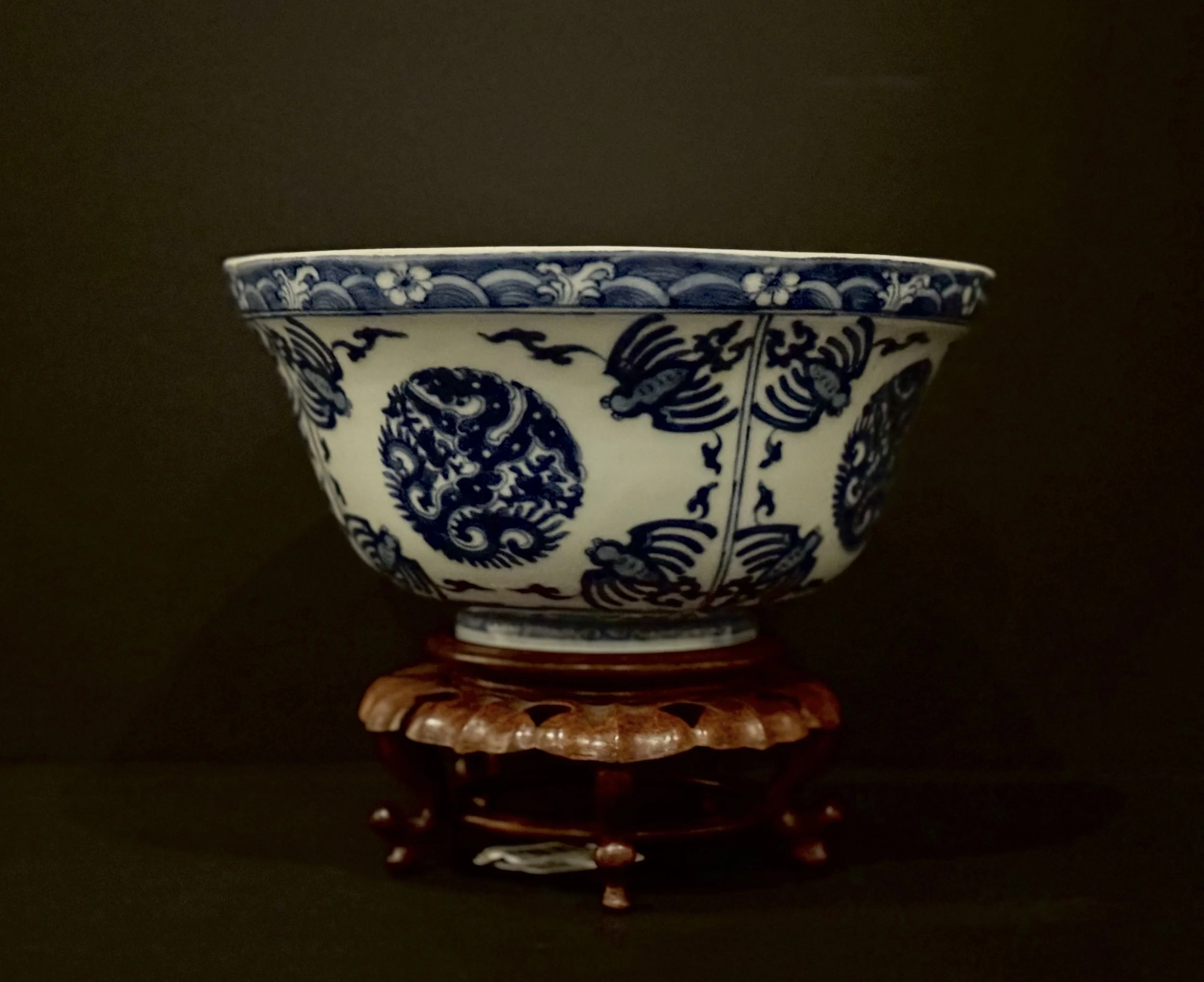 Image 2 of 5
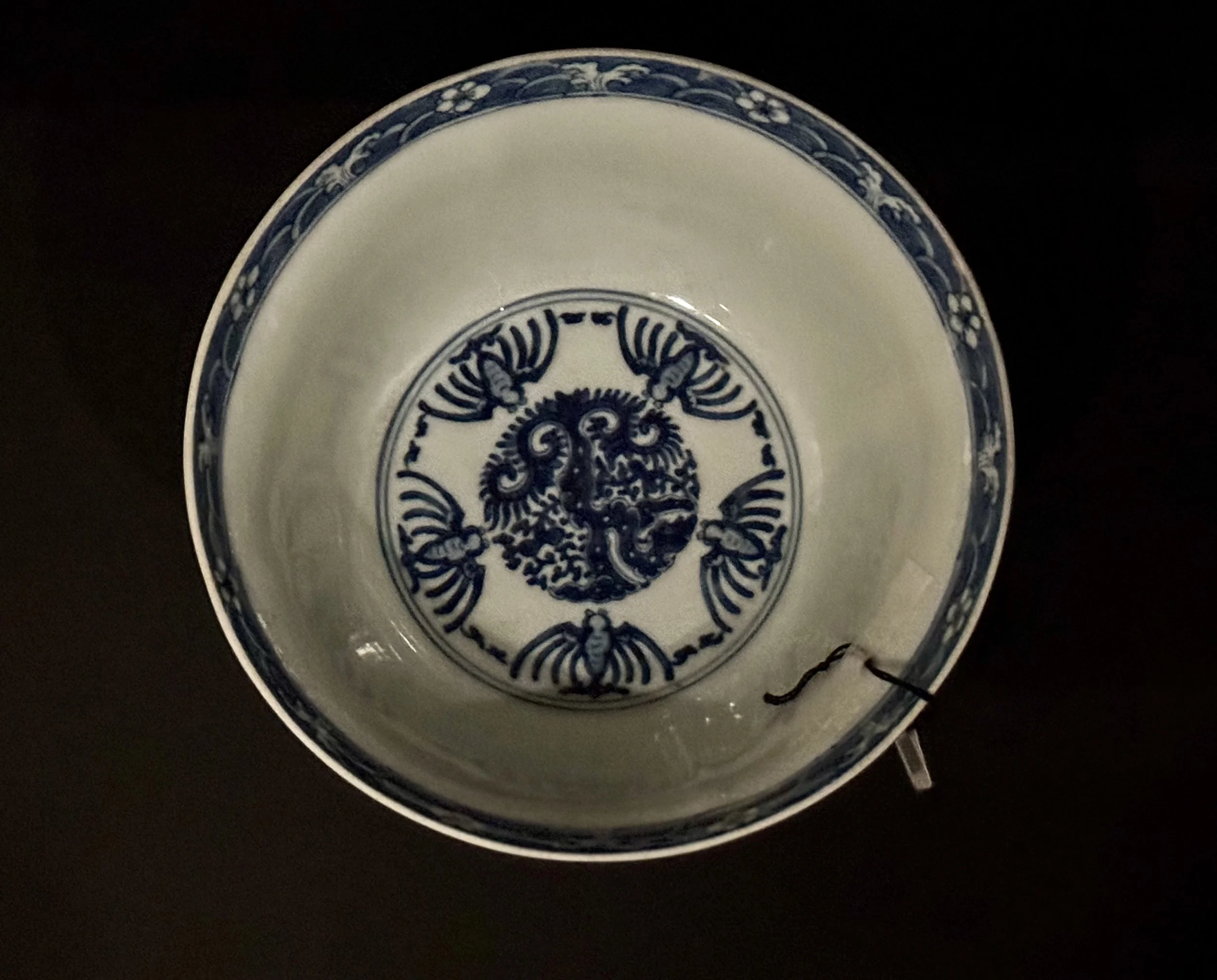 Image 3 of 5
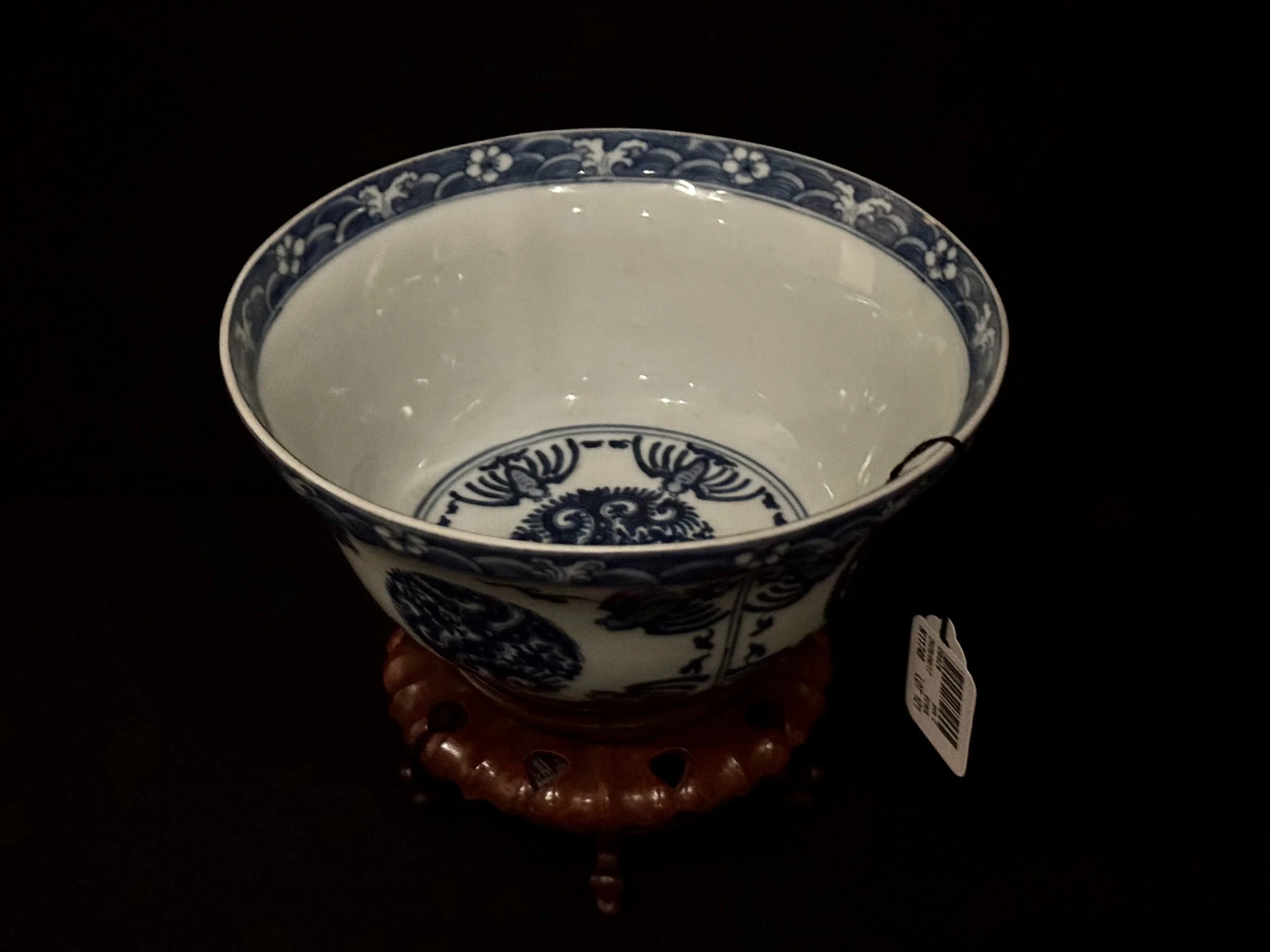 Image 4 of 5
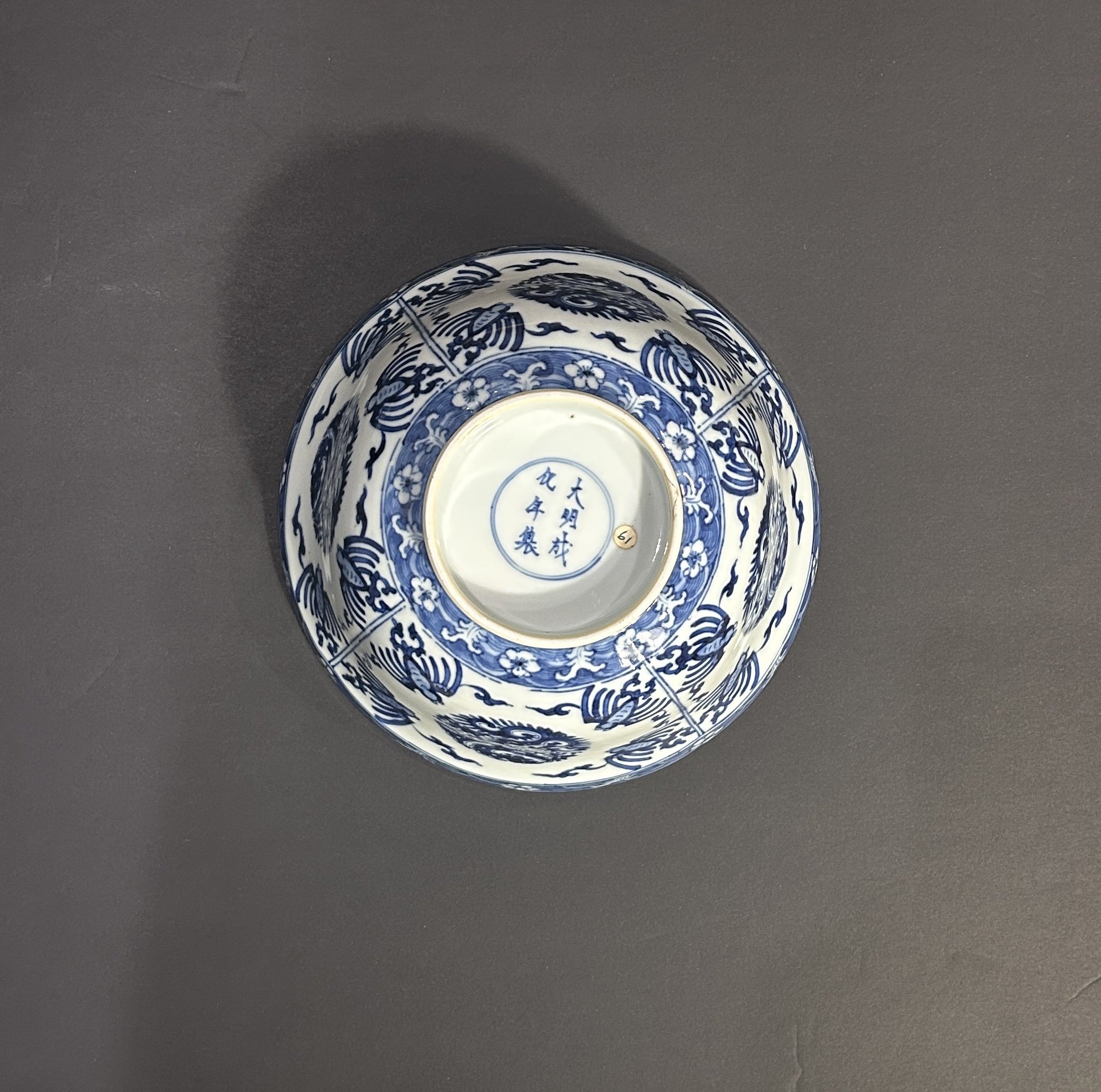 Image 5 of 5
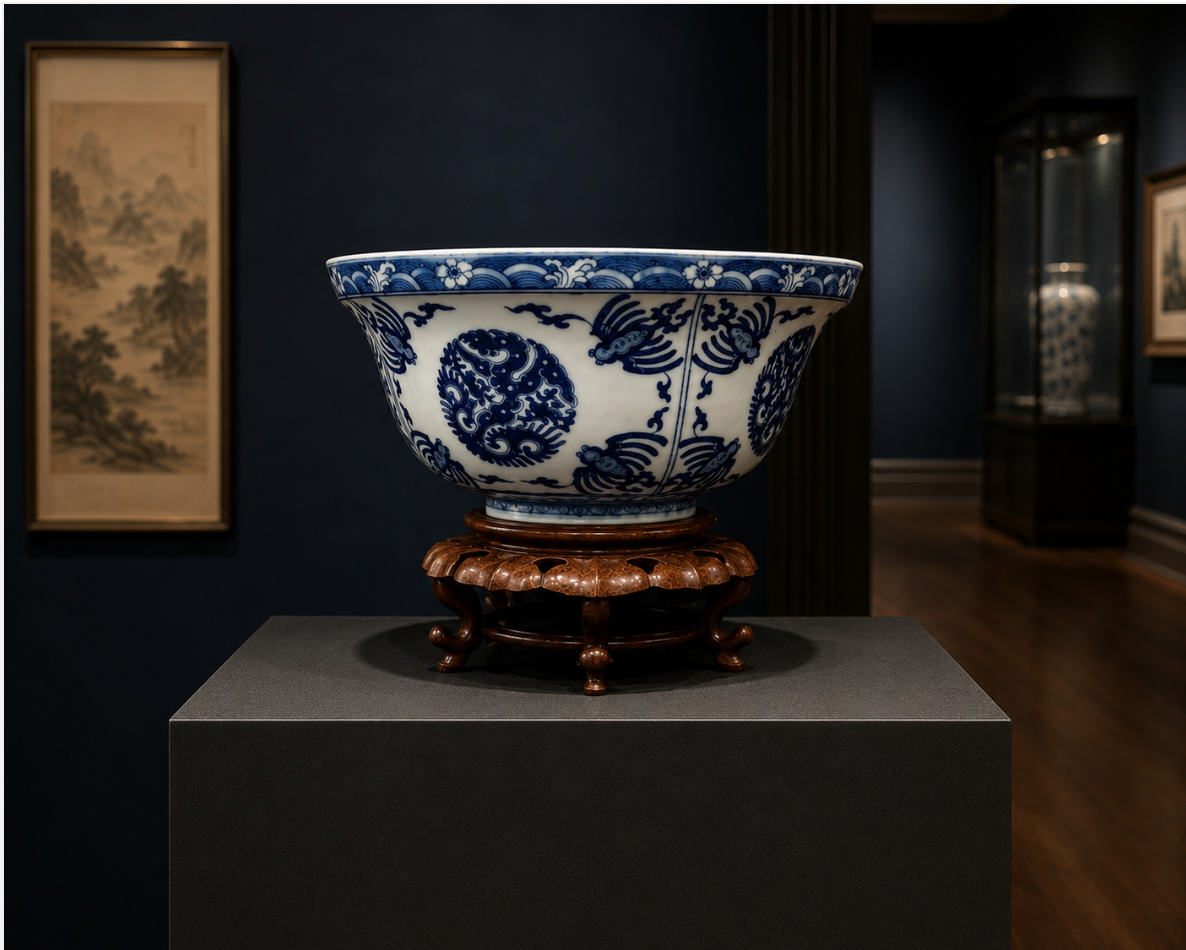
A Large blue and white Phoenix ' roundel bowl, Qing dynasty, Kangxi period. Collection of the sixth president of United States, John Quincy Adams (1767-1848).
A Large Blue and White 'Phoenix Roundel' Bowl
Qing Dynasty, Kangxi Period (1662–1722)
Underglaze cobalt blue on porcelain
Apocryphal Chenghua six-character mark within a double circle
Diameter: 8¾ in. (22.2 cm)
Provenance
By repute, the collection of the sixth President of the United States, John Quincy Adams (1767–1848)
Collection of Mrs. L. Garner
Collection of Harold L. Geiger (1904–1992)
Thence by descent
Introduction
This impressive blue and white porcelain bowl represents one of the finest artistic traditions of the early Qing dynasty. Produced during the reign of the Kangxi Emperor (r. 1662–1722), it reflects the remarkable revival of imperial porcelain production following decades of political upheaval at the end of the Ming dynasty.
The bowl combines technical mastery, symbolic imagery, and elegant proportions characteristic of Kangxi-period Jingdezhen porcelain. Although bearing a six-character Chenghua reign mark, the mark is apocryphal—a respectful tribute to the celebrated Ming emperor rather than an indication of its actual date of manufacture. This practice became widespread during the Qing dynasty and was intended to honor earlier masterpieces rather than deceive collectors.
Historical Context
During the seventeenth century China underwent one of the most turbulent periods in its history.
The fall of the Ming dynasty in 1644 temporarily disrupted porcelain production at the imperial kilns of Jingdezhen, Jiangxi Province. When the Qing dynasty consolidated power, the Kangxi Emperor initiated one of the greatest revivals in Chinese ceramic history.
Under the supervision of imperial officials, Jingdezhen again became the world's foremost porcelain center. Kilns developed remarkable control over cobalt pigments, producing brilliant sapphire-blue decoration beneath exceptionally clear glazes.
Many scholars regard the Kangxi period as the golden age of blue and white porcelain, rivaling even the greatest Ming productions.
Jingdezhen — The Porcelain Capital
The bowl was almost certainly produced at the imperial and commercial kilns of Jingdezhen, Jiangxi Province.
For nearly one thousand years Jingdezhen supplied porcelain to:
the Imperial Court
Buddhist temples
foreign embassies
European trading companies
wealthy Chinese merchants
Its porcelain became one of China's greatest exports.
European collectors of the seventeenth and eighteenth centuries referred to these wares simply as "China," a testament to their international prestige.
The Phoenix Decoration
The principal decoration consists of large phoenix roundels enclosed within vertical panel divisions.
The phoenix (Fenghuang) occupies one of the highest positions in Chinese symbolism.
Unlike the Western phoenix, which is associated primarily with rebirth from fire, the Chinese phoenix symbolizes:
peace
prosperity
virtue
harmony
imperial authority
heavenly blessing
Traditionally:
the dragon represented the Emperor
the phoenix represented the Empress
Together they symbolized the perfect balance of Yin and Yang, masculine and feminine cosmic forces.
Because this bowl depicts phoenixes without dragons, scholars generally interpret the imagery as celebrating feminine virtue, peace, and imperial refinement.
Roundels
The circular medallions framing each phoenix derive from decorative traditions dating back to the Yuan and Ming dynasties.
Roundels served several purposes:
organized large decorative fields
emphasized symmetry
framed auspicious symbols
created rhythm around the vessel
Here the phoenixes appear almost as floating celestial emblems.
The Border Decoration
Around the rim appears an elegant floral border.
Such borders were carefully planned to balance the visual weight of the larger exterior motifs.
Typical Kangxi borders often include:
stylized blossoms
scrolling foliage
waves
clouds
lotus scrolls
The decorative program reflects the extraordinary discipline of Jingdezhen painters.
The Chenghua Mark
The underside bears the six-character inscription:
大明成化年製
Translated:
"Made during the Chenghua reign of the Great Ming."
This does not indicate a Ming date.
Rather, Kangxi potters intentionally copied Chenghua marks because the Chenghua Emperor (1465–1487) had become synonymous with perfection in porcelain.
During the Qing dynasty, many imperial-quality porcelains respectfully carried earlier Ming reign marks.
This practice was accepted and admired by collectors.
Artistic Qualities
Several characteristics firmly place the bowl within Kangxi production:
luminous white porcelain body
brilliant underglaze cobalt
crisp brushwork
elegant, slightly flared profile
carefully proportioned foot ring
transparent glaze with remarkable clarity
The cobalt displays the rich tonal variation prized during the Kangxi period, ranging from deep sapphire to softer washes.
Symbolism
Every element carries auspicious meaning.
Phoenix
peace
virtue
renewal
imperial grace
Clouds
Cloud motifs symbolize:
Heaven
immortality
blessings
divine favor
Circular Roundels
The circle symbolizes:
eternity
completeness
cosmic harmony
Together the imagery creates an object intended not merely for use, but as an embodiment of auspicious ideals.
John Quincy Adams Provenance
One of the most fascinating aspects of this bowl is its traditional association with John Quincy Adams, sixth President of the United States.
Although described "by repute," such provenance is historically plausible.
John Quincy Adams had unusually deep connections with Asia:
He served as one of America's greatest diplomats.
He maintained extensive relationships with international merchants.
During his lifetime Chinese export porcelain had become highly desirable among elite American families.
Fine Chinese ceramics frequently entered distinguished New England collections through diplomatic gifts, merchant networks, and the China Trade.
While definitive documentary evidence linking the bowl directly to Adams has not been published, the tradition significantly enhances its historical interest and reflects the collecting tastes of America's early political elite.
Harold L. Geiger
The bowl later entered the collection of Harold L. Geiger (1904–1992).
Geiger assembled an important collection of Asian art, and objects from his collection have appeared through major auction houses and specialist dealers.
Its descent within the family preserves an unbroken modern collecting history.
Comparable Museum Examples
Similar Kangxi blue and white phoenix bowls can be found in the collections of:
The Palace Museum
National Palace Museum
The British Museum
Victoria and Albert Museum
The Metropolitan Museum of Art
Percival David Foundation of Chinese Art
These institutions preserve many of the finest Kangxi porcelains in the world and illustrate the exceptional quality achieved at Jingdezhen during the late seventeenth century.
Literature
Recommended references for further study include:
Regina Krahl, Chinese Ceramics from the Meiyintang Collection
Margaret Medley, The Chinese Potter
John Ayers, Chinese Ceramics in the Baur Collection
Rose Kerr, Chinese Ceramics: Porcelain of the Qing Dynasty
Jessica Harrison-Hall, Ming Ceramics in the British Museum
Sir Percival David Foundation Catalogues
Complete Collection of Treasures of the Palace Museum: Blue and White Porcelain
Sotheby's, Chinese Art, Hong Kong, September 2025 (comparable example)
Curatorial Assessment
This large Kangxi phoenix bowl exemplifies the technical brilliance that established Qing porcelain as one of China's greatest artistic achievements. Its refined cobalt painting, elegant potting, and auspicious iconography place it among the finest decorative porcelains of the late seventeenth century. The traditional association with President John Quincy Adams, followed by documented ownership through Mrs. L. Garner and collector Harold L. Geiger, gives the bowl an especially compelling collecting history that bridges Chinese imperial craftsmanship and early American appreciation of Asian art.
The combination of superb artistic quality, distinguished provenance, and symbolic decoration makes this bowl an exceptional example of Kangxi blue-and-white porcelain and a museum-worthy object illustrating the enduring dialogue between China and the Western world through the history of collecting.
A Large Blue and White 'Phoenix Roundel' Bowl
Qing Dynasty, Kangxi Period (1662–1722)
Underglaze cobalt blue on porcelain
Apocryphal Chenghua six-character mark within a double circle
Diameter: 8¾ in. (22.2 cm)
Provenance
By repute, the collection of the sixth President of the United States, John Quincy Adams (1767–1848)
Collection of Mrs. L. Garner
Collection of Harold L. Geiger (1904–1992)
Thence by descent
Introduction
This impressive blue and white porcelain bowl represents one of the finest artistic traditions of the early Qing dynasty. Produced during the reign of the Kangxi Emperor (r. 1662–1722), it reflects the remarkable revival of imperial porcelain production following decades of political upheaval at the end of the Ming dynasty.
The bowl combines technical mastery, symbolic imagery, and elegant proportions characteristic of Kangxi-period Jingdezhen porcelain. Although bearing a six-character Chenghua reign mark, the mark is apocryphal—a respectful tribute to the celebrated Ming emperor rather than an indication of its actual date of manufacture. This practice became widespread during the Qing dynasty and was intended to honor earlier masterpieces rather than deceive collectors.
Historical Context
During the seventeenth century China underwent one of the most turbulent periods in its history.
The fall of the Ming dynasty in 1644 temporarily disrupted porcelain production at the imperial kilns of Jingdezhen, Jiangxi Province. When the Qing dynasty consolidated power, the Kangxi Emperor initiated one of the greatest revivals in Chinese ceramic history.
Under the supervision of imperial officials, Jingdezhen again became the world's foremost porcelain center. Kilns developed remarkable control over cobalt pigments, producing brilliant sapphire-blue decoration beneath exceptionally clear glazes.
Many scholars regard the Kangxi period as the golden age of blue and white porcelain, rivaling even the greatest Ming productions.
Jingdezhen — The Porcelain Capital
The bowl was almost certainly produced at the imperial and commercial kilns of Jingdezhen, Jiangxi Province.
For nearly one thousand years Jingdezhen supplied porcelain to:
the Imperial Court
Buddhist temples
foreign embassies
European trading companies
wealthy Chinese merchants
Its porcelain became one of China's greatest exports.
European collectors of the seventeenth and eighteenth centuries referred to these wares simply as "China," a testament to their international prestige.
The Phoenix Decoration
The principal decoration consists of large phoenix roundels enclosed within vertical panel divisions.
The phoenix (Fenghuang) occupies one of the highest positions in Chinese symbolism.
Unlike the Western phoenix, which is associated primarily with rebirth from fire, the Chinese phoenix symbolizes:
peace
prosperity
virtue
harmony
imperial authority
heavenly blessing
Traditionally:
the dragon represented the Emperor
the phoenix represented the Empress
Together they symbolized the perfect balance of Yin and Yang, masculine and feminine cosmic forces.
Because this bowl depicts phoenixes without dragons, scholars generally interpret the imagery as celebrating feminine virtue, peace, and imperial refinement.
Roundels
The circular medallions framing each phoenix derive from decorative traditions dating back to the Yuan and Ming dynasties.
Roundels served several purposes:
organized large decorative fields
emphasized symmetry
framed auspicious symbols
created rhythm around the vessel
Here the phoenixes appear almost as floating celestial emblems.
The Border Decoration
Around the rim appears an elegant floral border.
Such borders were carefully planned to balance the visual weight of the larger exterior motifs.
Typical Kangxi borders often include:
stylized blossoms
scrolling foliage
waves
clouds
lotus scrolls
The decorative program reflects the extraordinary discipline of Jingdezhen painters.
The Chenghua Mark
The underside bears the six-character inscription:
大明成化年製
Translated:
"Made during the Chenghua reign of the Great Ming."
This does not indicate a Ming date.
Rather, Kangxi potters intentionally copied Chenghua marks because the Chenghua Emperor (1465–1487) had become synonymous with perfection in porcelain.
During the Qing dynasty, many imperial-quality porcelains respectfully carried earlier Ming reign marks.
This practice was accepted and admired by collectors.
Artistic Qualities
Several characteristics firmly place the bowl within Kangxi production:
luminous white porcelain body
brilliant underglaze cobalt
crisp brushwork
elegant, slightly flared profile
carefully proportioned foot ring
transparent glaze with remarkable clarity
The cobalt displays the rich tonal variation prized during the Kangxi period, ranging from deep sapphire to softer washes.
Symbolism
Every element carries auspicious meaning.
Phoenix
peace
virtue
renewal
imperial grace
Clouds
Cloud motifs symbolize:
Heaven
immortality
blessings
divine favor
Circular Roundels
The circle symbolizes:
eternity
completeness
cosmic harmony
Together the imagery creates an object intended not merely for use, but as an embodiment of auspicious ideals.
John Quincy Adams Provenance
One of the most fascinating aspects of this bowl is its traditional association with John Quincy Adams, sixth President of the United States.
Although described "by repute," such provenance is historically plausible.
John Quincy Adams had unusually deep connections with Asia:
He served as one of America's greatest diplomats.
He maintained extensive relationships with international merchants.
During his lifetime Chinese export porcelain had become highly desirable among elite American families.
Fine Chinese ceramics frequently entered distinguished New England collections through diplomatic gifts, merchant networks, and the China Trade.
While definitive documentary evidence linking the bowl directly to Adams has not been published, the tradition significantly enhances its historical interest and reflects the collecting tastes of America's early political elite.
Harold L. Geiger
The bowl later entered the collection of Harold L. Geiger (1904–1992).
Geiger assembled an important collection of Asian art, and objects from his collection have appeared through major auction houses and specialist dealers.
Its descent within the family preserves an unbroken modern collecting history.
Comparable Museum Examples
Similar Kangxi blue and white phoenix bowls can be found in the collections of:
The Palace Museum
National Palace Museum
The British Museum
Victoria and Albert Museum
The Metropolitan Museum of Art
Percival David Foundation of Chinese Art
These institutions preserve many of the finest Kangxi porcelains in the world and illustrate the exceptional quality achieved at Jingdezhen during the late seventeenth century.
Literature
Recommended references for further study include:
Regina Krahl, Chinese Ceramics from the Meiyintang Collection
Margaret Medley, The Chinese Potter
John Ayers, Chinese Ceramics in the Baur Collection
Rose Kerr, Chinese Ceramics: Porcelain of the Qing Dynasty
Jessica Harrison-Hall, Ming Ceramics in the British Museum
Sir Percival David Foundation Catalogues
Complete Collection of Treasures of the Palace Museum: Blue and White Porcelain
Sotheby's, Chinese Art, Hong Kong, September 2025 (comparable example)
Curatorial Assessment
This large Kangxi phoenix bowl exemplifies the technical brilliance that established Qing porcelain as one of China's greatest artistic achievements. Its refined cobalt painting, elegant potting, and auspicious iconography place it among the finest decorative porcelains of the late seventeenth century. The traditional association with President John Quincy Adams, followed by documented ownership through Mrs. L. Garner and collector Harold L. Geiger, gives the bowl an especially compelling collecting history that bridges Chinese imperial craftsmanship and early American appreciation of Asian art.
The combination of superb artistic quality, distinguished provenance, and symbolic decoration makes this bowl an exceptional example of Kangxi blue-and-white porcelain and a museum-worthy object illustrating the enduring dialogue between China and the Western world through the history of collecting.