 Image 1 of 3
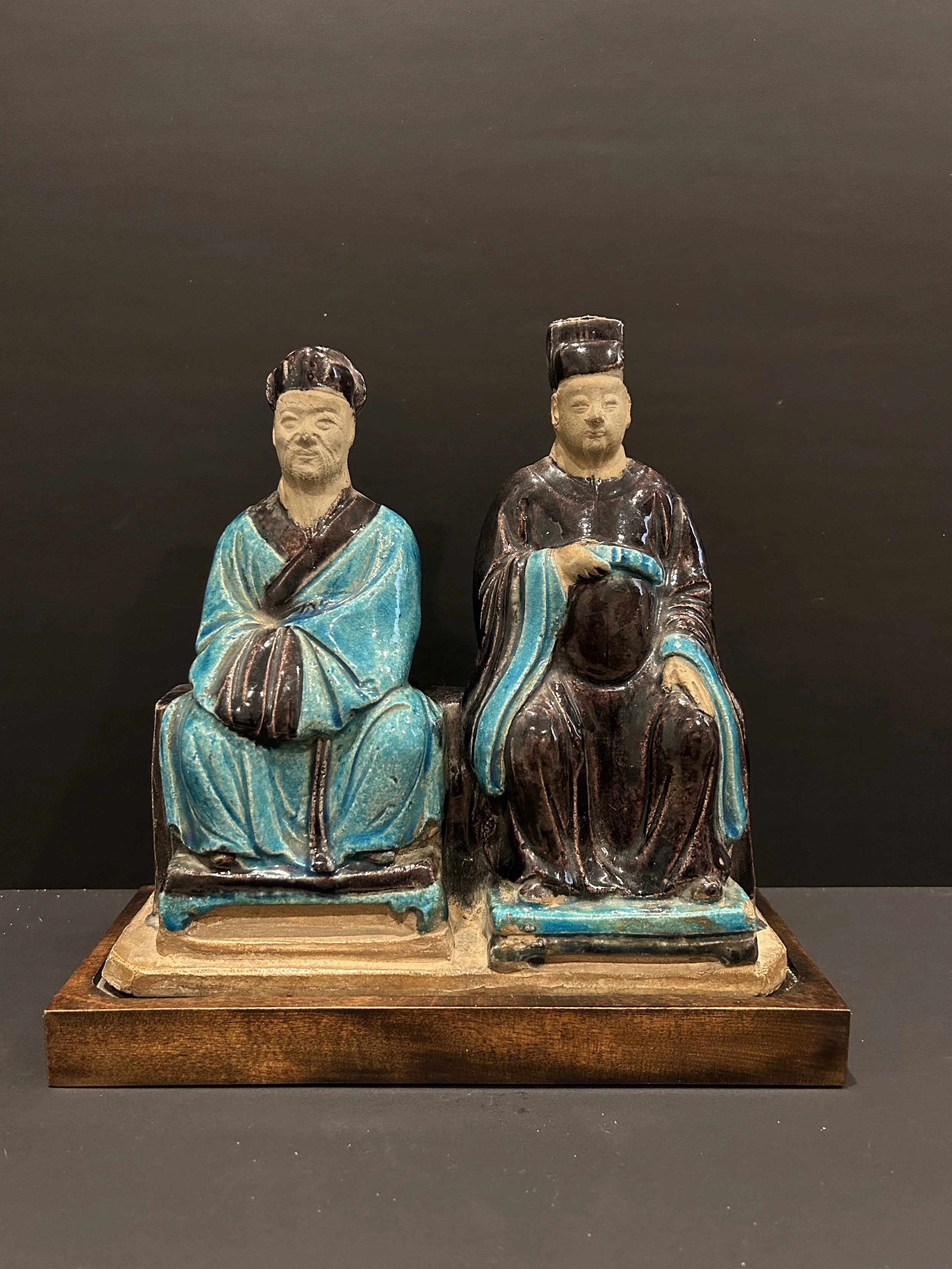 Image 2 of 3
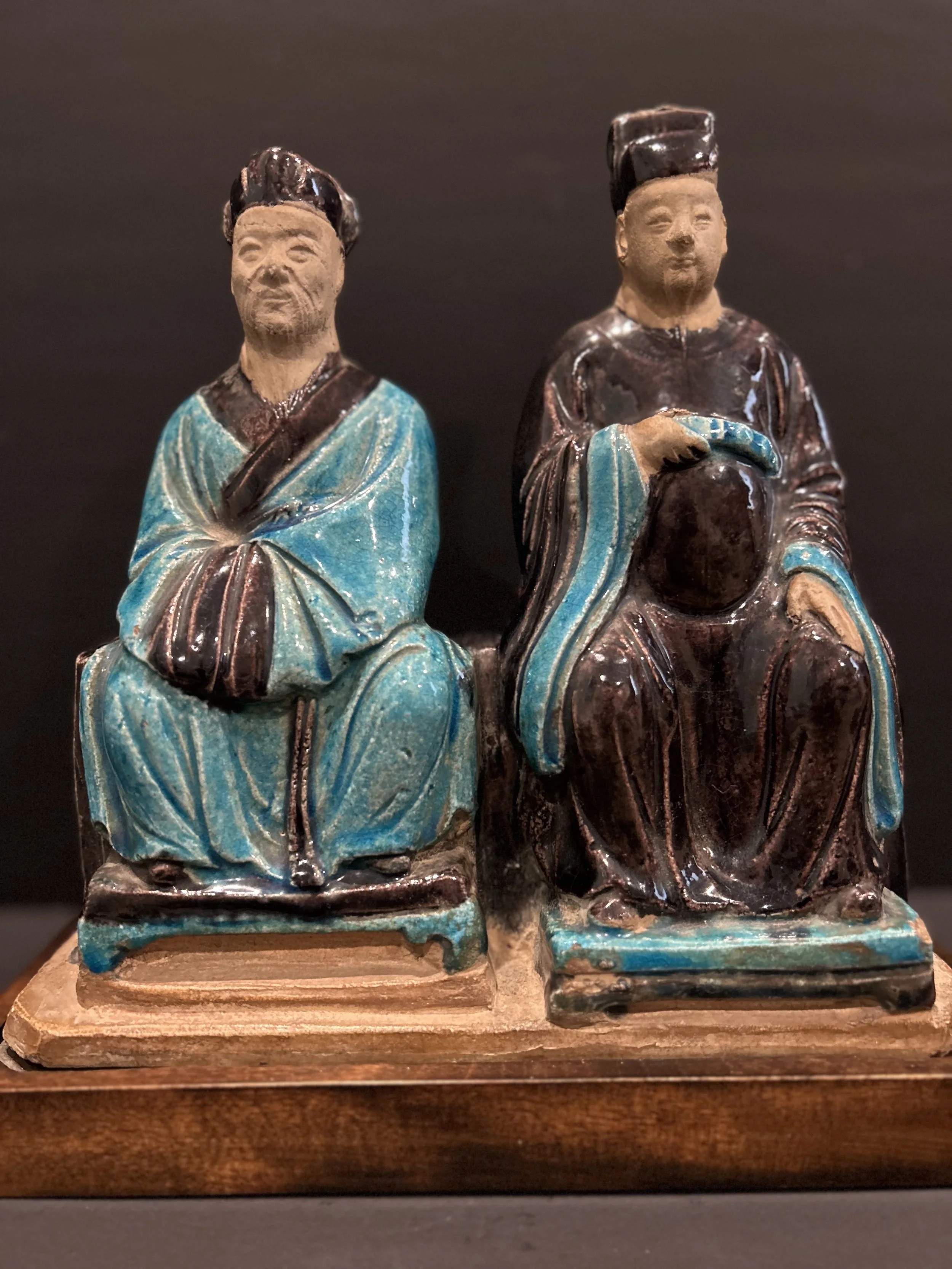 Image 3 of 3
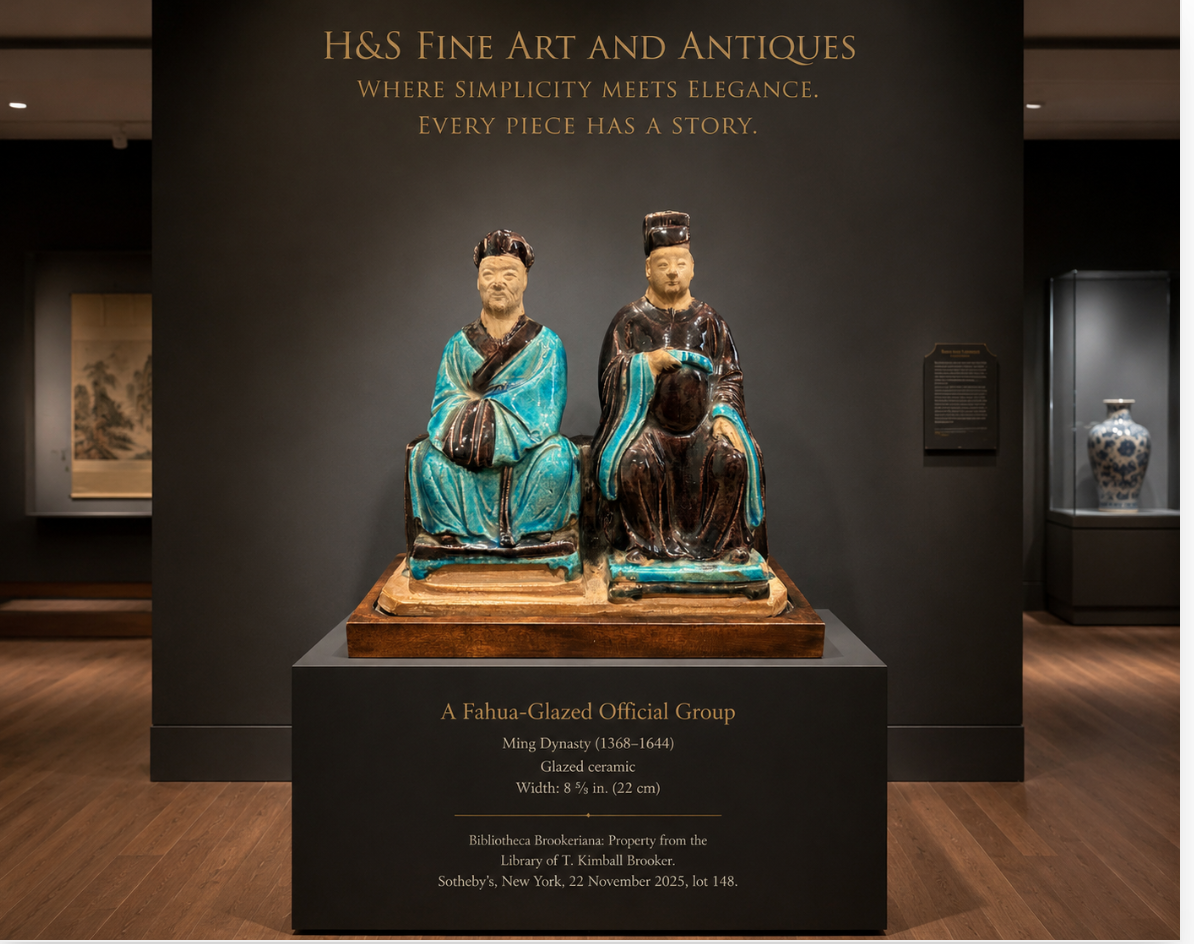
A Fahua-Glazed official group, Ming Dynasty.
A FAHUA-GLAZED GROUP OF TWO SEATED OFFICIALS OR DIGNITARIES
China, Ming Dynasty (1368–1644), probably 15th–16th century
Glazed ceramic with turquoise and aubergine-purple glazes
Affixed to a later wood stand
Width: 8⅝ inches (22 cm)
Provenance: Bibliotheca Brookeriana: Property from the Library of T. Kimball Brooker.
Sotheby’s, New York, CHINA / 5000 YEARS, 22 November 2025, lot 148.
EXHIBITION ESSAY
Among the most distinctive achievements of Chinese ceramic art during the Ming Dynasty was the development of brilliantly colored ceramics known as fahua (法华). Characterized by intense turquoise, deep violet or aubergine, blue, green, yellow, and cream-colored glazes, fahua ceramics occupy a fascinating position between traditional Chinese pottery, architectural decoration, and religious sculpture.
This remarkable sculptural group depicts two seated male officials or dignitaries, each presented frontally upon a raised seat or platform. Their formal clothing, distinctive headdresses, restrained gestures, and solemn expressions create an atmosphere of dignity and authority.
The figures are united by the brilliant turquoise and deep aubergine-purple glazes characteristic of Ming-dynasty fahua ceramics. Yet they are individually modeled, with differences in costume, posture, facial expression, and headdress suggesting distinctions of identity, status, or rank.
Although the precise identities of the two men remain unknown, their appearance places them firmly within the visual culture of officialdom, social hierarchy, religious patronage, and commemorative sculpture in Ming China.
The sculpture therefore offers an intriguing glimpse into a society in which political authority, religious belief, ancestral reverence, and social hierarchy were closely interconnected.
THE ART OF FAHUA CERAMICS
The term fahua describes a distinctive tradition of Chinese ceramics particularly associated with northern China and especially with ceramic production in Shanxi.
The technique developed from traditions of decorated architectural ceramics and lead-glazed stoneware.
Raised lines of clay were applied to the ceramic surface, dividing the composition into separate decorative compartments. Brilliantly colored glazes could then be placed within these outlined areas.
The resulting effect has frequently been compared with Chinese cloisonné enamel, in which thin metal wires separate areas of colored enamel.
In fahua ceramics, however, the decorative boundaries were created in clay.
This method allowed ceramic artists to produce dramatically contrasting areas of color.
Turquoise became one of the most recognizable colors associated with fahua production. Deep violet and aubergine glazes, produced through manganese-based colorants, provided dramatic contrast.
The present sculpture demonstrates this characteristic aesthetic particularly effectively.
The intense turquoise garments of the left-hand figure and the turquoise borders of the right-hand figure's robes contrast against the deep aubergine-purple surfaces of their clothing and headdresses.
The result is a powerful and immediately recognizable example of Ming ceramic color.
THE TWO SEATED MEN
The most compelling aspect of the sculpture is the identity and relationship of the two figures.
Both men are represented seated frontally.
The figure on the right wears a tall formal headdress and long robes. One arm crosses the body while the opposite hand rests upon the knee.
His elevated headdress and comparatively commanding posture may suggest a figure of higher status.
The man seated beside him wears a softer cap and voluminous turquoise robes. His hands appear concealed within his sleeves.
The concealment of the hands within long sleeves was associated with formal behavior and respectful deportment in traditional Chinese society.
Officials appearing before superiors or participating in ceremonial activities could adopt restrained poses emphasizing discipline, dignity, and social order.
The figures therefore belong to the broad visual vocabulary of Chinese officialdom and elite society.
Their precise identities, however, cannot presently be established.
They may represent civil officials associated with the Ming bureaucracy.
Alternatively, they could represent donors or patrons connected with a Buddhist or Daoist temple.
Another possibility is that the figures depict historical officials who became objects of local religious veneration.
Chinese temples sometimes contained images of magistrates, officials, military commanders, scholars, and historical personalities who were honored after death.
The sculpture may also have originally formed part of a larger group containing additional officials, attendants, guardians, or a central religious figure.
Without inscriptions or archaeological documentation establishing the sculpture's original location, these possibilities must remain interpretations rather than definitive identifications.
For this reason, the title “A Fahua-Glazed Group of Two Seated Officials or Dignitaries” is both accurate and appropriately cautious.
THE SIGNIFICANCE OF THE PAIRED COMPOSITION
The representation of two figures together is especially interesting.
Chinese religious and commemorative sculpture frequently employed hierarchical arrangements.
A central deity, ancestor, magistrate, or historical figure might be accompanied by officials, attendants, guardians, or donors.
Pairs could communicate concepts of order, hierarchy, companionship, complementary authority, and institutional continuity.
The subtle differences between the figures in the present sculpture may indicate differences of rank.
The tall headdress and more commanding posture of the right-hand figure could indicate seniority, while the figure beside him may represent a subordinate official, associate, attendant, or companion.
Yet the two men are presented together on approximately equal visual terms.
This creates a fascinating balance between individuality and collective identity.
Rather than representing a moment of dramatic action, the sculpture communicates permanence.
The figures sit quietly.
Their bodies are contained within heavy robes.
Their gestures are restrained.
Their expressions are solemn.
The emphasis is upon authority, dignity, stability, and social order.
These qualities were fundamental to the political and philosophical culture of Ming China.
OFFICIALDOM AND THE MING BUREAUCRACY
Government officials occupied an important position within Ming society.
The imperial bureaucracy was closely associated with China's long tradition of Confucian education and the civil service examination system.
Successful candidates could enter government service and become members of the scholar-official elite.
Official costume communicated social position.
Hats, robes, belts, ceremonial tablets, and rank badges helped distinguish officials and their position within the bureaucratic hierarchy.
During the Ming dynasty, embroidered rank badges known as buzi became important indicators of official status.
Civil officials were represented by birds, while military officials were represented by animals.
No clearly identifiable rank badges survive on the present figures.
It is therefore impossible to determine their exact bureaucratic rank.
Nevertheless, their formal clothing, headdresses, seated posture, and solemn presentation strongly associate them with the visual world of officials, dignitaries, and elite authority.
POSSIBLE ORIGINAL FUNCTION
Fahua ceramic sculptures were produced for a variety of settings.
Some decorated Buddhist and Daoist temples.
Others formed part of architectural structures.
Figures representing officials, immortals, attendants, guardians, donors, and religious personalities could be placed within shrines or arranged around central religious images.
Ceramic figures were also created for funerary environments, continuing China's ancient tradition of providing symbolic attendants and representations of earthly society for the afterlife.
The frontal presentation of the present figures suggests that the sculpture was intended to be viewed primarily from the front.
This characteristic may indicate placement against a wall, within an architectural niche, upon an altar, or as part of a larger sculptural arrangement.
The brilliant glazes would have made the figures highly visible within an interior architectural environment.
Turquoise and aubergine surfaces would have reflected available light, allowing the figures to maintain a strong visual presence within a temple or shrine.
The original function of the group cannot presently be determined with certainty.
Its formal composition, however, suggests an object associated with ceremonial display, religious devotion, commemoration, or the representation of institutional authority.
COLOR AND SYMBOLIC PRESENCE
The visual power of the sculpture depends heavily upon color.
Turquoise is the dominant color.
Brilliant turquoise glazes became one of the defining characteristics of fahua ceramics.
The color creates an appearance reminiscent of precious materials and provides dramatic contrast with the darker surfaces of the figures.
Deep aubergine-purple glaze provides visual weight.
The contrast between turquoise and purple emphasizes the folds of the robes and the physical separation of the figures.
The restrained treatment of the faces is equally important.
The faces remain comparatively subdued while the garments carry the strongest colors.
This allows the viewer's attention to move naturally from the brilliant robes toward the individualized expressions of the two men.
The sculpture consequently combines decorative brilliance with psychological restraint.
THE BIBLIOTHECA BROOKERIANA PROVENANCE
The modern provenance of the sculpture adds another important chapter to its history.
The group formed part of the Bibliotheca Brookeriana, the celebrated collection assembled by T. Kimball Brooker.
Brooker assembled one of the most distinguished modern private libraries devoted to Renaissance books, early printing, historical bindings, and the history of the book.
His collection became internationally recognized for the rarity, scholarly importance, and exceptional quality of its holdings.
The presence of the fahua group within the Bibliotheca Brookeriana connects the sculpture with the history of sophisticated private collecting.
The work subsequently appeared at Sotheby's New York in the sale CHINA / 5000 YEARS on 22 November 2025, lot 148.
The auction catalogue identified the sculpture as a “Fahua-glazed official group, Ming dynasty,” recorded its width as 8⅝ inches, noted that the figures were affixed to a wood stand, and documented its provenance from the Bibliotheca Brookeriana.
This documented auction appearance provides an important modern reference point in the ownership history of the sculpture.
MUSEUM AND SCHOLARLY CONTEXT
Important examples of Ming fahua ceramics are preserved in major museum collections.
The Metropolitan Museum of Art preserves significant examples of Ming ceramics that illustrate the extraordinary range of colored-glaze production in imperial China.
The British Museum contains one of the world's major collections of Chinese ceramics, including important comparative material for the study of Ming fahua production and glaze technology.
The Victoria and Albert Museum also preserves Chinese ceramics relevant to the history of Ming colored glazes and decorative traditions.
Collections and archaeological discoveries in Shanxi are particularly important because the province was a major center of fahua ceramic production.
Comparison with museum collections helps place the present sculpture within the broader history of Ming ceramic sculpture, architectural ceramics, and religious imagery.
SELECTED LITERATURE
For further study and comparative research, the following publications are particularly relevant:
Jessica Harrison-Hall, Ming Ceramics in the British Museum, London, 2001.
Suzanne G. Valenstein, A Handbook of Chinese Ceramics, Metropolitan Museum of Art, New York.
He Li, Chinese Ceramics: A New Comprehensive Survey, Thames & Hudson.
Margaret Medley, The Chinese Potter: A Practical History of Chinese Ceramics.
Rose Kerr and Nigel Wood, Science and Civilisation in China, Volume 5, Chemistry and Chemical Technology, Part XII: Ceramic Technology.
These publications provide useful discussions of Ming ceramics, ceramic technology, colored glazes, regional production, and the historical development of Chinese ceramic art.
EXHIBITION HISTORY
No institutional museum exhibition history for this specific sculpture has presently been documented.
Its recorded modern public appearance is:
Sotheby's, New York, CHINA / 5000 YEARS, 22 November 2025, lot 148.
Until additional documentary evidence emerges, no further exhibition history should be attributed to the sculpture.
CONCLUSION
This Fahua-Glazed Group of Two Seated Officials or Dignitaries represents the intersection of ceramic technology, sculpture, social hierarchy, and religious or commemorative practice during the Ming dynasty.
Its brilliant turquoise and aubergine glazes immediately identify it with the distinctive fahua ceramic tradition.
The solemn figures, formal clothing, and restrained gestures evoke the highly ordered world of Chinese officialdom and elite society.
Yet their precise identities remain mysterious.
They may have been officials, temple patrons, historical dignitaries, or members of a larger religious sculptural ensemble.
That uncertainty contributes to the fascination of the sculpture.
Removed from its original architectural or ritual context, the group survives as an evocative image of authority, companionship, hierarchy, and permanence in Ming China.
Its documented provenance from the Bibliotheca Brookeriana, followed by its appearance at Sotheby's New York, provides the sculpture with a distinguished modern collecting history.
Today, the group can be appreciated both as an example of the technical brilliance of Ming ceramic production and as a rare surviving sculptural representation of the people and institutions that shaped the political, religious, and cultural landscape of imperial China.
A FAHUA-GLAZED GROUP OF TWO SEATED OFFICIALS OR DIGNITARIES
China, Ming Dynasty (1368–1644), probably 15th–16th century
Glazed ceramic with turquoise and aubergine-purple glazes
Affixed to a later wood stand
Width: 8⅝ inches (22 cm)
Provenance: Bibliotheca Brookeriana: Property from the Library of T. Kimball Brooker.
Sotheby’s, New York, CHINA / 5000 YEARS, 22 November 2025, lot 148.
EXHIBITION ESSAY
Among the most distinctive achievements of Chinese ceramic art during the Ming Dynasty was the development of brilliantly colored ceramics known as fahua (法华). Characterized by intense turquoise, deep violet or aubergine, blue, green, yellow, and cream-colored glazes, fahua ceramics occupy a fascinating position between traditional Chinese pottery, architectural decoration, and religious sculpture.
This remarkable sculptural group depicts two seated male officials or dignitaries, each presented frontally upon a raised seat or platform. Their formal clothing, distinctive headdresses, restrained gestures, and solemn expressions create an atmosphere of dignity and authority.
The figures are united by the brilliant turquoise and deep aubergine-purple glazes characteristic of Ming-dynasty fahua ceramics. Yet they are individually modeled, with differences in costume, posture, facial expression, and headdress suggesting distinctions of identity, status, or rank.
Although the precise identities of the two men remain unknown, their appearance places them firmly within the visual culture of officialdom, social hierarchy, religious patronage, and commemorative sculpture in Ming China.
The sculpture therefore offers an intriguing glimpse into a society in which political authority, religious belief, ancestral reverence, and social hierarchy were closely interconnected.
THE ART OF FAHUA CERAMICS
The term fahua describes a distinctive tradition of Chinese ceramics particularly associated with northern China and especially with ceramic production in Shanxi.
The technique developed from traditions of decorated architectural ceramics and lead-glazed stoneware.
Raised lines of clay were applied to the ceramic surface, dividing the composition into separate decorative compartments. Brilliantly colored glazes could then be placed within these outlined areas.
The resulting effect has frequently been compared with Chinese cloisonné enamel, in which thin metal wires separate areas of colored enamel.
In fahua ceramics, however, the decorative boundaries were created in clay.
This method allowed ceramic artists to produce dramatically contrasting areas of color.
Turquoise became one of the most recognizable colors associated with fahua production. Deep violet and aubergine glazes, produced through manganese-based colorants, provided dramatic contrast.
The present sculpture demonstrates this characteristic aesthetic particularly effectively.
The intense turquoise garments of the left-hand figure and the turquoise borders of the right-hand figure's robes contrast against the deep aubergine-purple surfaces of their clothing and headdresses.
The result is a powerful and immediately recognizable example of Ming ceramic color.
THE TWO SEATED MEN
The most compelling aspect of the sculpture is the identity and relationship of the two figures.
Both men are represented seated frontally.
The figure on the right wears a tall formal headdress and long robes. One arm crosses the body while the opposite hand rests upon the knee.
His elevated headdress and comparatively commanding posture may suggest a figure of higher status.
The man seated beside him wears a softer cap and voluminous turquoise robes. His hands appear concealed within his sleeves.
The concealment of the hands within long sleeves was associated with formal behavior and respectful deportment in traditional Chinese society.
Officials appearing before superiors or participating in ceremonial activities could adopt restrained poses emphasizing discipline, dignity, and social order.
The figures therefore belong to the broad visual vocabulary of Chinese officialdom and elite society.
Their precise identities, however, cannot presently be established.
They may represent civil officials associated with the Ming bureaucracy.
Alternatively, they could represent donors or patrons connected with a Buddhist or Daoist temple.
Another possibility is that the figures depict historical officials who became objects of local religious veneration.
Chinese temples sometimes contained images of magistrates, officials, military commanders, scholars, and historical personalities who were honored after death.
The sculpture may also have originally formed part of a larger group containing additional officials, attendants, guardians, or a central religious figure.
Without inscriptions or archaeological documentation establishing the sculpture's original location, these possibilities must remain interpretations rather than definitive identifications.
For this reason, the title “A Fahua-Glazed Group of Two Seated Officials or Dignitaries” is both accurate and appropriately cautious.
THE SIGNIFICANCE OF THE PAIRED COMPOSITION
The representation of two figures together is especially interesting.
Chinese religious and commemorative sculpture frequently employed hierarchical arrangements.
A central deity, ancestor, magistrate, or historical figure might be accompanied by officials, attendants, guardians, or donors.
Pairs could communicate concepts of order, hierarchy, companionship, complementary authority, and institutional continuity.
The subtle differences between the figures in the present sculpture may indicate differences of rank.
The tall headdress and more commanding posture of the right-hand figure could indicate seniority, while the figure beside him may represent a subordinate official, associate, attendant, or companion.
Yet the two men are presented together on approximately equal visual terms.
This creates a fascinating balance between individuality and collective identity.
Rather than representing a moment of dramatic action, the sculpture communicates permanence.
The figures sit quietly.
Their bodies are contained within heavy robes.
Their gestures are restrained.
Their expressions are solemn.
The emphasis is upon authority, dignity, stability, and social order.
These qualities were fundamental to the political and philosophical culture of Ming China.
OFFICIALDOM AND THE MING BUREAUCRACY
Government officials occupied an important position within Ming society.
The imperial bureaucracy was closely associated with China's long tradition of Confucian education and the civil service examination system.
Successful candidates could enter government service and become members of the scholar-official elite.
Official costume communicated social position.
Hats, robes, belts, ceremonial tablets, and rank badges helped distinguish officials and their position within the bureaucratic hierarchy.
During the Ming dynasty, embroidered rank badges known as buzi became important indicators of official status.
Civil officials were represented by birds, while military officials were represented by animals.
No clearly identifiable rank badges survive on the present figures.
It is therefore impossible to determine their exact bureaucratic rank.
Nevertheless, their formal clothing, headdresses, seated posture, and solemn presentation strongly associate them with the visual world of officials, dignitaries, and elite authority.
POSSIBLE ORIGINAL FUNCTION
Fahua ceramic sculptures were produced for a variety of settings.
Some decorated Buddhist and Daoist temples.
Others formed part of architectural structures.
Figures representing officials, immortals, attendants, guardians, donors, and religious personalities could be placed within shrines or arranged around central religious images.
Ceramic figures were also created for funerary environments, continuing China's ancient tradition of providing symbolic attendants and representations of earthly society for the afterlife.
The frontal presentation of the present figures suggests that the sculpture was intended to be viewed primarily from the front.
This characteristic may indicate placement against a wall, within an architectural niche, upon an altar, or as part of a larger sculptural arrangement.
The brilliant glazes would have made the figures highly visible within an interior architectural environment.
Turquoise and aubergine surfaces would have reflected available light, allowing the figures to maintain a strong visual presence within a temple or shrine.
The original function of the group cannot presently be determined with certainty.
Its formal composition, however, suggests an object associated with ceremonial display, religious devotion, commemoration, or the representation of institutional authority.
COLOR AND SYMBOLIC PRESENCE
The visual power of the sculpture depends heavily upon color.
Turquoise is the dominant color.
Brilliant turquoise glazes became one of the defining characteristics of fahua ceramics.
The color creates an appearance reminiscent of precious materials and provides dramatic contrast with the darker surfaces of the figures.
Deep aubergine-purple glaze provides visual weight.
The contrast between turquoise and purple emphasizes the folds of the robes and the physical separation of the figures.
The restrained treatment of the faces is equally important.
The faces remain comparatively subdued while the garments carry the strongest colors.
This allows the viewer's attention to move naturally from the brilliant robes toward the individualized expressions of the two men.
The sculpture consequently combines decorative brilliance with psychological restraint.
THE BIBLIOTHECA BROOKERIANA PROVENANCE
The modern provenance of the sculpture adds another important chapter to its history.
The group formed part of the Bibliotheca Brookeriana, the celebrated collection assembled by T. Kimball Brooker.
Brooker assembled one of the most distinguished modern private libraries devoted to Renaissance books, early printing, historical bindings, and the history of the book.
His collection became internationally recognized for the rarity, scholarly importance, and exceptional quality of its holdings.
The presence of the fahua group within the Bibliotheca Brookeriana connects the sculpture with the history of sophisticated private collecting.
The work subsequently appeared at Sotheby's New York in the sale CHINA / 5000 YEARS on 22 November 2025, lot 148.
The auction catalogue identified the sculpture as a “Fahua-glazed official group, Ming dynasty,” recorded its width as 8⅝ inches, noted that the figures were affixed to a wood stand, and documented its provenance from the Bibliotheca Brookeriana.
This documented auction appearance provides an important modern reference point in the ownership history of the sculpture.
MUSEUM AND SCHOLARLY CONTEXT
Important examples of Ming fahua ceramics are preserved in major museum collections.
The Metropolitan Museum of Art preserves significant examples of Ming ceramics that illustrate the extraordinary range of colored-glaze production in imperial China.
The British Museum contains one of the world's major collections of Chinese ceramics, including important comparative material for the study of Ming fahua production and glaze technology.
The Victoria and Albert Museum also preserves Chinese ceramics relevant to the history of Ming colored glazes and decorative traditions.
Collections and archaeological discoveries in Shanxi are particularly important because the province was a major center of fahua ceramic production.
Comparison with museum collections helps place the present sculpture within the broader history of Ming ceramic sculpture, architectural ceramics, and religious imagery.
SELECTED LITERATURE
For further study and comparative research, the following publications are particularly relevant:
Jessica Harrison-Hall, Ming Ceramics in the British Museum, London, 2001.
Suzanne G. Valenstein, A Handbook of Chinese Ceramics, Metropolitan Museum of Art, New York.
He Li, Chinese Ceramics: A New Comprehensive Survey, Thames & Hudson.
Margaret Medley, The Chinese Potter: A Practical History of Chinese Ceramics.
Rose Kerr and Nigel Wood, Science and Civilisation in China, Volume 5, Chemistry and Chemical Technology, Part XII: Ceramic Technology.
These publications provide useful discussions of Ming ceramics, ceramic technology, colored glazes, regional production, and the historical development of Chinese ceramic art.
EXHIBITION HISTORY
No institutional museum exhibition history for this specific sculpture has presently been documented.
Its recorded modern public appearance is:
Sotheby's, New York, CHINA / 5000 YEARS, 22 November 2025, lot 148.
Until additional documentary evidence emerges, no further exhibition history should be attributed to the sculpture.
CONCLUSION
This Fahua-Glazed Group of Two Seated Officials or Dignitaries represents the intersection of ceramic technology, sculpture, social hierarchy, and religious or commemorative practice during the Ming dynasty.
Its brilliant turquoise and aubergine glazes immediately identify it with the distinctive fahua ceramic tradition.
The solemn figures, formal clothing, and restrained gestures evoke the highly ordered world of Chinese officialdom and elite society.
Yet their precise identities remain mysterious.
They may have been officials, temple patrons, historical dignitaries, or members of a larger religious sculptural ensemble.
That uncertainty contributes to the fascination of the sculpture.
Removed from its original architectural or ritual context, the group survives as an evocative image of authority, companionship, hierarchy, and permanence in Ming China.
Its documented provenance from the Bibliotheca Brookeriana, followed by its appearance at Sotheby's New York, provides the sculpture with a distinguished modern collecting history.
Today, the group can be appreciated both as an example of the technical brilliance of Ming ceramic production and as a rare surviving sculptural representation of the people and institutions that shaped the political, religious, and cultural landscape of imperial China.