 Image 1 of 5
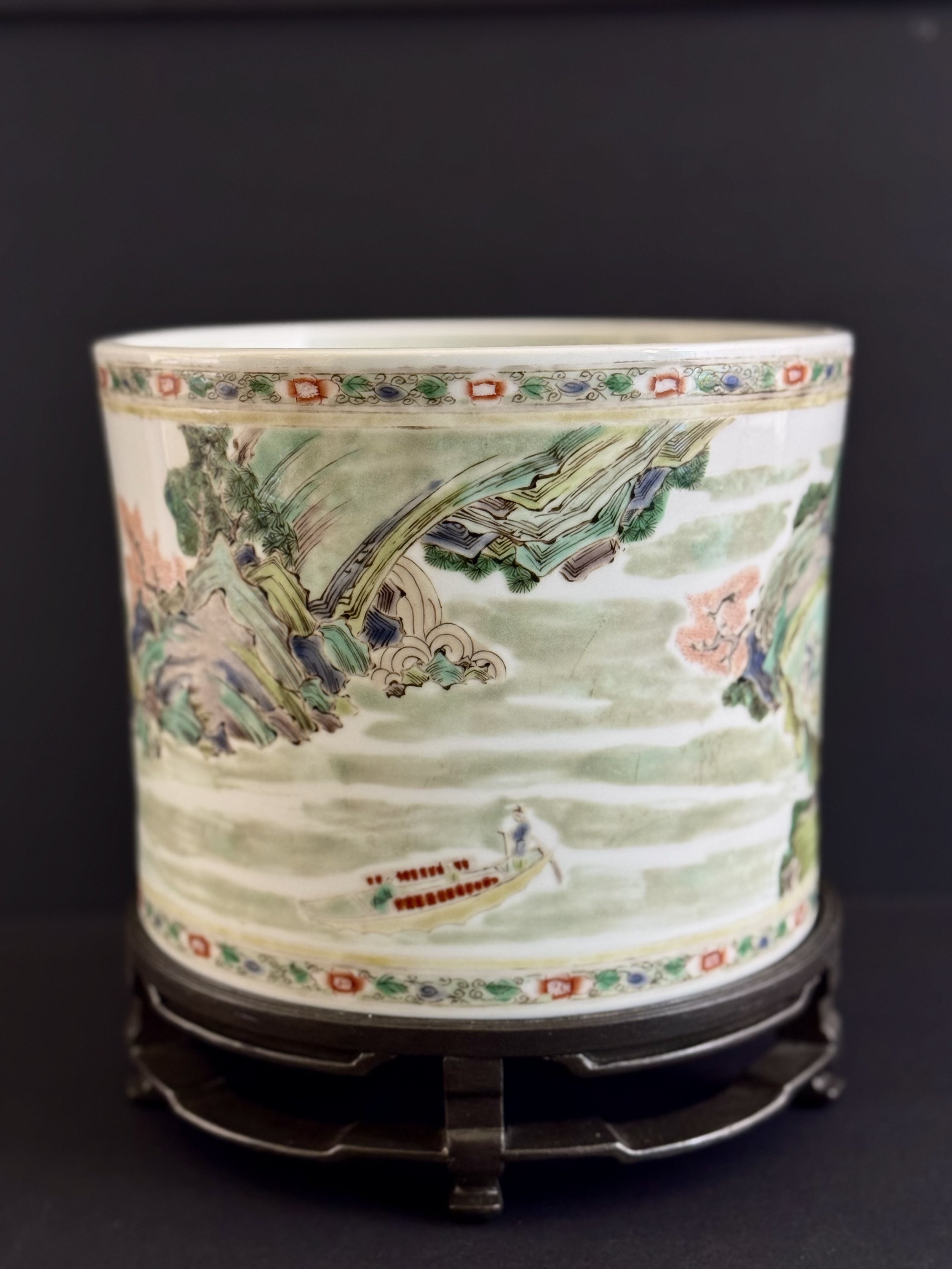 Image 2 of 5
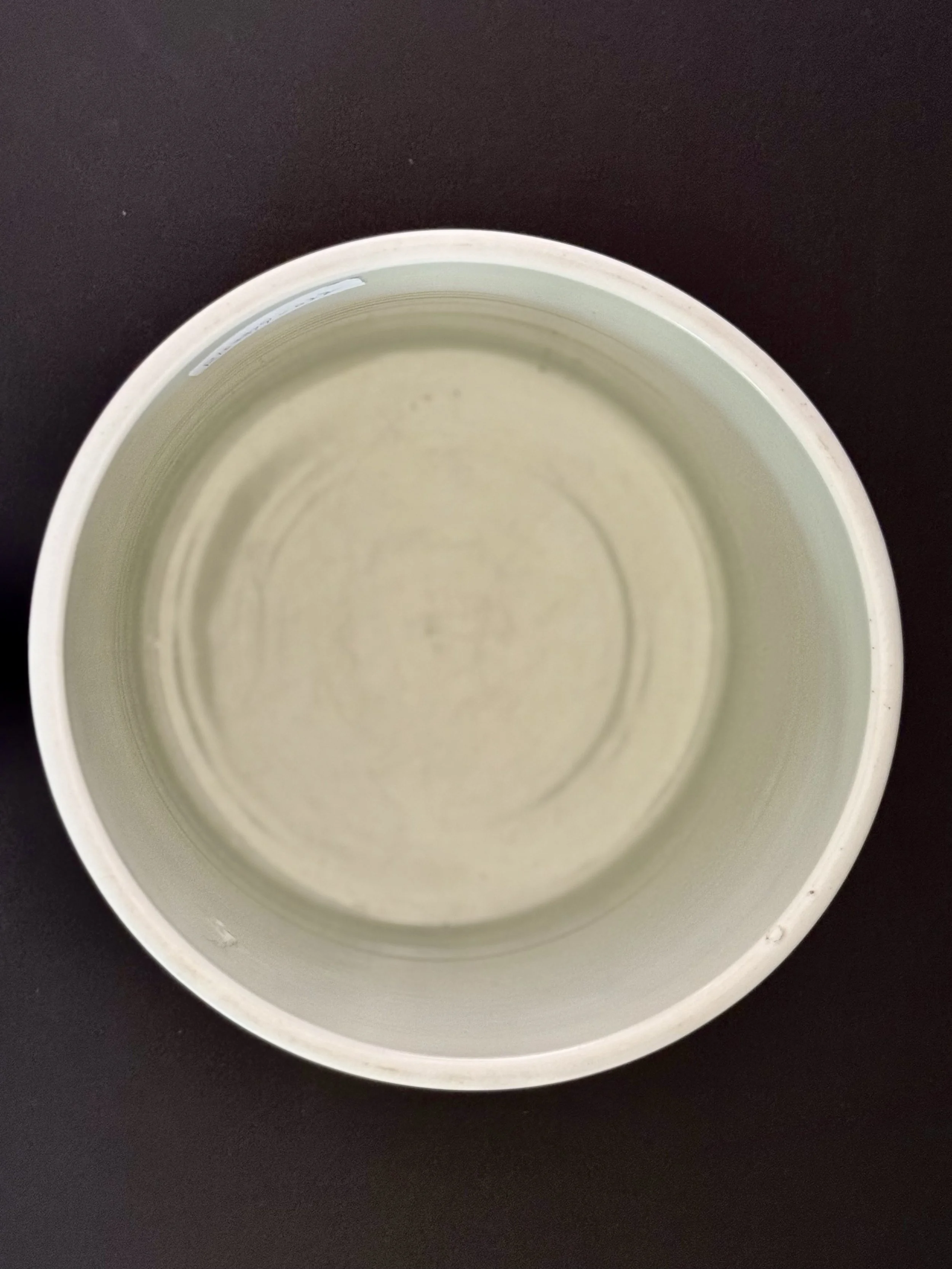 Image 3 of 5
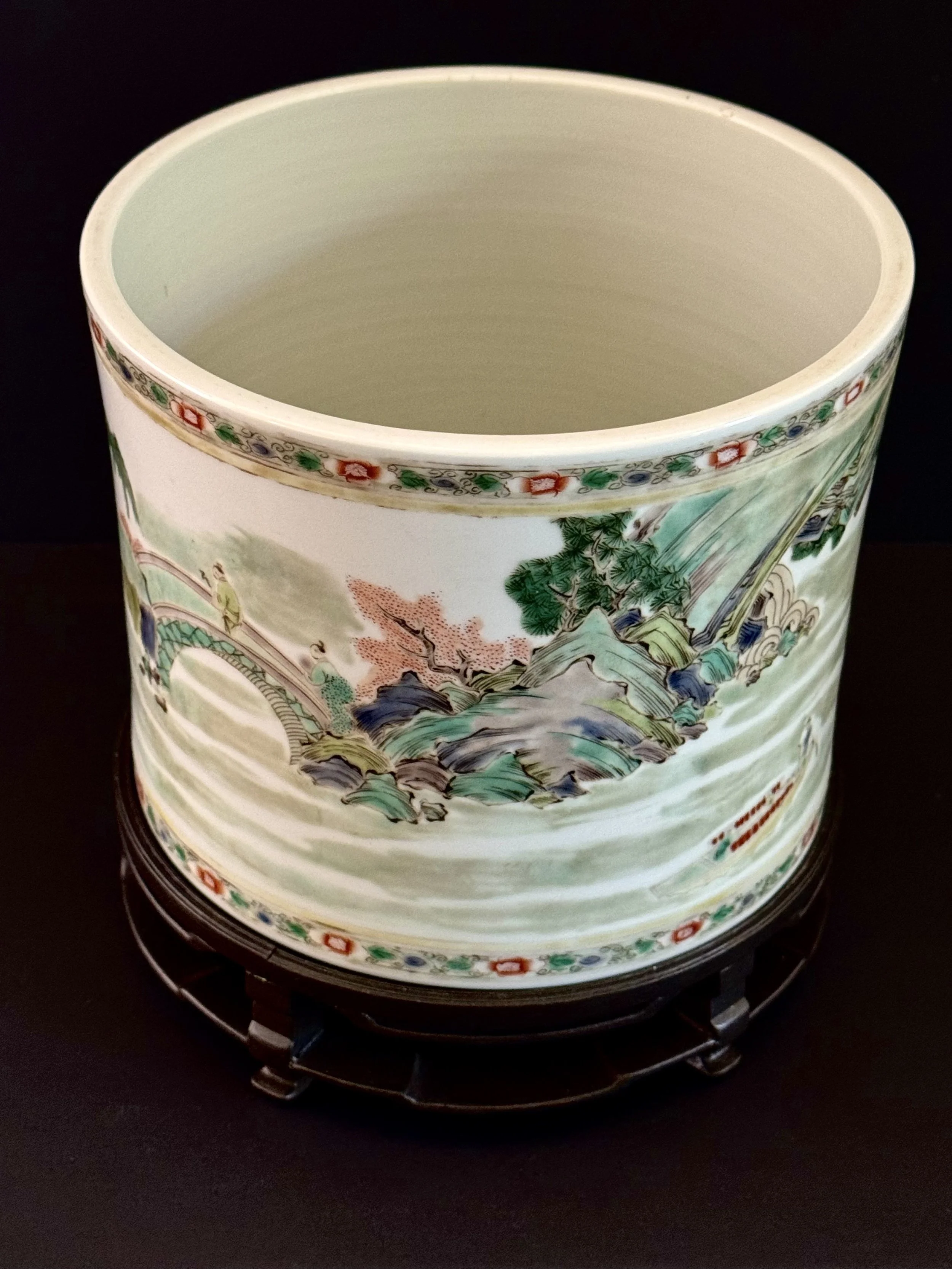 Image 4 of 5
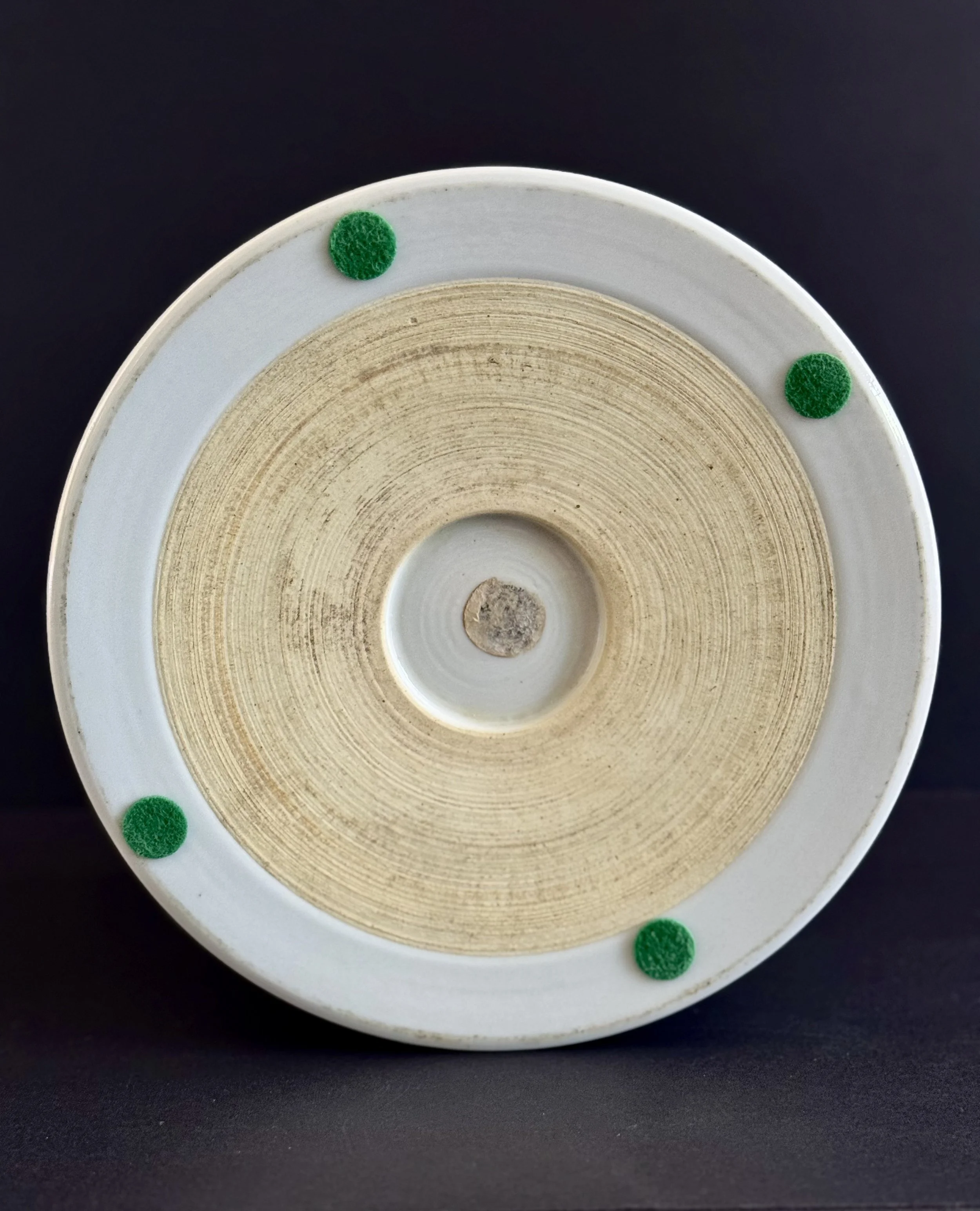 Image 5 of 5
A Scholar’s Journey Through Mountains and Water A Large Famille Verte Porcelain Brushpot (Bitong) China, Qing Dynasty, probably Kangxi Period (1662–1722)
A Scholar’s Journey Through Mountains and Water
A Large Famille Verte Porcelain Brushpot (Bitong)
China, Qing Dynasty, probably Kangxi Period (1662–1722)
Probably Jingdezhen, Jiangxi Province
Porcelain decorated in polychrome famille verte overglaze enamels.
Dimensions: Height 6 in. (15.2 cm); Diameter 7½ in. (19.1 cm)
Provenance:
Ralph M. Chait Galleries, New York, 1989.
Private American Collection.
THE OBJECT
This impressive cylindrical porcelain brushpot, known in Chinese as a bitong (筆筒), belongs to one of the most celebrated traditions of decorative porcelain produced during the Qing dynasty.
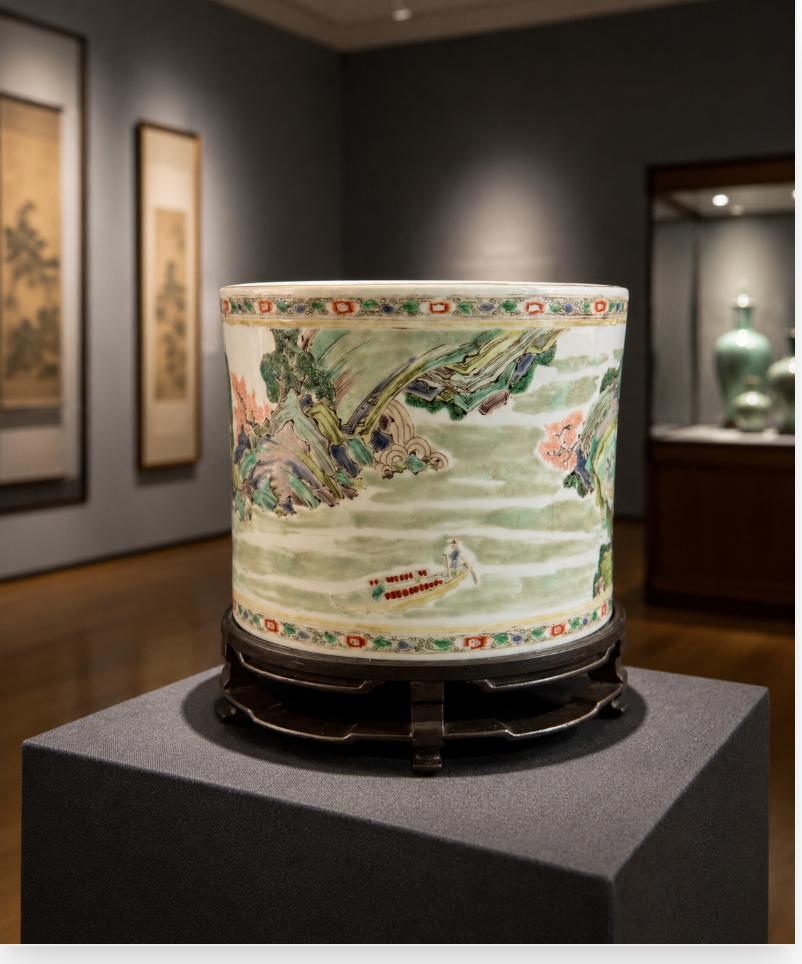
Decorated with an extensive continuous landscape populated by figures, a pavilion, bridge, boat, mountains, trees, rocky promontories, water, and mist, the vessel transforms the utilitarian form of the scholar’s brushpot into a panoramic work of landscape painting.
The composition is executed in the brilliant polychrome enamel palette traditionally known in Western scholarship as famille verte, or the “green family.”
The predominance of translucent green enamels, combined with iron red, yellow, aubergine, black, and blue, allowed ceramic painters to create remarkably sophisticated compositions on porcelain.
The technical quality, large scale, continuous landscape composition, decorative borders, and substantial cylindrical form place the present brushpot within a tradition particularly associated with the reign of the Kangxi emperor.
The attribution of the present brushpot to the Qing dynasty, probably Kangxi period (1662–1722), should nevertheless remain qualified pending examination of the object in person and consultation of the original Ralph M. Chait Galleries documentation from 1989.
THE KANGXI PERIOD AND THE GOLDEN AGE OF FAMILLE VERTE PORCELAIN
The long reign of the Kangxi emperor was one of the most important periods in the history of Chinese ceramics.
Following the political disruptions surrounding the collapse of the Ming dynasty and the establishment of Qing rule, the imperial porcelain workshops at Jingdezhen were reorganized and revitalized.
Jingdezhen, located in Jiangxi Province, had already served for centuries as the most important porcelain manufacturing center in China.
The region possessed deposits of porcelain stone and kaolin essential for the production of high-fired porcelain.
During the Kangxi period, ceramic production expanded dramatically.
Porcelain was produced for the imperial court, the Chinese domestic market, educated collectors, merchants, and the rapidly expanding international export trade.
Among the greatest achievements of Kangxi porcelain was the refinement of overglaze enamel decoration.
The palette later called famille verte by European scholars reached extraordinary levels of technical and artistic sophistication.
The ceramic painter could employ several shades of green together with iron red, yellow, aubergine, black, and blue.
These colors allowed artists to produce complex landscapes, narrative scenes, figures, birds, flowers, animals, and scenes inspired by Chinese history and literature.
The porcelain surface became a new form of pictorial space.
THE CHINESE SCHOLAR’S BRUSHPOT
The brushpot was one of the essential objects found upon the writing table of the Chinese scholar.
Known as a bitong, its primary function was to hold the brushes used for calligraphy and painting.
Yet the finest brushpots were never merely utilitarian containers.
They belonged to the sophisticated material culture of the Chinese scholar’s studio, known collectively as the wenfang, or “scholar’s study.”
The scholar’s writing table might contain brushes, inkstones, brush washers, water droppers, seals, seal paste boxes, wrist rests, paperweights, incense burners, and carefully selected natural and artistic objects.
Such objects expressed the education, taste, philosophical interests, and cultural identity of their owner.
Brushpots were produced in numerous materials, including bamboo, carved wood, lacquer, jade, stone, ivory, rhinoceros horn, cloisonné, bronze, and porcelain.
Porcelain offered ceramic painters a particularly large surface upon which elaborate pictorial compositions could be created.
The substantial dimensions of the present brushpot—7½ inches in diameter—provided the painter with an unusually generous pictorial field.
A LANDSCAPE PAINTING WRAPPED AROUND PORCELAIN
The principal decoration consists of an extensive continuous riverscape.
Rather than presenting a single frontal composition, the painter used the entire cylindrical surface of the vessel.
The viewer must physically move around the object, or slowly rotate it, to experience the complete landscape.
In this respect, the brushpot resembles a traditional Chinese handscroll.
A handscroll is not viewed all at once.
It is gradually opened and experienced as a succession of interconnected spaces.
The same principle operates here.
The landscape unfolds around the porcelain cylinder.
Mountains emerge from mist.
Rock formations descend toward the water.
A bridge crosses the landscape.
Figures travel through the countryside.
A pavilion appears among the trees.
A boat carrying passengers moves quietly across the river.
The composition creates the impression of an imaginary journey through nature.
MOUNTAINS AND WATER: THE TRADITION OF SHANSHUI
The landscape belongs to the great Chinese artistic tradition known as shanshui (山水), literally “mountain and water.”
Mountains and water represented the fundamental elements of the Chinese landscape tradition.
Mountains embodied stability, permanence, spiritual power, and the enduring forces of nature.
Water represented movement, transformation, passage, and the continuous flow of existence.
Together they created a symbolic vision of the natural universe.
The human figures in the present composition are deliberately small in relation to the surrounding landscape.
This contrast between monumental nature and diminutive human figures is fundamental to traditional Chinese landscape painting.
Humanity exists within nature rather than dominating it.
The scholar contemplating the brushpot could therefore imagine himself traveling through the painted landscape.
THE BOAT AND THE SCHOLAR’S JOURNEY
One of the most evocative details is the small boat moving through the river.
Boats appear frequently in Chinese landscape painting and porcelain decoration.
They could symbolize physical travel, intellectual freedom, withdrawal from government service, escape from worldly responsibilities, or the journey toward scholarly retirement.
The boat allows the viewer to enter imaginatively into the composition.
The scholar sitting at his writing table might contemplate the tiny vessel and imagine traveling through mountains and rivers toward an isolated retreat.
In this sense, the brushpot becomes an object of meditation.
THE BRIDGE
The bridge provides both a compositional and symbolic connection between different parts of the landscape.
Within Chinese painting, bridges often guide the viewer through pictorial space.
The eye follows the figures across the bridge, along pathways, toward pavilions, mountains, and distant spaces.
The bridge can also symbolize passage and transition.
Here, it connects the inhabited world with the expansive natural environment beyond.
THE PAVILION AND THE IDEAL OF SCHOLARLY RETREAT
The pavilion occupies an important place within the landscape.
Throughout Chinese painting and poetry, isolated pavilions and mountain retreats represented the cultivated scholar’s desire to withdraw temporarily from the political and social pressures of official life.
The scholar’s retreat was a place devoted to poetry, calligraphy, painting, music, literature, friendship, and contemplation.
The presence of the pavilion on a brushpot is therefore particularly appropriate.
The function of the vessel and the imagery decorating it reinforce one another.
The brushpot belonged to the scholar’s studio.
The painted pavilion represented the scholar’s idealized world.
TREES, ROCKS, AND MOUNTAINS
The trees and monumental rock formations further connect the composition with Chinese landscape painting.
Pine trees, when represented, traditionally conveyed associations with longevity, endurance, and moral strength.
Rocks and mountains represented permanence and the enduring structure of the natural world.
The painters responsible for the finest Kangxi famille verte porcelains borrowed extensively from the visual vocabulary of painting, printed books, and woodblock illustrations.
Consequently, the surface of the porcelain could function almost like a painted scroll.
THE FLORAL BORDERS
The landscape is framed above and below by narrow decorative borders containing flowers, scrolling foliage, and geometric ornament executed in multiple enamel colors.
These borders perform an important visual function.
They define the boundaries of the landscape while emphasizing the cylindrical architecture of the vessel.
The contrast between the tightly organized borders and the expansive landscape creates a sophisticated decorative rhythm.
The presence of floral borders surrounding continuous landscape compositions is also found on documented Kangxi famille verte brushpots.
THE BASE AND MANUFACTURE
The underside of the present brushpot is particularly worthy of study.
The broad recessed base displays concentric turning marks associated with finishing the vessel on the potter’s wheel.
The substantial construction reflects the challenges involved in producing large cylindrical porcelain forms.
Such vessels required careful preparation, controlled drying, high-temperature firing of the porcelain body and glaze, followed by the application of overglaze enamels and additional lower-temperature firings.
The finished vessel was therefore the product of multiple specialized craftsmen.
At Jingdezhen, one craftsman might prepare the clay, another throw the vessel, another finish the body, another apply the glaze, while specialized painters decorated the surface and kiln workers supervised the firing.
The finished brushpot represents both artistic creativity and the highly organized ceramic technology of Qing China.
THE R.H.R. PALMER COLLECTION COMPARISON
A particularly important comparison for the present brushpot is the famille verte cylindrical brushpot from the R.H.R. Palmer Collection, catalogued by Christie’s as Kangxi period (1662–1722).
The Palmer brushpot is decorated with a continuous riverscape showing two figures inside a pavilion, figures crossing a bridge, others traveling on a sampan, figures standing upon a promontory, and floral borders surrounding the landscape at the rim and base.
The vessel measures 7¼ inches (18.4 cm) in diameter.
Its provenance is recorded as Mallett, London, September 1927, followed by the Reginald and Lena Palmer Collection, inventory no. 129.
The Palmer brushpot was offered at Christie’s Hong Kong as Lot 2816 in A Heritage of Appreciation—Selected Treasures from the Palmer Family Collection.
View the R.H.R. Palmer Collection Famille Verte Brushpot at Christie’s
The comparison is noteworthy.
Both vessels are substantial cylindrical brushpots.
The Palmer example measures 7¼ inches in diameter, while the present brushpot measures 7½ inches.
Both employ a continuous riverscape.
Both contain figures moving through a mountainous landscape.
Both incorporate a pavilion.
Both include a bridge.
Both show a boat or sampan traveling through the water.
Both use mountainous promontories, trees, and waterways to create an unfolding panoramic composition.
Most significantly, both landscapes are framed between narrow floral borders at the rim and base.
These parallels make the Palmer brushpot a highly relevant published auction-market comparison for the form, decorative program, scale, and probable period of production.
However, the comparison should be used carefully.
The present brushpot is not from the Palmer Collection, and stylistic similarity does not establish identical workshop, painter, ownership history, or provenance.
Rather, the Palmer example provides a documented and closely related reference point for understanding the artistic tradition to which the present vessel appears to belong.
THE R.H.R. PALMER COLLECTION AND THE HISTORY OF CHINESE ART COLLECTING
The R.H.R. Palmer Collection occupies an important place in the history of twentieth-century collecting of Chinese art.
Reginald Howard Reed Palmer and Lena Palmer assembled an extensive collection of Chinese ceramics and works of art.
The collection was notable for its emphasis on quality, provenance, and documentation.
The Palmer family retained detailed acquisition records and collection ledgers.
The provenance of the comparable brushpot can therefore be traced to Mallett, London, in September 1927, before entering the Palmer Collection.
The appearance of the Palmer Collection at Christie’s provides scholars and collectors with an important body of documented Chinese ceramics against which related objects can be studied.
PROVENANCE OF THE PRESENT BRUSHPOT
The provenance of the present brushpot is:
Ralph M. Chait Galleries, New York, 1989.
Private American Collection.
This provenance deserves particular attention.
Ralph M. Chait Galleries has long been associated with the American market for Chinese art, particularly Chinese porcelain and works of art.
Acquisition from an established specialist gallery provides meaningful collecting context.
MUSEUM AND COLLECTION CONTEXT
Famille verte porcelain of the Kangxi period is represented in major museum collections throughout the world, including the British Museum, the Metropolitan Museum of Art, the Victoria and Albert Museum, the Musée Guimet, and the Rijksmuseum.
These collections demonstrate the importance of Kangxi famille verte porcelain within the broader history of Chinese ceramic art.
The form of the porcelain brushpot is especially significant because it connects ceramic production with the culture of the Chinese scholar’s studio.
EXHIBITION CONTEXT
There is presently no documentary evidence available to establish that this specific brushpot was exhibited publicly.
It would therefore be inappropriate to assign an exhibition history to the object without supporting documentation.
Nevertheless, Kangxi famille verte porcelain continues to be the subject of specialist exhibitions and scholarly catalogues.
The 2021 exhibition Famille Verte from Private Collections was devoted specifically to porcelain produced during the Kangxi reign and painted in famille verte and wucai enamels. The exhibition presented eighteen works selected largely from established private collections and illustrates the continuing scholarly and collecting importance of Kangxi famille verte porcelain.
SELECTED LITERATURE AND REFERENCES
For the study and cataloguing of the present brushpot, the following references are recommended:
Suzanne G. Valenstein, A Handbook of Chinese Ceramics, The Metropolitan Museum of Art, New York.
Rose Kerr and Nigel Wood, Science and Civilisation in China, Volume 5: Chemistry and Chemical Technology, Part XII: Ceramic Technology, Cambridge University Press.
Regina Krahl, Chinese Ceramics from the Meiyintang Collection.
C.J.A. Jörg and Jan van Campen, Chinese Ceramics in the Collection of the Rijksmuseum, Amsterdam: The Ming and Qing Dynasties, London, 1997.
John Ayers, Chinese Ceramics: The Koger Collection.
Michel Beurdeley and Guy Raindre, Qing Porcelain: Famille Verte, Famille Rose.
Christie’s, A Heritage of Appreciation—Selected Treasures from the Palmer Family Collection, Lot 2816, A Famille Verte Cylindrical Brush Pot, Kangxi period (1662–1722), from the R.H.R. Palmer Collection.
CONCLUSION
This large famille verte porcelain brushpot represents the close relationship between ceramic art, landscape painting, literature, and the intellectual culture of the Chinese scholar.
The object was functional, but its meaning extended far beyond function.
Placed upon the writing table, it provided the scholar with an imaginary landscape.
The mountains suggested permanence.
The flowing water evoked movement and transformation.
The bridge invited passage.
The boat suggested travel and withdrawal.
The pavilion represented the ideal scholarly retreat.
The diminutive figures reminded the viewer of humanity’s modest place within the vast natural world.
The cylindrical surface transformed the porcelain vessel into an unfolding handscroll, inviting the viewer to travel visually through mountains, rivers, bridges, pavilions, and distant spaces.
Its provenance from Ralph M. Chait Galleries, New York, in 1989, followed by a Private American Collection, adds an important modern collecting history.
Most notably, the close comparison with the documented Kangxi famille verte brushpot from the R.H.R. Palmer Collection—similar in dimensions and sharing the unusual combination of a continuous riverscape, pavilion, bridge, boat, figures, mountainous promontories, and floral borders—provides a particularly relevant reference for further scholarly investigation.
The present brushpot should therefore be understood not simply as a decorative porcelain vessel, but as a miniature painted world: an object created for the scholar’s table that brings together craftsmanship, philosophy, landscape painting, and the refined intellectual culture of Qing dynasty China.
A Scholar’s Journey Through Mountains and Water
A Large Famille Verte Porcelain Brushpot (Bitong)
China, Qing Dynasty, probably Kangxi Period (1662–1722)
Probably Jingdezhen, Jiangxi Province
Porcelain decorated in polychrome famille verte overglaze enamels.
Dimensions: Height 6 in. (15.2 cm); Diameter 7½ in. (19.1 cm)
Provenance:
Ralph M. Chait Galleries, New York, 1989.
Private American Collection.
THE OBJECT
This impressive cylindrical porcelain brushpot, known in Chinese as a bitong (筆筒), belongs to one of the most celebrated traditions of decorative porcelain produced during the Qing dynasty.
Decorated with an extensive continuous landscape populated by figures, a pavilion, bridge, boat, mountains, trees, rocky promontories, water, and mist, the vessel transforms the utilitarian form of the scholar’s brushpot into a panoramic work of landscape painting.
The composition is executed in the brilliant polychrome enamel palette traditionally known in Western scholarship as famille verte, or the “green family.”
The predominance of translucent green enamels, combined with iron red, yellow, aubergine, black, and blue, allowed ceramic painters to create remarkably sophisticated compositions on porcelain.
The technical quality, large scale, continuous landscape composition, decorative borders, and substantial cylindrical form place the present brushpot within a tradition particularly associated with the reign of the Kangxi emperor.
The attribution of the present brushpot to the Qing dynasty, probably Kangxi period (1662–1722), should nevertheless remain qualified pending examination of the object in person and consultation of the original Ralph M. Chait Galleries documentation from 1989.
THE KANGXI PERIOD AND THE GOLDEN AGE OF FAMILLE VERTE PORCELAIN
The long reign of the Kangxi emperor was one of the most important periods in the history of Chinese ceramics.
Following the political disruptions surrounding the collapse of the Ming dynasty and the establishment of Qing rule, the imperial porcelain workshops at Jingdezhen were reorganized and revitalized.
Jingdezhen, located in Jiangxi Province, had already served for centuries as the most important porcelain manufacturing center in China.
The region possessed deposits of porcelain stone and kaolin essential for the production of high-fired porcelain.
During the Kangxi period, ceramic production expanded dramatically.
Porcelain was produced for the imperial court, the Chinese domestic market, educated collectors, merchants, and the rapidly expanding international export trade.
Among the greatest achievements of Kangxi porcelain was the refinement of overglaze enamel decoration.
The palette later called famille verte by European scholars reached extraordinary levels of technical and artistic sophistication.
The ceramic painter could employ several shades of green together with iron red, yellow, aubergine, black, and blue.
These colors allowed artists to produce complex landscapes, narrative scenes, figures, birds, flowers, animals, and scenes inspired by Chinese history and literature.
The porcelain surface became a new form of pictorial space.
THE CHINESE SCHOLAR’S BRUSHPOT
The brushpot was one of the essential objects found upon the writing table of the Chinese scholar.
Known as a bitong, its primary function was to hold the brushes used for calligraphy and painting.
Yet the finest brushpots were never merely utilitarian containers.
They belonged to the sophisticated material culture of the Chinese scholar’s studio, known collectively as the wenfang, or “scholar’s study.”
The scholar’s writing table might contain brushes, inkstones, brush washers, water droppers, seals, seal paste boxes, wrist rests, paperweights, incense burners, and carefully selected natural and artistic objects.
Such objects expressed the education, taste, philosophical interests, and cultural identity of their owner.
Brushpots were produced in numerous materials, including bamboo, carved wood, lacquer, jade, stone, ivory, rhinoceros horn, cloisonné, bronze, and porcelain.
Porcelain offered ceramic painters a particularly large surface upon which elaborate pictorial compositions could be created.
The substantial dimensions of the present brushpot—7½ inches in diameter—provided the painter with an unusually generous pictorial field.
A LANDSCAPE PAINTING WRAPPED AROUND PORCELAIN
The principal decoration consists of an extensive continuous riverscape.
Rather than presenting a single frontal composition, the painter used the entire cylindrical surface of the vessel.
The viewer must physically move around the object, or slowly rotate it, to experience the complete landscape.
In this respect, the brushpot resembles a traditional Chinese handscroll.
A handscroll is not viewed all at once.
It is gradually opened and experienced as a succession of interconnected spaces.
The same principle operates here.
The landscape unfolds around the porcelain cylinder.
Mountains emerge from mist.
Rock formations descend toward the water.
A bridge crosses the landscape.
Figures travel through the countryside.
A pavilion appears among the trees.
A boat carrying passengers moves quietly across the river.
The composition creates the impression of an imaginary journey through nature.
MOUNTAINS AND WATER: THE TRADITION OF SHANSHUI
The landscape belongs to the great Chinese artistic tradition known as shanshui (山水), literally “mountain and water.”
Mountains and water represented the fundamental elements of the Chinese landscape tradition.
Mountains embodied stability, permanence, spiritual power, and the enduring forces of nature.
Water represented movement, transformation, passage, and the continuous flow of existence.
Together they created a symbolic vision of the natural universe.
The human figures in the present composition are deliberately small in relation to the surrounding landscape.
This contrast between monumental nature and diminutive human figures is fundamental to traditional Chinese landscape painting.
Humanity exists within nature rather than dominating it.
The scholar contemplating the brushpot could therefore imagine himself traveling through the painted landscape.
THE BOAT AND THE SCHOLAR’S JOURNEY
One of the most evocative details is the small boat moving through the river.
Boats appear frequently in Chinese landscape painting and porcelain decoration.
They could symbolize physical travel, intellectual freedom, withdrawal from government service, escape from worldly responsibilities, or the journey toward scholarly retirement.
The boat allows the viewer to enter imaginatively into the composition.
The scholar sitting at his writing table might contemplate the tiny vessel and imagine traveling through mountains and rivers toward an isolated retreat.
In this sense, the brushpot becomes an object of meditation.
THE BRIDGE
The bridge provides both a compositional and symbolic connection between different parts of the landscape.
Within Chinese painting, bridges often guide the viewer through pictorial space.
The eye follows the figures across the bridge, along pathways, toward pavilions, mountains, and distant spaces.
The bridge can also symbolize passage and transition.
Here, it connects the inhabited world with the expansive natural environment beyond.
THE PAVILION AND THE IDEAL OF SCHOLARLY RETREAT
The pavilion occupies an important place within the landscape.
Throughout Chinese painting and poetry, isolated pavilions and mountain retreats represented the cultivated scholar’s desire to withdraw temporarily from the political and social pressures of official life.
The scholar’s retreat was a place devoted to poetry, calligraphy, painting, music, literature, friendship, and contemplation.
The presence of the pavilion on a brushpot is therefore particularly appropriate.
The function of the vessel and the imagery decorating it reinforce one another.
The brushpot belonged to the scholar’s studio.
The painted pavilion represented the scholar’s idealized world.
TREES, ROCKS, AND MOUNTAINS
The trees and monumental rock formations further connect the composition with Chinese landscape painting.
Pine trees, when represented, traditionally conveyed associations with longevity, endurance, and moral strength.
Rocks and mountains represented permanence and the enduring structure of the natural world.
The painters responsible for the finest Kangxi famille verte porcelains borrowed extensively from the visual vocabulary of painting, printed books, and woodblock illustrations.
Consequently, the surface of the porcelain could function almost like a painted scroll.
THE FLORAL BORDERS
The landscape is framed above and below by narrow decorative borders containing flowers, scrolling foliage, and geometric ornament executed in multiple enamel colors.
These borders perform an important visual function.
They define the boundaries of the landscape while emphasizing the cylindrical architecture of the vessel.
The contrast between the tightly organized borders and the expansive landscape creates a sophisticated decorative rhythm.
The presence of floral borders surrounding continuous landscape compositions is also found on documented Kangxi famille verte brushpots.
THE BASE AND MANUFACTURE
The underside of the present brushpot is particularly worthy of study.
The broad recessed base displays concentric turning marks associated with finishing the vessel on the potter’s wheel.
The substantial construction reflects the challenges involved in producing large cylindrical porcelain forms.
Such vessels required careful preparation, controlled drying, high-temperature firing of the porcelain body and glaze, followed by the application of overglaze enamels and additional lower-temperature firings.
The finished vessel was therefore the product of multiple specialized craftsmen.
At Jingdezhen, one craftsman might prepare the clay, another throw the vessel, another finish the body, another apply the glaze, while specialized painters decorated the surface and kiln workers supervised the firing.
The finished brushpot represents both artistic creativity and the highly organized ceramic technology of Qing China.
THE R.H.R. PALMER COLLECTION COMPARISON
A particularly important comparison for the present brushpot is the famille verte cylindrical brushpot from the R.H.R. Palmer Collection, catalogued by Christie’s as Kangxi period (1662–1722).
The Palmer brushpot is decorated with a continuous riverscape showing two figures inside a pavilion, figures crossing a bridge, others traveling on a sampan, figures standing upon a promontory, and floral borders surrounding the landscape at the rim and base.
The vessel measures 7¼ inches (18.4 cm) in diameter.
Its provenance is recorded as Mallett, London, September 1927, followed by the Reginald and Lena Palmer Collection, inventory no. 129.
The Palmer brushpot was offered at Christie’s Hong Kong as Lot 2816 in A Heritage of Appreciation—Selected Treasures from the Palmer Family Collection.
View the R.H.R. Palmer Collection Famille Verte Brushpot at Christie’s
The comparison is noteworthy.
Both vessels are substantial cylindrical brushpots.
The Palmer example measures 7¼ inches in diameter, while the present brushpot measures 7½ inches.
Both employ a continuous riverscape.
Both contain figures moving through a mountainous landscape.
Both incorporate a pavilion.
Both include a bridge.
Both show a boat or sampan traveling through the water.
Both use mountainous promontories, trees, and waterways to create an unfolding panoramic composition.
Most significantly, both landscapes are framed between narrow floral borders at the rim and base.
These parallels make the Palmer brushpot a highly relevant published auction-market comparison for the form, decorative program, scale, and probable period of production.
However, the comparison should be used carefully.
The present brushpot is not from the Palmer Collection, and stylistic similarity does not establish identical workshop, painter, ownership history, or provenance.
Rather, the Palmer example provides a documented and closely related reference point for understanding the artistic tradition to which the present vessel appears to belong.
THE R.H.R. PALMER COLLECTION AND THE HISTORY OF CHINESE ART COLLECTING
The R.H.R. Palmer Collection occupies an important place in the history of twentieth-century collecting of Chinese art.
Reginald Howard Reed Palmer and Lena Palmer assembled an extensive collection of Chinese ceramics and works of art.
The collection was notable for its emphasis on quality, provenance, and documentation.
The Palmer family retained detailed acquisition records and collection ledgers.
The provenance of the comparable brushpot can therefore be traced to Mallett, London, in September 1927, before entering the Palmer Collection.
The appearance of the Palmer Collection at Christie’s provides scholars and collectors with an important body of documented Chinese ceramics against which related objects can be studied.
PROVENANCE OF THE PRESENT BRUSHPOT
The provenance of the present brushpot is:
Ralph M. Chait Galleries, New York, 1989.
Private American Collection.
This provenance deserves particular attention.
Ralph M. Chait Galleries has long been associated with the American market for Chinese art, particularly Chinese porcelain and works of art.
Acquisition from an established specialist gallery provides meaningful collecting context.
MUSEUM AND COLLECTION CONTEXT
Famille verte porcelain of the Kangxi period is represented in major museum collections throughout the world, including the British Museum, the Metropolitan Museum of Art, the Victoria and Albert Museum, the Musée Guimet, and the Rijksmuseum.
These collections demonstrate the importance of Kangxi famille verte porcelain within the broader history of Chinese ceramic art.
The form of the porcelain brushpot is especially significant because it connects ceramic production with the culture of the Chinese scholar’s studio.
EXHIBITION CONTEXT
There is presently no documentary evidence available to establish that this specific brushpot was exhibited publicly.
It would therefore be inappropriate to assign an exhibition history to the object without supporting documentation.
Nevertheless, Kangxi famille verte porcelain continues to be the subject of specialist exhibitions and scholarly catalogues.
The 2021 exhibition Famille Verte from Private Collections was devoted specifically to porcelain produced during the Kangxi reign and painted in famille verte and wucai enamels. The exhibition presented eighteen works selected largely from established private collections and illustrates the continuing scholarly and collecting importance of Kangxi famille verte porcelain.
SELECTED LITERATURE AND REFERENCES
For the study and cataloguing of the present brushpot, the following references are recommended:
Suzanne G. Valenstein, A Handbook of Chinese Ceramics, The Metropolitan Museum of Art, New York.
Rose Kerr and Nigel Wood, Science and Civilisation in China, Volume 5: Chemistry and Chemical Technology, Part XII: Ceramic Technology, Cambridge University Press.
Regina Krahl, Chinese Ceramics from the Meiyintang Collection.
C.J.A. Jörg and Jan van Campen, Chinese Ceramics in the Collection of the Rijksmuseum, Amsterdam: The Ming and Qing Dynasties, London, 1997.
John Ayers, Chinese Ceramics: The Koger Collection.
Michel Beurdeley and Guy Raindre, Qing Porcelain: Famille Verte, Famille Rose.
Christie’s, A Heritage of Appreciation—Selected Treasures from the Palmer Family Collection, Lot 2816, A Famille Verte Cylindrical Brush Pot, Kangxi period (1662–1722), from the R.H.R. Palmer Collection.
CONCLUSION
This large famille verte porcelain brushpot represents the close relationship between ceramic art, landscape painting, literature, and the intellectual culture of the Chinese scholar.
The object was functional, but its meaning extended far beyond function.
Placed upon the writing table, it provided the scholar with an imaginary landscape.
The mountains suggested permanence.
The flowing water evoked movement and transformation.
The bridge invited passage.
The boat suggested travel and withdrawal.
The pavilion represented the ideal scholarly retreat.
The diminutive figures reminded the viewer of humanity’s modest place within the vast natural world.
The cylindrical surface transformed the porcelain vessel into an unfolding handscroll, inviting the viewer to travel visually through mountains, rivers, bridges, pavilions, and distant spaces.
Its provenance from Ralph M. Chait Galleries, New York, in 1989, followed by a Private American Collection, adds an important modern collecting history.
Most notably, the close comparison with the documented Kangxi famille verte brushpot from the R.H.R. Palmer Collection—similar in dimensions and sharing the unusual combination of a continuous riverscape, pavilion, bridge, boat, figures, mountainous promontories, and floral borders—provides a particularly relevant reference for further scholarly investigation.
The present brushpot should therefore be understood not simply as a decorative porcelain vessel, but as a miniature painted world: an object created for the scholar’s table that brings together craftsmanship, philosophy, landscape painting, and the refined intellectual culture of Qing dynasty China.