 Image 1 of 5
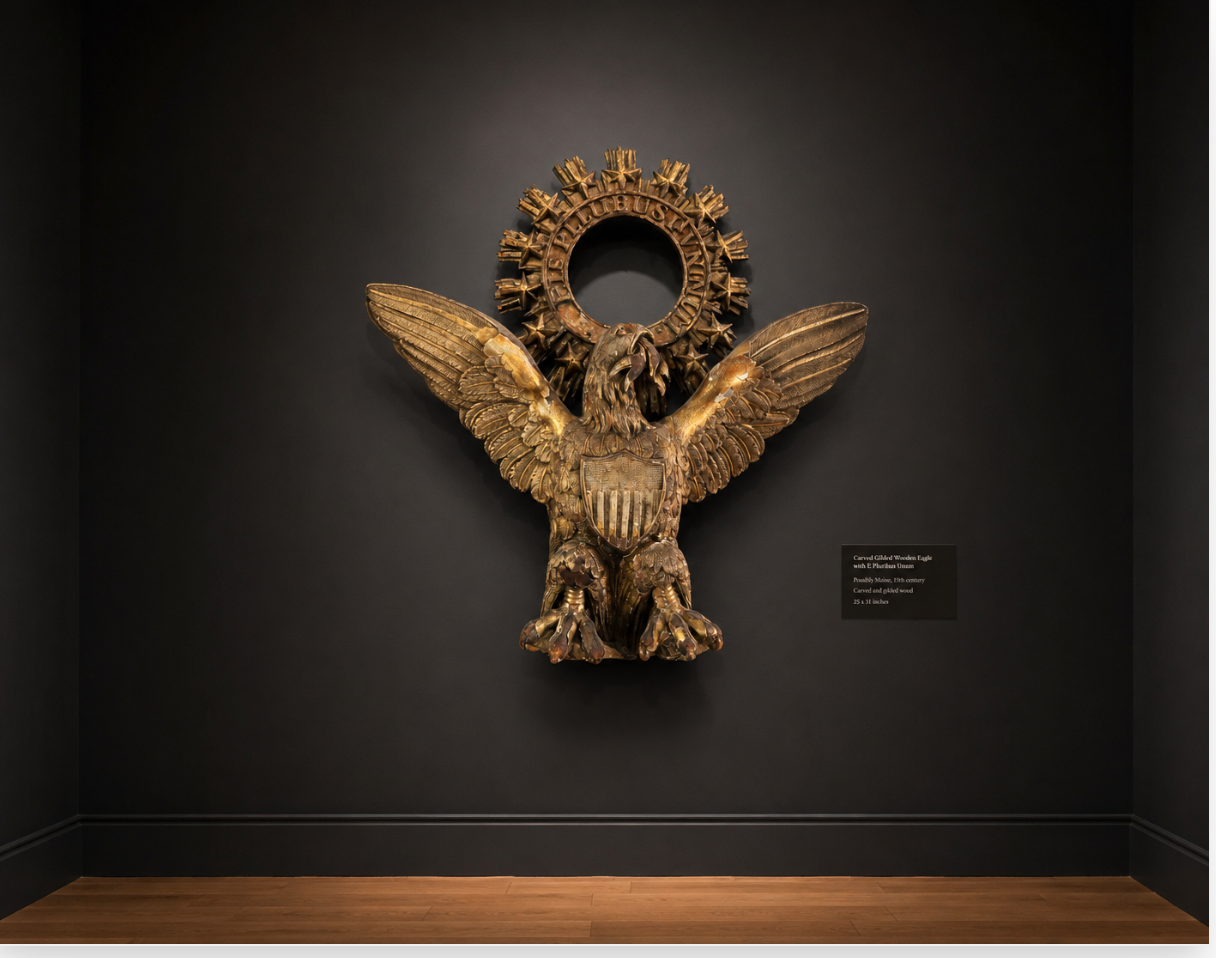 Image 2 of 5
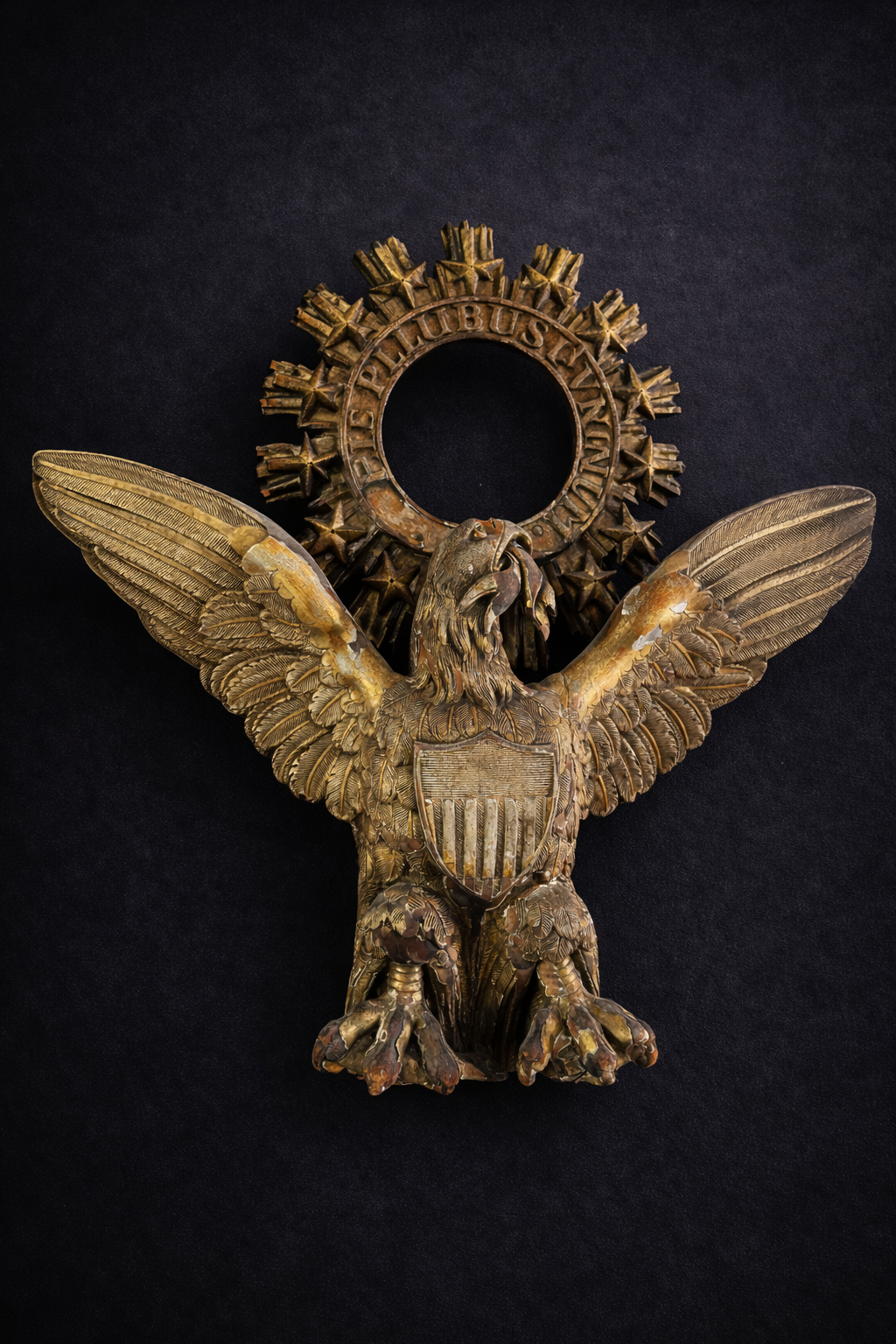 Image 3 of 5
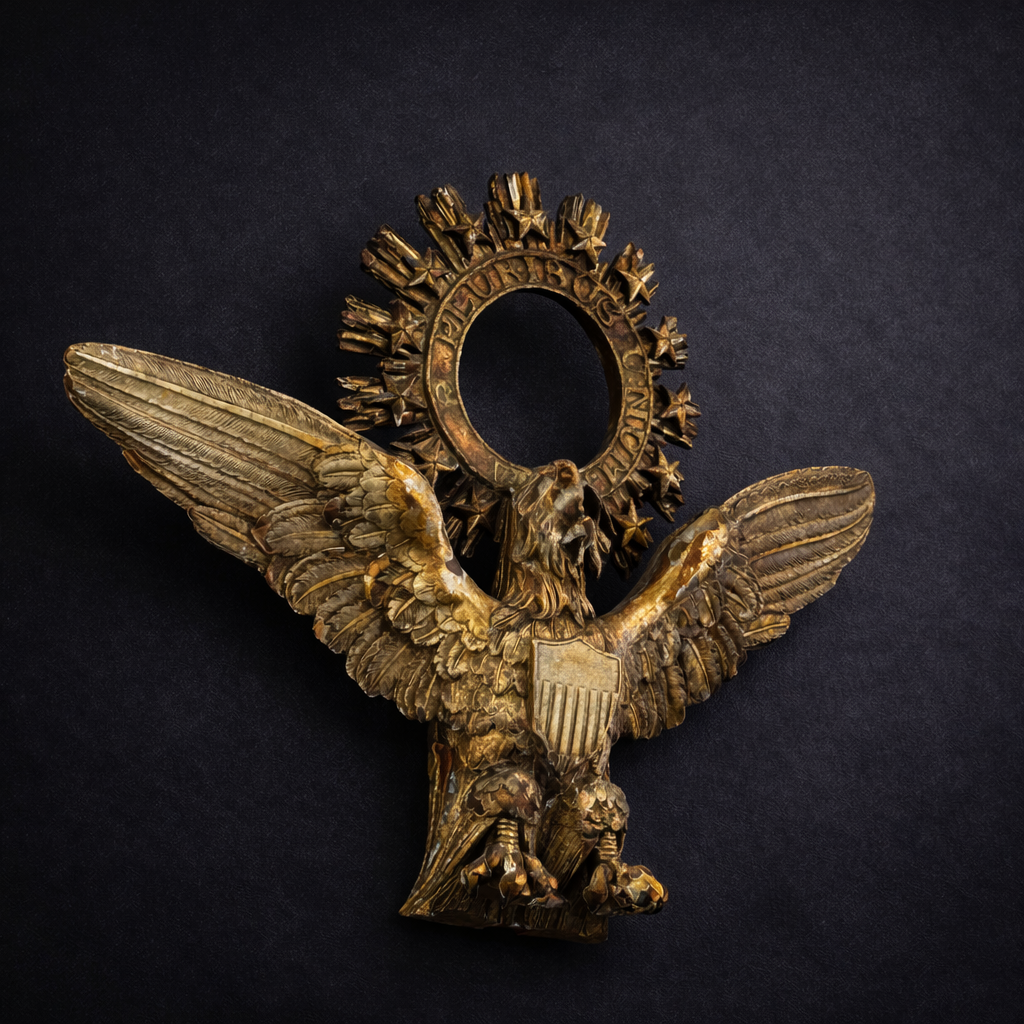 Image 4 of 5
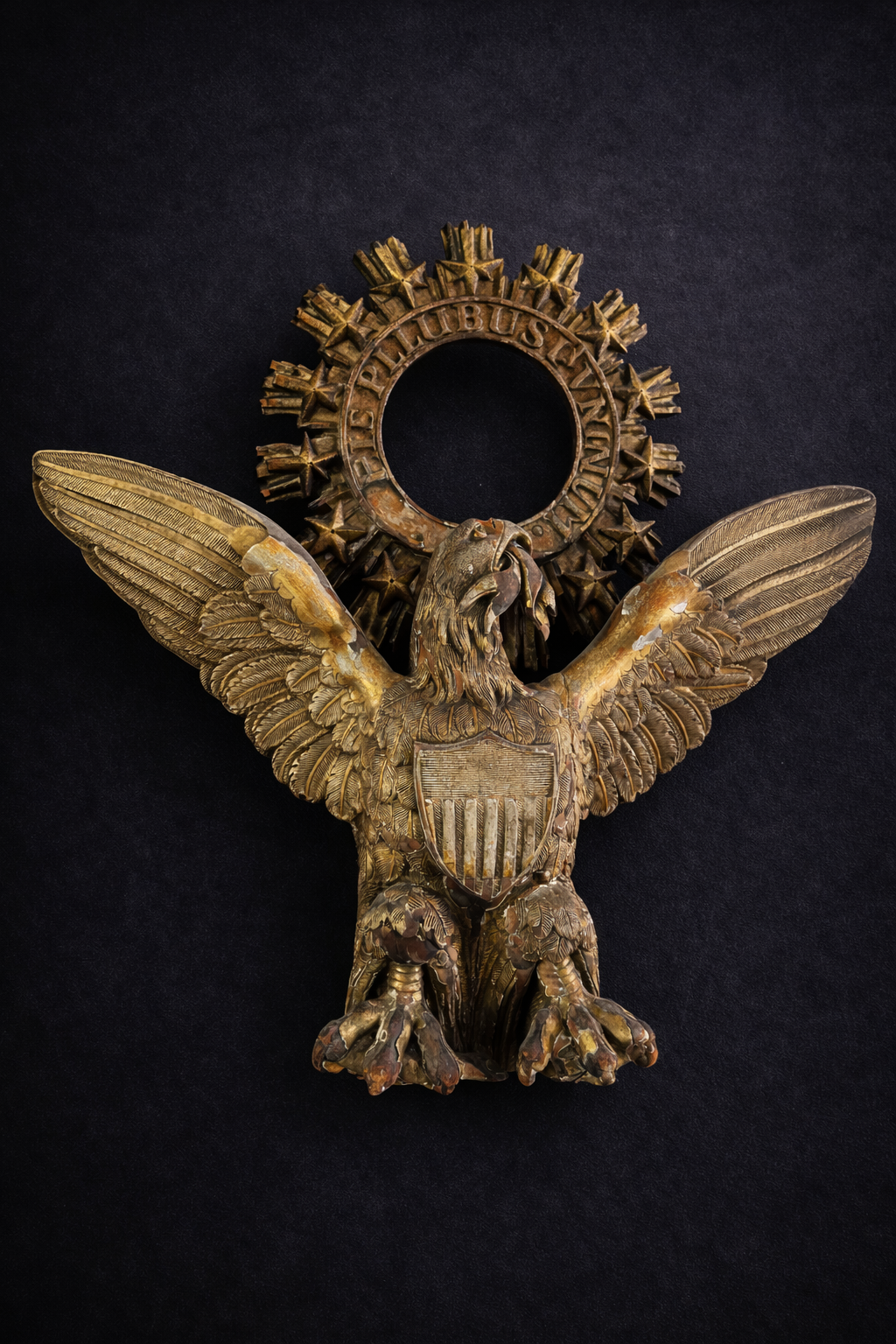 Image 5 of 5
A Carved Gilded Wooden Eagle, possibly Maine, 19th century. Length 25' Width 31".
A CARVED GILDED WOODEN EAGLE WITH E PLURIBUS UNUM SUNBURST
Possibly Maine, Mid-to-Late 19th Century
Carved and Gilded Wood
25 inches high × 31 inches wide
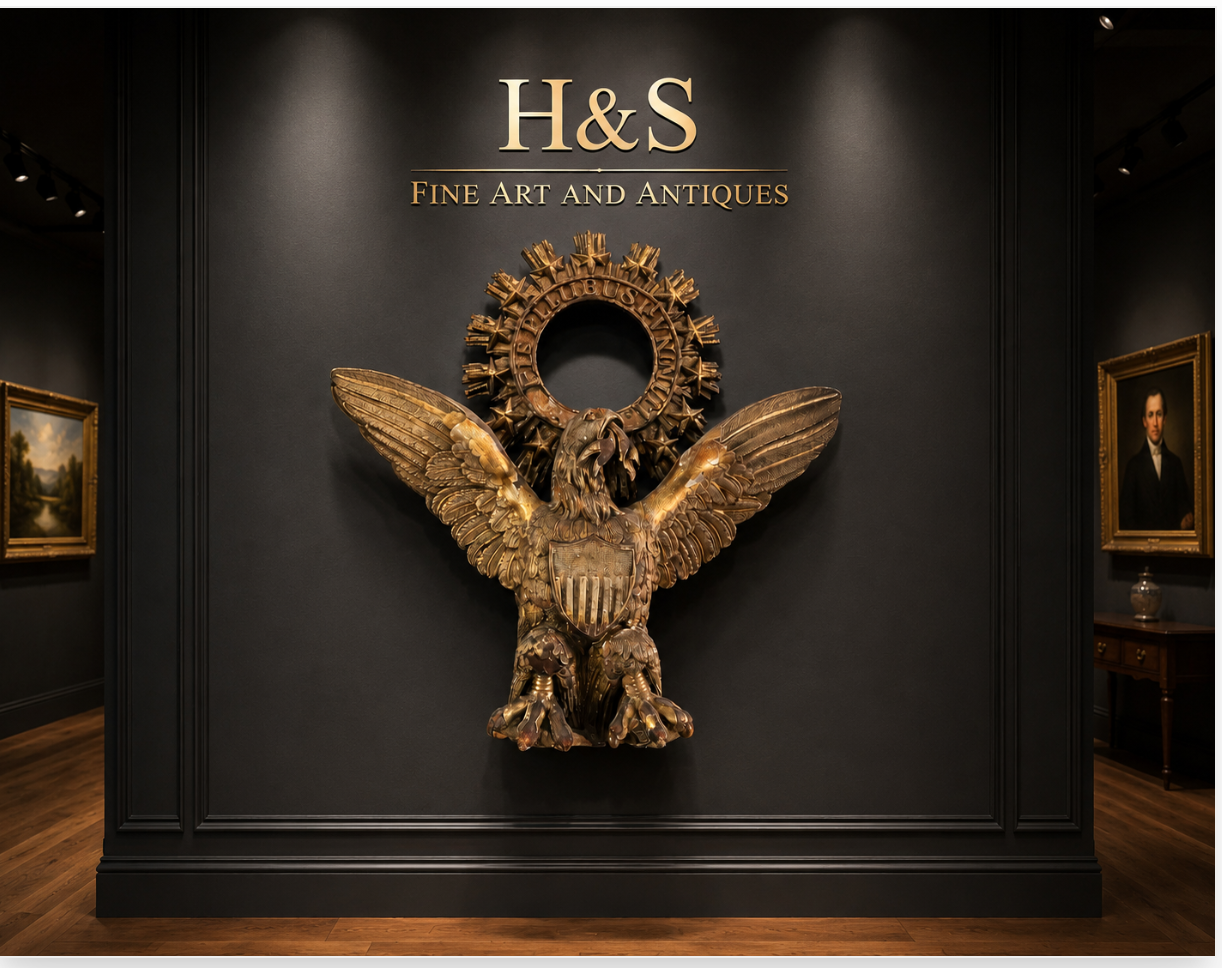
Few symbols are more deeply woven into the fabric of American history than the bald eagle. Since its adoption as the national emblem of the United States in 1782, the eagle has stood as a representation of liberty, strength, vigilance, and the enduring union of the American states. The present carved and gilded wooden eagle, accompanied by an elaborate starburst bearing the motto E Pluribus Unum, is a remarkable expression of nineteenth-century American patriotism and folk artistry.
Executed on a substantial scale, the eagle is depicted frontally with its wings fully outstretched in a commanding gesture of protection and authority. Its head turns slightly to its left, the beak open as if in proclamation, while deeply carved talons project beneath the body. Upon its breast rests the Federal shield, composed of vertical stripes recalling the original thirteen colonies and the founding ideals of the American Republic.
The sculptural quality of the carving is exceptional. Every feather is individually defined with carefully incised lines and deeply undercut contours that create an extraordinary sense of movement and vitality. The layered arrangement of the primary and secondary feathers demonstrates the hand of an accomplished carver who understood both natural form and decorative design. The bird possesses a monumentality and confidence that elevate it beyond mere decoration and into the realm of symbolic sculpture.
The eagle retains a rich gilded surface that has mellowed beautifully with age. The original gilding, once brilliant and reflective, has softened into a warm and varied palette of deep gold, honey, and amber tones. Areas of oxidation, gentle abrasion, and minor losses reveal the underlying bole and wood beneath the leaf, producing a patina that only generations of natural aging can achieve. Such surface qualities are highly prized among collectors and museums, for they attest to authenticity and prolonged historical use. The surviving gilding catches and reflects light with remarkable subtlety, imparting an almost luminous presence to the carving.
Perhaps the most intriguing feature is the carved circular sunburst situated above the eagle and bearing the motto:
E PLURIBUS UNUM
"Out of Many, One."
This phrase was adopted by the Continental Congress in 1782 as part of the Great Seal of the United States and expressed the extraordinary idea that thirteen independent colonies had voluntarily joined together to form one nation. It became one of the defining mottos of the American Republic and appeared on official seals, coinage, patriotic banners, military emblems, and countless decorative arts. The phrase encapsulates the central political experiment of the United States: unity arising from diversity and independent states becoming a single republic. The motto has appeared on American coinage continuously since the nineteenth century and remains one of the nation's most enduring expressions of civic identity.
The radiating stars and sunburst surrounding the motto further reinforce the patriotic symbolism. Such rays traditionally signify enlightenment, divine providence, and the emergence of a new nation. Similar radiating devices appear on early American military standards, Federal architecture, and civic monuments.
The attribution to Maine is entirely plausible. During the nineteenth century, Maine and the broader New England region became one of America's most important centers of patriotic carving and maritime ornament. Shipyards, naval installations, and seafaring communities fostered a thriving tradition of carving eagles for ships, public buildings, and civic organizations. New England craftsmen developed a distinctive style characterized by vigorous forms, deeply cut feathering, and highly expressive interpretations of the national bird.
The carving also invites comparison with the work of the celebrated Maine carver John Haley Bellamy (1836–1914), widely regarded as America's greatest eagle carver. Bellamy transformed the American eagle into one of the most iconic expressions of folk sculpture, producing highly stylized carvings distinguished by dramatic wings, animated heads, and powerful patriotic symbolism. His work often incorporated mottos and banners, including E Pluribus Unum and Don't Give Up the Ship.
Although the present example differs substantially from Bellamy's more elongated and stylized plaques and therefore should not presently be attributed to him, it belongs to the same rich New England tradition of patriotic eagle carving. The robust modeling, deeply carved feathering, and combination of eagle and motto suggest the hand of a skilled regional carver working within the broader maritime and civic carving traditions of Maine and coastal New England.
The original purpose of the carving remains open to interpretation and contributes to its intrigue. Several possibilities present themselves:
Maritime Origin
Maine's shipbuilding industry frequently employed carved eagles as stern ornaments, cabin decorations, and patriotic emblems on merchant and naval vessels. The substantial scale and bold execution of the present example are entirely consistent with maritime decorative traditions.
Architectural Ornament
Throughout the nineteenth century, carved eagles adorned courthouses, customs houses, town halls, armories, and other civic structures. The inclusion of the national motto would have been particularly appropriate in such settings.
Fraternal or Veterans' Hall
Patriotic organizations, including veterans' societies and civic associations, often commissioned monumental eagles and mottoes for ceremonial interiors and meeting halls.
Regardless of its precise original setting, the present carving embodies the extraordinary patriotism that characterized nineteenth-century America. Created during an era of expanding national identity, industrial progress, and increasing reverence for the symbols of the Republic, this eagle served not merely as decoration but as an expression of national ideals.
Today, the sculpture survives as both an exceptional work of American folk art and a powerful historical object. Its rich gilded surface, commanding scale, and profound symbolism make it an outstanding example of the artistic imagination that transformed the national emblem into one of the defining icons of American visual culture.
For further research and comparison, useful references include:
Carved Eagles: America's First Americana by the Journal of Antiques and Collectibles
Studies of the work of John Haley Bellamy and his New England eagle carvings.
Collections of carved American eagles in the The Mariners' Museum and Park, which houses Bellamy's monumental eagle carved for the USS Lancaster.
Comparative examples in the collections of the Shelburne Museum and the Smithsonian American Art Museum.
I would tentatively date the piece to circa 1850–1880 and place it within the Maine or broader coastal New England carving tradition, with the possibility that it originated as an architectural or maritime patriotic emblem. Photographs of the reverse, construction details, joinery, and any old mounting holes could pot
A CARVED GILDED WOODEN EAGLE WITH E PLURIBUS UNUM SUNBURST
Possibly Maine, Mid-to-Late 19th Century
Carved and Gilded Wood
25 inches high × 31 inches wide
Few symbols are more deeply woven into the fabric of American history than the bald eagle. Since its adoption as the national emblem of the United States in 1782, the eagle has stood as a representation of liberty, strength, vigilance, and the enduring union of the American states. The present carved and gilded wooden eagle, accompanied by an elaborate starburst bearing the motto E Pluribus Unum, is a remarkable expression of nineteenth-century American patriotism and folk artistry.
Executed on a substantial scale, the eagle is depicted frontally with its wings fully outstretched in a commanding gesture of protection and authority. Its head turns slightly to its left, the beak open as if in proclamation, while deeply carved talons project beneath the body. Upon its breast rests the Federal shield, composed of vertical stripes recalling the original thirteen colonies and the founding ideals of the American Republic.
The sculptural quality of the carving is exceptional. Every feather is individually defined with carefully incised lines and deeply undercut contours that create an extraordinary sense of movement and vitality. The layered arrangement of the primary and secondary feathers demonstrates the hand of an accomplished carver who understood both natural form and decorative design. The bird possesses a monumentality and confidence that elevate it beyond mere decoration and into the realm of symbolic sculpture.
The eagle retains a rich gilded surface that has mellowed beautifully with age. The original gilding, once brilliant and reflective, has softened into a warm and varied palette of deep gold, honey, and amber tones. Areas of oxidation, gentle abrasion, and minor losses reveal the underlying bole and wood beneath the leaf, producing a patina that only generations of natural aging can achieve. Such surface qualities are highly prized among collectors and museums, for they attest to authenticity and prolonged historical use. The surviving gilding catches and reflects light with remarkable subtlety, imparting an almost luminous presence to the carving.
Perhaps the most intriguing feature is the carved circular sunburst situated above the eagle and bearing the motto:
E PLURIBUS UNUM
"Out of Many, One."
This phrase was adopted by the Continental Congress in 1782 as part of the Great Seal of the United States and expressed the extraordinary idea that thirteen independent colonies had voluntarily joined together to form one nation. It became one of the defining mottos of the American Republic and appeared on official seals, coinage, patriotic banners, military emblems, and countless decorative arts. The phrase encapsulates the central political experiment of the United States: unity arising from diversity and independent states becoming a single republic. The motto has appeared on American coinage continuously since the nineteenth century and remains one of the nation's most enduring expressions of civic identity.
The radiating stars and sunburst surrounding the motto further reinforce the patriotic symbolism. Such rays traditionally signify enlightenment, divine providence, and the emergence of a new nation. Similar radiating devices appear on early American military standards, Federal architecture, and civic monuments.
The attribution to Maine is entirely plausible. During the nineteenth century, Maine and the broader New England region became one of America's most important centers of patriotic carving and maritime ornament. Shipyards, naval installations, and seafaring communities fostered a thriving tradition of carving eagles for ships, public buildings, and civic organizations. New England craftsmen developed a distinctive style characterized by vigorous forms, deeply cut feathering, and highly expressive interpretations of the national bird.
The carving also invites comparison with the work of the celebrated Maine carver John Haley Bellamy (1836–1914), widely regarded as America's greatest eagle carver. Bellamy transformed the American eagle into one of the most iconic expressions of folk sculpture, producing highly stylized carvings distinguished by dramatic wings, animated heads, and powerful patriotic symbolism. His work often incorporated mottos and banners, including E Pluribus Unum and Don't Give Up the Ship.
Although the present example differs substantially from Bellamy's more elongated and stylized plaques and therefore should not presently be attributed to him, it belongs to the same rich New England tradition of patriotic eagle carving. The robust modeling, deeply carved feathering, and combination of eagle and motto suggest the hand of a skilled regional carver working within the broader maritime and civic carving traditions of Maine and coastal New England.
The original purpose of the carving remains open to interpretation and contributes to its intrigue. Several possibilities present themselves:
Maritime Origin
Maine's shipbuilding industry frequently employed carved eagles as stern ornaments, cabin decorations, and patriotic emblems on merchant and naval vessels. The substantial scale and bold execution of the present example are entirely consistent with maritime decorative traditions.
Architectural Ornament
Throughout the nineteenth century, carved eagles adorned courthouses, customs houses, town halls, armories, and other civic structures. The inclusion of the national motto would have been particularly appropriate in such settings.
Fraternal or Veterans' Hall
Patriotic organizations, including veterans' societies and civic associations, often commissioned monumental eagles and mottoes for ceremonial interiors and meeting halls.
Regardless of its precise original setting, the present carving embodies the extraordinary patriotism that characterized nineteenth-century America. Created during an era of expanding national identity, industrial progress, and increasing reverence for the symbols of the Republic, this eagle served not merely as decoration but as an expression of national ideals.
Today, the sculpture survives as both an exceptional work of American folk art and a powerful historical object. Its rich gilded surface, commanding scale, and profound symbolism make it an outstanding example of the artistic imagination that transformed the national emblem into one of the defining icons of American visual culture.
For further research and comparison, useful references include:
Carved Eagles: America's First Americana by the Journal of Antiques and Collectibles
Studies of the work of John Haley Bellamy and his New England eagle carvings.
Collections of carved American eagles in the The Mariners' Museum and Park, which houses Bellamy's monumental eagle carved for the USS Lancaster.
Comparative examples in the collections of the Shelburne Museum and the Smithsonian American Art Museum.
I would tentatively date the piece to circa 1850–1880 and place it within the Maine or broader coastal New England carving tradition, with the possibility that it originated as an architectural or maritime patriotic emblem. Photographs of the reverse, construction details, joinery, and any old mounting holes could pot