A CARVED AND PAINTED FIGURE OF UNCLE SAM
American Folk Art, Centennial Period, Circa 1876
Carved and painted wood with original flag and staff
Height: 45 ¾ inches
Provenance: Kevin Keim Collection
Exhibited: Bergdorf Goodman, New York, September 11, 2002 (First Anniversary Commemoration of 9/11); Bergdorf Goodman, New York, July 4, 2008
Literature: Kevin Keim and Peter Keim, A Grand Old Flag: A History of the United States Through Its Flags, New York, 2007, illustrated p. 106.
Uncle Sam and the American Century
Few symbols are more instantly recognizable than Uncle Sam. For more than two centuries he has stood as the visual embodiment of the United States, appearing in political cartoons, military recruitment posters, patriotic celebrations, and countless works of American folk art. Yet before he became a national icon, Uncle Sam was a real person whose story emerged from the formative years of the American republic.
This extraordinary carved and painted figure, created during the Centennial year of 1876, captures Uncle Sam at the precise moment he became firmly established as America's national personification. Standing nearly four feet tall and holding an American flag on its original staff, the sculpture embodies the patriotic optimism and renewed national pride that accompanied the one-hundredth anniversary of American independence.
The boldly painted base bears the inscription:
"JULY-4"
"1776 – 1876"
directly commemorating the nation's Centennial celebration and firmly dating the object to one of the most important patriotic commemorations in American history.
More than a decorative object, this sculpture represents a powerful visual statement about national identity during a period when Americans sought to reunite following the Civil War and celebrate the achievements of the first century of the Republic.
The Real Uncle Sam: Samuel Wilson
The origin of Uncle Sam is generally traced to Samuel Wilson (1766–1854), a meat packer and businessman of Troy, New York. During the War of 1812, Wilson supplied barrels of salted beef and pork to the United States Army. These barrels were marked "U.S." to indicate government ownership. According to contemporary accounts, workers and soldiers jokingly referred to the initials as standing for "Uncle Sam," the affectionate nickname by which Wilson was already known. The story spread rapidly among soldiers and soon entered the American press. By 1813 and 1814 newspapers were already referring to the federal government as "Uncle Sam." Over time, the nickname evolved into one of the most enduring symbols in American history.
In 1961, the United States Congress officially recognized Samuel Wilson of Troy, New York, as the progenitor of America's national symbol.
The Evolution of an American Icon
The image of Uncle Sam did not appear fully formed. During the early nineteenth century, the United States was often represented by another figure known as "Brother Jonathan," a Yankee character associated with New England. Throughout the mid-nineteenth century the two figures gradually merged.
By the 1870s, political cartoonists had largely standardized Uncle Sam's appearance as a tall, lean man with white hair, a pointed beard, striped trousers, and a patriotic top hat. No artist was more influential in establishing this imagery than Thomas Nast, whose illustrations in Harper's Weekly helped define the national image of Uncle Sam for generations. By the Centennial period of 1876, the figure had become a universally recognized symbol of the United States.
This sculpture closely follows the visual conventions established during that era and may be considered one of the earliest three-dimensional folk-art interpretations of the fully developed Uncle Sam figure.
The Centennial of 1876
The Centennial International Exposition held in Philadelphia in 1876 was the largest patriotic celebration the nation had yet witnessed. Millions of Americans participated in parades, exhibitions, fireworks displays, and civic ceremonies commemorating one hundred years of independence.
Patriotic imagery flooded the country. Flags, banners, eagles, liberty caps, Washington portraits, and representations of Uncle Sam appeared in unprecedented numbers. Objects associated with the Centennial were often decorated with dates, stars, shields, and references to the Declaration of Independence.
The present figure belongs directly to this movement. The patriotic inscriptions on the base, combined with the original American flag and the iconic Uncle Sam figure, transform the sculpture into a visual monument to the Centennial itself.
As a surviving object from this remarkable national celebration, it offers a tangible connection to one of the defining moments in American cultural history.
Artistic Qualities
The figure demonstrates many of the characteristics that distinguish the finest American folk sculpture.
The unknown carver employed exaggerated proportions to dramatic effect. Uncle Sam's elongated body, unusually tall stovepipe hat, and extended facial features create a striking vertical composition that commands attention. His deeply carved eyes, long angular nose, and carefully rendered beard lend the figure an unmistakable personality.
The original paint scheme remains among its most appealing features. Brilliant reds, whites, and blues animate the figure while reinforcing its patriotic message. The striped trousers and star-spangled flag transform the sculpture into a living embodiment of the American flag itself.
Unlike many surviving examples, this figure retains its original flagstaff and accompanying flag, an important element that substantially enhances both its historical integrity and visual impact.
The sculptor understood that Uncle Sam was more than a portrait. He was a symbol. Consequently, realism is secondary to expression, allowing the figure to function simultaneously as sculpture, patriotic emblem, and public statement.
The American Flag and National Identity
The inclusion of the American flag is central to the sculpture's meaning. Throughout the nineteenth century, the flag evolved from a military standard into a universal symbol of national identity. During the Centennial period, flags appeared on everything from parade banners to household decorations.
The original flag carried by this figure transforms Uncle Sam into the guardian of the Republic itself. Together, the figure and flag create one of the most powerful visual pairings in American iconography.
The sculpture's appearance in Kevin Keim and Peter Keim's landmark publication A Grand Old Flag is particularly significant because that work examines American history through surviving flags and patriotic artifacts. Its inclusion underscores the object's importance within the broader history of American symbolism and patriotism.
Bergdorf Goodman Exhibitions
The exhibition history of this sculpture adds a remarkable chapter to its story.
The figure was selected for display in the celebrated windows of Bergdorf Goodman on Fifth Avenue in New York City, one of America's most influential luxury retailers known for museum-quality window installations and artistic presentations.
Its first appearance came on September 11, 2002, during the first anniversary commemoration of the attacks of September 11, 2001. At a moment when Americans were reflecting upon national unity, sacrifice, and resilience, the figure of Uncle Sam carried extraordinary emotional significance.
The sculpture returned to the Bergdorf Goodman windows for Independence Day celebrations on July 4, 2008, reaffirming its role as a powerful symbol of American identity and patriotism.
Very few examples of nineteenth-century American folk art can claim exhibition histories connected to such nationally meaningful occasions.
Provenance
The figure comes from the collection of Kevin Keim, one of the leading authorities on historic American flags and patriotic folk art. Through decades of scholarship, collecting, and publication, Kevin Keim has helped shape modern understanding of American patriotic material culture.
Its publication and ownership history place the sculpture within an important lineage of scholarly research and collecting devoted to preserving America's visual heritage.
Literature
Kevin Keim and Peter Keim, A Grand Old Flag: A History of the United States Through Its Flags, New York, 2007, p. 106.
Alton Ketchum, Uncle Sam: The Man and the Legend.
Library of Congress, "John Bull and Uncle Sam: Four Centuries of British-American Relations."
Smithsonian Institution, National Museum of American History, "Uncle Sam: The Man and the Meme."
Britannica, "Uncle Sam."
Curatorial Statement
This magnificent Centennial-era Uncle Sam stands among the most compelling surviving examples of American patriotic folk sculpture. Combining strong visual presence, original painted surfaces, retained flag and staff, distinguished provenance, publication in a major reference work, and exhibition history at Bergdorf Goodman, it occupies a unique place at the intersection of American folk art and national history.
Created during the nation's first great celebration of independence, it embodies the hopes, ideals, and patriotic spirit of the Centennial generation. More than a carved figure, it is a monument to the American story itself—linking the War of 1812, the Centennial of 1876, the tragedies and triumphs of modern America, and the enduring power of the Stars and Stripes.
Nearly 150 years after its creation, Uncle Sam still stands watch, flag in hand, as one of the most recognizable and beloved symbols of the United States.
A CARVED AND PAINTED FIGURE OF UNCLE SAM
American Folk Art, Centennial Period, Circa 1876
Carved and painted wood with original flag and staff
Height: 45 ¾ inches
Provenance: Kevin Keim Collection
Exhibited: Bergdorf Goodman, New York, September 11, 2002 (First Anniversary Commemoration of 9/11); Bergdorf Goodman, New York, July 4, 2008
Literature: Kevin Keim and Peter Keim, A Grand Old Flag: A History of the United States Through Its Flags, New York, 2007, illustrated p. 106.
Uncle Sam and the American Century
Few symbols are more instantly recognizable than Uncle Sam. For more than two centuries he has stood as the visual embodiment of the United States, appearing in political cartoons, military recruitment posters, patriotic celebrations, and countless works of American folk art. Yet before he became a national icon, Uncle Sam was a real person whose story emerged from the formative years of the American republic.
This extraordinary carved and painted figure, created during the Centennial year of 1876, captures Uncle Sam at the precise moment he became firmly established as America's national personification. Standing nearly four feet tall and holding an American flag on its original staff, the sculpture embodies the patriotic optimism and renewed national pride that accompanied the one-hundredth anniversary of American independence.
The boldly painted base bears the inscription:
"JULY-4"
"1776 – 1876"
directly commemorating the nation's Centennial celebration and firmly dating the object to one of the most important patriotic commemorations in American history.
More than a decorative object, this sculpture represents a powerful visual statement about national identity during a period when Americans sought to reunite following the Civil War and celebrate the achievements of the first century of the Republic.
The Real Uncle Sam: Samuel Wilson
The origin of Uncle Sam is generally traced to Samuel Wilson (1766–1854), a meat packer and businessman of Troy, New York. During the War of 1812, Wilson supplied barrels of salted beef and pork to the United States Army. These barrels were marked "U.S." to indicate government ownership. According to contemporary accounts, workers and soldiers jokingly referred to the initials as standing for "Uncle Sam," the affectionate nickname by which Wilson was already known. The story spread rapidly among soldiers and soon entered the American press. By 1813 and 1814 newspapers were already referring to the federal government as "Uncle Sam." Over time, the nickname evolved into one of the most enduring symbols in American history.
In 1961, the United States Congress officially recognized Samuel Wilson of Troy, New York, as the progenitor of America's national symbol.
The Evolution of an American Icon
The image of Uncle Sam did not appear fully formed. During the early nineteenth century, the United States was often represented by another figure known as "Brother Jonathan," a Yankee character associated with New England. Throughout the mid-nineteenth century the two figures gradually merged.
By the 1870s, political cartoonists had largely standardized Uncle Sam's appearance as a tall, lean man with white hair, a pointed beard, striped trousers, and a patriotic top hat. No artist was more influential in establishing this imagery than Thomas Nast, whose illustrations in Harper's Weekly helped define the national image of Uncle Sam for generations. By the Centennial period of 1876, the figure had become a universally recognized symbol of the United States.
This sculpture closely follows the visual conventions established during that era and may be considered one of the earliest three-dimensional folk-art interpretations of the fully developed Uncle Sam figure.
The Centennial of 1876
The Centennial International Exposition held in Philadelphia in 1876 was the largest patriotic celebration the nation had yet witnessed. Millions of Americans participated in parades, exhibitions, fireworks displays, and civic ceremonies commemorating one hundred years of independence.
Patriotic imagery flooded the country. Flags, banners, eagles, liberty caps, Washington portraits, and representations of Uncle Sam appeared in unprecedented numbers. Objects associated with the Centennial were often decorated with dates, stars, shields, and references to the Declaration of Independence.
The present figure belongs directly to this movement. The patriotic inscriptions on the base, combined with the original American flag and the iconic Uncle Sam figure, transform the sculpture into a visual monument to the Centennial itself.
As a surviving object from this remarkable national celebration, it offers a tangible connection to one of the defining moments in American cultural history.
Artistic Qualities
The figure demonstrates many of the characteristics that distinguish the finest American folk sculpture.
The unknown carver employed exaggerated proportions to dramatic effect. Uncle Sam's elongated body, unusually tall stovepipe hat, and extended facial features create a striking vertical composition that commands attention. His deeply carved eyes, long angular nose, and carefully rendered beard lend the figure an unmistakable personality.
The original paint scheme remains among its most appealing features. Brilliant reds, whites, and blues animate the figure while reinforcing its patriotic message. The striped trousers and star-spangled flag transform the sculpture into a living embodiment of the American flag itself.
Unlike many surviving examples, this figure retains its original flagstaff and accompanying flag, an important element that substantially enhances both its historical integrity and visual impact.
The sculptor understood that Uncle Sam was more than a portrait. He was a symbol. Consequently, realism is secondary to expression, allowing the figure to function simultaneously as sculpture, patriotic emblem, and public statement.
The American Flag and National Identity
The inclusion of the American flag is central to the sculpture's meaning. Throughout the nineteenth century, the flag evolved from a military standard into a universal symbol of national identity. During the Centennial period, flags appeared on everything from parade banners to household decorations.
The original flag carried by this figure transforms Uncle Sam into the guardian of the Republic itself. Together, the figure and flag create one of the most powerful visual pairings in American iconography.
The sculpture's appearance in Kevin Keim and Peter Keim's landmark publication A Grand Old Flag is particularly significant because that work examines American history through surviving flags and patriotic artifacts. Its inclusion underscores the object's importance within the broader history of American symbolism and patriotism.
Bergdorf Goodman Exhibitions
The exhibition history of this sculpture adds a remarkable chapter to its story.
The figure was selected for display in the celebrated windows of Bergdorf Goodman on Fifth Avenue in New York City, one of America's most influential luxury retailers known for museum-quality window installations and artistic presentations.
Its first appearance came on September 11, 2002, during the first anniversary commemoration of the attacks of September 11, 2001. At a moment when Americans were reflecting upon national unity, sacrifice, and resilience, the figure of Uncle Sam carried extraordinary emotional significance.
The sculpture returned to the Bergdorf Goodman windows for Independence Day celebrations on July 4, 2008, reaffirming its role as a powerful symbol of American identity and patriotism.
Very few examples of nineteenth-century American folk art can claim exhibition histories connected to such nationally meaningful occasions.
Provenance
The figure comes from the collection of Kevin Keim, one of the leading authorities on historic American flags and patriotic folk art. Through decades of scholarship, collecting, and publication, Kevin Keim has helped shape modern understanding of American patriotic material culture.
Its publication and ownership history place the sculpture within an important lineage of scholarly research and collecting devoted to preserving America's visual heritage.
Literature
Kevin Keim and Peter Keim, A Grand Old Flag: A History of the United States Through Its Flags, New York, 2007, p. 106.
Alton Ketchum, Uncle Sam: The Man and the Legend.
Library of Congress, "John Bull and Uncle Sam: Four Centuries of British-American Relations."
Smithsonian Institution, National Museum of American History, "Uncle Sam: The Man and the Meme."
Britannica, "Uncle Sam."
Curatorial Statement
This magnificent Centennial-era Uncle Sam stands among the most compelling surviving examples of American patriotic folk sculpture. Combining strong visual presence, original painted surfaces, retained flag and staff, distinguished provenance, publication in a major reference work, and exhibition history at Bergdorf Goodman, it occupies a unique place at the intersection of American folk art and national history.
Created during the nation's first great celebration of independence, it embodies the hopes, ideals, and patriotic spirit of the Centennial generation. More than a carved figure, it is a monument to the American story itself—linking the War of 1812, the Centennial of 1876, the tragedies and triumphs of modern America, and the enduring power of the Stars and Stripes.
Nearly 150 years after its creation, Uncle Sam still stands watch, flag in hand, as one of the most recognizable and beloved symbols of the United States.
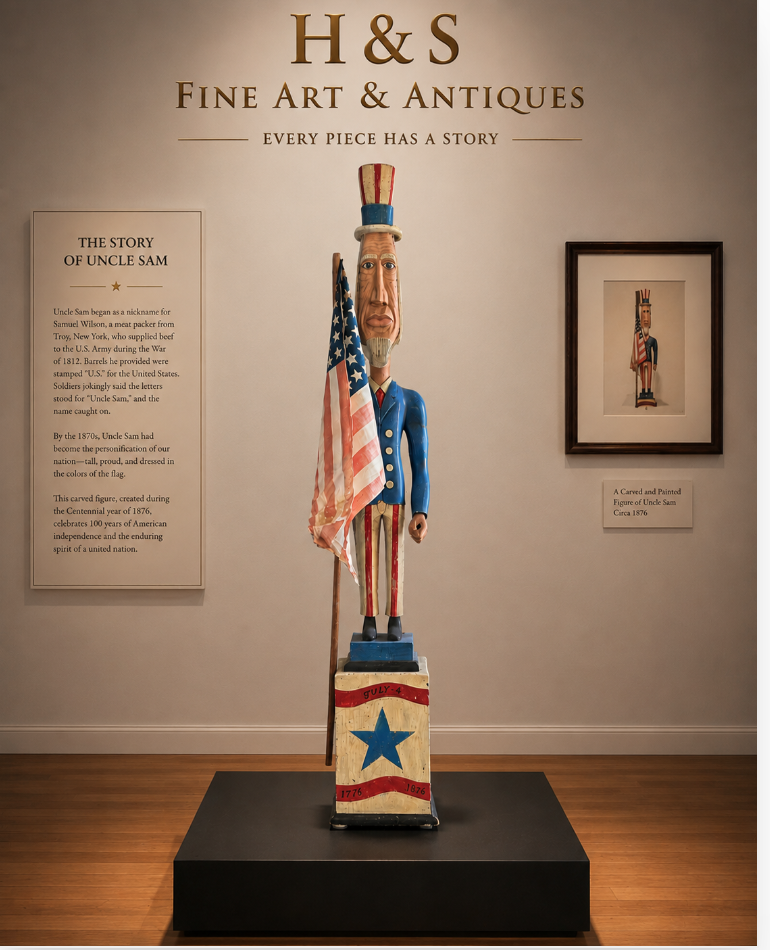 Image 1 of 9
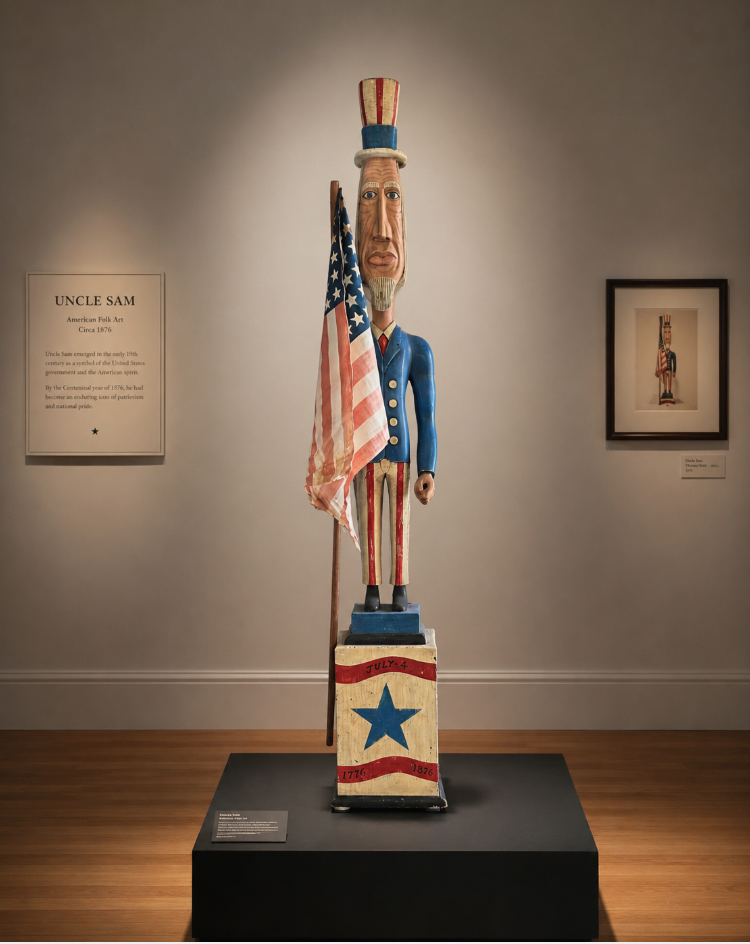 Image 2 of 9
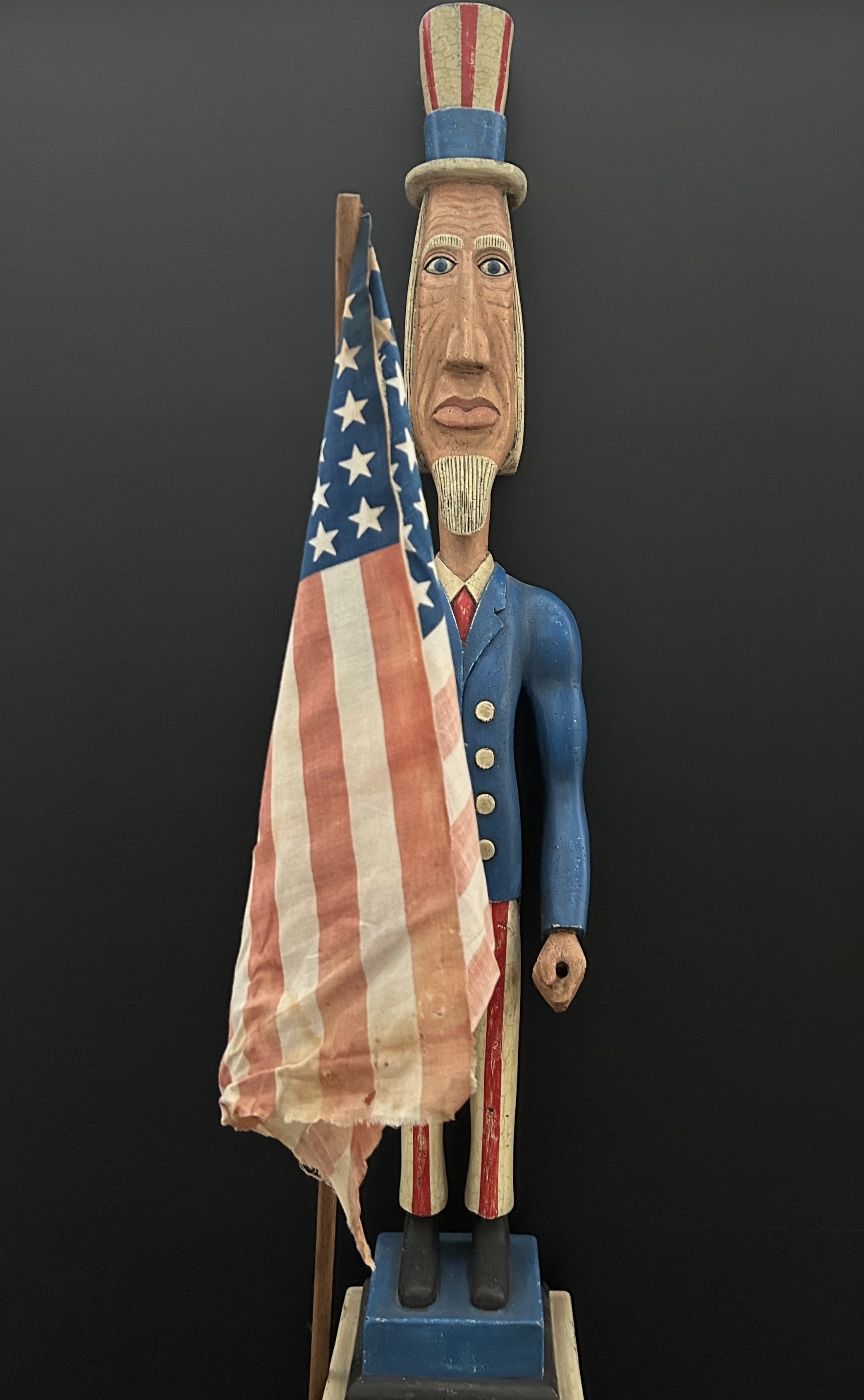 Image 3 of 9
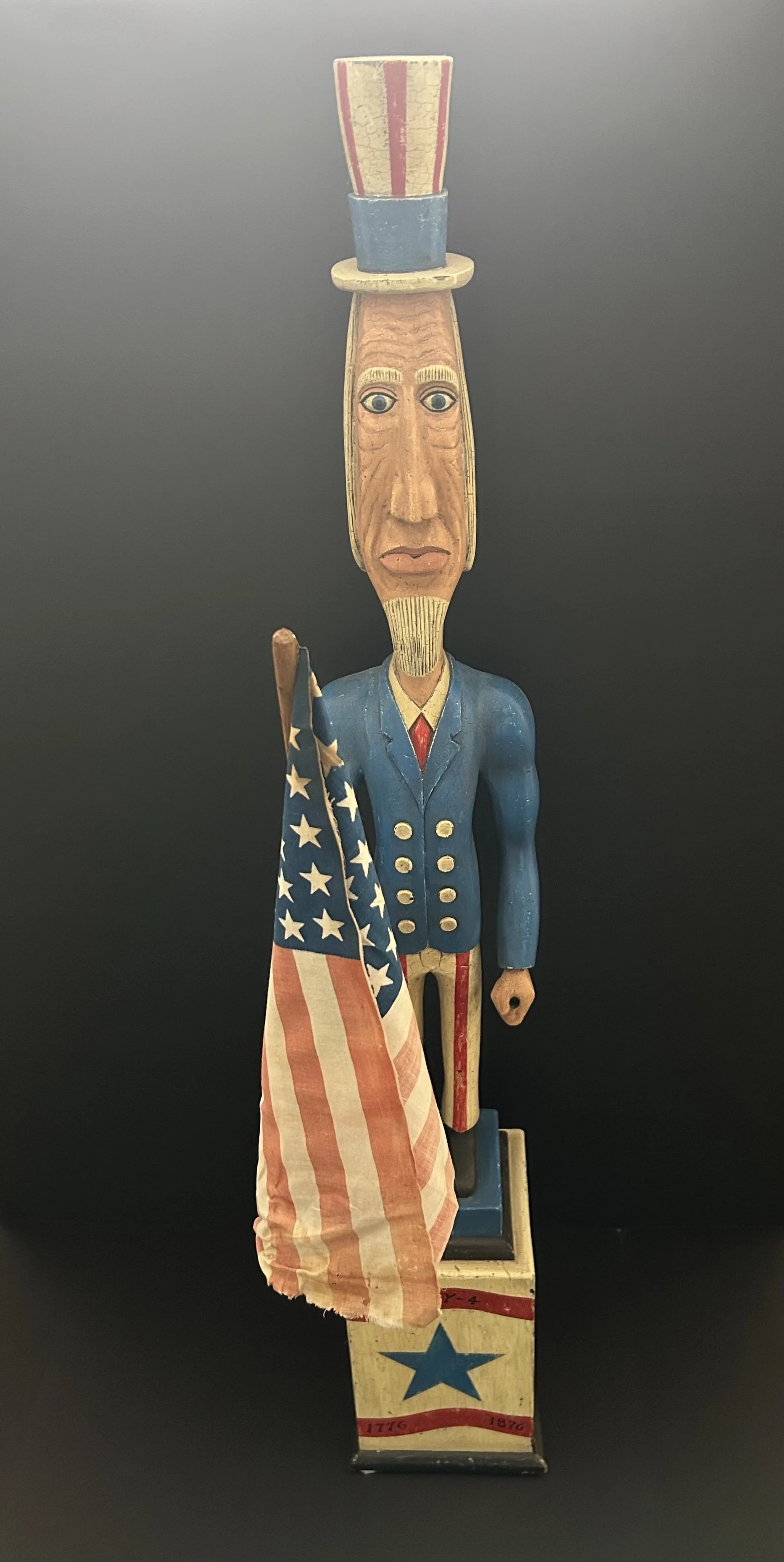 Image 4 of 9
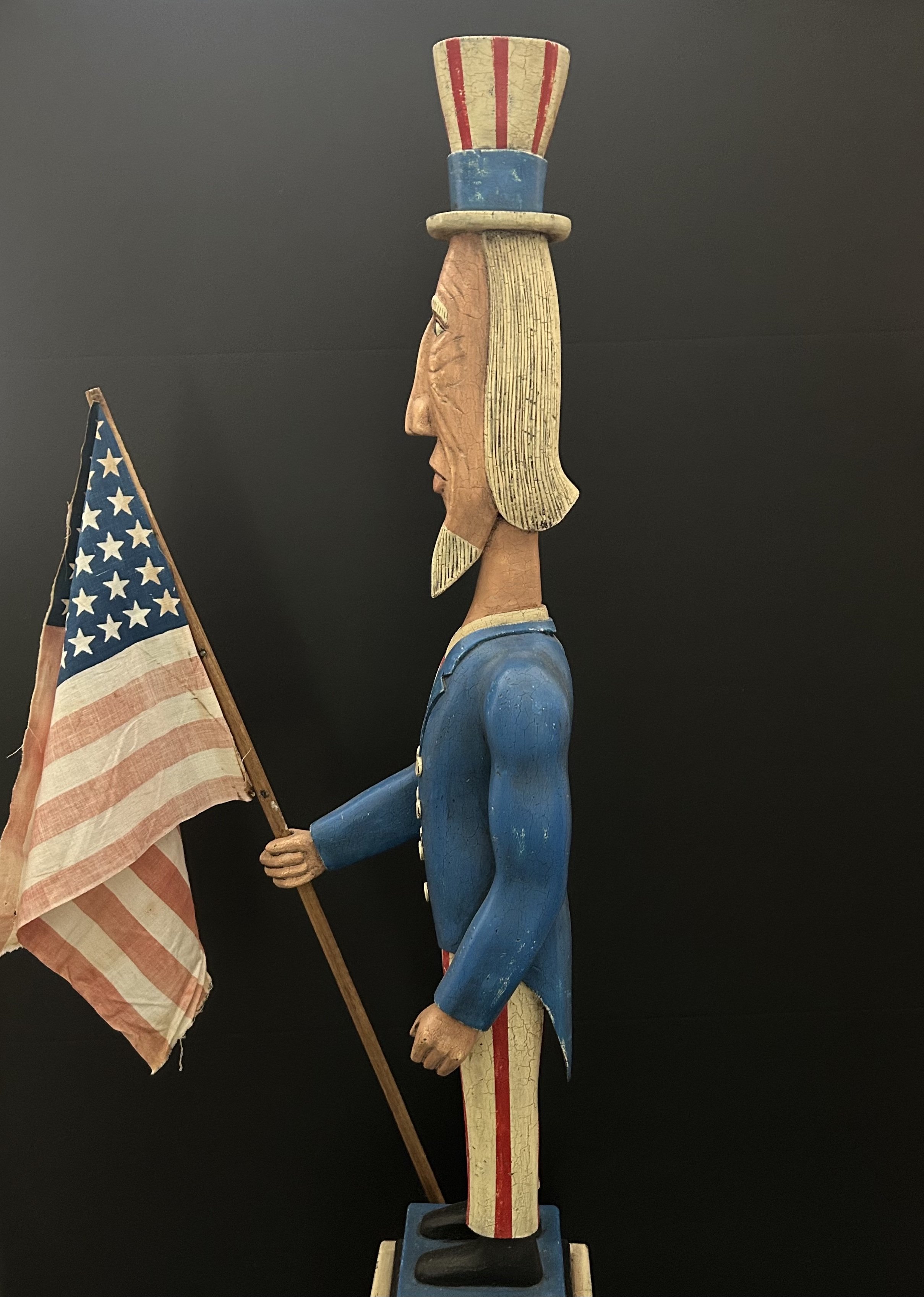 Image 5 of 9
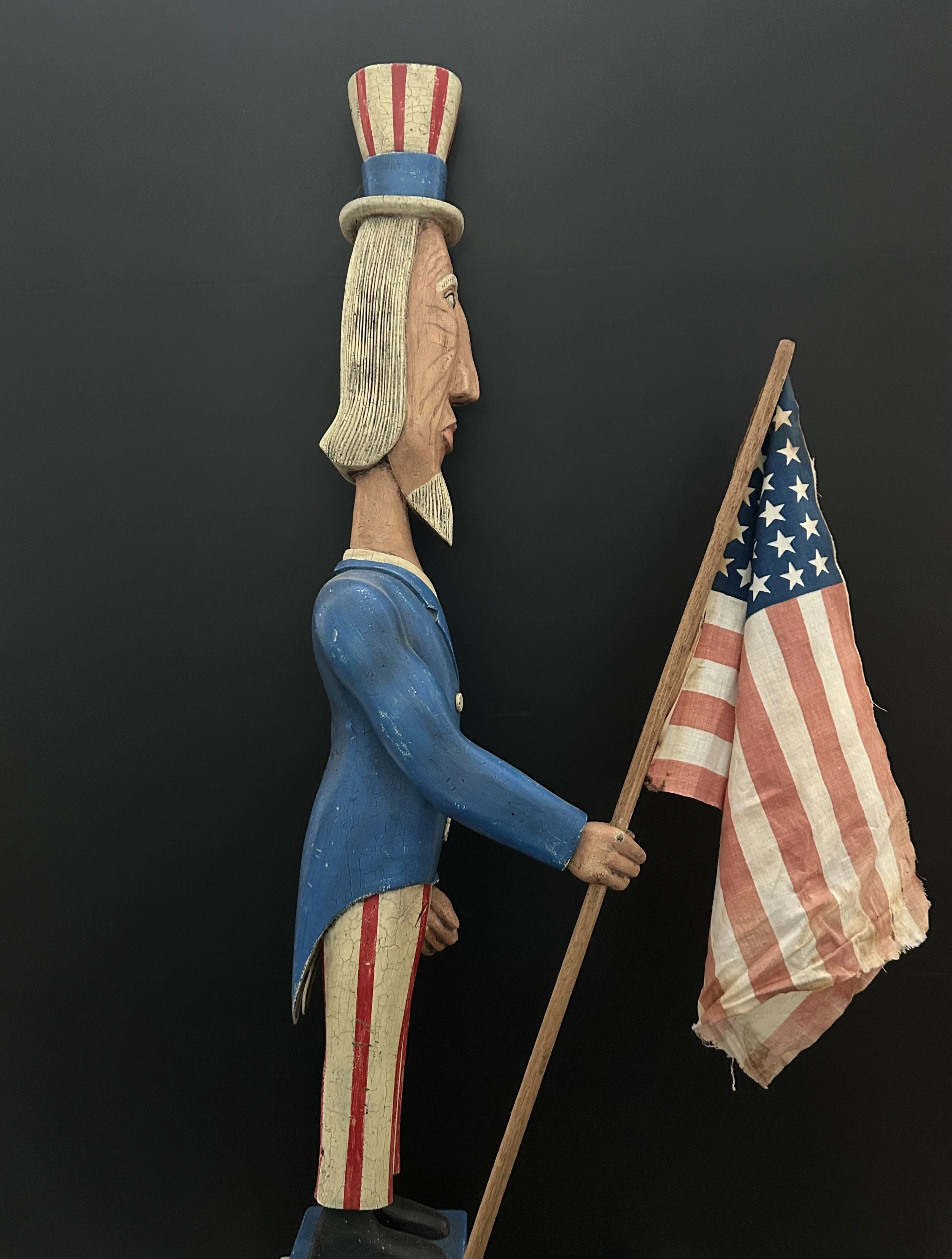 Image 6 of 9
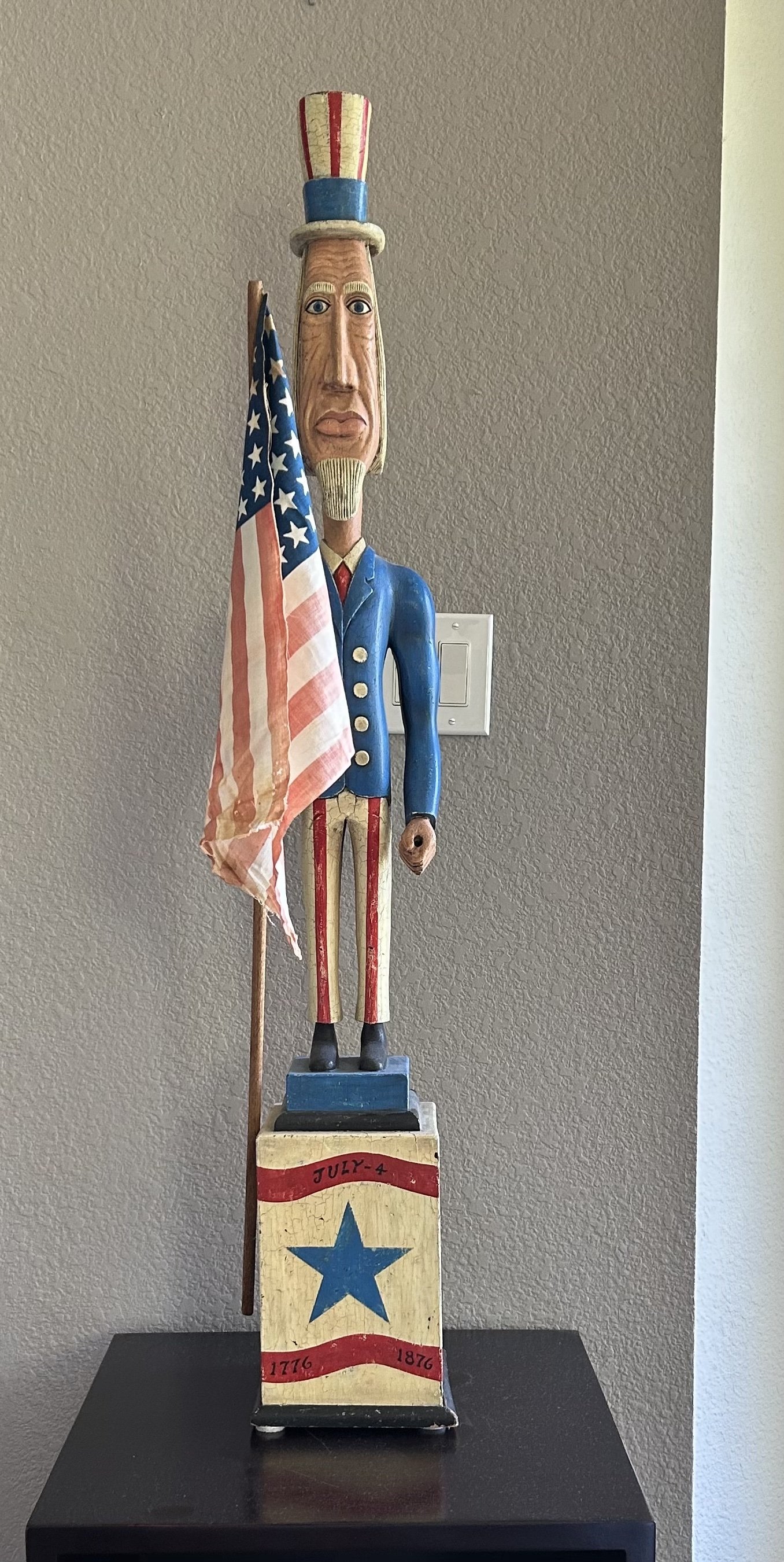 Image 7 of 9
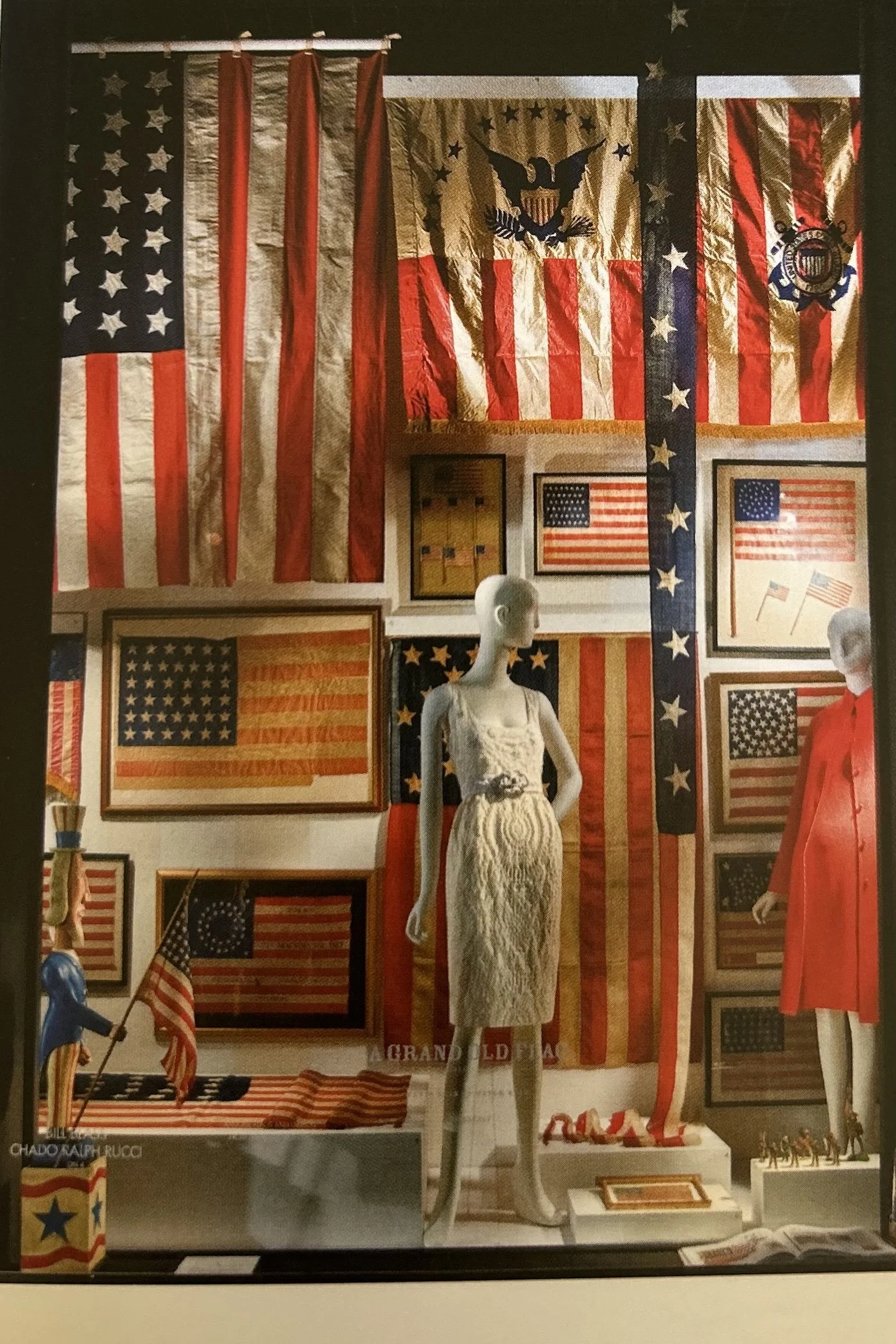 Image 8 of 9
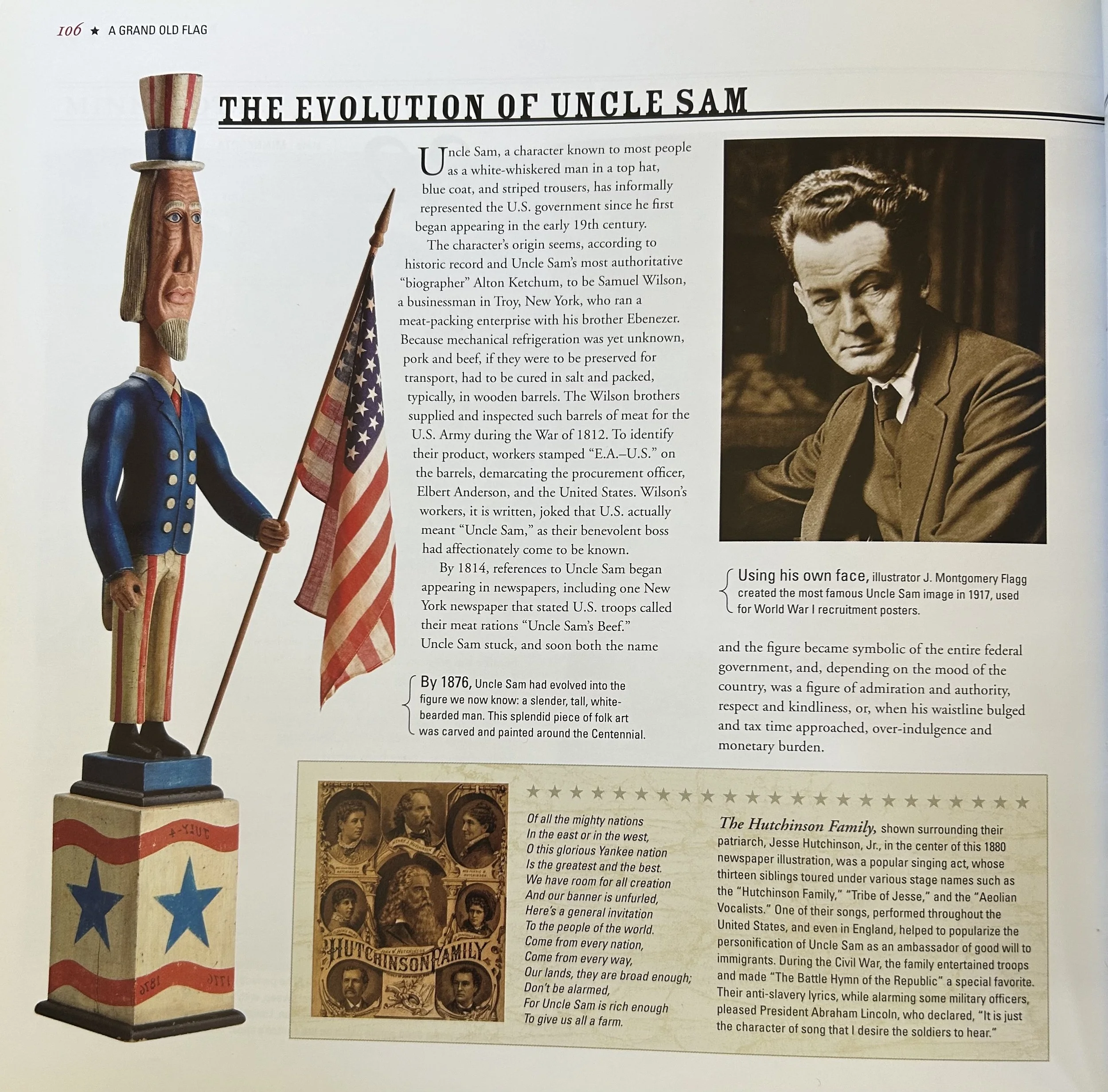 Image 9 of 9