 Image 1 of 5
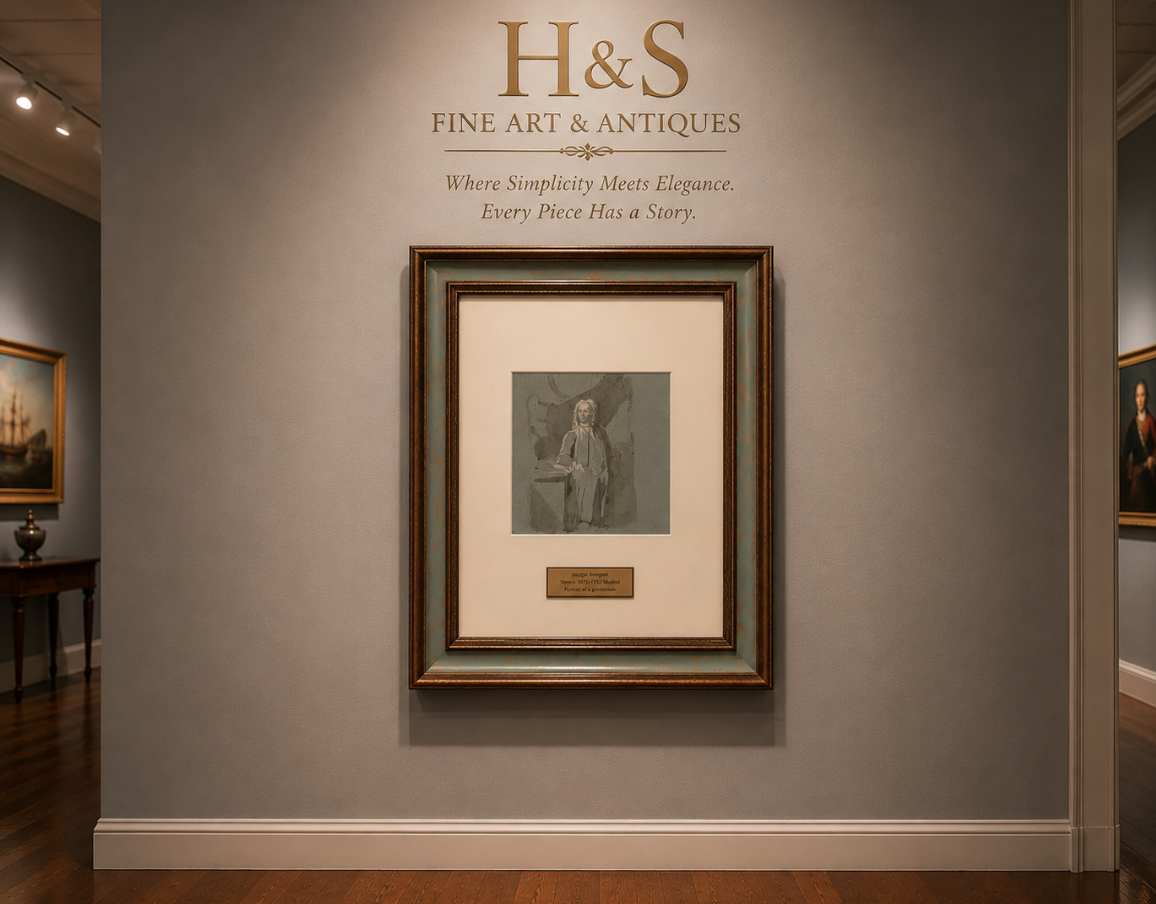 Image 2 of 5
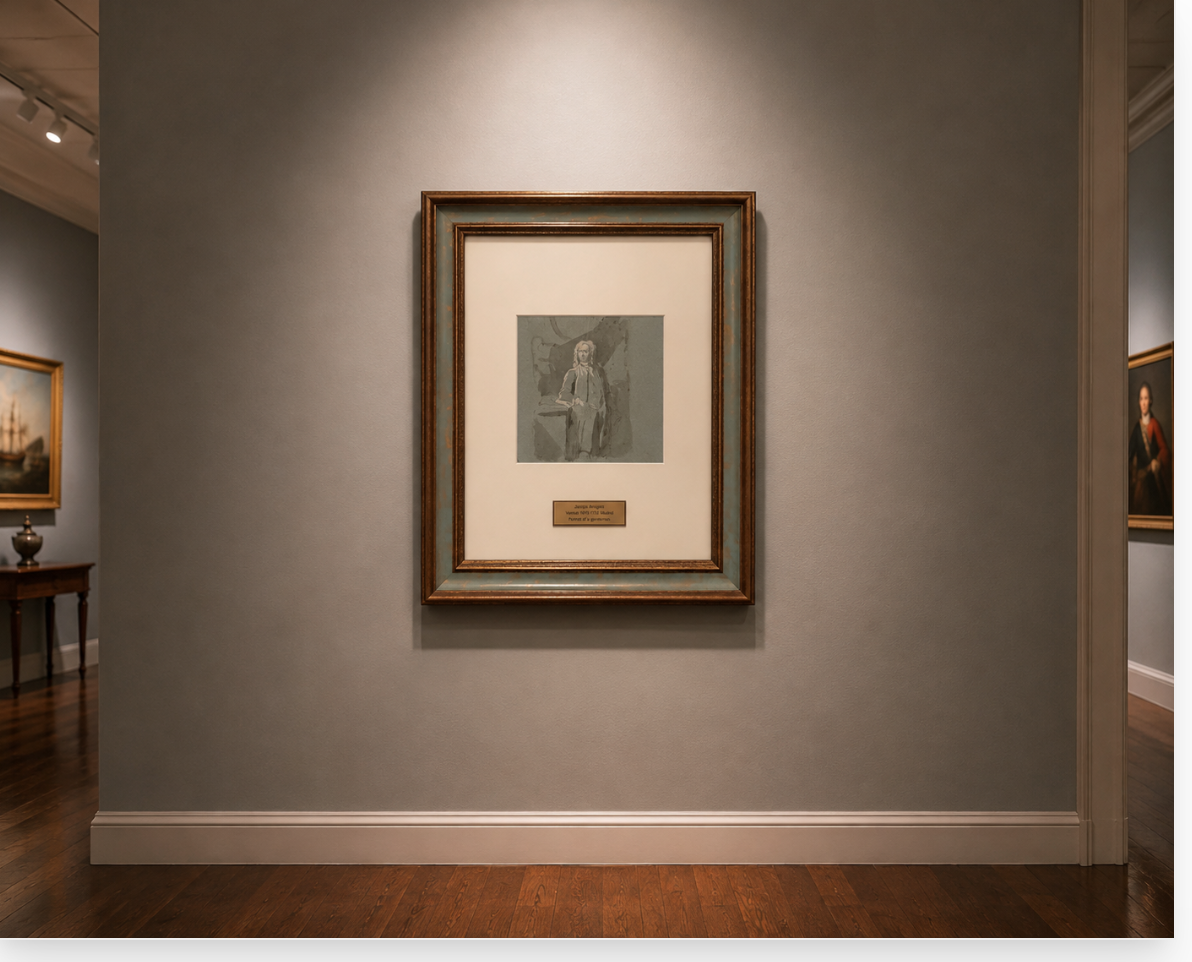 Image 3 of 5
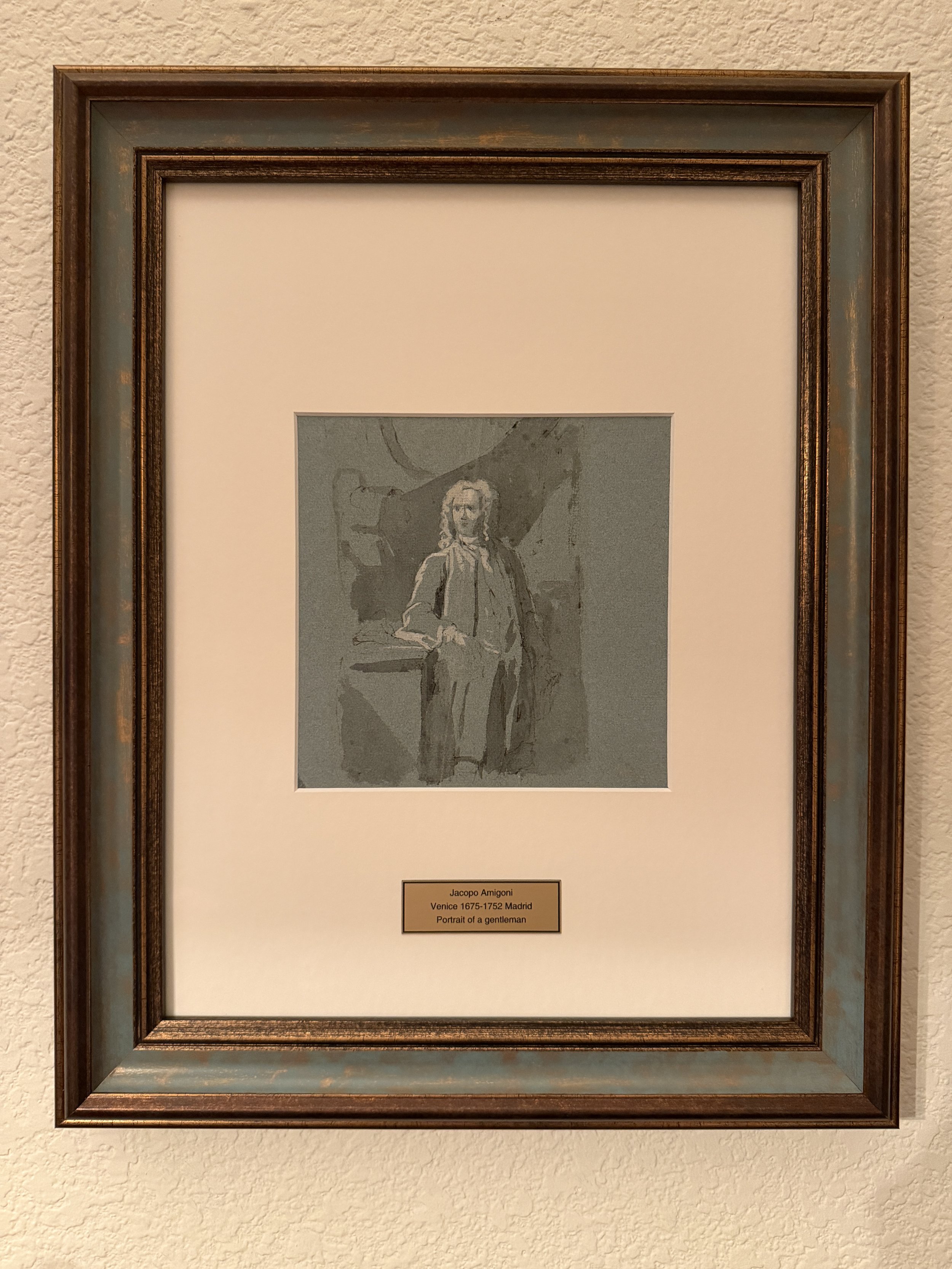 Image 4 of 5
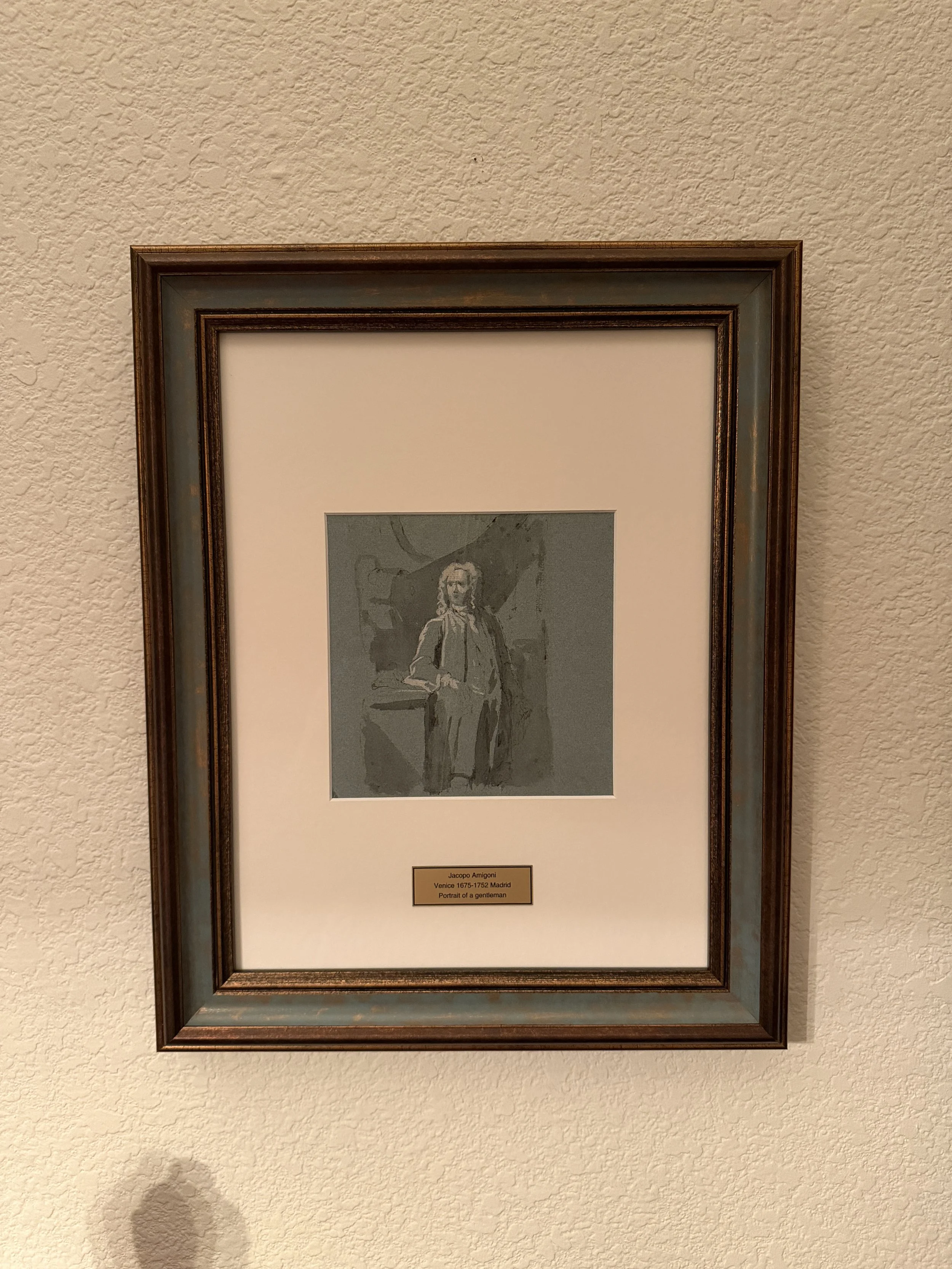 Image 5 of 5
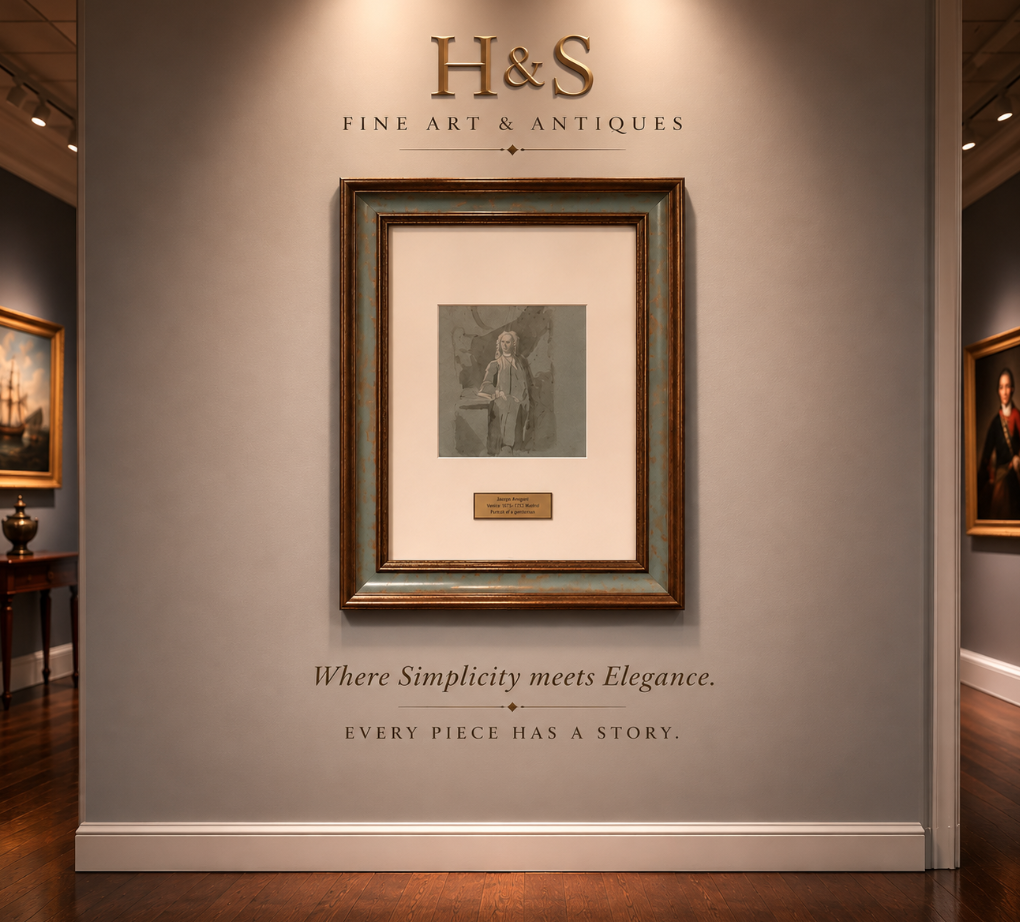
An Eighteenth-Century Portrait Drawing from the Circle of Jacopo Amigoni (Italian, active early 18th century) Portrait of a Gentleman Circa 1730–1735
An Eighteenth-Century Portrait Drawing from the Circle of Jacopo Amigoni
Circle of Jacopo Amigoni (?) (Italian, active early 18th century)
Portrait of a Gentleman
Circa 1730–1735
Pen and black ink, gray wash, heightened with white on blue paper
7¼ × 8½ inches (18.4 × 21.6 cm)
Provenance
Frederick Richard Meatyard (1881–1966), London.
Acquired from Meatyard in 1925 by Dan Fellows Platt (1873–1938), Englewood, New Jersey.(L.750a);
Bequeathed to Princeton University Art Museum, Princeton.
Probably with Castano Galleries, Boston.
Wilhelm Suida (1877–1959), New York.
By descent to Bertina Suida (1922–1992) and Robert L. Manning (1924–1996).
Private Collection.
Introduction:
Works of art often survive because they are beautiful. Others survive because they are important. Rarely does one encounter an object that possesses both qualities while also preserving a remarkable documentary history spanning nearly three centuries.
This refined eighteenth-century portrait drawing is one such work.
Although modest in scale, the drawing has traveled through some of the most distinguished hands in the history of collecting Old Master drawings. Once part of a now-lost album of portrait studies, it passed through the celebrated London dealer Frederick Richard Meatyard, entered the renowned collection of Dan Fellows Platt, became part of the Princeton University Art Museum, later belonged to one of the twentieth century's greatest historians of Italian painting, Wilhelm Suida, and has twice been the subject of modern scholarly study.
Today, it survives not merely as an elegant portrait of an unknown gentleman but as an important document in the history of European portraiture, museum collecting, and the ever-evolving discipline of art history.
Jacopo Amigoni and the Age of the Rococo
The drawing has traditionally been associated with Jacopo Amigoni (c. 1682–1752), one of the great cosmopolitan painters of the Venetian Rococo.
Born in Venice, Amigoni established an international reputation that carried him across Europe. During a remarkable career he worked in Venice, Bavaria, Paris, London, and finally Madrid, where he served the Spanish court until his death.
Unlike many Venetian painters whose careers remained centered in Italy, Amigoni became one of the first truly international artists of the eighteenth century. His elegant style appealed equally to European royalty, diplomats, opera stars, and the English aristocracy.
When Amigoni arrived in London in 1729, fashionable British portraiture was undergoing profound change. English patrons increasingly admired the lightness, grace, and sophisticated color associated with Venetian painting. Amigoni's portraits perfectly embodied those qualities, introducing a distinctly Continental elegance that would influence British taste for decades.
The Drawing
Executed in pen and black ink with gray wash and heightened with brilliant white on blue paper, the drawing demonstrates one of the most refined techniques practiced by Venetian draftsmen during the early eighteenth century.
Rather than drawing upon white paper alone, artists selected blue paper because its natural tone functioned as a middle value. Shadows could be added with transparent gray washes while white bodycolor modeled the highlights of the face, hands, and costume. The result was an economical yet remarkably luminous method of creating three-dimensional form.
The sitter remains unidentified.
He stands confidently beside an architectural element, wearing the powdered wig and fashionable dress associated with prosperous Georgian England. His relaxed pose suggests an individual accustomed to refinement and social standing—perhaps an aristocrat, lawyer, Member of Parliament, or gentleman connected with the royal court.
Although anonymous today, he represents precisely the cultivated class that embraced Italian portraiture during Amigoni's English years.
A Lost Album
One of the most fascinating discoveries concerning this drawing emerged through recent scholarship.
Rather than existing as an independent sheet, the drawing originally formed part of a remarkable collection of portrait studies, several of which were mounted together in a horizontal album.
That album has since disappeared.
During the 1920s, the London dealer Frederick Richard Meatyard (1881–1966) dismantled and dispersed the album, selling its individual pages to museums and distinguished collectors throughout Europe and America.
Today the surviving drawings reside in institutions including:
British Museum
Princeton University Art Museum
Fitzwilliam Museum
Courtauld Gallery
Louvre Museum
Nationalmuseum, Stockholm
Morgan Library & Museum
Each surviving sheet preserves one fragment of what was once a coherent eighteenth-century collection.
The present drawing is one of those rare survivors.
Frederick Richard Meatyard
The earliest documented modern owner was the distinguished London dealer Frederick Richard Meatyard.
Few dealers played a greater role in shaping twentieth-century collections of Old Master drawings. Meatyard possessed an exceptional eye for Italian draftsmanship and supplied museums and collectors across Europe and America with works of remarkable quality.
The dispersal of this portrait album around 1925 became one of the defining episodes in the collecting history of eighteenth-century Venetian drawings.
Dan Fellows Platt
Among the collectors who acquired drawings from Meatyard was Dan Fellows Platt (1873–1938).
Platt was not merely an enthusiastic collector.
He assembled one of the greatest collections of Italian drawings ever formed in America.
A Princeton graduate, lawyer, and philanthropist, Platt devoted decades to acquiring works by the masters of the Italian Renaissance and Baroque. His collection ultimately numbered in the thousands.
The present drawing bears Platt's collector's stamp (Lugt 750a) together with the date of its purchase from Meatyard in 1925, providing unusually precise documentation of its early twentieth-century history.
Princeton University Art Museum
Following Platt's death, his widow fulfilled his wishes by donating his extraordinary collection to Princeton University Art Museum in 1943.
The gift transformed Princeton into one of America's foremost centers for the study of Italian drawings.
Faced with preserving thousands of newly acquired works, curator Frank Jewett Mather Jr. undertook a carefully considered deaccession in 1944.
Contrary to common misconception, these drawings were not sold because they lacked importance.
Rather, selected sheets were released to finance the purchase of Solander boxes, archival mounting, and proper conservation for the enormous Platt Collection.
This drawing was among those deaccessioned during that historic effort.
Its museum provenance therefore represents an important chapter in the history of one of America's finest university collections.
Castano Galleries
Following its departure from Princeton, the drawing was probably handled by Castano Galleries of Boston, one of the respected dealers specializing in European paintings and Old Master drawings during the mid-twentieth century.
Although documentary evidence remains incomplete, Christie's records this passage with reasonable confidence.
Wilhelm Suida
The drawing next entered the collection of Wilhelm Suida (1877–1959).Suida ranks among the most influential historians of Italian Baroque painting of the twentieth century. Born in Vienna, he emigrated to the United States during the Second World War and became one of the foremost authorities on Italian art. His publications continue to serve as standard references for scholars today. Ownership by Wilhelm Suida represents more than distinguished provenance. It suggests that one of the world's leading experts considered the drawing worthy of study and preservation.
Following Suida's death, the drawing descended through his family before eventually returning to the marketplace.
Scholarship
The present drawing has attracted scholarly attention for more than fifty years.
In 1974, Elaine Claye published the drawing in her landmark article:
"A Group of Portrait Drawings by Jacopo Amigoni"
appearing in Master Drawings, the leading international journal devoted to Old Master drawings.
Claye reconstructed approximately forty-four surviving portrait studies dispersed from the Meatyard album and attributed them collectively to Jacopo Amigoni.
Nearly half a century later, Italian scholar Chiara Lo Giudice revisited the entire group.
Her meticulous research, published in Arte Veneta (2022), challenged the traditional attribution.
Rather than assigning the drawings directly to Amigoni, Lo Giudice demonstrated that the sheets likely record portraits painted by several artists active in eighteenth-century England, including Amigoni himself.
Accordingly, Christie's catalogued the present work as:
Circle of Jacopo Amigoni (?)
This revised attribution reflects the increasingly rigorous standards of modern connoisseurship rather than any reduction in the drawing's historical significance.
Indeed, the work has become even more valuable as evidence for understanding artistic practice in Georgian England.
An Evolving Story
Perhaps the greatest lesson offered by this drawing is that scholarship is never static.
Each generation of historians asks new questions.
Each discovery deepens our understanding.
What nineteenth-century collectors admired as a charming portrait became, in the twentieth century, an important work by Jacopo Amigoni. Today, twenty-first-century research suggests an even more nuanced interpretation—one that recognizes the drawing as part of a remarkable visual archive documenting portraiture produced by several artists working in England during the Rococo period.
Rather than diminishing the drawing, this evolving interpretation enriches it.
Its value lies not only in authorship but also in its documented journey through distinguished collections, museums, and scholarship.
Literature
Elaine Claye, "A Group of Portrait Drawings by Jacopo Amigoni,"Master Drawings, Vol. XII, No. 1, Spring 1974, pp. 41–48, no. 25.
Chiara Lo Giudice, "Un gruppo di disegni inglesi di ritratto e qualche nota sulla fortuna di Jacopo Amigoni in Inghilterra,"Arte Veneta, LXXIX, 2022, pp. 180–193.
Curator's Note
This drawing exemplifies the type of work that defines the philosophy of H&S Fine Art & Antiques. Its importance does not rest solely on the hand that created it, but on the extraordinary story it carries. From an eighteenth-century artist's studio to a lost album, from one of London's most respected dealers to Princeton University, through the collection of a leading art historian, and into the pages of modern scholarship, it has remained an object of study, preservation, and admiration for nearly three centuries.
Every collector hopes to acquire a work that has something meaningful to say about history. Few drawings speak with such quiet authority. At H&S Fine Art & Antiques, we believe that every exceptional object deserves not only careful preservation but thoughtful interpretation—for every piece has a story.
An Eighteenth-Century Portrait Drawing from the Circle of Jacopo Amigoni
Circle of Jacopo Amigoni (?) (Italian, active early 18th century)
Portrait of a Gentleman
Circa 1730–1735
Pen and black ink, gray wash, heightened with white on blue paper
7¼ × 8½ inches (18.4 × 21.6 cm)
Provenance
Frederick Richard Meatyard (1881–1966), London.
Acquired from Meatyard in 1925 by Dan Fellows Platt (1873–1938), Englewood, New Jersey.(L.750a);
Bequeathed to Princeton University Art Museum, Princeton.
Probably with Castano Galleries, Boston.
Wilhelm Suida (1877–1959), New York.
By descent to Bertina Suida (1922–1992) and Robert L. Manning (1924–1996).
Private Collection.
Introduction:
Works of art often survive because they are beautiful. Others survive because they are important. Rarely does one encounter an object that possesses both qualities while also preserving a remarkable documentary history spanning nearly three centuries.
This refined eighteenth-century portrait drawing is one such work.
Although modest in scale, the drawing has traveled through some of the most distinguished hands in the history of collecting Old Master drawings. Once part of a now-lost album of portrait studies, it passed through the celebrated London dealer Frederick Richard Meatyard, entered the renowned collection of Dan Fellows Platt, became part of the Princeton University Art Museum, later belonged to one of the twentieth century's greatest historians of Italian painting, Wilhelm Suida, and has twice been the subject of modern scholarly study.
Today, it survives not merely as an elegant portrait of an unknown gentleman but as an important document in the history of European portraiture, museum collecting, and the ever-evolving discipline of art history.
Jacopo Amigoni and the Age of the Rococo
The drawing has traditionally been associated with Jacopo Amigoni (c. 1682–1752), one of the great cosmopolitan painters of the Venetian Rococo.
Born in Venice, Amigoni established an international reputation that carried him across Europe. During a remarkable career he worked in Venice, Bavaria, Paris, London, and finally Madrid, where he served the Spanish court until his death.
Unlike many Venetian painters whose careers remained centered in Italy, Amigoni became one of the first truly international artists of the eighteenth century. His elegant style appealed equally to European royalty, diplomats, opera stars, and the English aristocracy.
When Amigoni arrived in London in 1729, fashionable British portraiture was undergoing profound change. English patrons increasingly admired the lightness, grace, and sophisticated color associated with Venetian painting. Amigoni's portraits perfectly embodied those qualities, introducing a distinctly Continental elegance that would influence British taste for decades.
The Drawing
Executed in pen and black ink with gray wash and heightened with brilliant white on blue paper, the drawing demonstrates one of the most refined techniques practiced by Venetian draftsmen during the early eighteenth century.
Rather than drawing upon white paper alone, artists selected blue paper because its natural tone functioned as a middle value. Shadows could be added with transparent gray washes while white bodycolor modeled the highlights of the face, hands, and costume. The result was an economical yet remarkably luminous method of creating three-dimensional form.
The sitter remains unidentified.
He stands confidently beside an architectural element, wearing the powdered wig and fashionable dress associated with prosperous Georgian England. His relaxed pose suggests an individual accustomed to refinement and social standing—perhaps an aristocrat, lawyer, Member of Parliament, or gentleman connected with the royal court.
Although anonymous today, he represents precisely the cultivated class that embraced Italian portraiture during Amigoni's English years.
A Lost Album
One of the most fascinating discoveries concerning this drawing emerged through recent scholarship.
Rather than existing as an independent sheet, the drawing originally formed part of a remarkable collection of portrait studies, several of which were mounted together in a horizontal album.
That album has since disappeared.
During the 1920s, the London dealer Frederick Richard Meatyard (1881–1966) dismantled and dispersed the album, selling its individual pages to museums and distinguished collectors throughout Europe and America.
Today the surviving drawings reside in institutions including:
British Museum
Princeton University Art Museum
Fitzwilliam Museum
Courtauld Gallery
Louvre Museum
Nationalmuseum, Stockholm
Morgan Library & Museum
Each surviving sheet preserves one fragment of what was once a coherent eighteenth-century collection.
The present drawing is one of those rare survivors.
Frederick Richard Meatyard
The earliest documented modern owner was the distinguished London dealer Frederick Richard Meatyard.
Few dealers played a greater role in shaping twentieth-century collections of Old Master drawings. Meatyard possessed an exceptional eye for Italian draftsmanship and supplied museums and collectors across Europe and America with works of remarkable quality.
The dispersal of this portrait album around 1925 became one of the defining episodes in the collecting history of eighteenth-century Venetian drawings.
Dan Fellows Platt
Among the collectors who acquired drawings from Meatyard was Dan Fellows Platt (1873–1938).
Platt was not merely an enthusiastic collector.
He assembled one of the greatest collections of Italian drawings ever formed in America.
A Princeton graduate, lawyer, and philanthropist, Platt devoted decades to acquiring works by the masters of the Italian Renaissance and Baroque. His collection ultimately numbered in the thousands.
The present drawing bears Platt's collector's stamp (Lugt 750a) together with the date of its purchase from Meatyard in 1925, providing unusually precise documentation of its early twentieth-century history.
Princeton University Art Museum
Following Platt's death, his widow fulfilled his wishes by donating his extraordinary collection to Princeton University Art Museum in 1943.
The gift transformed Princeton into one of America's foremost centers for the study of Italian drawings.
Faced with preserving thousands of newly acquired works, curator Frank Jewett Mather Jr. undertook a carefully considered deaccession in 1944.
Contrary to common misconception, these drawings were not sold because they lacked importance.
Rather, selected sheets were released to finance the purchase of Solander boxes, archival mounting, and proper conservation for the enormous Platt Collection.
This drawing was among those deaccessioned during that historic effort.
Its museum provenance therefore represents an important chapter in the history of one of America's finest university collections.
Castano Galleries
Following its departure from Princeton, the drawing was probably handled by Castano Galleries of Boston, one of the respected dealers specializing in European paintings and Old Master drawings during the mid-twentieth century.
Although documentary evidence remains incomplete, Christie's records this passage with reasonable confidence.
Wilhelm Suida
The drawing next entered the collection of Wilhelm Suida (1877–1959).Suida ranks among the most influential historians of Italian Baroque painting of the twentieth century. Born in Vienna, he emigrated to the United States during the Second World War and became one of the foremost authorities on Italian art. His publications continue to serve as standard references for scholars today. Ownership by Wilhelm Suida represents more than distinguished provenance. It suggests that one of the world's leading experts considered the drawing worthy of study and preservation.
Following Suida's death, the drawing descended through his family before eventually returning to the marketplace.
Scholarship
The present drawing has attracted scholarly attention for more than fifty years.
In 1974, Elaine Claye published the drawing in her landmark article:
"A Group of Portrait Drawings by Jacopo Amigoni"
appearing in Master Drawings, the leading international journal devoted to Old Master drawings.
Claye reconstructed approximately forty-four surviving portrait studies dispersed from the Meatyard album and attributed them collectively to Jacopo Amigoni.
Nearly half a century later, Italian scholar Chiara Lo Giudice revisited the entire group.
Her meticulous research, published in Arte Veneta (2022), challenged the traditional attribution.
Rather than assigning the drawings directly to Amigoni, Lo Giudice demonstrated that the sheets likely record portraits painted by several artists active in eighteenth-century England, including Amigoni himself.
Accordingly, Christie's catalogued the present work as:
Circle of Jacopo Amigoni (?)
This revised attribution reflects the increasingly rigorous standards of modern connoisseurship rather than any reduction in the drawing's historical significance.
Indeed, the work has become even more valuable as evidence for understanding artistic practice in Georgian England.
An Evolving Story
Perhaps the greatest lesson offered by this drawing is that scholarship is never static.
Each generation of historians asks new questions.
Each discovery deepens our understanding.
What nineteenth-century collectors admired as a charming portrait became, in the twentieth century, an important work by Jacopo Amigoni. Today, twenty-first-century research suggests an even more nuanced interpretation—one that recognizes the drawing as part of a remarkable visual archive documenting portraiture produced by several artists working in England during the Rococo period.
Rather than diminishing the drawing, this evolving interpretation enriches it.
Its value lies not only in authorship but also in its documented journey through distinguished collections, museums, and scholarship.
Literature
Elaine Claye, "A Group of Portrait Drawings by Jacopo Amigoni,"Master Drawings, Vol. XII, No. 1, Spring 1974, pp. 41–48, no. 25.
Chiara Lo Giudice, "Un gruppo di disegni inglesi di ritratto e qualche nota sulla fortuna di Jacopo Amigoni in Inghilterra,"Arte Veneta, LXXIX, 2022, pp. 180–193.
Curator's Note
This drawing exemplifies the type of work that defines the philosophy of H&S Fine Art & Antiques. Its importance does not rest solely on the hand that created it, but on the extraordinary story it carries. From an eighteenth-century artist's studio to a lost album, from one of London's most respected dealers to Princeton University, through the collection of a leading art historian, and into the pages of modern scholarship, it has remained an object of study, preservation, and admiration for nearly three centuries.
Every collector hopes to acquire a work that has something meaningful to say about history. Few drawings speak with such quiet authority. At H&S Fine Art & Antiques, we believe that every exceptional object deserves not only careful preservation but thoughtful interpretation—for every piece has a story.