CENTENNIAL OVERPRINT PARADE FLAG
Colorado Statehood and the Centennial of American Independence
Circa 1876
American
Printed cotton parade flag with original staff
15 ½ x 23 ½ inches
Among the most evocative surviving symbols of America's first century is this rare 38-star Centennial parade flag, produced in 1876 to commemorate the one-hundredth anniversary of the Declaration of Independence. Printed boldly with the inscription "CENTENNIAL 1876," the flag stands as both a patriotic celebration and a tangible artifact of one of the most important public commemorations in American history.
The year 1876 marked a defining moment in the American story. Barely a decade after the Civil War, the nation sought to reaffirm its identity through an unprecedented series of celebrations commemorating the centennial of independence. Cities, towns, civic organizations, veterans' groups, and millions of ordinary Americans participated in parades, exhibitions, and public ceremonies. No event symbolized this national renewal more powerfully than the Centennial International Exposition held in Philadelphia, the first World's Fair organized in the United States.
This flag was almost certainly produced for those celebrations. Surviving examples are concentrated in and around the Philadelphia region, suggesting a direct association with the Centennial Exposition and its related festivities. Visitors to Philadelphia encountered a city draped in patriotic imagery, and commemorative flags such as this one served as both souvenirs and symbols of national pride.
The flag bears thirty-eight stars representing Colorado, admitted to the Union on August 1, 1876. Colorado's admission coincided so closely with the nation's one-hundredth anniversary that it became forever known as "The Centennial State." Although the official 38-star flag did not become the legal national flag until July 4, 1877, manufacturers anticipated Colorado's statehood and began producing 38-star flags immediately. As a result, the 38-star configuration became the dominant star count associated with Centennial celebrations.
Particularly noteworthy is the flag's reverse-mount orientation, with the canton positioned in the upper-right corner. Modern flag etiquette requires the canton to appear in the upper-left corner, but no such standard governed parade flag production during the nineteenth century. Reverse-printed examples provide fascinating evidence of the practical and often informal manufacturing methods employed by printers of patriotic textiles during the Centennial era.
Unlike military colors intended for prolonged use, parade flags were ephemeral objects. Manufactured for a specific celebration and often waved enthusiastically during public events, most were discarded once festivities concluded. The survival of any Centennial parade flag is notable; the survival of a documented Centennial-overprint example retaining its original staff is exceptionally uncommon.
The design itself is among the most recognizable and coveted of all Centennial parade flags. Printed with the words "CENTENNIAL 1876" across the stripes, the flag combines three historic milestones in a single object: the centennial of American independence, the reunification of the nation after the Civil War, and the admission of Colorado as the thirty-eighth state.
The rarity of this particular pattern has long been recognized by leading scholars and collectors. Comparable examples are illustrated in the most important reference works on American flags and have appeared in some of the finest private collections assembled during the twentieth century.
A nearly identical example was formerly part of the celebrated collection of Boleslaw and Marie-Louise Mastai and is illustrated in Herbert Ridgeway Collins' landmark publication Threads of History: Americana Recorded on Cloth, 1775 to the Present. The Mastai Collection remains one of the most influential collections of American flags ever assembled and served as a foundation for modern scholarship in the field.
Another example is documented in J. Richard Pierce's Stars and Stripes, further establishing the design as a recognized rarity among surviving nineteenth-century parade flags.
Today scholars estimate that only a small number of these Centennial-overprint flags survive, with approximately twenty examples known. Their rarity, combined with their direct connection to America's Centennial celebrations, places them among the most desirable commemorative parade flags produced during the nineteenth century.
More than a patriotic textile, this flag is a witness to a defining national moment. It embodies the optimism of the Centennial generation, the expansion of the Union through Colorado's admission, and the renewed confidence of a nation entering its second century. As both a work of folk graphic design and a historical document, it remains one of the most compelling survivors of America's Centennial year.
References
Herbert Ridgeway Collins, Threads of History: Americana Recorded on Cloth, 1775 to the Present, Smithsonian Institution Press.
J. Richard Pierce, Stars and Stripes: Fabric of the American Spirit.
Boleslaw and Marie-Louise Mastai Collection of American Flags.
Centennial International Exposition, Philadelphia, 1876.
Colorado Statehood, August 1, 1876.
Published in the standard references on American flags
Related to the 1876 Philadelphia Centennial Exposition
Connected to Colorado's admission as the Centennial State
One of only approximately twenty known examples
Retaining its original staff
Presented in a museum-quality conservation frame
Those points are what sophisticated collectors of American flags, museums, and advanced Americana buyers look for first.
CENTENNIAL OVERPRINT PARADE FLAG
Colorado Statehood and the Centennial of American Independence
Circa 1876
American
Printed cotton parade flag with original staff
15 ½ x 23 ½ inches
Among the most evocative surviving symbols of America's first century is this rare 38-star Centennial parade flag, produced in 1876 to commemorate the one-hundredth anniversary of the Declaration of Independence. Printed boldly with the inscription "CENTENNIAL 1876," the flag stands as both a patriotic celebration and a tangible artifact of one of the most important public commemorations in American history.
The year 1876 marked a defining moment in the American story. Barely a decade after the Civil War, the nation sought to reaffirm its identity through an unprecedented series of celebrations commemorating the centennial of independence. Cities, towns, civic organizations, veterans' groups, and millions of ordinary Americans participated in parades, exhibitions, and public ceremonies. No event symbolized this national renewal more powerfully than the Centennial International Exposition held in Philadelphia, the first World's Fair organized in the United States.
This flag was almost certainly produced for those celebrations. Surviving examples are concentrated in and around the Philadelphia region, suggesting a direct association with the Centennial Exposition and its related festivities. Visitors to Philadelphia encountered a city draped in patriotic imagery, and commemorative flags such as this one served as both souvenirs and symbols of national pride.
The flag bears thirty-eight stars representing Colorado, admitted to the Union on August 1, 1876. Colorado's admission coincided so closely with the nation's one-hundredth anniversary that it became forever known as "The Centennial State." Although the official 38-star flag did not become the legal national flag until July 4, 1877, manufacturers anticipated Colorado's statehood and began producing 38-star flags immediately. As a result, the 38-star configuration became the dominant star count associated with Centennial celebrations.
Particularly noteworthy is the flag's reverse-mount orientation, with the canton positioned in the upper-right corner. Modern flag etiquette requires the canton to appear in the upper-left corner, but no such standard governed parade flag production during the nineteenth century. Reverse-printed examples provide fascinating evidence of the practical and often informal manufacturing methods employed by printers of patriotic textiles during the Centennial era.
Unlike military colors intended for prolonged use, parade flags were ephemeral objects. Manufactured for a specific celebration and often waved enthusiastically during public events, most were discarded once festivities concluded. The survival of any Centennial parade flag is notable; the survival of a documented Centennial-overprint example retaining its original staff is exceptionally uncommon.
The design itself is among the most recognizable and coveted of all Centennial parade flags. Printed with the words "CENTENNIAL 1876" across the stripes, the flag combines three historic milestones in a single object: the centennial of American independence, the reunification of the nation after the Civil War, and the admission of Colorado as the thirty-eighth state.
The rarity of this particular pattern has long been recognized by leading scholars and collectors. Comparable examples are illustrated in the most important reference works on American flags and have appeared in some of the finest private collections assembled during the twentieth century.
A nearly identical example was formerly part of the celebrated collection of Boleslaw and Marie-Louise Mastai and is illustrated in Herbert Ridgeway Collins' landmark publication Threads of History: Americana Recorded on Cloth, 1775 to the Present. The Mastai Collection remains one of the most influential collections of American flags ever assembled and served as a foundation for modern scholarship in the field.
Another example is documented in J. Richard Pierce's Stars and Stripes, further establishing the design as a recognized rarity among surviving nineteenth-century parade flags.
Today scholars estimate that only a small number of these Centennial-overprint flags survive, with approximately twenty examples known. Their rarity, combined with their direct connection to America's Centennial celebrations, places them among the most desirable commemorative parade flags produced during the nineteenth century.
More than a patriotic textile, this flag is a witness to a defining national moment. It embodies the optimism of the Centennial generation, the expansion of the Union through Colorado's admission, and the renewed confidence of a nation entering its second century. As both a work of folk graphic design and a historical document, it remains one of the most compelling survivors of America's Centennial year.
References
Herbert Ridgeway Collins, Threads of History: Americana Recorded on Cloth, 1775 to the Present, Smithsonian Institution Press.
J. Richard Pierce, Stars and Stripes: Fabric of the American Spirit.
Boleslaw and Marie-Louise Mastai Collection of American Flags.
Centennial International Exposition, Philadelphia, 1876.
Colorado Statehood, August 1, 1876.
Published in the standard references on American flags
Related to the 1876 Philadelphia Centennial Exposition
Connected to Colorado's admission as the Centennial State
One of only approximately twenty known examples
Retaining its original staff
Presented in a museum-quality conservation frame
Those points are what sophisticated collectors of American flags, museums, and advanced Americana buyers look for first.
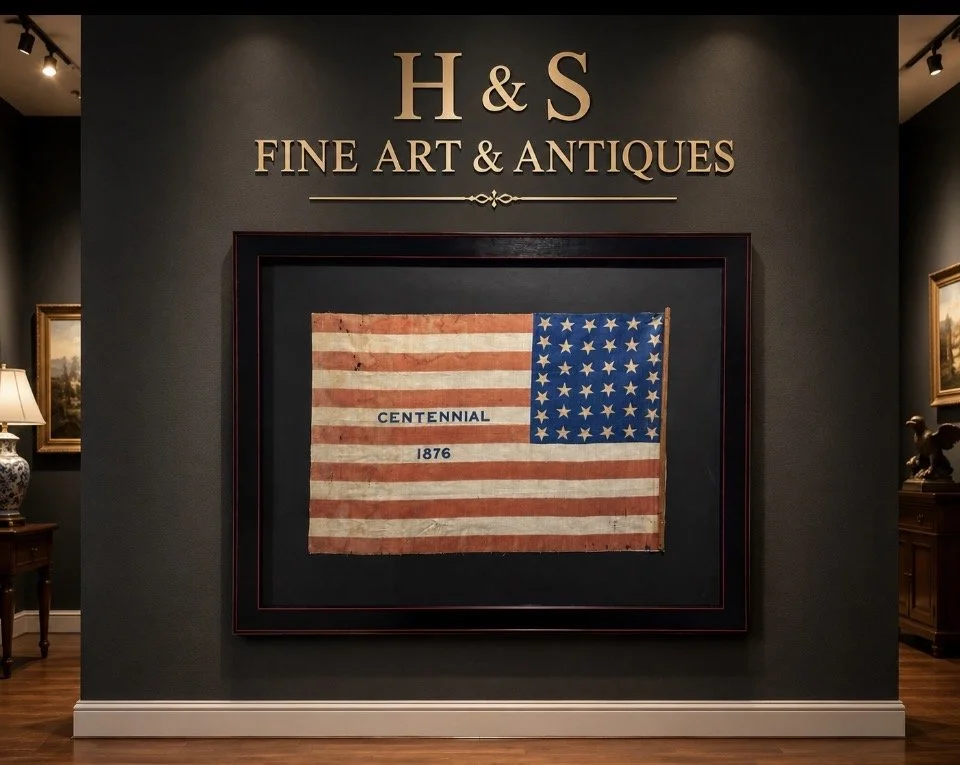 Image 1 of 4
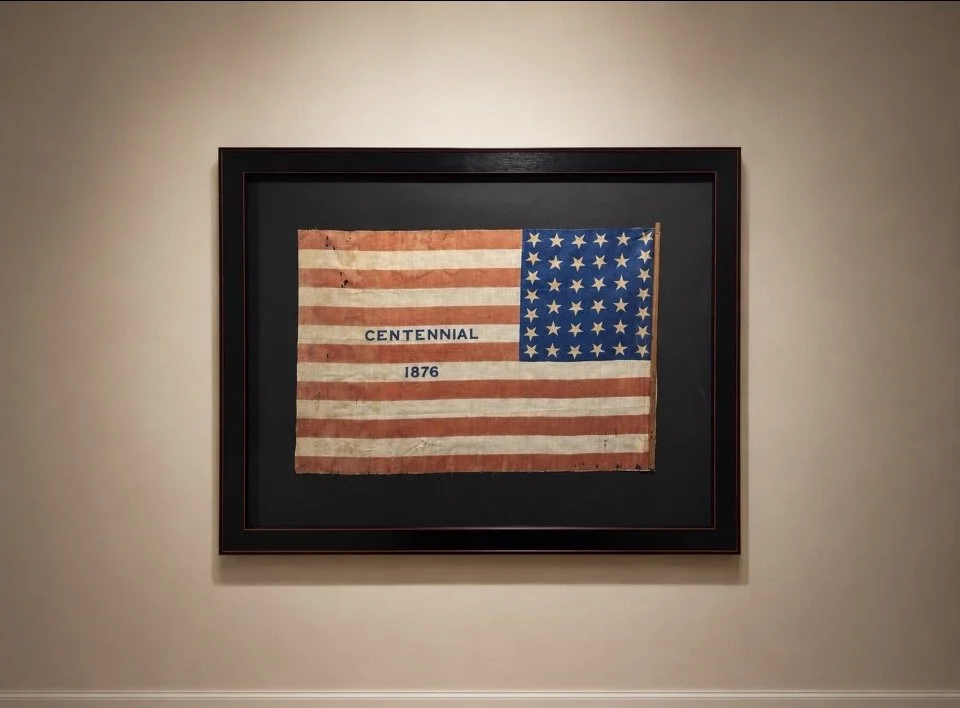 Image 2 of 4
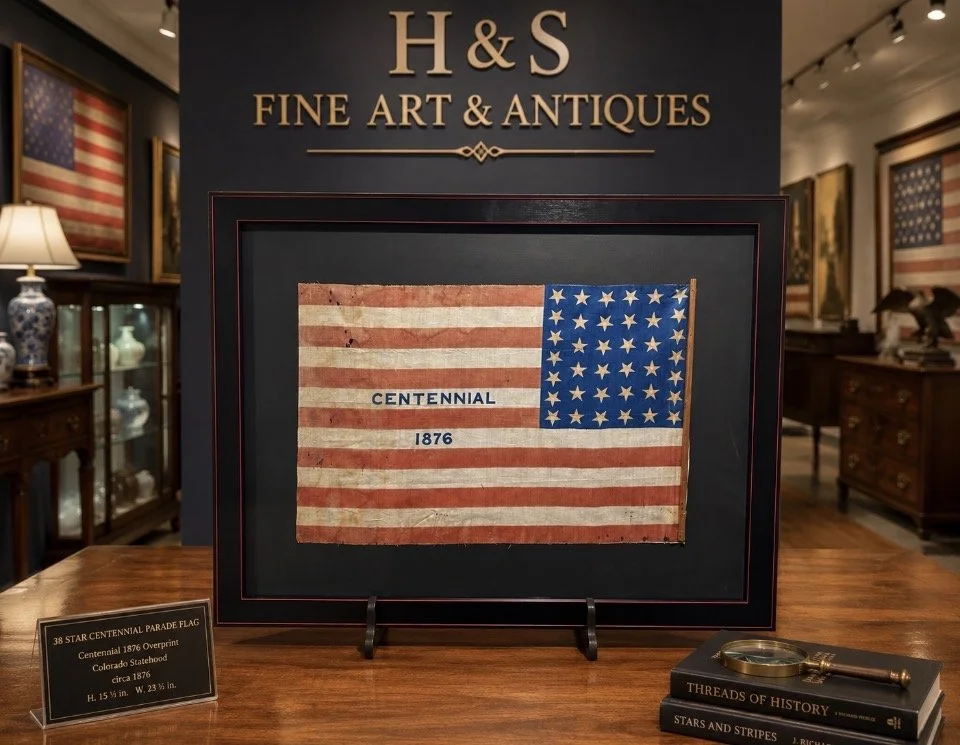 Image 3 of 4
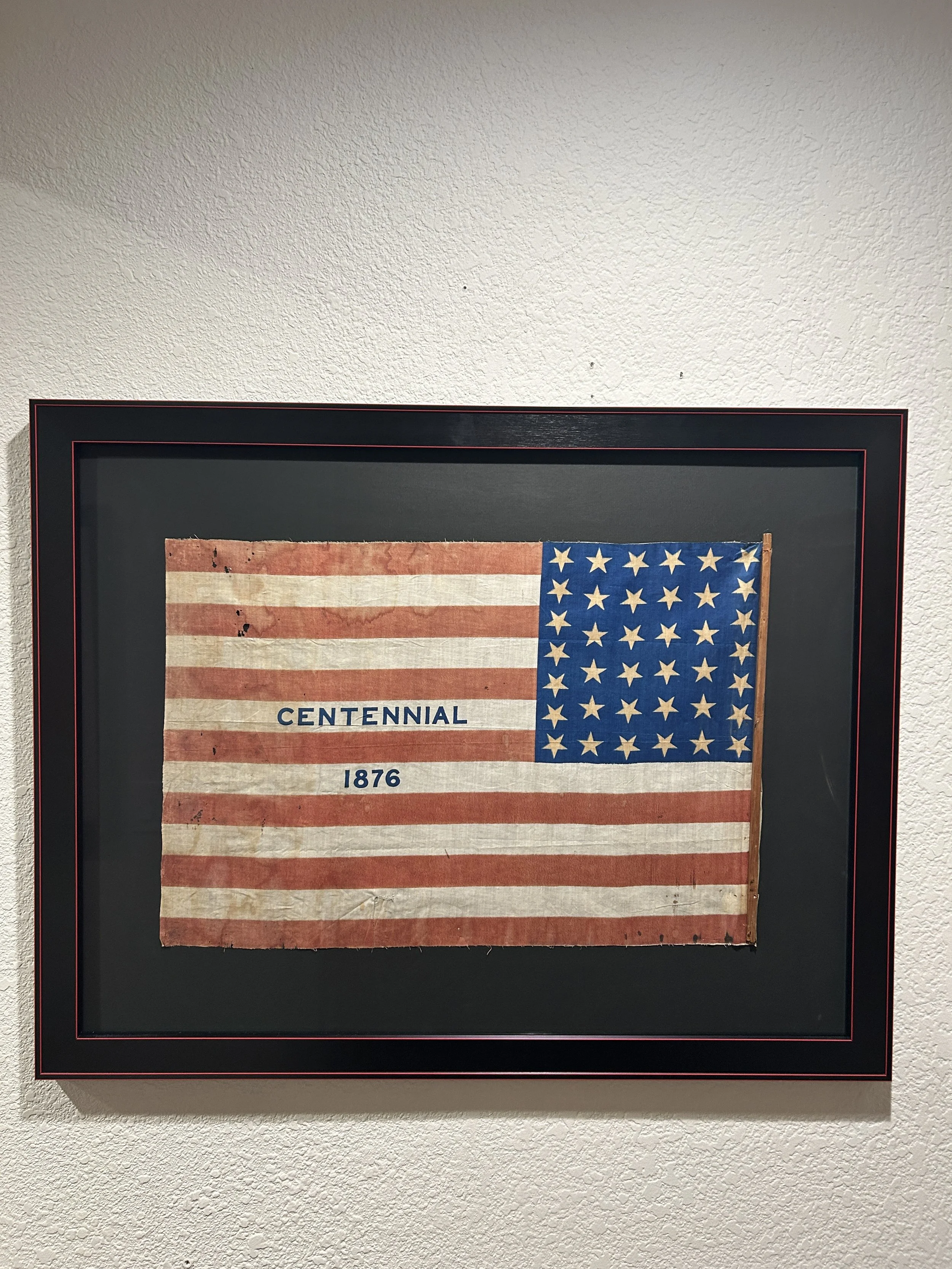 Image 4 of 4