 Image 1 of 5
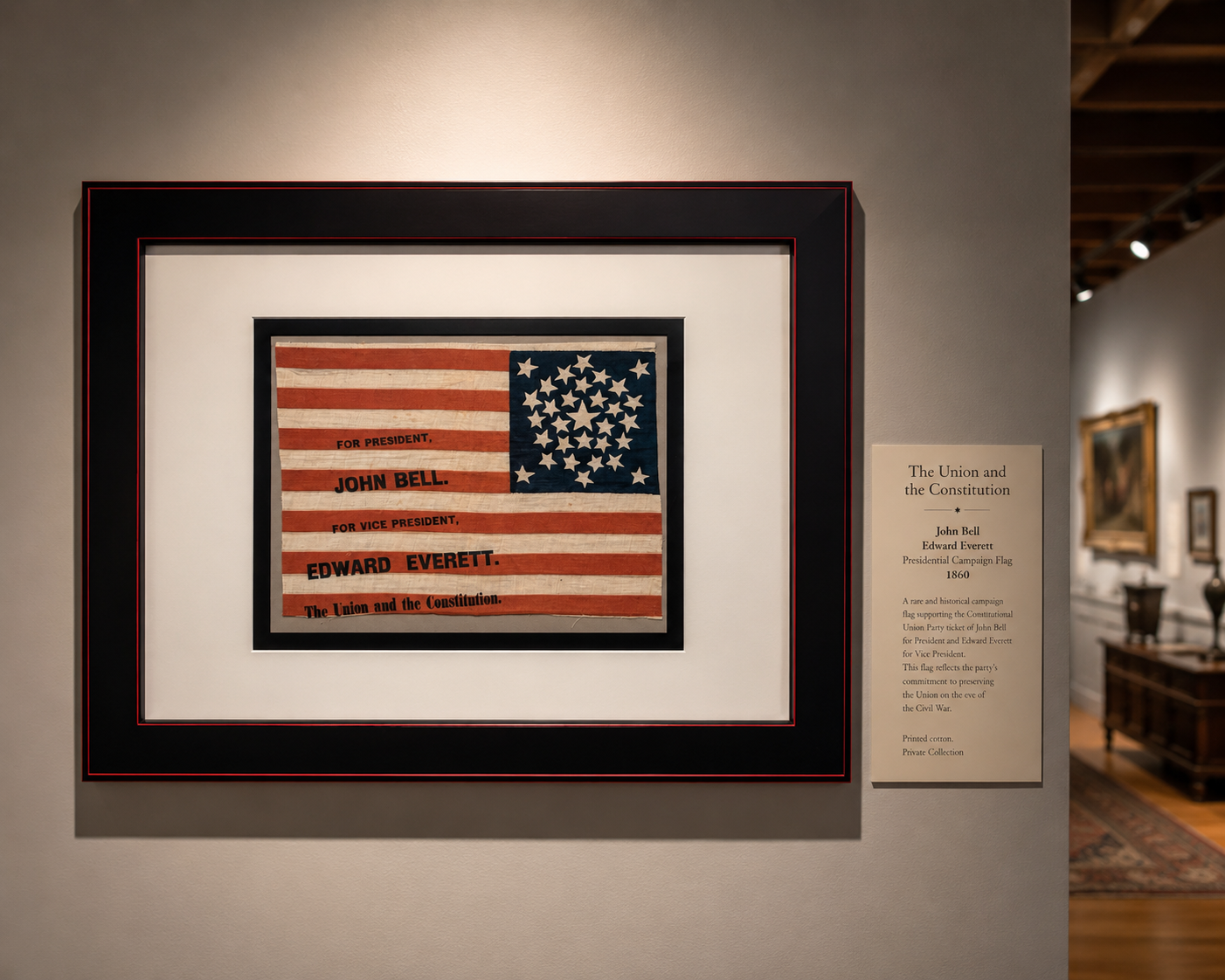 Image 2 of 5
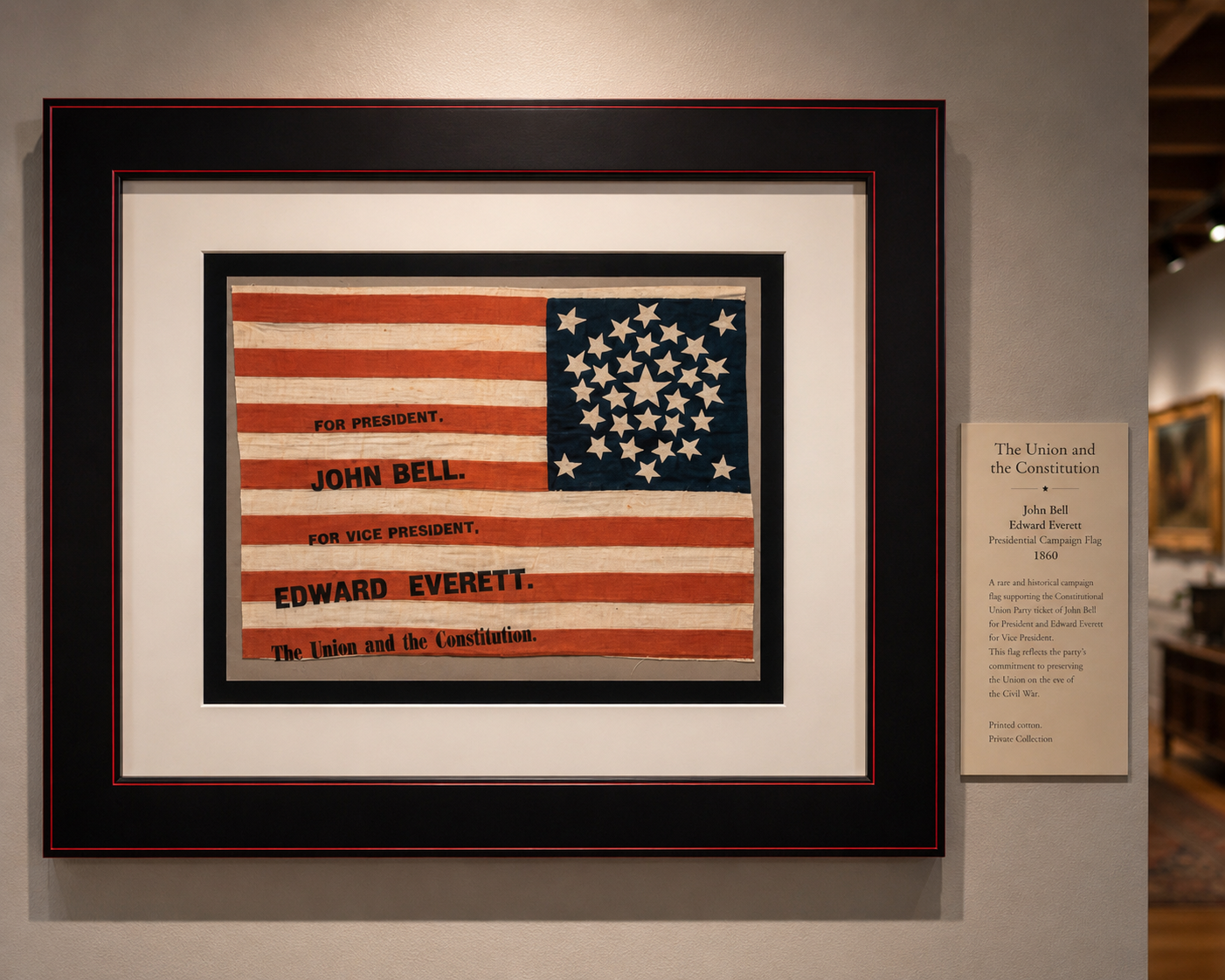 Image 3 of 5
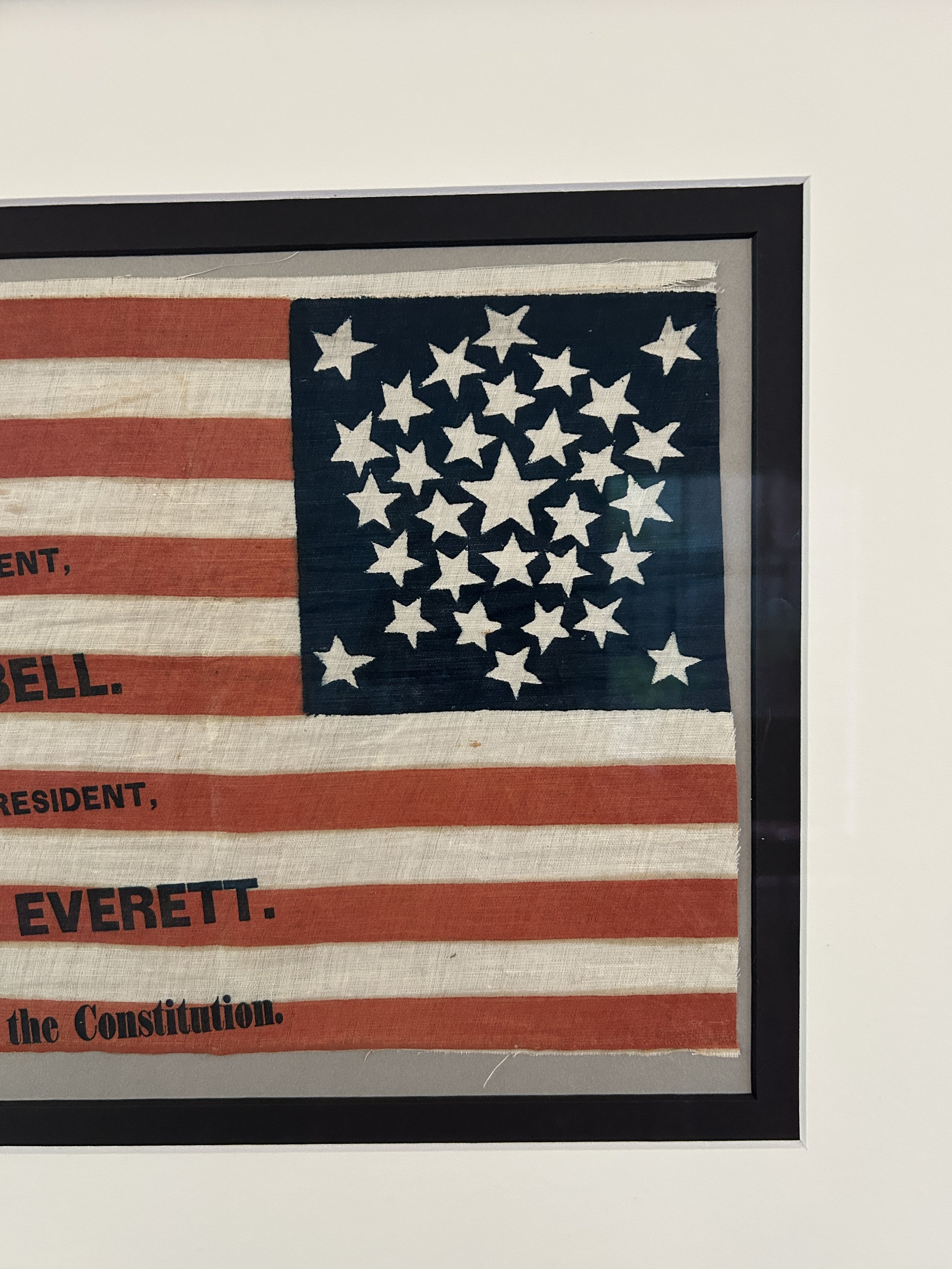 Image 4 of 5
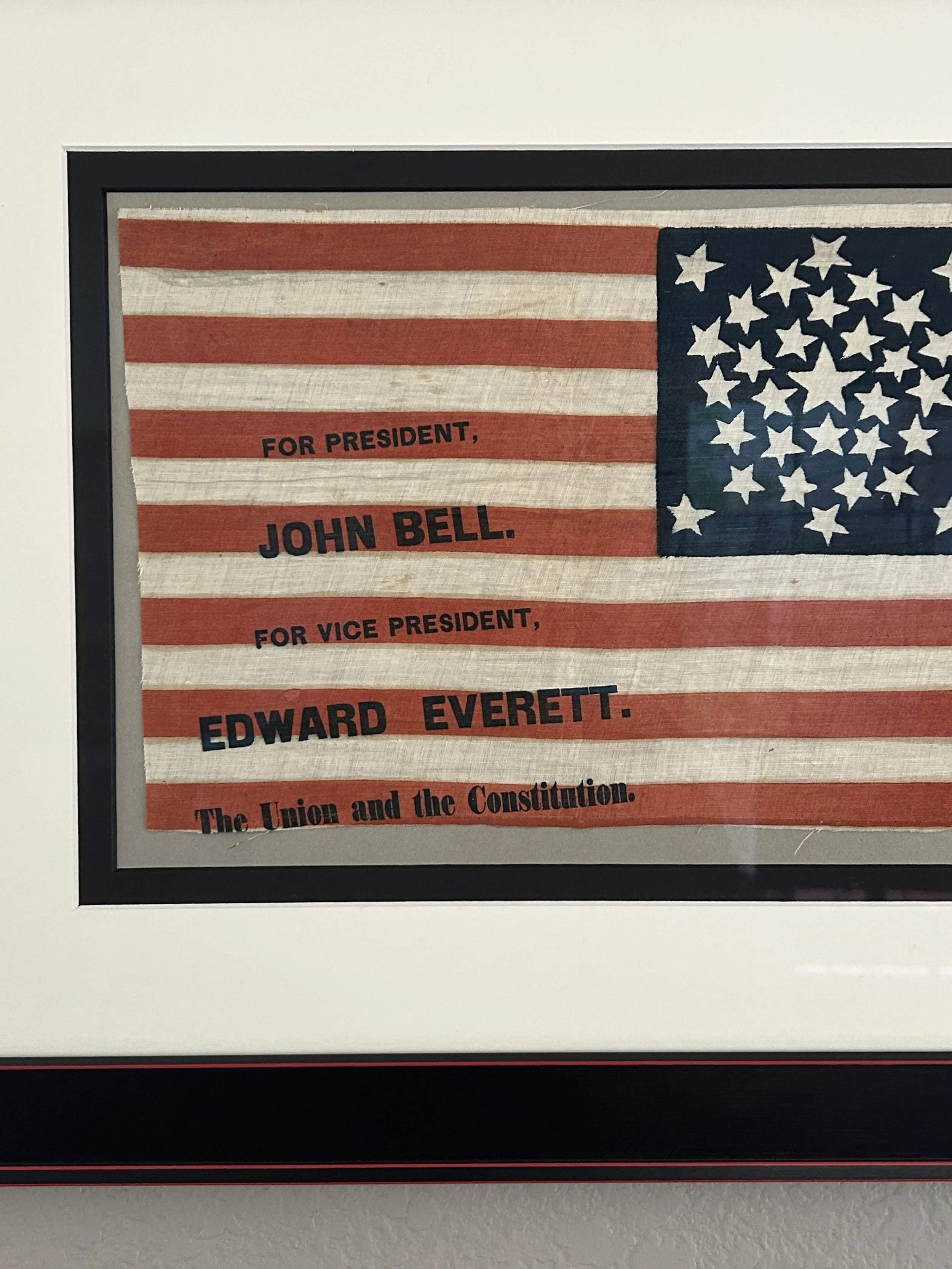 Image 5 of 5
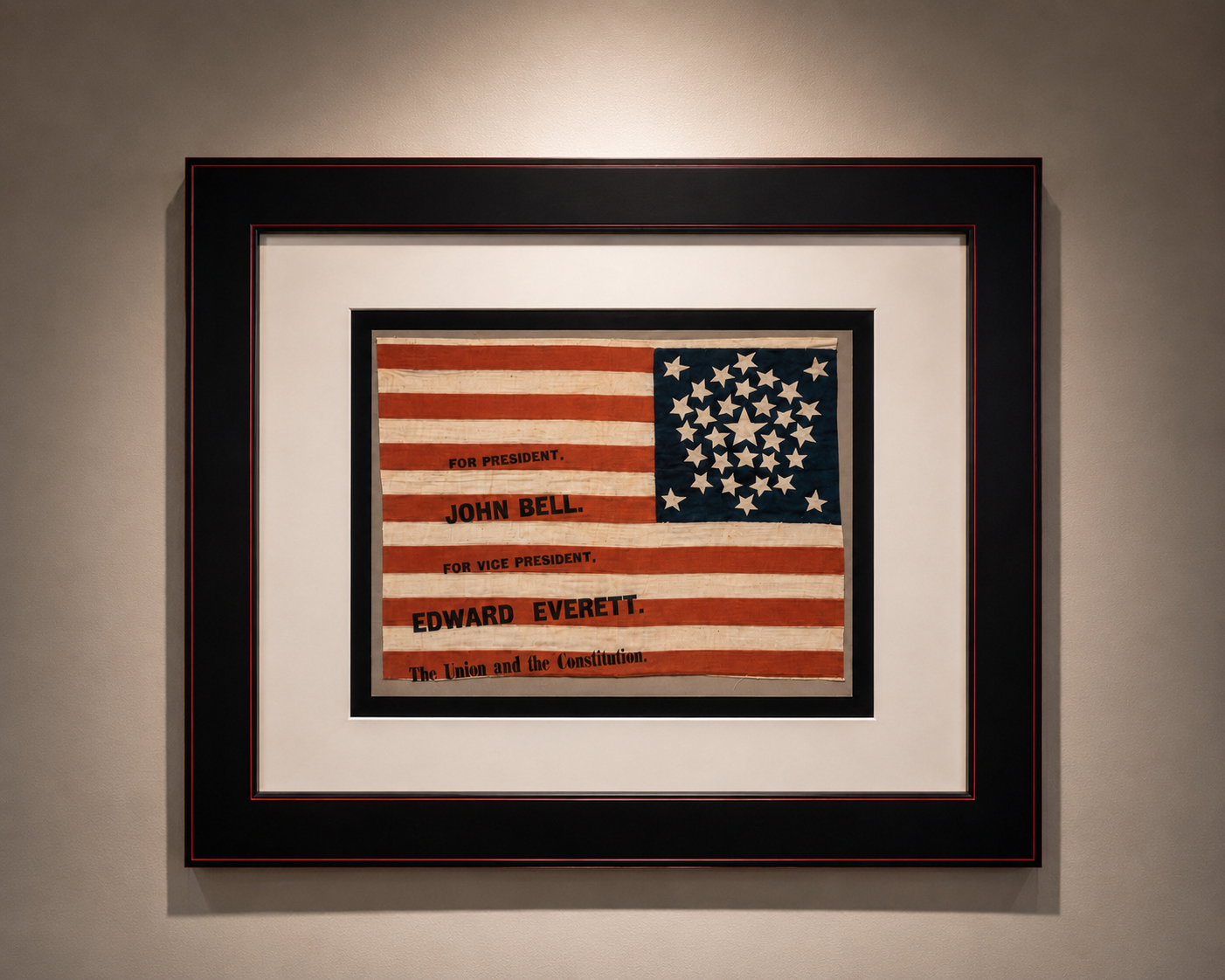
31 STAR PARADE FLAG, MADE FOR THE 1860 CAMPAIGN OF JOHN BELL & EDWARD EVERETT, WITH A “UNION AND THE CONSTITUTION” SLOGAN, PROBABLY MADE BY H.C. HOWARD OF PHILADELPHIA
The Union and the Constitution
A Thirty-One-Star Presidential Campaign Flag for John Bell and Edward Everett
United States, 1860
Probably made by H. C. Howard, Philadelphia
Block-printed cotton
8½ inches high × 11 inches wide
This American parade flag was produced for the 1860 presidential campaign of John Bell and Edward Everett, candidates of the Constitutional Union Party. Its thirty-one stars, unusual pentagonal medallion, and bold campaign inscriptions combine national imagery with a specific political appeal. Across the striped field, the words “The Union and the Constitution” express the central promise of a movement seeking to preserve the nation as sectional conflict threatened its survival.
Small enough to carry or display at a political gathering, the flag belongs to the material culture of nineteenth-century campaigning. Here, the national emblem becomes a vehicle for electoral persuasion. The candidates’ names occupy the stripes, while the blue canton supplies a distinctive constellation of stars. Its compact scale gives the message an immediacy that larger ceremonial banners often lack.
The Election of 1860
The presidential election of 1860 unfolded amid deepening conflict over slavery, its expansion into the western territories, and the relationship between federal authority and the states. Four principal candidates competed: Abraham Lincoln for the Republicans, Stephen A. Douglas for the Northern Democrats, John C. Breckinridge for the Southern Democrats, and John Bell for the Constitutional Union Party.
The Constitutional Union Party drew substantially from former Whigs and members of the American, or Know-Nothing, Party. Its platform emphasized the Constitution, preservation of the Union, and enforcement of existing laws. Rather than offering an explicit settlement of the slavery question, it sought to rally voters around institutions and principles that its supporters believed could hold the country together. The slogan printed on this flag condensed that position into a brief and memorable declaration.
Bell carried Tennessee, Kentucky, and Virginia, receiving thirty-nine electoral votes. Lincoln secured the presidency with an Electoral College majority despite winning less than forty percent of the popular vote. The flag consequently preserves the aspirations of a significant electoral movement whose proposed path to national unity was overtaken by secession and civil war.
The Candidates
John Bell brought a long record of public service to the campaign. A Tennessee politician, he had served in the House of Representatives, including as Speaker, briefly held the office of secretary of war, and later represented Tennessee in the United States Senate. His experience gave the Constitutional Union ticket an established national political figure at its head.
Edward Everett, the vice-presidential candidate, was a Massachusetts statesman, diplomat, educator, and prominent orator. His career included service as governor of Massachusetts, president of Harvard, United States senator, and secretary of state.
Everett’s later role at Gettysburg gives this campaign textile an additional historical connection. On November 19, 1863, he delivered the principal address at the dedication of the Soldiers’ National Cemetery before Lincoln spoke. In 1864, Everett supported Lincoln’s reelection, placing his talents in the service of the Union cause. The flag thus bears the name of a man whose public career crossed from electoral opposition to Lincoln into support for his wartime leadership.
Thirty-One Stars on an 1860 Flag
The thirty-one-star count originally acknowledged California’s admission to the Union on September 9, 1850. Under the legislation governing additions to the national flag, California’s star became official on July 4, 1851. Thirty-one stars remained the official count through July 3, 1858. By the presidential election of 1860, the official national flag contained thirty-three stars.
The campaign inscriptions nevertheless establish this flag’s intended use in 1860. Its date should therefore be understood through the combination of political text and textile design, rather than star count alone. Morven Museum’s closely related thirty-one-star Bell–Everett example is likewise dated to circa 1860.
An older printing block or existing stock may explain the continued use of thirty-one stars, although the precise production circumstances of this example remain undocumented. The discrepancy illustrates the importance of reading historical flags as complete objects: inscriptions can supply dating evidence more specific than the constellation itself.
The Pentagon Medallion and Possible Maker
The blue canton contains a distinctive pentagonal arrangement, supplemented by stars outside the principal formation. The irregular outlines and differing orientations of the stars lend the printed design considerable visual character. The canton appears at the upper right, an orientation also found on related examples of this campaign flag.
The attribution to H. C. Howard of Philadelphia rests on comparison with documented campaign designs. Flag specialist Jeff Bridgman identifies similarities between this pattern and a flag image submitted by Howard for copyright in July 1860. The Library of Congress also preserves a different Bell–Everett campaign banner associated with Howard’s June 8, 1860 copyright registration.
These records support Howard’s involvement in the production of campaign imagery and provide a basis for the attribution. They do not conclusively identify the maker of the present textile. “Probably made by H. C. Howard” therefore remains the appropriate catalogue wording.
Survival and Published Documentation
The survival of related Bell–Everett flags has an unusual textile history. In its November 2013 catalogue, Heritage Auctions reported that nearly all known examples of this name-flag design had emerged from a large quilt discovered in the 1980s. Bell–Everett flags, together with some Lincoln–Hamlin flags, had been reused as backing.
That account helps explain the preservation of examples of the design. It should be distinguished from the provenance of the present flag, whose connection to the quilt has not been established. The same catalogue states that this name-flag design was unknown to Herbert Ridgeway Collins when he compiled Threads of History. The present example should consequently not be described as illustrated in that book without further evidence.
A Museum Exhibition Comparison
A closely related thirty-one-star Bell campaign flag was included in The Stars and Stripes: Fabric of the American Spirit, presented at Morven Museum & Garden in Princeton, New Jersey, from July 1, 2011, through January 8, 2012.
Drawn from the Pierce Collection of American Parade Flags, the exhibition included an example with the pentagonal star pattern, candidates’ names, and “The Union and the Constitution” slogan. Its online catalogue provides a useful institutional comparison for the present flag. This reference concerns a related example and does not establish an exhibition history for the H&S flag.
Curator’s Note
The significance of this flag lies in the relationship between its imagery and its promise. The stars and stripes present a unified nation, while the campaign text asks voters to preserve that unity through allegiance to the Constitution.
Seen retrospectively, the slogan carries both conviction and uncertainty. Its supporters sought continuity at a moment when the country’s political institutions could no longer contain the conflict over slavery and sectional power. The flag preserves that unresolved moment through the words and symbols chosen by the campaign itself.
At H&S Fine Art & Antiques, we present this textile as a work of American political design and a document of the nation’s final antebellum election. Its unusual constellation, direct typography, and compact proportions give tangible form to an electoral movement’s hopes for the republic.
Selected References and Comparisons
Morven Museum & Garden. The Stars and Stripes: Fabric of the American Spirit, July 1, 2011–January 8, 2012. Online exhibition entry, “31-Star Bell 1860 Campaign Flag,” Pierce Collection. Comparable example.
Heritage Auctions. Political & Americana Signature Auction, November 23, 2013, lot 38240, “Bell & Everett: A Choice 1860 Campaign Flag.” Comparable example and discussion of the quilt discovery.
Heritage Auctions. December 3, 2016, lot 43323, “Bell & Everett: A Deceptively Scarce and Important 1860 Name Flag.” Larger variant and discussion of related slogan flags.
Library of Congress. For President John Bell. For Vice President Edward Everett, 1860, item 93506172. Documentary comparison for Howard’s campaign imagery.
Collins, Herbert Ridgeway. Threads of History: Americana Recorded on Cloth, 1775 to the Present. Smithsonian Institution Press, 1979. General reference for American political textiles, rather than a verified illustration of the present flag.
.