 Image 1 of 5
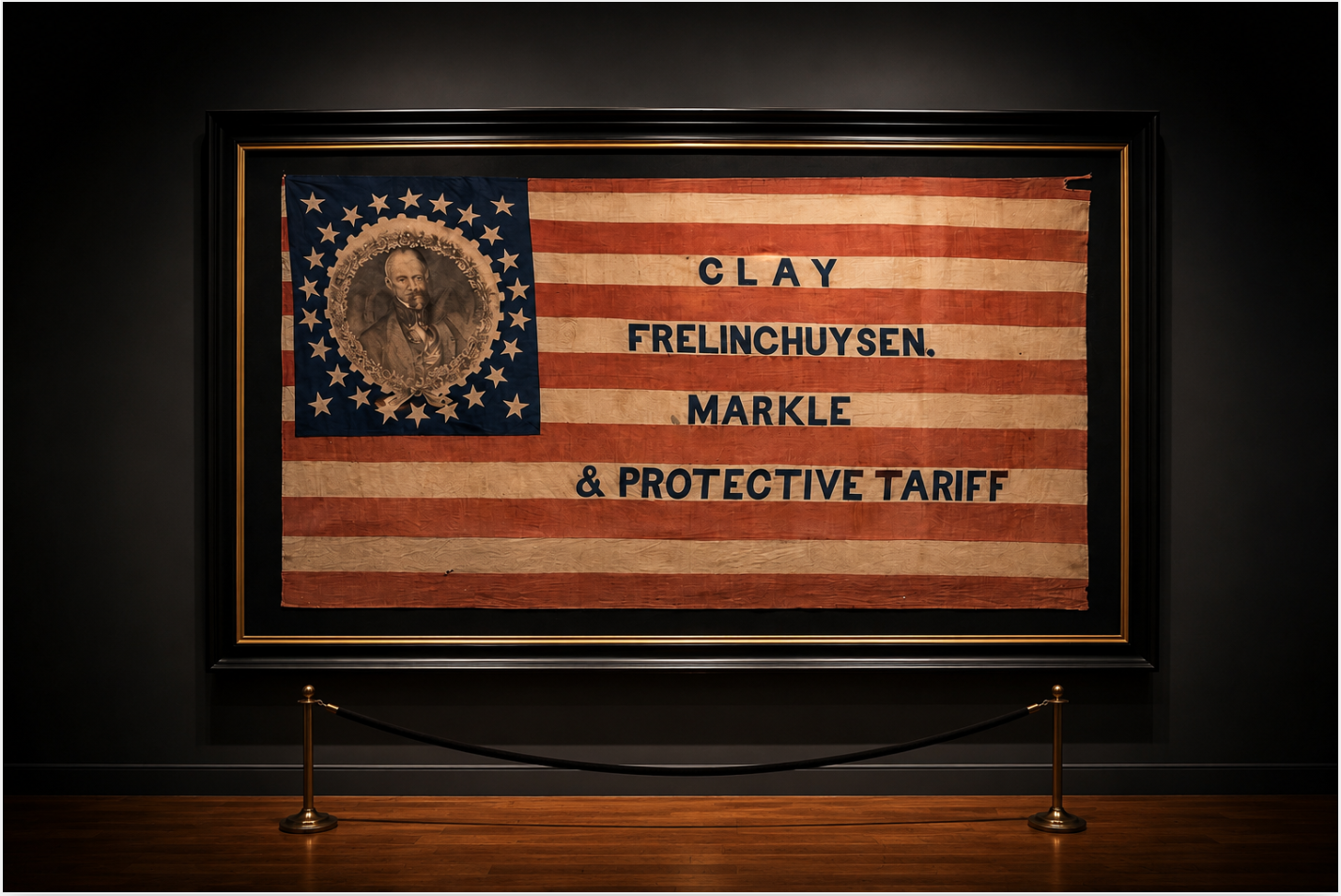 Image 2 of 5
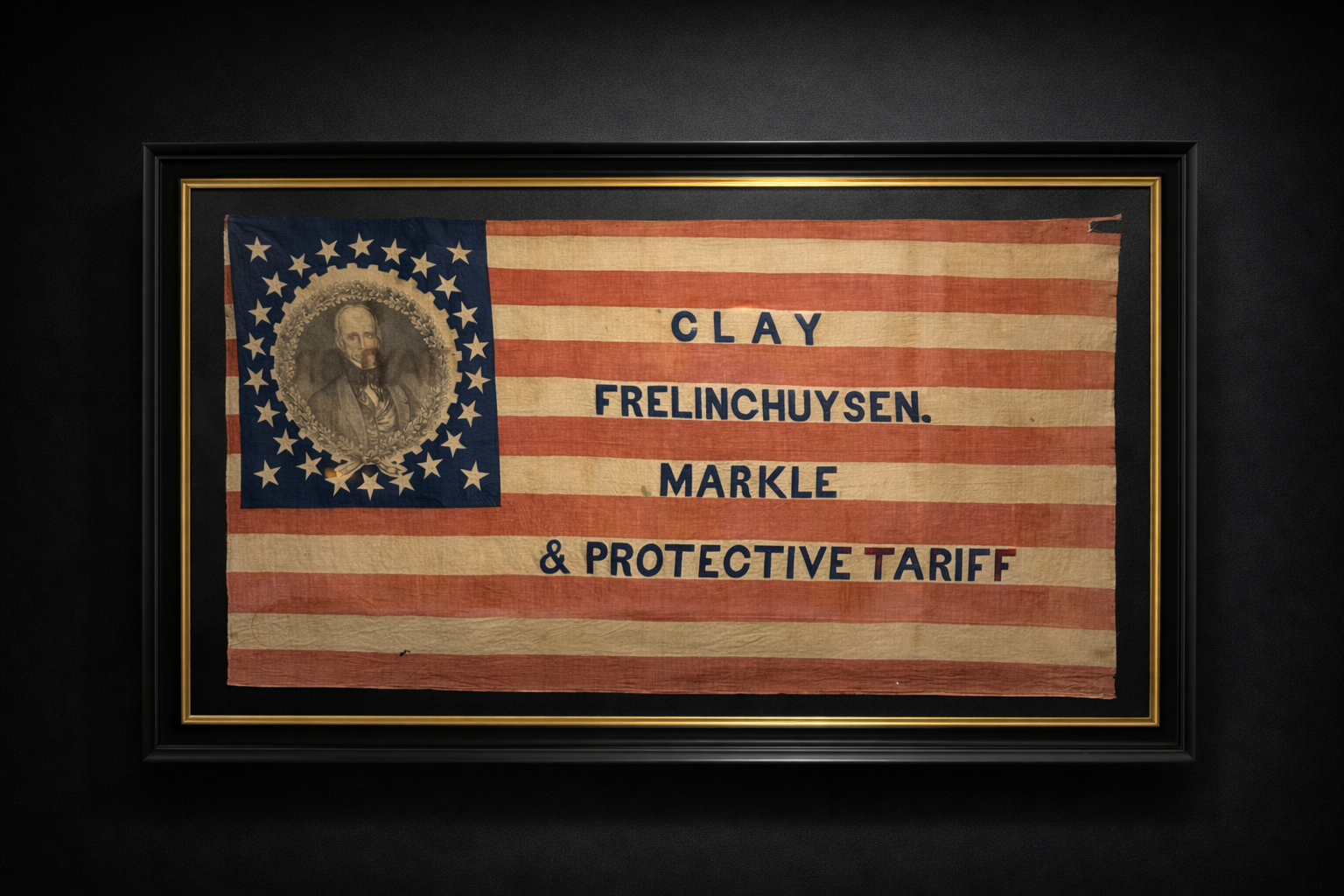 Image 3 of 5
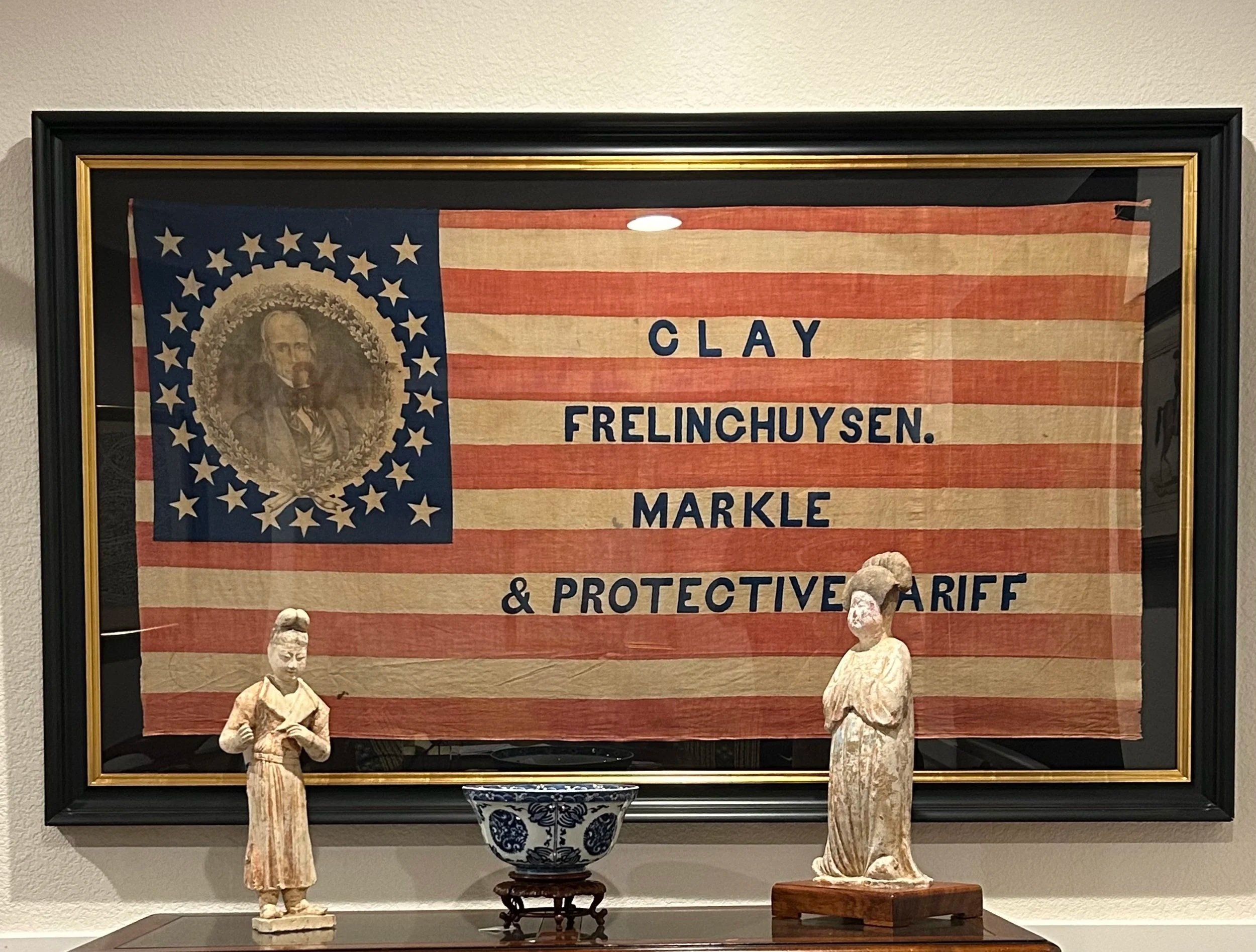 Image 4 of 5
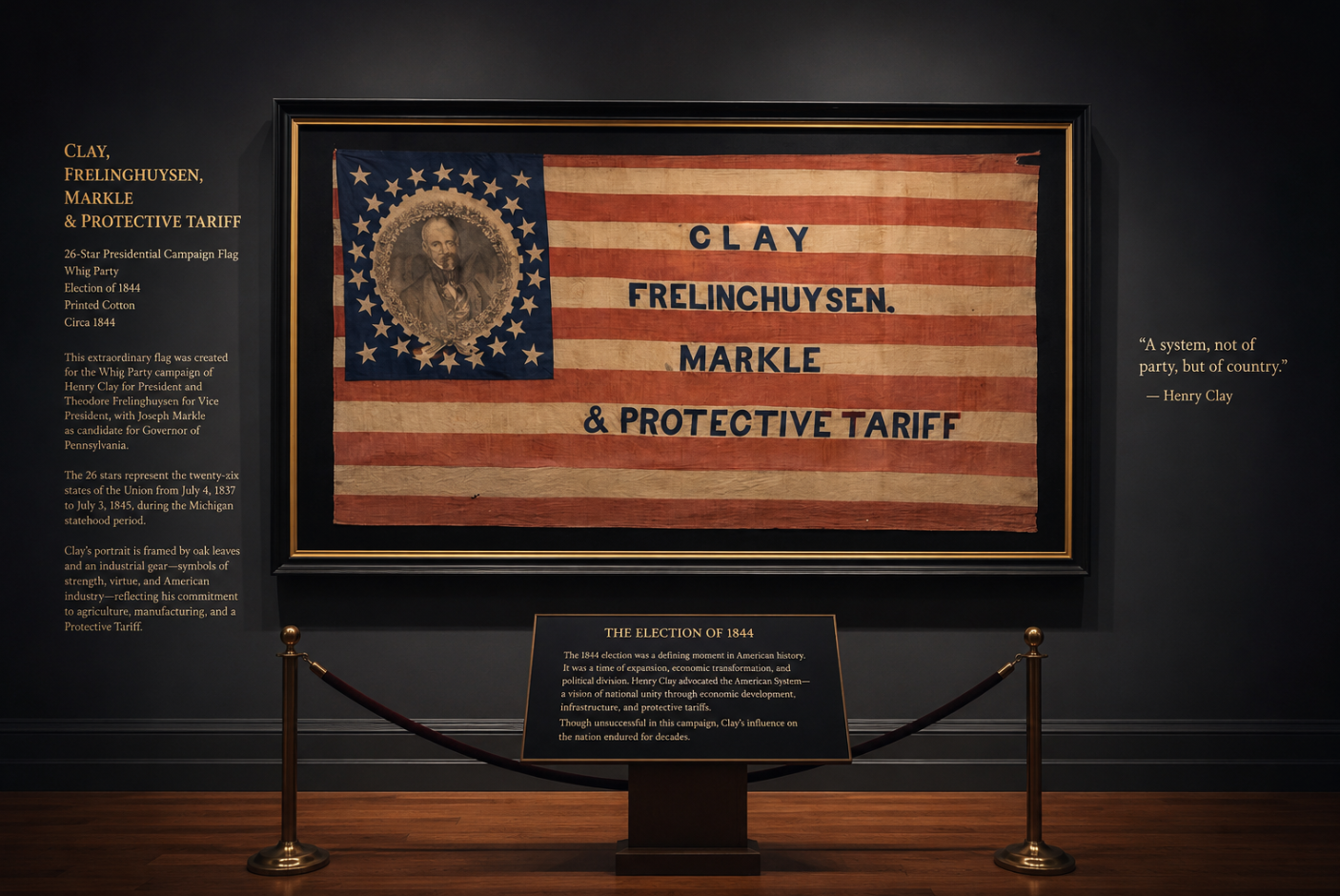 Image 5 of 5
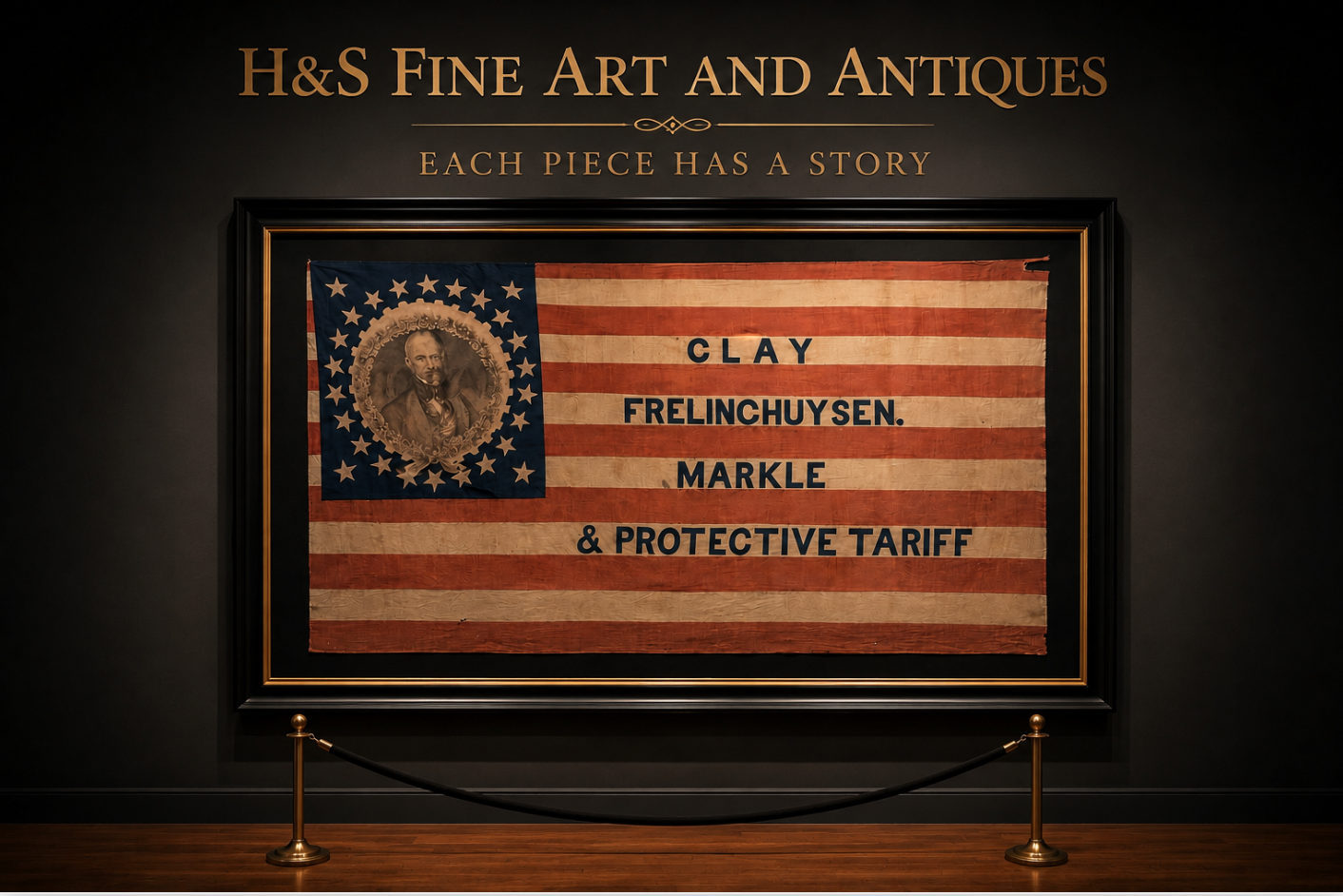
26 Star American Flag, made for 1844 Presidential campaign of Henry Clay and Theodore Frelinghuysen. Michigan joined the Union as the 16th state on January 26, 1837.
CLAY, FRELINGHUYSEN, MARKLE & PROTECTIVE TARIFF
An Extraordinary 26-Star Presidential Campaign Flag for the Election of 1844
American Printed Cotton Political Parade Flag
Whig Party Presidential Campaign
Henry Clay – Theodore Frelinghuysen – Joseph Markle
26 Stars, Michigan Statehood Period
Circa 1844
Among the rarest and most historically significant textiles produced in nineteenth-century America are presidential campaign flags. Created for public rallies, political parades, speeches, and election celebrations, these ephemeral objects were intended for temporary use and were seldom preserved. As a result, surviving examples from the antebellum era rank among the most coveted objects in the fields of Americana, political history, and vexillology.
This remarkable 26-star flag was produced for the presidential campaign of Henry Clay and Theodore Frelinghuysen during the election of 1844. Printed on cotton and incorporating both patriotic symbolism and political messaging, it stands among the earliest known American campaign flags and represents a pivotal moment in the nation's political development.
The canton contains a portrait of Henry Clay enclosed within a wreath-like medallion composed of oak leaves and industrial gear forms, an artistic combination that perfectly illustrates Clay's political philosophy. Surrounding the portrait are twenty-six stars representing the twenty-six states of the Union during the Michigan statehood period.
Across the striped field appear the words:
CLAY
FRELINGHUYSEN
MARKLE
& PROTECTIVE TARIFF
Together these names and slogans tell the story of one of the most consequential presidential contests in American history.
The Twenty-Six Stars
The star count represents the admission of Michigan as the twenty-sixth state.
Michigan entered the Union on January 26, 1837, and under federal law a new star was officially added to the national flag on the following Independence Day. Consequently, the 26-star American flag became official on July 4, 1837 and remained the national flag until July 3, 1845.
The twenty-six states represented on this flag embody an America still largely confined east of the Mississippi River but rapidly expanding westward. During this period the nation witnessed dramatic growth in industry, transportation, immigration, and territorial ambitions.
Because relatively few printed parade flags survive from this early era, the 26-star count is among the rarest encountered by collectors today. Flag scholars consider these among the earliest surviving printed political flags known.
Henry Clay: The Great Compromiser
The portrait displayed within the canton depicts Henry Clay (1777–1852), one of the most influential American statesmen of the nineteenth century.
A Senator from Kentucky, Speaker of the House, Secretary of State, and architect of numerous congressional compromises, Clay became known as "The Great Compromiser" for his ability to bridge sectional divisions between North and South.
Although he sought the presidency three times, Clay never occupied the office. Yet few politicians exerted greater influence on the development of the United States.
His economic vision became known as the American System, which advocated:
Protective tariffs
Internal improvements
Federal support for roads and canals
National economic development
Encouragement of American manufacturing
The inscription "PROTECTIVE TARIFF" on this flag directly references Clay's most important campaign issue.
Theodore Frelinghuysen
Clay's running mate was Theodore Frelinghuysen (1787–1862) of New Jersey.
A United States Senator, attorney, educator, and later President of Rutgers College, Frelinghuysen was widely respected for his moral character and reform-minded views. His selection helped broaden the Whig Party's appeal among religious and socially conservative voters.
The campaign represented one of the strongest Whig efforts to challenge Democratic dominance during the era preceding the Civil War.
Joseph Markle
One of the most fascinating aspects of this flag is the inclusion of the name MARKLE.
Research has identified this figure as Joseph Markle, the Whig candidate for Governor of Pennsylvania who ran concurrently with Clay's national campaign. A veteran of the War of 1812 and prominent Pennsylvania businessman, Markle's inclusion transforms the flag from a national campaign banner into a highly specific political textile tied directly to Pennsylvania's electoral landscape.
Campaign flags that include a third political candidate are exceptionally uncommon.
According to leading flag scholar Herbert Ridgeway Collins, only a handful of comparable examples are documented among more than 1,500 political textiles illustrated in Threads of History: Americana Recorded on Cloth, 1775 to the Present.
America in 1844
The election of 1844 occurred during one of the most transformative decades in American history.
The nation was debating:
Expansion into Texas
Westward migration
Industrial growth
Banking reform
Tariff policy
Slavery's expansion into new territories
Clay advocated economic development and national infrastructure, while his opponent James K. Polk championed territorial expansion and Manifest Destiny.
Polk's victory ultimately led to:
Annexation of Texas
The Mexican-American War
Acquisition of vast western territories
Acceleration of sectional tensions that would eventually culminate in the Civil War
As such, this flag survives not merely as campaign memorabilia but as a witness to a pivotal turning point in American history.
The Mystery of "Taylor"
An unusual and intriguing feature of the present flag is the later inscription of the word TAYLOR across Clay's portrait.
Most scholars believe this references General Zachary Taylor, the Mexican War hero who became the Whig Party's presidential nominee in 1848.
The addition may represent a later political adaptation of the flag after Clay's defeat, reflecting the shift in Whig support from the aging statesman to the popular military commander. Such alterations provide valuable evidence of how political textiles continued to be used and reinterpreted beyond their original purpose.
Rarity
The present flag belongs to a small and highly desirable group of pre-Civil War political textiles.
Comparable examples are held in major institutional collections, including:
The New-York Historical Society
Rutgers University
A virtually identical example is illustrated in institutional records and related scholarship, confirming both the authenticity and historical importance of this design.
The presence of:
A presidential candidate
A vice-presidential candidate
A gubernatorial candidate
A portrait medallion
A political slogan
The scarce 26-star count
places this flag among the most desirable surviving American political flags of the antebellum period.
Literature
Herbert Ridgeway Collins, Threads of History: Americana Recorded on Cloth, 1775 to the Present, Smithsonian Institution Press, Washington, D.C.
Kevin Keim and Peter Keim, A Grand Old Flag: A History of the United States Through Its Flags.
Official records and comparative examples in the collections of the New-York Historical Society and Rutgers University.
Significance
More than a campaign banner, this flag represents the aspirations and anxieties of an expanding nation. Produced at the dawn of mass political campaigning, it embodies the emergence of modern American electoral culture and preserves the memory of Henry Clay's final and most celebrated bid for the presidency.
Its rarity, graphic power, historical associations, and documented place within the literature of American political textiles make it one of the most compelling surviving artifacts from the election of 1844.
I would describe this as a museum-level Whig Party campaign flag, and among the strongest pieces of political Americana because it combines early flag history, Henry Clay portraiture, Pennsylvania political history, and one of the earliest known printed campaign flag formats in a single object. Based on the literature and institutional examples, it belongs in the top tier of pre–Civil War political textiles.
CLAY, FRELINGHUYSEN, MARKLE & PROTECTIVE TARIFF
An Extraordinary 26-Star Presidential Campaign Flag for the Election of 1844
American Printed Cotton Political Parade Flag
Whig Party Presidential Campaign
Henry Clay – Theodore Frelinghuysen – Joseph Markle
26 Stars, Michigan Statehood Period
Circa 1844
Among the rarest and most historically significant textiles produced in nineteenth-century America are presidential campaign flags. Created for public rallies, political parades, speeches, and election celebrations, these ephemeral objects were intended for temporary use and were seldom preserved. As a result, surviving examples from the antebellum era rank among the most coveted objects in the fields of Americana, political history, and vexillology.
This remarkable 26-star flag was produced for the presidential campaign of Henry Clay and Theodore Frelinghuysen during the election of 1844. Printed on cotton and incorporating both patriotic symbolism and political messaging, it stands among the earliest known American campaign flags and represents a pivotal moment in the nation's political development.
The canton contains a portrait of Henry Clay enclosed within a wreath-like medallion composed of oak leaves and industrial gear forms, an artistic combination that perfectly illustrates Clay's political philosophy. Surrounding the portrait are twenty-six stars representing the twenty-six states of the Union during the Michigan statehood period.
Across the striped field appear the words:
CLAY
FRELINGHUYSEN
MARKLE
& PROTECTIVE TARIFF
Together these names and slogans tell the story of one of the most consequential presidential contests in American history.
The Twenty-Six Stars
The star count represents the admission of Michigan as the twenty-sixth state.
Michigan entered the Union on January 26, 1837, and under federal law a new star was officially added to the national flag on the following Independence Day. Consequently, the 26-star American flag became official on July 4, 1837 and remained the national flag until July 3, 1845.
The twenty-six states represented on this flag embody an America still largely confined east of the Mississippi River but rapidly expanding westward. During this period the nation witnessed dramatic growth in industry, transportation, immigration, and territorial ambitions.
Because relatively few printed parade flags survive from this early era, the 26-star count is among the rarest encountered by collectors today. Flag scholars consider these among the earliest surviving printed political flags known.
Henry Clay: The Great Compromiser
The portrait displayed within the canton depicts Henry Clay (1777–1852), one of the most influential American statesmen of the nineteenth century.
A Senator from Kentucky, Speaker of the House, Secretary of State, and architect of numerous congressional compromises, Clay became known as "The Great Compromiser" for his ability to bridge sectional divisions between North and South.
Although he sought the presidency three times, Clay never occupied the office. Yet few politicians exerted greater influence on the development of the United States.
His economic vision became known as the American System, which advocated:
Protective tariffs
Internal improvements
Federal support for roads and canals
National economic development
Encouragement of American manufacturing
The inscription "PROTECTIVE TARIFF" on this flag directly references Clay's most important campaign issue.
Theodore Frelinghuysen
Clay's running mate was Theodore Frelinghuysen (1787–1862) of New Jersey.
A United States Senator, attorney, educator, and later President of Rutgers College, Frelinghuysen was widely respected for his moral character and reform-minded views. His selection helped broaden the Whig Party's appeal among religious and socially conservative voters.
The campaign represented one of the strongest Whig efforts to challenge Democratic dominance during the era preceding the Civil War.
Joseph Markle
One of the most fascinating aspects of this flag is the inclusion of the name MARKLE.
Research has identified this figure as Joseph Markle, the Whig candidate for Governor of Pennsylvania who ran concurrently with Clay's national campaign. A veteran of the War of 1812 and prominent Pennsylvania businessman, Markle's inclusion transforms the flag from a national campaign banner into a highly specific political textile tied directly to Pennsylvania's electoral landscape.
Campaign flags that include a third political candidate are exceptionally uncommon.
According to leading flag scholar Herbert Ridgeway Collins, only a handful of comparable examples are documented among more than 1,500 political textiles illustrated in Threads of History: Americana Recorded on Cloth, 1775 to the Present.
America in 1844
The election of 1844 occurred during one of the most transformative decades in American history.
The nation was debating:
Expansion into Texas
Westward migration
Industrial growth
Banking reform
Tariff policy
Slavery's expansion into new territories
Clay advocated economic development and national infrastructure, while his opponent James K. Polk championed territorial expansion and Manifest Destiny.
Polk's victory ultimately led to:
Annexation of Texas
The Mexican-American War
Acquisition of vast western territories
Acceleration of sectional tensions that would eventually culminate in the Civil War
As such, this flag survives not merely as campaign memorabilia but as a witness to a pivotal turning point in American history.
The Mystery of "Taylor"
An unusual and intriguing feature of the present flag is the later inscription of the word TAYLOR across Clay's portrait.
Most scholars believe this references General Zachary Taylor, the Mexican War hero who became the Whig Party's presidential nominee in 1848.
The addition may represent a later political adaptation of the flag after Clay's defeat, reflecting the shift in Whig support from the aging statesman to the popular military commander. Such alterations provide valuable evidence of how political textiles continued to be used and reinterpreted beyond their original purpose.
Rarity
The present flag belongs to a small and highly desirable group of pre-Civil War political textiles.
Comparable examples are held in major institutional collections, including:
The New-York Historical Society
Rutgers University
A virtually identical example is illustrated in institutional records and related scholarship, confirming both the authenticity and historical importance of this design.
The presence of:
A presidential candidate
A vice-presidential candidate
A gubernatorial candidate
A portrait medallion
A political slogan
The scarce 26-star count
places this flag among the most desirable surviving American political flags of the antebellum period.
Literature
Herbert Ridgeway Collins, Threads of History: Americana Recorded on Cloth, 1775 to the Present, Smithsonian Institution Press, Washington, D.C.
Kevin Keim and Peter Keim, A Grand Old Flag: A History of the United States Through Its Flags.
Official records and comparative examples in the collections of the New-York Historical Society and Rutgers University.
Significance
More than a campaign banner, this flag represents the aspirations and anxieties of an expanding nation. Produced at the dawn of mass political campaigning, it embodies the emergence of modern American electoral culture and preserves the memory of Henry Clay's final and most celebrated bid for the presidency.
Its rarity, graphic power, historical associations, and documented place within the literature of American political textiles make it one of the most compelling surviving artifacts from the election of 1844.
I would describe this as a museum-level Whig Party campaign flag, and among the strongest pieces of political Americana because it combines early flag history, Henry Clay portraiture, Pennsylvania political history, and one of the earliest known printed campaign flag formats in a single object. Based on the literature and institutional examples, it belongs in the top tier of pre–Civil War political textiles.
Clay’s platform focused on promotion of agriculture, and protective TARIFFS. Clay and Taylor werte politically rivals despite belonging to the same party. In 1848, many WHIGS believed CLAY could not win the presidency and instead threw their support behind the popular war hero TAYLOR, which explains the words TAYLOR written across Clay’s portrait.